


Brewers Video
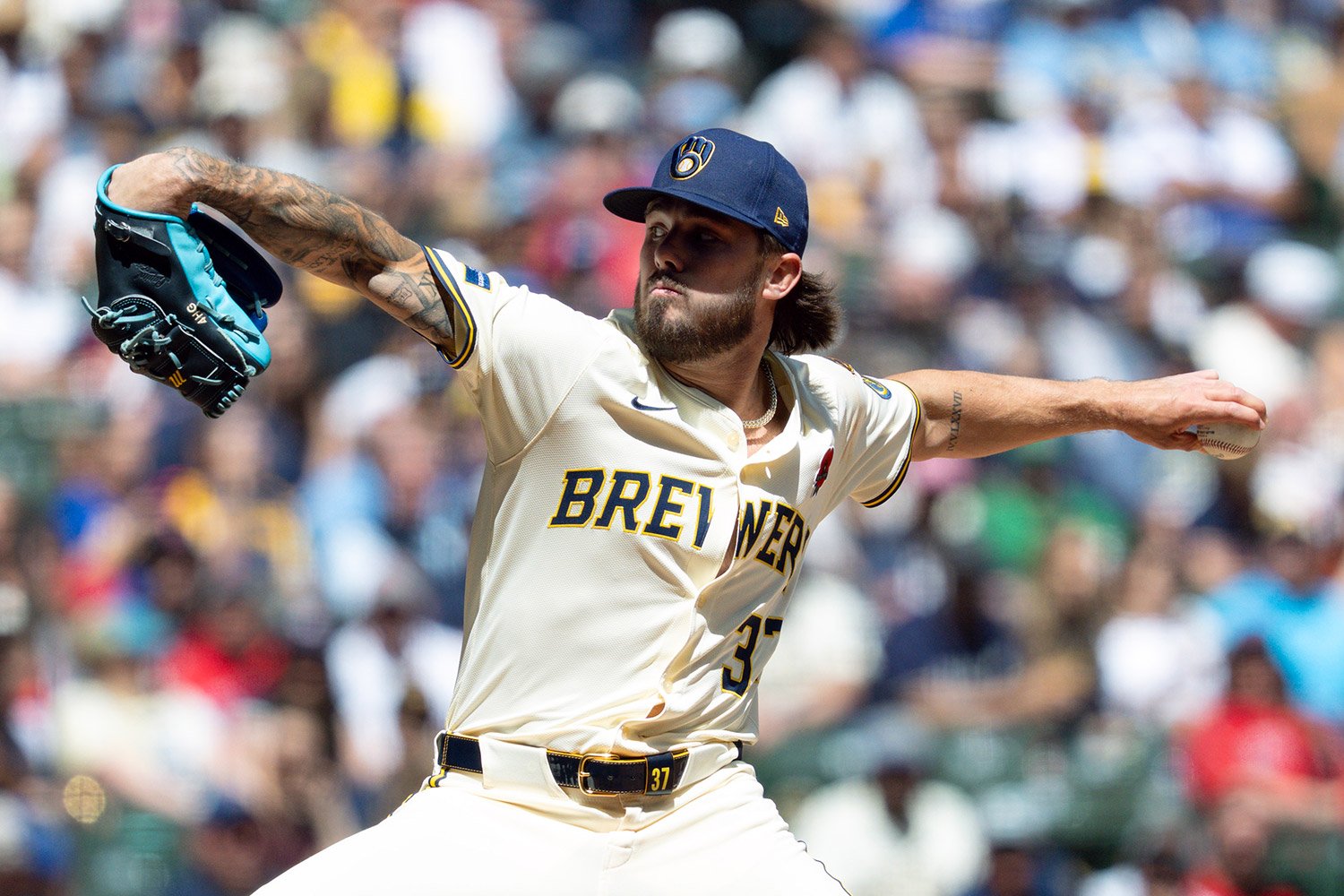
Good health has proven elusive for DL Hall in his first year-plus with the Brewers. Last season, he spent nearly four months on the injured list, first due to a knee injury and then to a succession of setbacks throughout multiple rehab assignments. This year, a lat injury delayed his season debut until Monday.
It took longer than anyone hoped, but the left-hander finally feels good physically.
“I feel healthy,” he said, adding with a chuckle, “Healthy’s a lucrative word, I guess.”
When he has been on the mound, Hall hasn’t looked like the pitcher the Brewers thought they were acquiring in the Corbin Burnes trade two offseasons ago. FanGraphs scouted his four-seam fastball as a 70-grade pitch at the time, and it induced whiffs on 28% of swings during his stints with the Baltimore Orioles in 2022 and 2023. Last season, it lost several ticks of velocity and carry, reducing it from a plus pitch to a batting-practice offering.
| Season | MPH | IVB (inches) | Stuff+ | StuffPro | xwOBA | Whiff% |
| 2022 | 96.2 | 16.8 | 113 | -0.6 | .291 | 24.6% |
| 2023 | 95.6 | 15.6 | 109 | -0.7 | .239 | 30.2% |
| 2024 | 93.3 | 14.3 | 82 | 0.6 | .376 | 12.5% |
Hall has attributed some of the missing zip on his heater to pitching with a hampered lower half. He expects it to return now that he’s moving better.
“It's just a matter of getting the body right, getting everything cleaned up,” he said. “Just a lot of bad reps went into my body when I was compensating (for) a lot of the injuries I dealt with.”
It hasn’t happened yet, though. Hall’s velocity and movement showed flashes early in some of his rehab outings, but for the most part, his four-seamer still looks like a below-average pitch. On Monday, it averaged 93.6 mph with 14.7 inches of induced vertical break, which translated to 79 Stuff+ and 0.2 StuffPro marks.
Last October, we speculated that if Hall’s four-seamer remained an underwhelming pitch, he would need an auxiliary fastball to help him protect it.
QuoteThe soft- and spin-heavy approach would carry limitations. Hall’s slider and changeup profile best as chase pitches off the plate, and he threw both pitches in the zone less than 40% of the time in 2024. That leaves his curveball as his remaining “land for a strike” pitch to get ahead in counts, and too many curveballs left over the plate can spell disaster. Protecting the four-seamer may require Hall to develop another fastball variant (a cutter or a two-seamer) he can use within the strike zone to set up breaking balls in two-strike counts.
Adding a cutter always made sense for Hall because he has a supination bias, meaning his hand and wrist naturally turn outward from his body when he releases the ball. His four-seamer had an active spin rate of 87% last year, which typically means a pitcher is slightly cutting the ball instead of staying behind it.
Realizing that a cutter meshed with his mechanics and could help his diminished four-seamer play up, he started toying with one before his final rehab outing last week.
“I've always been able to just get on that side of the ball better than the other side,” he said, “so it's like, ‘Let me just try it.’ So I threw a couple in the bullpen, spotting it up pretty well, good metrics. Was warming up for my last rehab outing, and got a call down and they said, ‘Hey, what does DL think about throwing a few cutters?’ And I was like, ‘Sure, I'll try it.’
“I think with my velo not being where it used to be, I think it's just another tool or weapon that I can use to protect my fastball.”
Hall threw five cutters in that appearance and two on Monday. Most encouraging is that he is holding velocity with the pitch. It’s averaged 91.2 mph, just a couple of ticks below his usual fastball.
“I think that partially comes from it being like a four-seam,” he said. “I'm basically just cocking my four-seam sideways, so it's pretty similar.”
Hall is also hopeful that having separate release cues for the four-seam and cutter will help keep him behind the former, allowing him to generate more of the pure backspin that creates that carry.
In addition to flashing the cutter, he also unintentionally debuted another new fastball on Monday. With Hall and Eric Haase unable to get on the same page with the pitch timer expiring, he hurriedly oriented the ball into a fastball grip in his hand. As he went into his delivery, he realized he was throwing a two-seamer.
“Haase went back to the first sign instead of going to my curveball,” he recalled. “I was looking for curveball. We hadn't really thrown any all game. Didn't get to it because of the pitch clock, so I just gripped the ball. I had no idea. I literally just gripped the ball, and when I felt the two seams under my fingers, I was like, ‘Oh ****.’ I knew what was about to happen.”
Since he struggles to pronate the baseball to create arm-side movement, Hall doesn’t plan to add a two-seamer to his arsenal. With the cutter, he already has a five-pitch mix that he’s been forced to refine without his best fastball. Hall’s MLB four-seam usage dipped under 50% for the first time last year, and it’s dropped further in 2025. Meanwhile, he’s had to lean more on his two breaking pitches and changeup.
.jpeg.a046a06dff451738ca0b8286f25f862a.jpeg)
“It’s been huge for me,” he said of learning to use his full arsenal. “It's not even necessarily by choice either, you know. It was kind of like sink or swim. So it's either figure out how to get outs with other stuff, or drown trying to blow 92 past them. It was a good thing for me, though.”
Because he has an option year remaining, Hall may not be a constant member of the active roster. But when he’s with the Brewers, Pat Murphy plans to deploy him and Aaron Ashby as “leverage long relievers” who can bridge the gap between short-range starters and the overworked high-leverage arms, or fill in for the latter when they need rest. Hall is slated to open for Quinn Priester against a lefty-heavy top of the Philadelphia Phillies lineup on Friday night.
“DL, Ashby, those guys are guys that can go multiple times during the week, multiple innings,” Murphy said. “I think you’re going to wear out your (Jared) Koenigs and your (Nick) Mears and your (Abner) Uribes and your (Trevor) Megills if you don’t have those couple two, three long guys.”
“It just comes down to getting outs,” Hall said. “I think the preparation stays the same. It's obviously a little bit harder. It's not as scheduled, and you never know when (you) might open or long relieve. But it all can be overcomplicated if you want it to be. It just comes down to getting outs.”
Whether he remains in that role or slides into another as the season progresses, he’s hoping that being forced to develop the rest of his arsenal will put him in an even better spot if his good fastball returns.
“I think I'll get a velo unlock whenever that time comes, hopefully soon. But I think once it does, and then you add in all the stuff I've had to pitch with over the past year-and-a-half, I think it can be pretty cool and pretty special.”
Which team do you dislike the most in the NL Central?

Follow Brewer Fanatic For Milwaukee Brewers News & Analysis



-
 1
1
-
 1
1


Recommended Comments
Create an account or sign in to comment
You need to be a member in order to leave a comment
Create an account
Sign up for a new account in our community. It's easy!
Register a new accountSign in
Already have an account? Sign in here.
Sign In Now