



Matt Breen
-
Posts
9,112 -
Joined
-
Last visited
-
Days Won
1
Content Type
Profiles
Forums
Blogs
Events
News
2026 Milwaukee Brewers Top Prospects Ranking
Milwaukee Brewers Videos
2022 Milwaukee Brewers Draft Picks
Milwaukee Brewers Free Agent & Trade Rumors, Notes, & Tidbits
Guides & Resources
2023 Milwaukee Brewers Draft Picks
2024 Milwaukee Brewers Draft Picks
The Milwaukee Brewers Players Project
2025 Milwaukee Brewers Draft Pick Tracker
2026 Milwaukee Brewers Draft Tracker: Picks & Bonuses
Store
Downloads
Gallery
Everything posted by Matt Breen
-
Today, DeJean said he still isn't fully recovered from his injury in November - which was a fractured fibula. He said he will NOT participate in the combine or Iowa's pro day (March 18), but said he will have workout for clubs closer to the draft. He - understandably - wants to be at full strength. He added that he is running at full speed as of last week.
-
 Nice article on Chourio in The Athletic: https://theathletic.com/5304057/2024/02/28/jackson-chourio-brewers-patience-debut/ Nothing earth shattering in the article - just a lot of observations and quotes from people (including Chourio). Of course, it's behind a paywall, so you have to have subscribed.
 -
I saw some stuff on Mitchell last year and was really interested in him. Small school guys sometimes get discounted on draft day. Thought maybe he was second rounder at the time. Then I saw him go up the boards the last couple of months. Maybe I'm focused on him as he's someone is sort of 'found' on my own. It's easily to get infatuated with someone like that.
-
No. I never really thought about it much until I wrote it down. But the idea of adding him is really cool. I have a feeling it would take some more - but who knows. I'm not sure how 'valuable' future picks are in the grand scheme of things.
-
Exactly. This is for fun. You are right - if we were able to trade into the top three (which is, what I think, it would take to get Harrison), he's the guy I'd select. But that would be fun to see Harrison with Love. I'm guessing the Packers would have to trade 1st in 2024, 1st in 2025, and both 2nd round picks in 2024 to get up to the #3 - which is New England. Perhaps even a little more. The first two picks will probably be QBs (Williams and Maye), and then - who knows. You would have to hope NE would more interested in acquiring draft capital rather than adding a QB (Daniels) or Harrison at #3. If Harrison makes it to the fourth pick, Arizona would be all over him in a heartbeat. So the third pick - with New England - is likely the only way to get him.
-
Yeah, Marvin Harrison Jr. is a pipe dream unless you give up next year's 1st as well. I'd love him - but not at that price. I like Alt a lot as well. Do I want to give up our 1st and two seconds? Not sure. Would be great to get him.
-
Okay, fun draft exercise. Right now the Packers don't pick until #25. But what if we moved up? Is there someone you think would be worth dealing extra capital to move up? Let's consider what it would cost - and then who you would select. Parameters: I am using the pick values found here: https://www.drafttek.com/NFL-Trade-Value-Chart.asp The Packers now pick at #25 (720 point value), #41 (490), #58 (320). Let's work with these picks. If the Packers put together all three picks, the value comes to 1530 points. That gets you up to the #6-7 pick area. Picks #25 and #41 equal 1210 points. That gets you to the #12 pick. Picks #25 and #58 equal 1040 points. That gets you to about the #15 pick. With those numbers, if the Packers moved up to any of those slots, who would you aim to pick? Again, just spitballing stuff. I'll start with one. I'd consider dealing the #25 and #58 picks to move up into the mid-late teens to select Toledo CB Quinyon Mitchell. The guy just looks like he is going to be a stud. Thanks for playing!
-
People sometimes just want to move on. It happens. Same people, same system, same everything. Maybe there were some personalities that just didn't quite mesh. Maybe it was being frustrated by certain problems that never got addressed. Who knows. It also might have been he was bored. He wanted a kick in the butt to go re-energize himself. He was a free agent and earned the right to go where he wanted, for whatever reasons. I'm not defending Counsell. He knew what his move would mean to Brewer fans. To try and pretend he didn't is just a lie. I think the thing that sucked most was he hosed Ross. That was pretty cutthroat. Sure Ross got his paycheck. But its gotta be a gut punch to have something like that happen. I honestly don't care about CC at this point. I just hope his team sucks. I don't really care about picking fights over little slights and comments. But whatever. As long as the Cubs lose.
-
I'm excited for Wiemer. I just hope the Brewers give him whatever he needs to improve and succeed. If that means some time at AAA - so be it.
-
Let me ask this: if you had players at the following positions available when you selected for the Packers - with the exact same ranking - what position would you select? Offensive tackle Offensive guard or center Cornerback Safety Edge Defensive tackle Quarterback
-
Just nice to see it happen. Let's hope we all are happy with the results.
-
I think the safeties are more round 2 type guys. No biggies out there this year. DeJean, who has some decent size to him - could play inside or out - as needed. S Tyler Nubin in round 2 would be a nice add. The Athletic has him at the spot in their latest mock.
-
I'm guessing the Packers go OL or DB in round one this year. I'm thinking defensive back. There's a nice group of them and if one falls that's great. Quinyon Mitchell looks like he'll be unavailable. He's rocketing up lists. Terrion Arnold looks like he'll be off the board as well when we pick. Guys we may like who may be available include Cooper DeJean, Kool-Aid McKinstry, and Nate Wiggins. Any of these guys would work. I've seen DeJean linked to the Packers in various mocks. Ennis Rakestraw Jr. is interesting as well - but he is probably more of a round 2 type guy. Of course, you never know who will drop.
-
I've seen Mitchell popping up at the end of the first round already. The latest Mock Draft from The Athletic had him at #19. I doubt he gets out of the first round unless something weird pops up. People love his upside.
-
Brewers reportedly talked to the Yankees about Burnes, asking for a deal centered around OF Spencer Jones - who is #86 on MLB's Top 100 chart. The Yankees said no. They also reportedly said the same thing to the White Sox when they offered Dylan Cease. https://www.mlbtraderumors.com/2024/02/quick-hits-roster-sizes-phillies-yankees-burnes.html
-
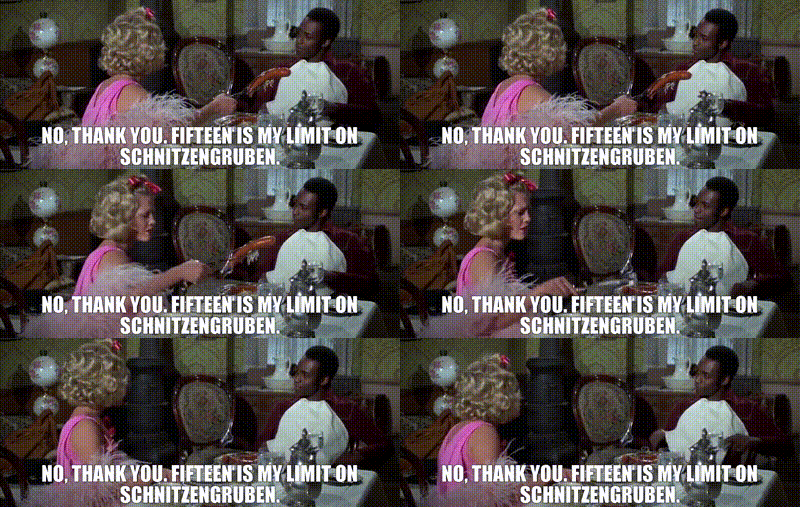
Mel Brooks is still with us. Age 97. Probably his greatest film is Blazing Saddles - which recently celebrated its 50th anniversary. Many people don't realize that Richard Pryor wrote the script with Brooks (and others), and he was supposed to star in the film. But the studio thought he was too controversial. Thankfully, Cleavon Little was awesome.
-
I'm not going to weigh in on whether to sign Bauer or not, but will say that I think that whatever team he signs with is going to have a PR headache to deal with. "Why are you giving millions of dollars to a sexual deviant/predator" will be the simplest question. That's not an easy thing to answer. As people have pointed out, Bauer has never been charged or convicted of anything. But there are some serious allegations. And the stuff he has admitted to is pretty sordid. Illegal? Perhaps not, but not exactly family time stuff. Perhaps it won't be too bad - and the outrage won't emerge or take hold. But a team has to be prepared for all of it. And any team signing him is going to have to be wondering in the back of their mind if there's anything else that hasn't come to light. They'll be walking on eggshells hoping nothing new emerges. Teams are usually okay with taking on a player that has made a 'mistake'. A guy gets in a fight or gets a DUI or makes some inappropriate comments on Twitter or whatever. That's small peanuts compared to what Bauer has faced. Most club probably don't want the headache involved. I will say that I'm betting someone does sign him. It will be at a small base salary with tons of incentives. This will protect the team in case something else crops up and he can't pitch. Otherwise, they will say he's made mistakes, paid the price, never convicted, and vowed to be a better person - and add that he's gone if anything happens or comes out. What team will do this - who knows. I'm guessing a contender who is desperate for starting pitching. But I doubt the Crew do anything like this. But who knows.
-
Yeah, I think he's totally convinced he won't be anything but a reliever - hence the lower ranking (#90) than some publications. I don't have a problem with that - just pointing out his reasoning for the lower ranking.
-
"Mr Warmth" was anything but warm, unless you're talking about his temper. Image courtesy of Brewer Fanatic & Brock Beauchamp Mike Caldwell was nicknamed ‘Mr. Warmth.’ But let’s be clear: the name was dripping with irony. It was sort of like calling the 6’6” guy ‘Tiny.’ Caldwell was called many things during his playing days, including mean, fierce, nasty, obnoxious, and passionate. He is one of the finest pitchers ever to wear a Brewer uniform. Ralph Michael Caldwell was born in Tarboro, NC, on January 22, 1949. He went to North Carolina State University in 1968, had an outstanding collegiate pitching career, and graduated with a degree in sociology. But he was not a major pro prospect because he lacked loud skills and, thus, upside. He was selected in the 12th round pick of the 1971 amateur draft by the San Diego Padres. As a result of the lowly selection, Caldwell would have a chip on his shoulder - which would drive him relentlessly to succeed. As an advanced college pitcher, the right-handed Caldwell was promoted to the big leagues the same year he was drafted, after only 19 games in A ball. He never returned to the minors. Caldwell showed promise early on as he moved between starting and relieving. He had a great sinker, a good curve, and solid control. He spent two seasons in San Diego before being dealt to San Francisco in 1974. A breakout year he followed as he went 14-5 with a 2.95 ERA as a starter. Things were looking pretty good. However, the following year, Caldwell faltered as he struggled with bone spurs in his elbow. He soon returned to the reliever and spot starter role - and his numbers suffered. After the 1976 season, he was dealt to the Cardinals, who flipped him to Cincinnati. The book seemed to have been written on the 28-year-old Caldwell. He did whatever he was asked. He ate up innings but didn’t strike out a lot of batters. He showed flashes of being special but never enough to sustain real success. It led to mixed results. He had the trappings of a journeyman. No one, however, doubted his passion or competitiveness. Manager Don Zimmer said this of Caldwell: “He’s one of the fiercest competitors you’ll find in this business.” Caldwell worked 14 games as a reliever for the Reds in 1977 before being dealt to the Milwaukee Brewers for two minor leaguers. With the Crew, he remained in his typical role as a reliever and spot starter, with typical middling results. And then, in 1978, everything changed for Mr. Warmth. The team suffered some injuries early on to Moose Haas and Bill Travers - opening up a rotation spot. Caldwell got the nod - and what followed was one of the greatest seasons in Milwaukee Brewer history. Caldwell was brilliant. He posted a 22-9 record and a sparkling 2.36 ERA. He tossed an astounding 293 innings pitched, including 23 complete games. He was voted second in the Cy Young race and earned the American League Comeback Player of the Year Award. How did this happen? How did a journeyman pitcher turn into one of baseball’s best starters? The answer was Caldwell’s devastating sinker. It became the reliable ‘out’ pitch that he had never possessed. Caldwell credited manager George Bamberger with helping him refine his sinker - but the whispers behind the scenes said that Bamberger, a former pitching coach, had taught Caldwell how to master the spitter. Caldwell and Bamberger denied such allegations, which were never proven. 1978 was a fantastic year for Caldwell and the Brewers. The team was on the rise as Bambi’s Bombers threatened to bludgeon into submission opposing pitching staffs. But the year was also the high water mark for Caldwell. Bamberger was known to ride his starters long and hard and throwing nearly 300 innings took a toll on Caldwell’s arm. He loved the workload, but he was never the same again. Caldwell settled in as a serviceable starter for the Brewers for the next five years, always throwing more than 200 innings in a season, except for once. He was a solid but not elite starter, which was important for one of the hardest-hitting teams of the era. During his time in Milwaukee, Caldwell butted heads with others, especially manager Buck Rodgers. The two reportedly hated each other and some labeled Caldwell a cancer. He was thrilled when Rodgers was let go - for Harvey Kuehn - early in the 1982 season. Caldwell went on to have a memorable postseason that year, winning two games in the World Series. His first start was a shutout, while he gave up 14 hits over 8.1 innings in his second game. However, he gave up two hits in relief in the fateful game seven loss. Caldwell continued to take the ball every five days for Milwaukee until time and injuries began to catch up with him. A nagging ankle injury dogged Caldwell, and in 1984, he was limited to only 19 starts. It didn’t help that Caldwell’s name, along with Paul Molitor’s, came up in an investigation of drug use in the majors. No action was ever levied against Caldwell after a two-year investigation. In January of 1985, the Brewers elected to waive Caldwell. At 36, Caldwell still hoped to catch on with another major league team but no offer came. Perhaps it was his reputation as a clubhouse cancer. Or the drug allegations. But it was probably just that he was aging and falling apart, having worked more than 1,500 innings over the past seven years. And with that, Mike Caldwell’s career as a major league pitcher was over. He left Milwaukee as one of the best starting pitchers in franchise history, a position he still holds today. In his 7+ seasons in Milwaukee, Caldwell had a 102-80 record and a 3.74 ERA. He had double-digit wins for six consecutive seasons. His name is all over the leaderboards for the franchise. He is second in wins, innings pitched, and shutouts. He is in the top 10 of many other categories, including 5th in bWAR with 17.3. Caldwell holds the franchise record with an astounding 81 complete games, not likely to be broken. His 1978 season is one of the franchise’s best as he produced six shutouts and a bWAR of 8.2, the second most ever behind Teddy Higuera. During his career, Caldwell was known as a Yankee killer. From 1977 to 1982, he was 12–5 with a 2.66 ERA against the Bronx Bombers. Caldwell is also famous for brawling with Yankees star Reggie Jackson. Caldwell went inside on Jackson several times during a game after the Yankees had done so with the Brewers. Jackson took issue, and the resulting scrum lasted 12 minutes. After his major league career, Caldwell stayed active in the game, working for more than 20 years in the minor leagues as a pitching coach before retiring. He was inducted into the North Carolina State Hall of Fame in 2013 and the Brewers Wall of Honor in 2014. Please share your memories of former Brewer starting pitcher Mike Caldwell. View full article
-
Mike Caldwell Pitched With A Mountainous Chip On His Shoulder
Matt Breen posted an article in History
 Mike Caldwell was nicknamed ‘Mr. Warmth.’ But let’s be clear: the name was dripping with irony. It was sort of like calling the 6’6” guy ‘Tiny.’ Caldwell was called many things during his playing days, including mean, fierce, nasty, obnoxious, and passionate. He is one of the finest pitchers ever to wear a Brewer uniform. Ralph Michael Caldwell was born in Tarboro, NC, on January 22, 1949. He went to North Carolina State University in 1968, had an outstanding collegiate pitching career, and graduated with a degree in sociology. But he was not a major pro prospect because he lacked loud skills and, thus, upside. He was selected in the 12th round pick of the 1971 amateur draft by the San Diego Padres. As a result of the lowly selection, Caldwell would have a chip on his shoulder - which would drive him relentlessly to succeed. As an advanced college pitcher, the right-handed Caldwell was promoted to the big leagues the same year he was drafted, after only 19 games in A ball. He never returned to the minors. Caldwell showed promise early on as he moved between starting and relieving. He had a great sinker, a good curve, and solid control. He spent two seasons in San Diego before being dealt to San Francisco in 1974. A breakout year he followed as he went 14-5 with a 2.95 ERA as a starter. Things were looking pretty good. However, the following year, Caldwell faltered as he struggled with bone spurs in his elbow. He soon returned to the reliever and spot starter role - and his numbers suffered. After the 1976 season, he was dealt to the Cardinals, who flipped him to Cincinnati. The book seemed to have been written on the 28-year-old Caldwell. He did whatever he was asked. He ate up innings but didn’t strike out a lot of batters. He showed flashes of being special but never enough to sustain real success. It led to mixed results. He had the trappings of a journeyman. No one, however, doubted his passion or competitiveness. Manager Don Zimmer said this of Caldwell: “He’s one of the fiercest competitors you’ll find in this business.” Caldwell worked 14 games as a reliever for the Reds in 1977 before being dealt to the Milwaukee Brewers for two minor leaguers. With the Crew, he remained in his typical role as a reliever and spot starter, with typical middling results. And then, in 1978, everything changed for Mr. Warmth. The team suffered some injuries early on to Moose Haas and Bill Travers - opening up a rotation spot. Caldwell got the nod - and what followed was one of the greatest seasons in Milwaukee Brewer history. Caldwell was brilliant. He posted a 22-9 record and a sparkling 2.36 ERA. He tossed an astounding 293 innings pitched, including 23 complete games. He was voted second in the Cy Young race and earned the American League Comeback Player of the Year Award. How did this happen? How did a journeyman pitcher turn into one of baseball’s best starters? The answer was Caldwell’s devastating sinker. It became the reliable ‘out’ pitch that he had never possessed. Caldwell credited manager George Bamberger with helping him refine his sinker - but the whispers behind the scenes said that Bamberger, a former pitching coach, had taught Caldwell how to master the spitter. Caldwell and Bamberger denied such allegations, which were never proven. 1978 was a fantastic year for Caldwell and the Brewers. The team was on the rise as Bambi’s Bombers threatened to bludgeon into submission opposing pitching staffs. But the year was also the high water mark for Caldwell. Bamberger was known to ride his starters long and hard and throwing nearly 300 innings took a toll on Caldwell’s arm. He loved the workload, but he was never the same again. Caldwell settled in as a serviceable starter for the Brewers for the next five years, always throwing more than 200 innings in a season, except for once. He was a solid but not elite starter, which was important for one of the hardest-hitting teams of the era. During his time in Milwaukee, Caldwell butted heads with others, especially manager Buck Rodgers. The two reportedly hated each other and some labeled Caldwell a cancer. He was thrilled when Rodgers was let go - for Harvey Kuehn - early in the 1982 season. Caldwell went on to have a memorable postseason that year, winning two games in the World Series. His first start was a shutout, while he gave up 14 hits over 8.1 innings in his second game. However, he gave up two hits in relief in the fateful game seven loss. Caldwell continued to take the ball every five days for Milwaukee until time and injuries began to catch up with him. A nagging ankle injury dogged Caldwell, and in 1984, he was limited to only 19 starts. It didn’t help that Caldwell’s name, along with Paul Molitor’s, came up in an investigation of drug use in the majors. No action was ever levied against Caldwell after a two-year investigation. In January of 1985, the Brewers elected to waive Caldwell. At 36, Caldwell still hoped to catch on with another major league team but no offer came. Perhaps it was his reputation as a clubhouse cancer. Or the drug allegations. But it was probably just that he was aging and falling apart, having worked more than 1,500 innings over the past seven years. And with that, Mike Caldwell’s career as a major league pitcher was over. He left Milwaukee as one of the best starting pitchers in franchise history, a position he still holds today. In his 7+ seasons in Milwaukee, Caldwell had a 102-80 record and a 3.74 ERA. He had double-digit wins for six consecutive seasons. His name is all over the leaderboards for the franchise. He is second in wins, innings pitched, and shutouts. He is in the top 10 of many other categories, including 5th in bWAR with 17.3. Caldwell holds the franchise record with an astounding 81 complete games, not likely to be broken. His 1978 season is one of the franchise’s best as he produced six shutouts and a bWAR of 8.2, the second most ever behind Teddy Higuera. During his career, Caldwell was known as a Yankee killer. From 1977 to 1982, he was 12–5 with a 2.66 ERA against the Bronx Bombers. Caldwell is also famous for brawling with Yankees star Reggie Jackson. Caldwell went inside on Jackson several times during a game after the Yankees had done so with the Brewers. Jackson took issue, and the resulting scrum lasted 12 minutes. After his major league career, Caldwell stayed active in the game, working for more than 20 years in the minor leagues as a pitching coach before retiring. He was inducted into the North Carolina State Hall of Fame in 2013 and the Brewers Wall of Honor in 2014. Please share your memories of former Brewer starting pitcher Mike Caldwell.
 -
All the debate over the deal aside, Hall is really intriguing. He's never put up numbers to match his talents - so it will be fascinating to see where he goes.
-
Yeah, Baltimore is loaded. That's what years of awful play potentially gets you. Everything comes together like they have for them.
-
Thanks for mentioning. I took care of.
-
The grades the Brewers got were B, B, C+ and B-. Doesn't mean there are nice things about the deal. As I noted, they don't dislike the players. Lots of potential. Just that Baltimore did great. Orioles got A, A, A, and A.
-
Generally, they love the deal for Baltimore since they are getting an ace - which they need. And they love that they didn't give up any premium prospects. Ortiz is blocked and Hall was probably bound for the bullpen. For Milwaukee, it's a mixed review. They don't dislike the players - just that it's not really doing much for the team - especially in 2024. And especially after signing Hoskins, which most everyone thinks signaled were 'all in' for 2024 and planning on running back Burnes and Adamas and so forth. We are worse for the move - Baltimore is better - and didn't have to lose a player like Mayo to make the move.

