Matt Breen
-
Posts
9,112 -
Joined
-
Last visited
-
Days Won
1
Content Type
Profiles
Forums
Blogs
Events
News
2026 Milwaukee Brewers Top Prospects Ranking
Milwaukee Brewers Videos
2022 Milwaukee Brewers Draft Picks
Milwaukee Brewers Free Agent & Trade Rumors, Notes, & Tidbits
Guides & Resources
2023 Milwaukee Brewers Draft Picks
2024 Milwaukee Brewers Draft Picks
The Milwaukee Brewers Players Project
2025 Milwaukee Brewers Draft Pick Tracker
2026 Milwaukee Brewers Draft Tracker: Picks & Bonuses
Store
Downloads
Gallery
Everything posted by Matt Breen
-
 I think Ortiz can pretty much play anywhere in the IF. May be 2B or 3B. Maybe SS (if we deal Adamas). I think he profiles as a better hitter than Turang - but we shall see. Maybe the team will take things to camp and play those that step up between Black, Turang and Ortiz.
 -
One reason for Ortiz's age was he was a college player - and thus didn't reach pro ball until he was 21. He then missed all of 2020 due to the COVID stuff. And then most of the next season due to injury. So he's a bit behind most players - developmentally.
-
Pretty much every team in the league would do that deal.
-
This is very true. Burnes is a huge, huge lose. Team playing the long game. Let's hope it pays off.
-
Sadness. I thought we had something interesting in him. Oh well.
-
We dealt a competitive pick for Claudio a few years ago. I think that's about their value.
-
I hope there's more to the deal. Not surprised if there isn't. I don't think the deal is bad - Hall/Ortiz for Burnes - I just think there's a premium we should be getting something extra.
-
Connor Norby would an interesting addition. If there is more.
-
I only know it will be a wild night. People are going to go crazy was we debate the deal, analyze the ramifications, and all else that goes with it. I know nothing else. So, yes, a wild night.
-
Will be a wild night...
-
Mitchell has a minor league strikeout rate of 25.5%. While not huge, it's still not great. However in college, it was 15.5%. Players tend to having higher strikeout rates once they reach the majors due to the better pitching - that makes sense. Huira is a really a weird case. 16% in college. 23.6% in the minors. Then 36% in the majors. I'm. not sure if we should use the extreme outlier as a model. But it shows that it does happen. But I think it's not hard to believe that Mitchell will be better - but still not great. Maybe 30% is a goal. Then improve down the road. We should remember that Mitchell has only 500 or so ABs in three years due to injuries. So you would hope that he will only get better with more experience. Of course, perhaps he's got a fatal flaw in his approach and pitchers will only keep exploiting it. Personally, I think Mitchell is a fascinating player - and I'd love to see him play full time this year. Frelick, Mitchell, Chourio and Wiemer would be an amazing defensive outfield (Yelich can DH).
-
Woo would be great, but I think this package is light for him. Mitchell just has too many questions to make him as valuable. However, I think the idea of Mitchell isn't a bad idea for Seattle. Rodriguez is a solid defender in CF, but Mitchell would be an upgrade. You figure Haniger plays one of the corners (or does he DH?) - but the other outfielders are not really inspiring. Taylor Trammell was a nice prospect, but looks overmatched thus far. Interesting idea. Adding young arms is important with Miley and Burnes likely gone after this year.
-
Turner is fascinating in that he didn't become an everyday major leaguer until he was 31 years old. Yet he's managed to take home $135m (including the upcoming season). Not bad for a guy who was waived at age 25 (by Baltimore), and allowed to be a free agent by the Mets (rather than offer arbitration) at age 29. Even with the Dodgers it took him until he was there for three years to get 500+ ABs.
-
I would have loved Turner for the Brewers. Play some 1B/3B/DH. And the beard would have been fun. But after signings Hoskins, probably not so much. Dude still can hit, but he's 39 - the wheels have to fall off at some point - correct?
-
Burnes, Peralta, Miley and Rea are probably locks. I hope Gasser is the next guy. He did well at AAA, so his time is now. Ross will step in when there are any injuries (and there are always injuries). I'd look at Ashby as a wild card. Don't count him for anything, but if it happens - awesome. Small seems to be a reliever going forward. I'd like to see Rodriguez get a half season at AAA and see how he does. He might be ready by mid-season if needed.
-
Tyler Black #5 3B in the MLB Pipeline: https://www.mlb.com/news/top-third-base-prospects-for-2024?t=mlb-pipeline-coverage They said, "he’ll rank in the middle of our new Top 100 when it drops on Friday."
-
Adding Hoskins really helps this lineup - as people have noted. I'm guessing the DH will rotate between the extra outfielders (especially Yelich) and maybe Black and Contreras on occasion. Yelich at DH will help the OF defense (the foursome of Mitchell, Wiemer, Chourio, Frelick would make one of the best defensive OFs in baseball). Our offense could, potentially, be so much better in 2024. So much depends on the young guys - Chourio, Black, Mitchell, Frelick, Wiemer, Turang. I mean, a big chunk of these guys need to step up this year. Let's hope it happens.
-
While a half season is a crappy way to assess a coach, I credit the team from cutting bait if they truly believe he is not working out. This team is built for now - and we can't afford to wait for our guy to figure things out (assuming there's something to figure out).
-
Was there really a vote for top rookie last year? And Monasterio won? Wow. I don't recall that.
-
Are The Brewers Interested in Joey Votto?
Matt Breen replied to Brock Beauchamp's topic in Transaction Rumors & Proposals
Not positive, but I think it was more of he would never leave the Reds if he had the choice. So as long as they want him. That time has come. -
Are The Brewers Interested in Joey Votto?
Matt Breen replied to Brock Beauchamp's topic in Transaction Rumors & Proposals
Hah! This is awesome. I said to myself that the Brewers adding Votto would be so up our alley. I'll take him over Jake Bauers. -
Wild Card Game: Packers @ Cowboys - Sunday, Jan 14 3:30pm
Matt Breen replied to homer's topic in Other Sports
A day after the game, it's still amazing to think how much we dominated. The score doesn't demonstrate that. Just a great win. -
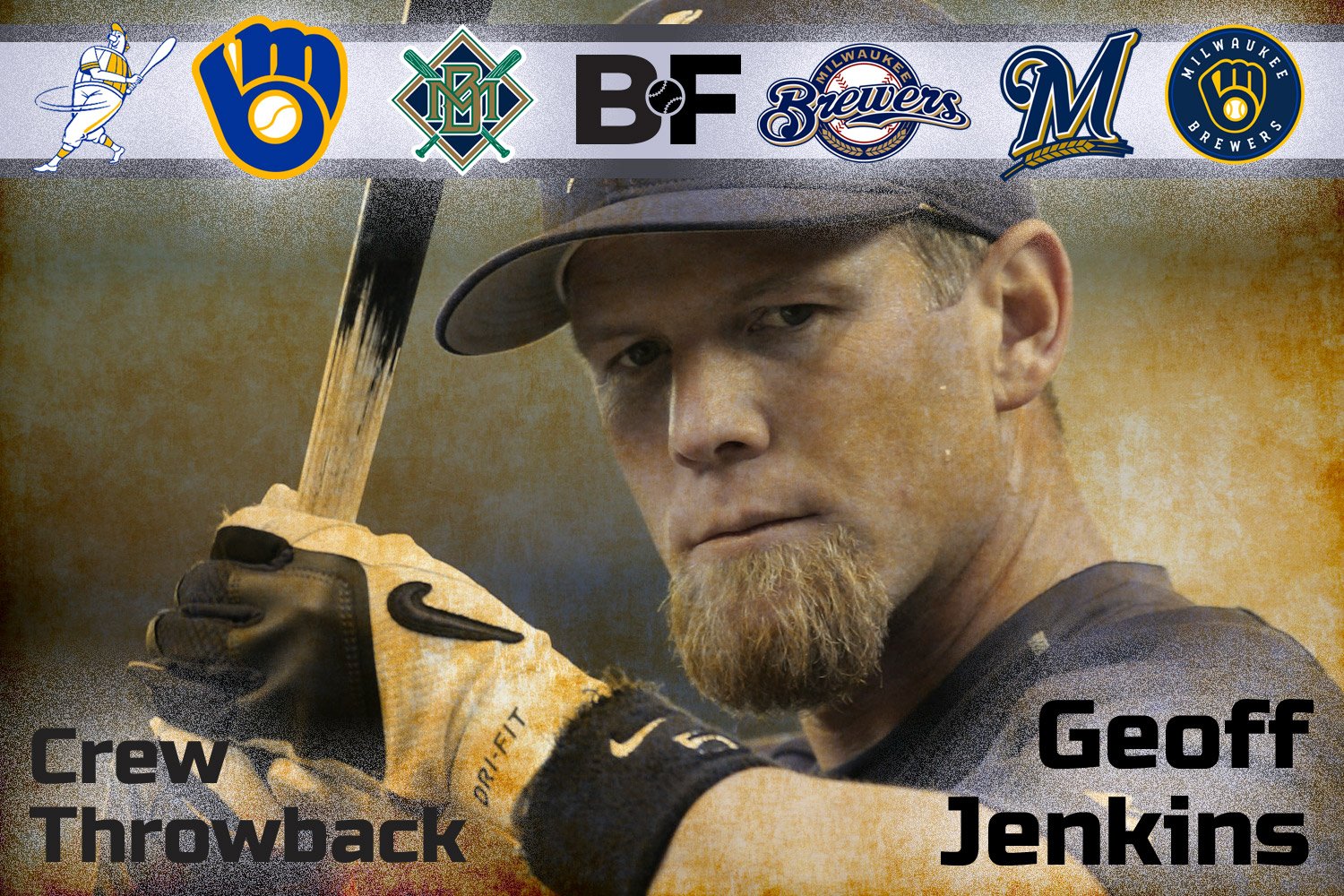
The 1990s were the dark ages for the Milwaukee Brewers in developing players. It was the era of GM Sal Bando, his 1st round selections littered with failures. Geoff Jenkins was one of the few highlights of that era of development. Image courtesy of Brewer Fanatic & Brock Beauchamp The list of developmental shortcomings includes Ty Hill, Ken Henderson, Gabby Martinez, Todd Dunn, Antone Williamson, Chad Green, J.M. Gold, Kyle Peterson, Ken Felder... you get the picture. However, the decade found a couple of gold nuggets in the first round. This included pitcher Ben Sheets in 1999 and outfielder Geoff Jenkins in 1995 - who would go on to have a stellar 10-year career with Milwaukee. Geoff Scott Jenkins was born in Olympia, Washington, on July 21, 1974. He was an outstanding athlete - growing up in Rancho Cordova, California. He attended USC to play college baseball and led the Trojans to the College World Series. He finished his career as one of the school’s best sluggers. The Brewers selected the left-handed hitting Jenkins in the first round of the 1995 draft - the 9th overall pick. He was seen as an advanced hitter with a good arm who could quickly climb the minor league ladder. He did well his first two seasons, then struggled during his first year at Triple A. However, he pounded opposing pitchers the following season and received a call to the big leagues. He hit a modest .229 in 84 games that season but broke out big the following year, hitting .313 (a career-high) with 21 home runs in 138 games. The following season, he hit 34 homers for a .303 average and Jenkins appeared to be a perennial All-Star in the making. Mainly playing left field, Jenkins quickly demonstrated several qualities (good and bad) that would mark him for most of his career. First, when healthy, he was a very good hitter. However, he was not a great hitter. He didn’t take a lot of walks, and he often struggled against the left-handed pitchers. Against the latter, he managed only a .712 OPS compared to a .871 average against right-handers. His struggles against lefties kept him from becoming an elite hitter. Second, Jenkins was constantly dinged by injuries throughout his career. He played the game hard, and he was often nursing nagging injuries. In 2002, he dislocated an ankle, causing him to miss more than half the year. Jenkins returned in 2003 to have an outstanding season - and make his only All-Star appearance. Jenkins continued to be a productive player for Milwaukee throughout his ten-year run and gamely switched to right field for two years to accommodate the acquisition of Carlos Lee in 2005. The fans appreciated his hard-nosed performances, not to mention the 200+ homers he hit for the club. Jenkins continued to produce at the plate as he moved into his 30s. However, his inability to hit lefties became more pronounced - and he often sat against southpaws. After the 2007 season, with his contract up, the Brewers elected to let the 32-year-old Jenkins go as a free agent after ten years with the club. He signed with Philadelphia and began the season as their left fielder. However, as the season progressed, and he struggled at the plate he found himself on the bench more and more. Jenkins’ numbers were not good that year, and by the time the postseason came around (the first time Jenkins had ever been in the playoffs), he was strictly a benchwarmer - and there was even talk of keeping him off the postseason roster. Jenkins got only four at-bats in the 2008 playoffs and only a single hit. But that hit was a memorable one. In the series finale, he crushed a key double and scored a run, helping the Phillies win the World Series. Philadelphia released Jenkins the following March, and his playing career was over. He was 34 years old. He officially retired in 2010 after signing a one-day contract with the Brewers. Geoff Jenkins was one of the most productive members of the Brewers organization during his 10-year tenure. For his career, he ranks 10th in bWAR, 7th for games played, 6th in hits, 5th in doubles, and 4th in HRs. He hit .300+ twice and represented the Brewers at the All-Star game. Of note: Jenkins is one of only eight players in major league history to strike out six times in a game. Also, he was frequently misidentified as Packers quarterback Brett Favre. In retirement, Jenkins has become the owner of Arizona's sports fitness training facility, where he resides with his family. Geoff Jenkins was a really good ballplayer for the Milwaukee Brewers. He played hard, put up solid numbers, and stayed loyal to the franchise and the fans. He tended to go into slumps and struck out a lot - frustrating many - but as his .843 OPS and 200+ home runs attest, he could hit. The tough thing for Jenkins was having to be a part of so many bad teams during his tenure. In his time in Milwaukee, only one team - his last - was above .500. He never made it to the playoffs with the franchise. While his one year in Philadelphia was not the most memorable, he came away with a World Series ring - a nice way to top off a career. Please share your memories of former Brewer outfielder Geoff Jenkins. View full article
-
 The list of developmental shortcomings includes Ty Hill, Ken Henderson, Gabby Martinez, Todd Dunn, Antone Williamson, Chad Green, J.M. Gold, Kyle Peterson, Ken Felder... you get the picture. However, the decade found a couple of gold nuggets in the first round. This included pitcher Ben Sheets in 1999 and outfielder Geoff Jenkins in 1995 - who would go on to have a stellar 10-year career with Milwaukee. Geoff Scott Jenkins was born in Olympia, Washington, on July 21, 1974. He was an outstanding athlete - growing up in Rancho Cordova, California. He attended USC to play college baseball and led the Trojans to the College World Series. He finished his career as one of the school’s best sluggers. The Brewers selected the left-handed hitting Jenkins in the first round of the 1995 draft - the 9th overall pick. He was seen as an advanced hitter with a good arm who could quickly climb the minor league ladder. He did well his first two seasons, then struggled during his first year at Triple A. However, he pounded opposing pitchers the following season and received a call to the big leagues. He hit a modest .229 in 84 games that season but broke out big the following year, hitting .313 (a career-high) with 21 home runs in 138 games. The following season, he hit 34 homers for a .303 average and Jenkins appeared to be a perennial All-Star in the making. Mainly playing left field, Jenkins quickly demonstrated several qualities (good and bad) that would mark him for most of his career. First, when healthy, he was a very good hitter. However, he was not a great hitter. He didn’t take a lot of walks, and he often struggled against the left-handed pitchers. Against the latter, he managed only a .712 OPS compared to a .871 average against right-handers. His struggles against lefties kept him from becoming an elite hitter. Second, Jenkins was constantly dinged by injuries throughout his career. He played the game hard, and he was often nursing nagging injuries. In 2002, he dislocated an ankle, causing him to miss more than half the year. Jenkins returned in 2003 to have an outstanding season - and make his only All-Star appearance. Jenkins continued to be a productive player for Milwaukee throughout his ten-year run and gamely switched to right field for two years to accommodate the acquisition of Carlos Lee in 2005. The fans appreciated his hard-nosed performances, not to mention the 200+ homers he hit for the club. Jenkins continued to produce at the plate as he moved into his 30s. However, his inability to hit lefties became more pronounced - and he often sat against southpaws. After the 2007 season, with his contract up, the Brewers elected to let the 32-year-old Jenkins go as a free agent after ten years with the club. He signed with Philadelphia and began the season as their left fielder. However, as the season progressed, and he struggled at the plate he found himself on the bench more and more. Jenkins’ numbers were not good that year, and by the time the postseason came around (the first time Jenkins had ever been in the playoffs), he was strictly a benchwarmer - and there was even talk of keeping him off the postseason roster. Jenkins got only four at-bats in the 2008 playoffs and only a single hit. But that hit was a memorable one. In the series finale, he crushed a key double and scored a run, helping the Phillies win the World Series. Philadelphia released Jenkins the following March, and his playing career was over. He was 34 years old. He officially retired in 2010 after signing a one-day contract with the Brewers. Geoff Jenkins was one of the most productive members of the Brewers organization during his 10-year tenure. For his career, he ranks 10th in bWAR, 7th for games played, 6th in hits, 5th in doubles, and 4th in HRs. He hit .300+ twice and represented the Brewers at the All-Star game. Of note: Jenkins is one of only eight players in major league history to strike out six times in a game. Also, he was frequently misidentified as Packers quarterback Brett Favre. In retirement, Jenkins has become the owner of Arizona's sports fitness training facility, where he resides with his family. Geoff Jenkins was a really good ballplayer for the Milwaukee Brewers. He played hard, put up solid numbers, and stayed loyal to the franchise and the fans. He tended to go into slumps and struck out a lot - frustrating many - but as his .843 OPS and 200+ home runs attest, he could hit. The tough thing for Jenkins was having to be a part of so many bad teams during his tenure. In his time in Milwaukee, only one team - his last - was above .500. He never made it to the playoffs with the franchise. While his one year in Philadelphia was not the most memorable, he came away with a World Series ring - a nice way to top off a career. Please share your memories of former Brewer outfielder Geoff Jenkins.
 -
It's sort of like Happy Gilmore's approach to teeing off on the golf course - only with pitching.