

Brewers Video
Welcome to Brewer Fanatic's 2024 top 20 prospect rundown! The Brewers graduated a number of their top prospects throughout the 2024 season, including Jackson Chourio, so there are some new names to look at heading into this offseason.
Let's take a look at the first installment of prospects, numbered 16-20, as voted on and compiled by the Brewer Fanatic community.
#20 RHP Brett Wichrowski (Wisconsin Timber Rattlers, Biloxi Shuckers)

The Brewers' 13th-round selection in last year's draft, Wichrowski received a lot of attention this spring, when he showed up throwing in the upper 90s and reportedly reaching 101 MPH on his fastball. Drafted out of Bryant University, Wichrowski had been sitting in the low 90s in college, despite splitting time between starting and relieving.
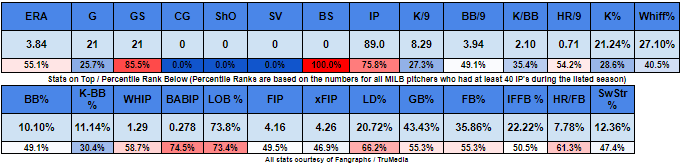
Starting all 21 games he appeared in this season, Wichrowski’s average velocity of 94.6 MPH wasn’t as high as what he had shown in spring, but it was still a jump of 3.4 MPH over his average fastball in 2023 at Bryant. According to Baseball America, that 3.4 MPH jump was the second-largest increase in average four-seam fastball velocity among all minor-league pitchers. Beyond the velo, Wichrowski seems to have the three-fastball combination that the Brewers love, at times cutting the ball, other times running it, to go along with his more standard four-seam fastball shape.
The best pitch in Wichrowski’s repertoire is his low- to mid-80s sweeper. He most often uses it against right-handed hitters as a put-away pitch, though he’s shown an ability to land it for strikes as well. He does this against righties especially, but also against lefties at times. Wichrowski also throws a shorter, harder slider, and he appears to be more comfortable using that version against lefties than the sweeper. He rounds his repertoire out with a changeup in the mid- to upper 80s that is a work in progress, but it made strides throughout the season.
The Brewers are likely thrilled with the progress Wichrowski made in 2024. For him to make another big leap in 2025, though, he will need to show a better ability to generate swings and misses. His stuff is too good for his whiff rate and strikeout rate to be 40th and 28th percentile, respectively, like they were this season. Improvement in his command could help him put hitters away more consistently, and it would help him to limit the walks a bit more.
Wichrowski seems like a strong candidate to begin in Biloxi next season, and a 2026 ETA seems most realistic. However, if his command does make big strides, he could work his way into the conversation as early as next season.
#19 OF Luis Lara (Wisconsin Timber Rattlers)

The Brewers signed Lara in their 2022 International class, and he was one of the bigger investments of that year for them. He began 2023 in Extended Spring Training, but soon proved too talented to be sent to the Arizona Complex League and was promoted to Low-A Carolina a month into the season. He later moved to High-A, where he finished 2023. In 2024, he returned to High-A and spent the entire season there.

Listed at 5-foot-7 and 155 pounds at the time of signing as a 16-year-old, he doesn’t appear to have grown taller since then, though he does seem to have bulked up. A plus runner and twitchy athlete in general, Lara does his best to make up for the lack of size with his athleticism.
This athleticism and speed show up most often in the outfield, where Lara already shows signs of being a plus defender in center field. He improved his jumps out there this year, as well as his routes to the ball. He plays with a Sal Frelick-like reckless abandon in the outfield, unafraid of running into walls or of laying out. Lara has the ability to be a major-league center fielder in the future, and a good one, at that.
Lara also uses his plus speed on the bases, stealing 45 bases in 2024. While his success rate of 76% isn’t great, he is likely being encouraged to push his limits in the lower levels, which can lead to being caught more often than if he only were to take off when he was comfortable. The reason Lara has dropped 11 spots on this list since the end of 2023 is certainly not due to his defense or baserunning, but rather the lack of progression offensively.
His power actually took a slight step forward (though it remains well below average), hitting four home runs and posting some exit velocities over 105 MPH--an impressive feat for someone his size. The negative was that he regressed in the other three facets that had previously carried his profile. His line drive rate went from an elite 27% in 2023 to a middle-of-the-road 22.9% in 2024 and in turn, his ground ball rate jumped up around 8%. Lara’s whiff rate went from an elite 17% to a merely very good 20.3%. He also stepped back in the walk department, going from an average number of 11% to a 22nd-percentile 8.4%.
This could end up being a fork in the road in Lara’s career. Will he look to continue to add power, which could help cover up some regression in other areas of his game? Will he try to get back to being an elite bat-to-ball guy, rather than a good one? Is it possible to find the ideal balance between those two, especially given his physical limitations? These are all questions he will look to answer in 2025. His glove is good enough to allow the bat to lag behind, but it will need to be better than it was in 2024 if he is going to continue to climb through the system.
#18 IF Luis Peña (DSL Brewers)

Signed as an international free agent in the 2024 class, Peña received $800,000, which was the third-largest bonus in the Brewers’ class. He didn’t take long to show why the Brewers were willing to guarantee him that much money, getting off to a red-hot start in the Dominican Summer League and finishing it as one of the best hitters in the league.

Peña is tooled-up across the board, but his speed stands out above all else. Scouts say it’s either 70- or 80-grade speed, and the stolen base numbers certainly support that, as he went 39-for-43 stealing on the season. Reports have Peña with an above-average arm, possibly plus, and many evaluators believe he will have a chance to stick at shortstop for the long term. If he does end up having to move off of short, third base would be a possibility due to his arm strength, but many believe he would end up in center field, where his speed would allow him to prosper.
Offensively, Peña has a very aggressive approach. His bat-to-ball skills border on elite, which allows him to take that approach, especially at the lower levels. His strikeout rate of 8.2% is a clear sign that he had no issues with this approach in the DSL, but it is something that pitchers might be able to take better advantage of as he moves through the system, so a bit more patience could go a long way. He has the potential for an above-average to plus hit tool, due to his contact skills.
Peña has really fast hands and a ton of bat speed, along with a swing that should help him generate pretty consistent loft on the ball. While the power didn’t show up in home runs this year (only one), he did have six triples and 16 doubles. Some evaluators project him to have above-average power once he adds good weight to his projectable frame. His strong ability to pull the ball in the air would combine well with added strength.
His ceiling is one of the highest in the organization, but there is a long way to go in his development. It will be interesting to see if Peña finds himself beginning the 2025 season in Low-A Carolina, or if he spends time in the Arizona Complex League. If he does skip the ACL, and he shows an ability to drive the ball a bit more (as well as a slightly more patient approach), he’s the type of talent who could not only fly up Brewers lists, but also national ones.
#17 RHP Carlos F Rodriguez (Nashville Sounds, Milwaukee Brewers)

Rodriguez was selected by the Brewers in the sixth round of the 2021 MLB Draft. He came out of Florida Southwestern State Junior College, which means you can include him on the growing list of JuCo pitchers who have succeeded or are showing signs of future success in the Brewers system. Rodriguez made his MLB debut this season, pitching to mixed results, especially struggling the second time through the order. None of this is out of the ordinary for a 22-year-old, though, and he showed in Nashville that there’s still plenty of reason to monitor him as a potential rotation piece in the future.

A true six-pitch pitcher, Rodriguez throws all three variations of fastballs (four-seam, sinker and cutter). He also throws a changeup, curveball and slider. None of them stand out as plus pitches, but all of them are average or better. Rodriguez helps his stuff play up by messing with the timing of hitters.
His four-seam and sinker are both thrown in the 91-94 range for the most part, but he can reach back and touch up to 96 MPH when he needs it. His four-seam shape is pretty standard, but his -4.5 Vertical Approach Angle helps the ball play above bats, and helped him post a very solid 29% whiff rate against the pitch this season. The cutter is thrown in the 87-89 range, and is the pitch he tends to command the best out of all of his pitches. None of them are outliers in terms of a movement profile, but they do play well off of each other.
In terms of secondaries, Rodriguez throws his changeup the most often. It averaged around 15” of horizontal break, and generated a 33% whiff rate in 2024. It’s a really solid put-away pitch against left-handed hitters, which is going to be important as he moves forward, as Rodriguez did have his struggles with lefties this season. Left-handed hitters posted a .760 OPS against him in Nashville, while righties only had a .562 OPS.
His curveball is another pitch that saw some improvement this season. Previously seen as his sixth-best pitch, he started throwing the curve a bit harder, as it averaged 75.8 MPH this season and didn’t drop into the upper 60s at any point, which it had in the past. The results were a 35.1% whiff rate and the lowest opponent xwOBA of any of his pitches. He rounds the repertoire out with his slider, which he used less than he had in the past, but which was still a good put-away pitch as well, posting a 33% whiff rate.
Rodriguez’s command was very hot-and-cold this season. He will need to find some more consistency moving forward. When he’s at his best, he looks like a back-of-the-rotation starter. When the command is not on, he will have a hard time recording outs at the MLB level. His stuff is not bad, but it's not good enough to overcome poor command. He will head into 2025 as rotation depth, and it’s very likely we will see him make some starts for the Brewers again next season.
#16 RHP K.C. Hunt (Carolina Mudcats, Wisconsin Timber Rattlers, Biloxi Shuckers)

Hunt was signed as an undrafted free agent following the 2023 MLB Draft. In the 20 rounds of the draft, nobody used a pick on him. About 14 months later, he’s just put the finishing touches on a spectacular debut season, taking home co-Pitcher of the Year honors in the organization, and is now seen as a top-20 prospect in the Brewers system, at least in these parts. Hunt began the season with Low-A Carolina as a reliever and finished it in Double-A Biloxi as a starter. It was a whirlwind of a season, but Hunt never wavered, performing extremely well every step of the way.

Hunt’s move to the rotation was made possible by his five-pitch mix, consisting of a four-seam fastball, slider, cutter, curveball and changeup (in order of 2024 usage). The four-seam is thrown in the 90-93 MPH range, and averaged around 18” of Induced Vertical Break. It also comes in with a -4.5 Vertical Approach Angle, both of which helped it play up above what the velocity would lead you to guess. His cutter is in the 86-88 range on average, and generated a lot of swings and misses on pitches away from righties.
His mid-80s bullet slider is a true plus-plus, elite offering. According to Baseball America, he recorded a 48% whiff rate, 40% chase rate and a staggering 58% CSW% (Called Strikes + Whiff Rate) with the slider. Pitch-level data isn’t publicly available for Double-A and lower, but that CSW% would have been the highest for anyone with at least 200 sliders thrown at Triple-A or MLB this season. The closest was Jason Adam of the Rays, who had a 49.3% rate. An absolutely elite offering.
Hunt’s curveball is a good pitch as well, though he struggles to command it as well as the slider. The curve has sharp, downer movement and a pretty big shape, which can make it difficult to spot. Off nights were rare for Hunt in 2024, but when they happened, it often came when he was struggling to get the curve down. He also threw a changeup, though he only used it 5% of the time. Another upper-80s pitch, it was mainly used against lefties. He struggled with it early on, but it actually made some pretty big strides throughout the season and is an average pitch at this point.
Command and control were both fantastic for Hunt as well. He threw 65% of his pitches for strikes and posted a very strong 6.3% walk rate.
Hunt did so well in his two-month stint at Double-A that the organization may feel comfortable having him begin 2025 in Nashville, where he would be one call away from making his MLB debut. Hunt has mid-rotation upside with his wide array of pitches and above-average command. There seems to be a good chance of seeing him in Milwaukee, sooner rather than later.
What stands out from 16-20 on this list? Anybody you think is over/under ranked? Let us know your thoughts in the comments!
Do you approve of the job Pat Murphy is doing as Brewers manager?

Interested in learning more about the Milwaukee Brewers' top prospects? Check out our comprehensive top prospects list that includes up-to-date stats, articles and videos about every prospect, scouting reports, and more!
View Brewers Top Prospects



Recommended Comments
Create an account or sign in to comment
You need to be a member in order to leave a comment
Create an account
Sign up for a new account in our community. It's easy!
Register a new accountSign in
Already have an account? Sign in here.
Sign In Now