

Jump to content
Brewer Fanatic
  • Brewers History

    The 2007 Brewers Set The Stage For Future Success After 25 Years Of Futility


    Michael Trzinski

    As the Milwaukee Brewers players trudged off the playing surface of Busch Stadium at 10:15pm on October 20, 1982, after a heart-breaking 6-3 loss to the St. Louis Cardinals in Game 7 of the World Series, fans probably never imagined that a Brewers team would not seriously challenge for a division title for another quarter-century.

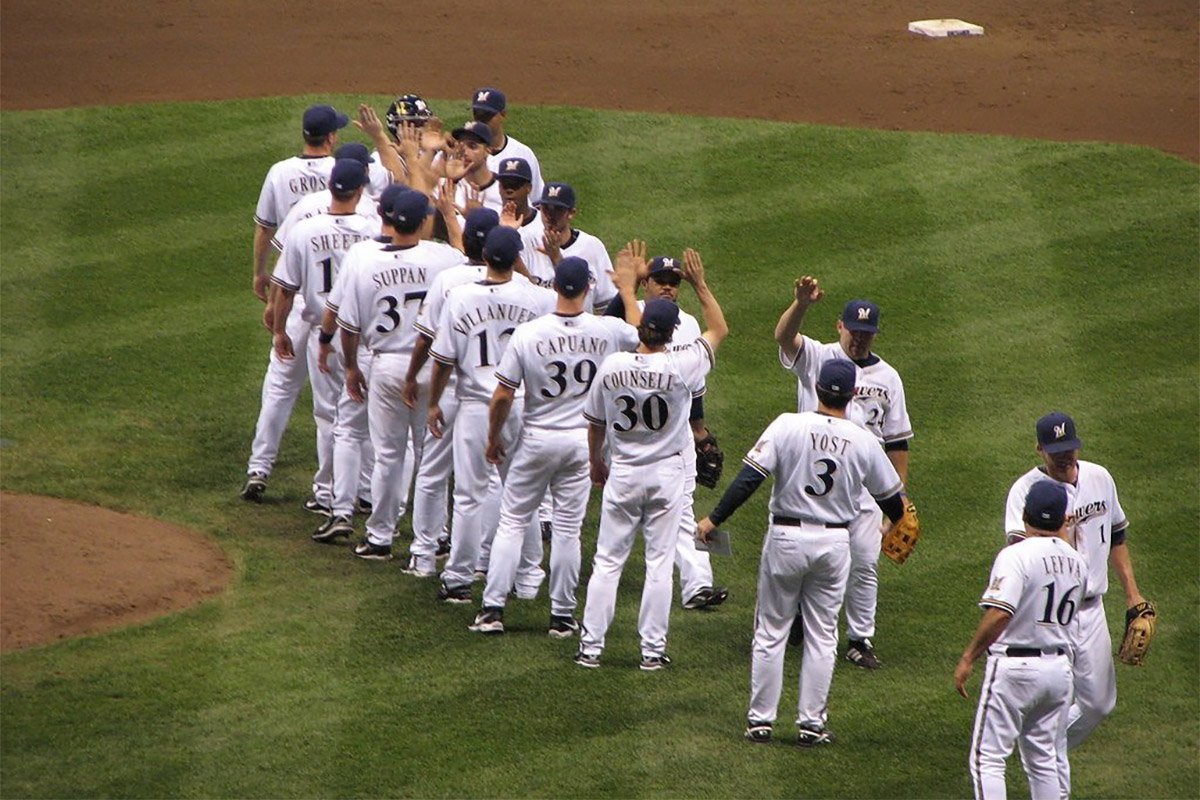
    Image courtesy of Tristan Porto on Flickr

    Brewers Video

    Sure, the 1992 squad closed to within two games of the Toronto Blue Jays with two games left in the regular season, but they lost twice to the Oakland Athletics to fall short. The 1982 Suds Series loss gave Milwaukee players (and their fans) a hangover that lasted until 2007.

    In 2006, the Brewers won their first five games and went 14-11 in April but never had another winning month, finishing with a 75-87 record, good for fourth place in the National League Central.

    Coming into 2007, the Brewers had a few question marks, but none bigger than finding someone to man the third base position. Corey Koskie—the regular at the hot corner in 2006—was still doubtful from the post-concussion syndrome that ended his season in July. The Brewers gave a non-roster invite to a young player from Granada Hills, California, via the University of Miami. His name was Ryan Braun, and he wore jersey number 75 in spring training. Also invited to his first camp was a young right-handed pitcher named Yovani Gallardo, who wore number 76. Both were long shots to make the big-league roster. In late March, both were reassigned to the Brewers minor league camp.

    The Brewers had a disappointing 13-17 record during the spring, and both Braun and Gallardo started the season at Triple-A Nashville. They wouldn’t stay there long.

    Milwaukee started out on fire, 3.5 games ahead of the NL Central field as the calendar turned to May. Three weeks later, with the team losing nine of 13 games and the third base platoon of Tony Graffanino and Craig Counsell batting a combined .227, the Brewers called up Braun, who had slashed .342/.418/.701 with 10 home runs across 117 at-bats in Nashville.

    Braun went 4-for-8 in his first two games, including a double and a home run. However, the team struggled the last week of May, losing five of seven games, but still held a 6.5-game lead over second-place Pittsburgh.

    Milwaukee had several players with very good numbers the first two months, including pinch-hitter/outfielder Tony Gwynn Jr. (.333), first baseman Prince Fielder (19 HR, 43 RBI), and shortstop J.J. Hardy (.304/.350/.567 with 15 home runs). Closer Francisco Cordero notched 19 saves in 19 opportunities and a minuscule ERA of 0.41 with 16 straight scoreless outings.

    In mid-June, starting pitcher Chris Capuano was placed on the 15-day disabled list, and Gallardo was called to replace him. In his major league debut on June 18, Gallardo allowed a first-inning run to the San Francisco Giants but pitched 6.1 innings, giving up four hits, three earned runs, and three walks while striking out four in a 5-4 victory. The Brewers won their next four games to add to their lead, going 8.5 games up over Chicago and St. Louis.

    But the Brewers limped into the All-Star break, losing seven of the last 10 games going into the mid-summer recess. Four players were named to the All-Star team: Fielder started at first base, while pitchers Ben Sheets and Cordero pitched an inning. Hardy got into the game late at shortstop.

    Milwaukee won four games in a row to start the second half but then struggled over the next two weeks, winning only five of 16 games to tie for first place with Chicago on August 2. The Crew won a pair of one-run contests against the Phillies to regain the lead but dropped nine of their next 11 to fall into the runner-up spot.  

    The NL standings on the morning of August 22 showed the Brewers and the Cubs tied. The Brewers promptly lost five in a row to drop to third place behind the Cubs and Cardinals. A run of 6-2 moved the Brewers back into a tie with the Cubs just after Labor Day. After Sheets went down with a left hamstring strain on September 18, the Brewers season imploded as they won only five of 12 games to end the year and finished two games back of the Cubs with an 83-79 mark.

    Although the team had a disappointing end to a season that seemed full of promise, several individual players had great seasons. Braun won the NL Rookie of the Year award after slashing .324/.370/.624 with 34 home runs and 97 RBIs in just 451 at-bats. His defensive play wasn't as exemplary, as he committed 26 errors at third base for a .895 fielding percentage. (The following year, he was moved to the outfield.) Fielder had an OPS+ of 157, led the league with 50 home runs, and finished third in MVP balloting. Three other players hit more than 20 HRs: Hardy (26), Corey Hart (24) and Geoff Jenkins (21). The team smashed 231 home runs, besting the previous best of 216, which, of course, was tallied in the magical year of 1982. (That mark has since been bettered by the 250 hit by the club in 2019.)

    Journeyman Joe Dillon played errorless ball at five different positions and slashed .342/.390/.500 across 76 at-bats in a super-sub role. Rickie Weeks led the team with 25 stolen bases in just 118 games.

    On the mound, Cordero finished second in the NL with 44 saves, had an ERA+ of 149, and a FIP of 2.25. Sheets, Jeff Suppan, and Dave Bush won a dozen games, while Claudio Vargas picked up 11 victories. Rookie Gallardo ended with nine wins, a FIP of 3.41 and an ERA+ of 121.

    The 2007 campaign was a springboard for future success. The C.C. Sabathia-led Brewers reached the NLDS the following season before losing to the Philadelphia Phillies. Three years later, the Brew Crew reached Game 6 of the NLCS before losing to the Cardinals. Then came a six-year playoff drought.

    The Brewers have made the playoffs in six of the last seven years. However, the 2018 season ended with a disappointing Game 7 loss to the Los Angeles Dodgers in the NLCS at Miller Park. Ironically, that game ended just after 10pm on October 20, the same date as the 1982 World Series Game 7 loss.

    Milwaukee fans have come to expect the Brewers to advance to the playoffs, as they have been crowned NL Central champs three of the last four seasons. With gritty manager Pat Murphy, the Brewers should continue to play well and contend for the division title. Young, exciting players like Jackson Chourio and Brice Turang, as well as a half-dozen top prospects who could make it to Milwaukee anytime, make this a great day to be a Brewers fan. Like Braun and Gallardo in 2007, the new crop of Brewer stars could make this team very special.


    Are you interested in Brewers history? Then check out the Milwaukee Brewers Players Project, a community-driven project to discover and collect great information on every player to wear a Brewers uniform!

    View The Players Project

    Follow Brewer Fanatic For Milwaukee Brewers News & Analysis

    Recent Brewers Articles

    Recent Brewers Videos

    Brewers Top Prospects

    Brandon Sproat

    Milwaukee Brewers - MLB, RHP
    Sproat had a rough first appearance in a Brewers uniform (3 IP, 7 ER, 3 HR). On Thursday, he gave up one run on 4 hits and a walk over 6 2/3 innings. He struck out six Blue Jays batters.

    User Feedback

    Recommended Comments

    Featured Comments

    The 2007 season was a major turning point. Good recap and nice memories. That was the beginning of the first wave after rebuilding from the worst times of Brewer history, as Fielder, Weeks, Braun along with Hall, Hart and Hardy created the young core that fueled the 2008-2011 playoff pushes. Back then finding pitching was the Achilles heal of the BrewCrew (while CC Sabathia and Zach Greinke were big trades, no consistent starter developed other than Gallardo, and we had to rely on guys like Suppan and Wolf for big innings over those years). The Braun era also bridged to the Yelich / pitching led seasons that fans know now, and that has become the new standard bearer. Exciting times.

    This is close to the era that existed before I was a fan - the 1978 - 1983 Brewers who had a winning record and would have made the playoffs multiple times if 3 division or wild card teams existed back then.  But that leads to the other memories for me the 1987-1988 seasons, where the Brewers were very competitive and would have been in the mix for playoffs if a different system was used. The 1987 team was better in record than the WS champ Twins, and only finished second because of the dominant seasons the Tigers and Blue Jays had. That was the 13-0/first no-hitter season and also sported the 12 game losing streak. The 1988 team wasn't quite as good, but was within a few games of the BoSox who really struggled in September, and a good final push by the Brewers would have seen them as a Division winner, but they were 4-4 in the last 10 days of the season. But were still one of the top 6 teams in the AL and could haven been playoff caliber with different rules.

    The 1992 team was the last peak of that Young/Gantner/Molitor led teams that started in the late 70s and essentially ended in 1992. And from that point on the Sal Bando / Selig "dark era" teams of the late 90s and early 00s were awful and didn't have a winning record for a decade and a half, and wasn't even closer than 8 GB in any division until the 2007 seasons. To put that in perspective the Brewers from 1993 - 2006 had one .500 season (2005) during that time and no playoff pushes (closest finish was 3rd place, 8 GB). While from 2007 - 2024 they have had 12 winning seasons out of 18, and 8 playoff appearances. This was even factoring in the 2015-2016 mini-rebuild, and also has the sub-.500 2020 team that made the playoffs (as karma's way of not giving the '87, '88 or '92 teams their deserving chance).

    So this is the really the best the Brewers have truly been in their history. The 1978-1983 span was amazing, but this 2018-2024 run of 6 playoffs in 7 yeas and 4 division titles I think surpasses that.

    • Like 1

    The infield of that season (3B Braun. SS Hardy, 2B Weeks, 1B Fielder) was arguably the best infield of any Brewers team of all time - with maybe the 1982 infield (3B Molitor, SS Yount, 2B Gantner, 1B Cooper) as the only rival.

    • Like 1
    1 hour ago, Harold Hutchison said:

    The infield of that season (3B Braun. SS Hardy, 2B Weeks, 1B Fielder) was arguably the best infield of any Brewers team of all time - with maybe the 1982 infield (3B Molitor, SS Yount, 2B Gantner, 1B Cooper) as the only rival.

    The 2007 infield was great at the plate but brutal afield...Braun (-32), Fielder (-15), Weeks (-10). Only by the grace of JJ (+9) did they sneak above -50 DRS by a couple runs. Put it all together and BRef says they were worth 11.0 WAR.

    Robin Yount put up 10.6 WAR all by himself in 1982. Throw in another 14.5 WAR from Molly, Coop, Gumby and the 1982 infield more than doubled the 2007 infield's WAR total.

    A number of those late seventies early eighties infields eclipsed 2007 pretty easily - 1977 (14.8 WAR), 1978 (16.4 WAR), 1979 (13.1 WAR), 1980 (20.1 WAR), 1983 (20.1 WAR).

    For a more recent season that cleared the 2007 infield by a few wins there was 1996 with Jaha (4.2) Vina (1.7) Valentin (3.9) Cirillo (4.5) combining for 14.5 WAR.

    From a total value standpoint, the 2007 infield was most comparable to years like...

    1992 (11.3 WAR)
    Stubbs (0.1) Fletcher (3.4) Listach (4.5) Seitzer (3.3)

    1998 (11.0 WAR)
    Jaha (0.0) Vina (3.1) Valentin (2.0) Cirillo (5.9)


    • Like 1

    Fielder and Weeks are arguably the best players the Brewers ever had at second and first. Hardy arguably now the third best shortstop in Brewers history given Willy Adames' three-plus seasons. Braun's defense was a weakness at third, but he only led the NL in slugging that year and won Rookie of the Year.

    The `82 infield had two who were the best of all time at third (Molitor) and short (Yount), with Cooper the #3 all-time first baseman (behind Fielder and Richie Sexson). At second base, there's Gantner, who was very good on defense, but whose bat was not exactly his strong suit - and who arguably has been eclipsed as the 5th-best second baseman of all time by Platinum Glove winner Brice Turang. Yount brings the MVP hardware.

    The question is, which do you think was a bigger anchor, Braun's defense at third, or Gantner's lack of offensive prowess? To me, it's Gantner.

    58 minutes ago, Harold Hutchison said:

    Fielder and Weeks are arguably the best players the Brewers ever had at second and first. Hardy arguably now the third best shortstop in Brewers history given Willy Adames' three-plus seasons. Braun's defense was a weakness at third, but he only led the NL in slugging that year and won Rookie of the Year.

    The `82 infield had two who were the best of all time at third (Molitor) and short (Yount), with Cooper the #3 all-time first baseman (behind Fielder and Richie Sexson). At second base, there's Gantner, who was very good on defense, but whose bat was not exactly his strong suit - and who arguably has been eclipsed as the 5th-best second baseman of all time by Platinum Glove winner Brice Turang. Yount brings the MVP hardware.

    The question is, which do you think was a bigger anchor, Braun's defense at third, or Gantner's lack of offensive prowess? To me, it's Gantner.

    Gantner was basically a league average hitter in 1982. That made him above average among second basemen of the time. Braun was abysmal defensively at third. 

    Even with the Fangraphs WAR calculation, which is more favorable to the 2007 team, the right side of the infield is basically a wash with Cooper a bit ahead of Fielder (the difference offensively isn't as big as you might think, and Cooper was the better defender) and Weeks a bit ahead of Gantner. Braun's defense leaves him way behind Molitor's 1982, and I am sorry, as solid as Hardy was, he is being compared to the best season in Brewers history. 

    The 1982 infield contained arguably the best seasons in the careers of two Hall of Famers and probably the second best seasons from its other two members. This 2016 article labeled them the best single-season infield of all time. I'm sorry, but this isn't even close.

    • Like 1


    Create an account or sign in to comment

    You need to be a member in order to leave a comment

    Create an account

    Sign up for a new account in our community. It's easy!

    Register a new account

    Sign in

    Already have an account? Sign in here.

    Sign In Now

×
×
  • Create New...