


Brewers Video
Brewers Owner Mark Attanasio likes to keep the payroll light, which means the front office staff needs to find the pieces of a World Series contender on a budget. This time last year, this philosophy resulted in elite starter Corbin Burnes wearing another team's uniform for the first time in his MLB career. Burnes' departure, alongside an abundance of injuries to their pitching staff, meant many meaningful innings needed to be covered by guys at the bottom of the depth chart. Things got so bad that Dallas Keuchel was starting games at one point (no disrespect, but come on, it's 2024).
Although it was ugly for most of the year, the rotation ended in a good spot, thanks to breakout seasons from Colin Rae and Tobias Myers and decent deadline acquisitions in Frankie Montas and Aaron Civale. As we sit here today in the middle of the 2024 offseason, the Brewers have declined their club option on Colin Rea, and Frankie Montas has declined his half of the mutual option on his contract, signing with the New York Mets. Now, down two rotation mainstays, it may seem the Brewers have holes they need to fill in their rotation. However, the somewhat underwhelming sum of money Brewers general manager Matt Arnold will dish out this offseason probably won't go toward a top-end arm for the rotation. Why? Well, other than the whole ownership thing, Brandon Woodruff.
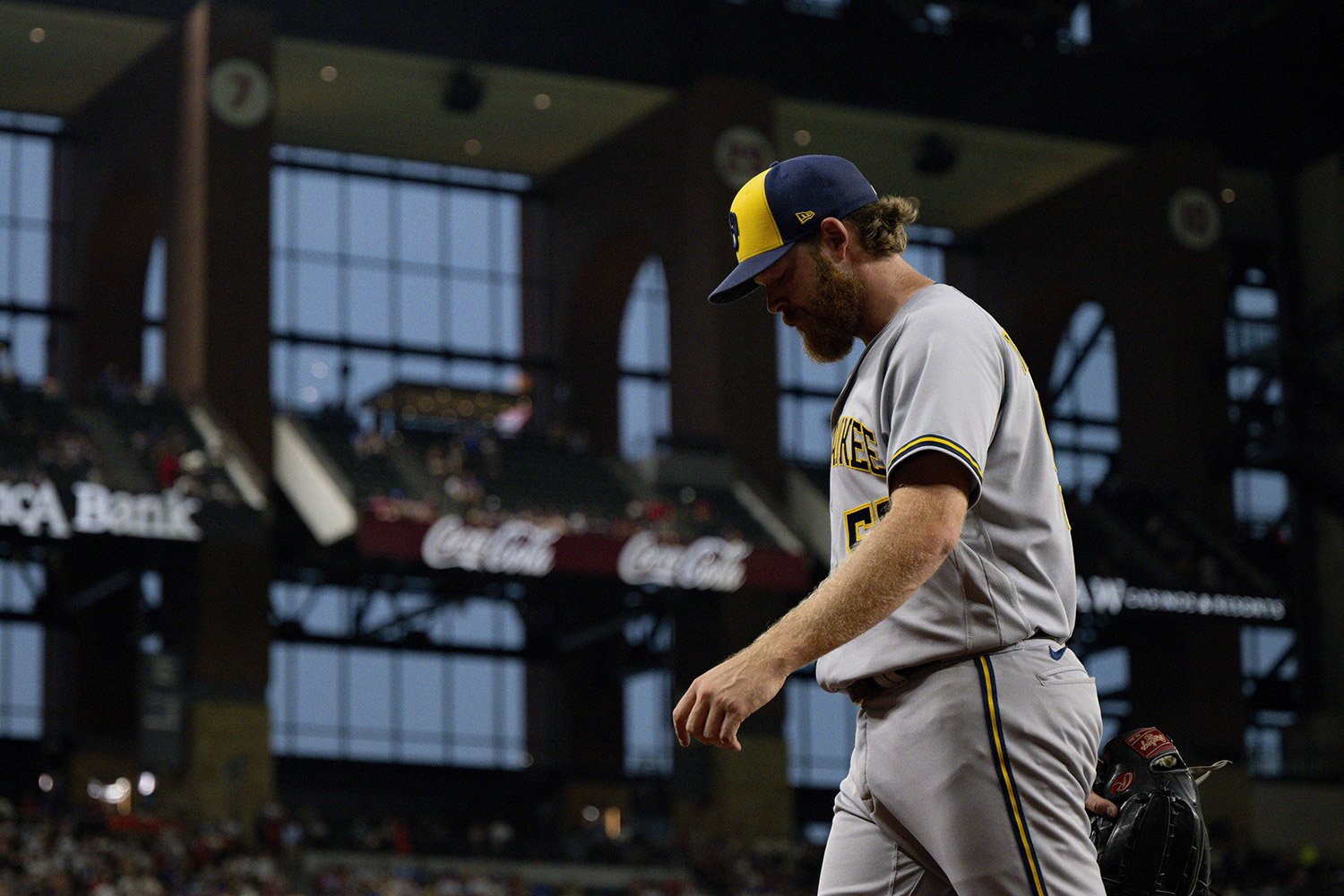
The two-time All-Star is one of the names associated with the modern "golden era" of Brewers baseball. Since his permanent move to the starting rotation in 2019, Woodruff has shown he has the makings of a true number one. However, in early April 2023, Woodruff hit the 15-day injured list with right shoulder inflammation. Later, when transferred to the 60-day injured list, the right-hander didn't return to Brewer's rotation until August. Before the regular season could close, Woodruff was back on the injured list and ruled out for 2024 to undergo an anterior capsular repair in his throwing shoulder. Expecting to be at full strength for the 2025 season, the Brewers are hoping Woodruff can come back and, at a minimum, compete with Freddy Peralta to be the team's one starter. Although capable of being a number one, having one of DL Hall or Aaron Ashby as the fifth starter, the Brewers need to be confident that Woodruff can return to form and solidify the top end of the rotation, given the unproven youth at the bottom. Well, how confident can we be? First, what is a shoulder capsule? And what can we expect from Woodruff returning from a significant shoulder surgery? Let's take a look.
Unlike Tommy John or an MCL repair, an anterior capsular repair is a rare but significant surgery for a pitcher, with few modern examples of players undergoing the operation. Keeping it simple, the capsule of the shoulder provides restraint and stabilization to the shoulder joint while allowing a wide range of motion. In 2007, Oakland Athletics pitcher Rich Harden tore his right shoulder capsule and pitched with the injury for four years until he decided to get it surgically repaired in 2011. Harden avoided surgery because it had and has been a historically difficult injury to return from. A list of pitchers who have had some variation of the surgery includes Dallas Braden, Mark Prior, John Danks, Chien-Ming Wang, and Chris Young, all of whom failed to return to their previous form. After four seasons of a significant velocity drop and other injuries resulting from pitching with an unstable shoulder, Harden believed he could repair his shoulder and return to his pre-capsule tear form. After the year-long rehab process, Harden signed a minor-league deal with the Minnesota Twins but never pitched another major-league inning before his release and retirement in 2013.
In 2010, New York Mets All-Star pitcher Johan Santana tore his anterior capsule. Upon his return to the major leagues in 2012, Santana hadn't lost a step and was looking to end the idea that an anterior capsule injury was challenging to rehab from. By the end of April 2012, Sanata pitched to a 2.25 ERA and finished May with a complete game shutout. The next game, Mets manager Terry Collins let Santana ride out a 134-pitch no-hitter against the St Louis Cardinals. However, Santana's season started falling apart after the no-hit bid, putting together an ERA over eight in his next ten starts. Santana was ruled out for the year by August with another tear in his shoulder capsule.
Santana never pitched again, ending his major league career in 2012. I bring Santana into the equation to say that although historically, returns after a capsular repair are often underwhelming, return to previous form is possible, as seen in the very small sample from Santana. Although his re-injury may be a concern, it had much more to do with volume than vulnerability due to the repair. Even newly crowned manager of the year, Pat Murphy, would be fired if he let one of his guys throw 134 bullets, let alone after major shoulder surgery.
A modern example that bodes well for Woodruff is that of Julio Urias. Before Urias was in the news for, well, you probably know what, he was in the news for his absolute dominance on the mound, making his debut at 19 years of age, a feat you rarely see in today's game. Most of these dominant years came after his anterior capsular repair in 2017. Woodruff and Urias are slightly different pitchers, but we can still draw a few conclusions from his case. During Urias's first entire season back from surgery in 2019, the average velocity on his pitches showed insignificant changes, unlike most historical cases. His fastball increased by two mph, and his secondary pitches fluctuated plus or minus two mph, an excellent sign for Woodruff, who, in his last full year, 2022, had above-average velocity among right-handed pitchers on all of his pitches.
Urias's ability to induce spin remained relatively unharmed by his surgically repaired shoulder, adding around 100 rpm to most of his pitches. Urias had a few trips to the injured list in the following five major league seasons. Still, none were due to problems with his repaired shoulder, indicating that re-injury risk is relatively low and further justifies that Santana's re-injury was a response to his workload. With contrasting results between most historical cases and guys like Santana or Urias, it's hard to say what outcome would be most likely. Studies say the odds of return are high.
A 2024 paper published by the Orthopaedic Journal of Sports Medicine studying returns to sport after arthroscopic capsular repair in elite baseball players sampled 11 unnamed players at different levels, eight of which were major leaguers. Nine of the 11 returned to play at their previous level. One major leaguer returned to professional baseball in Mexico, and the oldest in the sample, at age 34, retired post-surgery. The study doesn't specify statistical outcomes upon return. However, the study stated, "Surveyed players were unanimously pleased with their outcome... They would readily recommend the procedure to a colleague and would have the procedure again if needed in the future." I could be missing the bigger picture, but it seems unlikely that anyone physically unable to throw how they used to would share this opinion.
The study sampled pitchers aged 20-34, with the two unsuccessful cases coming from players above 30. In the case of Urias, age was still on his side, as he was repairing his shoulder at 20 years old. However, Woodruff is facing his age 31 season. Can we be confident that age won't influence his return to play? A 2014 study published by the Journal of Shoulder and Elbow Surgery analyzed capsular repairs in baseball players. The study sampled five unnamed professional baseball players with an average age of 33.5 (ages 31-37) and found that 80% of cases returned to the pre-injury level. It's also worth noting Santana returned from surgery at age 33. Age is a prominent factor in rehab from any surgery, but it's fair to say age will not be a deciding predictor in Woodruff's return to play.
The return-to-play outcomes after anterior capsular repair vary, with historical cases showing mixed results. However, examples like Julio Urías or Johan Santana offer hope for Woodruff's return to form. It's worth noting at no point in the process have the Brewers or Woodruff ever voiced concern in the rehab process, Woodruff going far enough to say, "I'm going [to] be the strongest I'll ever be at any point in my career because I'm going [to] have a year and just basically get my body ready for pitching." History says it can be done, but whether or not the optimism is a front for the media, we will see Woodruff pitch in 2025. As the season gets underway, we will all be closely monitoring Woodruff. If he can combine his established velocity and spin with a successful recovery, he may anchor a rotation capable of making a run in 2025.
Are you optimistic about the Brewers right now?

Follow Brewer Fanatic For Milwaukee Brewers News & Analysis



-
 1
1


Recommended Comments
Create an account or sign in to comment
You need to be a member in order to leave a comment
Create an account
Sign up for a new account in our community. It's easy!
Register a new accountSign in
Already have an account? Sign in here.
Sign In Now