


Brewers Video
With Willy Adames all but guaranteed to depart in free agency, the Brewers need a replacement on the left side of the infield. They can fill that need by moving Joey Ortiz to shortstop and acquiring a third baseman, or they can keep Ortiz at the hot corner and bring in a shortstop.
Having both options does not dramatically expand the number of paths available in free agency, though. The infield market is uninspiring, featuring just seven middle infielders or third basemen worth more than 0.8 fWAR in 2024. Two of them—Adames and Alex Bregman—are likely beyond Milwaukee’s price range.
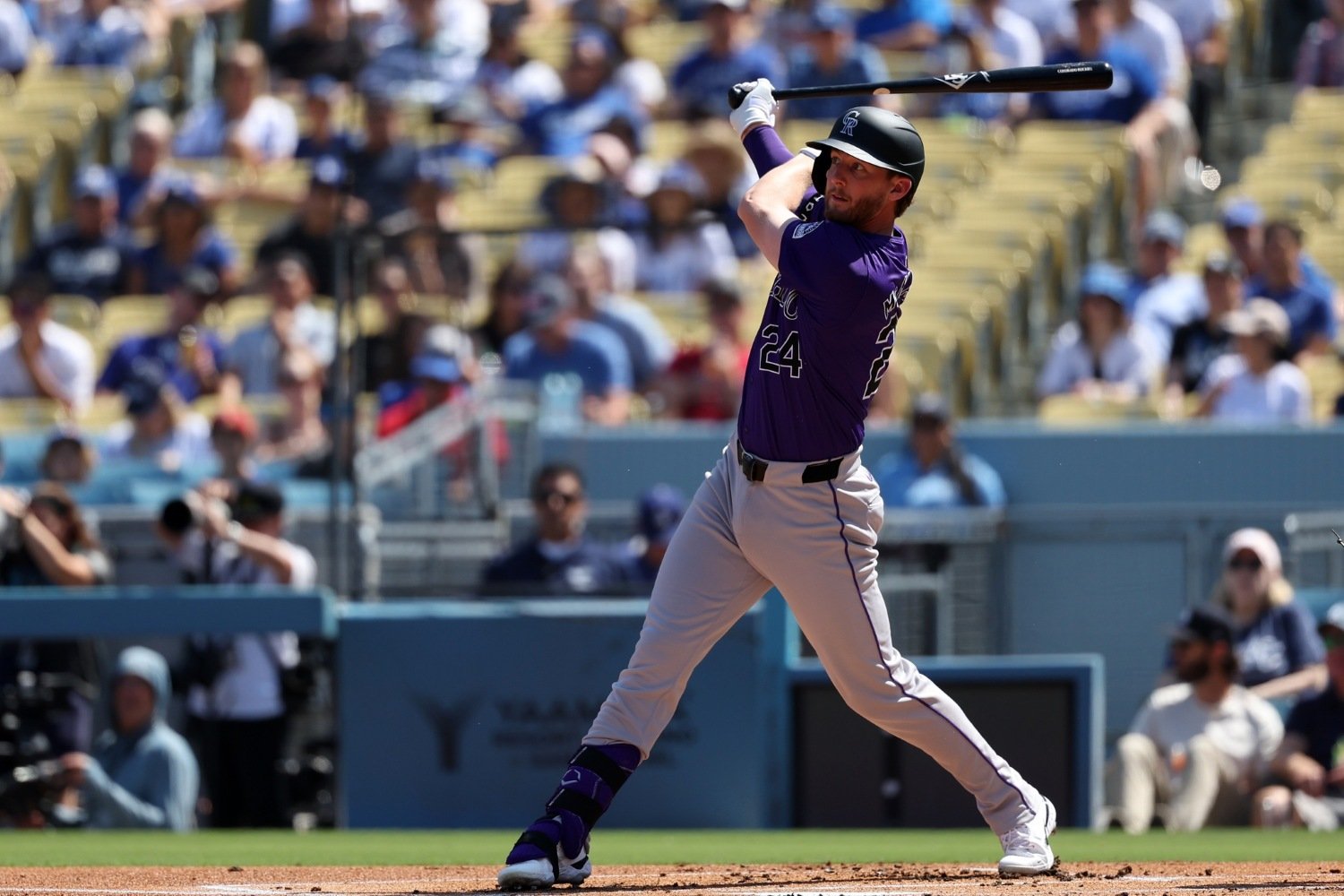
The trade market could feature alternatives. The Colorado Rockies are reportedly cutting payroll over the winter and intend to shop several veteran players. Third baseman Ryan McMahon, who is halfway through a six-year extension he signed before the 2022 season, could be among them.
'Could' is the key word. In recent years, Colorado’s front office has been unwilling to trade players it has deemed essential to the franchise’s identity, even if the prudent move is to flip them for younger talent. McMahon lands firmly within that echelon, and the Rockies already withheld him from the trade block at the July deadline when he was fresh off his first All-Star nod.
Given how unconventionally the club operates, McMahon’s availability is anyone’s guess. If the Rockies put him on the market, though, there’s an obvious fit in Milwaukee, along with a level of upside absent in free agency.
McMahon is an eight-year veteran who has emerged as one of baseball’s best defensive third basemen. Since inheriting the position from Nolan Arenado in 2021, he has more Defensive Runs Saved (DRS) at the hot corner than anyone but Pittsburgh's Ke'Bryan Hayes. His 37 Outs Above Average trail only Hayes and Arenado.
That makes him a perfect fit for a Brewers team that places a premium on defense as part of its run-prevention strategy. Offensively, it’s more challenging to judge whether McMahon is a worthwhile target. His left-handed bat has carried untapped potential for years, but his natural tendencies as a hitter and his health complicate his path to unlocking another gear.
McMahon hits the ball hard. Since the start of 2018, he ranks in the 91st percentile of big-league hitters in hard-hit rate and average exit velocity. The veteran also whiffs frequently, running a career 28.7% strikeout rate. That means he generates loud contact at a great rate per batted ball, but at a middling rate per swing.
Furthermore, how McMahon produces and steers that contact separates him from most left-handed power hitters, and it’s partially why he’s approaching his 30th birthday with an underwhelming career .243/.324/.422 line and 92 DRC+. Many left-handed hitters, particularly those with stronger builds who hit the ball hard, are pull-heavy hitters. They like to turn on pitches over the middle and inner thirds of the plate. Since 2018, lefties have a pull rate 4.4 percentage points higher than righties.
McMahon has a more balanced spray chart, working the opposite field more than the average lefty. His 27.9% opposite field rate ranks in the 88th percentile of left-handed hitters with at least 1,000 plate appearances since the start of 2018. His 39.3% pull rate ranks in the 11th percentile.
Take a look at how McMahon’s directional batted-ball distribution in 2024 differed from that of the average left-handed batter.


Unlike most of his peers, McMahon appears in his comfort zone when going the other way, and he’s done more damage to that area than most. His .643 slugging percentage on opposite-field batted balls ranks 15th in the aforementioned pool of lefties. The average is .491.
That unique profile has a drawback, though: regularly taking the ball the other way instead of pulling it prevents McMahon from fully tapping into his raw power.
One might assume that the solution is recommending he pull more pitches, but it’s more complicated than that. McMahon has not proven capable of consistently pulling the ball in the air. Instead, roughly two-thirds of his pull-side contact has been on the ground, including 71.2% in 2024. Rolling over so frequently has kept McMahon from maximizing his pull-side contact.
| Direction | LA | Exit Velo | Hard Hit% | GB% | LD% | FB% |
| Pull | 0.3 | 89.7 | 43.0% | 66.3% | 20.6% | 12.2% |
| Middle | 11.0 | 93.5 | 55.4% | 43.4% | 27.0% | 28.3% |
| Oppo | 23.2 | 90.1 | 42.7% | 22.1% | 30.7% | 40.0% |
McMahon has ample power to right field. He’s pulled 53 of his 124 career home runs, and his career 1.439 slugging percentage on pulled non-grounders ranks in the 93rd percentile of left-handed hitters during that time. Tapping into that stroke consistently has been the issue.
It appeared McMahon was starting to break out during the first half of the year. He earned an appearance in the Midsummer Classic by hitting .272/.350/.447 with 14 home runs in his first 95 games. However, his strikeout and pull rates remained unchanged from his career averages. His bat cratered in the second half, as he posted a .592 OPS, and the end result was a standard McMahon line: .242/.325/.397 with 20 home runs for a 94 DRC+.
Health played a role in that ugly finish. McMahon claimed he lost 12-15 pounds while battling a virus out of the All-Star break and also played through left knee tendinitis.
While the illness cannot be held against him, McMahon’s balky knees have hampered him throughout the last two years. The recent history of lower-body ailments, the continuing disconnect between his ceiling and batted-ball profile, and his heavy swing-and-miss tendencies are red flags as he exits his 20s.
Therein lies the dilemma the Brewers would face in deciding whether to pursue McMahon. His potential is undeniable, but expecting him to realize that ceiling is a precarious and potentially costly bet. He’s owed $44 million over the next three years, including $16 million annually in 2026 and 2027, and his high valuation within the Colorado front office could mean a steep ask in return for his services. His name has been noticeably absent from the list of candidates the Rockies would shop to dump salary.
McMahon’s elite defense gives him a high floor as a solid starter in his current form, and it’s possible that leaving Coors Field will positively nudge his offense on its own. It would eliminate the challenge of frequently adjusting to differences in pitch flight imparted by the vastly different home and road elevations. DJ LeMahieu and Arenado are recent examples of players who posted career years at age 30 or older after escaping the Coors effect.
Still, McMahon requires more development to fully unlock the skill of pulling the ball in the air. It’s impossible to know, from the outside, whether his failure to make that jump in eight seasons is due to lackluster instruction or McMahon’s own inability to master the right adjustments. Furthermore, his strikeout rate already teeters along territory that can handicap a hitter’s opportunities to do consistent damage. Any loss of bat speed in the next three years could prove catastrophic if it worsens his contact rate and plate discipline.
If he’s available, the Brewers must weigh McMahon’s promise against those concerns. Is acquiring him to man third base for the next three years a smart allocation of resources this winter? There are compelling arguments to be made in either direction.
Which team do you dislike the most in the NL Central?

Follow Brewer Fanatic For Milwaukee Brewers News & Analysis



-
 3
3
-
 1
1



Recommended Comments
Create an account or sign in to comment
You need to be a member in order to leave a comment
Create an account
Sign up for a new account in our community. It's easy!
Register a new accountSign in
Already have an account? Sign in here.
Sign In Now