


Brewers Video
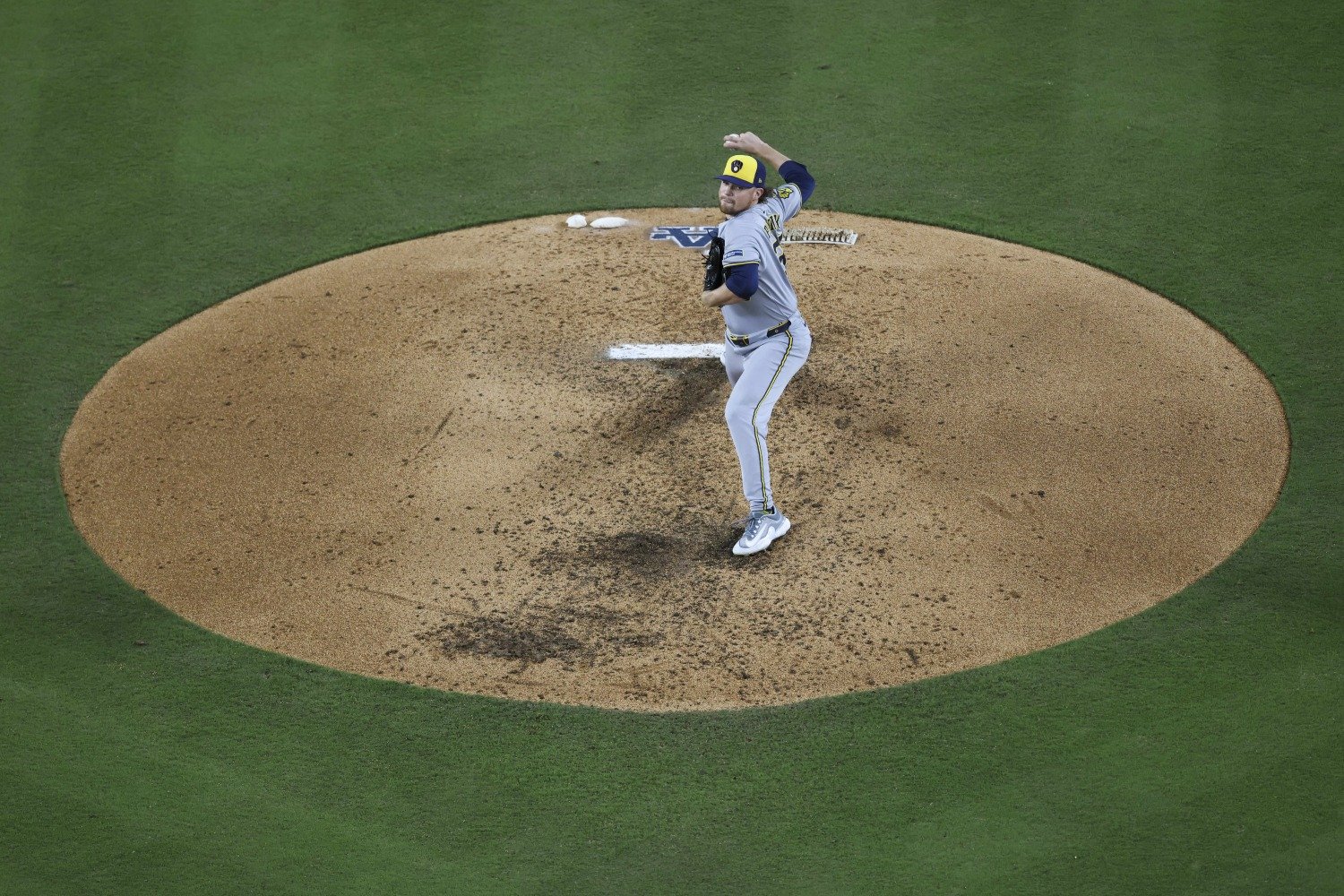
He may not have received much love during baseball’s awards season, but Chad Patrick’s rookie season was among the most productive in baseball. The right-hander filled in admirably for an injury-ravaged Milwaukee rotation during the first half and posted a 3.53 ERA and 3.90 SIERA in 119 ⅔ innings. His 2.6 fWAR tied for second among National League rookies.
Despite that value, the shape of Patrick’s season left him somewhat overlooked. After the Brewers got healthier, he bounced on and off the roster throughout the second half. Even though his fWAR matched those of Caleb Durbin and Isaac Collins, who finished third and fourth in NL Rookie of the Year voting, respectively, Patrick finished seventh.
After serving as an unsung hero during the regular season, Patrick vaulted himself into the national spotlight when he moved to the bullpen for the postseason. His average fastball velocity climbed to nearly 96 mph in shorter spurts, and he allowed just three hits in nine innings, with a 35% strikeout rate.
The Brewers will likely stretch Patrick back out in spring training, and he might be the most intriguing of last season's returning starters. He was second in Stuff+ among regular Brewers starters, trailing only Jacob Misiorowski and finishing ahead of Milwaukee ace (and popular trade target) Freddy Peralta.
- Jacob Misiorowski (119 Stuff+)
- Chad Patrick (105)
- Freddy Peralta (102)
- Quinn Priester (97)
- Brandon Woodruff (96)
Given his perceived shortcomings, seeing Patrick as the runner-up on that list may initially be surprising. For most of the season, the narrative was that his limited arsenal was effective early in games but made him vulnerable as a true starter. When the Brewers optioned him back to Nashville on July 6, 87% of his pitches thrown had been some kind of fastball. Without reliable secondary pitches, he got hit hard as the game progressed. Opponents had a .398 wOBA the third time through the order against Patrick. Left-handed hitters posted an overall .341 wOBA against him.
When the Brewers recalled Patrick for a spot start on August 19, he returned with a new breaking ball that had greater movement separation from his signature cutter. Statcast classifies it as a slurve, but Patrick usually calls it a curveball.

The new pitch worked wonders for him. Including the postseason, opponents managed just three singles in 16 at-bats while whiffing on 45% of swings. During that time, he limited left-handers to a .268 wOBA. The curveball’s 117 Stuff+ was well above average.
There had always been a tradeoff with Patrick’s arsenal: his three distinct fastball shapes made it challenging for hitters to identify which kind of heater they were seeing, but they could almost always gear up for something between 87 and 95 mph, without much drop. According to Baseball Prospectus, his movement and velocity spreads both ranked in the 7th percentile of qualified pitchers.
Averaging nearly 86 mph, Patrick’s curveball didn’t significantly expand his poor velocity spread, but it did fix his movement spread problem. Each of his fastballs averaged at least 11.1 inches of induced vertical break, but the curveball averaged -4.3 inches. Hitters could no longer eliminate a pitch with true downward bite and now had a wider range of movement and location to cover.
Patrick also masked the pitch incredibly well. According to Baseball Prospectus’s tunneling metrics, hitters had only a 12% chance of correctly identifying it as a curveball by the time they needed to decide whether to swing. That was the sixth-lowest probability among pitches thrown at least 25 times during the regular season. Instead, they were 47% likely to misidentify it as a cutter.
Even if those probabilities become less extreme as Patrick throws more curveballs over a larger sample, the pitch should still be plenty deceptive. Given how well the cutter and curveball tunnel off one another, it should come as no surprise that he leaned more on that pairing during his dominant postseason.

While that October excellence generated the most buzz surrounding Patrick’s future, his potential is not tied to the bullpen. His new breaking ball will play in any role, and while those shorter outings gave his velocity an extra nudge, his average four-seamer and two-seamer were already climbing toward 95 mph as a starter.

Patrick isn’t the youngest arm in a deep stable of potential Brewers starters; nor does his arsenal look the flashiest at first glance. But he revealed more upside late last year than he did earlier in the season. His new breaking ball can keep hitters off-balance deeper into games and make him less vulnerable against lefties. Other Brewers might garner more popularity as breakout picks, but Patrick appears as close as any of them to putting it all together. It's time to stop overlooking him.
Which team do you dislike the most in the NL Central?

Follow Brewer Fanatic For Milwaukee Brewers News & Analysis



-
 2
2
-
 2
2


Recommended Comments
Create an account or sign in to comment
You need to be a member in order to leave a comment
Create an account
Sign up for a new account in our community. It's easy!
Register a new accountSign in
Already have an account? Sign in here.
Sign In Now