


Brewers Video
I hew to a few key principles when considering who I think deserves to enter the National Baseball Hall of Fame. It doesn't really matter, of course, because I don't have a vote, but I go through some version of the exercise each year, because I can't evaluate the choices made by the tenured members of the Baseball Writers Association of America without coming to my own conclusions about who should go in and why. Here are my main thoughts about the ballot as it exists these days, in no particular order:
- By and large, I'm a "big Hall" guy. There are, for my money, more important and wonderful players on the outside of Cooperstown looking in than guys who have plaques but didn't exactly merit them. Off-field matters notwithstanding, I tend to err on the side of letting in players who don't check all of some old-fashioned voters' boxes but who brightened the field with their presence over long careers.
- I'll usually favor peak over longevity, but I think some public discourse has run too far in that direction. We ought to value the desire, dedication, and adaptability to stay helpful for more than a decade, even if a player had a truly elite seven- or eight-year peak.
- I'm unwilling to exclude a player for using performance-enhancing drugs. I do discount players' numbers slightly if we know that they used, but the problem was huge and systemic and while each person bears personal responsibility for the choices they made about how to seek competitive edges during that era, I don't feel that using those drugs (or, in Carlos Beltrán's case, being the focal point of the investigation into the Astros' sign-stealing scandal) should keep a deserving player out of the Hall.
- On the other hand, I'm something of a hardliner when it comes to more egregious and (in my opinion) serious failures of character. This is the highest honor that can be conferred on a member of this profession, and it's my feeling that we should deny that honor to people who (most especially) inflict violence on family members, intimate partners, or any other group, especially if they were repeat offenders. That also goes for people who espouse hateful things (no Curt Schilling for me, when he was eligible) and those who drink and drive and don't learn from the egregious, wantonly dangerous misdeed (no Todd Helton for me, either, though I lost that argument).
That should give you some clues as to whose names are about to appear below. Without further ado, here we go.
CC Sabathia
A no-brainer. Sabathia pitched 19 seasons as a workhorse, and not just an innings-eater, but an ace. He was, arguably, the last great pitcher of his kind, a threat to go eight innings every time he toed the rubber. Sabathia made 134 starts in which he went at least 7 1/3, which is not only the fifth-most since 1995, but 22 more than the most by any active hurler. (Justin Verlander sits at 112.) I heartily recommend his memoir, Till The End, which documents not only his career, but his long battle with alcohol dependence. He was larger than life on the mound, a great postseason pitcher, and late in his career, a big enough man to admit that he was hurting a great many people he loved by destroying himself. His journey to sobriety is as inspiring to many as his incredible talent and phenomenal performances.
Ichiro Suzuki
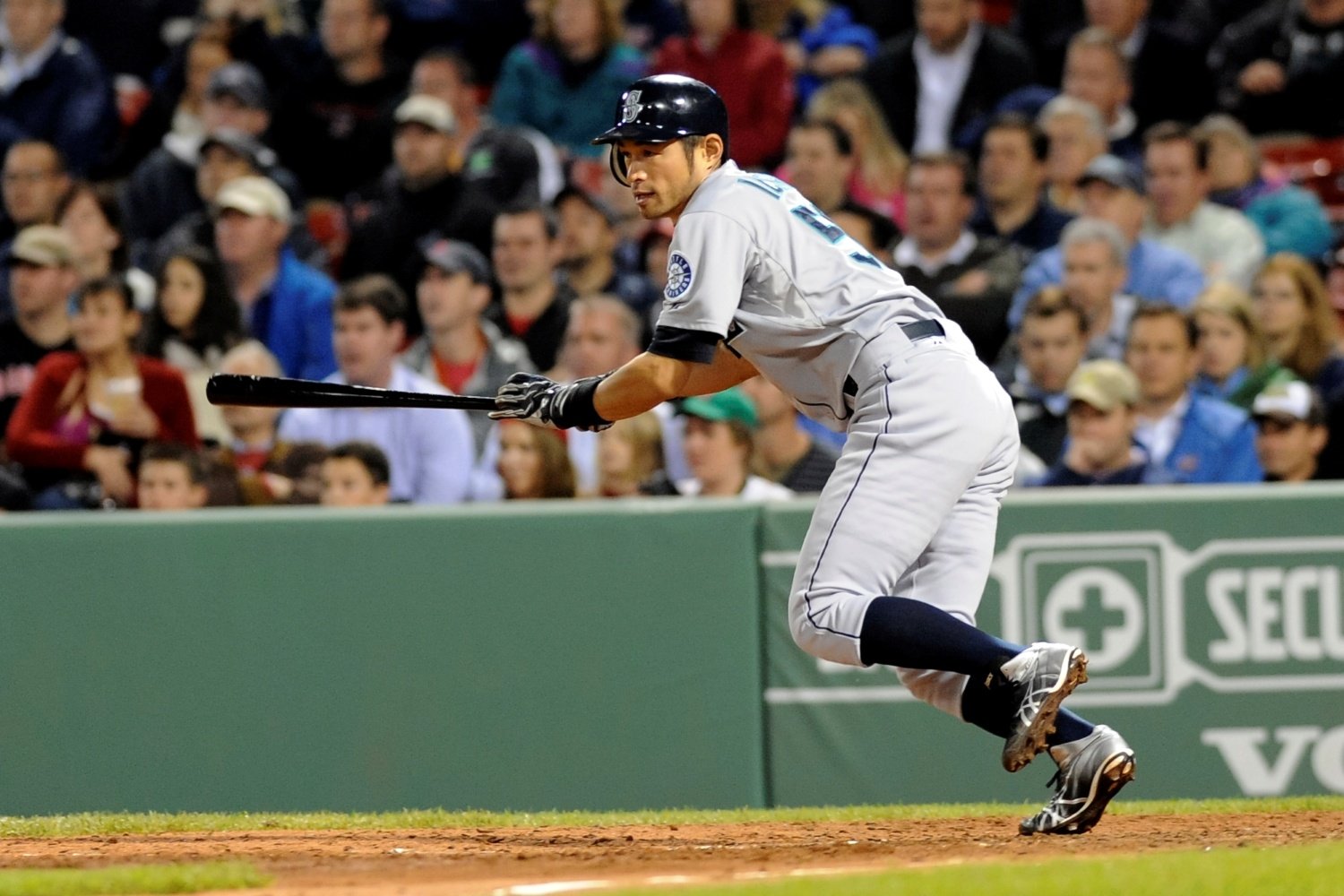
The most singular player in modern baseball history. Suzuki didn't even come to the States until he was 27, which hid some of his greatest brilliance from us, and yet, no one who ever watched him doubted he was a Hall of Famer. His feel for contact—especially the ability to hit the ball deep enough to the left side of the infield to secure a single almost every time, even if the shortstop managed to keep it on the dirt—was breathtaking, and his arm in right field was the most entertaining of his generation. That was true not only because he threw so well, but because he did it with such a whipsaw grace, from a small frame, and because he augmented the utility of his sheer arm strength by charging every single with fluid speed and confidence. He's one of the 25 best baseball players ever, if we widen our lens to remember that his skill set probably peaked during his final few years in Japan. If you've never looked up his NPB numbers, do so. His lowest full-season average there was .342, and he left after batting .387/.460/.539 in 2000.
Alex Rodríguez
Is he truly likable? No. Is he obnoxious on FOX broadcasts now? Yes. Did he use steroids, even after testing went into effect and everyone understood them to be taboo? Absolutely. But unlike (say) Barry Bonds and Roger Clemens, Rodríguez was never accused of being violent or criminally inappropriate toward women, and while he might have had a vague reputation as a self-satisfied jerk off the field, his sins outside the lines are relatively tame. They don't remotely erase the fact that, along with Bonds and Willie Mays and Henry Aaron, Rodríguez has a very strong case as the best player of all time. His pwoer and speed were incredible, but some players could loosely match those tools. What no one ever matched was the way he blended those loud tools with subtle but equally valuable refined skills, from an intelligent and adaptable approach at the plate to clever and dazzling defense.
Carlos Beltrán
I mentally bin Beltrán with Scott Rolen. While they were different in several obvious ways, both were extremely well-rounded—so much so that it was sometimes regrettably easy to overlook their greatest strengths in favor of marveling at their lack of weaknesses. Beltrán's raw numbers are slightly diminished by the mix of parks and league run environments he encountered over the years, and even so, they're gaudy. He was also, throughout his 20s, one of the best defensive center fielders of his generation, which often got lumped in and treated like an afterthought, given the balanced offensive dynamism he offered as a switch-hitter. That he helped engineer the banging scheme in 2017 is a shame, but not a dark enough mark on his record to make me think twice about wanting to see him enter the Hall. He found so many ways to be good late in his career, and was so respected by teammates throughout that career, that I'm more inclined to give him bonus points for baseball character than to strike him from the list for cheating in his senescence.
Félix Hernández
I think that, because he came up so young and was thus in decline by his age-30 season, people remember Hernández's peak as shorter than it really was. From 2009-15, Hernández made six All-Star teams, won a Cy Young Award, finished twice two other times and was in the top 10 for the honor thrice more. He averaged 228 innings and 221 strikeouts per season and had a 2.83 ERA. If those seven years were his whole peak, this would be a thorny conversation. In reality, though, he had come up in the middle of 2005 and had three full, perfectly solid campaigns before really hitting his stride in that 2009 campaign. He also pitched with personality, and was a bit of a throwback: he didn't have to strike you out for you to feel as though you had no chance when he was done with you.
Andy Pettitte
Yes, he used HGH, and yes, I hold that against him—almost more than I do for hitters, because one of the chief challenges for pitchers is to stay healthy and I consider things that artificially reduce that risk an especially egregious sin against the game. Pettitte was an emblem of an era, though. Every October, you'd turn on the TV, and he would be there, with the cap pulled so low over his eyes that his face was just a black abyss behind his glove. He'd be coming off a strong regular season, but there would be questions about him—and then he'd answer them with a resounding performance that helped vault his teams to one World Series after another. Pitchers deserve some extra credit for holding up under the hot lights, and for achieving longevity even when piling up extra innings after lots of their counterparts had gone home each fall.
Chase Utley
Like Beltrán, Utley was a winner, because he did everything well and sought the edge everywhere it could be found. He bordered on dirty, but if the rest of the league were as dedicated to playing the game ferociously as he was, they wouldn't have been in any danger from him. He was ruthless, and he was everywhere. During his peak, he hit for average, drew walks, stole bases more efficiently than anyone else in baseball, and played better defense at second base than anyone else in baseball. The thing people overlooked too often, because he tended to hit more doubles than homers, was his power. He averaged 27 homers and 67 total extra-base hits per year from 2005-10, and he also perfected the art of being hit by pitches. The second half of his career was underwhelming, but he should have won two MVPs (which, in a testament to him, went to teammtes instead) before that decline began.
Billy Wagner
I love the story of Wagner breaking his right arm playing hat football when he was a kid, and thus becoming an accidental lefty. It speaks not only to his resourcefulness, but to his passion for the sport; he couldn't be without baseball long enough to let an injury heal all the way. He just switched arms and kept hucking it.
You'd like to see more volume, even from a reliever, to put them in. Yet, Wagner had more strikeouts than either Trevor Hoffman or Mariano Rivera, even though they had roughly 180 and 350 more career innings than he did, respectively. You'd like to see a better postseason track record, too. But the fact is that Wagner struck out 33.2% of opposing batters for his career, which would be an elite rate for a single season even now—and that was at a time when the baseline for strikeouts was about 20% lower than it is now. When he came in to close out a game against your team, you knew he was a Hall of Famer.
Russell Martin
For me, this is not as controversial as some have made it. Martin was a unique athlete who could have stuck on the infield if he'd insisted upon it, but instead, he made himself a great catcher—one of the best defenders at the most important non-pitching position on the field, in an era full of great defensive catchers. That so much of his value comes from pitch framing inevitably dings him for many, but I love framing and believe its value is real and should be acknowledged. Martin also brought a modicum of power and unusual speed to the position, and you didn't have to make the big tradeoffs that so many catchers force their teams to make. He was well-rounded, an average-plus hitter and a terrific run preventer, as well as a beloved teammate whose teams were a truly wild 212 games over .500 when he started during his career. In 11 different seasons, his team was at least 11 games to the good.
Ben Zobrist
This one, admittedly, is a fringy case. I'd like to see Zobrist stick around on the ballot, as much as I'd like to see him actually inducted. He's the guy who probably did have too short a career to make a compelling Hall case, but from 2009-16, he defined an evolving role for the whole league, playing all over the diamond (and being above-average at each spot) and hitting .271/.366/.439, despite a lot of those seasons being fallow ones for offense throughout the league. I also give him some extra credit for being instrumental in two straight World Series runs by teams he was on, the 2015 Royals and the 2016 Cubs.
Excluded here, but worth a quick mention, are the following:
- Bobby Abreu makes a very strong case, and once Beltrán gets in, I think it will be easier to fairly judge him and for some voters to find room for him on their ballots.
- Andruw Jones, Manny Ramírez, Francisco Rodríguez, and Omar Vizquel were not considered, as I consider all of them to have been disqualifyingly violent and/or cruel away from the field.
- Dustin Pedroia is very close to Utley as a candidate, and probably could have gotten his slot. I'll certainly be taking another close look at him next year.
- Brian McCann is a similar candidate to Martin, but I want to advocate Martin first.
- David Wright and Troy Tulowitzki were clearly Hall of Fame talents. I'm not yet sure I can get them over the line, based on how truncated by injuries their careers were, but they're legitimate candidates.
There's my ballot. It's imperfect; all ballots are. It was fun to put it together, though, and I'd love to hear what you think of it, as well as whom you would support.





Recommended Comments
Create an account or sign in to comment
You need to be a member in order to leave a comment
Create an account
Sign up for a new account in our community. It's easy!
Register a new accountSign in
Already have an account? Sign in here.
Sign In Now