


Brewers Video
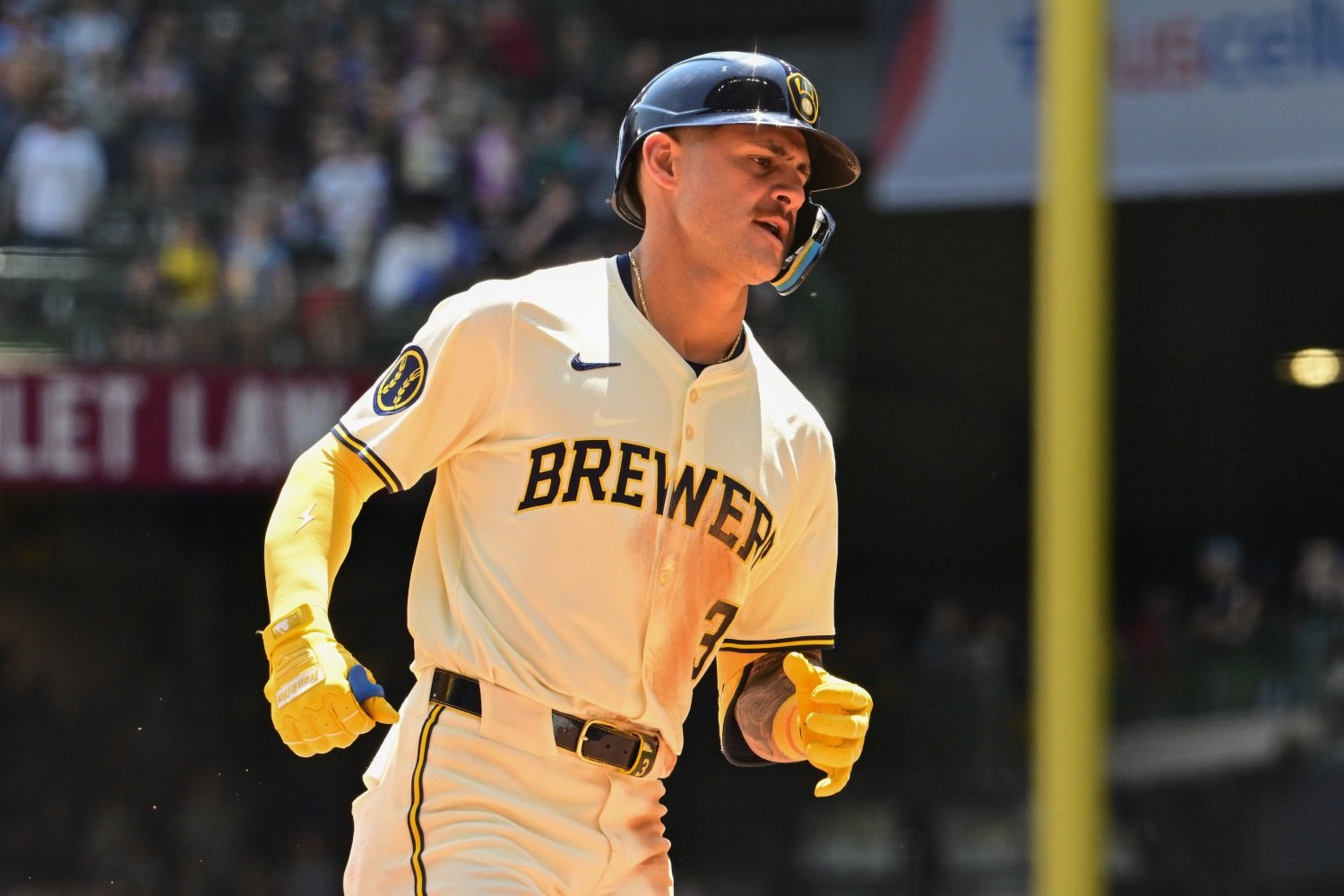
A few weeks into the 2024 season, Joey Ortiz had pretty surface-level numbers, but some troubling sub-surface indices. Over the last few, though, he's exploded, taking over the third-base job for what could be the next half-decade or more.
It's not as though outright failure was forcing an adjustment. When Joey Ortiz got to the ballpark on Apr. 24, he had a slash line of .279/.392/.349 to his name. In his first 51 plate appearances as a Milwaukee Brewer, he was walking 15.7 percent of the time and only striking out 15.7 percent of the time. In that sense, things were good.
Ortiz and the coaching staff maintained a growth mindset, though, and the area of potential growth was glaringly obvious: Ortiz wasn't generating any serious quality of contact. He wasn't hitting the ball hard, and when he did, he wasn't getting any air under it. Even in a spring when the ball seems a bit deadened and offense has been down, an ISO of .070 is very low--almost disqualifying, in terms of ever hitting in the top half of a competitive lineup.
Since then, everything has changed. Ortiz has traded a little bit of contact for more power, but it's worked like a charm. He's batting .275/.377/.647 since April 24. How? Let's break it down, using the suite of stats I introduced in a piece about Rhys Hoskins earlier this season.
| Span | Low/Med/High Hit % | Sweet Spot Exit Vel. | Well-Hit Launch Angle | wSSEV | Swing Speed |
| Through 4/23 | 42.9/31.4/25.7 | 79.6 | 1.6 | 66.7 | 73.6 |
| Since 4/24 | 27.5/37.5/35.0 | 96.2 | 12.5 | 83.9 | 75.3 |
(For newcomers, to keep it brief: Low Hit balls have a launch angle under 2 degrees. Medium Hit balls are between 2 and 25. High Hit balls are at 25 degrees or higher. Sweet spot exit velocity (SSEV) is the average exit velocity on balls with a launch angle between 10 and 35 degrees, and well-hit launch angle (WHLA) is the average angle on any ball with an exit velocity of 95 MPH or more. Weighted SSEV (wSSEV) accounts both for the authority with which balls in that launch angle band are hit, and the frequency with which a hitter produces such batted balls. Compared to average exit velocity or Barrel rate, wSSEV is a better indicator and predictor of total production.)
Ortiz was dead last (275th of 275) in wSSEV through Apr. 23. His mark since then is still below-average (166th of 227), but the difference is huge. With good bat-to-ball skills and plate discipline, he's more than viable if he can sustain this caliber of contact on balls with a little bit of air underneath them. He got there by making an adjustment geared toward more bat speed, and now that Statcast publicly offers bat-tracking data, we can show just how stark a difference it made when he embraced that change.

As you can see, the change wasn't gradual or steady. It was huge and sudden. Ortiz re-engineered his swing, and (literally) BOOM: he took off.
This change shows up even on video. He hasn't dramatically altered his setup or the shape of his swing, but the rhythm of his movements has changed. Here's a swing that yielded typical contact (at the time) for Ortiz, from early in the season.
Note the rhythmic but slightly slow load phase, and the way Ortiz's weight drifts forward before his swing really gets up to speed. Now, compare that swing to this one, on a similar pitch during the Brewers' recent visit to Kansas City.
Again, the essential characteristics of the swing are the same, but everything is more on time, and Ortiz's weight stays back a bit longer, letting the bat gain more speed through the contact point. This has been his habit for the last three weeks or so, now, but it took a while to get there.
This is a minor adjustment, rather than a mechanical overhaul. It's as much about his growing confidence--about learning what to look for, and where, and when, and believing in the scouting reports and your ability to execute them--as it is about the actual movements. Hitting is timing. That said, even an effort just to be moving sooner and swing with more conviction can now translate into tangible improvements, which we can quantify all the way down to the level of raw movements.
Ortiz will have more adjustment periods. He's not a finished product and newly established offensive superstar. He is, however, showing why the Brewers were right to believe in him enough to make him a centerpiece of the Corbin Burnes trade. He's figured out how to unleash his best swing more often against big-league pitching, and he's emerging as a player who can hit in the middle third of the Brewers batting order even as they pursue a deep run into October. It's fun to be able to capture that as granularly as we now can.
Do you approve of the job the Brewers' front office is doing?

Follow Brewer Fanatic For Milwaukee Brewers News & Analysis



-
 2
2


Recommended Comments
Create an account or sign in to comment
You need to be a member in order to leave a comment
Create an account
Sign up for a new account in our community. It's easy!
Register a new accountSign in
Already have an account? Sign in here.
Sign In Now