


Brewers Video
This is, in a way, the inverse of Betteridge's Law of Headlines. Call it Axford's axiom, or Turnbow's razor: Always be worried about relievers. Never fully trust them. That's the job of managers and pitching coaches, and the fact that managers and pitching coaches have no choice but to trust relievers is why most of them get fired every few years. Your favorite hitter's slump is probably half in your head, and half the normal thing, and they'll probably be great again in a week. Your favorite reliever is a ticking time bomb; his swoon is probably a very real problem.
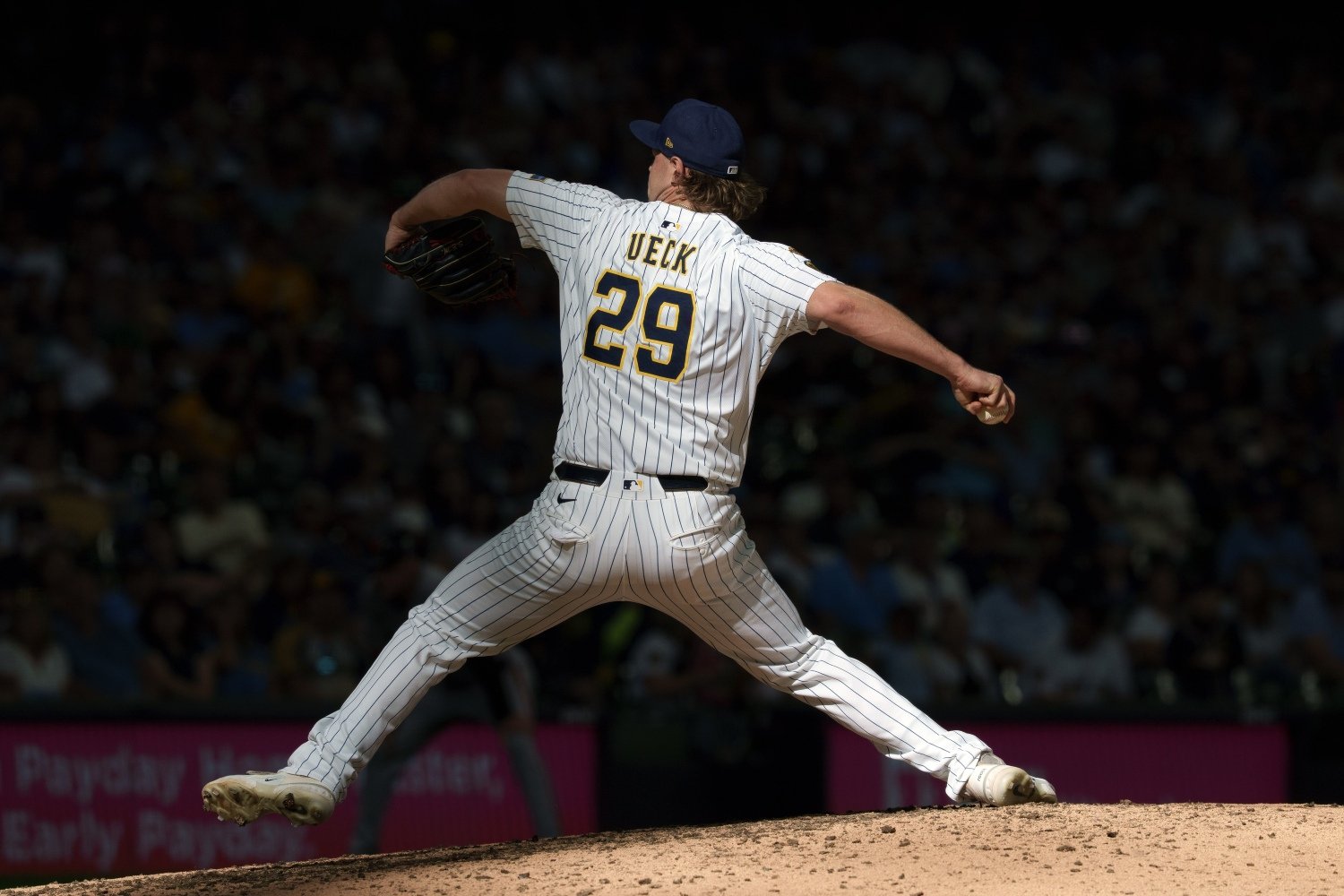
But let's not paint with too broad a brush, here, and also, let's not treat Trevor Megill like he's just any other reliever. After all, the Brewers have shown a certain knack for not only finding elite relievers, but keeping them great for an unusually long time. Josh Hader didn't flash in the pan for a year and then fizzle. Neither did Devin Williams. Each of those ex-Crew relief aces have found misfortune this summer, but each first had a multi-year run as a dominant hurler for Milwaukee. Megill has some of the characteristics they each had: a funky delivery, and overwhelming strikeout stuff.
Even this month, Megill has fanned 13 of his 39 opposing batters. He's only walked two, and he's only allowed one home run. His ERA is 4.00, which is hardly catastrophic. So, on the other hand, maybe we're fretting over nothing. Yes, Megill blew two saves against the Giants at The Ueck this weekend, and yes, he let a lead slip away the previous weekend in Cincinnati. That latter blip came in extra innings, though, when Megill only had a one-run lead and the Reds got to start the inning with a runner at second base. Even if we also look askance at the game he saved against the Mets on August 9, when it took a brilliant throw to the plate by Blake Perkins and a fine tag by William Contreras to cut down the tying run, things don't look all that awful.
Pretty quickly, perhaps, the truth of this thing is coming into focus: Yes, there's something real going on here. No, it doesn't mean that Megill is done being a reliable closer. His faltering performance this month is worth watching, and even worrying over, because he'll be entrusted with more slim leads against good teams come October. On the other hand, it's not a sign that he's no longer a dominant pitcher. He can be that, and more. It might just require a bit of a breather.
The season is a grind. Every team has players who wear down, and teams who go on historically great runs like the one the Brewers have over the last six weeks tend to have their high-leverage relievers cluster in that camp. It's not a matter of mismanagement; it's just the cost of being great.
Some pitchers can operate fine when appearing on consecutive days semi-regularly. Megill, however, wears down if used that much. His huge frame and his high-effort, high-velocity delivery require lots of maintenance. Last year, he appeared on zero oe one days' rest a total of 20 times. This year, that number is already 25. He's appeared on zero days of rest five times since the All-Star break, alone, and another three times on a single day. The problem isn't even his performances in those specific games, though; it's the way the accretion of them taxes his overall readiness for all games.
Dedicated to his craft and aware of the mixed blessing of his huge dimensions, Megill knows his body. He can find his way to his usual velocity, and even to his usual movement numbers. He knows them; he thinks about them; he trains and prepares and works to sustain them. So, when things go wrong for Megill, it's because he's compromising in other places to get to what he can control—to be the best version of himself possible, even when he's not at his best. So, this month, his spin rate is down slightly. He can whip his body up into enough of a lather to move everything as fast and as powerfully as usual, but he can't fake the feel and the touch that comes with doing so comfortably.
Because his rising four-seamer and his snapdrgon power curve both depend on excellent spin efficiency to generate movement, that reduction in sheer spin has also meant a bit less movement this month.
.jpeg.0b595e1cf5ead48c87e07ae3770cbe55.jpeg)
That's a significant difference; it can make a difference in whether or not his curve earns a whiff, or in whether or not his heater stays above the barrel. It's not a calamity, though. This is still a pitcher who should be able to succeed. Has something else wobbled?
Yes. Here's where Megill's fastballs ended up, from Opening Day through the end of July.

If you've watched Megill over his two years (parts of three seasons) in Milwaukee, you know that his heater plays superbly at the top of the zone—but that he's also capable of steering it downhill, flat and hot and deceptive, to grab the bottom rail, around the knees. His ability to change eye levels even with the heat is part of why his curve is more devastating than those of many other pitchers who rely on this pair of offerings.
Here's where those fastballs have been in August.

A little tired, and perhaps a hair short on the calm focus and confidence that relievers have at their freshest, Megill is trying to do his usual thing—but he's often finding either that he can't drive the ball downhill enough, or that the spin-based relative lift he had a few months ago is missing. Vertically, he's gone from filling up the whole zone to living in the Danger Zone, around waist-high. Even at 100 miles per hour, hitters can square you up in the middle of the zone. Megill has been there more this month, because of his heavy use and the attendant decline in his sheer stuff.
There was little Pat Murphy could have done to prevent or mitigate this. It's part-and-parcel with the role Megill took on after Williams was traded last December—a role Megill was eager to take. Being a closer means taking the ball to shut it down when your team has a lead to protect and just a few outs to get. It's not the hardest job in the majors, but it comes with some very real burdens. Megill isn't especially well-suited to them. That's ok. He's a great reliever, and a good fit for the demands of the job within any given game. We're seeing the physical grind of the gig catch up to him a bit this month, but as long as the team continues to have breathing room and can ease off the gas in the second half of September, Megill should be ready to slam the door again come the postseason.
Do you approve of the job the Brewers' front office is doing?

Follow Brewer Fanatic For Milwaukee Brewers News & Analysis



-
 2
2



Recommended Comments
Create an account or sign in to comment
You need to be a member in order to leave a comment
Create an account
Sign up for a new account in our community. It's easy!
Register a new accountSign in
Already have an account? Sign in here.
Sign In Now