


Brewers Video
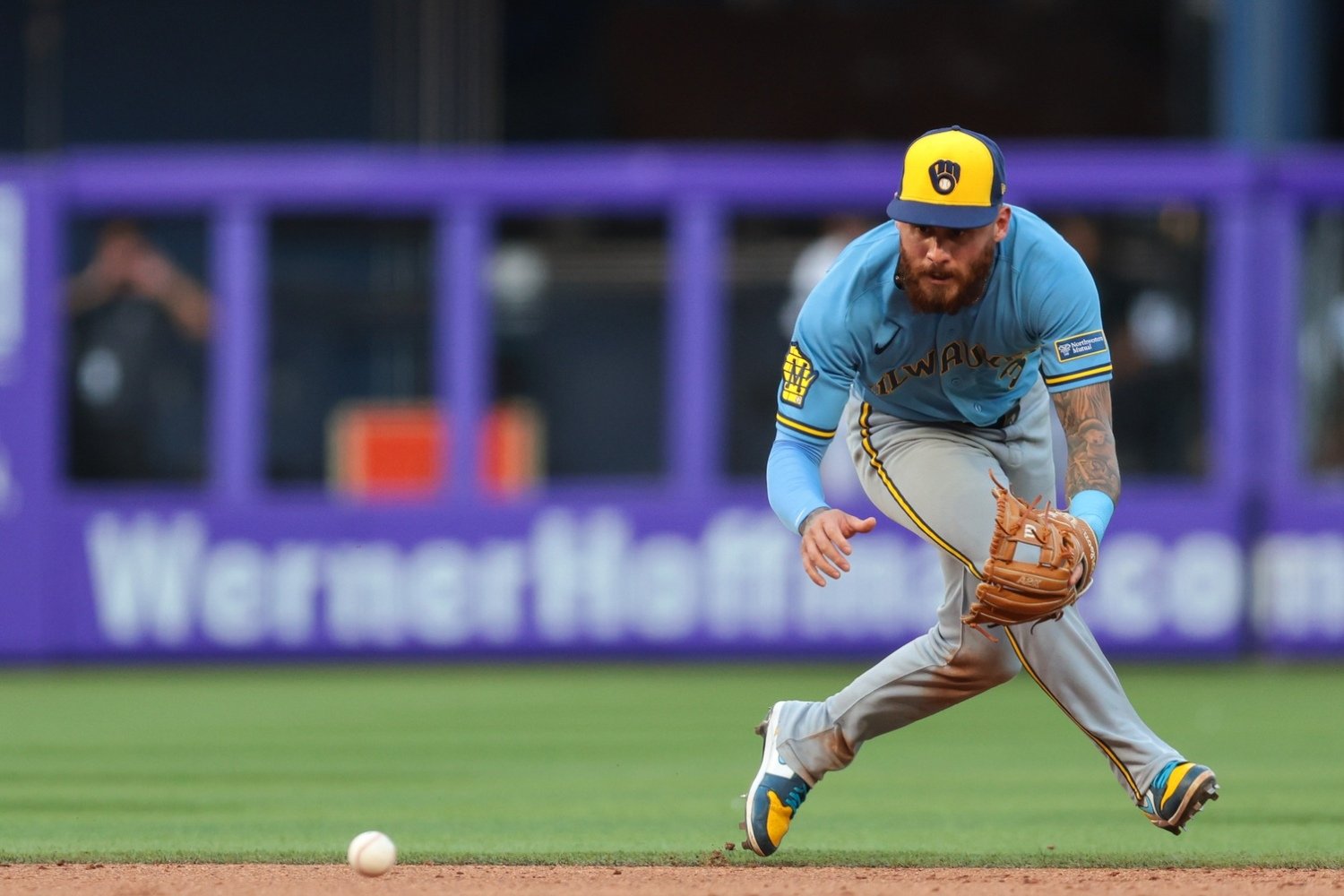
Admittedly, Joey Ortiz hasn't gotten a perfect set of chances in the majors. He was blocked when he was first ready for the big leagues, during his final season with the Orioles organization. He was displaced for a year after being traded to the Brewers, when he slid to third base to play alongside Willy Adames. He's hit at the bottom of the batting order most of the time over the last year-plus, where you often get one fewer plate appearance than players at the top of the card; see the starting pitcher one fewer time; and hit with fewer runners on base in front of you. He's battled a few nagging injuries. Since the start of last August, during which time teammate Brice Turang has over 350 plate appearances across all competitions, Ortiz has just 165.
Unfortunately, it's impossible to justify giving him more than that. In fact, he probably ought to have fewer. Ortiz is batting .200/.255/.227 since Aug. 1, 2025, including regular-season, playoff and World Baseball Classic games. He hit one home run during Cactus League play this spring, but that's the only one he's hit since the second game after last year's All-Star break, at any level. Ortiz is, fundamentally, broken.
Hitters go through phases during which their timing is badly off, or when the ball doesn't carry for them or during which line drives always seem to find gloves. This is something different, and worse. Ortiz is simply overmatched, in a way no other hitter in the league is.
To understand how true this is, you first need to know the following:
- Ortiz has a relatively flat swing. His swing path tilt has slightly increased in each year of his career, from 27° in 2024 to 29° this season, but the league averages between 32° and 33°.
- The flatter your swing is, the more important it is for you to catch the ball out in front of your body. Steeper swings can hit the ball sharply even deep in the hitting zone, but a flat one can only produce a ball with a good chance to be a hit (or any chance to be an extra-base hit) if the batter's intercept point—the place where the bat and the ball meet, or would have met, in the case of a whiff—is at least 27 inches in front of a hitter's center of mass. The league's average intercept point is closer to 31 inches in front of the body, and again, a flat swing usually does better in that range or slightly farther in front. Some steep swings can work with a contact point in the mid-20s, but the lower your tilt, the farther out front you must catch the ball to be productive.
Ortiz has always let the ball travel pretty deep. Often accused of being passive at the plate, he's trying to be selective and to see the ball well before making a swing decision—but therefore, he lives life on the edge of being late to the hitting zone. He runs one of the lowest attack angles in the league, even when going well, which means that he barely gets through the process of slashing his bat down into the hitting zone before meeting the pitch; he's not working upward with the barrel nearly as much as most hitters are.
Since the start of the second half last year, though, this has all gone to an extreme at which having success as a big-league batter is no longer possible. Ortiz's average intercept point, relative to his center of mass, has receded month by month:
- April 2025: 29.4 in.
- May 2025: 31.2
- June 2025: 28.7
- July 2025: 29.6
- August 2025: 28.8
- September 2025: 26.5
- April 2026: 23.7
The ball is, as they say, in Ortiz's kitchen. He's no waterbug, but no one is strong enough to hit the ball hard—especially to the areas of the field where that can pay off best—when catching it that deep. Looking at the intercept point relative to his stance (and relative to the same visual for last year) illustrates the problem tidily:
.png.b0a10c85dbdf76557bfd6e4a1cf5a535.png)
He's tried opening his stride, as the ball gets on top of him, to square his barrel to the pitch earlier in his swing and fight it off. As the numbers tell you, it's not working. Few hitters in the league have an average intercept point deeper than the front edge of home plate, where Ortiz was even last year. No one else in the league has one 9 inches past the front edge, as Ortiz has so far this season. The second-deepest intercept point in the league belongs to the Rays' Chandler Simpson, the slap-hitting super-speedster. Simpson's sheer speed allows him to survive with an intercept point 6.8 inches past the front edge of the plate, but hitting for power is out of the question for him. Right now, it's out of the question for Ortiz, too, even though the Brewers shortstop has about three scouting grades of bat speed on the Tampa outfielder.
Simpson offers a good següe to the obvious alternative to Ortiz at shortstop, though, and therein lies (arguably) a dilemma. David Hamilton isn't hitting much better than Ortiz this season—just .178/.339/.178—but the fundamentals of his profile are much stronger. He needs to make some significant adjustments, and he doesn't have Ortiz's bat speed, either, but he can drive the ball a bit and has made much better swing decisions than Ortiz has. His own intercept point is dangerously close to being too deep, but he has a much steeper swing than Ortiz's, and if he wants to create more space to catch the ball out front, he has a simple means of doing so: get deeper in the batter's box.
.png.d1ae73965f68f6863e4884e15d5442a1.png)
As ugly as the batting average is (and despite the lack of an extra-base hit by either player), there's no question that Hamilton is a better hitter than Ortiz, right now. The question, instead, is whether the Brewers will ever feel comfortable eschewing Ortiz's defensive brilliance in favor of the upside Hamilton provides in the batter's box. That question is complicated, and its answer might simply be 'no'.
Pat Murphy and the Brewers coaching staff trust Ortiz at shortstop to a unique degree. They like everything about the way he plays the position, including the ways he's improved since coming to the club. He's sure-handed and smart, in addition to having a quick first step and plus range. He makes all the plays a team can ask a shortstop to make, and he never seems to make a glaring mistake.
Hamilton is more spectacular, but less consistent. He has better range than Ortiz, and perhaps a stronger arm. He's creative, and his ceiling at the position might be higher. However, there are occasions on which he speeds up too much in the effort to make a play, leading to bobbles or outright drops of playable grounders. Rushing that way can also lead to bad throws, which are compound errors: they nearly always give a runner an extra base.
With the game on the line, the Brewers absolutely (and rightly) trust Ortiz more than they trust Hamilton at short, even though the latter is a better athlete and can make a wider array of plays. So far this year, the magnitude of Ortiz's brokenness at bat has led to Hamilton getting six of the 21 starts at shortstop, but for that raio to flip—for the lefty-batting Hamilton to take on the majority of the playing time at the position—one of a few things will have to change. More stability from third baseman Luis Rengifo would nudge things in that direction; it would mean the team needs Hamilton at third base less. More of Hamilton's offensive skills translating to results would create more momentum for a change, too.
Most of all, though, the team needs to see Hamilton make the routine play routinely, even in non-routine moments. If his steadiness with the glove catches up to Ortiz's, he'll become the starting shortstop immediately (if briefly; Cooper Pratt, Jesus Made and more are on the way). For now, though, Ortiz remains a part of the team's daily plans, despite his utter inability to muster any offense. Hamilton needs things to break his way, but he also has a chance to make his own breaks, by slowing down ever so slightly in the field.
Do you approve of Brewers' ownership?

Follow Brewer Fanatic For Milwaukee Brewers News & Analysis



-
 1
1



Recommended Comments
Create an account or sign in to comment
You need to be a member in order to leave a comment
Create an account
Sign up for a new account in our community. It's easy!
Register a new accountSign in
Already have an account? Sign in here.
Sign In Now