


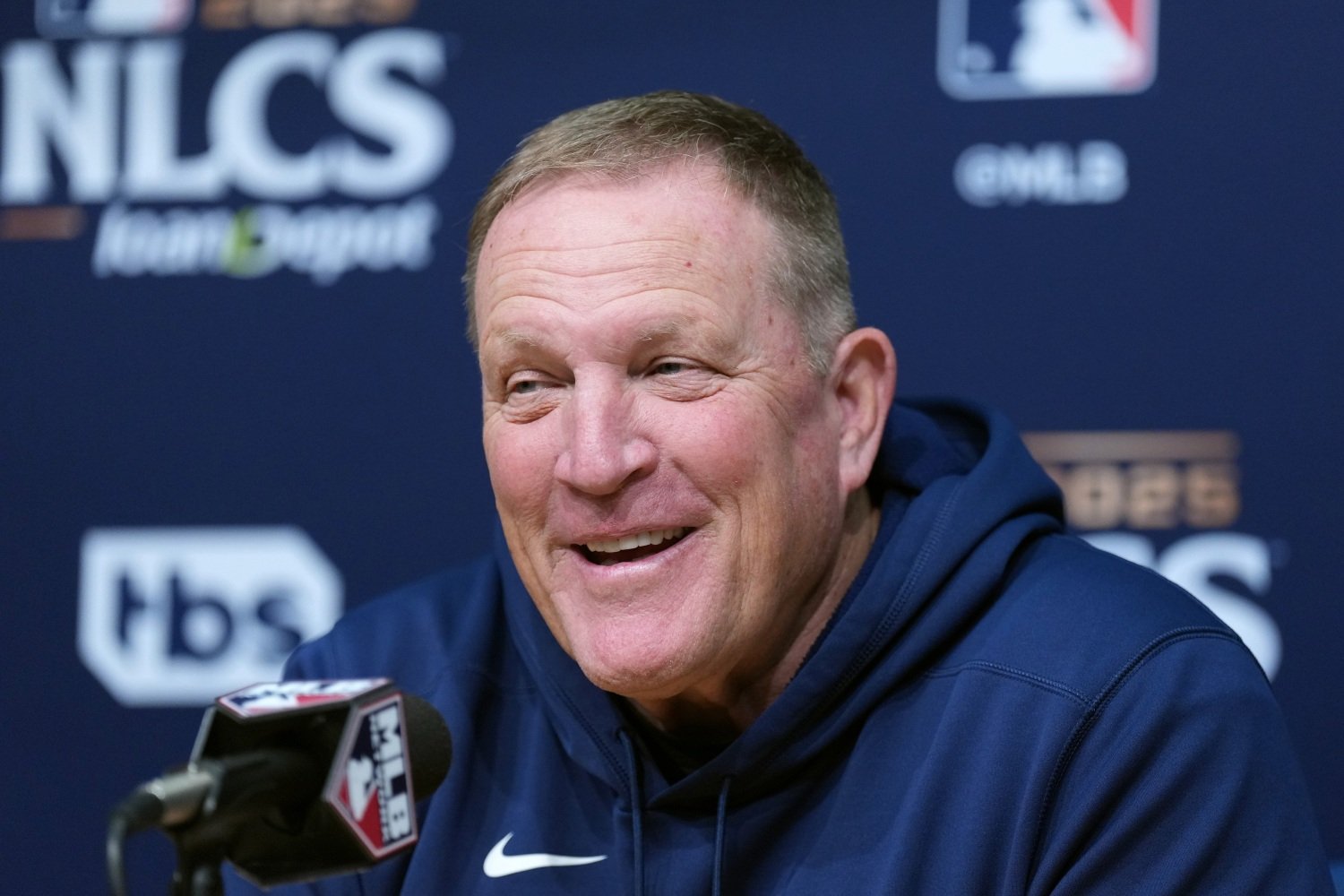
Image courtesy of © Kirby Lee-Imagn Images
Brewers Video
After a few days to decompress from the Milwaukee Brewers’ four-game disposal in the NLCS, there are still a few questions to explore before turning the page.
Did Pat Murphy’s incessant praise of the Los Angeles Dodgers and consistent dismissal of his own team become too much for some players to overcome?
Those who followed the Brewers all season know that Murphy played the underdog card all season, even as Milwaukee shot up the standings. He definitely gave tons of praise to his players throughout the year, too, talking about their resiliency, their unique talents, and how they all come together to win as a team, rather than having a bunch of individual stars. Based on preseason expectations and the eventual results, it seemed to work well.
Those who followed the Brewers all season know that Murphy played the underdog card all season, even as Milwaukee shot up the standings. He definitely gave tons of praise to his players throughout the year, too, talking about their resiliency, their unique talents, and how they all come together to win as a team, rather than having a bunch of individual stars. Based on preseason expectations and the eventual results, it seemed to work well.
But after knocking off the Chicago Cubs in the NLDS and jumping right into media conversations ahead of the Brewers’ date with the Dodgers, the messaging from Murphy began to feel over-the-top. On the American Family Field turf following NLDS Game 5, Murphy was already saying, “I don’t know how many of our guys would make their team...”
Of course, he did continue by saying, “...but it ain’t about that. It’s about how we come together as a team to compete.” Well, good cover, but that was an extremely strong statement that might have hit some Brewers in the gut a bit. Some of the other pointed comments by Murphy included:
- "I’m sure most Dodger players can’t name eight guys on our roster."
- "They’re probably better at almost every position than us."
- "We don’t have the big-name payroll, we don’t have the big-name stars, although some are becoming recognizable."
- "Snell makes more money than our entire pitching staff, and it’s for good reason."
Even if every word was true, that doesn’t mean your players want to hear it from their leader—especially on the brink of the World Series. At that point, does it even matter? You can say professional athletes shouldn’t be affected by comments like these, but they’re still human. Most had never been in this moment, and everyone understood the mountain ahead.
Their manager essentially framed the Dodgers as a team they were lucky just to compete against—a star-studded powerhouse almost beyond reach. Maybe the mindset that worked across 162 games had the opposite effect when everything was on the line. In baseball, the mental game is enormous. Just because you can’t quantify it doesn’t mean it isn’t real.
Why didn’t the Brewers try to bunt for any hits with such a struggling offense?
When you finish the NLCS with a .118 batting average and an 8 wRC+ (EIGHT!), you have to question bashing your head against the wall and doing (more or less) the same thing all series. The Brewers led MLB in bunt hits during the regular season, and that could have been a viable weapon against a group of pitchers who were shutting down the Brewers’ offense.
When you finish the NLCS with a .118 batting average and an 8 wRC+ (EIGHT!), you have to question bashing your head against the wall and doing (more or less) the same thing all series. The Brewers led MLB in bunt hits during the regular season, and that could have been a viable weapon against a group of pitchers who were shutting down the Brewers’ offense.
If Hall of Famer Paul Molitor, a career .306 hitter over 21 seasons with 3,319 career hits (11th all time), would drop down bunts when he was scuffling at the dish, certainly a bunch of “Average Joes” can do it with a chance to reach the World Series. While Andrew Vaughn was one of the egregiously poor hitters in the NLCS (0-for-12), he can be excused thanks to his lack of speed. The other four culprits don’t really have an alibi.
Christian Yelich, Brice Turang, Sal Frelick and Joey Ortiz combined to go 3-for-49 (.061) in the NLCS, a stunning lack of production. Yet, to my recollection, not one attempted a bunt for hit. Sure, some guys would “show” bunt at the start of an at-bat, but those weren’t real attempts. Teams don’t see it as much as they used to, and certainly don’t practice the various locations players can drop bunts down, so the opportunities were there. Admittedly, the Dodgers infield played great defense throughout the set, but Milwaukee could have put more pressure on them.
No one is claiming bunt singles would have flipped the entire series, but maybe you steal a game and change the trajectory. Even a failed bunt attempt can serve a purpose. For some hitters, it helps reset their timing by forcing them to track the ball to the bat. With runners on, it forces movement and increases the odds of a defensive mistake. Simply showing the threat of a bunt can alter defensive positioning, potentially opening up a hole later.
That’s why refusing to even attempt a bunt during a historically awful offensive stretch feels like a glaring missed opportunity. If you’re truly using every tool at your disposal to keep your season alive, why leave a proven one untouched as everything slips away?
That’s why refusing to even attempt a bunt during a historically awful offensive stretch feels like a glaring missed opportunity. If you’re truly using every tool at your disposal to keep your season alive, why leave a proven one untouched as everything slips away?
Did the Brewers’ pitching plans create a net positive or negative in the NLCS?
There’s no doubt that Murphy and his staff were trying to squeeze every ounce of leverage they could out of their pitchers and maximize matchups to handle the Dodgers’ potent lineup. Some people loathe the use of openers, though there are times they make complete sense, especially in a postseason series where every pitch feels like the one that could crush your hopes.
There’s no doubt that Murphy and his staff were trying to squeeze every ounce of leverage they could out of their pitchers and maximize matchups to handle the Dodgers’ potent lineup. Some people loathe the use of openers, though there are times they make complete sense, especially in a postseason series where every pitch feels like the one that could crush your hopes.
In the short term, which is all we can go by since the series ended in four games, the special gambit paid off. Looking at the big picture, the Brewers’ pitching staff held Los Angeles to two and three runs in a pair of games, and then five runs in the other pair. That’s strong work against a lineup loaded with proven All-Star and Hall-of-Fame talent. Ironically, the two traditional starts pitchers made (by Freddy Peralta and Jose Quintana) came in the two games that yielded the most runs. Both Peralta and Quintana gave up three runs in their starts, though the latter only lasted two frames in Game 4.
For the most part, the horde of relievers did their jobs to keep Milwaukee in each game. Unfortunately, the offense never took advantage. Jacob Misiorowski was phenomenal, and some might still question if he should have started Game 3 instead of following opener Aaron Ashby, who was pitching for the fifth time in eight days. Ashby gave up a run two batters into the contest and pitched only one-third of an inning.
For the most part, the horde of relievers did their jobs to keep Milwaukee in each game. Unfortunately, the offense never took advantage. Jacob Misiorowski was phenomenal, and some might still question if he should have started Game 3 instead of following opener Aaron Ashby, who was pitching for the fifth time in eight days. Ashby gave up a run two batters into the contest and pitched only one-third of an inning.
Had the NLCS reached Game 5 or 6, the bullpen usage and non-traditional starts might have further caught up with the Brewers’ hurlers. Abner Uribe already looked to be on fumes, and Chad Patrick (who was dominant in the NLDS) showed a few more signs of being human in the NLCS. The early decisions might also have limited the Brewers' options throughout each game to adjust to certain matchups and situations. Either way, it would have been nice to see how it would have all played out.
The Brandon Woodruff injury threw things off, and Quinn Priester’s shakiness added to the need to use openers and bullpen days. No one is blaming the pitching for the team getting swept, but if the Brewers reach the postseason again next season, relying on starting pitchers more often could make the difference—not that anyone has the perfect formula in October.
Which team do you dislike the most in the NL Central?

Follow Brewer Fanatic For Milwaukee Brewers News & Analysis



-
 2
2


Recommended Comments
Create an account or sign in to comment
You need to be a member in order to leave a comment
Create an account
Sign up for a new account in our community. It's easy!
Register a new accountSign in
Already have an account? Sign in here.
Sign In Now