


Brewers Video
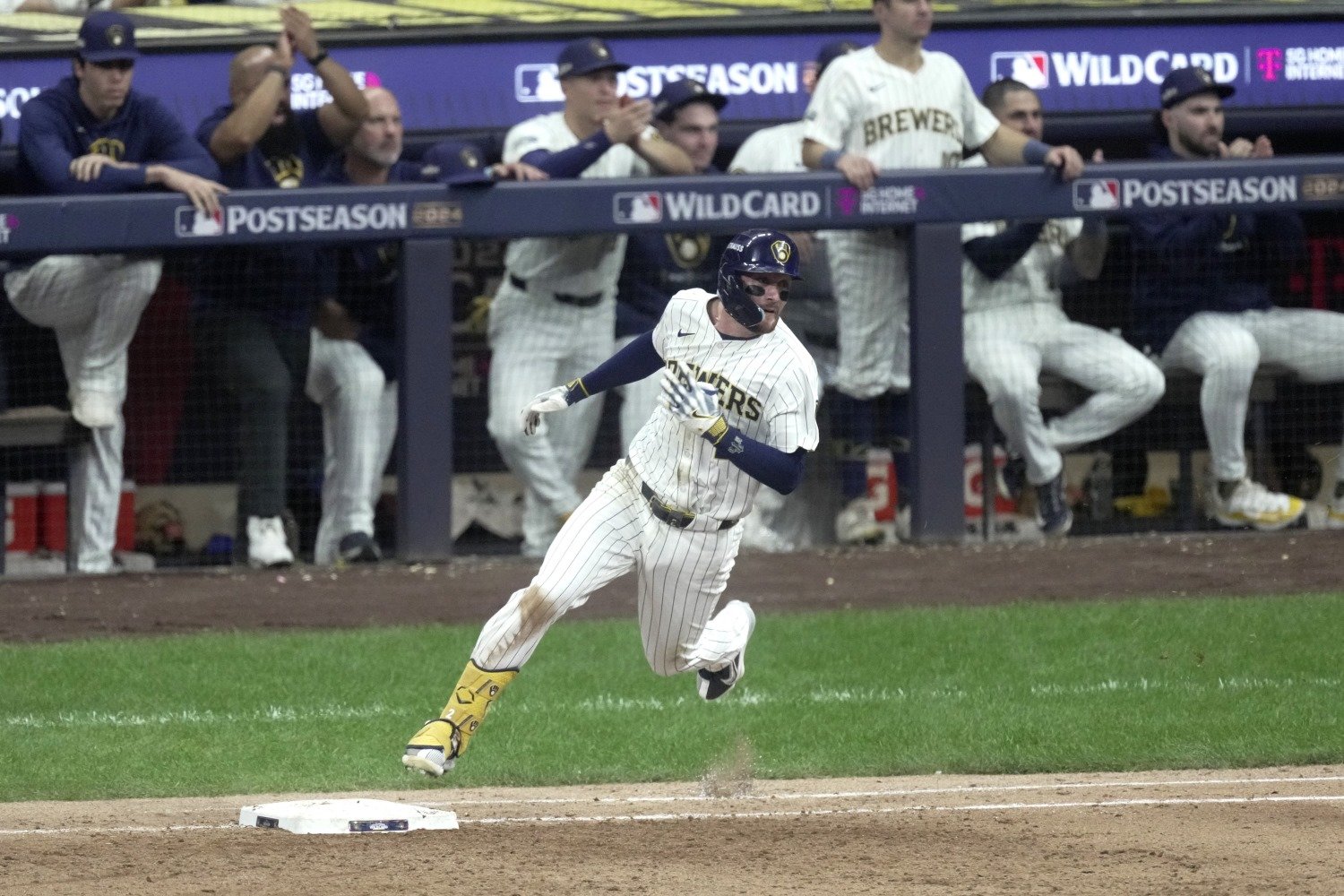
The Brewers' second baseman made strides at the plate in 2024—enough to establish himself as one of the best at the position. Yet, a challenging second half was a reminder to keep expectations around his bat tempered.
When Pat Murphy declared in spring training that he expected Brice Turang to take a “quantum leap” in his sophomore season, the prediction was followed by instructions for the assembled media in his office.
“If he doesn’t, I want you to say, ‘Murph, you said he’s going to make a quantum leap. What the hell?’ I’ll say I was wrong because I don’t mind saying that. But I believe in this kid in a huge way.”
Murphy’s words looked prophetic, on the surface, for most of the season’s first half. Through Jul. 4, Turang hit .291/.352/.415 in his 341 plate appearances, good for a 115 wRC+. His bat then cratered the rest of the way, with a .209/.272/.269 line and 53 wRC+ that resembled his anemic rookie campaign. Turang finished his second big-league season as a well-below-average hitter, slashing .254/.316/.349 for an 87 wRC+.
Despite the disappointing finish, that was still a massive improvement over the previous year’s 61 wRC+. It afforded Turang’s true strengths as a player the runway to shine. His bat was capable enough to keep him in the field for more than 1,200 innings at second base, where he led baseball with 22 Defensive Runs Saved. With an improved on-base percentage, he stole 50 bases and finished sixth in baserunning runs above average (7.2), according to FanGraphs.
According to Baseball-Reference’s version of the metric, which uses DRS for its defensive valuation, Turang accrued 4.6 wins above replacement. That trailed only William Contreras among Brewers position players, and only Ketel Marte among qualified second basemen. It also ranked 26th among all players, regardless of position.
To revisit Murphy’s prediction, gaining 80 points of OPS and becoming one of the best second basemen in the sport could reasonably be defined as a quantum leap. Still, the Jekyll-and-Hyde nature of Turang’s two half-seasons calls into question how much he truly grew as a hitter and whether he has more room to develop.
The starting point is reviewing the discernible changes to Turang’s stance, swing, and approach from 2023 to 2024. He switched bats, simplified his pre-pitch load, and made his swing one of the shortest in baseball. Everything was geared toward reducing strikeouts and harmless flyouts, with Turang hitting more line drives and ground balls to reach base more frequently.
That’s the best approach for Turang, who still has a wiry build after adding 20 pounds of muscle last winter and is unlikely to succeed in attempts to hit for power. However, it also comes with limitations. Turang was pushing those limits with his early-season output, and regression outside his control wears significant responsibility for his second-half downturn.
| Date | wOBA | xwOBA | BABIP | Exit Velo | LA | Hard Hit | Chase% | Contact% |
| Thru 7/4 | .335 | .298 | .339 | 86.2 | 4.3 | 32.7% | 24.7% | 87.2% |
| From 7/5 | .243 | .278 | .254 | 83.6 | 3.6 | 26.1% | 31.2% | 85.2% |
Expected wOBA is derived from expected outcomes, based on a player’s quality and quantity of contact, among other variables. It’s neither predictive nor a perfect metric for evaluating a player’s deserved results, but it often provides a more useful snapshot than box score outcomes.
Turang outperformed his xwOBA by 37 points through Jul. 4 and underperformed it by 35 points the rest of the way. His wOBA fell by 92 points, but his xwOBA only declined by 20 points. That’s still a noticeable drop, but it would not be nearly as magnified by the average viewer throughout a 162-game season.
Based mainly on the kind of batted balls he was hitting, Turang was experiencing plenty of favorable luck throughout the season’s first three months. His performance worsened as the year went along, but much of the shift was due to his luck flipping—to the point that it evened out by season’s end. He ended the year with a .294 wOBA that nearly matched his .289 xwOBA.
Compounding the reversed luck were worse swings. Turang has never been one to hit the ball hard often, and his quality of contact fell even further down the stretch. His swing decisions flipped from strong to poor.
| Date | wOBA | xwOBA | Exit Velo | Contact% | Chase% |
| Thru 7/4 | .306 | .264 | 87.2 | 83.9% | 19.3% |
| From 7/5 | .216 | .231 | 83.4 | 79.3% | 32.9% |
A complete collapse against breaking pitches was the main culprit.
Turang made remarkable strides against fastballs this year, slashing his whiff rate nearly in half from 2023 to 2024 while improving from a .283 to a .330 xwOBA. It seemed, on the surface, that he had acclimated to breaking pitches in the early months of the year, but a .264 xwOBA pointed to it being a mirage. It also helped that he saw plenty of breakers over the middle of the plate, which yielded much of his early damage. Neither the mistake pitches nor the damage lasted.

From Jul. 5 onward, right-handed pitchers attacked Turang with more spin to better locations, and with more elevated fastballs on the inner third of the plate.


The results were ugly. Over the season’s final three months, Turang often flailed at spin regardless of location, and while his compact bat path usually meant he still made contact, it was rarely productive. He became particularly vulnerable to inside breakers from right-handers and outside ones from left-handers.

Perhaps trying to protect against more velocity at the top of the zone made it more difficult for Turang to cover the breaking ball. Perhaps he was worn down a bit by the grind. Whatever the cause, it became one of the catalysts behind his dropoff.
Turang made some mechanical adjustments in the season’s final weeks. Starting on Sept. 12, he lowered his hands to hold his bat more upright and stood a little less crouched in the box. Those tweaks did not produce noticeable results in a small sample, but they make Turang’s setup something to watch when he reports to spring training in 2025.

Turang nearly tripled his WAR from 2023 to 2024. By that measure, he took a quantum leap. His development at the plate, mainly consisting of an altered approach that helped him hold his own against fastballs, was closer to a lunge, albeit in the right direction. Turang still struggles mightily with anything soft and does not drive the ball often, leaving him well shy of being a reliably league-average bat. His final slash line is a solid indicator of his standing as a hitter and where he’s most likely to settle offensively as his career progresses.
The good news remains that an OPS within the .660 to .680 range is all Turang needs to be a key cog in Milwaukee’s young core. As someone who brings elite contributions in the field and on the bases, the floor of his overall value is high. The total package is a player who can be a quality second baseman for years to come. It’s just best to keep expectations tempered toward the bat.
Do you approve of the job the Brewers' front office is doing?

Follow Brewer Fanatic For Milwaukee Brewers News & Analysis



-
 2
2


Recommended Comments
Create an account or sign in to comment
You need to be a member in order to leave a comment
Create an account
Sign up for a new account in our community. It's easy!
Register a new accountSign in
Already have an account? Sign in here.
Sign In Now