


Brewers Video
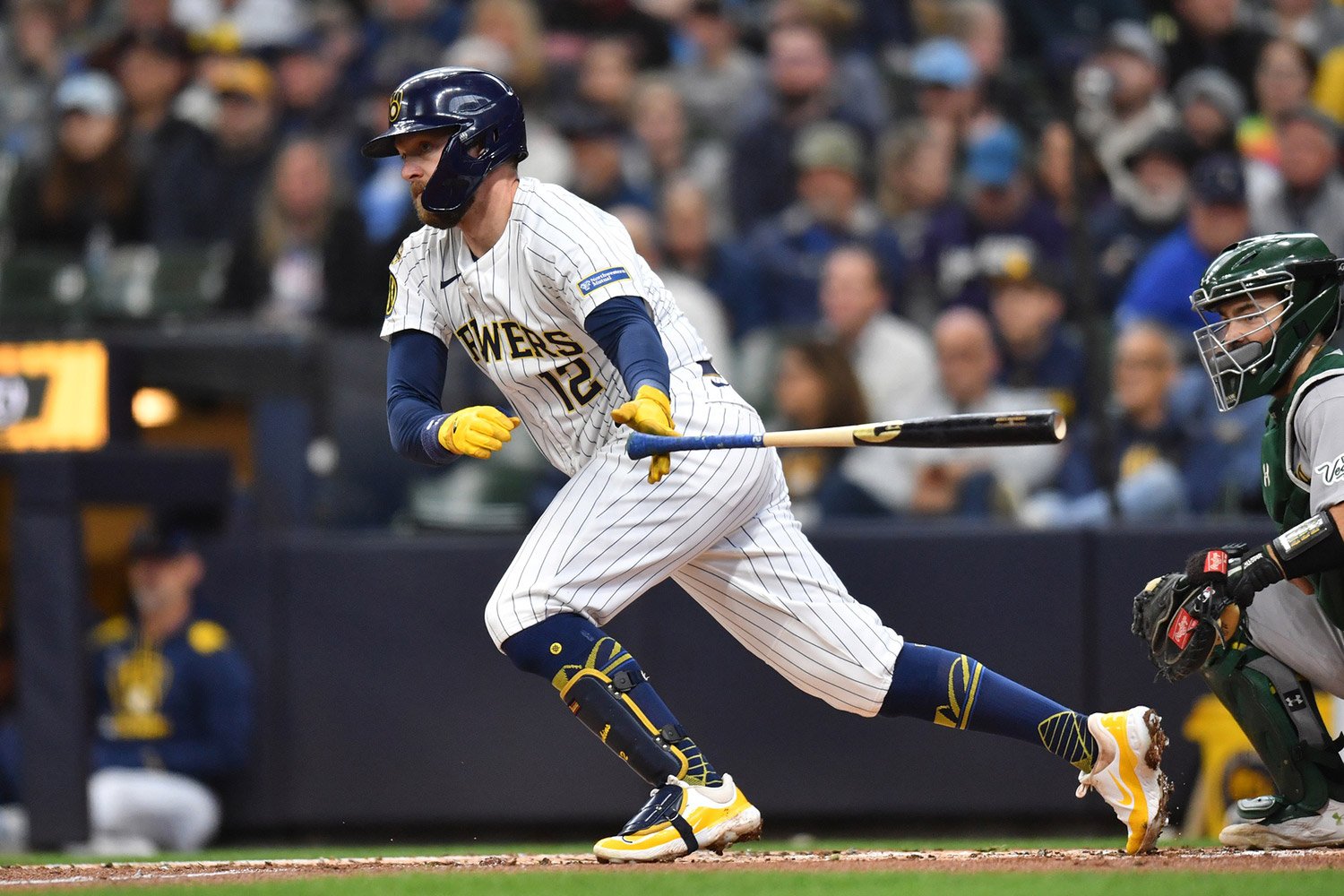
Rhys Hoskins is finally producing when it matters. The early-season hype is now translating into real production, and by almost every traditional metric, he's having his best season since 2022. The power is coming back, he's getting on base at a great clip, and he's giving Milwaukee the middle-of-the-order presence they hoped for when signing him in 2024. But if you open his Baseball Savant page, his percentile rankings paint a different picture.
Compare Hoskins's early 2025 results to his 2024 campaign, and the improvement is clear: he's walking more, striking out less, hitting for a higher average, and getting on base more often. While his slugging is still climbing after the team's poor three-game start in March, his April slug is already 20 points higher than his 2022 season total—and he was plenty good that year, his last before the ACL tear that altered his career early in 2023. By any traditional offensive metric, he looks like the same person bashing homers in Citizens Bank Park just three years ago.
However, not all the underlying numbers support the topline ones. Of the 11 Statcast batting metrics consistently recorded since 2022, Hoskins's 2025 percentile rankings have improved in only 4: expected batting average (xBA), launch angle sweet-spot percentage, whiff rate, and strikeout rate. Some of his other metrics are nearly at his 2022 benchmarks, but several key indicators are still down, both in percentile ranking and raw value. So what's going on?
The League Is Getting Better, But That Is Only Part of It
There is no denying that big-league hitters are improving. Development labs, mechanical optimization, and better strength and conditioning programs have raised the floor across the league. In short, the crowd is catching up. Broadly, we see young players supplanting older ones faster than ever. However, that's only part of the equation. Two other factors are essential to explain what is happening: first, the gap between "average" and "elite" is now razor-thin. Second, there is a difference between traditional stats and Statcast data.
In today's game, a hitter can add a couple of hard-hit balls, increase their average exit velocity by a tick, and still drop in percentile rankings. Why? Because the distribution of talent has become more condensed. The difference between the 60th percentile and the 85th might come down to five or six swings over a month. The elite tier hasn't necessarily become unreachable; it's more crowded, less forgiving, and more competitive than ever. With so many players capable of quality hitting, slight differences can significantly impact percentile rankings.
Take average exit velocity, for example. As the leaderboard stands today, the difference between the 60th and 80th percentiles is 1.4 mph, with single percentile values being differentiated by as little as 0.1 mph. Walk rates, especially, tell a similar story. Even though Hoskins improved his walk rate from 2022, his percentile ranking dropped from the 80th percentile to the 69th percentile. In the early portion of the 2025 season, the league average walk rate is 3.39 per game, the highest mark in a full 162-game season since 2009. And for players like Hoskins, that means you can be performing well, even improving, and still not see that reflected in the bright red circles of a Savant page. To put the shift in further context, Hoskins' 72nd percentile 90.1 mph average exit velocity in 2022 would land him in the 53rd percentile today, barely above league average.
The Results Are There, Even If Statcast Isn't Sold Yet
Rhys Hoskins is doing many of the same things he did in 2022. The traditional metrics look great, and from a raw numbers standpoint, the statcast profile is slowly starting to look familiar again. But even with clear improvements from last year, the underlying figures remain lower than three seasons ago. These aren't glaring red flags, especially considering where he was in 2024. But still, in today's league, even if Hoskins can replicate his 2022 season from a numbers standpoint, the savant page will look considerably more blue.
And that leads us to the final question: What matters more, the process or the results?
Traditional stats, such as BA, OBP, and WRC+, tell us what happened. Statcast tries to tell us why it happened and whether it's sustainable.
Hoskins' surface-level numbers suggest he's producing like it's 2022 again. But the underlying metrics indicate he's doing it with weaker contact, fewer frequent barrels, and reduced contact quality.
We're still dealing with a small sample one month into the season. There's time for things to shift. Maybe Hoskins' Statcast profile will catch up to the box scores, but more likely, the slugging won't stay at 2022 levels, given the dip in barrel rate and exit velocity. While hovering around league average, his expected weighted on-base average isn't as high as expected from a top middle-of-the-order bat. Compared to last year, though, his 73rd-percentile Batting run value represents a clear upgrade for Milwaukee. While the early results may be louder than the underlying process suggests, this isn't entirely a fluke. But if these trends continue, Hoskins' profile might not reach its full potential, and the Brewers could face more regression than they'd hoped.
Are you optimistic about the Brewers right now?

Follow Brewer Fanatic For Milwaukee Brewers News & Analysis



-
 1
1


Recommended Comments
Create an account or sign in to comment
You need to be a member in order to leave a comment
Create an account
Sign up for a new account in our community. It's easy!
Register a new accountSign in
Already have an account? Sign in here.
Sign In Now