


Brewers Video
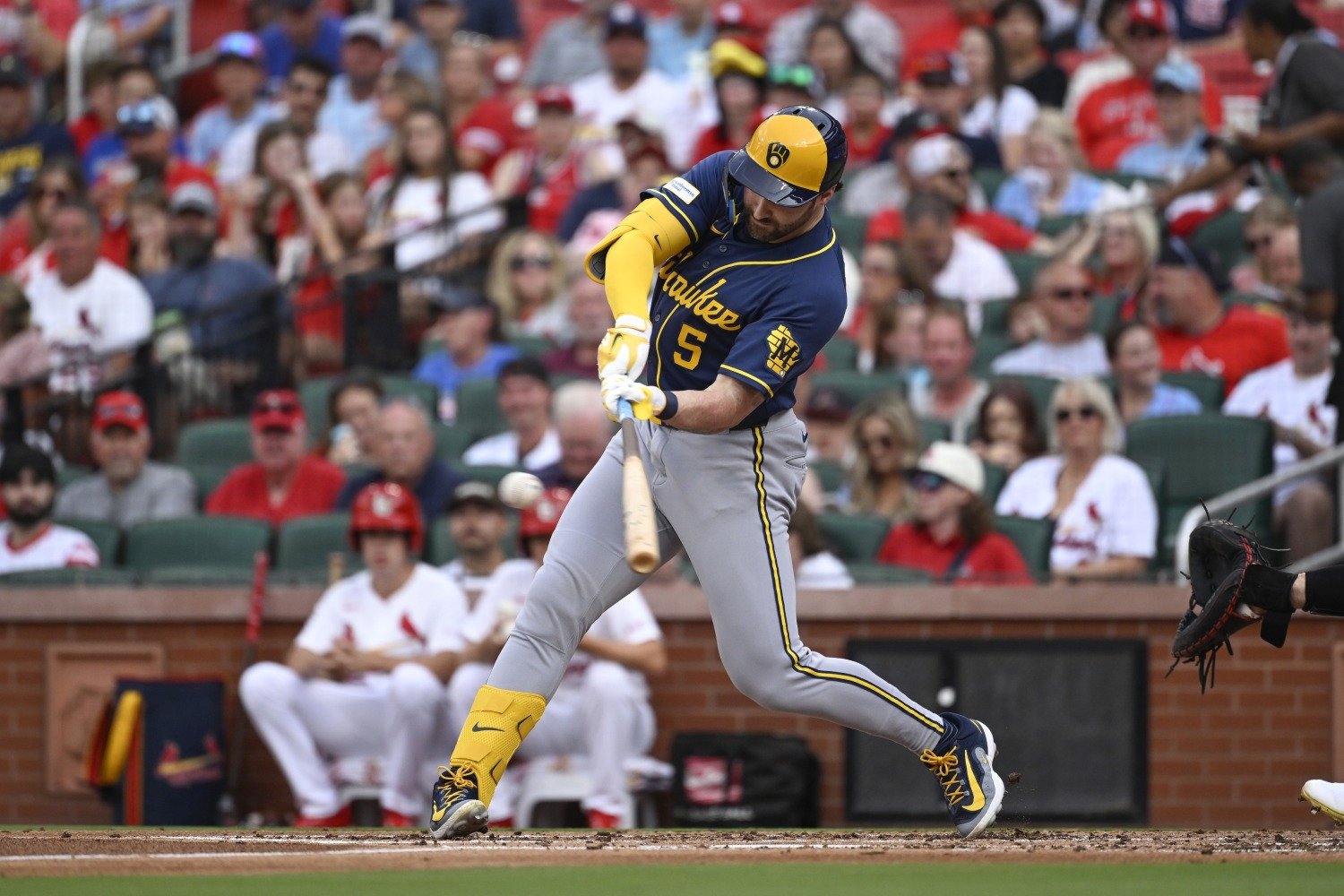
Though the Brewers finally lost a game against the Cardinals Wednesday night, Garrett Mitchell did the same thing he's done in several recent Brewers wins: hit the ball hard, often. He had two hits, including a double, pushing his OPS for 2026 to .831. Though he still has just eight home runs, that was his 18th double, to go with three triples. He's batting .276/.366/.465 on the campaign, though for many, the most important column on his Baseball Reference page is 'PA'. Already, Mitchell has come to the plate 293 times, nearly matching the combined total (302) he had in 2024 and 2025.
Before this season, Mitchell had only once collected more than 78 plate appearances in a month; that came in August 2024. In no previous season did he even appear in the majors during May or June. This year, he's had at least 79 plate appearances in each month. At last, he's had the runway to take off as a player.
Many worried that when he finally found that runway, he would crash and burn. His profile at the plate—with an extreme swing-and-miss tendency and too many ground balls—seemed like it might doom him to a future as a fourth outfielder, or (if injuries eroded his raw talent) even less. There were some calls last offseason for the Brewers to move on from Mitchell already, and if he hadn't been extremely cheap to retain, they might even have done it.
The takeoff has gone off without a hitch, though, and the air flow over Mitchell's wings appears to be well-balanced. It's not just about being healthier than ever, and it's not just about getting more reps and more experience against top-flight pitchers. It's also because Mitchell has made a real and crucial swing change, which probably looks subtle but has changed his game in a radical way.
We can use Statcast's excellent visualizations of players' swings in animated movement-tracking form to spot the tweaks Mitchell has made. To do so, let's start by comparing what Mitchell looked like in 2024 (the only other time he's gotten enough playing time in a season for Statcast to build a composite animation of him) to what he looks like now, at the first major checkpoint of the swing—when his hands drop into the slot from which his swing fires.

This is our starting point, because it is (in one sense) the starting point of the swing, but it's also a large share of the difference we're going to dig into. In the past, Mitchell had what hitting people call a "long front arm" early in his swing. Look how much higher he's ratcheted his front shoulder in the image on the left, and how it's already turning outward more than he's doing this season. As a result, note the fact that his hands are more centered within his frame on the right, even though he's positioning them to extend his arms through the swing already. Mitchell's weight begins to shift forward a hair sooner this year, but his front shoulder stays closed longer and his hands stay back a hair better.
Now, here's where Mitchell was in each season, at the next major checkpoint in a swing—the moment when his attack angle becomes positive. In other words, this is when his bat stops working down from behind his shoulder into the hitting zone and starts moving slightly uphill, to get on plane with the incoming pitch.

The differences are much more subtle here, because already, most of them are just remnants of the change he made to how he starts his swing. On the right side of each image, notice the difference in the two numbers below the attack angle. At the moment when he begins to get on plane with the pitch, his bat is angled more toward the opposite field this season. His swing is also flatter, with less downward tilt from his handle to his barrel. Why? because the change to keep his front shoulder in a bit longer early in the swing has allowed him to flatten out the swing to catch up with pitches above his belt. In the past, the early rotation of his upper body forced him to create a steeper plane. If he didn't do so, back then, he would sap his own power and be too short through the hitting zone, ending up with a weakly-hit ball off the end of the bat.
This year, because of that earlier change, Mitchell can be more linear and longer through the hitting zone even if he needs to swing flatter than is his default. He still has the option of dipping more for low and bendy pitches, but he doesn't lose bat speed or the ability to cover his preferred timing window, either way.
Mitchell is also swinging notably faster this year, by the time he reaches his contact point. That's because of the slightly later rotation of the shoulder, too. There's more torque in his swing; it's more violent. Swinging a bit flatter has meant a few more whiffs and no fewer ugly swings, but it's allowed him to wait longer to make his swing decision, which has contribued to his very strong walk rate. He's also able to square up a wider variety of pitches, so despite a bit more error baked into his address of the ball, there's less glaring a hole in his swing.
Will Mitchell remain this good all year, if he stays healthy? It's hard to say. He still swings and misses a lot, for a guy who doesn't hit for all that much power and often hits it on the ground. But maybe a quick comparison to two players with similarly superb bat speedcan elucidate why what Mitchell is doing is working, even if it's not working as well for him as for either of them. First, here are visuals of Kyle Schwarber's swing at the same two moments as we studied above for Mitchell.

Schwarber has almost identical bat speed to Mitchell's, and like the new version of Mitchell, he swings fairly flat. On the left, you can see that his hands get into their firing position without the long from arm; he's ready to rip through the ball. However, Schwarber doesn't create as much early bat speed as Mitchell does. The Brewers center fielder has his hands much deeper in the hitting zone when he gets his barrel out from behind his body than Schwarber does when he gets to the same point. On the right, you can see that Schwarber is coming much closer to square to the path of the incoming pitch than Mitchell is when he starts to work uphill. He's going to catch the ball farther in front of his body, with his bat angled much more toward the pull field. That's why Schwarber produces titanic pull-side power so consistently, whereas Mitchell does so rarely. Again, though, Mitchell is ahead of Schwarber in producing early bat speed. He can be late and still hit the ball hard; Schwarber doesn't have that luxury.
Here are the same two images for fellow Brewers slugger Jake Bauers.

Bauers creates that early bat speed and keeps his hands back, just like Mitchell. He gets around the ball more, like Schwarber, which is why he's produced more power than Mitchell has. However, he's compelled to be steeper to the ball, just as Mitchell was a couple of years ago. He's put himself in great positions to be on time, but when he's not, he doesn't have much chance to catch the ball with his barrel. His timing window is somewhat narrow; so is Schwarbers. Increasingly. Mitchell's is wide, giving him a margin for error in one dimension that he's sacrificed in another.
Mitchell is unique. No one else who swings this fast is this oriented toward the opposite field. He's creating so much bat speed while still getting into the hitting zone that he can afford to catch the ball deep. It's a quintessentially Brewers way to hit; only they could help a player with so much bat speed engineer such a non-damage-focused approach. And yet, it seems to be the perfect one for him. It's preserved much of what made him intriguing over his previous, injury-plagued stints, but it's also introduced more adaptability. Whatever his flaws, Mitchell is emerging as something very close to an All-Star center fielder. His rejiggered swing gets the credit for that, and in turn, the Brewers and the player get a lot of credit for the diligent adjustments and perseverance to achieve that transformation while keeping Mitchell healthy and ready to play every day.
Are you optimistic about the Brewers right now?

Follow Brewer Fanatic For Milwaukee Brewers News & Analysis



-
 1
1
-
 1
1


Recommended Comments
Create an account or sign in to comment
You need to be a member in order to leave a comment
Create an account
Sign up for a new account in our community. It's easy!
Register a new accountSign in
Already have an account? Sign in here.
Sign In Now