


Brewers Video
Sunday night and Monday morning brought news of two more free agents signing deals to join the starting rotations of NL contenders. The price tags on each clarify the stakes of the Brewers' ongoing effort to build a homegrown rotation.
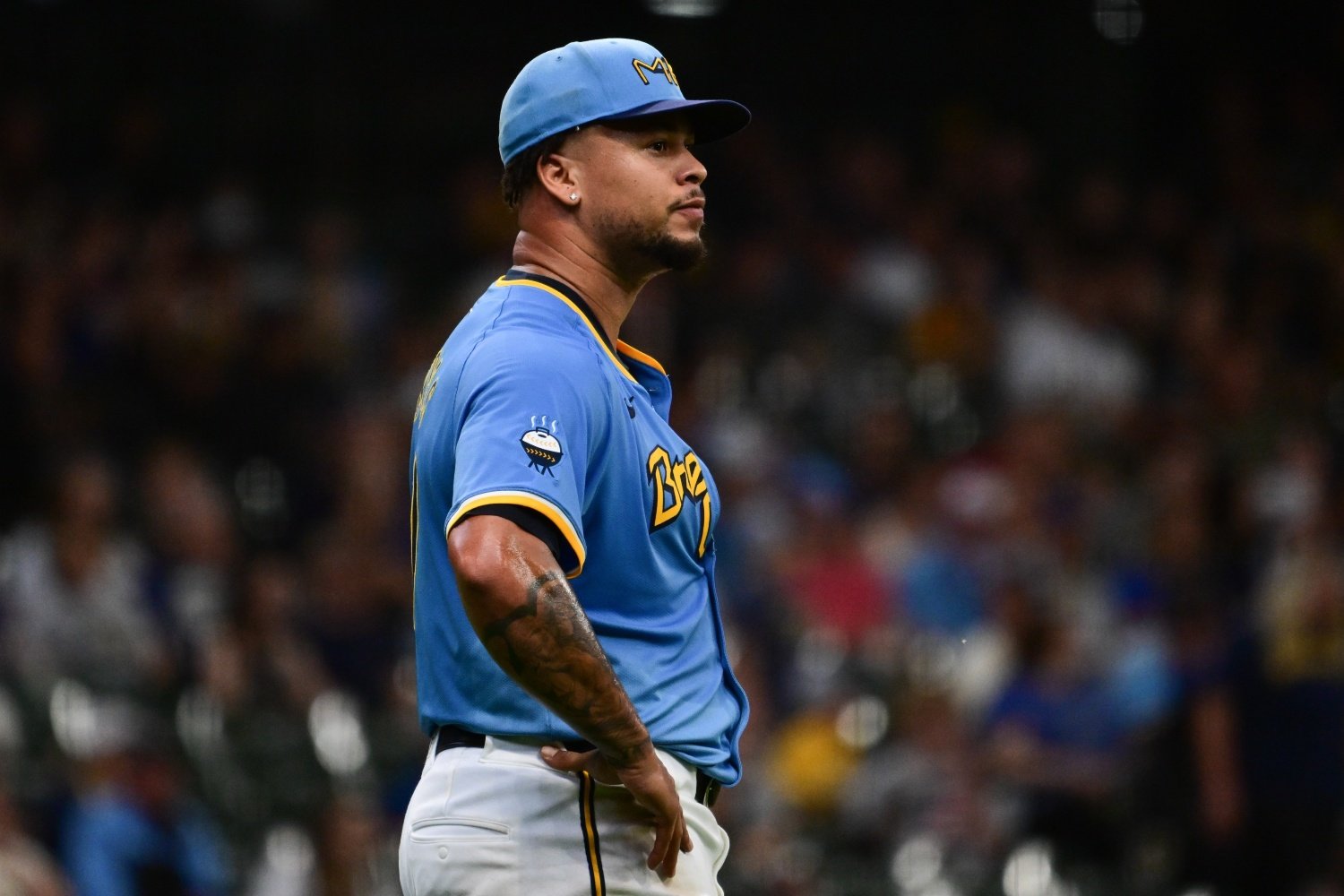
Late Sunday night, Brewers trade deadline acquisition Frankie Montas found his new home, signing with David Stearns and the New York Mets for up to $34 million over two years. Montas will make $17 million in 2025, then have the right to trigger a player option for 2026 for another $17 million. It's a deal that suggests, somewhat shockingly, that Montas was doing more than saving face when he turned down his side of a $20 million mutual option for 2025 on the deal he signed with the Reds last winter, and which the Brewers traded for ahead of the July trade deadline.
While the Brewers likely wouldn't have exercised their side of that option anyway, given their budgetary constraints and the fact that Montas is more a middle-of-the-rotation starter with health questions than a potential ace or a reliable innings eater, the deal makes clear how tough it might turn out to be to replace him—or, for that matter, to replace Colin Rea, whom they elected not to retain on a deal worth barely a quarter of that Montas option at the outset of the offseason. That impression only deepens when one considers the similar move that broke overnight, as Matthew Boyd signed a two-year deal worth $29 million with the division-rival Cubs.
Neither of these moves was likely to interest the Brewers, even if they had a bit more money to spend. Chicago, in particular, paid a small premium to lock up some upside with Boyd (who struck out almost 28% of his batters faced in 2024) early in the offseason, and while he's the type of pitcher the Brewers generally like (broad pitch mix, funky slot, good peripheral skills), they believe fervently in their ability to find arms as good or better for significantly less money. However, both New York and the Cubs are among the teams with whom the Crew figures to be directly competing for places in the NL playoff picture next season, and each got a bit better by adding these hurlers. Meanwhile, Milwaukee's rotation still has lots of question marks, and if Boyd costs almost $15 million per year, it's fair to wonder whether (let alone how much) the team can afford to get involved in the market for free-agent starters.
That's the bad news. The good news, of course, is that the team has Freddy Peralta, Brandon Woodruff, Tobias Myers, and Aaron Civale already locked in, with a bevy of good young candidates beyond that. Civale sure seems to have meaningful trade value, should they decide to go that route, since he's a pitcher about on par with Montas and Boyd and is due less than half what Montas will make in 2025. The early flurry of the winter usually includes deals a bit richer than they would have been had the same player signed in the same place six weeks later, so Matt Arnold and company might still realize some bargains by waiting until January to make their move.
In the long run, though, these deals continue to signal something simple and fairly obvious: the Brewers' single most important organizational competency is their ability to develop dubious pitchers into viable big-league starters. Myers is a tremendous example. The team also signed Deivi García earlier this offseason, a down payment on what could be a similar rags-to-riches story. They have to keep winning the tough battle to turn such pitchers into solid starters, and to find even more extreme (if much lower-ceiling) reclamation projects, like Rea and Eric Lauer and execute equally well.
Eventually, though, they also need a new wave of homegrown aces, in order to sustain the success they've enjoyed since helping turn Corbin Burnes, Woodruff and Peralta into stars. That makes their failure to sign draft pick Chris Levonas this past summer hurt a little more. It makes the continued growth and development of Jacob Misiorowski and Logan Henderson crucial, and underscores the importance of DL Hall blossoming as a starter (rather than a reliever) if at all possible.
The Brewers will recover and regroup after the financial setback of their TV rights going from a regional sports network to distribution by the league, but that will take time, and they might never see the gap shrink substantially between themselves and the Cubs, Mets, or Dodgers. To keep up with (or beat) those teams, they'll have to keep being brilliant in their scouting and player development, as well as roster building. If that wasn't clear enough before Montas and Boyd signed, it should be dramatically so now. Spending money on starting pitching won't be much of an option for Milwaukee for the foreseeable future. They'll have to win another way, just as they've always needed to.





Recommended Comments
Create an account or sign in to comment
You need to be a member in order to leave a comment
Create an account
Sign up for a new account in our community. It's easy!
Register a new accountSign in
Already have an account? Sign in here.
Sign In Now