


Brewers Video
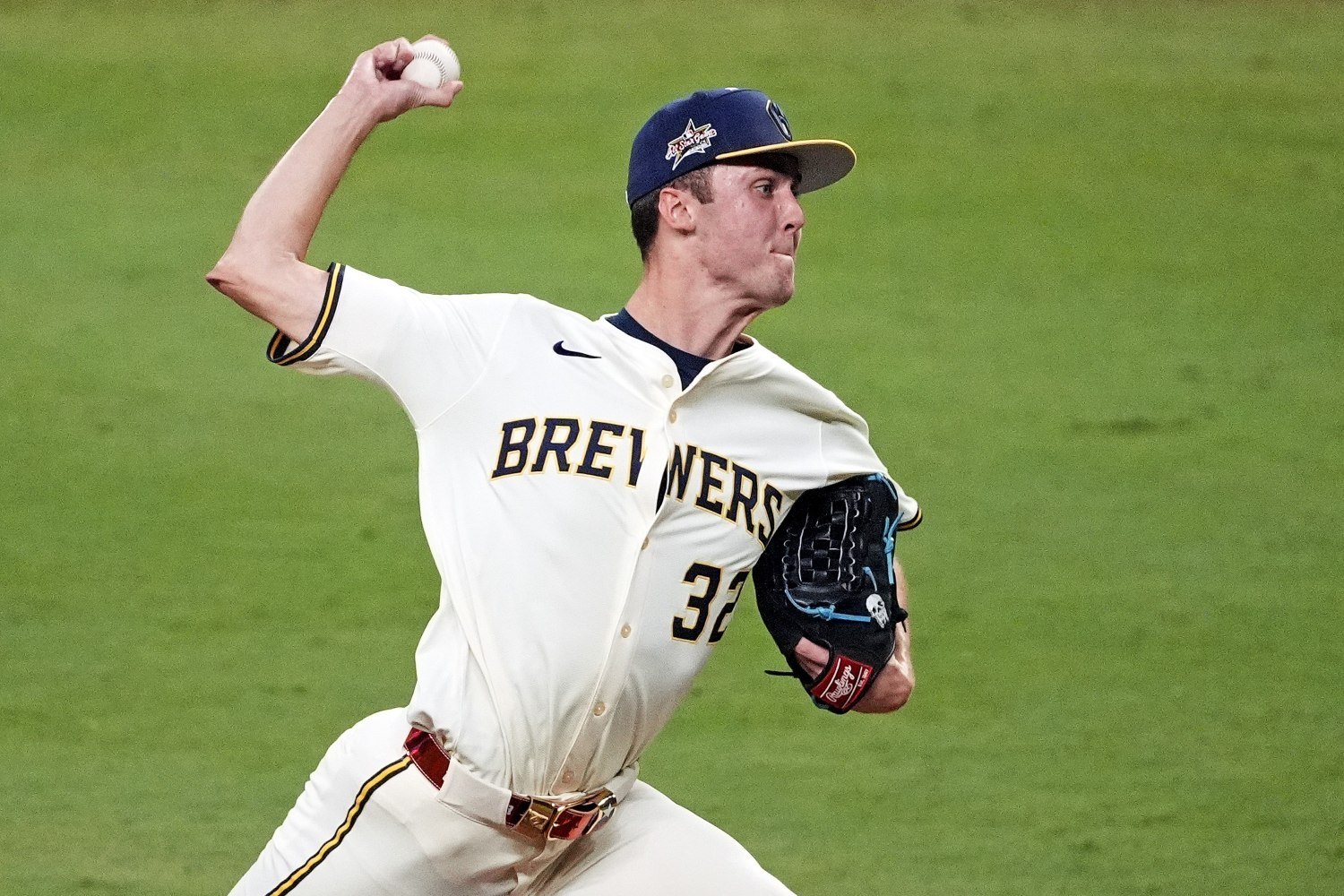
Jacob Misiorowski has taken the league by storm since his arrival, surpassing any and all expectations we may have had for his first five starts. He posted 11 straight scoreless, hitless innings to begin his career. The most devastating fastball perhaps in the history of starting pitchers. A 96-mph slider and a wipeout curveball. Oh, and he's pounding the strike zone, so far.
All of the above have created a hype and buzz around the Brewers star that may be unparalleled in their history. Neither Corbin Burnes, Brandon Woodruff nor Freddy Peralta had this type of hype surrounding them. He's as big a deal as Ben Sheets was. Misiorowski is partly responsible for some roaring weekday crowds, including a Wednesday day game sell-out against Paul Skenes. Is it any wonder the front office want to lock him up for a longer term? The question is, what does a fair price look like for both sides?
First, I'll go through some rationale, with the contract I'd recommend below:
Are There Any Comparable Deals?
Signing rookies to long-term extensions is becoming increasingly popular, particularly among the mid- and small-market teams. Jackson Chourio is a prime example, wherein the Brewers bought out his arbitration years, plus one additional season, for $82 million. For that investment, they received two team options for additional years at $25 million apiece, all before he had set foot on a big-league diamond. In summation, they may have bought out arbitration and four free-agent years for $132 million.
Contrastingly, Jackson Merrill waited until after he had performed in the big leagues, surging to 2nd place in Rookie of the Year voting behind Skenes and, in the ensuing offseason, signed a nine-year deal worth $135 million, buying out five years of control and four years of free agency within that. The Padres also have a team option for 2035, and there are incentives that could take the contract value as high as $204 million.
Between Chourio and Merrill, the main difference is that one contract includes one extra pre-arbitration year ($750,000 or so in expected salary), while the other has incentives that could net an additional $70 million during their time in San Diego. From that, we can surmise that with Jacob Misiorowski exploding onto the scene in such boisterous fashion, any deal will likely have a solid base with strong performance incentives that depend on a variety of factors—particularly, the volume of innings he pitches.
It's always best to compare apples to apples, though, and if Chourio and Merrill are apples, Misiorowski (a pitcher) is a more exotic fruit. Maybe it's better to compare his prospective deal to those signed by Hunter Greene (six years, $53 million, with a club option that could push the money to $72 million and incentives that could get it to $80 million, all signed after one year of services) or Spencer Strider (six years, $75 million, plus an option that could push it to $92 million, signed at the same stage as Greene). At the end of this year, if Misiorowski finishes highly enough in Rookie of the Year balloting, he would effectively have the same amount of service time as Greene and Strider each did when they signed those deals.
How Long Would the Contract Be For?
The Brewers will want to buy out at least two years of Misiorowski's free agency. At present, were he to finish top two in Rookie of the Year voting, Misiorowski would have five years of control remaining. If not, there would be six years left.
At 23 years old, the Brewers may want to keep their newfound ace until his age-30 or -31 season via a combination of confirmed contracted years and team options. As such, I would suggest the contract to be for eight years guaranteed, with one team option for a ninth year. The Brewers would want to do that at a fairly low annual average value, though, and unless they're more flexible than expected on that point, Misiorowski and his representatives might prefer a structure more akin to the Greene and Strider deals.
So, How Much is Jacob Misiorowski Worth?
In short: a lot. The phenom has already shown his ability to fill stadiums and bring back revenue from the talent in his right arm. To a front office, that's hugely important, in the same way as the revenue Shohei Ohtani brings in from Japan helps cover his Dodgers contract. On the flip side, pitchers have less of an impact than great hitters can (especially given modern constraints on workloads) and have a significantly higher risk of long-term injury.
Let's assume, for the moment, that Misiorowski does place well enough in awards voting to earn his full year of service this fall. In that case, his salaries over the balance of his existing team control might look like this.
- 2026: $760,000
- 2027: $780,000
- 2028: $4 million
- 2029: $10 million
- 2030: $16 million
These are slightly on the generous side of arbitration, assuming minimal injuries and some level of consistent dominance as a pitcher. So for those five years, the payout is probably going to be around $32 million, though it could go as high as $40m if he stays healthy. (He'll also make money via the league's newly created pre-arbitration bonus pools, but the Brewers don't have to pay him that money; it comes from the league's central fund.)
Then comes the big part: free agency years. At this point, the Brewers can take a gamble that the version of Misiorowski we see now is not only going to stay at his current level of performance, but perhaps even continue to improve. He could regress; his command could waver, as it so often has in the past; or he could become weighed down with injuries. All of this needs to be taken into account, and the pitcher we see now could be vastly different in five or six years' time. Brandon Woodruff is a fairly recent example of just that.
In the Strider deal, Atlanta gave their fireballer $48 million over the remaining term of his arbitration-eligible seasons, paying a bit of a premium for the right to backload that money (he'll make only $6 million total over the first three years of this deal, including 2025, and jump all the way to $20 million in 2026) and a below-market rate on his first year of would-be free agency, plus their club option thereafter. A similar structure for Misiorowski might include $40 million over the next five years, then $25 million or so in guarantees for 2031 and an option worth about the same amount in 2032.
Incentives
While they're in a similar market position to the Reds when they signed Greene, the Brewers have more other commitments (Christian Yelich, Chourio) than the Reds did. They also have less money to spend each year than Atlanta, and have to consider that in a way Atlanta didn't when inking Strider. Thus, they might need to approach Misiorowski with a deal that would buy down the above calculations to a lower guaranteed annual salary, by offering him some rich and reachable incentives.
If the Brewers lowered the base value of Misiorowski's contract to a six-year deal for $55 million, with a team option at $28 million for year seven, that may be more palatable. On top of that, incentives that could add up to $25 million for Misiorowski, depending on innings pitched per season, awards voting and other honors (like All-Star selections). If it came with an opt-out clause or no-trade protection, for example, that could enhance the contract from the pitcher's side, directly earning his increased salary in a way the Brewers could agree to. They just need to avoid paying eight-figure salaries for a pitcher who can't take the mound; they'll happily pay for whatever production he manages when he's healthy enough to pitch.
What Should The Brewers Offer For Jacob Misiorowski?
For a start, six years and $60 million, with a club option for 2032 worth $28 million and a $5-million buyout. They could also include incentives worth up to $6 million per season, with about half that reachable based on innings alone.
When Might A Deal Be Struck?
In all likelihood, nothing will be arranged prior to this offseason. A lot of the expected value in this contract, on either side, hinges on whether or not Misiorowski is under team control for 2031, and we won't know that until awards votes are tabulated in November. If we reach next season and no deal has been struck, Misiorowski might rapidly price himself out of Milwaukee's reach. The pre-arbitration bonus pool certainly gives players more leverage in these negotiations.
Jacob Misiorowski looks every bit a superstar. He reels in crowds and brings media spotlight and attention in a way not seen since 2019 Christian Yelich. A long-term deal could well be in the best interests of both parties, but can they come together to make a mutual agreement?
Would you make the deal mentioned above? Is it too expensive? Too cheap? Let us know your thoughts in the comments below!
Do you approve of Brewers' ownership?

Follow Brewer Fanatic For Milwaukee Brewers News & Analysis



-
 2
2


Recommended Comments
Create an account or sign in to comment
You need to be a member in order to leave a comment
Create an account
Sign up for a new account in our community. It's easy!
Register a new accountSign in
Already have an account? Sign in here.
Sign In Now