


Brewers Video
The arbitration system favors teams over players, so no one should be surprised that the Brewers are following the league-wide procedure of taking one of their best players through it.
Arbitration is a dreaded topic in all baseball circles. Hearings are unpleasant. Players, coaches, and executives don’t like talking about them, and reporters and writers don’t enjoy covering them.
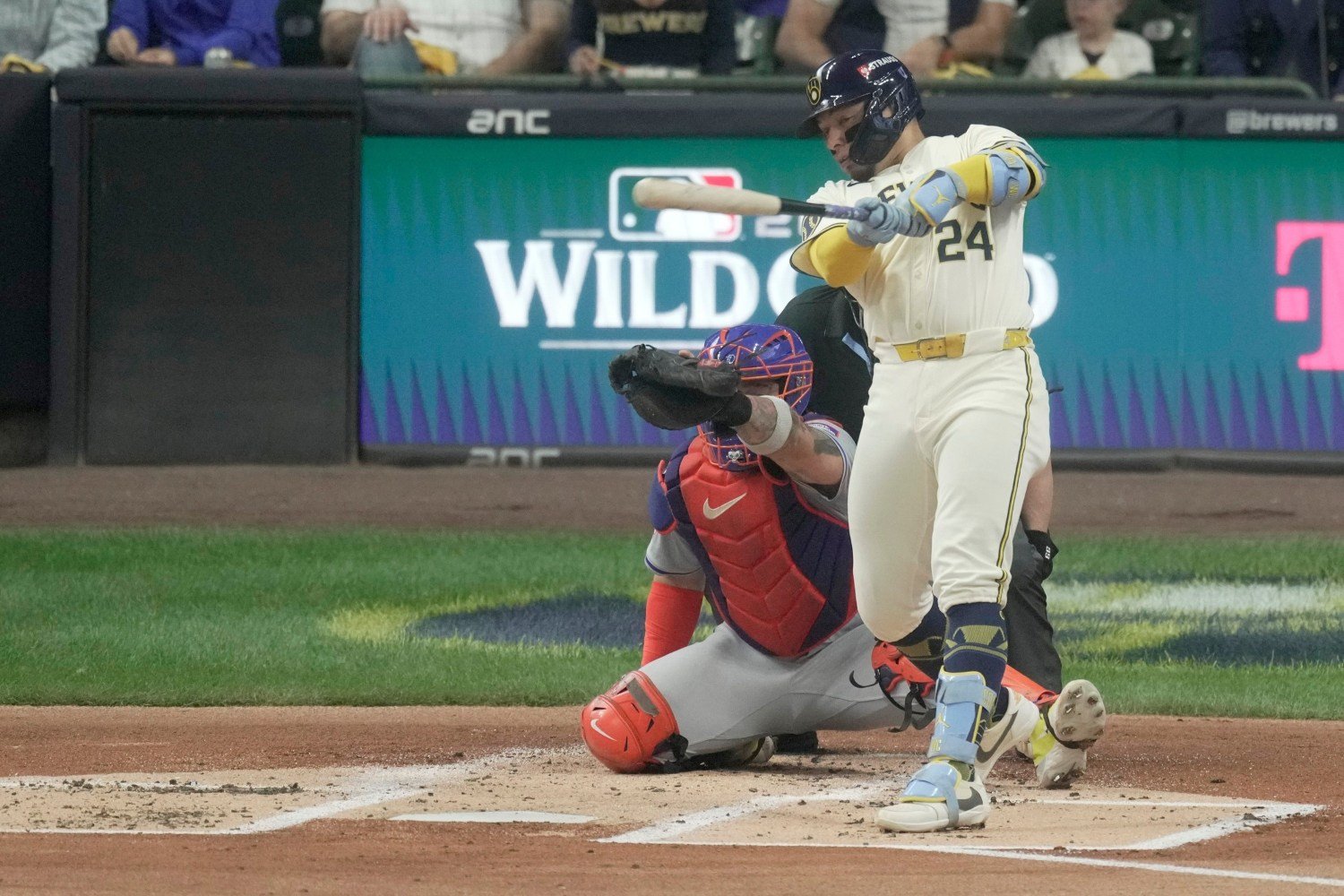
Unfortunately, those discussions will again be part of the Brewers' news cycle leading into spring training. For the third time in six years, the club will almost certainly go to and win a hearing against one of its star players. This time, it’s William Contreras.
Teams and players seek to avoid hearings if possible and succeed in most cases, but salary settlements are tougher to reach with elite players. The Brewers reached agreements on 2025 contracts with every arbitration-eligible player on their roster except Contreras, whose camp filed at $6.5 million. The club countered at $5.6 million.
While teams can continue negotiating with players until the minute their hearing begins, don’t expect Contreras and the Brewers to settle. An extension to buy out his arbitration seasons, like the one Devin Williams signed a year ago, feels like a long shot. As a 27-year-old coming off consecutive seasons of more than 5 fWAR, Contreras likely feels comfortable letting his performance dictate salary bumps from one year to the next until he hits free agency at age 30.
Understanding why the Brewers drew a line less than $1 million shy of Contreras’s request requires awareness of what arbitration is, and is not. It’s a confusing process compared to the more straightforward procedure of signing contracts with free agents, so here’s a quick primer.
Arbitration allows productive players to receive significant raises in their final three seasons before unrestricted free agency, but it is not designed to award them the salaries they would command on the open market. If he became a free agent today, Contreras would easily find a nine-figure contract. FanGraphs's WAR-based value metric estimates that his production last year was worth $43.5 million. He and the Brewers filed at less than 15% of that number.
Instead, the process is heavily steeped in precedent. Each side builds its case and arrives at its proposed salary figure by comparing the player’s statistics and accolades to those of a similar player in the same arbitration year. They present their cases to a panel of arbitrators, who decide whether the player will receive the salary he requested or the one his team chose.
Most players do not enter arbitration after a precedent-breaking performance, so agents and executives have similar notions of a realistic salary request. This can make it easier to agree on a figure and avoid a hearing. Things get hairy when elite players seek to break the norm and establish higher baseline arbitration salaries.
Contreras’s camp requested what would be the highest first-season arbitration salary for a catcher since Buster Posey’s $8-million agreement with the San Francisco Giants ahead of the 2013 season. Posey shattered the salary precedent because he crushed the on-field one the year before; he hit .336 with 103 RBIs, won the NL MVP and Silver Slugger awards, and accrued 9.8 fWAR, the single-season record for a catcher.
No catcher since has come close to that production, so neither have their salaries. The baseline for first-time arbitration-eligible backstops of Contreras’s caliber has sat slightly over $5 million for a decade.
| Year | Player | First-Year Arbitration Salary | Previous Season fWAR | Career fWAR |
| 2013 | Buster Posey | $8,000,000 | 9.8 | 15.2 |
| 2013 | Matt Wieters | $5,500,000 | 4.1 | 12.6 |
| 2018 | JT Realmuto | $2,900,000 | 4.8 | 6.9 |
| 2023 | Will Smith | $5,250,000 | 4.3 | 11.9 |
| 2024 | Jonah Heim | $3,050,000 | 4.0 | 7.3 |
| 2025 | Adley Rutschman | $5,500,000 | 2.8 | 13.3 |
| 2025 | Cal Raleigh | $5,600,000 | 5.4 | 13.9 |
| 2025 | William Contreras | TBD | 5.4 | 13.1 |
The Brewers filed at the same salary the Seattle Mariners and catcher Cal Raleigh (also in his first year of arbitration) agreed to earlier on Thursday. That’s not a coincidence; it’s the established rate for a catcher in Contreras’s position.
Hard-line stances in arbitration—more specifically, a refusal to willingly go much higher than established salaries, if at all—have become standard practice across baseball. The arbitration process is flawed in how it compensates players and heavily favors clubs. Because each case draws on those before it as a baseline, giving certain players the unprecedented salaries they request without a hearing would erode the system’s benefit to teams. Professional baseball is a business, and the shrewd businessman does not undermine an institution that gives him an advantage.
This is why the Brewers sparred in hearings with Josh Hader and Corbin Burnes. Hader filed at a record $6.4-million salary for a first-year arbitration reliever, and Burnes sought a record $10.75 million for a starting pitcher in his second arbitration year. The front office could have accepted, but doing so would have created a ripple effect on future salaries. Instead, it drew a hard line and let the arbitration process play out. Every other team would have done the same.
The process will repeat with Contreras. The Brewers will not directly argue that he is worth only $5.6 million, but that he is similar in value to Raleigh, who settled for that amount. Contreras’s side will argue that he’s been a more valuable catcher than those who went through similar cases before him, justifying a near-unprecedented $6.5 million salary.
Given their career numbers, the Brewers’ comparison is very reasonable. Raleigh and Contreras are nearly identical in the two flavors of WAR that incorporate catcher defense. While the latter has a higher wRC+, the former has more home runs and RBIs, two traditional counting stats still heavily valued by the panel.
| Player | G | AVG | OBP | SLG | wRC+ | HR | RBI | fWAR | WARP |
| Cal Raleigh | 464 | .218 | .296 | .444 | 111 | 93 | 251 | 13.9 | 13.4 |
| William Contreras | 449 | .277 | .358 | .465 | 126 | 68 | 239 | 13.1 | 12.2 |
This hearing will almost certainly take place, and the Brewers will almost certainly win. Their spokespeople will make arguments that can hurt feelings and sour relationships, just as they did against Hader and Burnes.
Contreras won’t be alone, either. Assuming most clubs take “file-and-trial” approaches with unresolved cases, here are a few seemingly insignificant salary disagreements over which teams will go to a hearing next month:
- the Cubs and Kyle Tucker ($17.5 million vs. $15 million)
- the Cardinals and Lars Nootbaar ($2.95 million vs. $2.45 million), Brendan Donovan ($3.3 million vs. $2.85 million), and Andre Pallante ($2.1 million vs. $1.925 million)
- the Dodgers and Alex Vesia ($2.35 million vs. $2.05 million)
- the Red Sox and Jarren Duran ($4 million vs. $3.5 million)
- the Yankees and Mark Leiter Jr. ($2.5 million vs. $2.05 million)
This is a league-wide procedure, not one exclusive to small-market teams operating on lower payrolls. In almost every case, no front office willingly raises the bar for player compensation in arbitration. It's not a nefarious scheme specifically concocted by Mark Attanasio and Matt Arnold to cut costs where other organizations are not. It’s part of the established MLB playbook, and the Brewers are just one of 30 teams who follow it.
It’s not fun to discuss. The business side of baseball often feels slimy, and the system is unfair to players. However, none of that changes the present reality facing Contreras and the Brewers. By understanding the process, both parties can handle an unpleasant situation professionally.
Do you approve of Brewers' ownership?

Follow Brewer Fanatic For Milwaukee Brewers News & Analysis



-
 3
3


Recommended Comments
Create an account or sign in to comment
You need to be a member in order to leave a comment
Create an account
Sign up for a new account in our community. It's easy!
Register a new accountSign in
Already have an account? Sign in here.
Sign In Now