



Jirsch
-
Posts
39 -
Joined
-
Last visited
Content Type
Profiles
Forums
Blogs
Events
News
2026 Milwaukee Brewers Top Prospects Ranking
Milwaukee Brewers Videos
2022 Milwaukee Brewers Draft Picks
Milwaukee Brewers Free Agent & Trade Rumors, Notes, & Tidbits
Guides & Resources
2023 Milwaukee Brewers Draft Picks
2024 Milwaukee Brewers Draft Picks
The Milwaukee Brewers Players Project
2025 Milwaukee Brewers Draft Pick Tracker
2026 Milwaukee Brewers Draft Tracker: Picks & Bonuses
Store
Downloads
Gallery
Everything posted by Jirsch
-

Brewers (Gasser) vs Padres (Buehler): 10/7/26, 9:00pm
Jirsch replied to Brock Beauchamp's topic in Archived Game Threads
Well, wouldn't that be poetic end to a road loss slump....I'm all for it! -
To answer on Chourios reaction to the play: Chourio was credited with staying with the play to get the out. He said he wasn't sure what happened high above him. "I thought I had a chance on that ball kind of the whole time off the bat," he said through the team interpreter. "Then the only thing I kind of realized, it changed direction a little bit, but I thought I had a beat on it for the majority of the time." And the StatCast explanation that I found: The ball left Ty France's bat at 105.3 mph, but with an incredibly steep 49-degree launch angle. In physics and baseball tracking, launch angle is everything. A 49-degree angle means the ball was hit almost straight up—a massive "moonshot" pop-up. According to actual historical Statcast data, balls hit at 105.3 mph with a 49-degree launch angle result in outs 99.5% of the time. There has never been a home run with a launch angle above 46 degrees hit at American Family Field in the entire Statcast era. The roof was closed, meaning there was no outfield breeze to carry a ball that was pushed so high into the air. Actual trajectory modeling showed that France's hit would have only been a home run in exactly one MLB stadium: Daikin Park in Houston, purely because of its uniquely short 315-foot "Crawford Boxes" in left field. If a ball is genuinely projected to travel 410 feet (deep into the stands), the outfielder will immediately turn around and sprint back to the wall. On this play, Brewers left fielder Chourio barely moved. He tracked the ball off the bat, drifted slightly, and camped out on the warning track. Chourio noted after the game that he felt he "had a chance on that ball the whole time" and only noticed a slight change in direction when it ticked the cable. The ball didn't drop out of the sky because it was robbed of 410 feet of distance; it dropped because it was a towering pop-up that was already destined to land right in the left fielder's glove.
-
Loving hypotheticals, if the Crew go 17-17 the rest of the way, the Cubs need to go 23-11. baring any crazy ish happening, and everything keeps going the way it has since the all star break, we got this division locked up...right??!!
-
Fangraphs - Remaining Standings Projections
Jirsch replied to Jirsch's topic in Milwaukee Brewers Talk
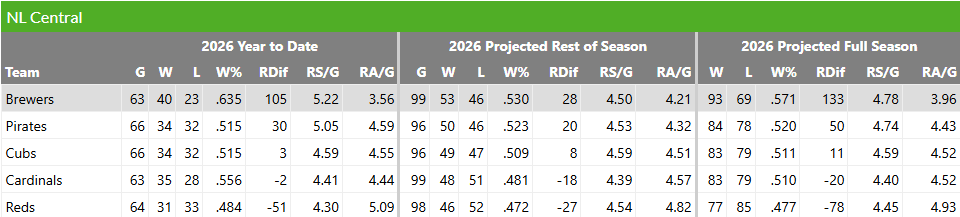
With 60 to go, Fangraphs now has us projected as 31-29 the rest of the way for 95 wins and finishing 7 clear of the Cubs for the division. With a middle of the road strength of schedule, and depending on what gets done at the deadline, optimistically I'd put them at 34-26 to get to 98 wins. Just greedy since I want to see this team best last years team! -
Fangraphs has the team winning the division by 9 games when it is all said and done....53-46 the rest of the way is entirely doable from my chair....thoughts??
-
Just a quick note on my experience. if this has been mentioned already, I apologize, just wanted to get some info out there. I had been piggybacking off of a relatives DIRECTV the last couple years after we cut the cord so that we could watch the games on the app. Decided this year to bite the bullet and do the Brewers.tv option so I didn't have to screen share. When I went to pay, it showed that if you are a member of GovX, you receive 35% off. So, for those of you who are active-duty military, veterans, first responders, or government employees, if you do not have a verified GovX account, go ahead and sign up, verify through ID.me, and get your discount. Went from paying $99.99 to just over $68 for the year after taxes.
-
Completely agree with all of this. To break it down just a touch more, say the Brewers only win one more game in each remaining series and go a dreadful 7-15 down the stretch. The Cubs go 13-9 to get the tiebreaker. I think that's the only way they would have a chance to catch up. As adambr2 said, I think worst case scenario for the Crew is .500 ball, which forces the Cubs to play .772 baseball the rest of the way. For a Cubs team that has played .535 baseball since the All-Star break, that would be a huge step up the last 22 games of the year.
-
Per Jon Heyman...Corbin Burnes to the Diamondbacks...6 years, 210 million...opt out after 2 years
-
Just saw his name mentioned somewhere and thought it was worth a discussion. I love Roki and I think the Crew have a legit shot at him, but do the Brewers get a bit crafty and go after the NPB vet? 35 years old, but had another stellar year last year, and probably would not break the bank on a 2 or 3 year deal.
-
I agree with Bieder that he's fully entrenched there as we speak, and IMO should stay there. Hopefully Cooper becomes our SS of the future, more sooner than later. Losing Adames definitely opens a spot for him, even though the jump from AA to the Majors would be a big one. Size-wise, he's not prototypical, but I think he's just fine....look at Cruz who is 6'7" 215 (although he is far from the norm!). Pratt is 6'4" 195, and comps well with the likes of Seager and Correa.
-
Cardinals (Gray) vs Brewers (Myers): 5/9/24, 6:40pm
Jirsch replied to Brock Beauchamp's topic in Archived Game Threads
Glass half full...I think today begins a 9-4 run the next 13. Not a really hot take, I know. But honestly, I might be disappointed if that doesn't happen since the competition is pretty lacking in the next four series..... -
So Brice is having a helluva year so far IMO. .309 with a .803 OPS, 12.9 whiff % and 1.5 WAR. I'm pretty sure no one here is close to complaining about that and would take that all year from him, (or anyone on the roster for that matter). But my favorite stat is the 14 stolen bases without getting caught. In fact, he's had 31 stolen bases in a row dating back to last year. Vince Coleman holds the record at 50 consecutive stolen bases back in 1987. I get that the bigger bases and minimal throw overs helps the situation, but my question for the group is, do you think he will break the record?
-
Take this for what its worth, but I just read something where Bauer was quoted as saying the following (understanding this is his situation, so this is obviously from his swayed point of view): "Everybody that's behind the scenes...players, coaches, GM's....everyone we've talked to that's a baseball person, is like "We'd sign you in a heartbeat, but we take it to ownership and it's a hard no". And no owners will meet with us, no owners...they won't give us a reason why. I'm offering to play for literally the league veteran minimum....its like, you have to pay that spot anyway." I don't agree that he's washed up and can't hack it at the MLB level anymore. But even if that could be the case, I think he's worth a vet minimum flyer. Just my opinion.
-
Say what you want about Bauer. I don't know him on a personal level, and I'm guessing no one here does either. Is he an ******? Maybe.....is he arrogant....sure. Is he a criminal? No. Did a few women try to trap him and get a pay day? No doubt about that now that a bunch of evidence has come out. And, to be honest, I've never been one to care how someone is perceived on the internet, or from people who don't personally know them. You know the old adage "Throwing stones at a glass house". On a baseball level, he would be an immediate, low cost help. Is he going to K 14 in 6 IP on the major league level? Probably not. But does he have a serviceable, mid rotation floor with a #1 upside? Sure does, in my opinion. But honestly owners and front offices are to scared to touch him, and with the evidence that just exonerated him, I'm not sure why..... Just take a deep breath and put yourself in his shoes for a minute....if it was me, and a lie ruined my career, I'd do anything to clear my name and get back to where I was professionally.