Jake McKibbin
-
Posts
2,395 -
Joined
-
Last visited
-
Days Won
6
Content Type
Profiles
Forums
Blogs
Events
News
2026 Milwaukee Brewers Top Prospects Ranking
Milwaukee Brewers Videos
2022 Milwaukee Brewers Draft Picks
Milwaukee Brewers Free Agent & Trade Rumors, Notes, & Tidbits
Guides & Resources
2023 Milwaukee Brewers Draft Picks
2024 Milwaukee Brewers Draft Picks
The Milwaukee Brewers Players Project
2025 Milwaukee Brewers Draft Pick Tracker
2026 Milwaukee Brewers Draft Tracker: Picks & Bonuses
Store
Downloads
Gallery
Everything posted by Jake McKibbin
-
Yeah the difference Adamczewski makes to this lineup is impressive. It just appears a ton more formidable and certainly seems to help those playing around him. Can we also note once again how impressive that 90th percentile EV is for an 18 year old?!?
-
Can't extend a QO to anyone acquired during their final year of control. That being said, given Arizona are still in the hunt and would be losing that QO, that may factor into their valuation of him
-
2025 Official Draft Signings Thread
Jake McKibbin replied to Jake McKibbin's topic in MLB Draft & International Signings
Andrew Fischer confirmed per BA to sign for $3,500,000, roughly 18% under slot and a $768,100 saving Front sheet has been updated to match the below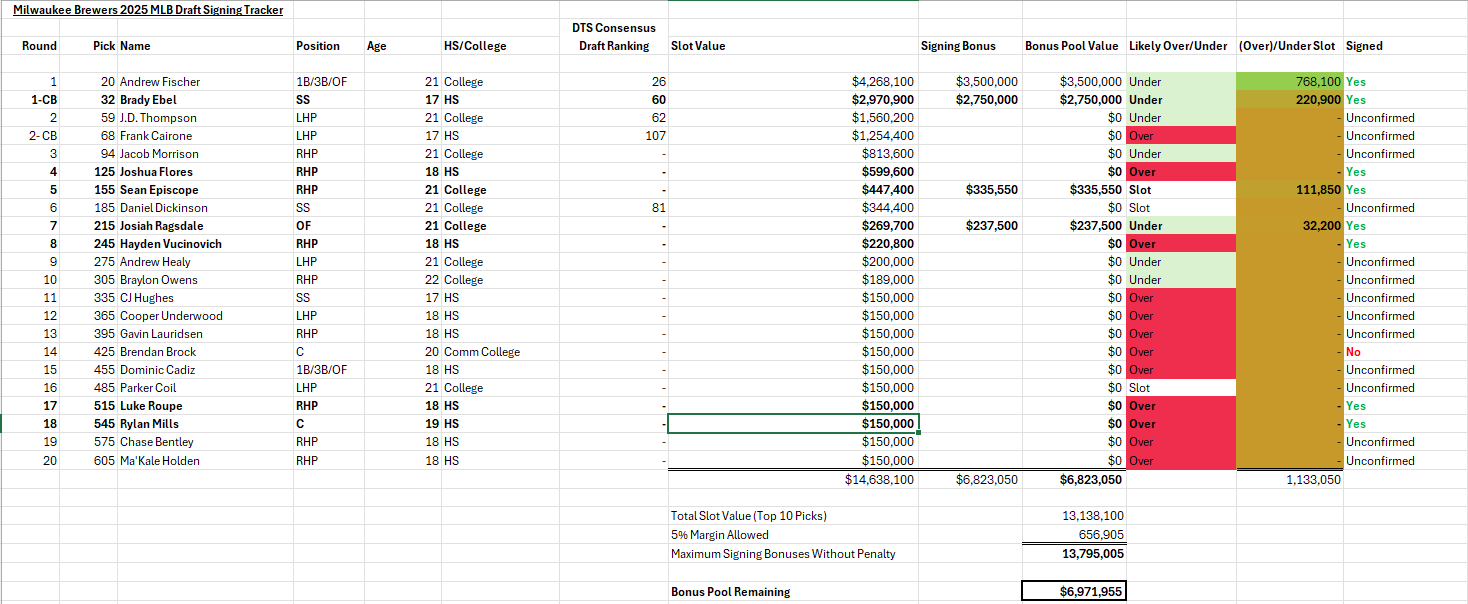
-
Due to how inefficient Misiorowski was last season, taking 4/5 innings and reaching 90+ pitches to do so, I thought I'd have a look at how many pitches he threw last season compared to this one. In 2024, he threw 1434 pitches at Double A Biloxi and a further 295 at Triple A Nashville, so 1729 in total In 2025 so far he's thrown 1014 at Triple A Nashville and 469 with Milwaukee, so 1483 in total Different people have different schools of thought in how much you can push a pitcher each season around their innings count, so take from that what you will, but it does present a slightly rosier pitcher than the innings totals comparison (97 1/3 in 2024, 92 2/3 in 2025 so far)
-
(1).png.31e78184a82af4ea26f6a72a53b0c3f2.png) The Milwaukee Brewers are soaring. On the high of an 11-game winning streak, they now sit atop not just the NL Central, but the entire National League.. The rotation is the stuff of dreams, with Jacob Misiorowski, Freddy Peralta, Brandon Woodruff and Quinn Priester all throwing the ball nicely while Jose Quintana fills the fifth starter role with aplomb. The offensive output and the bullpen have been impressive, but both are showing signs that an upgrade could go a long way. With a chance to not just take the division against a rival who are pushing their own chips in, but also take a top-two seed and avoid the Wild Card Series that's caused so much hurt to the Brewers, there's a serious opportunity for the front office to make a mark by fortifying their roster both in terms of impact and depth. Here's how. Ryan O'Hearn - 1B/OF, Baltimore Orioles There may not be a more perfect fit than this one. Ryan O'Hearn has improved year on year with the bat, posting an .838 OPS in 2025 while showcasing plus walk rates and strikeout rates. He's patient at the plate—perhaps, occasionally, too patient—but he's a left-handed bat with the ability to clear the fence who also plays some of the best first-base defense in baseball. Regardless of the future performance of Rhys Hoskins or Andrew Vaughn, O'Hearn has shown himself a superior option to Jake Bauers by a healthy margin. He should be an everyday option against right-handed pitchers, whether that be at first base or the occasional spot start in left field. Against righties, O'Hearn is slashing .296/.390/.498 in 2025, whereas he has just a .597 OPS against left-handers. The Brewers are missing some mix-and-match versatility on their bench, with limited impact offensively. Whether that comes from O'Hearn or from him pushing Vaughn or Hoskins into a bench role, he makes the infield look a lot sturdier from an offensive and defensive standpoint. Gregory Soto - LHP, Baltimore Orioles The other area that's shown some flakiness of late is the back end of the bullpen, and especially Jared Koenig. His aggressive approach to strike-throwing means that, when his stuff is slightly down, he can get hit hard. Unfortunately, that's shown up more of late, with two home runs against the Dodgers in a single outing. The Brewers are basically carrying a passenger on their roster as well, with Easton McGee and Tobias Myers pitching just three innings between them in July, meaning the Brewers can add a leverage arm without sacrificing anything meaningful in their bullpen assortment. Gregory Soto is another candidate from the Orioles who makes a lot of sense. Pitching like a left-handed Abner Uribe, Soto relies on a bowling-ball sinker and tight gyro slider that garner a lot of swing-and-miss to put hitters under pressure. He also possesses an ability to add more sweep to his slider, presenting another look for hitters that allows his whole arsenal to blend together quite effectively: He has walked more hitters this year, but he avoids barrels like the best of them and can strike out hitters with the best of them. I'd like to see him blend in the sweeper a little more often if he joined the Brewers, given its weak contact profile and deception alongside the slider, but there are a lot of tools to work with in Soto that could close up the one remaining hole in the Brewers bullpen. Adding these two rentals shouldn't be overly expensive, although the trade market will no doubt push up prices. Both are free agents at the end of the season and, even better, the Orioles have a clear need for young, controllable major-league arms, something the Brewers are swimming in right now. It may involve a current arm like Myers or Chad Patrick alongside an upside arm from Double A or below, but the Brewers definitely have the excess depth to make this trade without breaking a sweat. The Milwaukee Brewers need more pieces. They're an injury away from a problem in either the outfield or at first base, and the added versatility will leave them well-stocked heading into the most important months of the season. Gregory Soto can reinforce a bullpen that may just be flagging a little bit, and strengthen the depth they have in their relief corps. What would you give up for these Baltimore Orioles assets? How much of a boost can they provide the surging Milwaukee Brewers? Let us know your thoughts in the comments below!
The Milwaukee Brewers are soaring. On the high of an 11-game winning streak, they now sit atop not just the NL Central, but the entire National League.. The rotation is the stuff of dreams, with Jacob Misiorowski, Freddy Peralta, Brandon Woodruff and Quinn Priester all throwing the ball nicely while Jose Quintana fills the fifth starter role with aplomb. The offensive output and the bullpen have been impressive, but both are showing signs that an upgrade could go a long way. With a chance to not just take the division against a rival who are pushing their own chips in, but also take a top-two seed and avoid the Wild Card Series that's caused so much hurt to the Brewers, there's a serious opportunity for the front office to make a mark by fortifying their roster both in terms of impact and depth. Here's how. Ryan O'Hearn - 1B/OF, Baltimore Orioles There may not be a more perfect fit than this one. Ryan O'Hearn has improved year on year with the bat, posting an .838 OPS in 2025 while showcasing plus walk rates and strikeout rates. He's patient at the plate—perhaps, occasionally, too patient—but he's a left-handed bat with the ability to clear the fence who also plays some of the best first-base defense in baseball. Regardless of the future performance of Rhys Hoskins or Andrew Vaughn, O'Hearn has shown himself a superior option to Jake Bauers by a healthy margin. He should be an everyday option against right-handed pitchers, whether that be at first base or the occasional spot start in left field. Against righties, O'Hearn is slashing .296/.390/.498 in 2025, whereas he has just a .597 OPS against left-handers. The Brewers are missing some mix-and-match versatility on their bench, with limited impact offensively. Whether that comes from O'Hearn or from him pushing Vaughn or Hoskins into a bench role, he makes the infield look a lot sturdier from an offensive and defensive standpoint. Gregory Soto - LHP, Baltimore Orioles The other area that's shown some flakiness of late is the back end of the bullpen, and especially Jared Koenig. His aggressive approach to strike-throwing means that, when his stuff is slightly down, he can get hit hard. Unfortunately, that's shown up more of late, with two home runs against the Dodgers in a single outing. The Brewers are basically carrying a passenger on their roster as well, with Easton McGee and Tobias Myers pitching just three innings between them in July, meaning the Brewers can add a leverage arm without sacrificing anything meaningful in their bullpen assortment. Gregory Soto is another candidate from the Orioles who makes a lot of sense. Pitching like a left-handed Abner Uribe, Soto relies on a bowling-ball sinker and tight gyro slider that garner a lot of swing-and-miss to put hitters under pressure. He also possesses an ability to add more sweep to his slider, presenting another look for hitters that allows his whole arsenal to blend together quite effectively: He has walked more hitters this year, but he avoids barrels like the best of them and can strike out hitters with the best of them. I'd like to see him blend in the sweeper a little more often if he joined the Brewers, given its weak contact profile and deception alongside the slider, but there are a lot of tools to work with in Soto that could close up the one remaining hole in the Brewers bullpen. Adding these two rentals shouldn't be overly expensive, although the trade market will no doubt push up prices. Both are free agents at the end of the season and, even better, the Orioles have a clear need for young, controllable major-league arms, something the Brewers are swimming in right now. It may involve a current arm like Myers or Chad Patrick alongside an upside arm from Double A or below, but the Brewers definitely have the excess depth to make this trade without breaking a sweat. The Milwaukee Brewers need more pieces. They're an injury away from a problem in either the outfield or at first base, and the added versatility will leave them well-stocked heading into the most important months of the season. Gregory Soto can reinforce a bullpen that may just be flagging a little bit, and strengthen the depth they have in their relief corps. What would you give up for these Baltimore Orioles assets? How much of a boost can they provide the surging Milwaukee Brewers? Let us know your thoughts in the comments below!- 17 comments
-
- 6
-

-

-
- 2025 trade deadline
- ryan ohearn
- (and 1 more)
-
Image courtesy of © Daniel Kucin Jr.-Imagn Images The Milwaukee Brewers are soaring. On the high of an 11-game winning streak, they now sit atop not just the NL Central, but the entire National League.. The rotation is the stuff of dreams, with Jacob Misiorowski, Freddy Peralta, Brandon Woodruff and Quinn Priester all throwing the ball nicely while Jose Quintana fills the fifth starter role with aplomb. The offensive output and the bullpen have been impressive, but both are showing signs that an upgrade could go a long way. With a chance to not just take the division against a rival who are pushing their own chips in, but also take a top-two seed and avoid the Wild Card Series that's caused so much hurt to the Brewers, there's a serious opportunity for the front office to make a mark by fortifying their roster both in terms of impact and depth. Here's how. Ryan O'Hearn - 1B/OF, Baltimore Orioles There may not be a more perfect fit than this one. Ryan O'Hearn has improved year on year with the bat, posting an .838 OPS in 2025 while showcasing plus walk rates and strikeout rates. He's patient at the plate—perhaps, occasionally, too patient—but he's a left-handed bat with the ability to clear the fence who also plays some of the best first-base defense in baseball. Regardless of the future performance of Rhys Hoskins or Andrew Vaughn, O'Hearn has shown himself a superior option to Jake Bauers by a healthy margin. He should be an everyday option against right-handed pitchers, whether that be at first base or the occasional spot start in left field. Against righties, O'Hearn is slashing .296/.390/.498 in 2025, whereas he has just a .597 OPS against left-handers. The Brewers are missing some mix-and-match versatility on their bench, with limited impact offensively. Whether that comes from O'Hearn or from him pushing Vaughn or Hoskins into a bench role, he makes the infield look a lot sturdier from an offensive and defensive standpoint. Gregory Soto - LHP, Baltimore Orioles The other area that's shown some flakiness of late is the back end of the bullpen, and especially Jared Koenig. His aggressive approach to strike-throwing means that, when his stuff is slightly down, he can get hit hard. Unfortunately, that's shown up more of late, with two home runs against the Dodgers in a single outing. The Brewers are basically carrying a passenger on their roster as well, with Easton McGee and Tobias Myers pitching just three innings between them in July, meaning the Brewers can add a leverage arm without sacrificing anything meaningful in their bullpen assortment. Gregory Soto is another candidate from the Orioles who makes a lot of sense. Pitching like a left-handed Abner Uribe, Soto relies on a bowling-ball sinker and tight gyro slider that garner a lot of swing-and-miss to put hitters under pressure. He also possesses an ability to add more sweep to his slider, presenting another look for hitters that allows his whole arsenal to blend together quite effectively: He has walked more hitters this year, but he avoids barrels like the best of them and can strike out hitters with the best of them. I'd like to see him blend in the sweeper a little more often if he joined the Brewers, given its weak contact profile and deception alongside the slider, but there are a lot of tools to work with in Soto that could close up the one remaining hole in the Brewers bullpen. Adding these two rentals shouldn't be overly expensive, although the trade market will no doubt push up prices. Both are free agents at the end of the season and, even better, the Orioles have a clear need for young, controllable major-league arms, something the Brewers are swimming in right now. It may involve a current arm like Myers or Chad Patrick alongside an upside arm from Double A or below, but the Brewers definitely have the excess depth to make this trade without breaking a sweat. The Milwaukee Brewers need more pieces. They're an injury away from a problem in either the outfield or at first base, and the added versatility will leave them well-stocked heading into the most important months of the season. Gregory Soto can reinforce a bullpen that may just be flagging a little bit, and strengthen the depth they have in their relief corps. What would you give up for these Baltimore Orioles assets? How much of a boost can they provide the surging Milwaukee Brewers? Let us know your thoughts in the comments below! View full article
- 17 replies
-
- 3
-
-
-
- 2025 trade deadline
- ryan ohearn
- (and 1 more)
-
Mon. 7/21 - Three Complex Games in Store
Jake McKibbin replied to Jim Goulart's topic in Brewers Minor League Talk
Miqueas Mercedes now, and despite being a similar age the velocity gap is noticeable vs Colmenarez. Impressive spin rates for his age with 2300 RPM's on the four seam fastball and averaging almost 94 mph on that offering, as well as solid vertical break given the low arm angle. The slider is a tight offering, really killing the vertical break well while his release points all blend quite nicely together. Killing the break on the changeup too, you can see why this arm has been pushed this season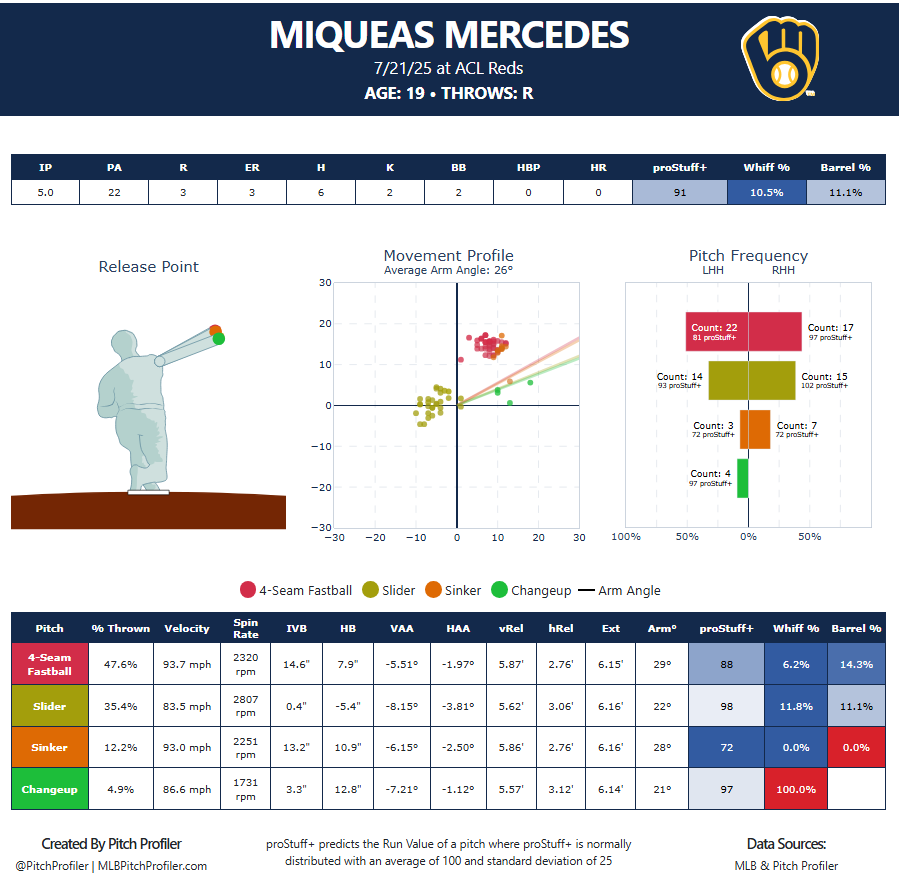
-
Mon. 7/21 - Three Complex Games in Store
Jake McKibbin replied to Jim Goulart's topic in Brewers Minor League Talk
Gabriel Colmenarez game summary. A lot of release point variation, and the stuff is representative of his age but I do like the movement profiles on his changeup quite a bit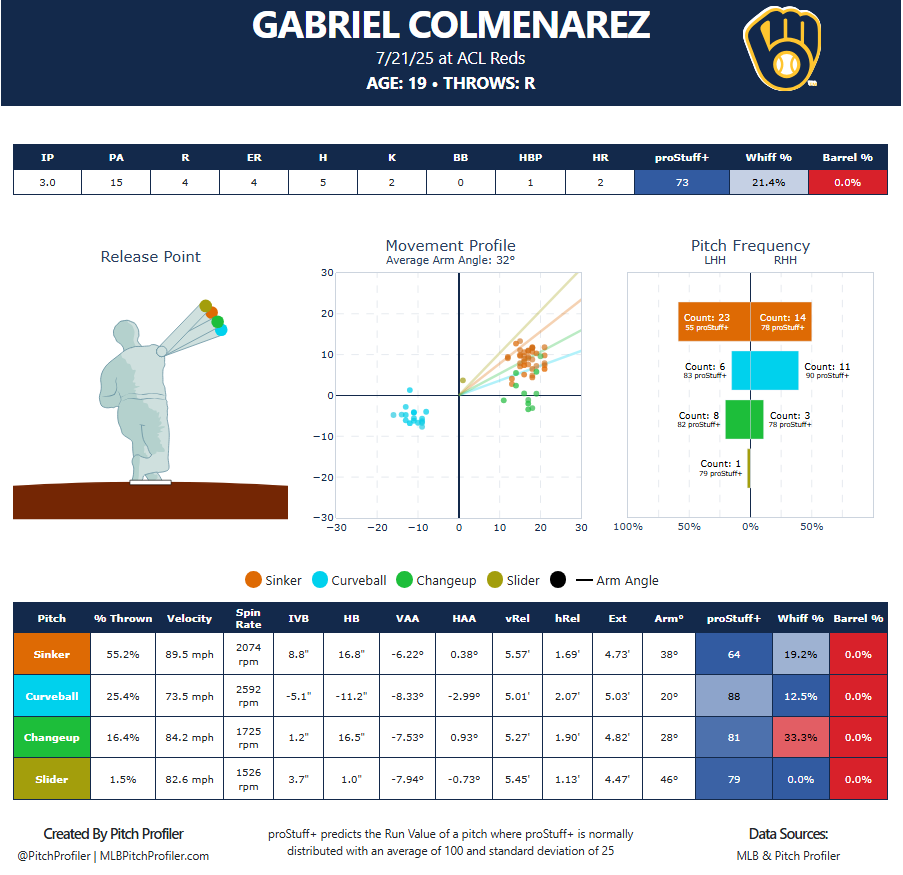
-
Mon. 7/21 - Three Complex Games in Store
Jake McKibbin replied to Jim Goulart's topic in Brewers Minor League Talk
Handelfry hit three batted balls over 105 mph yesterday -
 Ryan Helsley plays for the St Louis Cardinals. The Cardinals seemed determined to sell this season, despite looking like a solid contender for the playoffs for most of the season. It's a "Major League" type of problem for a club looking to reset, but it could play to the Brewers' advantage. Rumors are swirling that Ryan Helsley will be available at the deadline, and he could be the perfect complement to a Brewers bullpen that could perhaps strengthen its leverage spots. While Jared Koenig has performed admirably, he doesn't have the shutdown presence of Helsley, and a combination of the Cardinals bulldog with Trevor Megill and Abner Uribe could be truly devastating at the back end. While Helsley has been one of the best closers in baseball over the last few seasons, his walk rates have shot up and he has been prone to some hard contact. He profiles quite like the 2025 Megill in that his fastball whiffs have dried up but he's using his slider more often to devastating effect. His market will no doubt be strong, but his walk rates have surged and, by being a rental, the price may not be shockingly high for the Cardinals to part with their closer. Would you want to see Ryan Helsley pitching for your Milwaukee Brewers? What would you be willing trade for the rental closer?
 -
Ryan Helsley plays for the St Louis Cardinals. The Cardinals seemed determined to sell this season, despite looking like a solid contender for the playoffs for most of the season. It's a "Major League" type of problem for a club looking to reset, but it could play to the Brewers' advantage. Rumors are swirling that Ryan Helsley will be available at the deadline, and he could be the perfect complement to a Brewers bullpen that could perhaps strengthen its leverage spots. While Jared Koenig has performed admirably, he doesn't have the shutdown presence of Helsley, and a combination of the Cardinals bulldog with Trevor Megill and Abner Uribe could be truly devastating at the back end. While Helsley has been one of the best closers in baseball over the last few seasons, his walk rates have shot up and he has been prone to some hard contact. He profiles quite like the 2025 Megill in that his fastball whiffs have dried up but he's using his slider more often to devastating effect. His market will no doubt be strong, but his walk rates have surged and, by being a rental, the price may not be shockingly high for the Cardinals to part with their closer. Would you want to see Ryan Helsley pitching for your Milwaukee Brewers? What would you be willing trade for the rental closer? View full rumor
-
I won't break the paywall, but anyone with a BA subscription should take a loot at Eli-Ben Porats statcast standouts, covering Braylon Owens and, very very intriguingly, Parker Coil
-
Fascinating game coming up. It would be an incredible one to see Misiorowski pitch against Logan Gilbert for the 12, but the Mariners have been hot Cal Raleigh and Randy Arozarena are on fire of late
-
2025 Official Draft Signings Thread
Jake McKibbin replied to Jake McKibbin's topic in MLB Draft & International Signings
@brendannnbrock • Instagram photo WWW.INSTAGRAM.COM brendannnbrock on July 18, 2025: "Staying home ☝️ #boomer". Looks like Brendan Brock is staying with Oklahoma -
I'd say you're probably right that a few will filter through, with the tougher, later signings left until the end. They'll want to have a strong idea of their bonus pool before confirming those negotiations although they will have ballpark figures in mind
-
Tyler Black recalled as Jake Bauers on the 10 day IL with shoulder inflammation.
-
2025 Official Draft Signings Thread
Jake McKibbin replied to Jake McKibbin's topic in MLB Draft & International Signings
Updated in bold to show signings confirmed in the media, if not officially released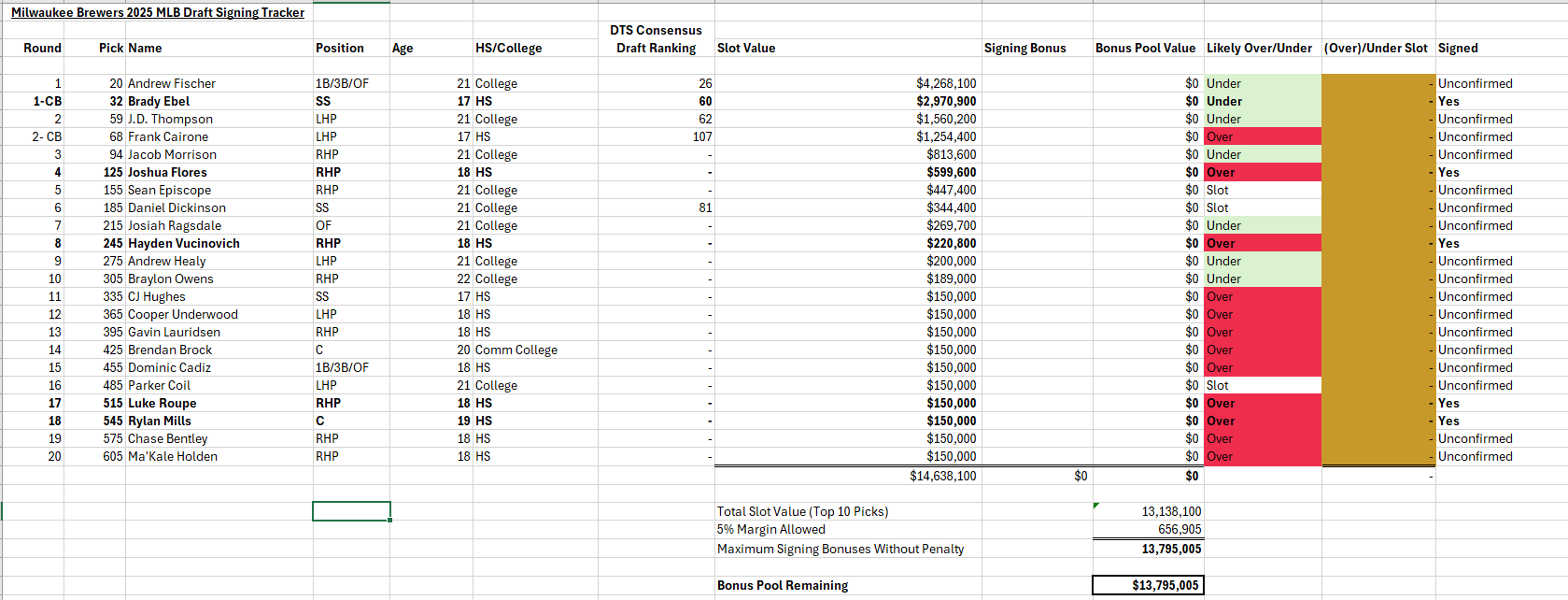
-
Theoretically yes, but the pitcher is unlikely to agree to that. These contracts have inherent compromises on both sides. Is a risk for the Brewers with the unknown of future performance, limited track record of Misiorowski's command and injury risks. For Misiorowski, he's worth far more than $25m AAV in free agency if he sustains this level of performance. Still it's a gamble both sides may be willing to take, trading future earnings potential for guaranteed life changing money, while the Brewers gamble on health and performance continuing.
-
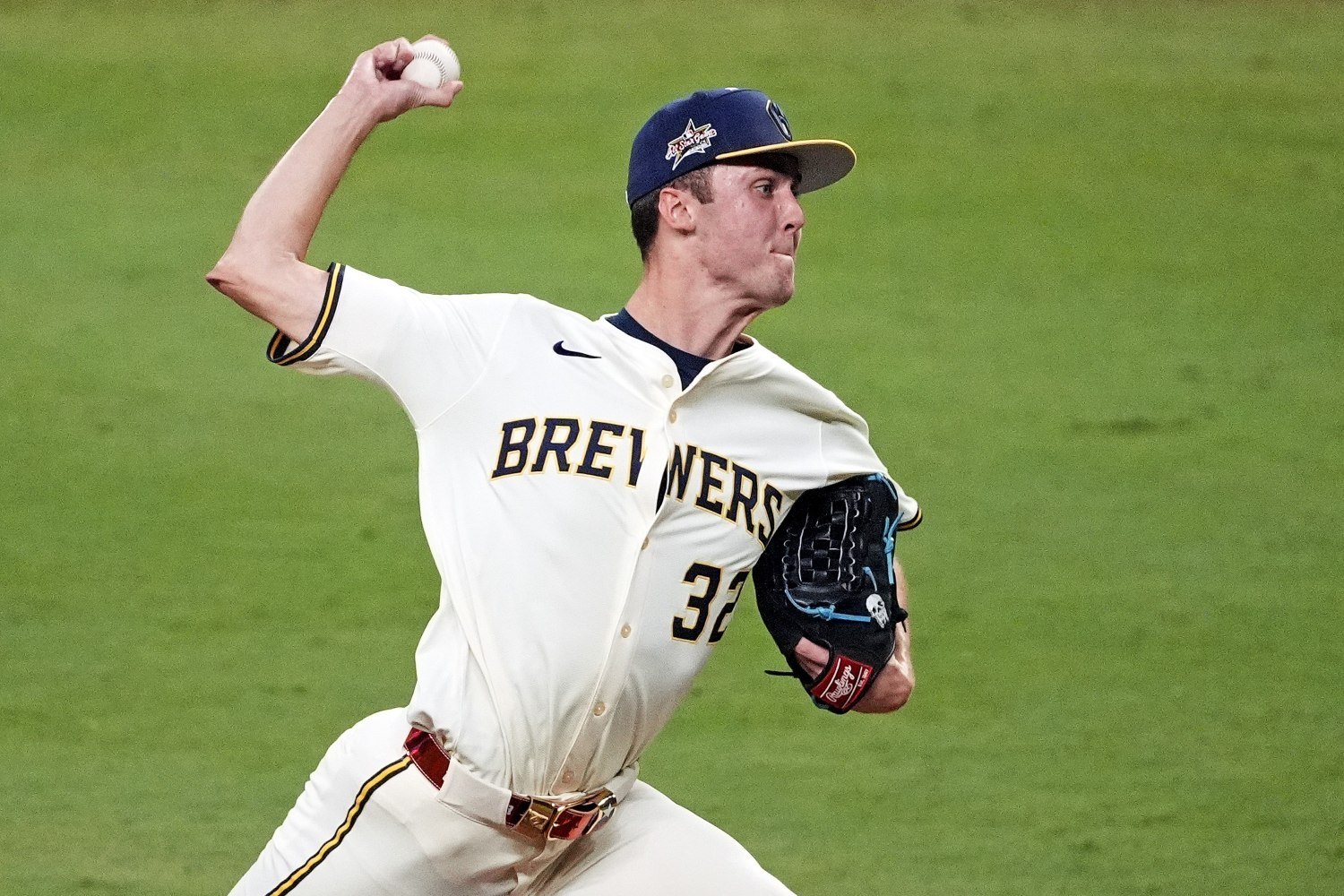 Jacob Misiorowski has taken the league by storm since his arrival, surpassing any and all expectations we may have had for his first five starts. He posted 11 straight scoreless, hitless innings to begin his career. The most devastating fastball perhaps in the history of starting pitchers. A 96-mph slider and a wipeout curveball. Oh, and he's pounding the strike zone, so far. All of the above have created a hype and buzz around the Brewers star that may be unparalleled in their history. Neither Corbin Burnes, Brandon Woodruff nor Freddy Peralta had this type of hype surrounding them. He's as big a deal as Ben Sheets was. Misiorowski is partly responsible for some roaring weekday crowds, including a Wednesday day game sell-out against Paul Skenes. Is it any wonder the front office want to lock him up for a longer term? The question is, what does a fair price look like for both sides? First, I'll go through some rationale, with the contract I'd recommend below: Are There Any Comparable Deals? Signing rookies to long-term extensions is becoming increasingly popular, particularly among the mid- and small-market teams. Jackson Chourio is a prime example, wherein the Brewers bought out his arbitration years, plus one additional season, for $82 million. For that investment, they received two team options for additional years at $25 million apiece, all before he had set foot on a big-league diamond. In summation, they may have bought out arbitration and four free-agent years for $132 million. Contrastingly, Jackson Merrill waited until after he had performed in the big leagues, surging to 2nd place in Rookie of the Year voting behind Skenes and, in the ensuing offseason, signed a nine-year deal worth $135 million, buying out five years of control and four years of free agency within that. The Padres also have a team option for 2035, and there are incentives that could take the contract value as high as $204 million. Between Chourio and Merrill, the main difference is that one contract includes one extra pre-arbitration year ($750,000 or so in expected salary), while the other has incentives that could net an additional $70 million during their time in San Diego. From that, we can surmise that with Jacob Misiorowski exploding onto the scene in such boisterous fashion, any deal will likely have a solid base with strong performance incentives that depend on a variety of factors—particularly, the volume of innings he pitches. It's always best to compare apples to apples, though, and if Chourio and Merrill are apples, Misiorowski (a pitcher) is a more exotic fruit. Maybe it's better to compare his prospective deal to those signed by Hunter Greene (six years, $53 million, with a club option that could push the money to $72 million and incentives that could get it to $80 million, all signed after one year of services) or Spencer Strider (six years, $75 million, plus an option that could push it to $92 million, signed at the same stage as Greene). At the end of this year, if Misiorowski finishes highly enough in Rookie of the Year balloting, he would effectively have the same amount of service time as Greene and Strider each did when they signed those deals. How Long Would the Contract Be For? The Brewers will want to buy out at least two years of Misiorowski's free agency. At present, were he to finish top two in Rookie of the Year voting, Misiorowski would have five years of control remaining. If not, there would be six years left. At 23 years old, the Brewers may want to keep their newfound ace until his age-30 or -31 season via a combination of confirmed contracted years and team options. As such, I would suggest the contract to be for eight years guaranteed, with one team option for a ninth year. The Brewers would want to do that at a fairly low annual average value, though, and unless they're more flexible than expected on that point, Misiorowski and his representatives might prefer a structure more akin to the Greene and Strider deals. So, How Much is Jacob Misiorowski Worth? In short: a lot. The phenom has already shown his ability to fill stadiums and bring back revenue from the talent in his right arm. To a front office, that's hugely important, in the same way as the revenue Shohei Ohtani brings in from Japan helps cover his Dodgers contract. On the flip side, pitchers have less of an impact than great hitters can (especially given modern constraints on workloads) and have a significantly higher risk of long-term injury. Let's assume, for the moment, that Misiorowski does place well enough in awards voting to earn his full year of service this fall. In that case, his salaries over the balance of his existing team control might look like this. 2026: $760,000 2027: $780,000 2028: $4 million 2029: $10 million 2030: $16 million These are slightly on the generous side of arbitration, assuming minimal injuries and some level of consistent dominance as a pitcher. So for those five years, the payout is probably going to be around $32 million, though it could go as high as $40m if he stays healthy. (He'll also make money via the league's newly created pre-arbitration bonus pools, but the Brewers don't have to pay him that money; it comes from the league's central fund.) Then comes the big part: free agency years. At this point, the Brewers can take a gamble that the version of Misiorowski we see now is not only going to stay at his current level of performance, but perhaps even continue to improve. He could regress; his command could waver, as it so often has in the past; or he could become weighed down with injuries. All of this needs to be taken into account, and the pitcher we see now could be vastly different in five or six years' time. Brandon Woodruff is a fairly recent example of just that. In the Strider deal, Atlanta gave their fireballer $48 million over the remaining term of his arbitration-eligible seasons, paying a bit of a premium for the right to backload that money (he'll make only $6 million total over the first three years of this deal, including 2025, and jump all the way to $20 million in 2026) and a below-market rate on his first year of would-be free agency, plus their club option thereafter. A similar structure for Misiorowski might include $40 million over the next five years, then $25 million or so in guarantees for 2031 and an option worth about the same amount in 2032. Incentives While they're in a similar market position to the Reds when they signed Greene, the Brewers have more other commitments (Christian Yelich, Chourio) than the Reds did. They also have less money to spend each year than Atlanta, and have to consider that in a way Atlanta didn't when inking Strider. Thus, they might need to approach Misiorowski with a deal that would buy down the above calculations to a lower guaranteed annual salary, by offering him some rich and reachable incentives. If the Brewers lowered the base value of Misiorowski's contract to a six-year deal for $55 million, with a team option at $28 million for year seven, that may be more palatable. On top of that, incentives that could add up to $25 million for Misiorowski, depending on innings pitched per season, awards voting and other honors (like All-Star selections). If it came with an opt-out clause or no-trade protection, for example, that could enhance the contract from the pitcher's side, directly earning his increased salary in a way the Brewers could agree to. They just need to avoid paying eight-figure salaries for a pitcher who can't take the mound; they'll happily pay for whatever production he manages when he's healthy enough to pitch. What Should The Brewers Offer For Jacob Misiorowski? For a start, six years and $60 million, with a club option for 2032 worth $28 million and a $5-million buyout. They could also include incentives worth up to $6 million per season, with about half that reachable based on innings alone. When Might A Deal Be Struck? In all likelihood, nothing will be arranged prior to this offseason. A lot of the expected value in this contract, on either side, hinges on whether or not Misiorowski is under team control for 2031, and we won't know that until awards votes are tabulated in November. If we reach next season and no deal has been struck, Misiorowski might rapidly price himself out of Milwaukee's reach. The pre-arbitration bonus pool certainly gives players more leverage in these negotiations. Jacob Misiorowski looks every bit a superstar. He reels in crowds and brings media spotlight and attention in a way not seen since 2019 Christian Yelich. A long-term deal could well be in the best interests of both parties, but can they come together to make a mutual agreement? Would you make the deal mentioned above? Is it too expensive? Too cheap? Let us know your thoughts in the comments below!
 -
Image courtesy of © Dale Zanine-Imagn Images Jacob Misiorowski has taken the league by storm since his arrival, surpassing any and all expectations we may have had for his first five starts. He posted 11 straight scoreless, hitless innings to begin his career. The most devastating fastball perhaps in the history of starting pitchers. A 96-mph slider and a wipeout curveball. Oh, and he's pounding the strike zone, so far. All of the above have created a hype and buzz around the Brewers star that may be unparalleled in their history. Neither Corbin Burnes, Brandon Woodruff nor Freddy Peralta had this type of hype surrounding them. He's as big a deal as Ben Sheets was. Misiorowski is partly responsible for some roaring weekday crowds, including a Wednesday day game sell-out against Paul Skenes. Is it any wonder the front office want to lock him up for a longer term? The question is, what does a fair price look like for both sides? First, I'll go through some rationale, with the contract I'd recommend below: Are There Any Comparable Deals? Signing rookies to long-term extensions is becoming increasingly popular, particularly among the mid- and small-market teams. Jackson Chourio is a prime example, wherein the Brewers bought out his arbitration years, plus one additional season, for $82 million. For that investment, they received two team options for additional years at $25 million apiece, all before he had set foot on a big-league diamond. In summation, they may have bought out arbitration and four free-agent years for $132 million. Contrastingly, Jackson Merrill waited until after he had performed in the big leagues, surging to 2nd place in Rookie of the Year voting behind Skenes and, in the ensuing offseason, signed a nine-year deal worth $135 million, buying out five years of control and four years of free agency within that. The Padres also have a team option for 2035, and there are incentives that could take the contract value as high as $204 million. Between Chourio and Merrill, the main difference is that one contract includes one extra pre-arbitration year ($750,000 or so in expected salary), while the other has incentives that could net an additional $70 million during their time in San Diego. From that, we can surmise that with Jacob Misiorowski exploding onto the scene in such boisterous fashion, any deal will likely have a solid base with strong performance incentives that depend on a variety of factors—particularly, the volume of innings he pitches. It's always best to compare apples to apples, though, and if Chourio and Merrill are apples, Misiorowski (a pitcher) is a more exotic fruit. Maybe it's better to compare his prospective deal to those signed by Hunter Greene (six years, $53 million, with a club option that could push the money to $72 million and incentives that could get it to $80 million, all signed after one year of services) or Spencer Strider (six years, $75 million, plus an option that could push it to $92 million, signed at the same stage as Greene). At the end of this year, if Misiorowski finishes highly enough in Rookie of the Year balloting, he would effectively have the same amount of service time as Greene and Strider each did when they signed those deals. How Long Would the Contract Be For? The Brewers will want to buy out at least two years of Misiorowski's free agency. At present, were he to finish top two in Rookie of the Year voting, Misiorowski would have five years of control remaining. If not, there would be six years left. At 23 years old, the Brewers may want to keep their newfound ace until his age-30 or -31 season via a combination of confirmed contracted years and team options. As such, I would suggest the contract to be for eight years guaranteed, with one team option for a ninth year. The Brewers would want to do that at a fairly low annual average value, though, and unless they're more flexible than expected on that point, Misiorowski and his representatives might prefer a structure more akin to the Greene and Strider deals. So, How Much is Jacob Misiorowski Worth? In short: a lot. The phenom has already shown his ability to fill stadiums and bring back revenue from the talent in his right arm. To a front office, that's hugely important, in the same way as the revenue Shohei Ohtani brings in from Japan helps cover his Dodgers contract. On the flip side, pitchers have less of an impact than great hitters can (especially given modern constraints on workloads) and have a significantly higher risk of long-term injury. Let's assume, for the moment, that Misiorowski does place well enough in awards voting to earn his full year of service this fall. In that case, his salaries over the balance of his existing team control might look like this. 2026: $760,000 2027: $780,000 2028: $4 million 2029: $10 million 2030: $16 million These are slightly on the generous side of arbitration, assuming minimal injuries and some level of consistent dominance as a pitcher. So for those five years, the payout is probably going to be around $32 million, though it could go as high as $40m if he stays healthy. (He'll also make money via the league's newly created pre-arbitration bonus pools, but the Brewers don't have to pay him that money; it comes from the league's central fund.) Then comes the big part: free agency years. At this point, the Brewers can take a gamble that the version of Misiorowski we see now is not only going to stay at his current level of performance, but perhaps even continue to improve. He could regress; his command could waver, as it so often has in the past; or he could become weighed down with injuries. All of this needs to be taken into account, and the pitcher we see now could be vastly different in five or six years' time. Brandon Woodruff is a fairly recent example of just that. In the Strider deal, Atlanta gave their fireballer $48 million over the remaining term of his arbitration-eligible seasons, paying a bit of a premium for the right to backload that money (he'll make only $6 million total over the first three years of this deal, including 2025, and jump all the way to $20 million in 2026) and a below-market rate on his first year of would-be free agency, plus their club option thereafter. A similar structure for Misiorowski might include $40 million over the next five years, then $25 million or so in guarantees for 2031 and an option worth about the same amount in 2032. Incentives While they're in a similar market position to the Reds when they signed Greene, the Brewers have more other commitments (Christian Yelich, Chourio) than the Reds did. They also have less money to spend each year than Atlanta, and have to consider that in a way Atlanta didn't when inking Strider. Thus, they might need to approach Misiorowski with a deal that would buy down the above calculations to a lower guaranteed annual salary, by offering him some rich and reachable incentives. If the Brewers lowered the base value of Misiorowski's contract to a six-year deal for $55 million, with a team option at $28 million for year seven, that may be more palatable. On top of that, incentives that could add up to $25 million for Misiorowski, depending on innings pitched per season, awards voting and other honors (like All-Star selections). If it came with an opt-out clause or no-trade protection, for example, that could enhance the contract from the pitcher's side, directly earning his increased salary in a way the Brewers could agree to. They just need to avoid paying eight-figure salaries for a pitcher who can't take the mound; they'll happily pay for whatever production he manages when he's healthy enough to pitch. What Should The Brewers Offer For Jacob Misiorowski? For a start, six years and $60 million, with a club option for 2032 worth $28 million and a $5-million buyout. They could also include incentives worth up to $6 million per season, with about half that reachable based on innings alone. When Might A Deal Be Struck? In all likelihood, nothing will be arranged prior to this offseason. A lot of the expected value in this contract, on either side, hinges on whether or not Misiorowski is under team control for 2031, and we won't know that until awards votes are tabulated in November. If we reach next season and no deal has been struck, Misiorowski might rapidly price himself out of Milwaukee's reach. The pre-arbitration bonus pool certainly gives players more leverage in these negotiations. Jacob Misiorowski looks every bit a superstar. He reels in crowds and brings media spotlight and attention in a way not seen since 2019 Christian Yelich. A long-term deal could well be in the best interests of both parties, but can they come together to make a mutual agreement? Would you make the deal mentioned above? Is it too expensive? Too cheap? Let us know your thoughts in the comments below! View full article
-
Qualifying offer for 2025 is expected to be a little over $20m for those wondering ($21.05 in 2024)
-
Brewers NDFA Signings - 2025
Jake McKibbin replied to Spencer Michaelis's topic in MLB Draft & International Signings
Awesome spot! Doing a little digging, and Perry seems to have an arsenal consisting of: - Fastball 88-93 mph - Cutter 84-88 mph - Curveball 76-79 mph - Changeup 80-84 mph The curve looks tasty here -
If I recall correctly, he was about to sign with Boston when the Brewers called. He mentioned in an interview a while back there hadn't actually been any communication from them up until that point, and Boston had a pretty comparable offer on the table
-
Brock Stewart for Marco Dinges, yes or no?
Jake McKibbin replied to Brock Beauchamp's topic in Transaction Rumors & Proposals
Yeah it seems like a trade proposal based less on Brewers needs, and more on pre-season rankings than anything. If Stewart wasn't injury prone and the Brewers desperately needed relief help then maybe, but Dinges is probably pushing his way towards top 5 prospect in the system by years end (not there yet, but certainly on his way in terms of pure upside) -
Cooper Underwood on going pro vs going to college: Also a little clip of Underwood from the MLB Draft combine (interesting the Brewers took two High school arms that boosted their stock significantly at the combine in Lauridsen and Underwood) https://www.mlb.com/video/cooper-underwood-strikes-out-two?partnerId=web_video-playback-page_video-share That curveball looks nasty for his age

(1).png.31e78184a82af4ea26f6a72a53b0c3f2.png)