



Matt Breen
-
Posts
9,112 -
Joined
-
Last visited
-
Days Won
1
Content Type
Profiles
Forums
Blogs
Events
News
2026 Milwaukee Brewers Top Prospects Ranking
Milwaukee Brewers Videos
2022 Milwaukee Brewers Draft Picks
Milwaukee Brewers Free Agent & Trade Rumors, Notes, & Tidbits
Guides & Resources
2023 Milwaukee Brewers Draft Picks
2024 Milwaukee Brewers Draft Picks
The Milwaukee Brewers Players Project
2025 Milwaukee Brewers Draft Pick Tracker
2026 Milwaukee Brewers Draft Tracker: Picks & Bonuses
Store
Downloads
Gallery
Everything posted by Matt Breen
-
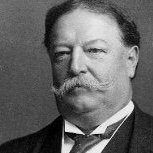 Despite their recent additions, the Brewers could still use infield help on Opening Day 2025. Image courtesy of © Gregory Fisher-Imagn Images The Brewers trade of Devin Williams to New York Yankees for Nestor Cortes and Caleb Durbin addresses a couple of glaring holes in the team’s roster: starting pitching and infield depth. But let’s not kid ourselves about Durbin - he will not be unquestioningly given a starting position in 2025. He might be a nice story, but some believe he projects as a utility player rather than an everyday infielder. Sure, Durbin can put the ball in play, and he has plus speed. But he doesn’t hit the ball hard, which limits his upside. Could Durbin be an everyday infielder in the majors? Yes, but the likelihood is small. No matter your take on Durbin, the Brewers should be looking at providing infield competition for 2025. With Joey Ortiz and Brice Turang, the team has flexibility in how they line up their defense. With that in mind, this article looks at three players who could handle second or third base next year in Milwaukee. None of these players has a sure starting spot in the big leagues in 2025, so they shouldn’t break the bank to acquire - assuming their teams are open to dealing them. Brett Baty, 3B, NY Mets Baty represents a guy with a bright pedigree who has lost his shine. Baty, drafted 12th overall in 2019, was a top 50 prospect a few years ago, hitting .300+ at Triple A with power. But he has underwhelmed at the major league level. Over the past two years, he's logged more than 500 at-bats yet has struggled with a .607 OPS. He has been surpassed at third base by Mark Vientos. By the way, a wild card is free agent Pete Alonso. Without Alonso, the club might be happy to shift Baty to first base. But the Mets are probably odds on being a favorite to bring back Alonso, leaving Baty without a position. The left-handed hitting Baty would be a risk due to his (thus far) failure to adapt to big league pitching. But the guy is still only 25 years old - and if the Brewers feel they can help him reach his potential, he's a 25+ home run bat who the club would control for five years. He would slide into the third base spot with Turang and Ortiz handling the middle of the infield. Justin Foscue, 2B, Texas Rangers The right-handed hitting Foscue was the 14th overall pick in 2020. He is a bat-first guy but lacks range and arm strength. That means he would slot into the Brewers lineup as a second baseman, with Turang and Ortiz covering shortstop and third base. Foscue has been a good (but not great) minor-league hitter. While his power has been good, his calling card has been his ability to get on base (career .388 OBP in the minors). He has walked more than he has struck out in the last two years at Triple A. Foscue has never hit over .300 as a pro, but he's also never hit below .266. His hit tool is very good, and his bat has potential for 20 home runs. The key is whether his glove can play at the big league level. Some believe he is destined for first base or designated hitter. Foscue's value probably dipped in 2024, when he had a short but terrible stint with the Rangers. He got only two hits in 42 at-bats. With Marcus Semien entrenched at second base, Foscue looks destined for first base and/or designated hitter duties in 2025 with Texas unless the Brewers can pry him away. Josh Smith, INF, Texas Rangers Back to Texas for another trade target. Left-handed hitting Josh Smith was a solid prospect for the Rangers - demonstrating a good hit tool in the minors but modest power. After struggling in 2022 and 2023 in extended time with Texas, he broke out last season after an injury to third baseman Josh Jung. Smith hit .258 with 13 home runs and played solid defense at the hot corner. The 27-year-old Smith could probably play second or third base for Milwaukee (he came up at shortstop but lacks range). He will likely never be a great defender, but he should be at least adequate. His bat would play just fine, but he likely won’t ever be a big home run hitter. Smith lacks a position for Texas, assuming Josh Jung comes back healthy. However, he would be a wonderful utility player. Still, Smith shouldn't be too expensive due to his lack of big upside. The Costs of Another Trade Each player profiled in this article has their positives - and negatives. Baty offers the big power the Brewers crave but probably the biggest bust potential. Smith is the safest of the three trade targets, with the highest floor - but the lowest ceiling. Foscue is probably the most solid all-around bat but lacks positional flexibility. All of the players have five or six years of control remaining. None of these three trade targets represents a huge expenditure to acquire. Tyler Black would be a player that could potentially net Smith or Foscue, either straight up or with some minor tweaking to seal the deal. Black is an overpay for Baty, but perhaps a trade could be centered around one of the Brewers' bullpen arms, such as Elvis Peguero. Or if the club wanted to dip into their minor league system, Mike Boeve or Yophery Rodriguez would work for Baty. Either player could be packaged with another prospect for Smith or Foscue. Ultimately, the club would be trading from depth for a position of need. View full article
 -
Nice deal for both teams. Gotta give up stuff for a high level player. Teel and Montgomery are really nice prospects. Still prospects, but the kinds of guys the White sox need to get. Boston gets a top of the rotation arm that isn't costing $200+ million.
-
I agree, it was weird we didn't protect Smith.
-
The Brewers have a need at third base and seem likely to trade Devin Williams. Here are three teams that line up with their needs. The Milwaukee Brewers have two holes in their 2025 roster. The first is an infield position with the expected loss of Willy Adames, and the second is rotation depth. This article will address the former. What follows are three proposals to acquire an infielder to try to make up for the loss of Adames. The Brewers must give up something of value to get something of value. So, each of these proposals will be centered around Devin Williams. The reason for this is the Brewers had one of the game’s best relief corps last year, and it looks like they could be exceptional again in 2025. That makes Williams a bit of a luxury. Each proposal focuses on the primary players involved but may have to be fleshed out to be completed. Trade Proposal #1 Mets get Devin Williams, RP Brewers get Ronny Mauricio, INF Mauricio missed all of 2024 with an ACL injury. Prior to that, he was a perennial top 100 prospect (generally ranking in the back half of the list). Mauricio has plus power, hitting 20 or more home runs each year from 2021-23. But he has a below-average hit tool, and his career walk rate is a weak 6.5%. Mauricio is a solid fielder with a very good arm. Where he would lineup for Milwaukee would depend; he has mostly played the middle infield slots, but he has some experience at third base where his strong arm would play well. Mauricio is a good prospect, not a great one. But he has six years of control and upside to go with the risk. Twenty home runs and a .250 BA aren't out of the question, but the team might have to be patient as Mauricio gets back up to speed after missing all of 2024. The Mets would have to figure out the pecking order of Williams and Edwin Diaz, but that’s not a bad thing to have to worry about. No matter, Williams would go a long way to helping the Mets bullpen, which ranked 17th in the majors in 2024. Trade Proposal #2 Phillies get Devin Williams, RP, and Tyler Black, OF Brewers get Alec Bohm, 3B Let's start with Tyler Black. His best position is probably left field. The Brewers have a lot of outfielders: Christian Yelich, Jackson Chourio, Blake Perkins, Garrett Mitchell, and Sal Frelick. So unless the club feels Black can play first base regularly (or they give him consistent at-bats at designated hitter), he's expendable. The Phillies' bullpen was mediocre last season, and they will likely lose one of their top relievers, Jeff Hoffman. So Williams would fit in nicely for a team looking to go all the way in 2025. Bohm would be controllable for two years and fill an obvious need at third (with Turang and Ortiz handling shortstop and second base). Bohm has hit between .274 and .280 in each of the past three years and should give the team 15-20 home runs. His defense has not been great, but improved dramatically in 2024. So if the team feels that improvement will stick, Bohm would nicely fill a position of great need. Trade Proposal #3 Tigers get Devin Williams, RP, and Tyler Black, OF Brewers get Jace Jung, 3B This idea is a stretch because the Tigers have no third baseman ready to step in without Jung. But there are rumors that Detroit might make a run at quality bat, and Alex Bregman is one of the best. Bregman would slot in nicely at third base for Detroit, offering exceptional all-around play. And if you want to connect some dots, Detroit's manager is former Houston skipper A.J. Hinch. Otherwise, Black would offer Detroit a potential left fielder to go with one of the game’s best closers in Williams. Jung - who generally falls in the latter half of Top 100 prospect lists - would get the first shot at the third base gig in Milwaukee. He is a former first-round pick and a solid bat in the minors, including above-average power. His 34-game stint with Detroit in 2024 was very mediocre - but not a disaster. His low salary and six years of control would be very attractive to Milwaukee. View full article
- 4 replies
-
- 1
-

-
- devin williams
- ronny mauricio
- (and 2 more)
-
Three Devin Williams Trades To Fill The Brewers Third Base Needs In 2025
Matt Breen posted an article in Brewers
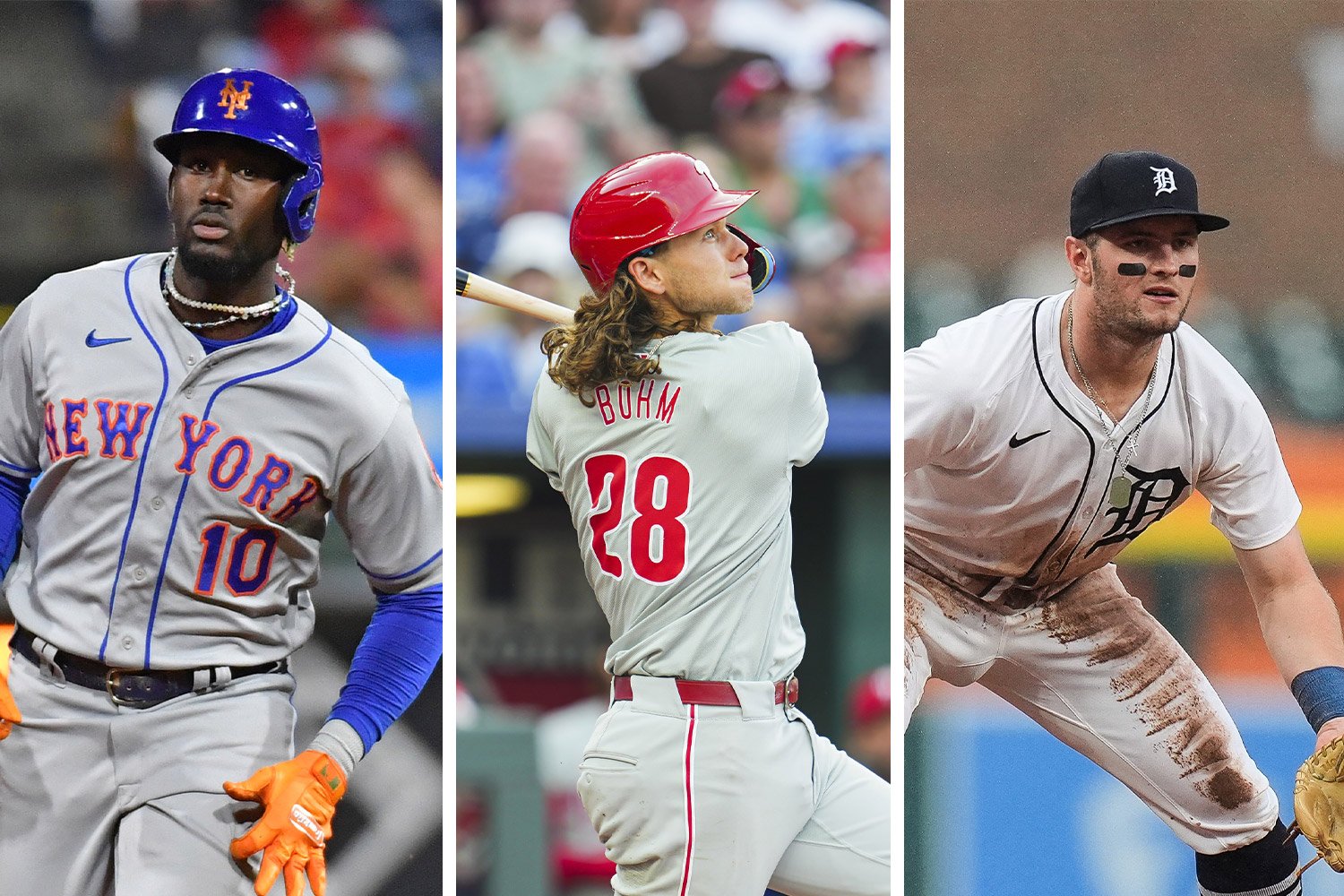 The Milwaukee Brewers have two holes in their 2025 roster. The first is an infield position with the expected loss of Willy Adames, and the second is rotation depth. This article will address the former. What follows are three proposals to acquire an infielder to try to make up for the loss of Adames. The Brewers must give up something of value to get something of value. So, each of these proposals will be centered around Devin Williams. The reason for this is the Brewers had one of the game’s best relief corps last year, and it looks like they could be exceptional again in 2025. That makes Williams a bit of a luxury. Each proposal focuses on the primary players involved but may have to be fleshed out to be completed. Trade Proposal #1 Mets get Devin Williams, RP Brewers get Ronny Mauricio, INF Mauricio missed all of 2024 with an ACL injury. Prior to that, he was a perennial top 100 prospect (generally ranking in the back half of the list). Mauricio has plus power, hitting 20 or more home runs each year from 2021-23. But he has a below-average hit tool, and his career walk rate is a weak 6.5%. Mauricio is a solid fielder with a very good arm. Where he would lineup for Milwaukee would depend; he has mostly played the middle infield slots, but he has some experience at third base where his strong arm would play well. Mauricio is a good prospect, not a great one. But he has six years of control and upside to go with the risk. Twenty home runs and a .250 BA aren't out of the question, but the team might have to be patient as Mauricio gets back up to speed after missing all of 2024. The Mets would have to figure out the pecking order of Williams and Edwin Diaz, but that’s not a bad thing to have to worry about. No matter, Williams would go a long way to helping the Mets bullpen, which ranked 17th in the majors in 2024. Trade Proposal #2 Phillies get Devin Williams, RP, and Tyler Black, OF Brewers get Alec Bohm, 3B Let's start with Tyler Black. His best position is probably left field. The Brewers have a lot of outfielders: Christian Yelich, Jackson Chourio, Blake Perkins, Garrett Mitchell, and Sal Frelick. So unless the club feels Black can play first base regularly (or they give him consistent at-bats at designated hitter), he's expendable. The Phillies' bullpen was mediocre last season, and they will likely lose one of their top relievers, Jeff Hoffman. So Williams would fit in nicely for a team looking to go all the way in 2025. Bohm would be controllable for two years and fill an obvious need at third (with Turang and Ortiz handling shortstop and second base). Bohm has hit between .274 and .280 in each of the past three years and should give the team 15-20 home runs. His defense has not been great, but improved dramatically in 2024. So if the team feels that improvement will stick, Bohm would nicely fill a position of great need. Trade Proposal #3 Tigers get Devin Williams, RP, and Tyler Black, OF Brewers get Jace Jung, 3B This idea is a stretch because the Tigers have no third baseman ready to step in without Jung. But there are rumors that Detroit might make a run at quality bat, and Alex Bregman is one of the best. Bregman would slot in nicely at third base for Detroit, offering exceptional all-around play. And if you want to connect some dots, Detroit's manager is former Houston skipper A.J. Hinch. Otherwise, Black would offer Detroit a potential left fielder to go with one of the game’s best closers in Williams. Jung - who generally falls in the latter half of Top 100 prospect lists - would get the first shot at the third base gig in Milwaukee. He is a former first-round pick and a solid bat in the minors, including above-average power. His 34-game stint with Detroit in 2024 was very mediocre - but not a disaster. His low salary and six years of control would be very attractive to Milwaukee.
 -
There's a joke here. Not sure what. But probably NSFW.
- 12 replies
-
- 3
-

-
- logan henderson
- chad patrick
- (and 1 more)
-
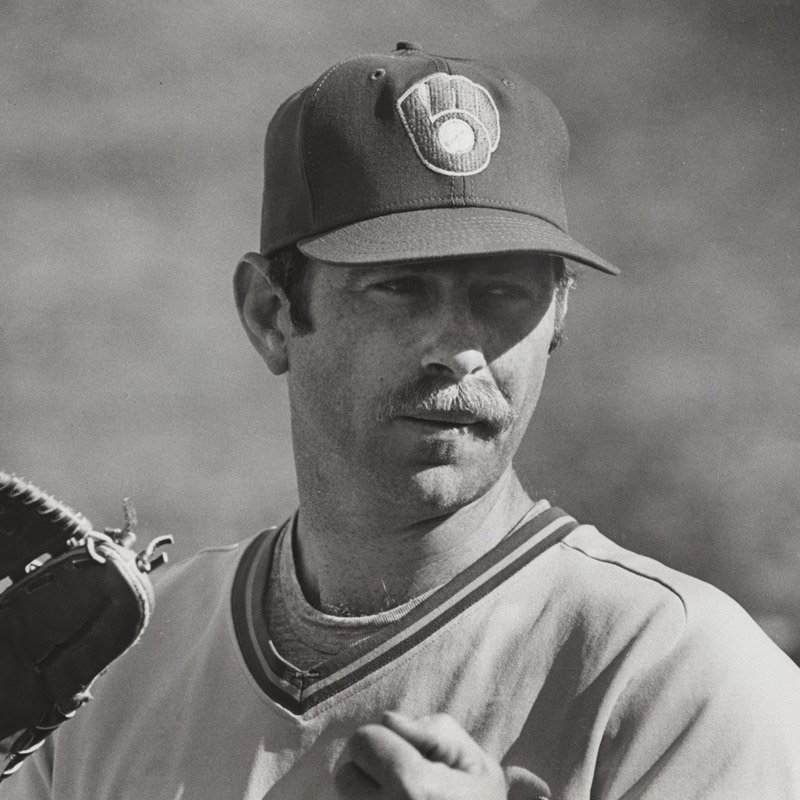 Mike Caldwell was nicknamed ‘Mr. Warmth.’ But let’s be clear: the name was dripping with irony. It was sort of like calling the 6’6” guy ‘Tiny.’ Caldwell was called many things during his playing days, including mean, fierce, nasty, obnoxious, and passionate. He is one of the finest pitchers ever to wear a Brewer uniform. Ralph Michael Caldwell was born in Tarboro, NC, on January 22, 1949. He went to North Carolina State University in 1968, had an outstanding collegiate pitching career, and graduated with a degree in sociology. But he was not a major pro prospect because he lacked loud skills and, thus, upside. He was selected in the 12th round pick of the 1971 amateur draft by the San Diego Padres. As a result of the lowly selection, Caldwell would have a chip on his shoulder - which would drive him relentlessly to succeed. As an advanced college pitcher, the right-handed Caldwell was promoted to the big leagues the same year he was drafted, after only 19 games in A ball. He never returned to the minors. Caldwell showed promise early on as he moved between starting and relieving. He had a great sinker, a good curve, and solid control. He spent two seasons in San Diego before being dealt to San Francisco in 1974. A breakout year he followed as he went 14-5 with a 2.95 ERA as a starter. Things were looking pretty good. However, the following year, Caldwell faltered as he struggled with bone spurs in his elbow. He soon returned to the reliever and spot starter role - and his numbers suffered. After the 1976 season, he was dealt to the Cardinals, who flipped him to Cincinnati. The book seemed to have been written on the 28-year-old Caldwell. He did whatever he was asked. He ate up innings but didn’t strike out a lot of batters. He showed flashes of being special but never enough to sustain real success. It led to mixed results. He had the trappings of a journeyman. No one, however, doubted his passion or competitiveness. Manager Don Zimmer said this of Caldwell: “He’s one of the fiercest competitors you’ll find in this business.” Caldwell worked 14 games as a reliever for the Reds in 1977 before being dealt to the Milwaukee Brewers for two minor leaguers. With the Crew, he remained in his typical role as a reliever and spot starter, with typical middling results. And then, in 1978, everything changed for Mr. Warmth. The team suffered some injuries early on to Moose Haas and Bill Travers - opening up a rotation spot. Caldwell got the nod - and what followed was one of the greatest seasons in Milwaukee Brewer history. Caldwell was brilliant. He posted a 22-9 record and a sparkling 2.36 ERA. He tossed an astounding 293 innings pitched, including 23 complete games. He was voted second in the Cy Young race and earned the American League Comeback Player of the Year Award. How did this happen? How did a journeyman pitcher turn into one of baseball’s best starters? The answer was Caldwell’s devastating sinker. It became the reliable ‘out’ pitch that he had never possessed. Caldwell credited manager George Bamberger with helping him refine his sinker - but the whispers behind the scenes said that Bamberger, a former pitching coach, had taught Caldwell how to master the spitter. Caldwell and Bamberger denied such allegations, which were never proven. 1978 was a fantastic year for Caldwell and the Brewers. The team was on the rise as Bambi’s Bombers threatened to bludgeon into submission opposing pitching staffs. But the year was also the high water mark for Caldwell. Bamberger was known to ride his starters long and hard and throwing nearly 300 innings took a toll on Caldwell’s arm. He loved the workload, but he was never the same again. Caldwell settled in as a serviceable starter for the Brewers for the next five years, always throwing more than 200 innings in a season, except for once. He was a solid but not elite starter, which was important for one of the hardest-hitting teams of the era. During his time in Milwaukee, Caldwell butted heads with others, especially manager Buck Rodgers. The two reportedly hated each other and some labeled Caldwell a cancer. He was thrilled when Rodgers was let go - for Harvey Kuehn - early in the 1982 season. Caldwell went on to have a memorable postseason that year, winning two games in the World Series. His first start was a shutout, while he gave up 14 hits over 8.1 innings in his second game. However, he gave up two hits in relief in the fateful game seven loss. Caldwell continued to take the ball every five days for Milwaukee until time and injuries began to catch up with him. A nagging ankle injury dogged Caldwell, and in 1984, he was limited to only 19 starts. It didn’t help that Caldwell’s name, along with Paul Molitor’s, came up in an investigation of drug use in the majors. No action was ever levied against Caldwell after a two-year investigation. In January of 1985, the Brewers elected to waive Caldwell. At 36, Caldwell still hoped to catch on with another major league team but no offer came. Perhaps it was his reputation as a clubhouse cancer. Or the drug allegations. But it was probably just that he was aging and falling apart, having worked more than 1,500 innings over the past seven years. And with that, Mike Caldwell’s career as a major league pitcher was over. He left Milwaukee as one of the best starting pitchers in franchise history, a position he still holds today. In his 7+ seasons in Milwaukee, Caldwell had a 102-80 record and a 3.74 ERA. He had double-digit wins for six consecutive seasons. His name is all over the leaderboards for the franchise. He is second in wins, innings pitched, and shutouts. He is in the top 10 of many other categories, including 5th in bWAR with 17.3. Caldwell holds the franchise record with an astounding 81 complete games, not likely to be broken. His 1978 season is one of the franchise’s best as he produced six shutouts and a bWAR of 8.2, the second most ever behind Teddy Higuera. During his career, Caldwell was known as a Yankee killer. From 1977 to 1982, he was 12–5 with a 2.66 ERA against the Bronx Bombers. Caldwell is also famous for brawling with Yankees star Reggie Jackson. Caldwell went inside on Jackson several times during a game after the Yankees had done so with the Brewers. Jackson took issue, and the resulting scrum lasted 12 minutes. After his major league career, Caldwell stayed active in the game, working for more than 20 years in the minor leagues as a pitching coach before retiring. He was inducted into the North Carolina State Hall of Fame in 2013 and the Brewers Wall of Honor in 2014.
 -
Mike Caldwell was nicknamed ‘Mr. Warmth.’ But let’s be clear: the name was dripping with irony. It was sort of like calling the 6’6” guy ‘Tiny.’ Caldwell was called many things during his playing days, including mean, fierce, nasty, obnoxious, and passionate. He is one of the finest pitchers ever to wear a Brewer uniform. Ralph Michael Caldwell was born in Tarboro, NC, on January 22, 1949. He went to North Carolina State University in 1968, had an outstanding collegiate pitching career, and graduated with a degree in sociology. But he was not a major pro prospect because he lacked loud skills and, thus, upside. He was selected in the 12th round pick of the 1971 amateur draft by the San Diego Padres. As a result of the lowly selection, Caldwell would have a chip on his shoulder - which would drive him relentlessly to succeed. As an advanced college pitcher, the right-handed Caldwell was promoted to the big leagues the same year he was drafted, after only 19 games in A ball. He never returned to the minors. Caldwell showed promise early on as he moved between starting and relieving. He had a great sinker, a good curve, and solid control. He spent two seasons in San Diego before being dealt to San Francisco in 1974. A breakout year he followed as he went 14-5 with a 2.95 ERA as a starter. Things were looking pretty good. However, the following year, Caldwell faltered as he struggled with bone spurs in his elbow. He soon returned to the reliever and spot starter role - and his numbers suffered. After the 1976 season, he was dealt to the Cardinals, who flipped him to Cincinnati. The book seemed to have been written on the 28-year-old Caldwell. He did whatever he was asked. He ate up innings but didn’t strike out a lot of batters. He showed flashes of being special but never enough to sustain real success. It led to mixed results. He had the trappings of a journeyman. No one, however, doubted his passion or competitiveness. Manager Don Zimmer said this of Caldwell: “He’s one of the fiercest competitors you’ll find in this business.” Caldwell worked 14 games as a reliever for the Reds in 1977 before being dealt to the Milwaukee Brewers for two minor leaguers. With the Crew, he remained in his typical role as a reliever and spot starter, with typical middling results. And then, in 1978, everything changed for Mr. Warmth. The team suffered some injuries early on to Moose Haas and Bill Travers - opening up a rotation spot. Caldwell got the nod - and what followed was one of the greatest seasons in Milwaukee Brewer history. Caldwell was brilliant. He posted a 22-9 record and a sparkling 2.36 ERA. He tossed an astounding 293 innings pitched, including 23 complete games. He was voted second in the Cy Young race and earned the American League Comeback Player of the Year Award. How did this happen? How did a journeyman pitcher turn into one of baseball’s best starters? The answer was Caldwell’s devastating sinker. It became the reliable ‘out’ pitch that he had never possessed. Caldwell credited manager George Bamberger with helping him refine his sinker - but the whispers behind the scenes said that Bamberger, a former pitching coach, had taught Caldwell how to master the spitter. Caldwell and Bamberger denied such allegations, which were never proven. 1978 was a fantastic year for Caldwell and the Brewers. The team was on the rise as Bambi’s Bombers threatened to bludgeon into submission opposing pitching staffs. But the year was also the high water mark for Caldwell. Bamberger was known to ride his starters long and hard and throwing nearly 300 innings took a toll on Caldwell’s arm. He loved the workload, but he was never the same again. Caldwell settled in as a serviceable starter for the Brewers for the next five years, always throwing more than 200 innings in a season, except for once. He was a solid but not elite starter, which was important for one of the hardest-hitting teams of the era. During his time in Milwaukee, Caldwell butted heads with others, especially manager Buck Rodgers. The two reportedly hated each other and some labeled Caldwell a cancer. He was thrilled when Rodgers was let go - for Harvey Kuehn - early in the 1982 season. Caldwell went on to have a memorable postseason that year, winning two games in the World Series. His first start was a shutout, while he gave up 14 hits over 8.1 innings in his second game. However, he gave up two hits in relief in the fateful game seven loss. Caldwell continued to take the ball every five days for Milwaukee until time and injuries began to catch up with him. A nagging ankle injury dogged Caldwell, and in 1984, he was limited to only 19 starts. It didn’t help that Caldwell’s name, along with Paul Molitor’s, came up in an investigation of drug use in the majors. No action was ever levied against Caldwell after a two-year investigation. In January of 1985, the Brewers elected to waive Caldwell. At 36, Caldwell still hoped to catch on with another major league team but no offer came. Perhaps it was his reputation as a clubhouse cancer. Or the drug allegations. But it was probably just that he was aging and falling apart, having worked more than 1,500 innings over the past seven years. And with that, Mike Caldwell’s career as a major league pitcher was over. He left Milwaukee as one of the best starting pitchers in franchise history, a position he still holds today. In his 7+ seasons in Milwaukee, Caldwell had a 102-80 record and a 3.74 ERA. He had double-digit wins for six consecutive seasons. His name is all over the leaderboards for the franchise. He is second in wins, innings pitched, and shutouts. He is in the top 10 of many other categories, including 5th in bWAR with 17.3. Caldwell holds the franchise record with an astounding 81 complete games, not likely to be broken. His 1978 season is one of the franchise’s best as he produced six shutouts and a bWAR of 8.2, the second most ever behind Teddy Higuera. During his career, Caldwell was known as a Yankee killer. From 1977 to 1982, he was 12–5 with a 2.66 ERA against the Bronx Bombers. Caldwell is also famous for brawling with Yankees star Reggie Jackson. Caldwell went inside on Jackson several times during a game after the Yankees had done so with the Brewers. Jackson took issue, and the resulting scrum lasted 12 minutes. After his major league career, Caldwell stayed active in the game, working for more than 20 years in the minor leagues as a pitching coach before retiring. He was inducted into the North Carolina State Hall of Fame in 2013 and the Brewers Wall of Honor in 2014. View full player
-
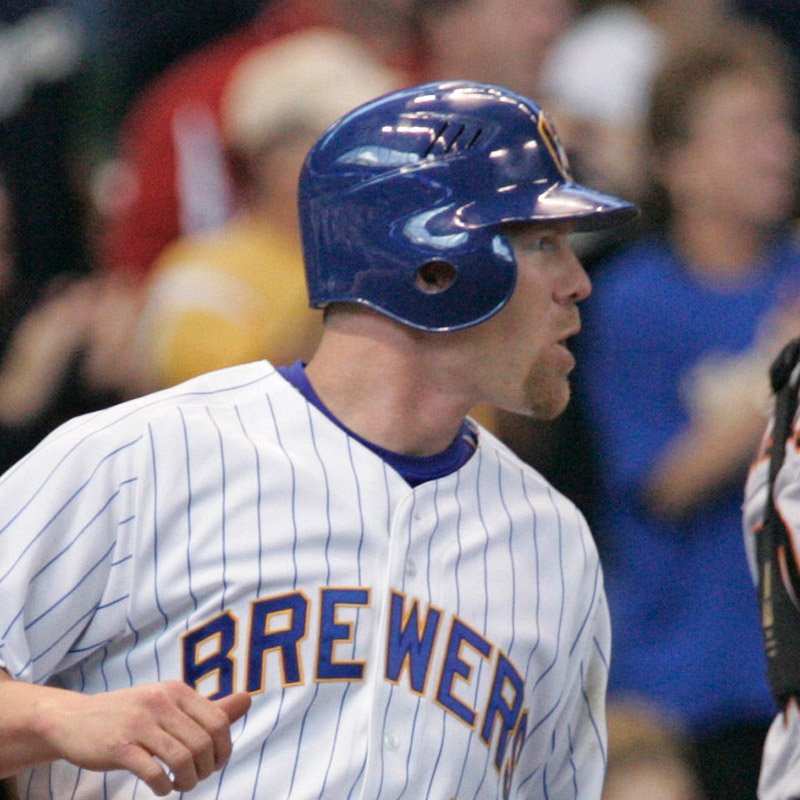 The list of developmental shortcomings includes Ty Hill, Ken Henderson, Gabby Martinez, Todd Dunn, Antone Williamson, Chad Green, J.M. Gold, Kyle Peterson, Ken Felder... you get the picture. However, the decade found a couple of gold nuggets in the first round. This included pitcher Ben Sheets in 1999 and outfielder Geoff Jenkins in 1995 - who would go on to have a stellar 10-year career with Milwaukee. Geoff Scott Jenkins was born in Olympia, Washington, on July 21, 1974. He was an outstanding athlete - growing up in Rancho Cordova, California. He attended USC to play college baseball and led the Trojans to the College World Series. He finished his career as one of the school’s best sluggers. The Brewers selected the left-handed hitting Jenkins in the first round of the 1995 draft - the 9th overall pick. He was seen as an advanced hitter with a good arm who could quickly climb the minor league ladder. He did well his first two seasons, then struggled during his first year at Triple A. However, he pounded opposing pitchers the following season and received a call to the big leagues. He hit a modest .229 in 84 games that season but broke out big the following year, hitting .313 (a career-high) with 21 home runs in 138 games. The following season, he hit 34 homers for a .303 average and Jenkins appeared to be a perennial All-Star in the making. Mainly playing left field, Jenkins quickly demonstrated several qualities (good and bad) that would mark him for most of his career. First, when healthy, he was a very good hitter. However, he was not a great hitter. He didn’t take a lot of walks, and he often struggled against the left-handed pitchers. Against the latter, he managed only a .712 OPS compared to a .871 average against right-handers. His struggles against lefties kept him from becoming an elite hitter. Second, Jenkins was constantly dinged by injuries throughout his career. He played the game hard, and he was often nursing nagging injuries. In 2002, he dislocated an ankle, causing him to miss more than half the year. Jenkins returned in 2003 to have an outstanding season - and make his only All-Star appearance. Jenkins continued to be a productive player for Milwaukee throughout his ten-year run and gamely switched to right field for two years to accommodate the acquisition of Carlos Lee in 2005. The fans appreciated his hard-nosed performances, not to mention the 200+ homers he hit for the club. Jenkins continued to produce at the plate as he moved into his 30s. However, his inability to hit lefties became more pronounced - and he often sat against southpaws. After the 2007 season, with his contract up, the Brewers elected to let the 32-year-old Jenkins go as a free agent after ten years with the club. He signed with Philadelphia and began the season as their left fielder. However, as the season progressed, and he struggled at the plate he found himself on the bench more and more. Jenkins’ numbers were not good that year, and by the time the postseason came around (the first time Jenkins had ever been in the playoffs), he was strictly a benchwarmer - and there was even talk of keeping him off the postseason roster. Jenkins got only four at-bats in the 2008 playoffs and only a single hit. But that hit was a memorable one. In the series finale, he crushed a key double and scored a run, helping the Phillies win the World Series. Philadelphia released Jenkins the following March, and his playing career was over. He was 34 years old. He officially retired in 2010 after signing a one-day contract with the Brewers. Geoff Jenkins was one of the most productive members of the Brewers organization during his 10-year tenure. For his career, he ranks 10th in bWAR, 7th for games played, 6th in hits, 5th in doubles, and 4th in HRs. He hit .300+ twice and represented the Brewers at the All-Star game. Of note: Jenkins is one of only eight players in major league history to strike out six times in a game. Also, he was frequently misidentified as Packers quarterback Brett Favre. In retirement, Jenkins has become the owner of Arizona's sports fitness training facility, where he resides with his family. Geoff Jenkins was a really good ballplayer for the Milwaukee Brewers. He played hard, put up solid numbers, and stayed loyal to the franchise and the fans. He tended to go into slumps and struck out a lot - frustrating many - but as his .843 OPS and 200+ home runs attest, he could hit. The tough thing for Jenkins was having to be a part of so many bad teams during his tenure. In his time in Milwaukee, only one team - his last - was above .500. He never made it to the playoffs with the franchise. While his one year in Philadelphia was not the most memorable, he came away with a World Series ring - a nice way to top off a career.
 -
The list of developmental shortcomings includes Ty Hill, Ken Henderson, Gabby Martinez, Todd Dunn, Antone Williamson, Chad Green, J.M. Gold, Kyle Peterson, Ken Felder... you get the picture. However, the decade found a couple of gold nuggets in the first round. This included pitcher Ben Sheets in 1999 and outfielder Geoff Jenkins in 1995 - who would go on to have a stellar 10-year career with Milwaukee. Geoff Scott Jenkins was born in Olympia, Washington, on July 21, 1974. He was an outstanding athlete - growing up in Rancho Cordova, California. He attended USC to play college baseball and led the Trojans to the College World Series. He finished his career as one of the school’s best sluggers. The Brewers selected the left-handed hitting Jenkins in the first round of the 1995 draft - the 9th overall pick. He was seen as an advanced hitter with a good arm who could quickly climb the minor league ladder. He did well his first two seasons, then struggled during his first year at Triple A. However, he pounded opposing pitchers the following season and received a call to the big leagues. He hit a modest .229 in 84 games that season but broke out big the following year, hitting .313 (a career-high) with 21 home runs in 138 games. The following season, he hit 34 homers for a .303 average and Jenkins appeared to be a perennial All-Star in the making. Mainly playing left field, Jenkins quickly demonstrated several qualities (good and bad) that would mark him for most of his career. First, when healthy, he was a very good hitter. However, he was not a great hitter. He didn’t take a lot of walks, and he often struggled against the left-handed pitchers. Against the latter, he managed only a .712 OPS compared to a .871 average against right-handers. His struggles against lefties kept him from becoming an elite hitter. Second, Jenkins was constantly dinged by injuries throughout his career. He played the game hard, and he was often nursing nagging injuries. In 2002, he dislocated an ankle, causing him to miss more than half the year. Jenkins returned in 2003 to have an outstanding season - and make his only All-Star appearance. Jenkins continued to be a productive player for Milwaukee throughout his ten-year run and gamely switched to right field for two years to accommodate the acquisition of Carlos Lee in 2005. The fans appreciated his hard-nosed performances, not to mention the 200+ homers he hit for the club. Jenkins continued to produce at the plate as he moved into his 30s. However, his inability to hit lefties became more pronounced - and he often sat against southpaws. After the 2007 season, with his contract up, the Brewers elected to let the 32-year-old Jenkins go as a free agent after ten years with the club. He signed with Philadelphia and began the season as their left fielder. However, as the season progressed, and he struggled at the plate he found himself on the bench more and more. Jenkins’ numbers were not good that year, and by the time the postseason came around (the first time Jenkins had ever been in the playoffs), he was strictly a benchwarmer - and there was even talk of keeping him off the postseason roster. Jenkins got only four at-bats in the 2008 playoffs and only a single hit. But that hit was a memorable one. In the series finale, he crushed a key double and scored a run, helping the Phillies win the World Series. Philadelphia released Jenkins the following March, and his playing career was over. He was 34 years old. He officially retired in 2010 after signing a one-day contract with the Brewers. Geoff Jenkins was one of the most productive members of the Brewers organization during his 10-year tenure. For his career, he ranks 10th in bWAR, 7th for games played, 6th in hits, 5th in doubles, and 4th in HRs. He hit .300+ twice and represented the Brewers at the All-Star game. Of note: Jenkins is one of only eight players in major league history to strike out six times in a game. Also, he was frequently misidentified as Packers quarterback Brett Favre. In retirement, Jenkins has become the owner of Arizona's sports fitness training facility, where he resides with his family. Geoff Jenkins was a really good ballplayer for the Milwaukee Brewers. He played hard, put up solid numbers, and stayed loyal to the franchise and the fans. He tended to go into slumps and struck out a lot - frustrating many - but as his .843 OPS and 200+ home runs attest, he could hit. The tough thing for Jenkins was having to be a part of so many bad teams during his tenure. In his time in Milwaukee, only one team - his last - was above .500. He never made it to the playoffs with the franchise. While his one year in Philadelphia was not the most memorable, he came away with a World Series ring - a nice way to top off a career. View full player
-
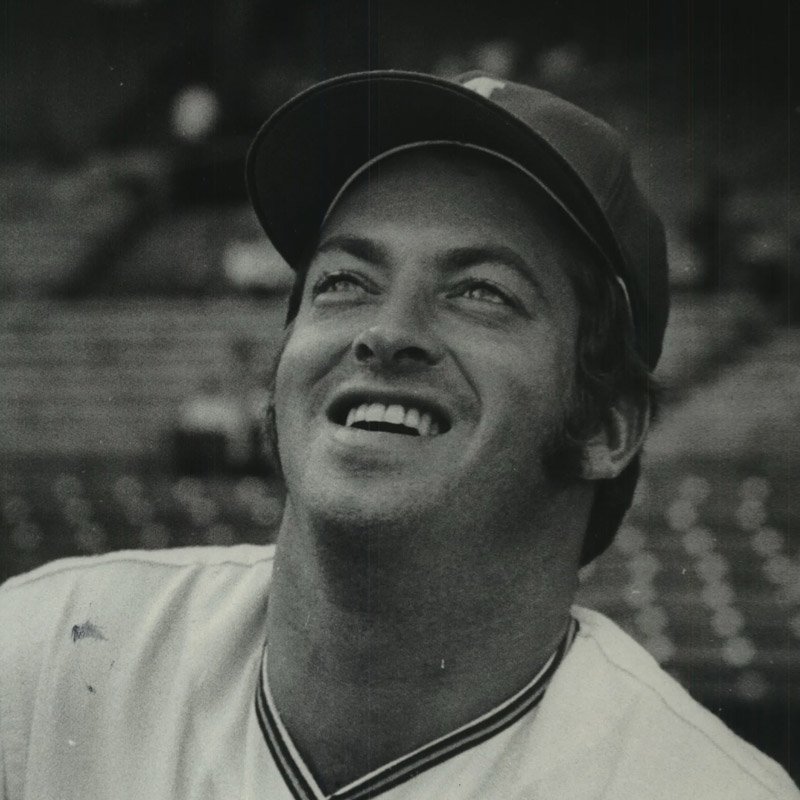 Ken George Sanders was born in St. Louis, Missouri on July 8, 1941. He attended high school in St. Louis, where he starred in football, baseball, and soccer. After graduation, Sanders briefly went to St. Louis University before signing with the Kansas City Athletics as a free agent in 1960. In his first season in D-affiliate ball, Sanders threw an astounding 240 innings, racking up 22 complete games and 19 wins - all while still a teenager. The next few years saw Sanders find middling success, and in 1964, he was converted to a full-time reliever. He made his major league debut later that year. Sanders spent the rest of the 1960s bouncing between the major and minor leagues including time in Oakland, Boston, and Kansas City. At times, he struggled with his control, walking too many batters. Still, he was mostly effective; his ERA was never more than 3.80. And then, before the 1970 season, Sanders was dealt by the A’s to the Brewers, along with Mike Hershberger, Lew Krausse Jr., and Phil Roof in exchange for Don Mincher and Ron Clark. The 28-year-old Sanders began the season at Spokane, the Brewers Triple-A affiliate, before getting the call to Milwaukee. What followed was Sanders' greatest stint in baseball. That season, he was outstanding, tossing 92 innings to the tune of a 1.75 ERA. He also had 13 saves and demonstrated improved command. Brewers Manager Dave Bristol nicknamed Sanders ‘Bulldog’ because he was “So mean, tough and stubborn on the mound.” It was great stuff - but even better was yet to come. In 1971, Sanders had the finest campaign of his career. Operating as the club’s closer, he appeared in 83 games, threw 136 innings, and had 31 saves - the latter leading the majors. It was all highlighted by a sparkling 1.91 ERA, plus a major league record 77 games finished. He was selected as the Brewers MVP. For his stellar campaign, Sanders was named Fireman of the Year by the Sporting News and even received MVP votes - the first Brewer pitcher to ever do so. The 1972 season began well for Sanders, but some mid-season struggles saw him removed from the closer’s role as manager Del Crandall lost faith in him. Sanders's numbers - 92 IP, 3.12 ERA, and 17 saves - were respectable but far from the heights of his previous work with the club. In the offseason, the Brewers decided to move on from Sanders, trading him to Philadelphia along with Jim Lonborg, Ken Brett, and Earl Stephenson in exchange for Don Money, John Vukovich, and Bill Champion. The Phillies flipped Sanders to Minnesota a month later. Sanders spent the next four years on five major league teams (as well as some minor league clubs) - sometimes pitching well, sometimes not so good. In 1977, he rejoined the Brewers organization, tossing 30 ineffective innings at Triple-A Spokane. After that, he knew the writing was on the wall and retired. Ken Sanders was 35 years old. After his retirement, Sanders stayed in the Milwaukee area, living in Hales Corners, where he and his wife, Mary Ann - his childhood sweetheart - raised three children. Sanders began a career in real estate and then moved into banking. One interesting tidbit where real estate and baseball came together was when Sanders, in 2013, was the listing agent for the Field of Dreams site in Iowa. Sanders stayed involved in baseball in retirement, serving on the MLB Players Alumni Association board for 20 years and participating in various fantasy camps for two decades. Sanders, 82 as of this article, splits his time between Milwaukee and Florida. Ken Sanders was, at first glance, the very definition of a journeyman ball player. 18 seasons. Parts of 13 years in the minor leagues. Eight major league teams over 11 years. But he was, when given the opportunity, effective. He has a lifetime ERA of 2.97 in 409 games and 656 innings pitched. That includes 86 saves. Sanders' time in Milwaukee (less than three full seasons) defines him in most fans' eyes. Yes, it was a short run but the 1970-71 stint was brilliant. Sanders still holds the Brewers record for the most games pitched in a season, 83, tied with Alex Claudio. And his 77 games finished that same year - is a team record. He is one of only two Brewers to win the Fireman of the Year award (the other being Rollie Fingers). The award was discontinued in 2011. So hats off to Ken Sanders - who saved (pun intended) his very best for Milwaukee.
 -
Ken George Sanders was born in St. Louis, Missouri on July 8, 1941. He attended high school in St. Louis, where he starred in football, baseball, and soccer. After graduation, Sanders briefly went to St. Louis University before signing with the Kansas City Athletics as a free agent in 1960. In his first season in D-affiliate ball, Sanders threw an astounding 240 innings, racking up 22 complete games and 19 wins - all while still a teenager. The next few years saw Sanders find middling success, and in 1964, he was converted to a full-time reliever. He made his major league debut later that year. Sanders spent the rest of the 1960s bouncing between the major and minor leagues including time in Oakland, Boston, and Kansas City. At times, he struggled with his control, walking too many batters. Still, he was mostly effective; his ERA was never more than 3.80. And then, before the 1970 season, Sanders was dealt by the A’s to the Brewers, along with Mike Hershberger, Lew Krausse Jr., and Phil Roof in exchange for Don Mincher and Ron Clark. The 28-year-old Sanders began the season at Spokane, the Brewers Triple-A affiliate, before getting the call to Milwaukee. What followed was Sanders' greatest stint in baseball. That season, he was outstanding, tossing 92 innings to the tune of a 1.75 ERA. He also had 13 saves and demonstrated improved command. Brewers Manager Dave Bristol nicknamed Sanders ‘Bulldog’ because he was “So mean, tough and stubborn on the mound.” It was great stuff - but even better was yet to come. In 1971, Sanders had the finest campaign of his career. Operating as the club’s closer, he appeared in 83 games, threw 136 innings, and had 31 saves - the latter leading the majors. It was all highlighted by a sparkling 1.91 ERA, plus a major league record 77 games finished. He was selected as the Brewers MVP. For his stellar campaign, Sanders was named Fireman of the Year by the Sporting News and even received MVP votes - the first Brewer pitcher to ever do so. The 1972 season began well for Sanders, but some mid-season struggles saw him removed from the closer’s role as manager Del Crandall lost faith in him. Sanders's numbers - 92 IP, 3.12 ERA, and 17 saves - were respectable but far from the heights of his previous work with the club. In the offseason, the Brewers decided to move on from Sanders, trading him to Philadelphia along with Jim Lonborg, Ken Brett, and Earl Stephenson in exchange for Don Money, John Vukovich, and Bill Champion. The Phillies flipped Sanders to Minnesota a month later. Sanders spent the next four years on five major league teams (as well as some minor league clubs) - sometimes pitching well, sometimes not so good. In 1977, he rejoined the Brewers organization, tossing 30 ineffective innings at Triple-A Spokane. After that, he knew the writing was on the wall and retired. Ken Sanders was 35 years old. After his retirement, Sanders stayed in the Milwaukee area, living in Hales Corners, where he and his wife, Mary Ann - his childhood sweetheart - raised three children. Sanders began a career in real estate and then moved into banking. One interesting tidbit where real estate and baseball came together was when Sanders, in 2013, was the listing agent for the Field of Dreams site in Iowa. Sanders stayed involved in baseball in retirement, serving on the MLB Players Alumni Association board for 20 years and participating in various fantasy camps for two decades. Sanders, 82 as of this article, splits his time between Milwaukee and Florida. Ken Sanders was, at first glance, the very definition of a journeyman ball player. 18 seasons. Parts of 13 years in the minor leagues. Eight major league teams over 11 years. But he was, when given the opportunity, effective. He has a lifetime ERA of 2.97 in 409 games and 656 innings pitched. That includes 86 saves. Sanders' time in Milwaukee (less than three full seasons) defines him in most fans' eyes. Yes, it was a short run but the 1970-71 stint was brilliant. Sanders still holds the Brewers record for the most games pitched in a season, 83, tied with Alex Claudio. And his 77 games finished that same year - is a team record. He is one of only two Brewers to win the Fireman of the Year award (the other being Rollie Fingers). The award was discontinued in 2011. So hats off to Ken Sanders - who saved (pun intended) his very best for Milwaukee. View full player
-
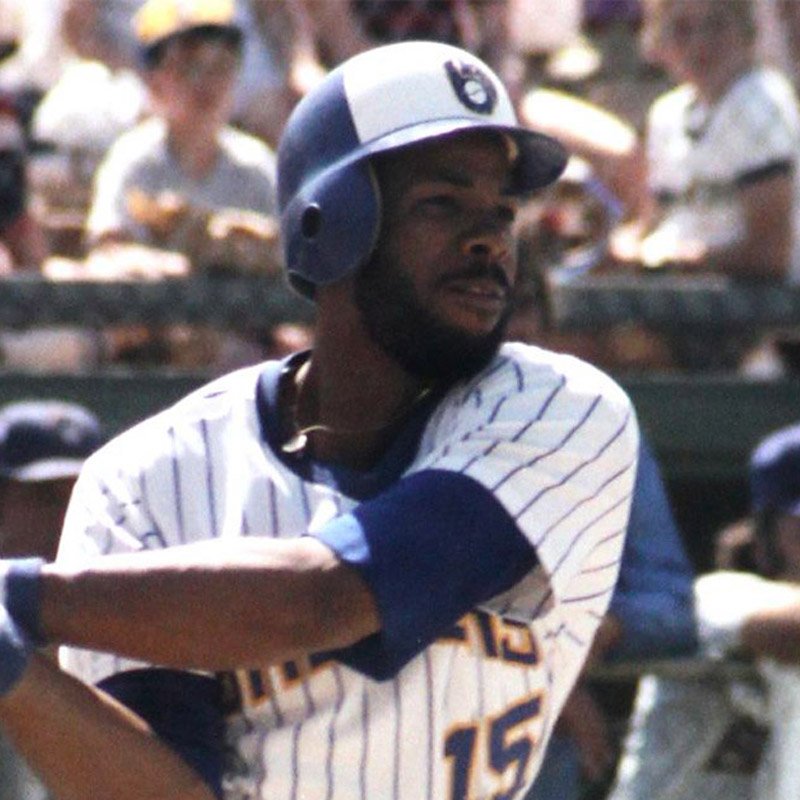 Cecil Celester Cooper was born in Brenham, Texas, on December 20, 1949. He was the youngest of 13 children. His father may have played in the Negro Leagues - but that story is a little murky. Cecil’s older brothers were accomplished baseball players - two of whom played for the barnstorming Indianapolis Clowns. One of his brothers - Sylvester - once caught Satchel Paige. The tall, lanky, left-handed hitting Cecil Cooper was drafted by the Boston Red Sox in the 6th round of the 1968 draft. And it was quickly apparent that Cecil Cooper could hit the ball. His minor league stops include batting averages of .336, .354, .379, and .452 (yes, .452, albeit on only 84 at-bats). His career minor league batting average was .327. Cooper made his major league debut in September of 1971 at 21. However, Cooper had a few obstacles breaking into the Red Sox lineup. Defensively, he struggled - limiting him to first base and designated hitter. The Sox moved an aging Carl Yastrzemski to first in 1973 and already had Orlando Cepeda at DH. Also, while Cooper hit for average, he didn’t have much power. He finally got a chance to stick with the Red Sox in 1974, getting 400+ at-bats and hitting a solid .275 with eight home runs. For the next two years, Cooper played semi-regularly - and continued to show modest - but emerging - power and high batting averages. He appeared primed to break out as a full-time player. And then, in December of 1976, Boston traded away Cooper to Milwaukee - bringing back their former first baseman (the slugging George Scott) along with outfielder Bernie Carbo. The trade was not popular with either club. And while Scott had a monster in 1977, Cooper became a legend in Milwaukee. Cooper hit .300 or better for seven straight years and averaged 20+ home runs. His stance closely mimicked that of the great Rod Carew, allowing him to become an excellent hitter to the opposite field. He even snagged a pair of Gold Gloves during that time. Cooper’s finest season was in 1980 when he hit a whopping .352 and led the majors in total bases and RBIs. He was a key cog in the great Brewer clubs of the era, rivaling Yount and Molitor. If Cooper had any chinks in his armor, it was his free-swinging approach at the plate. He just didn’t walk very often. But that is a minor ding when you are hitting .300+. As Cooper aged, his power faded - and eventually, his batting average. In 1985, at 35, he hit .293 with 16 home runs. The following season - his last full-time player - his numbers dropped to .258 and a dozen HRs. The Crew ran Cooper out for one more season, but his numbers only worsened. By mid-season, he was let go. No one wanted an aging first baseman with a fading bat - and thus, his career was over. Most men would die for Cecil Cooper’s career as a player: 2,192 hits, 248 HRs, and a .298 average. He appeared in five All-Star games, won two Gold Gloves, finished in the top 5 in MVP votes three times, and was a key World Series team member in 1982. Cooper’s stats are even more impressive when you consider he never really achieved full-time playing status until he arrived in Milwaukee. As a Brewer, he ranks at the top of many of the club’s hitting categories. He is 4th in bWAR, 3rd in batting average (.302), 5th in games played (1490), 6th in HRs (201) - the list goes on and on. His single-season average of .352 in 1980 is the team’s second-best, just behind Paul Molitor’s .353 in 1987. His ability and longevity place him in the top 10 of most Brewer records. The other impressive thing about Cooper was his contributions off the field. He was heavily involved in charity and community efforts. In 1983, he was awarded baseball’s coveted Roberto Clemente Award for humanitarian and community service. After his playing career was over, Cooper spent some time as an agent, then in 1996, joined the Brewers as farm director. He then turned to coaching - becoming Milwaukee’s bench coach in 2002. After a stint managing in the minors and another year as a bench coach in Houston, he was named the Astros manager, serving in that capacity from 2007-2009. He had middling success as a manager and was let go at the end of the 2009 season. After that, he retired. Cooper was inducted into the Brewer Walk of Fame in 2002 and was elected to the Wisconsin Athletic Hall of Fame in 2007. He now lives in Katy, Texas, with his wife Octavia. Cecil Cooper was a great player on some of the best teams in Brewer history. But he was a quiet, unassuming man - often overshadowed by his more flashy teammates and oversized personalities - such as Robin Yount, Paul Molitor, and Gorman Thomas. And even when Cooper had an amazing season, such as the year he hit .352, George Brett hit an astounding .390, limiting his exposure throughout baseball. No matter, Cecil Cooper was a rock in the Brewer lineup for a decade and just hitting year after year. His teammates loved him, and so did the fans.
 -
Cecil Celester Cooper was born in Brenham, Texas, on December 20, 1949. He was the youngest of 13 children. His father may have played in the Negro Leagues - but that story is a little murky. Cecil’s older brothers were accomplished baseball players - two of whom played for the barnstorming Indianapolis Clowns. One of his brothers - Sylvester - once caught Satchel Paige. The tall, lanky, left-handed hitting Cecil Cooper was drafted by the Boston Red Sox in the 6th round of the 1968 draft. And it was quickly apparent that Cecil Cooper could hit the ball. His minor league stops include batting averages of .336, .354, .379, and .452 (yes, .452, albeit on only 84 at-bats). His career minor league batting average was .327. Cooper made his major league debut in September of 1971 at 21. However, Cooper had a few obstacles breaking into the Red Sox lineup. Defensively, he struggled - limiting him to first base and designated hitter. The Sox moved an aging Carl Yastrzemski to first in 1973 and already had Orlando Cepeda at DH. Also, while Cooper hit for average, he didn’t have much power. He finally got a chance to stick with the Red Sox in 1974, getting 400+ at-bats and hitting a solid .275 with eight home runs. For the next two years, Cooper played semi-regularly - and continued to show modest - but emerging - power and high batting averages. He appeared primed to break out as a full-time player. And then, in December of 1976, Boston traded away Cooper to Milwaukee - bringing back their former first baseman (the slugging George Scott) along with outfielder Bernie Carbo. The trade was not popular with either club. And while Scott had a monster in 1977, Cooper became a legend in Milwaukee. Cooper hit .300 or better for seven straight years and averaged 20+ home runs. His stance closely mimicked that of the great Rod Carew, allowing him to become an excellent hitter to the opposite field. He even snagged a pair of Gold Gloves during that time. Cooper’s finest season was in 1980 when he hit a whopping .352 and led the majors in total bases and RBIs. He was a key cog in the great Brewer clubs of the era, rivaling Yount and Molitor. If Cooper had any chinks in his armor, it was his free-swinging approach at the plate. He just didn’t walk very often. But that is a minor ding when you are hitting .300+. As Cooper aged, his power faded - and eventually, his batting average. In 1985, at 35, he hit .293 with 16 home runs. The following season - his last full-time player - his numbers dropped to .258 and a dozen HRs. The Crew ran Cooper out for one more season, but his numbers only worsened. By mid-season, he was let go. No one wanted an aging first baseman with a fading bat - and thus, his career was over. Most men would die for Cecil Cooper’s career as a player: 2,192 hits, 248 HRs, and a .298 average. He appeared in five All-Star games, won two Gold Gloves, finished in the top 5 in MVP votes three times, and was a key World Series team member in 1982. Cooper’s stats are even more impressive when you consider he never really achieved full-time playing status until he arrived in Milwaukee. As a Brewer, he ranks at the top of many of the club’s hitting categories. He is 4th in bWAR, 3rd in batting average (.302), 5th in games played (1490), 6th in HRs (201) - the list goes on and on. His single-season average of .352 in 1980 is the team’s second-best, just behind Paul Molitor’s .353 in 1987. His ability and longevity place him in the top 10 of most Brewer records. The other impressive thing about Cooper was his contributions off the field. He was heavily involved in charity and community efforts. In 1983, he was awarded baseball’s coveted Roberto Clemente Award for humanitarian and community service. After his playing career was over, Cooper spent some time as an agent, then in 1996, joined the Brewers as farm director. He then turned to coaching - becoming Milwaukee’s bench coach in 2002. After a stint managing in the minors and another year as a bench coach in Houston, he was named the Astros manager, serving in that capacity from 2007-2009. He had middling success as a manager and was let go at the end of the 2009 season. After that, he retired. Cooper was inducted into the Brewer Walk of Fame in 2002 and was elected to the Wisconsin Athletic Hall of Fame in 2007. He now lives in Katy, Texas, with his wife Octavia. Cecil Cooper was a great player on some of the best teams in Brewer history. But he was a quiet, unassuming man - often overshadowed by his more flashy teammates and oversized personalities - such as Robin Yount, Paul Molitor, and Gorman Thomas. And even when Cooper had an amazing season, such as the year he hit .352, George Brett hit an astounding .390, limiting his exposure throughout baseball. No matter, Cecil Cooper was a rock in the Brewer lineup for a decade and just hitting year after year. His teammates loved him, and so did the fans. View full player
-
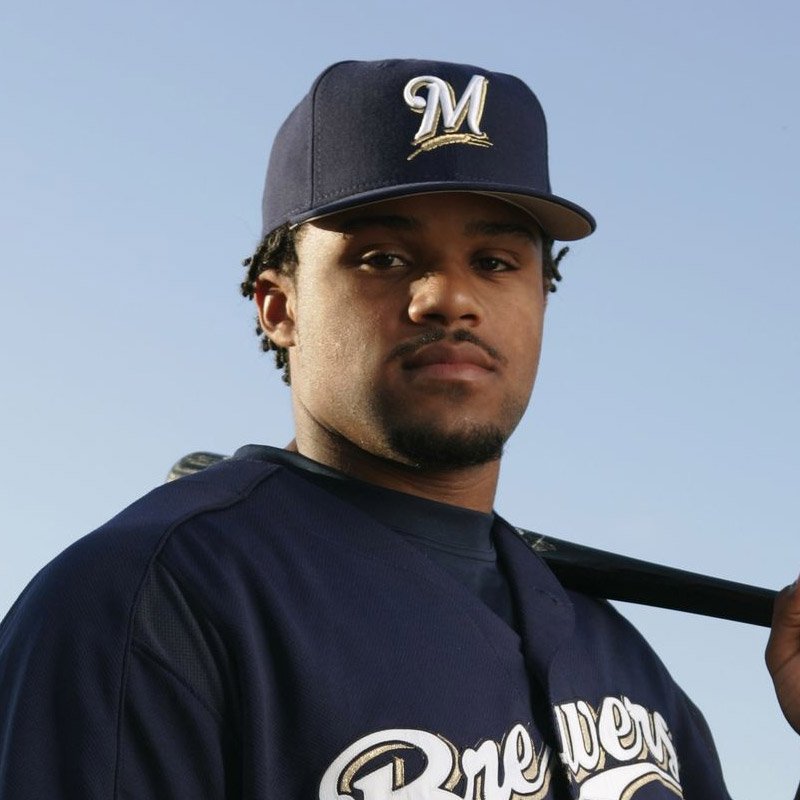 Prince Fielder was born in Ontario, California, on May 9, 1984. His father was slugging first baseman, Cecil Fielder. Despite being a natural right-hander, Cecil had Prince learn to hit left-handed as a kid. Fielder grew up around baseball and was a fixture in the Tigers clubhouse. He even took batting practice and hit an upper-deck home run at the age of 12. He attended high school in Florida - his prodigious power attracted the attention of college and professional scouts. The Brewers drafted Fielder in the first round - seventh overall selection - of the 2002 draft. No one doubted Fielder’s ability to hit the ball - but some questioned if his body type (5’11” and weighed 250+ pounds) would allow him to play at the highest levels. Many scouts wondered if he could even handle 1B - and thought he was destined to be a DH. The Brewers felt that Fielder was athletic enough to play regularly in the field. No matter what anyone thought about Fielder’s glove - he quickly proved he could hit. He smashed a grand slam in his first professional game - and never stopped hitting. At Ogden - Rookie Ball - he clubbed 10 HR and hit .390 in 41 games. The baseball world quickly took notice - the 18-year-old kid could hit. Fielder’s progress through the minor leagues was steady and consistent. He pounded between 23 and 28 HRs and never hit below .272. The Brewers felt they had a star slugger on their hands. In 2005, the 21-year-old Fielder got a 39-game trial in Milwaukee. The team was sold after he hit a respectable .288 on 59 ABs - plus a pair of HRs. The only problem was that the Brewers had a good first baseman on the roster - Lyle Overbay. That issue was addressed when the club dealt Overbay to the Toronto Blue Jays in the offseason. First base was now Fielder’s. And the young man did not disappoint - hitting 28 HRs with a .271 batting average. He was seventh in Rookie of the Year voting. But it was the following season - 2007 - where the big man broke out. That year he smashed a club record 50 HRs (a record that still stands) and produced an OPS north of 1.000. Fielder’s plate discipline also developed at this time - and over the next five years, he averaged more than 100 walks a season. By the way, Fielder’s powerful bat was essential to his success because he was not an asset in the field. At his best, Prince was still a below-average first baseman. But Fielder’s glove is not what allowed him to anchor the Brewer lineup for six seasons. It was his potent bat. In that time, he hit between 28 and 50 HRs each season, averaging more than 100 RBI a year. His batting average was always steady - between .260-.300. He was also an iron man - averaging 160 games played during his six full seasons. During his time in Milwaukee, Fielder was named to three all-star teams, won two Silver Slugger awards, and three times finished either third or fourth in the MVP voting. But most importantly, in 2008, Fielder helped lead the Brewers to their first playoff appearance in 25 years. And then, in 2011, the club captured the NL Central title and reached the NLCS (losing to the Cardinals). The offseason ended Fielder’s tenure in Milwaukee - something most fans expected as the big first baseman was a free agent. The Brewers - most people believed - wouldn’t be able to compete financially with the bigger market clubs. And they were right. Fielder signed a 9-year, $214M contract with the Tigers in January 2012. While Fielder continued to produce in Detroit (including hitting a career-high .313 in 2012), his power began to slip. In 2013, he hit .279 and 25 HRs. Not bad, but not up to his standards. In the off-season, Fielder was traded to Texas - and things went badly out of the gate. In the first 42 games of the year, he hit .247 and only three home runs. He then missed the rest of the year after undergoing neck surgery. Fielder rebounded in 2015, hitting .305 to go with 23 HRs. But the following season was a disaster as he was plagued by back and neck problems. In July, he was diagnosed with herniations in his neck. Within a month, he announced his playing career was over. Fielder was just 32 years old. The end of Fielder’s career was abrupt - especially considering he had been an iron man with the Brewers. Fielder concluded his career with 319 HR and more than 1,000 RBI. If he had stayed healthy, it’s not out of the realm of possibility that he could have hit another 100+ home run. Perhaps even have gotten to 500. That would have put him into Hall of Fame contention. Prince was one of the most feared power hitters in the majors at his best. He holds the Brewers' team record for home runs and RBIs in a season and ranks third in career HRs - despite only playing six seasons in Milwaukee. Fielder is the youngest player in National League history to hit 50 home runs in a season and captured two Home Run Derby titles. Perhaps Fielder’s greatest legacy is being a key cog in rejuvenating the Brewer franchise in the late 2000s and into the 2010s. Because of his massive power, every at-bat of Fielder’s at Miller Park was a legitimate threat to go sailing out of the stadium. Fielder was inducted into the Brewers Walk of Fame in 2022. Fielder, by the way, had a contentious relationship with his father, Cecil, much of it because of his parent’s bitter divorce. Also, Prince resented his father’s often overbearing attempts to control his career - and thus, he wanted little to do with Cecil. Upon his retirement, Fielder focused on his family - his wife and him raising their two sons in Florida. Both boys - who are taller than their father - are considered quality baseball players - so there may be another generation of Fielders in the major leagues.
 -
Prince Fielder was born in Ontario, California, on May 9, 1984. His father was slugging first baseman, Cecil Fielder. Despite being a natural right-hander, Cecil had Prince learn to hit left-handed as a kid. Fielder grew up around baseball and was a fixture in the Tigers clubhouse. He even took batting practice and hit an upper-deck home run at the age of 12. He attended high school in Florida - his prodigious power attracted the attention of college and professional scouts. The Brewers drafted Fielder in the first round - seventh overall selection - of the 2002 draft. No one doubted Fielder’s ability to hit the ball - but some questioned if his body type (5’11” and weighed 250+ pounds) would allow him to play at the highest levels. Many scouts wondered if he could even handle 1B - and thought he was destined to be a DH. The Brewers felt that Fielder was athletic enough to play regularly in the field. No matter what anyone thought about Fielder’s glove - he quickly proved he could hit. He smashed a grand slam in his first professional game - and never stopped hitting. At Ogden - Rookie Ball - he clubbed 10 HR and hit .390 in 41 games. The baseball world quickly took notice - the 18-year-old kid could hit. Fielder’s progress through the minor leagues was steady and consistent. He pounded between 23 and 28 HRs and never hit below .272. The Brewers felt they had a star slugger on their hands. In 2005, the 21-year-old Fielder got a 39-game trial in Milwaukee. The team was sold after he hit a respectable .288 on 59 ABs - plus a pair of HRs. The only problem was that the Brewers had a good first baseman on the roster - Lyle Overbay. That issue was addressed when the club dealt Overbay to the Toronto Blue Jays in the offseason. First base was now Fielder’s. And the young man did not disappoint - hitting 28 HRs with a .271 batting average. He was seventh in Rookie of the Year voting. But it was the following season - 2007 - where the big man broke out. That year he smashed a club record 50 HRs (a record that still stands) and produced an OPS north of 1.000. Fielder’s plate discipline also developed at this time - and over the next five years, he averaged more than 100 walks a season. By the way, Fielder’s powerful bat was essential to his success because he was not an asset in the field. At his best, Prince was still a below-average first baseman. But Fielder’s glove is not what allowed him to anchor the Brewer lineup for six seasons. It was his potent bat. In that time, he hit between 28 and 50 HRs each season, averaging more than 100 RBI a year. His batting average was always steady - between .260-.300. He was also an iron man - averaging 160 games played during his six full seasons. During his time in Milwaukee, Fielder was named to three all-star teams, won two Silver Slugger awards, and three times finished either third or fourth in the MVP voting. But most importantly, in 2008, Fielder helped lead the Brewers to their first playoff appearance in 25 years. And then, in 2011, the club captured the NL Central title and reached the NLCS (losing to the Cardinals). The offseason ended Fielder’s tenure in Milwaukee - something most fans expected as the big first baseman was a free agent. The Brewers - most people believed - wouldn’t be able to compete financially with the bigger market clubs. And they were right. Fielder signed a 9-year, $214M contract with the Tigers in January 2012. While Fielder continued to produce in Detroit (including hitting a career-high .313 in 2012), his power began to slip. In 2013, he hit .279 and 25 HRs. Not bad, but not up to his standards. In the off-season, Fielder was traded to Texas - and things went badly out of the gate. In the first 42 games of the year, he hit .247 and only three home runs. He then missed the rest of the year after undergoing neck surgery. Fielder rebounded in 2015, hitting .305 to go with 23 HRs. But the following season was a disaster as he was plagued by back and neck problems. In July, he was diagnosed with herniations in his neck. Within a month, he announced his playing career was over. Fielder was just 32 years old. The end of Fielder’s career was abrupt - especially considering he had been an iron man with the Brewers. Fielder concluded his career with 319 HR and more than 1,000 RBI. If he had stayed healthy, it’s not out of the realm of possibility that he could have hit another 100+ home run. Perhaps even have gotten to 500. That would have put him into Hall of Fame contention. Prince was one of the most feared power hitters in the majors at his best. He holds the Brewers' team record for home runs and RBIs in a season and ranks third in career HRs - despite only playing six seasons in Milwaukee. Fielder is the youngest player in National League history to hit 50 home runs in a season and captured two Home Run Derby titles. Perhaps Fielder’s greatest legacy is being a key cog in rejuvenating the Brewer franchise in the late 2000s and into the 2010s. Because of his massive power, every at-bat of Fielder’s at Miller Park was a legitimate threat to go sailing out of the stadium. Fielder was inducted into the Brewers Walk of Fame in 2022. Fielder, by the way, had a contentious relationship with his father, Cecil, much of it because of his parent’s bitter divorce. Also, Prince resented his father’s often overbearing attempts to control his career - and thus, he wanted little to do with Cecil. Upon his retirement, Fielder focused on his family - his wife and him raising their two sons in Florida. Both boys - who are taller than their father - are considered quality baseball players - so there may be another generation of Fielders in the major leagues. View full player
-
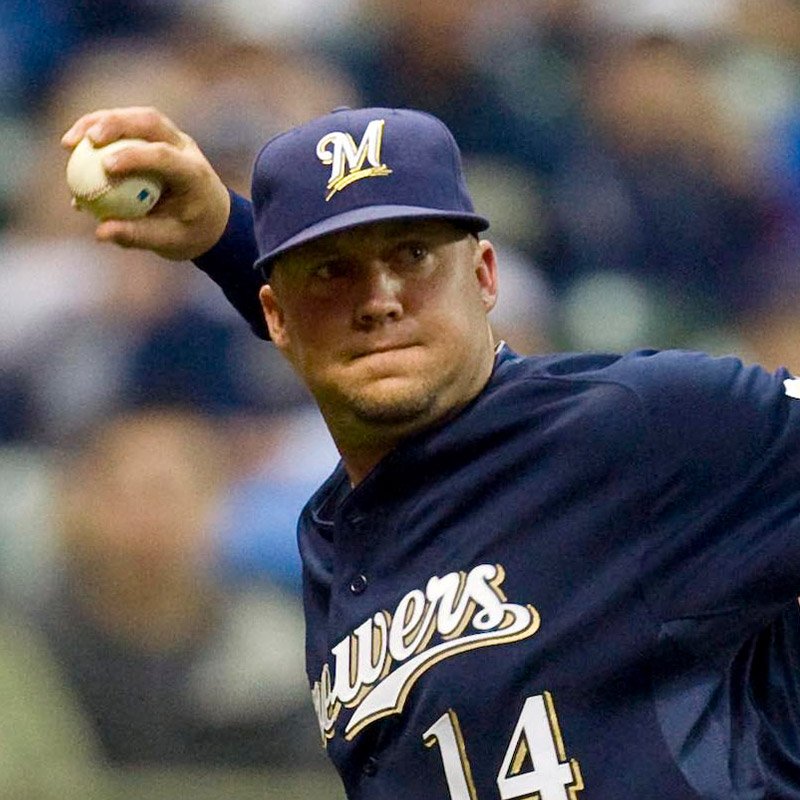 Casey McGehee was a guy with limited athleticism (compared to his peers) and no tool that he could ride to success. He was a waiver wire pickup - almost an afterthought - who went on to play eight years in the majors and several more in Japan. He was born in Santa Cruz, California, on Oct. 12, 1982. He attended Fresno State and was drafted in the 10th round of the 2003 MLB draft by the Chicago Cubs. The right-handed hitting McGehee was not a top prospect. He hit for a decent average and had a solid arm but lacked power, was slow, and was limited defensively. McGehee played mostly 3B, but the Cubs did give him a shot at catcher - without much success. He was classic organizational fodder. By 2008, McGehee had reached AAA and even got a September callup with the Cubbies. But Chicago didn’t see a place for him. Aramis Ramirez was entrenched at 3B, and McGehee didn’t offer defensive versatility. Thus, he was waived after the season - and claimed by the Brewers. The move to Milwaukee was a career changer for McGehee. He made the club out of spring training as a reserve infielder but soon saw more action due to injuries. By June, he played regularly - moving between third and second bases. And not just playing but playing well. For the 2009 season, McGehee hit a robust .301 and surprised everyone by socking 16 home runs in only 355 at-bats. He had never hit more than a dozen home runs in the minors. For his performance, McGehee was fifth in voting for the NL Rookie of the Year. Going forward, the third base job was his. In the 2010 season, he was proved to be the high water mark for Casey McGehee. He played in 157 games, blasted 23 HR, drove in 104 runs, hit a solid .285, and was voted the team’s most valuable player. The 2011 season saw the Brewers capture the NL Central crown, but it was a disappointing year for McGehee. His batting average (.223) and power (13 HR) cratered. Plus, he struggled defensively, leading NL third basemen in errors. The Brewer infield defense that season - featuring McGehee, Yuniesky Betancourt, Prince Fielder, and Rickie Weeks - was brutal. Looking to replace the recently departed big bat of Prince Fielder, the Brewers signed FA 3B Aramis Ramirez from the Cubs. Without a position, the Crew sent McGehee to the Pirates for reliever Jose Veras. The next few years were a roller coaster for MeGhee. He struggled in 2012 and then went to Japan in 2013 to reestablish his value - hitting .292 with 28 HR. The Marlins brought him back to the States the following year, and he was their regular 3B - hitting .287 - but with only four home runs. His successful season led to a trade to the Giants, but the magic was gone. McGehee was bad, which led to a midseason release. He hooked back up with Miami later that year and then took a minor league deal with the Tigers in 2016 - leading to a short but dreadful stint in Detroit. After that, there were two good seasons in Japan - and then retirement. In 2022, McGehee was named head coach of Union University, a private Baptist Christian college in Jackson, Tennessee. Casey McGehee had a short - only three years - but memorable stint with the Brewers. He was one of those guys who had AAAA player written all over him when Milwaukee claimed him off waivers from the Cubs. But when he got the chance to play - he seized the opportunity - and ended up having some really good years at a time when we needed someone at 3B. In three years in Milwaukee, he hit .267 with 52 HR. He always played hard - and the fans appreciated his efforts - even as his bat faltered. Unfortunately, McGehee’s lack of athleticism caught up to him as he got a bit older - something not uncommon for players of his caliber. To his credit, when he faltered, he never stopped trying to adjust to the game. This led to several additional seasons in the Big Leagues, plus some success in Japan. Some highlights of McGehee’s Brewer career include hitting .301 as a rookie, driving in 104 runs in 2010, and a four-hit game that same year. Please share your memories of former Brewer 3B Casey McGehee.
 -
Casey McGehee was a guy with limited athleticism (compared to his peers) and no tool that he could ride to success. He was a waiver wire pickup - almost an afterthought - who went on to play eight years in the majors and several more in Japan. He was born in Santa Cruz, California, on Oct. 12, 1982. He attended Fresno State and was drafted in the 10th round of the 2003 MLB draft by the Chicago Cubs. The right-handed hitting McGehee was not a top prospect. He hit for a decent average and had a solid arm but lacked power, was slow, and was limited defensively. McGehee played mostly 3B, but the Cubs did give him a shot at catcher - without much success. He was classic organizational fodder. By 2008, McGehee had reached AAA and even got a September callup with the Cubbies. But Chicago didn’t see a place for him. Aramis Ramirez was entrenched at 3B, and McGehee didn’t offer defensive versatility. Thus, he was waived after the season - and claimed by the Brewers. The move to Milwaukee was a career changer for McGehee. He made the club out of spring training as a reserve infielder but soon saw more action due to injuries. By June, he played regularly - moving between third and second bases. And not just playing but playing well. For the 2009 season, McGehee hit a robust .301 and surprised everyone by socking 16 home runs in only 355 at-bats. He had never hit more than a dozen home runs in the minors. For his performance, McGehee was fifth in voting for the NL Rookie of the Year. Going forward, the third base job was his. In the 2010 season, he was proved to be the high water mark for Casey McGehee. He played in 157 games, blasted 23 HR, drove in 104 runs, hit a solid .285, and was voted the team’s most valuable player. The 2011 season saw the Brewers capture the NL Central crown, but it was a disappointing year for McGehee. His batting average (.223) and power (13 HR) cratered. Plus, he struggled defensively, leading NL third basemen in errors. The Brewer infield defense that season - featuring McGehee, Yuniesky Betancourt, Prince Fielder, and Rickie Weeks - was brutal. Looking to replace the recently departed big bat of Prince Fielder, the Brewers signed FA 3B Aramis Ramirez from the Cubs. Without a position, the Crew sent McGehee to the Pirates for reliever Jose Veras. The next few years were a roller coaster for MeGhee. He struggled in 2012 and then went to Japan in 2013 to reestablish his value - hitting .292 with 28 HR. The Marlins brought him back to the States the following year, and he was their regular 3B - hitting .287 - but with only four home runs. His successful season led to a trade to the Giants, but the magic was gone. McGehee was bad, which led to a midseason release. He hooked back up with Miami later that year and then took a minor league deal with the Tigers in 2016 - leading to a short but dreadful stint in Detroit. After that, there were two good seasons in Japan - and then retirement. In 2022, McGehee was named head coach of Union University, a private Baptist Christian college in Jackson, Tennessee. Casey McGehee had a short - only three years - but memorable stint with the Brewers. He was one of those guys who had AAAA player written all over him when Milwaukee claimed him off waivers from the Cubs. But when he got the chance to play - he seized the opportunity - and ended up having some really good years at a time when we needed someone at 3B. In three years in Milwaukee, he hit .267 with 52 HR. He always played hard - and the fans appreciated his efforts - even as his bat faltered. Unfortunately, McGehee’s lack of athleticism caught up to him as he got a bit older - something not uncommon for players of his caliber. To his credit, when he faltered, he never stopped trying to adjust to the game. This led to several additional seasons in the Big Leagues, plus some success in Japan. Some highlights of McGehee’s Brewer career include hitting .301 as a rookie, driving in 104 runs in 2010, and a four-hit game that same year. Please share your memories of former Brewer 3B Casey McGehee. View full player
-
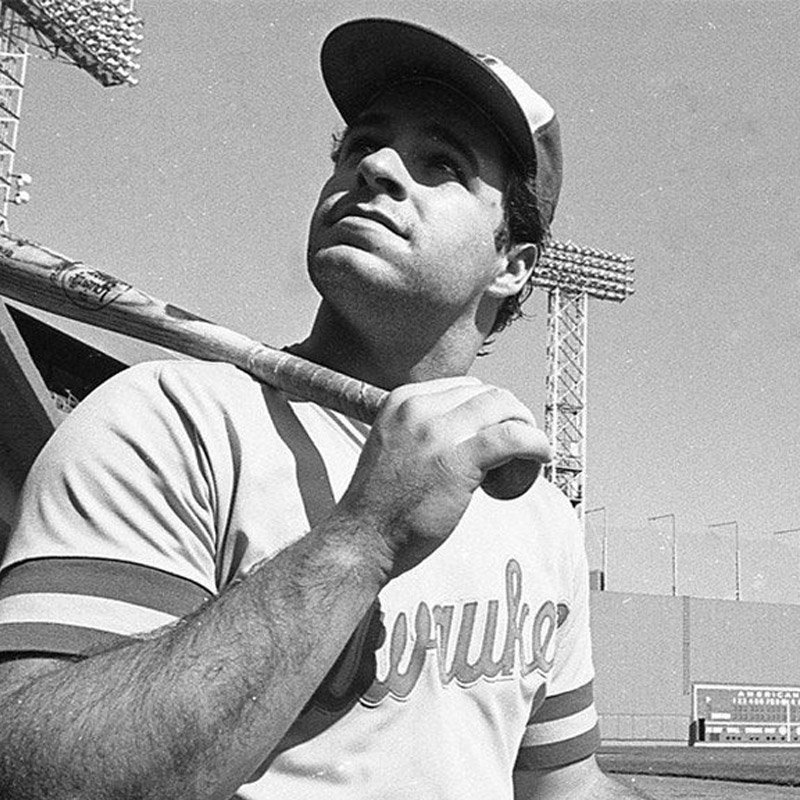 Billy Jo Robidoux (pronounced Roe-Buh-Dough) was born in Ware, Massachusetts, in 1964. A left-handed hitting first baseman, Robidoux was a sixth-round pick by the Brewers in the 1982 draft. From the get-go, it was clear that Billy Jo Robidoux could hit. His career minor league batting average is a robust .308 and he walked more than he struck out. As a 19-year-old at A-ball, he hit .317 with 10 home runs. But Robidoux broke out in 1985 at AA El Paso, hitting .342 with 23 HR and 123 RBI en route to winning the Texas League MVP award. Robidoux got an 18-game trial with Milwaukee that fall for his efforts. He hit a pair of home runs and drove in four runs in the final game of the season - a glimpse of good things to come - or so thought Brewer fans. For the organization - and many fans - Robidoux represented a chance to incorporate an exciting young hitter into an aging lineup. Mainstays such as Cooper, Gantner, Yount, Oglivie, and Moore were 30 and older. The following season, 1986, Robidoux got a chance to play regularly when Cecil Cooper was injured. The big first baseman started out well, hitting .290 over the season's first six weeks - although with little power. However, he injured his knee, which sidelined him for a month. When he returned, he was a different player. In a slump - and not playing full-time - the Brewers shipped Robidoux to the minors for two months. When he returned to the majors, his problems continued, and he finished the season hitting just .227 with a single home run in 56 games. Hardly the breakout that everyone had hoped for. In reality, Robidoux's chance had come and gone in Milwaukee. Injuries dogged Robidoux, and he played in only 153 games in 1987 and 1988 (56 were in Milwaukee, the rest at AAA). But the magic-hitting stroke was now gone. Even at AAA, he struggled to be anything more than ordinary. In Milwaukee, he hit .194 and .253, respectively, in limited action. Granted free agency after the 1988 season, Robidoux signed with Chicago. He hit well at AAA but failed to register an impact at the big league level, hitting a meager .128 in 16 games. He moved on to Boston the next season and surprised many by winning the 1B job out of training camp. However, he struggled to hit in the first month, then injured his shoulder diving for a ground ball. Surgery was required. He returned in July, but he was clearly a different player. Just throwing the ball sent pain shooting through the nerves of his elbow. And he described swinging the bat as if someone had stuck a knife in his shoulder. He was sent to the minors after hitting only .143 over 16 games. Billy Jo Robidoux’s career was essentially over. The wear and tear of playing the game hard had overwhelmed his body. He was 26 years old. After retiring, Robidoux returned to his hometown, Ware, Massachusetts, working for the city's highway department. He has stayed involved in sports, coaching baseball at the high school level for seven years (alongside his father), and umpiring and refereeing baseball and basketball at the high school and college levels. He has remained a part of the Brewer family, participating in fantasy camps. Billy Jo Robidoux had an unremarkable career. He hit .209 with 5 home runs in 468 at-bats in six years - most in Milwaukee. His 13% walk rate is the one thing you can highlight about his time in the big leagues. Without question, injuries played a significant role in derailing his career. However, while Robidoux never hit at the major league level, his 1985 season was among the finest in Brewers' minor league history. A 1.020 OPS, 97 BB vs. only 62K, a .342 BA, and 23 HR. That was stuff that made Brewers fans drool. But unlike today, those shiny numbers were masked by context. Robidoux's team, El Paso, hit .302 collectively. Yes, Robidoux had a great year. But in the context of the extreme hitter's park he played in, our expectations should have been tempered. It was not to be, and Billy Jo Robidoux has gone down in Milwaukee Brewer history as one of the organization's most disappointing prospects. Still, no one could take away the man's name. When someone looks for the most unusual names in baseball history - Billy Jo Robidoux often appears on their lists.
 -
Billy Jo Robidoux (pronounced Roe-Buh-Dough) was born in Ware, Massachusetts, in 1964. A left-handed hitting first baseman, Robidoux was a sixth-round pick by the Brewers in the 1982 draft. From the get-go, it was clear that Billy Jo Robidoux could hit. His career minor league batting average is a robust .308 and he walked more than he struck out. As a 19-year-old at A-ball, he hit .317 with 10 home runs. But Robidoux broke out in 1985 at AA El Paso, hitting .342 with 23 HR and 123 RBI en route to winning the Texas League MVP award. Robidoux got an 18-game trial with Milwaukee that fall for his efforts. He hit a pair of home runs and drove in four runs in the final game of the season - a glimpse of good things to come - or so thought Brewer fans. For the organization - and many fans - Robidoux represented a chance to incorporate an exciting young hitter into an aging lineup. Mainstays such as Cooper, Gantner, Yount, Oglivie, and Moore were 30 and older. The following season, 1986, Robidoux got a chance to play regularly when Cecil Cooper was injured. The big first baseman started out well, hitting .290 over the season's first six weeks - although with little power. However, he injured his knee, which sidelined him for a month. When he returned, he was a different player. In a slump - and not playing full-time - the Brewers shipped Robidoux to the minors for two months. When he returned to the majors, his problems continued, and he finished the season hitting just .227 with a single home run in 56 games. Hardly the breakout that everyone had hoped for. In reality, Robidoux's chance had come and gone in Milwaukee. Injuries dogged Robidoux, and he played in only 153 games in 1987 and 1988 (56 were in Milwaukee, the rest at AAA). But the magic-hitting stroke was now gone. Even at AAA, he struggled to be anything more than ordinary. In Milwaukee, he hit .194 and .253, respectively, in limited action. Granted free agency after the 1988 season, Robidoux signed with Chicago. He hit well at AAA but failed to register an impact at the big league level, hitting a meager .128 in 16 games. He moved on to Boston the next season and surprised many by winning the 1B job out of training camp. However, he struggled to hit in the first month, then injured his shoulder diving for a ground ball. Surgery was required. He returned in July, but he was clearly a different player. Just throwing the ball sent pain shooting through the nerves of his elbow. And he described swinging the bat as if someone had stuck a knife in his shoulder. He was sent to the minors after hitting only .143 over 16 games. Billy Jo Robidoux’s career was essentially over. The wear and tear of playing the game hard had overwhelmed his body. He was 26 years old. After retiring, Robidoux returned to his hometown, Ware, Massachusetts, working for the city's highway department. He has stayed involved in sports, coaching baseball at the high school level for seven years (alongside his father), and umpiring and refereeing baseball and basketball at the high school and college levels. He has remained a part of the Brewer family, participating in fantasy camps. Billy Jo Robidoux had an unremarkable career. He hit .209 with 5 home runs in 468 at-bats in six years - most in Milwaukee. His 13% walk rate is the one thing you can highlight about his time in the big leagues. Without question, injuries played a significant role in derailing his career. However, while Robidoux never hit at the major league level, his 1985 season was among the finest in Brewers' minor league history. A 1.020 OPS, 97 BB vs. only 62K, a .342 BA, and 23 HR. That was stuff that made Brewers fans drool. But unlike today, those shiny numbers were masked by context. Robidoux's team, El Paso, hit .302 collectively. Yes, Robidoux had a great year. But in the context of the extreme hitter's park he played in, our expectations should have been tempered. It was not to be, and Billy Jo Robidoux has gone down in Milwaukee Brewer history as one of the organization's most disappointing prospects. Still, no one could take away the man's name. When someone looks for the most unusual names in baseball history - Billy Jo Robidoux often appears on their lists. View full player
-
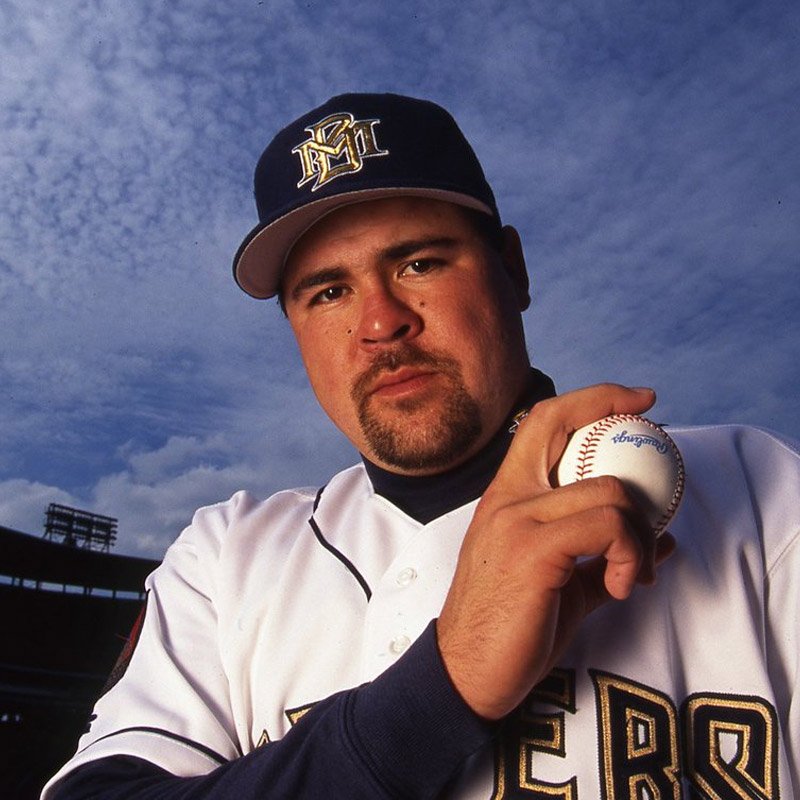 Mike Fetters was a stocky player with a goatee and mullet. He had some pitching quirks, including a narrow-eyed scowl. It all gave him the appearance of a bulldog - which was not an inaccurate description of Fetters - one of the best relievers for the franchise in the 1990s. Mike Fetters was born in 1964 in Van Nuys, California, but grew up in Hawaii. He attended Pepperdine University and was drafted by the California Angels in the 1st round (27th overall) of the 1986 draft. A big, right-handed pitcher, Fetters moved steadily through the minors as a starter. He displayed good strikeout rates, but he also walked too many batters. He got a one-game call to the majors in 1989, then spent most of 1990 and 1991 with the Angels, who used him primarily as a reliever. The results were mixed. Then, in December of 1991, the Angels traded Fetters and minor leaguer Glenn Carter to the Brewers for workhorse reliever Chuck Crim. The 27-year-old Fetters was moved to the bullpen full-time by Milwaukee and proceeded to have his finest season, throwing 62.2 innings with a 1.87 ERA. Two years later, Fetters was given the closer’s job and saved 17, 22, and 32 games between 1994 and 1996. Fetters landed on the DL early in 1997 and surrendered the closer’s role to Doug Jones that season. During the 1993-97 seasons, Fetters was a good, not a great, player. He walked a few too many batters and gave up a few too many hits. But still, he was a quality contributor to the team from the bullpen. After the 1997 season, the Brewers dealt Fetters Ben McDonald and Ron Villone to the Cleveland Indians for Marquis Grissom and Jeff Juden. The reason for the trade was that Fetters was due nearly $2.5M the next season, and with Doug Jones occupying the closer’s role, that was a bit expensive for the front office. Fetters’ 6-year stint with Milwaukee was - without question - the highlight of his career. Once out of Milwaukee, he bounced around the league for seven more years, playing for seven different teams. He had Tommy John surgery in 2003 and retired before the 2005 season. He was 39 years old. During his time in Milwaukee, Mike Fetters was a good reliever. He produced a 2.99 ERA over six years and tossed 334 innings. He walked 152 batters and struck out 245. His 79 career saves ranks sixth all-time for the Brewers, and his 32 saves in 1996 was a team record (it has been broken many times since). For his career, Fetters played in 16 different seasons for eight different teams. He appeared in 620 games, had 100 saves, won 31 games, lost 41, and had an ERA of 3.58. He never made an all-star game during his career. After his playing days, Fetters worked in radio and TV for the Arizona Diamondbacks and moved into coaching. He is currently the Diamondbacks bullpen coach. On the mound, Fetters was known for his head movement. Before pitching, he took a deep breath and quickly moved his head 90 degrees to the left. He claimed he did this because of the stress of pitching. He was also known for having a good sense of humor, making him popular with his teammates and the media.
 -
Mike Fetters was a stocky player with a goatee and mullet. He had some pitching quirks, including a narrow-eyed scowl. It all gave him the appearance of a bulldog - which was not an inaccurate description of Fetters - one of the best relievers for the franchise in the 1990s. Mike Fetters was born in 1964 in Van Nuys, California, but grew up in Hawaii. He attended Pepperdine University and was drafted by the California Angels in the 1st round (27th overall) of the 1986 draft. A big, right-handed pitcher, Fetters moved steadily through the minors as a starter. He displayed good strikeout rates, but he also walked too many batters. He got a one-game call to the majors in 1989, then spent most of 1990 and 1991 with the Angels, who used him primarily as a reliever. The results were mixed. Then, in December of 1991, the Angels traded Fetters and minor leaguer Glenn Carter to the Brewers for workhorse reliever Chuck Crim. The 27-year-old Fetters was moved to the bullpen full-time by Milwaukee and proceeded to have his finest season, throwing 62.2 innings with a 1.87 ERA. Two years later, Fetters was given the closer’s job and saved 17, 22, and 32 games between 1994 and 1996. Fetters landed on the DL early in 1997 and surrendered the closer’s role to Doug Jones that season. During the 1993-97 seasons, Fetters was a good, not a great, player. He walked a few too many batters and gave up a few too many hits. But still, he was a quality contributor to the team from the bullpen. After the 1997 season, the Brewers dealt Fetters Ben McDonald and Ron Villone to the Cleveland Indians for Marquis Grissom and Jeff Juden. The reason for the trade was that Fetters was due nearly $2.5M the next season, and with Doug Jones occupying the closer’s role, that was a bit expensive for the front office. Fetters’ 6-year stint with Milwaukee was - without question - the highlight of his career. Once out of Milwaukee, he bounced around the league for seven more years, playing for seven different teams. He had Tommy John surgery in 2003 and retired before the 2005 season. He was 39 years old. During his time in Milwaukee, Mike Fetters was a good reliever. He produced a 2.99 ERA over six years and tossed 334 innings. He walked 152 batters and struck out 245. His 79 career saves ranks sixth all-time for the Brewers, and his 32 saves in 1996 was a team record (it has been broken many times since). For his career, Fetters played in 16 different seasons for eight different teams. He appeared in 620 games, had 100 saves, won 31 games, lost 41, and had an ERA of 3.58. He never made an all-star game during his career. After his playing days, Fetters worked in radio and TV for the Arizona Diamondbacks and moved into coaching. He is currently the Diamondbacks bullpen coach. On the mound, Fetters was known for his head movement. Before pitching, he took a deep breath and quickly moved his head 90 degrees to the left. He claimed he did this because of the stress of pitching. He was also known for having a good sense of humor, making him popular with his teammates and the media. View full player
-
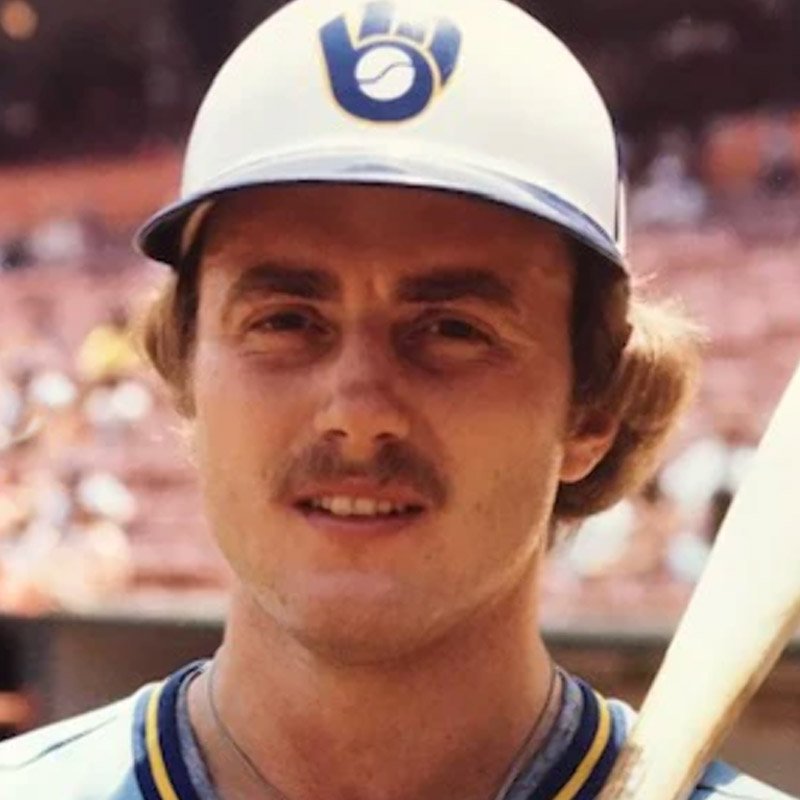 Jim Gantner was born in Fond du Lac, Wisconsin, in 1953 and grew up in nearby Eden. He played two seasons at UW-Oshkosh before being selected by the Brewers in the 12th round of the 1974 draft. He moved steadily through the minor league system, playing primarily shortstop and a little 3B. Gantner was not a heralded prospect, showing a solid hit tool and above-average speed (but by no means great speed) - but modest power. The Brewers called up Gantner from AA ball in 1976, giving him a 26-game tryout. That season, he pinch-ran for Hank Aaron in the future hall-of-famer’s final major league game on October 3, 1976. After spending most of 1977 at AAA, Gantner stuck with the club the following year and remained on the roster for 15 years. Initially a utility type playing mostly 2B and 3B, Gantner eventually settled in at 2B for much of his career. He became a regular in 1980 - at age 27 - and provided solid, if unspectacular, play for the next decade. Gantner became the scrappy guy who did the little things and complimented the big bats of the era - Yount, Molitor, Cooper, Thomas, Oglivie, etc. He was not that athletic and lacked standout skills, but he got the job done. Gumby became a vital cog in the high-scoring Brewer machine of the era. He was a remarkably consistent player - generally hitting between about .270-.290 almost every year of his career. He hit over .280 seven times. His power was limited - 11 HRs was his top long ball season - he wasn’t a good base stealer, and he didn’t walk much. But for all that, he put the ball in play - rarely striking out (the highest K number in his career was 51), and - as noted - hitting for a solid batting average. Even as Gantner got older, he still hit for a decent average, even as his modest power diminished even further. Gantner's last season was in 1992. He had played part of the year with a labrum tear and torn rotator cuff. He considered playing longer, but injuries wouldn't allow it. He officially retired in 1994, having played parts of 17 years with Milwaukee. Those 17 seasons with the Brewers - and no other team - ranks him 38th on the list of players to have played their entire career for one club. Robin Yount’s 20 years with the franchise is the Brewer record. Gantner’s best season came in 1983 when he hit .282 with career highs in HR (11), RBI (74), and OPS (.730). For his career, he hit .274 and had an OPS of .671. They weren't great numbers but were not bad for a middle infielder of the era. Also, he was generally an above-average defender, which brought value to his overall game. Due to Gantner's longevity, his name is all over the Brewer record books. Baseball-Reference has him at 22.4 WAR (8th all-time), and his 9.9 defensive WAR is the best for any Brewer career. Other numbers: 1801 games played (3rd all-time), 6189 ABs (4th), 726 runs (5th), 1696 hits (5th), 262 doubles (6th), 38 triples (5th), 568 RBI (9th), 137 SB (5th), 52 HBP (6th), 106 sacrifice hits (#1), 52 sacrifice flies (5th). He also has the 3rd lowest strikeout rate in Brewers' history. Overall, Gantner was a classic overachiever who succeeded through hard work and playing an overall solid game. He was always a positive to the team - but rarely was he anything more than good. But that allowed him to stay around and play in the big leagues for a long time. Fans loved Gartner’s hard play - not to mention his Wisconsin roots. He was an important part of the great Brewer teams of the early 1980s and helped the team reach the World Series for the only time in history (he hit .333 in the fall classic). Gantner was inducted into the UW-Oshkosh Titan Hall of Fame in 1984. He was also inducted into the Wisconsin Sports Hall of Fame in 2005 and is a member of the Brewers Wall of Honor and Walk of Fame. After baseball, Gantner took part in various business ventures and became a coach. He was the Brewers first base coach in 1996-97 and managed the Wisconsin Woodchucks in the Northwoods League in 2007. He moved back to Eden in 2008, where he became the part owner of a pub - Scuds Buds. For years he served as a part-time coach at Brewer home games and participated in clinics and fantasy camps.
 -
Jim Gantner was born in Fond du Lac, Wisconsin, in 1953 and grew up in nearby Eden. He played two seasons at UW-Oshkosh before being selected by the Brewers in the 12th round of the 1974 draft. He moved steadily through the minor league system, playing primarily shortstop and a little 3B. Gantner was not a heralded prospect, showing a solid hit tool and above-average speed (but by no means great speed) - but modest power. The Brewers called up Gantner from AA ball in 1976, giving him a 26-game tryout. That season, he pinch-ran for Hank Aaron in the future hall-of-famer’s final major league game on October 3, 1976. After spending most of 1977 at AAA, Gantner stuck with the club the following year and remained on the roster for 15 years. Initially a utility type playing mostly 2B and 3B, Gantner eventually settled in at 2B for much of his career. He became a regular in 1980 - at age 27 - and provided solid, if unspectacular, play for the next decade. Gantner became the scrappy guy who did the little things and complimented the big bats of the era - Yount, Molitor, Cooper, Thomas, Oglivie, etc. He was not that athletic and lacked standout skills, but he got the job done. Gumby became a vital cog in the high-scoring Brewer machine of the era. He was a remarkably consistent player - generally hitting between about .270-.290 almost every year of his career. He hit over .280 seven times. His power was limited - 11 HRs was his top long ball season - he wasn’t a good base stealer, and he didn’t walk much. But for all that, he put the ball in play - rarely striking out (the highest K number in his career was 51), and - as noted - hitting for a solid batting average. Even as Gantner got older, he still hit for a decent average, even as his modest power diminished even further. Gantner's last season was in 1992. He had played part of the year with a labrum tear and torn rotator cuff. He considered playing longer, but injuries wouldn't allow it. He officially retired in 1994, having played parts of 17 years with Milwaukee. Those 17 seasons with the Brewers - and no other team - ranks him 38th on the list of players to have played their entire career for one club. Robin Yount’s 20 years with the franchise is the Brewer record. Gantner’s best season came in 1983 when he hit .282 with career highs in HR (11), RBI (74), and OPS (.730). For his career, he hit .274 and had an OPS of .671. They weren't great numbers but were not bad for a middle infielder of the era. Also, he was generally an above-average defender, which brought value to his overall game. Due to Gantner's longevity, his name is all over the Brewer record books. Baseball-Reference has him at 22.4 WAR (8th all-time), and his 9.9 defensive WAR is the best for any Brewer career. Other numbers: 1801 games played (3rd all-time), 6189 ABs (4th), 726 runs (5th), 1696 hits (5th), 262 doubles (6th), 38 triples (5th), 568 RBI (9th), 137 SB (5th), 52 HBP (6th), 106 sacrifice hits (#1), 52 sacrifice flies (5th). He also has the 3rd lowest strikeout rate in Brewers' history. Overall, Gantner was a classic overachiever who succeeded through hard work and playing an overall solid game. He was always a positive to the team - but rarely was he anything more than good. But that allowed him to stay around and play in the big leagues for a long time. Fans loved Gartner’s hard play - not to mention his Wisconsin roots. He was an important part of the great Brewer teams of the early 1980s and helped the team reach the World Series for the only time in history (he hit .333 in the fall classic). Gantner was inducted into the UW-Oshkosh Titan Hall of Fame in 1984. He was also inducted into the Wisconsin Sports Hall of Fame in 2005 and is a member of the Brewers Wall of Honor and Walk of Fame. After baseball, Gantner took part in various business ventures and became a coach. He was the Brewers first base coach in 1996-97 and managed the Wisconsin Woodchucks in the Northwoods League in 2007. He moved back to Eden in 2008, where he became the part owner of a pub - Scuds Buds. For years he served as a part-time coach at Brewer home games and participated in clinics and fantasy camps. View full player
-
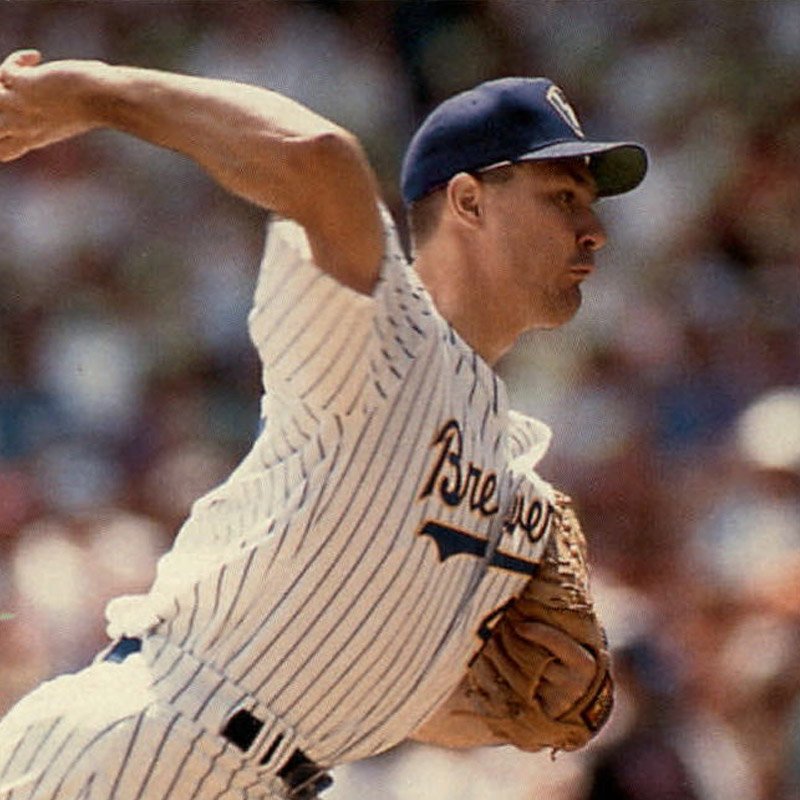 Bill Wegman was born in Cincinnati, Ohio, in 1962. The Brewers nabbed the tall (6’5”) right-hander out of high school in the 5th round of the 1981 amateur draft. Initially an infielder, Wegman took well to pitching as he quickly established himself in his second year, going 12-6 with a 2.81 ERA at Beloit. And the good times kept rolling for Wegman as he posted a career minor league ERA south of 3.00. With his success, Wegman received a three-game stint with the Brewers in 1985 at age 22 and then landed a spot in the Brewers rotation the following year. Wegman struggled the first few years of his career, often victimized by the long ball, but he delivered much-needed innings to the Brewers - averaging over 200 IP from 1986-88. He missed much of the 1989 and 1990 seasons due to injury, but he returned to have two stellar seasons in 1991-92. He won 15 games and had a 2.84 ERA in 1991, followed by his best year in 1992, when he threw 261.2 innings (seventh best in team history) and produced a 3.20 ERA in 35 starts. Injuries, however, returned in 1993 and 1994, leading to diminishing results. In 1995, the team moved Wegman to the bullpen - but the results weren’t good. A free agent that off-season, Wegman elected to retire rather than try and catch on with another club. He was 32 years old. Bill Wegman was not a strikeout pitcher. He succeeded by limiting walks and pitching to contact and his slider was his best pitch. He spent parts of 11 years in Milwaukee - the second longest tenure in team history for a pitcher (Jim Slaton holds the record - 12 years - although not consecutive). Despite the injuries, his longevity allowed him to put an imprint on Brewer records. Wegman’s 17.8 bWAR ranks fourth all-time, while his 81 wins are seventh. His 2.137 balls per 9 innings rank fifth overall, and his 1482.2 IP rank fourth. He started 216 games (5th all-time) and tossed 33 complete games (8th). On the negative side, Wegman served up 187 HRs - second most in team history (behind Jim Slaton) and surrendered 1567 hits - fourth most. His 90 losses are also second most in team history - again, behind Slaton. For his career, Wegman ended up going 81-90. Wegman was, unfortunately, plagued by injuries on and off for much of his career. He mixed several excellent years with numerous mediocre (or just bad) years. At his best, he was an above-average workhorse who helped the Brewers nearly make the playoffs in the early 90s. He is a member of the Brewers Wall of Honor. A very religious man, after retiring, Wegman became a pastor in Cincinnati.
