


Brewers Video
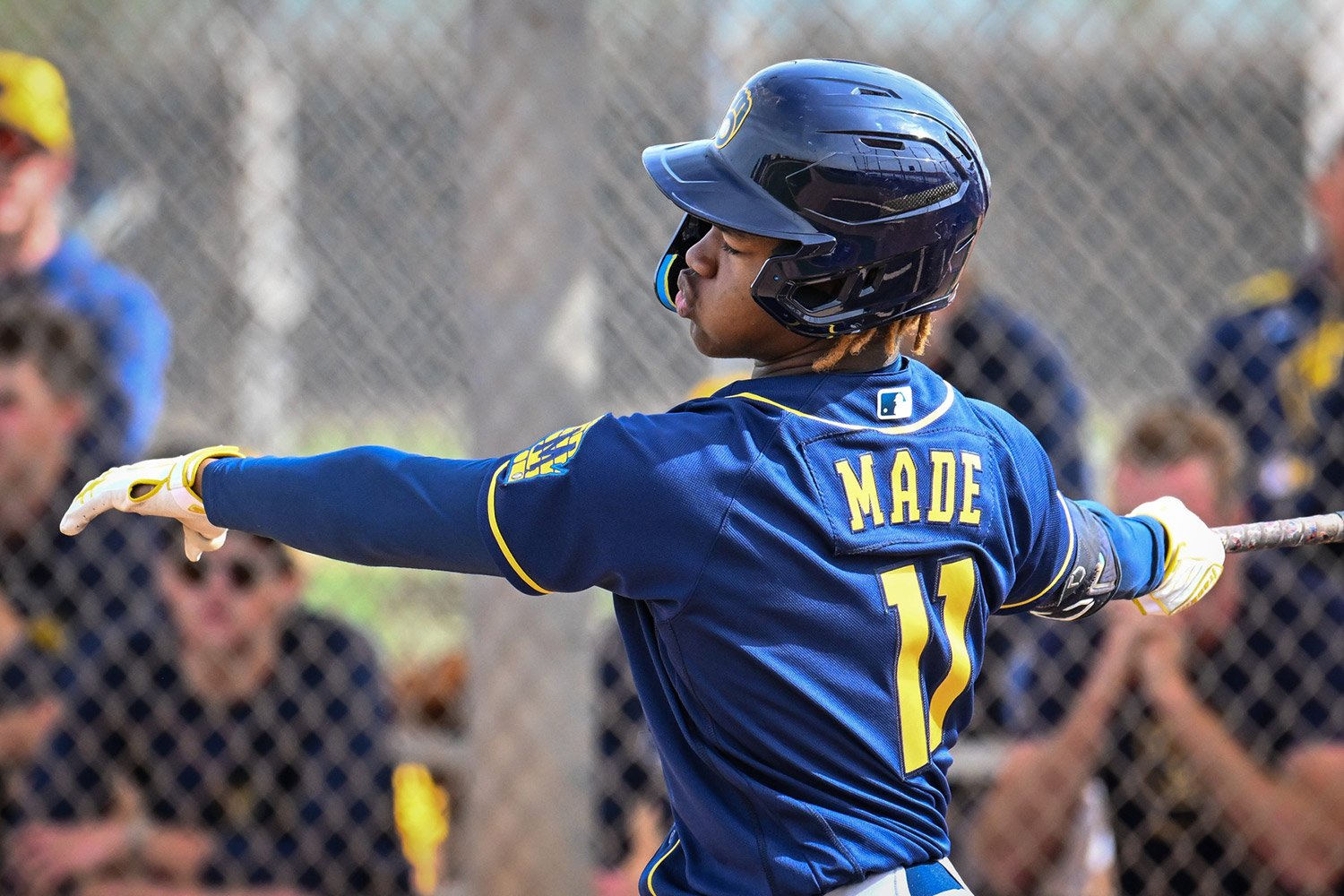
Jesus Made has some of the most freakish athleticism in baseball at just 19 years old. He stole 47 bases in 59 attempts last year. He was regularly sitting at 74 mph in bat speed as at May 2025 (MLB average 71.9 mph) per Brenton del Chiaro's interview on the Just Baseball Podcast. He also displayed extremely polished swing decisions, sitting at league average in zone swing rates in High-A Wisconsin and better than league average chase rates, all mightily impressive from someone who was 18 to start the 2025 season.
Combining that with a highly regarded hit tool, using fantastic hands to manoeuvre the barrel to the ball, as Aram Leighton noted. Even when he was beaten on a pitch, his hand control was sublime to square up the baseball. Combine that with a surging development at shortstop in 2025, and you have almost all of the traditional tools covered.
The only thing I haven't talked about is the power production, and that's what currently distinguishes Made from the likes of Konnor Griffin. While Made has the present bat speed and a frame that teases even further upside with natural growth, at present, that power isn't being tapped into.
Made slashed .285/.379/.413 in 2025, showcasing those impressive plate discipline and hitting tools, but the actual home run and extra base power wasn't quite where one would expect from a top prospect in the game. Contrast that to Konnor Griffin, who, while a year older than Made, traversed the same levels of the minor leagues and stole 65 bases, slugged 21 home runs, and also produced excellent defense at both shortstop and in center field, and Griffin certainly gets the nod for now. Made's age is part of this, and we should expect some rawness in the tools, but that doesn't mean we can't investigate how the Brewers will cut this diamond to produce the best possible results.
The Front Leg
Jesús Made's issue isn't that he struggles to make quality contact, nor that he doesn't hit the ball hard. It all comes down to elevating the ball. Aram Leighton was talking about Made recently and mentioned that his average launch angle on hard-hit balls was just 5°, meaning his barreled balls weren't leaving his bat at angles that could clear the fence and instead were more predisposed towards doubles power and hard-hit singles. His best quality contact was averaging a low line drive, limiting his offensive ceiling.
Again, Made is just 19 years old and has plenty of time to work on this, but something Del Chiaro has noted in the past is how Made's weight at the point of contact, especially from the left-hand side, is very much on his front foot.

Here's a freeze frame from a ball Made almost took out to the opposite field (impressive in its own right, given his age), but I thought it best to highlight the mechanics on one of his better swings. If you look at his right leg, his entire weight is balanced on it just before contact. He tries to lean back after in an effort to gain more natural loft, but the sheer weight on that foot (he could almost stand on one leg here) reduces the tilt he can get from the left side, and it prevents him from accessing more loft in his batted ball profile.
From there, Made continues to see his weight moving forward over that leg, with his head in front of his hips as he gets too much momentum forward, creating what is a very flat bat path.
Yes, he manages to barrel the ball and almost slices it under it enough to take it out of the park, but it's not a consistent way to gain that launch angle. The most remarkable thing about this contact is that he sliced under the ball, using a steep-ish bat path to backspin underneath the ball. How he blasted this ball as far as he did, I have absolutely no idea. It's absurd and speaks to the raw tools the Brewers are working with in this instance.
The second video below is from a side angle and presents a different view of the issue. You can see Made doesn't get quite so on top of his lead leg, but his weight is moving forward too far and preventing him from getting that natural loft. Even as he's finishing his swing, the head and the body weight are continuing to move forward through the swing, actually diluting some of the rotational power he's generating and keeping that plane of his swing on a very flat arc.
Let's contrast this with someone Jesús Made has oft been compared to, Ketel Marte. A fellow switch hitter with lightning fast hands and covering the middle infield, it feels an apt comparison, and the Brewers would love to see Made find the same level of home run threat out of his physical capabilities. You can see below how Marte's swing looks more balanced at impact, using his lead leg to push his hip and weight back, sling-shotting his bat through the strike zone while also creating a more upward plane for the bat path as he leans back at the point of contact:
We mentioned hard-hit launch angles earlier, and these are going to be key for Made's development. For a player who hits the ball as hard as he does, you want to see those barreled balls going for extra bases and home runs, not singles through the infield (a profile Brewers fans will be acutely aware of with Christian Yelich).
In 2017, Marte hit six home runs in 70 games, not dissimilar to Made, A couple of seasons later, he instituted changes to his leg kick allowing him to stay more on his back leg, leading to an average launch angle going from 5.2° in 2018 to 11.7° in 2019, all while increasing his average exit velocities and creating even more consistently hard contact. His 2025 hard hit launch angle was 12°, almost 7° above Made's, but his transition in 2019 shows that, with a more optimized loading pattern and weight transfer in his legs, Made can achieve that relatively quickly if all goes according to plan.


Looking at the freeze frames of the follow-through, you can see how the weight had shifted through and after the point of contact. Where Made's weight continues to move forward, leaving his head actually ahead of his hips, Marte's has kicked backward, creating a more upward path to the baseball and allowing him to do a lot more damage.
As previously mentioned, Made is still just 19. He will be until May this year, and he's likely to be playing at Double-A Biloxi. He's a top prospect for a reason, and it's because people can dream on the tools and freakish athleticism he possesses. If he can find a way to get into his back leg more, particularly from the left side (where he should see more plate appearances), Made will go from being a consistent, strong performer and potential All-Star at shortstop to a perennial MVP candidate.
His recent Instagram stories suggest this hasn't been a point of emphasis yet this offseason, still putting a lot of weight on his lead leg, but it's something Brenton Del Chiaro is acutely aware of as the minor league hitting co-ordinator.
The Brewers' organizational philosophy is not to step in unless the player approaches them, but with Made now in the upper minors, I would expect to see this emphasized during 2026 spring training and in-season work. It's certainly something to keep an eye on, especially in games. It's not a monumental change, in fact, it's relatively subtle, but the difference it could make to Made's offensive profile is startling.
Are you optimistic about the Brewers right now?

Interested in learning more about the Milwaukee Brewers' top prospects? Check out our comprehensive top prospects list that includes up-to-date stats, articles and videos about every prospect, scouting reports, and more!
View Brewers Top ProspectsFollow Brewer Fanatic For Milwaukee Brewers News & Analysis



-
 1
1


Recommended Comments
Create an account or sign in to comment
You need to be a member in order to leave a comment
Create an account
Sign up for a new account in our community. It's easy!
Register a new accountSign in
Already have an account? Sign in here.
Sign In Now