


Brewers Video
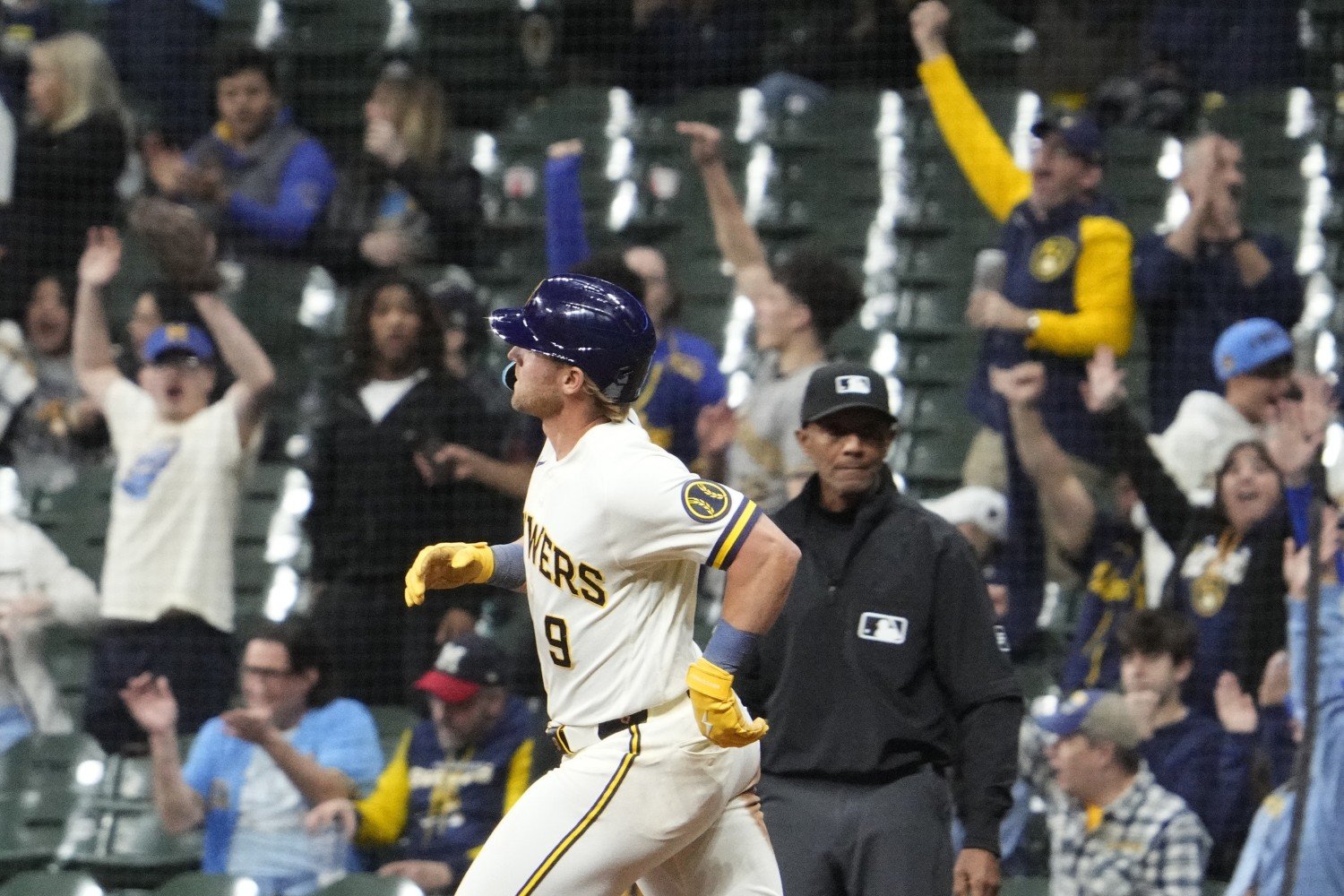
During the key sixth-inning rally in which the Brewers essentially put away Tuesday night's win over the Rays, Jake Bauers hit a wicked line drive to the hole between first and second. Second baseman Ben Williamson dove to his left and knocked the ball down, but his quick recovery was for naught; he threw late and wide. Bauers, hustling down the line, stepped on first base as he ran through it, as batter-runners are obligated to do if they want to be safe.
What first-base umpire C.B. Bucknor dared to ask is: What if he hadn't? Wouldn't that have been wild?
To test the hypothesis, Bucknor ruled that that very thing had happened—that Bauers had either missed the bag, skipped willfully over it, or so callously disrespected it in the particular way in which he stomped on the pillow that it didn't count. The play had fallen into some confusion after the ball bounced toward home plate and was returned to first baseman Jonathan Aranda, who tagged Bauers. Bucknor called the Brewers first baseman out for not having touched the base yet, which, again, Bauers had done. But an artist does not wait for the beautifully impossible to happen; they get out their canvas and render the impossible vivid and present. Bucknor's easel is the box score, and his brush is the pump of his fist. He installed his work of creative fiction into the game, and we all got to watch the fractal hilarity unfold into its endless angles and dimensions from there.
An unfortunate bastion of conservative censorship stepped in to scuttle the festival before it could really begin. The Brewers challenged Bucknor's call, which was rapidly overturned by the replay center at MLB's central office in New York. The reviewers failed Bucknor's transgressive test of imagination, apparently mistaking his commedia dell'arte for one thing we all knew it couldn't be: a mistaken and literal interpretation of the action itself. Maybe you just had to be there.
No matter. Art does not change the world by peeling the tentacled unicorn from the canvas and flinging it into the sky; it changes it by forcing us to consider that possibility for a time. Bucknor challenged us all to imagine a wilder, more interesting, less boringly well-ordered world. Why ought he stop now? What has ever been achieved when an artist reached a new frontier and left their audience in awe, only to retreat? Here, for his consideration and yours, are several more ways he can still elevate the craft of umpiring into something more mind-expanding.
1. Batter's Balk
There is a great, unexplored margin awaiting the umpire who pounces on our shared uncertainty about the balk rule. Pitchers are not allowed to intentionally deceive baserunners as they prepare to work with the bases occupied. They must come set and avoid a flinch as they prepare to kick and fire. Lefties must not stride toward home plate but throw to first. Often, though, even players and coaches struggle to define the nuances of the balk rule and end up in futile arguments with umpires, either demanding a balk in vain or decrying one they can't understand.
That's not fun or compelling, though; it's just arguing. An artist might first glance at the rule known as the catcher's balk, whereby a catcher can be punished for touching the ball with their mask or helmet and the runner is awarded a base—but their eye would be drawn, then, on into the negative space where a mere mortal's eye fails to see anything at all. What about the batter? You ever seen one of these guys? What a twitchy bunch of weirdos. They're shifting their weight, they're waggling their bat, they're tapping their foot. And the pitcher's just standing still. Why not call the batter for a balk—maybe assessing a strike, or calling the runner out, or maybe even calling the batter out but advancing the runner, just as with other balks? Bucknor, surely, will soon try it.
2. Infield Big Fly
One peculiar rule protects the offense from manipulation by the infield on pop-ups with multiple runners on base. Rather than permit a team to turn an easy, unearned double play by letting such a ball fall and forcing runners at the next bases, the infield fly rule bids an umpire to call the play dead while the ball is still in the air. Runners can advance at their own risk, but even if the ball hits the ground, they're not obligated to sally forth.
With the bases empty and/or with two outs, though, batters get no relief whatsoever on pop-ups. Bucknor could reinterpret the rule to be aimed purely at augmenting offense, and after all, how far off would he be? We could soon find out. Next time a batter hits a fly ball on the infield, look for Bucknor to rule the ball a home run, before it comes down.
3. Catch or Trap?
There has always been a delightful bit of drama in watching an outfielder streak after a sinking line drive, sliding or diving to pluck the ball out of the low-lying scrap of sky left between horsehide and grass. Did he catch it, or trap it? Did it almost imperceptibly hop on the turf, or was the last finger of the player's glove beneath it at that final instant? Sometimes, even dozens of looks will leave you unsure. The game waits breathless for those rulings, especially if there were runners on base when the ball was struck and the fielder's heroics were attempted.
Routine fly balls don't offer an obvious answer to those thrills, so we need the Bucknors of the world to supply it. What if a fielder caught the ball with both feet beneath them, shoulder-high and sure—but it was ruled a trap and the ball was made live? Bucknor can see the whimsy and the upside, even if you can't, yet.
4. Fair or Foul
Long white lines separate the 90° wedge that is fair territory from the surrounds of foul ground on a baseball diamond. Historically—albeit with some notable, even pivotal exceptions—umpires simply call balls hit between those lines fair and those outside them foul. This is unimaginative and restrictive. The great Harry Chapin once wrote a song about a boy who saw all the colors of the rainbow in the morning sun and the flowers all around him, but whose joyous creativity was crushed by an overzealous schoolmarm who compelled him to render his flowers in red, his leaves in green, and the sun in yellow. The ballad's message is clear: break, you, the chains of imaginative bondage that society has placed on you. Be not shackled by the black-white binaries and the straight lines of a world doomed to a depressive death. Breathe those colors; feel the sun in purple-yellow and let the sweet blue heat that runs through its rays touch the back of your throat as you sing out your freedom. Just so, Bucknor ought to invite us out from our corners and into the round.
This doesn't require an abandonment of the concept of fair and foul. Bucknor doesn't have to either physically or mentally carve out a special area of foul territory in center field, or make the press box fair. He can simply do as he did Tuesday night. The next time a ball is hit up the middle, he should call it foul. Because what if it had been? As much as what we all saw tells us it was fair, such a call would challenge us to eschew overconfidence and to accept that we are not so different, one from another. A ball was hit up the middle. In what important way was that ball different from one hit toward the first-base dugout? You have an opinion about that, but it was handed down to you by your version of a glowering nun. Let Bucknor's art show you how those batted balls are the same, really.
5. Tagging the Soul
We all love a good tag. A fielder who gets into position, reads an incoming throw, anticipates the movement of a runner attempting an evasive slide and nabs them for a crucial out is doing that thing which makes sport greatest, at least in traditional lore: demonstrating grace and genius under pressure. But what are they doing, really? They wear a woven contraption of leather to entrap another. They enact non-hostile but real violence by thwacking and thwapping their handnet onto the uniform of some poor fellow soldier, separated from them in livery but perhaps no different from them in real sympathies and sensibilities. We call this a tag. We call this an out. We only know this way of things.
Bucknor has the third eye that renders his first two moot. That's the eye that saw contact between Bauers's sole and the bag on Tuesday, but none between his soul and the bag. He could further invite us to share his gift by giving us more examples of when an apparent connection is illusory. Sure, a glove touched a runner's jersey before the runner grabbed a base, but whose spirit connected with its object more? Did the fielder make the tag with enough love in their heart, enough serious understanding of their impact on the man between their legs, and enough deep-seated desire for victory to merit the out? Should such a thing be decided by a simplistic measurement of space and time, or can we be more fearless—more profound? Is a world in which the runner slid in safely so different from this one? Is that runner safe, after all, even if he was a bit late in putting his own glove to the relevant rubber? The world melts and reshapes itself in glorious new ways for those who can see that (perhaps) he was.
We must all learn to see what's before us, lest we be struck by cars or bitten by snakes before we really wake up to the universe, at some age between 14 and 30. However, we must all learn to see what is not before us, too—what is real, but simply confined to the past or the future for the moment; what is not real, but could be; what will never be real, but is more important than what is. You saw Jake Bauers step on first base, like every unhurried runner in baseball history has done. What you saw was real, but it didn't matter very much. One brave person challenged you to see around and behind and beneath that reality, and to understand its full nature—as well as the vast and heart-stopping red-white sear of the reality beyond it. He might offer you another chance, soon. Will you take it?
Are you optimistic about the Brewers right now?

Follow Brewer Fanatic For Milwaukee Brewers News & Analysis



-
 1
1
-
 9
9
-
 1
1


Recommended Comments
Create an account or sign in to comment
You need to be a member in order to leave a comment
Create an account
Sign up for a new account in our community. It's easy!
Register a new accountSign in
Already have an account? Sign in here.
Sign In Now