


Brewers Video
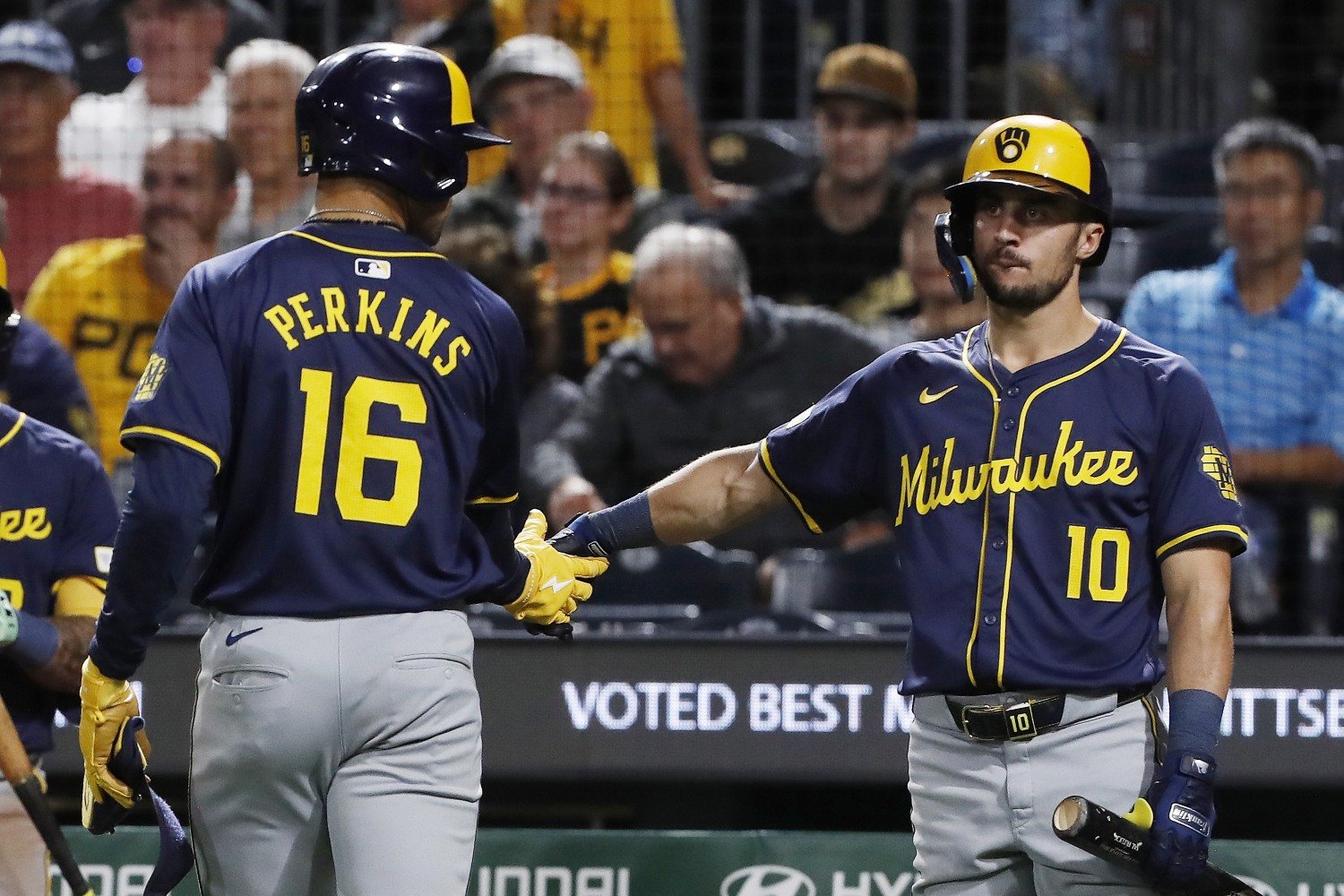
No, the Brewers (who were a much better team than the Royals in 2024 and have a much, much stronger farm system than Kansas City does) do not face the same urgency or the same constraints in their decision-making as their American League counterparts. Still, there's an almost irresistible fit between the two sides. Milwaukee has a surplus of outfielders, with Christian Yelich, Sal Frelick, Jackson Chourio, Garrett Mitchell, and Blake Perkins in the majors and (if, as expected, he moves to the grass full-time in 2025) Tyler Black, Ernesto Martinez, and Luis Lara making their way toward the big leagues in the upper minors. They have, by contrast, an increasingly glaring need for a starting pitcher, and while they might find one in a trade involving Devin Williams sometime this winter, their experience with DL Hall in 2024 surely taught them not to count that particular species of chicken while it's still a somewhat fragile-looking egg.
For their part, the Royals are showing more willingness to spend money than the Brewers, perhaps emboldened less by confidence in their own balance sheets than by ownership's desire to win public approval for a new ballpark project in downtown Kansas City. However, their coffers are not materially deeper than Milwaukee's, and the big deal to which they agreed with MIchael Wacha to keep him from exercising his opt-out clause and becoming a free agent has soaked up some of their budget. Meanwhile, they have one of the five or six worst farm systems in baseball—and that's me giving them the benefit of the doubt. A trade of prospects to fill the hole atop their lineup that nearly cost them their playoff berth last year (and impelled them to rush out onto the waiver wire to pluck up Tommy Pham, Robbie Grossman and Yuli Gurriel in late August) is not going to work, if they want to build toward any semblance of real, sustained competitiveness during Bobby Witt Jr.'s prime.
That sets up a bit of a staring contest, and a bit of a scouting showdown. Who can find the confidence to lock in on one of the other side's potential targets? Who can spot the key, fixable flaw that might let a so-far frustrating player blossom into what they need—and who has the guts to give up a player who could otherwise help them next year in order to obtain one who fits their needs a bit more neatly?
From the Brewers' outfield bin, I think they and the Royals would actually have a pretty easy time agreeing on a pref list specific to the context of a trade negotiation. Yelich and Chourio plainly are not going anywhere. Mitchell, with his blend of upside and risk, is the wrong kind of gamble for a team that expects Witt, Vinnie Pasquantino, and Salvador Perez to anchor their lineup. They'll want to acquire one of Frelick, Perkins, or Black, and because what they need most is good defense and good on-base skills, it probably goes in that very order, in terms of the absolute value of those players to the team. For the Brewers, though, Black is a year further from free agency than the other two, and if there's going to be a window to maximize the trade value of Perkins, it's right now. Frelick is a comforting, consistent presence for the Crew. Thus, Milwaukee's list of players they'd most readily trade would go Perkins, Black, Frelick. To decide which list wins, you have to decode the other set of options—which is a theoretically simpler one, with just two players from whom to choose, but actually a very nuanced choice.
The two hurlers Kansas City would make available in this kind of deal are Brady Singer and Alec Marsh. Those two made a total of 57 starts for the Royals last year, spending most of the season as the back end of a rotation made famous by Wacha, Cole Ragans and Seth Lugo. The other pitcher who could be thrown into that mix is Daniel Lynch IV, but he's somewhat akin to Mitchell, in terms of his service time, accomplishment, and questionable projectability. It's unlikely that either side would want him to get involved here. We'll stick to examining Singer and Marsh.
With each pitcher, there are some important performance questions to answer, but we should quickly set forth their divergent value propositions in terms of salary and team control, first. Singer, a former first-round pick, has already surpassed four years of service time in the big leagues and is making his third trip through arbitration this winter. (He was a Super Two guy two years ago.) He could make over $8.5 million this season, so he's hardly a financial bargain, and because he'll almost immediately reach five years of service time after Opening Day, he won't be optionable. He will turn 29 next summer, but he's certainly an established, high-floor veteran starter. He cuts a profile not totally dissimilar to that of Aaron Civale (although the differences, which we'll break down later, are important), and in a profile sketch, he would fill the rotation slot vacated by the team's choice to decline Colin Rea's option and cut Bryse Wilson. The big hangup is that he'll make even more than the two of them would have made next season, combined, so to bring him in, the team has to believe he'd pitch exceptionally well for them.
Marsh is more of a wild card. He's not as young as he seems, set to turn 27 next May, but after being drafted out of college in 2019 and having his first full pro season canceled by COVID, he traced a longish arc to the majors. Like Perkins and Frelick, he still has five years of team control remaining, but (more like Black, here) he hasn't fully proved himself as a big-leaguer. When Kansas City traded for Michael Lorenzen in July, they sent Marsh to Triple-A to await an injury; they proactively replaced him. He will still be able to be sent down for one more season in 2025, though, so the fact that he's still walking that tightrope isn't automatically disqualifying.
Given the team's budget and its perpetual roster crunch, Marsh might suit the Brewers better from a purely logistical perspective. The key question, though, is the one we must now tackle: Which pitcher is better?
Breaking Down Brady
In 32 starts for the 2024 Royals, Singer delivered 180 innings and a 3.71 ERA. On that information alone, almost every team in the league would pounce on him with a leap of joy. For plenty of rotations, that's a No. 2 starter, these days. To get even average run prevention over such volume from a fourth option perfectly illustrates how the Royals ended up playing into October.
Not so fast, though—alas, literally. Singer lost a tick on his fastball from 2022 to 2023, and another from 2023 to 2024. Not long ago, he sat at 93-94 MPH with his heater and could scrape 97. Now, he's 91-93 and only got up to 94.8 MPH as an absolute max in 2024. His peripheral numbers also suggest that some of his ERA's sheen was luck, as his FIP was almost a full run higher. Finally, we have to grapple with his inconsistency. Though he takes the ball and pitches as unfailingly as anyone, the quality of his outings varies widely. In 2023, his ERA was a hideous 5.52.
That's all just at the surface, though. Let's break the ice and dive into the good stuff. Singer made a major change in the way he attacks hitters last year, and we can't really evaluate him without reckoning with it. Here's where he threw his pitches to both righties and lefties in 2022 and 2023.

That's a lot of stuff in the middle of the zone to opposite-handed batters, which would seem to augur bad things. You can see him trying to work righties low and away on a consistent basis, but there, too, we see plenty of creep into the middle of the strike zone. Now, here are the same plots for 2024.

Whoa! The changes to righties are small—just a bit better at keeping the ball down, but then, was he not changing eye levels as well?—but the transformation to lefties is eye-opening. He clearly made a commitment to pounding them low and away, the same way he has with righties all along. It's refreshing to see a pitcher with a plan.
Except here's the thing: in 2022-23, Singer allowed a .740 OPS to right-handed batters, and a .754 to lefties. He wasn't quite split-neutral, but very close. He did have a good amount of success in 2022 against righties, but they mashed him in 2023. All that stuff in the heart of the zone didn't, seemingly, make him easily hittable for lefties. Then, in 2024, that small adjustment to righties begot a huge change, as he held them to an anemic .563 OPS—but much of that was washed out by the way lefties caved his head in, to the tune of an .855 OPS. They just hammered him, even though he seemed to do a bit better at working them away and down. What gives?
Well, firstly, we need to acknowledge a big old pitch mix change. For years, the Royals made vague noises about getting Singer to do something different with his very simple sinker-slider arsenal, but they finally got through to him amid the mess of 2023. He went from a sinker/slider guy who threw a few halfhearted changeups to a sinker/slider/four-seamer/sweeper/changeup guy who was trying to be a whole new man.

Singer started trying to reassert a four-seamer in 2023, which is why his blob of sinkers there seems to spread into what is very much the four-seamer's territory in 2024. He deepened his arsenal, as every pitching analyst on Earth ever asked him to do, and look, it brought down his ERA by 1.8 runs! But, if you're at all used to reading plots like these, you can also see a little bit of artifice at work here. Singer doesn't seem to have a knack for bold new pitch designs: new shapes, new cues, new world. His four-seamer and his sweeper hang off his sinker and his slider, respectively, like humps on Quasimodo—exactly that way, really, because they're not the same and they're certainly not pretty, but they don't seem able to create real separation.
In relatively light duty, the sweeper does still get some whiffs, and the four-seamer certainly gets more of them than does the sinker. He's using each new offering the way you'd want, too. Against lefties, he's given about one-third of his previous sinker usage over to his four-seamer, and he's using the sweeper as a variant on the changeup, trying to find called strikes and catch hitters guessing something else.

The problem was hinted at in the plots of his movement above. His four-seamer doesn't have much hop on it, so it's hopelessly dependent on being well-located to be effective, especially against lefties. He has a low release point and great extension, so when he can hit the top rail of the strike zone with the four-seamer, it comes in with a good, flat vertical approach angle and is tough to hit. Too often, though, he's missing, and especially missing down. Singer's induced vertical break on the four-seamer is in the 12th percentile of the league. Meamwhile. only three other players have a wider range of vertical movement on the pitch, on average, which means too many balls that come right down into the center of the zone. Here's where his fastballs were located to lefties in 2024.

And here's how they performed against the pitch, by location:

When he does miss in the heart of the zone, it's the meatiest meatball a lefty batter will see all week. The pitch isn't fast or lively enough to beat hitters there. For the four-seamer to take on positive value and help him get lefties out consistently, he'll need to start dotting the upper, inner third with the pitch. Plenty of pitchers simply can't throw the high, gloveside heater with any consistency, and for those people, the results of trying to force it tend to be disastrous. One pivotal choice Singer must make is whether to move over on the rubber and tinker with his mechanics, which are distinctive and help him create that extension but might be compromising both his deception and his ability to locate to certain quadrants with all the weapons he would like.
Against righties, of course, a few small changes worked like a charm.

He used his slider to set up his sweeper, inviting the hitter to see those two very similar offerings as the same one. He used the four-seamer (which he had no problem commanding to that high, gloveside spot when there wasn't a lefty batter standing in the box near it) to tease hitters along the outer edge, then threw them the sinker or slider in equal share right after it, leaving them stumped about which way the ball was about to veer. He's really tapped into something with that sequence of pitches, as evidenced by the success he had against righties all year.
Singer's four-seamer, to the extent that it has deception for the hitter, gets it by cutting a bit more than they anticipate.

He leverages that well against righties, but will have to clear the mental hurdle of doing the same thing to lefties. Because of his unique arm action and the fact that his misses are mostly vertical, he can afford to hammer lefties inside with more confidence than he's shown. These are all things the Brewers might view as "unlocks" for Singer, who does check a number of their boxes, overall. Two years ago, when he seemed a bit stubborn about making changes to his mix and approach, he would not have been a fit for the team. Now, he looks like a potentially good one, and they might really think they can take him to another level with some mechanical work to get velocity back and/or a cutter, as suggested by his arm slot and natural fastball shape.
We Are Marsh-all?
After all that on Singer, the downlow on Marsh might seem almost simplistic, but it's nuanced in its own ways. To start at the beginning: his problem is a dead zone fastball. In other words, based on his arm slot, his heater just moves exactly the way the hitters' eyes are trained to expect it to move.

That's sometimes curable and changeable, but it requires some mechanical tweaks that don't work for everyone. In all likelihood, the better answer for Marsh is to start throwing his sinker more and his four-seamer less. Right now, he spends way too much time in the horizontal middle of the zone with that sinker, but that's partially because he's aligned himself to generate the best possible angles for the four-seamer. He doesn't command either pitch as well as you'd like, in terms of specific location to avoid the risk of being hit hard, and that's why he was—to the tune of a .434 opponent slugging average and 19 home runs allowed in just 129 innings of 4.53 ERA ball.
That's all the bad news, but stick around for the good: Marsh throws six pitches, with the two flavors of heater, a little-used changeup, and three breaking balls: a slider, a sweeper, and a curveball. None but the sweeper is a true bat-missing, special pitch, but he can throw all of them for strikes.

Marsh can also keep hitters from truly teeing off on his heat, when he's right, because he excels at spin mirroring and the use of seam effects to alter movement. Here's a chart showing the distribution of spin axes on his pitches as they come out of his hand. Remember, a hitter can't really read the difference between two spin axes that are 180 degrees from one another, because the ball spins too fast to discern which way it's spinning. Hitters only see the telltale dot on the ball, or a certain blur pattern associated with a particular spin axis family. All of Marsh's offerings can look pretty similar out of the hand:

Because of the orientation of the seams, though, those pitches move very disparately. So, even if a hitter guesses right on which pitch is coming, his eyes will have to contend with a bit of extra wiggle on certain offerings.

Marsh definitely has the better raw stuff. His three breaking balls all have above-average upside, and he can rush his fastball up there as hot as 98 miles per hour—though he lives more comfortably at 94-96. He lives more dangerously, but if Marsh figured out how to truly weaponize his arsenal, he could reach a higher ceiling than Singer, sliding lightly in behind Freddy Peralta and alongside Tobias Myers in the 2025 rotation.
What It Comes Down To
His youth, low salary and optionability make Marsh, objectively, the more valuable trade chip. If the Royals gave him up, they would certainly expect to get the player highest on their pref list. Could the Brewers find enough upside in Marsh to justify breaking Frelick loose from the rest of the core of the team and swapping him out, even if it be for a player of similar total value at a position of greater short- and medium-term need?
Singer, by contrast, could probably be had for Perkins or Black, and the two sides might even agree to some ancillary benefits added in to sweeten that deal for the Brewers. A little cash coming along would make it much easier to justify taking on Singer, given that even though he nominally has two years of team control remaining, he'll need to pitch very well in 2025 in order for Milwaukee to want him at what would be a very inflated arbitration price in 2026.
There are other pitchers available whom the Brewers wouldn't have to study so closely and work with so much after acquiring them, That's precisely why these two feel like typical Milwaukee targets, though. Knowing full well that they have a great infrastructure for pitching development and instruction, the Brewers like to bring in guys who leave something to be desired for other teams, and to provide that value themselves, from within. It's like having the confidence in your own cooking to buy raw ingredients, rather than pay the extra money to go out to eat—even if the meal is very important.
Kansas City and Milwaukee have gotten together on some highly notable trades in the past, with gratifying results on both sides. This feels like a moment when another such move might be possible.






Recommended Comments
Create an account or sign in to comment
You need to be a member in order to leave a comment
Create an account
Sign up for a new account in our community. It's easy!
Register a new accountSign in
Already have an account? Sign in here.
Sign In Now