


Brewers Video
When the Brewers activated Christian Yelich from the injured list on Tuesday, it was not surprising that they optioned Tyler Black back to Triple-A Nashville as the corresponding move. If anything, it was expected. Black was effectively the Yelich replacement: a left-handed-hitting DH and occasional left fielder. He was going to lose most of his at-bats with the former NL MVP back in the fold.
Furthermore, despite his productive .333/.357/.481 slash line, Black was not actually having quality plate appearances or putting good swings on the ball. His .369 wOBA was nearly double his .192 xwOBA, which was so low because he struck out 25% of the time and had just a 15% hard-hit rate. Baseball Prospectus evaluated his performance less harshly but still credited him with just an 86 DRC+, meaning he deserved to perform 14% worse than the average hitter based on the process of his plate appearances and the quality of pitching he faced.
Black did, however, show a change that could make him a more viable hitter down the line. He's changed his bat path this year, decreasing his swing tilt from 37 degrees in 2024 and 39 degrees in 2025 to 35 degrees this year. Pat Murphy teased that modified swing when Black was recalled, saying he and the Brewers had worked on making his bat path less choppy to help him make more consistent contact.
"He had that small margin for error this way in his swing," Murphy said last month, referring to Black's inability to get his barrel to pitches at different heights in the strike zone. "We're helping him try to [get] a little more on plane a little bit. Because it's hard to hit that other way, with that 'V,' you know? A lot of guys did, but you're going to mishit a lot of balls."
With a swing tilt nearing 40 degrees, Black had one of the steeper, more vertical swings in baseball. Such a swing travels downward more before working its way back up as it makes contact with the pitch. Philadelphia Phillies outfielder Brandon Marsh has a similar 37-degree swing tilt this year as a left-handed hitter. Notice how his swing path forms a "U" shape as it travels through the hitting zone.
There's no one right swing path for success – every hitter is different, and there's more to a swing than just its tilt – but a naturally steeper path can often put hitters in a better position to make the best kind of contact with different pitches, provided there's some adaptability to the swing based on pitch height. Murphy himself considers more vertical swings to be the most productive.
Black's bat path didn't have that "U" shape, though. Instead of traveling in an arc, his bat often came straight down and then straight up. He makes contact very deep in the hitting zone – about 21 inches toward the pitcher from his center of mass, according to Statcast. With such a steep swing, you would expect his bat to still be coming down when he makes that deep contact, producing a negative attack angle. Instead, his attack angle last season was 9 degrees, meaning his bat was already coming back up by that time. That's the choppy "V" shape Murphy is referencing.
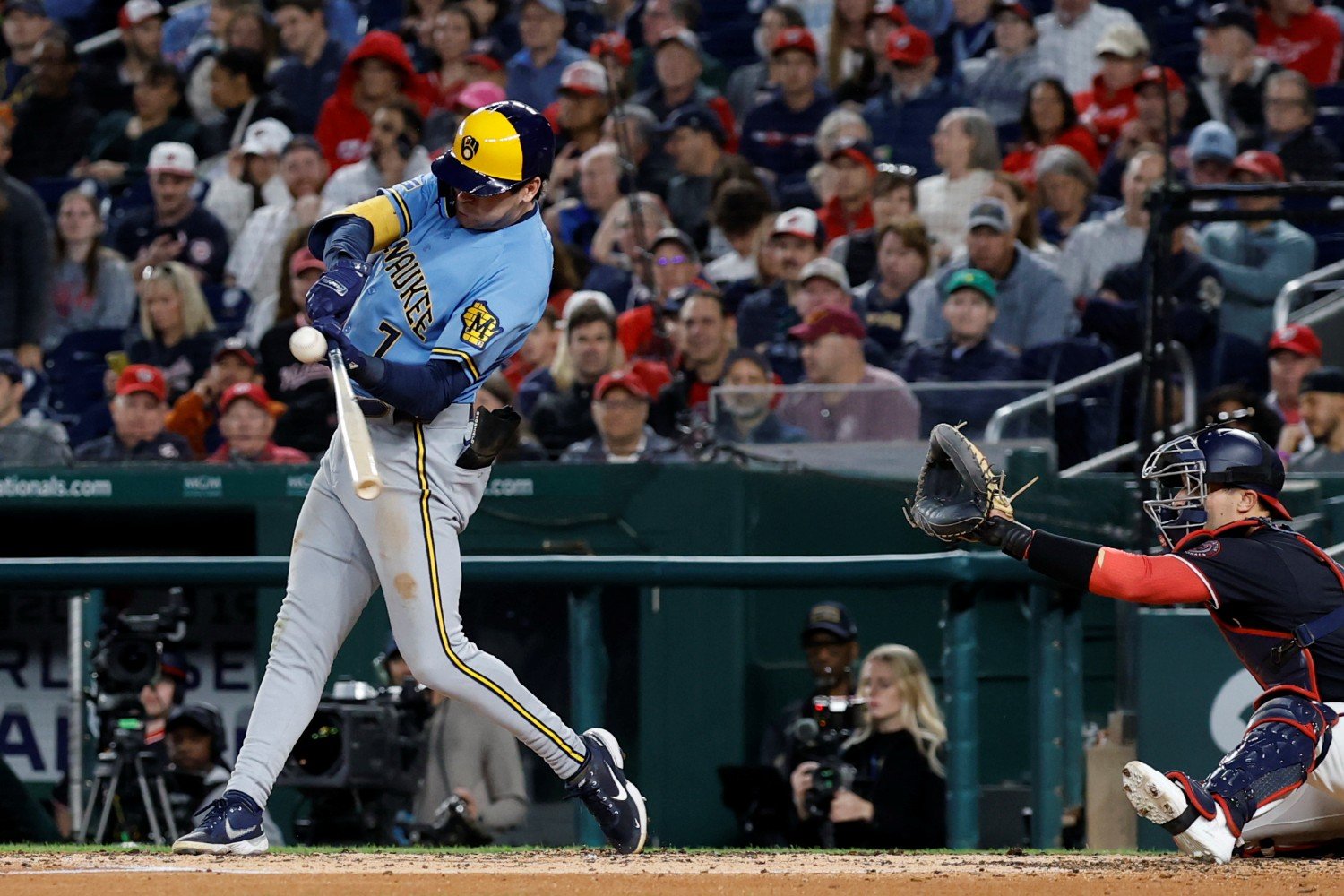
If all of that sounds like a mouthful, here's what it looked like in real life back in 2024. You can see Black chop at a fastball down the middle, with his bat quickly traveling straight down and then straight up. It was a very hittable pitch, yet he was late on it and underneath it, producing a 77.6-mph bloop single to left-center. It was a hit, but it wasn't the kind of contact any hitter would hope to make with such a fastball.
In addition to lowering his swing tilt, Black's attack angle also decreased to 5 degrees in his brief time with the Brewers this year. His swing path is still pretty steep, but it's far less choppy. You can see how it's a more normal-looking path in one of Black's few hard-hit balls this year, a fastball he pulled off the right-field wall for a double against the Arizona Diamondbacks.
It's worth noting that those two swings occurred in different situations. One was a middle fastball, and the other was closer to the outside corner. The first was also a defensive two-strike swing, while the second came in a 1-1 count, where a hitter will usually look to do more damage with an in-zone pitch. Still, those two cuts illustrate the problem with Black's previous swing and how he and the Brewers are trying to correct it.
The payoff hasn't come yet, though, with Black still looking overmatched by big-league pitching. His timing was still too late during his latest stint, and he chased too much and rarely made solid contact. Those mishit balls would have eventually found more gloves. Black is best off in Nashville for now, where he'll continue getting at-bats to grow more comfortable with that revamped swing.
"Tyler knows that he's good enough to play in the big leagues," Murphy said. "He knows that he's wanted, and his time will come again."
Are you optimistic about the Brewers right now?

Follow Brewer Fanatic For Milwaukee Brewers News & Analysis



-
 2
2


Recommended Comments
Create an account or sign in to comment
You need to be a member in order to leave a comment
Create an account
Sign up for a new account in our community. It's easy!
Register a new accountSign in
Already have an account? Sign in here.
Sign In Now