


Brewers Video
The former first-round pick has had a hard time getting underneath the ball, a hard time making enough contact against high-level pitching, and a hard time staying healthy. Is fixing two of those three good enough?
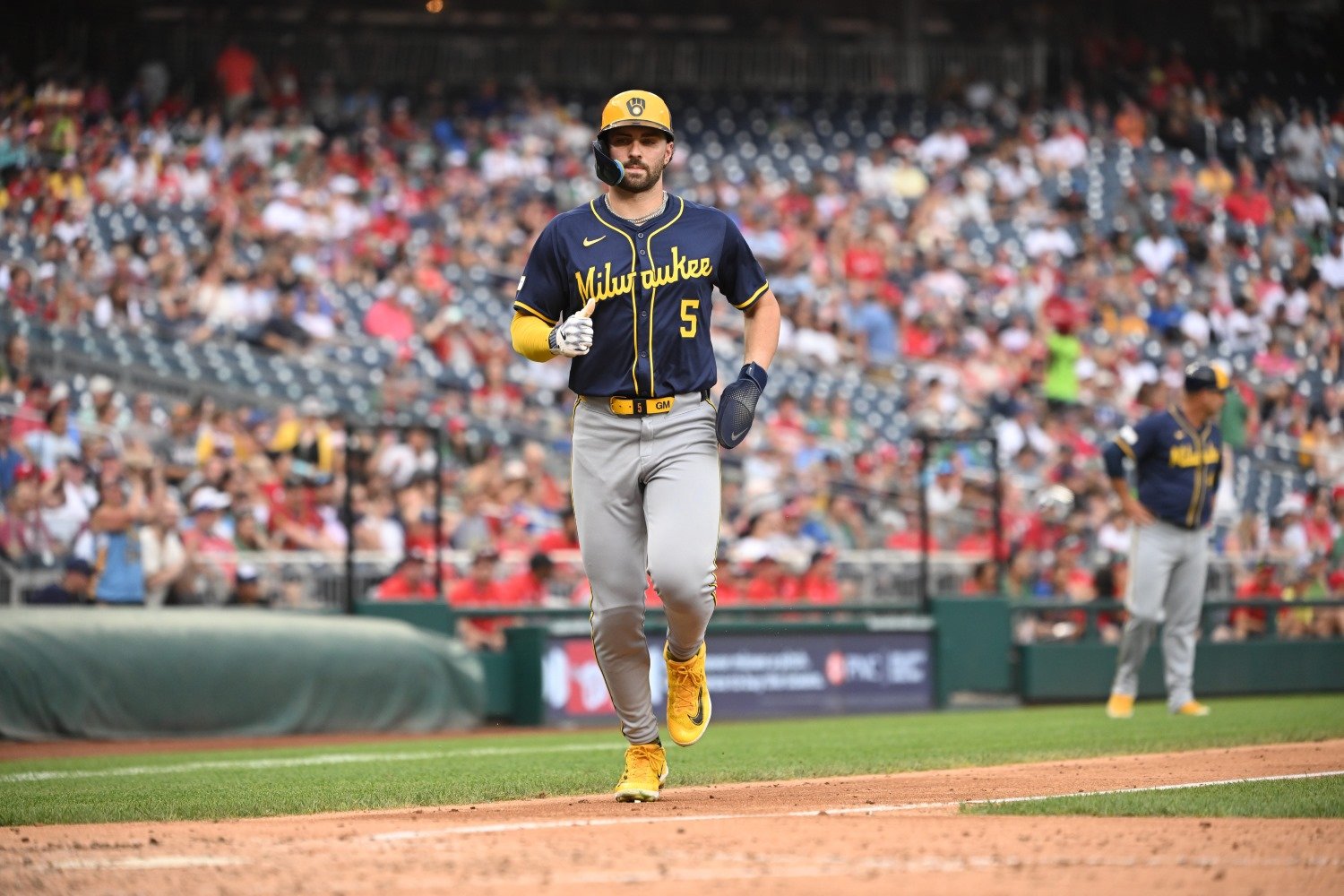
The sample is tiny. That's always one problem where evaluating Garrett Mitchell is concerned. He's batting .290/.372/.420 for the Brewers so far this year, but that's in just 78 plate appearances, after he missed the first three months of the season with a broken bone in his hand. If it wasn't for bad luck, Mitchell (who was a prized prospect heading into his junior year at UCLA, before COVID thwarted the bulk of that collegiate season and curtailed the pre-Draft scouting process) would have no injury luck at all. Last year, it was a major shoulder injury on a unique play at third base. This time, he just hurt his hand on a swing.
Because so many of these have been freak injuries with no obvious risk of recurrence, though, maybe we can allow ourselves to hope that they're in the past. Mitchell has certainly looked healthy and strong so far, and not just in that the numbers are good. As ever, when he's fit enough to take the field, he looks the part of a very good big-league ballplayer.
Dig beneath the surface of this small sample of performance, though, and the same old warning signs are there. He's whiffing on over 31 percent of all swings, one of the worst rates in baseball. He doesn't elevate the ball, and when a hitter both whiffs a lot and puts the ball on the ground a lot, the two flaws can sometimes feed into each other, overshadowing and choking out a bevy of other skills or virtues. It's why Mitchell has had so many doubters, even as he's played his way to the majors and put up good numbers just about every time he's gotten the chance.
Maybe it's time to allow for a bit more optimism. He might never develop high-end in-game power, because of the ground ball rate, but Mitchell has quietly struck a fine balance this year, using his good batting eye to make up for his own lack of contact skills. He's walking at a very sturdy 11.5% rate, and he's only striking out at a 25.6% clip. Because he hits the ball fairly hard, albeit mostly on the ground and on low trajectories when in the air, and because he's blindingly fast, he's also running a superb batting average on balls in play. That's always been part of his profile; we should expect him to have stellar BABIPs unless he's playing through some hampering malady.
That cocktail of patience and BABIP skills can easily cancel out a strikeout rate in his current range. The danger comes when he's on the wrong side of 30%, and at the moment, that's not the case. At the moment, it makes sense to pencil him in third in the lineup when the team faces a right-handed starting pitcher, which is what Pat Murphy did Tuesday night.
Now, can he keep up (er, down) this strikeout rate, while whiffing as much as he currently does when he swings? Uhhh, no. Mitchell has only chased 11.9% of pitches outside the zone so far this year. That's an incredible figure--both in that it's deeply impressive, and in that it's not sustainable. Over a larger sample, Mitchell's plate discipline will fray slightly. It's inevitable. No one else in baseball is chasing as little as he is, because when you play more than a month's worth of games, it's impossible to do so. Mitchell is also swinging at almost 73% of the pitches he sees within the zone. Of the 473 batters who have at least 50 plate appearances this year, no one has as great a disparity between their in-zone and out-of-zone swing rates as Mitchell does.
Maybe Mitchell can remain the leader, but in absolute terms, the gap between those two rates is going to shrink. Meanwhile, the number of pitches he sees inside the zone is going to increase. Right now, he's in the 36th percentile for zone rate, but that's just noise based on how little he's played. As pitchers realize that he's not driving the ball to the fences (let alone over them), they will throw him more strikes, and that will both expose his swing-and-miss issues and force him to expand the zone more, to protect the plate when behind in the count. A reckoning is coming, if he can stay healthy long enough to face it.
That said, it doesn't have to be a reckoning in which he's found wanting and demoted again. He could very well meet the challenge, by either getting a bit more air under the ball (maybe that's just a matter of targeting specific locations within the zone where his bat path is conducive to loft and power) or getting the bat on the ball more often. It's just that the shape of his at-bats will have to change, especially if he stays in the heart of the lineup.
Murphy and his staff need a stand-in for Christian Yelich. It's not fair to expect that of Mitchell, whose vulnerability to the strikeout makes him so different from the extraordinary pure hitter Yelich is, but as Mitchell well knows, baseball is not always fair. He has a big opportunity before him, and he's already made some impressive improvements. If he can sustain them, even as regression and adjustment curves come for him, then he could be the hero of the Brewers' stretch run.





Recommended Comments
Create an account or sign in to comment
You need to be a member in order to leave a comment
Create an account
Sign up for a new account in our community. It's easy!
Register a new accountSign in
Already have an account? Sign in here.
Sign In Now