


Brewers Video
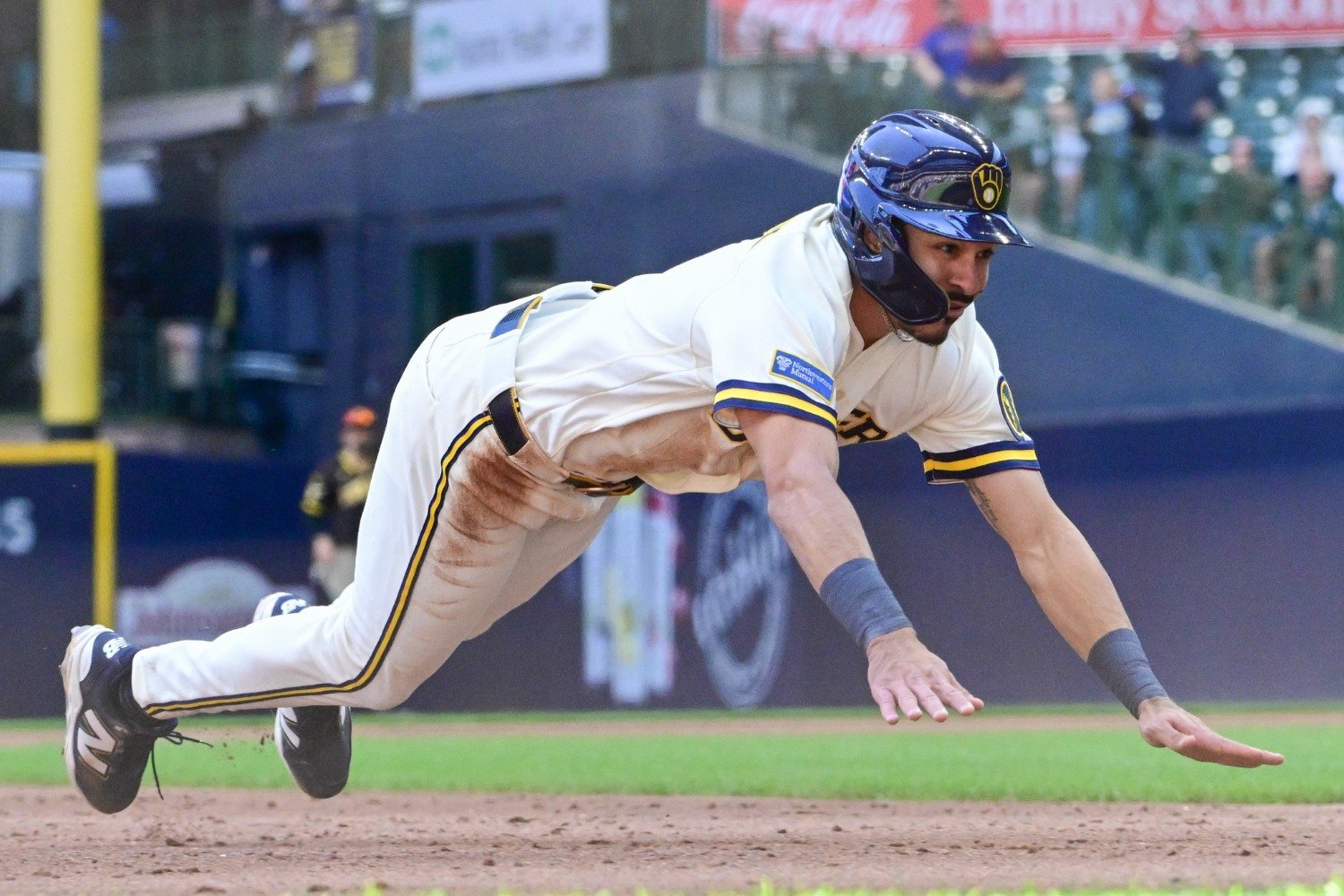
From the moment they reacquired him from the Boston Red Sox a few weeks before spring training, the Brewers have raved about David Hamilton’s athleticism.
“From an ability standpoint and his work, I couldn't ask for anything more to work with,” third base and infield coach Matt Erickson said. “I think he’s a part of this for a while.”
Compared to the headline return of left-handers Kyle Harrison and Shane Drohan, Hamilton may have looked like a throw-in piece in that Boston trade—a part-time player who could replace Andruw Monasterio in a utility role. The Brewers see him as anything but an afterthought. He’s appeared in 34 of the team’s 41 games, has taken the seventh-most plate appearances despite hitting near the bottom of the order, and has recently taken much of Joey Ortiz’s playing time at shortstop against right-handed pitchers.
Hamilton’s track record as a 28-year-old doesn’t point to much upside. In 668 career plate appearances, he’s hit for a 76 wRC+, 80 DRC+, and .272 xwOBA, meaning both his results and process in the box have been extremely poor. But the Brewers see a player who can move quickly and explosively. Hamilton’s average sprint speed of 29.2 feet per second ranks in the 95th percentile of runners this year. That athleticism, they believe, gives him the potential to be an elite defender at any position and hit for more pop than he’s shown so far.
“He's not even scratching the surface of what he's capable of,” Murphy said, “but there are some big, big adjustments he needs to make to be the player we think he can be. And I'm sure the Red Sox saw the same thing.”
So far, the Brewers have not gotten much more out of Hamilton than the Red Sox. In 118 plate appearances this year, he owns a 75 wRC+, 86 DRC+, and .269 xwOBA. Each of those numbers nearly matches what he did in Boston. Baseball Prospectus has credited him with 0 Deserved Runs Prevented at both third base and shortstop, meaning he’s been an average defender instead of a plus one.
There have been two noticeable changes to Hamilton’s offense this year: he’s walking 11% of the time, and he’s leveraging his speed by bunting, leading baseball with eight bunt hits. That approach has gotten him on base more often, but it’s tanked any semblance of power in his game. Hamilton’s .327 on-base percentage is easily a career high, but he has just one extra-base hit. That walk rate might not hold up, either, as he expands the zone much more than the average hitter with two strikes.

Shrinking the field with bunts and making speed his defining attribute won’t help Hamilton unlock his upside. If anything, it discourages a breakthrough. The Brewers aren’t trying to pigeonhole him into playing that style of offense, Murphy said, but for him to be a helpful piece right now, he needs to reach base with walks and singles on the ground.
“If he gets to first, wow, he's dangerous,” Murphy said, alluding to Hamilton’s base-stealing ability. “So we're trying to build it from there. The swing part, the amount of impact he can have, he's got some in there. He's got some bat speed, and his hands work. He can handle different pitches. He can hit the ball hard. But that's a process, though.”
Behind the scenes, the Brewers are trying to make Hamilton’s swing—most specifically, how he rotates his torso—more nuanced. He’s always been a pull-happy hitter who has hit the ball hardest when it leaks back over the middle or is low and inside. Pitchers have countered that by pitching him away, where he often fails to stay on the ball.

Because of his inclination to open up and pull the inside pitch, nearly all of Hamilton’s hard-hit fly balls this year have occurred on pitches around that low-and-in pocket.

The problem is that he’s doing that same thing on most pitches, regardless of location. In both clips below, you can see Hamilton’s front side fly open as he swings. On the middle-in fastball, he rips a hard fly ball to center field. On the middle-away sinker, he rolls over to second base.
If you freeze the video just as he’s about to make contact, his chest is similarly open toward right field on both swings, even though they’re on opposite sides of the plate. Hamilton keeps his eye on the ball and adjusts his swing path to make contact with both pitches, but he’s not in a position to work through the pitch away because his chest is already rotating toward right field.

“Your direction is here,” Murphy said, gesturing toward a hypothetical right field before pointing in the opposite direction, “and that pitch is coming from here. You’re going to pull off it. You’re going to hit around it. You’re going to smother it, when it’s closer to him. So having him understand how to get on the ball line is a really tough process.”
That process has yet to bear fruit. The results have been more mixed for Hamilton’s continued work with Erickson on the left side of the infield, where he has misplayed a handful of routine opportunities.
Ortiz got off to a similarly unremarkable start as a full-time shortstop last year, and it took him months to develop a more explosive first step alongside his fluid hands and body control. Hamilton is the opposite: his first step and range are elite, but he struggles with controlling that explosiveness. According to Baseball Prospectus’s Attempt Range metric, he has fielded two more balls than the average shortstop would reach, but he has completed plays at a slightly below-average rate.
“His metrics are unbelievable, but controlling the baseball, throwing accurately, redirecting the ball, tags, all that stuff, he's got a ways to go,” Murphy said. “But his movement and the ground he can cover, those metrics are unbelievable.”
On some occasions, Erickson said, Hamilton has been so eager to complete a play that he’s taken his eye off the ball prematurely. It caused him to miss a catch on an attempted double play turn against the Pittsburgh Pirates last month.
Other times, Hamilton has gotten stuck in his fielding position after a grounder enters his glove, prompting him to urgently fire an errant throw to make up for that lost time. That also happened multiple times in that Pittsburgh series.
In each instance, Hamilton struggled with the start-and-stop rhythm of completing certain plays. At times, his raw athleticism has outpaced his tempo on the infield.
“I think that's something with all infielders in general, and especially ones that are super explosive and twitchy, not to play the game too fast,” Erickson said. “You want to break down and slow down for the catch, and then kind of keep that same rhythm through the catch and through the exchange and into your throw. And I think the guys that do that are the most consistent throwers with accuracy.”
After still grading as a negative defender at shortstop a few weeks ago, Hamilton’s metrics have trended positively since the calendar flipped to May. There’s still work to be done (Erickson wants to see a more consistent arm action across throws), but he’s looked more comfortable lately.
“He's a versatile piece, because he can play all three infield spots, and he can play them all very well,” Erickson said. “Now we’ve just got to get him to be consistent as much as possible.”
Even if the Brewers remain bullish on his ceiling, the reality is that Hamilton has not progressed enough overall as the club nears a decision point on the left side of the infield. Milwaukee shortstops have combined for a 49 wRC+ so far this year, and prospects Cooper Pratt and Jett Williams have started adapting to Triple-A pitching within the last two weeks. Ortiz is more likely to lose his roster spot to one of those two, but their arrival would push Hamilton into more of a part-time role. For now, he’ll remain in the lineup against most right-handed pitchers as the Brewers keep trying to tap into his skill set.
“This is a super valuable kid, but it's got to come together,” Murphy said. “He’s got to understand exactly who he is and what he can become, and understand what adjustments he needs to make and how to do it.”
Are you optimistic about the Brewers right now?

Follow Brewer Fanatic For Milwaukee Brewers News & Analysis



-
 3
3



Recommended Comments
Create an account or sign in to comment
You need to be a member in order to leave a comment
Create an account
Sign up for a new account in our community. It's easy!
Register a new accountSign in
Already have an account? Sign in here.
Sign In Now