


Brewers Video
The next offseason deadline is approaching. The Brewers have a handful of minor-league players eligible for the Rule 5 draft. Here's why some candidates are more likely than others to be protected.
At the beginning of the month, the Brewers trimmed their 40-man roster to 36 by declining club options and waiving several players. That was partially in preparation for the next key offseason date that arrives next week: the deadline to protect players from December's Rule 5 Draft.
The draft aims to give big-league opportunities to players who may be buried on their current organization’s depth chart. Unprotected players signed at age 19 or older become eligible after playing four years of professional baseball, and those signed at 18 or younger become eligible after five years. If left unprotected, these players are available for teams to add to their big-league rosters.
Players on the 40-man roster of their current club are not available to other teams in the draft, so teams often select the contracts of their best eligible prospects by the deadline to protect them. The deadline to do so is next Tuesday, Nov. 19.
The Brewers have more than 40 eligible players (the complete list is available here), but only a handful are serious candidates to be selected by other teams or added to Milwaukee’s 40-man roster. If recent history is any indication, it’s unlikely the club will protect more than two or three of these players.
It’s worth noting that leaving a player exposed does not mean the Brewers don’t value them. It’s often a calculated gamble that favors the player’s current team if he’s not an elite prospect.
Although the Draft technically lasts until all 30 teams have passed, and can involve multiple rounds, most teams do not make a pick. Only 10 selections were made in last year’s draft, and 15 in 2022. The drafting team cannot send the player to the minor leagues, and that player must remain on the active roster for at least 90 days of the season for the club to retain their rights beyond that year. For this reason, the team that lost the player still has a decent chance of getting them back within a few months.
With that in mind, here’s a narrowed-down list of potential additions to the Brewers’ 40-man roster and their likelihood of being protected.
RHP Logan Henderson
Henderson is the only lock on this list. The 22-year-old righthander shot up prospect rankings with an excellent 2024 season that began in High-A and ended in Triple-A. In 17 starts spanning three levels, he pitched to a 3.52 ERA and 3.63 FIP with a fantastic 31.2% strikeout rate and a 6.27 strikeout-to-walk ratio. The updated rankings at FanGraphs named Henderson Milwaukee’s 12th-best prospect, and Brewer Fanatic recently ranked him 8th.
His fastball usually sits in the low 90s, but Henderson can reach back for 95-96. He’s unique in that he generates above-average ride from backspin on his four-seamer while throwing it from a low slot. This helps it play exceptionally at the top of the zone, where the pitch induces plenty of whiffs and pop-ups. Henderson complements the fastball with a 60-grade changeup that has plenty of fade and separation off his heater.
Henderson has developed strong command of his fastball-changeup combination, leaving the mastery of a consistent secondary pitch with glove-side movement as his next hill to conquer. Neither his cutter nor slider have developed much in the minor leagues. However, his upside and straightforward path to big-league innings in 2025 make him a slam dunk to join the 40-man roster in a few days.
RHP Coleman Crow
Every candidate after Henderson has protection odds ranging from toss-up to unlikely, but Crow may have a leg up on his contemporaries due to his promise and Milwaukee’s presumed desire to see more of him.
Acquired in return for Adrian Houser and Tyrone Taylor last winter, Crow missed the 2024 regular season while rehabbing from the Tommy John surgery he underwent the previous August. He’s pitched four times in the Arizona Fall League with mixed results, but at the time of the trade, prospect evaluators viewed Crow as someone who could quickly ascend to the big leagues in a bulk role upon recovery.
His low-90s fastball isn’t as effective as Henderson’s, but it’s a serviceable pitch when Crow commands it at the top of the zone from his arm slot. His ability to spin the ball is his standout trait. In addition to his fastball, Crow throws two distinct breaking balls that could make him an MLB-ready arm at some point in 2025. All three pitches have excellent spin rates.
Crow’s curveball has received as high as a 60 grade from evaluators, and the tracked curves he’s thrown in the AFL have averaged -10 inches of induced vertical break with nearly 17 inches of horizontal break. His slider is a shorter and harder pitch, sitting in the mid-80s with 4.8 inches of induced vertical break and 5 inches of horizontal break.
Unsurprisingly, Crow has been plenty reliant on his breaking pitches in the minor leagues. He’ll need that approach to succeed at the game’s highest level. Refining his sinker and changeup could make him more likely to stick as a starter, but his breaking balls should allow him to navigate a lineup once in a multi-inning relief role.
The Brewers could take the gamble of leaving Crow unprotected in hopes that nobody is willing to roster him in his first season back from major surgery. They’ve invested player capital and time into his rehab, though, and adding him to the 40-man roster is the safe route for maintaining a chance of a return on that commitment.
RHP Shane Smith
The 24-year-old Smith signed with the Brewers as an undrafted free agent in 2022 while recovering from Tommy John surgery. He began the 2024 season as a reliever in Double-A before transitioning into a starting role. His performance earned him a September promotion to Triple-A, where he allowed just two runs in five relief outings. Across the two levels, he posted a 3.05 ERA and 2.91 FIP with a 29.6% strikeout rate in 94 ⅓ innings.
Like Crow, Smith’s calling card is his slurve-like curveball, but his breaking ball possesses even more depth with less sweep. His mid-90s fastball has also received strong grades and sometimes trends toward a rise-cut shape. Smith also features a hard bullet slider and began experimenting with a sweeper in 2024.
Smith could crack the big leagues as a reliever in 2025, but his inconsistent fastball shape and the deep relief corps in Milwaukee could thwart that. It’s unlikely the Brewers will devote two roster spots to pitchers with plus breaking balls but no or limited experience above Double-A, so a decision on who to protect alongside Henderson could come down to Smith or Crow.
RHP Chad Patrick
The Brewers acquired Patrick from the Oakland A’s a year ago in exchange for Abraham Toro. He was named International League Pitcher of the Year in his first season with his new organization, leading the league in ERA (2.90) and strikeouts (146) while logging 136 1/3 innings for the Nashville Sounds.
Despite that showing, Patrick never received a promotion, even as the Brewers looked to shore up what was a patchwork rotation for prolonged stretches of the season. That was likely due to his lack of upside and uncertainty about how his profile will translate to the big leagues, which could also make the club comfortable with losing him to another organization.
Beneath that shiny ERA were a more pedestrian 3.98 FIP and 4.84 DRA. Patrick’s bread and butter is his cutter, but while it was highly effective against Triple-A opponents, its shape often varied wildly from one pitch to the next.

Clusters on a pitch movement graph are generally not supposed to be that big. While no pitch will leave a pitcher’s hand in exactly the same fashion every time, Patrick’s cutter can look like an entirely different offering within a single outing. No one else in the upper levels of the game has quite this much variability.

It raises the possibility that Patrick manipulates the cutter by design. If he doesn’t, it’s an unpredictability that makes it harder to trust him to pitch at the highest level. Add in the home run concerns baked into his heavy fly-ball profile and inconsistent walk numbers, and there are reasons to believe the Brewers are not as likely to protect him as his surface-level numbers might indicate.
1B/OF Ernesto Martinez Jr.
Martinez just re-upped with the Brewers on a new minor-league deal after enjoying a breakout campaign at age 25. He spent the entire year in Double-A, hitting .284/.365/.466 with 13 home runs for a 146 wRC+.
Standing 6-foot-6 and weighing 250 pounds, Martinez has always possessed an exciting blend of raw power and speed. He still has a ways to go, but the significant cuts to his strikeout rate in recent seasons are the real story. Making more contact is what’s positioned him to finally reach the upper minors after a slower progression through the first several years of his career. He’s been primarily a first baseman, but has also made cameos in center field due to his athleticism and range in the field.
Martinez is still raw enough entering his age-26 season that the Brewers likely don’t see a pressing need to protect him. Still, he probably renewed some optimism within the organization (and earned some external looks) with a resurgent season.
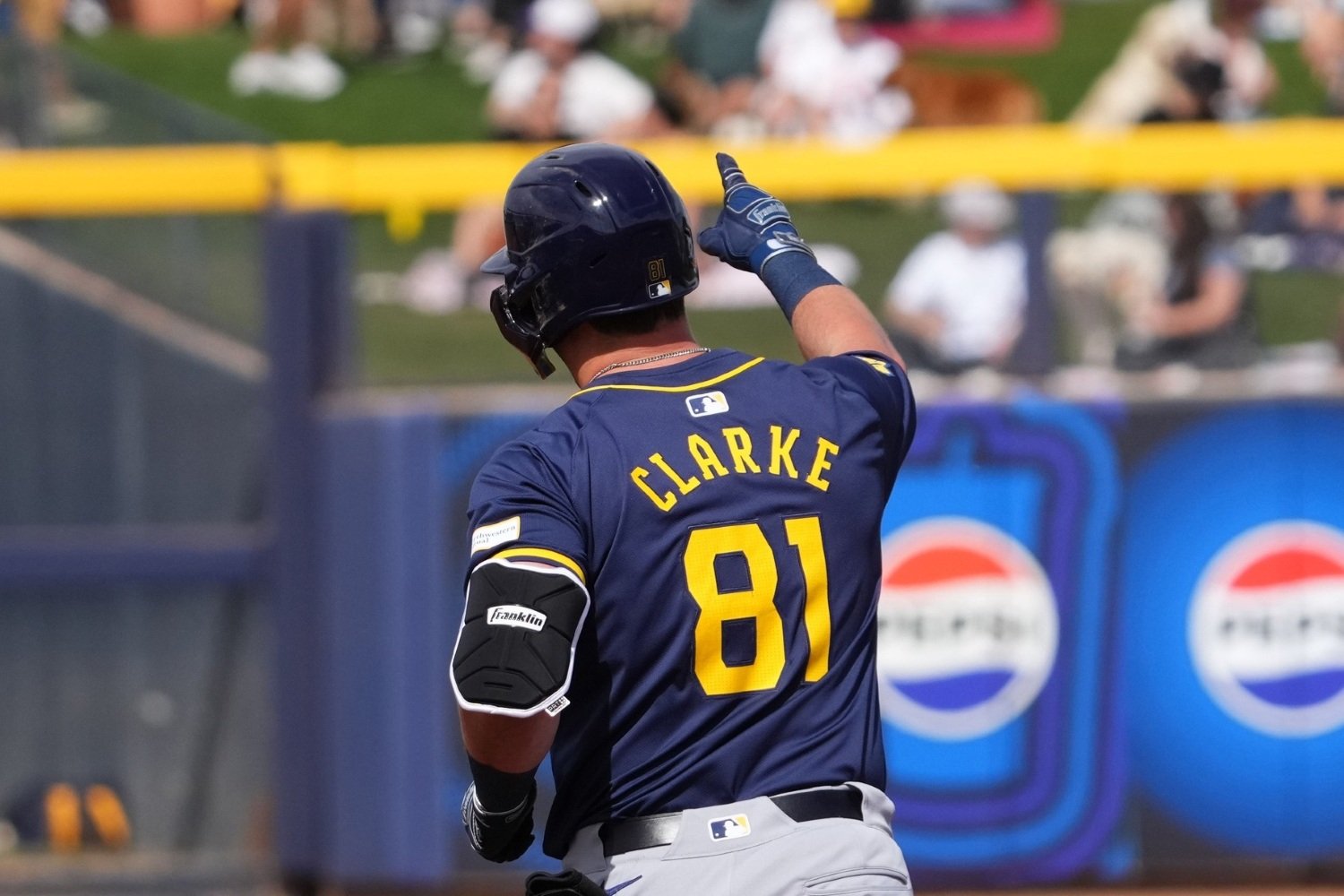
1B/C Wes Clarke
After smashing 26 home runs in 118 games at Double-A Biloxi in 2023, Clarke made his presence felt in spring training by homering four times. The slugger then went deep 21 times during the minor-league season, spending most of it in Triple-A.
Clarke has caught 80 games in the minor leagues but has played primarily first base, and profiles as a DH in the big leagues. Offensively, he’s a stereotypical three-true-outcomes hitter from the right side. Too much swing-and-miss stands between him and being a semi-reliable MLB bat. He struck out 35.1% of the time in Triple-A, where his 40.6% whiff rate was the fourth-highest among hitters with at least 300 plate appearances.
The Brewers could use more power in their lineup, but Clarke isn’t the answer. He’s highly unlikely to be protected. While a rebuilding organization could take a gamble on his light-tower power, the low floor presented by the holes in his swing means he’ll probably return to Nashville in 2025.
Do you approve of the job the Brewers' front office is doing?

Follow Brewer Fanatic For Milwaukee Brewers News & Analysis



-
 4
4


Recommended Comments
Create an account or sign in to comment
You need to be a member in order to leave a comment
Create an account
Sign up for a new account in our community. It's easy!
Register a new accountSign in
Already have an account? Sign in here.
Sign In Now