Jump to content
Brewer Fanatic

Spencer Michaelis

Brewer Fanatic Contributor
  • Posts

    1,003
  • Joined

  • Last visited

  • Days Won

    16

 Content Type 

Profiles

Forums

Blogs

Events

News

2026 Milwaukee Brewers Top Prospects Ranking

Milwaukee Brewers Videos

2022 Milwaukee Brewers Draft Picks

Milwaukee Brewers Free Agent & Trade Rumors, Notes, & Tidbits

Guides & Resources

2023 Milwaukee Brewers Draft Picks

2024 Milwaukee Brewers Draft Picks

The Milwaukee Brewers Players Project

2025 Milwaukee Brewers Draft Pick Tracker

Store

Downloads

Gallery

Everything posted by Spencer Michaelis

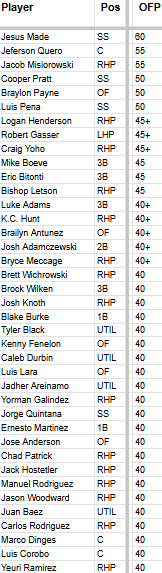
  1. Welcome back to Brewer Fanatic's 2024 top 20 prospect breakdown! In this edition, we break down Cooper Pratt, who comes in as the third-best prospect in the system, as voted on and compiled by the Brewer Fanatic community. Image courtesy of © Dan Powers/USA TODAY NETWORK-Wisconsin / USA TODAY NETWORK via Imagn Images 3. Cooper Pratt (Carolina Mudcats, Wisconsin Timber Rattlers, Biloxi Shuckers) The Brewers surprisingly selected Pratt in the sixth round in 2023, a pick that many evaluators considered the steal of the draft at the time. Pratt was ranked the 25th-best overall prospect in the draft by FanGraphs, 45th by MLB Pipeline, and 63rd by Baseball America. Pratt was, like many Brewers selections in recent history, a pick based on a mix of analytics and pure scouting. He would stand out in most teams' models, but he also stood out to the pro scouts watching him on the prep circuit over the last few years. Pratt began his first full season with the Carolina Mudcats as a 19-year-old, spent time with the Wisconsin Timber Rattlers, and eventually finished his season playing for the Biloxi Shuckers in their lone playoff series. What to Like: On the defensive side, Pratt appears to be poised to stick at shortstop, despite his 6-foot-4 build. He was recently awarded the Rawlings MiLB Gold Glove award as the best defensive shortstop in the minor leagues. Pratt has very good hands, and advanced actions for his age. He gets solid reads off the bat and does especially well when coming in on the ball, or ranging up the middle. As the season progressed, he looked more and more comfortable ranging to his right to cover the hole between shortstop and third base. Pratt’s arm is above-average, if not plus, and it allows him to record outs on plays that not many players his age could make. While not a burner, Pratt is an above-average runner with good instincts on the bases. He has a very smooth gait and used it well on the bases in 2024, stealing 27 bags successfully and being caught just three times. While he probably won’t be a prolific basestealer in his prime, a 20-steal big-league season wouldn’t be out of the question. He also appears to have good baserunning instincts, and looks to take the extra base when he can. Offensively, Pratt’s approach at the plate was considered one of the best among all the high school selections in his class. According to Baseball America, he posted fantastic plate discipline and bat-to-ball numbers during his time on the tournament circuit. “Over a 668-pitch sample, Pratt had just a 12% overall miss rate and 17% chase rate," reads the BA report. "His miss rate falls to just 6% on pitches in the zone.” Unsurprisingly, that whiff rate was higher in pro ball, but the 23.2% rate he posted in 2024 was still 77th-percentile and shows that he has above-average contact skills. Pratt has a simple operation at the plate, utilizing a small leg kick and extremely quick hands. Those traits combine to form a smooth swing that keeps the barrel in the zone for a long time and allows him to hit the ball with authority to all fields, and also to hit line drives at an elite level. His 30.5% line drive rate was in the 98th percentile among all minor-league hitters, and he batted .728 on those line drives, including 11 of his 15 doubles and three of his eight home runs. What to Work On: Pratt is not providing much in the way of in-game power at this point in his career. Still, his frame shows the potential to grow into much more, and he did start to show signs of improvement after his promotion to High-A. Pratt hit five home runs with the Timber Rattlers in only 95 plate appearances. He had only hit three in 311 plate appearances with Carolina. In order to get to that power more consistently, Pratt could benefit from hitting fly balls more often; his 28.2% rate is extremely low. However, similar to Mike Boeve, there's a risk of losing his elite ability to hit line drives in that process. As long as he keeps getting stronger, he might be able to make this profile work well enough to get to 20-homer power, but he’s more likely to end up in the 10-15 range without the adjustment. While Pratt drew quite a few walks in Low-A, he did see that number fall sharply in High-A. He went from a 12.2% walk rate to a 4.2% rate, and at the same time, he saw his strikeout rate jump from 18.3% to 25.3%. His power numbers made a leap at High-A, but could that have been at the cost of his plate discipline and bat-to-ball abilities? A sample of under 100 plate appearances isn’t any reason to sound the alarms, but it will be something to monitor moving forward. Defensively, continued improvement in his initial read off the bat will help ensure that he sticks as a shortstop. As mentioned earlier, this mainly shows up on balls hit to his backhand. He already made a jump in this regard in 2024, but getting even better at it could take him from a really good shortstop to a great one. What’s next: Pratt has already popped up on a couple of Top 100 lists around the industry. His ability to defend at short, hit line drives and play smart baseball all give him a really solid floor. If he can trade some of his ground balls for fly balls and continue to add weight to a frame that can definitely carry more, he may begin to tap into a bit more power. A power jump, while maintaining what he’s already good at, would likely make him a consensus Top 100 prospect. Starting Pratt back in Wisconsin with the Timber Rattlers is a possibility, given he only spent a few weeks there in 2024. However, considering the amount of infield depth in the Brewers system at the lower levels (as well as Pratt’s promotion to Double-A for the Shuckers playoff series) would seem to point to a potential Biloxi assignment to begin 2025. What are your thoughts on Pratt? What are you hoping to see from him in 2025? Let us know in the comments! View full article
  2. 3. Cooper Pratt (Carolina Mudcats, Wisconsin Timber Rattlers, Biloxi Shuckers) The Brewers surprisingly selected Pratt in the sixth round in 2023, a pick that many evaluators considered the steal of the draft at the time. Pratt was ranked the 25th-best overall prospect in the draft by FanGraphs, 45th by MLB Pipeline, and 63rd by Baseball America. Pratt was, like many Brewers selections in recent history, a pick based on a mix of analytics and pure scouting. He would stand out in most teams' models, but he also stood out to the pro scouts watching him on the prep circuit over the last few years. Pratt began his first full season with the Carolina Mudcats as a 19-year-old, spent time with the Wisconsin Timber Rattlers, and eventually finished his season playing for the Biloxi Shuckers in their lone playoff series. What to Like: On the defensive side, Pratt appears to be poised to stick at shortstop, despite his 6-foot-4 build. He was recently awarded the Rawlings MiLB Gold Glove award as the best defensive shortstop in the minor leagues. Pratt has very good hands, and advanced actions for his age. He gets solid reads off the bat and does especially well when coming in on the ball, or ranging up the middle. As the season progressed, he looked more and more comfortable ranging to his right to cover the hole between shortstop and third base. Pratt’s arm is above-average, if not plus, and it allows him to record outs on plays that not many players his age could make. While not a burner, Pratt is an above-average runner with good instincts on the bases. He has a very smooth gait and used it well on the bases in 2024, stealing 27 bags successfully and being caught just three times. While he probably won’t be a prolific basestealer in his prime, a 20-steal big-league season wouldn’t be out of the question. He also appears to have good baserunning instincts, and looks to take the extra base when he can. Offensively, Pratt’s approach at the plate was considered one of the best among all the high school selections in his class. According to Baseball America, he posted fantastic plate discipline and bat-to-ball numbers during his time on the tournament circuit. “Over a 668-pitch sample, Pratt had just a 12% overall miss rate and 17% chase rate," reads the BA report. "His miss rate falls to just 6% on pitches in the zone.” Unsurprisingly, that whiff rate was higher in pro ball, but the 23.2% rate he posted in 2024 was still 77th-percentile and shows that he has above-average contact skills. Pratt has a simple operation at the plate, utilizing a small leg kick and extremely quick hands. Those traits combine to form a smooth swing that keeps the barrel in the zone for a long time and allows him to hit the ball with authority to all fields, and also to hit line drives at an elite level. His 30.5% line drive rate was in the 98th percentile among all minor-league hitters, and he batted .728 on those line drives, including 11 of his 15 doubles and three of his eight home runs. What to Work On: Pratt is not providing much in the way of in-game power at this point in his career. Still, his frame shows the potential to grow into much more, and he did start to show signs of improvement after his promotion to High-A. Pratt hit five home runs with the Timber Rattlers in only 95 plate appearances. He had only hit three in 311 plate appearances with Carolina. In order to get to that power more consistently, Pratt could benefit from hitting fly balls more often; his 28.2% rate is extremely low. However, similar to Mike Boeve, there's a risk of losing his elite ability to hit line drives in that process. As long as he keeps getting stronger, he might be able to make this profile work well enough to get to 20-homer power, but he’s more likely to end up in the 10-15 range without the adjustment. While Pratt drew quite a few walks in Low-A, he did see that number fall sharply in High-A. He went from a 12.2% walk rate to a 4.2% rate, and at the same time, he saw his strikeout rate jump from 18.3% to 25.3%. His power numbers made a leap at High-A, but could that have been at the cost of his plate discipline and bat-to-ball abilities? A sample of under 100 plate appearances isn’t any reason to sound the alarms, but it will be something to monitor moving forward. Defensively, continued improvement in his initial read off the bat will help ensure that he sticks as a shortstop. As mentioned earlier, this mainly shows up on balls hit to his backhand. He already made a jump in this regard in 2024, but getting even better at it could take him from a really good shortstop to a great one. What’s next: Pratt has already popped up on a couple of Top 100 lists around the industry. His ability to defend at short, hit line drives and play smart baseball all give him a really solid floor. If he can trade some of his ground balls for fly balls and continue to add weight to a frame that can definitely carry more, he may begin to tap into a bit more power. A power jump, while maintaining what he’s already good at, would likely make him a consensus Top 100 prospect. Starting Pratt back in Wisconsin with the Timber Rattlers is a possibility, given he only spent a few weeks there in 2024. However, considering the amount of infield depth in the Brewers system at the lower levels (as well as Pratt’s promotion to Double-A for the Shuckers playoff series) would seem to point to a potential Biloxi assignment to begin 2025. What are your thoughts on Pratt? What are you hoping to see from him in 2025? Let us know in the comments!
  3. Welcome back to Brewer Fanatic's 2024 top 20 prospect breakdown! In this edition, we will be taking a look at Robert Gasser. Gasser comes in as the fourth-best prospect in the system, as voted on and compiled by the Brewer Fanatic community. Image courtesy of © Mark Hoffman-Imagn Images 4. Robert Gasser (Nashville Sounds, Milwaukee Brewers) A second-round draft pick by the Padres in the 2021 draft, Gasser was in the midst of his first full season when the infamous Josh Hader trade went down at the trade deadline in 2022. He finished his Padres career at the High-A level, having thrown 90 1/3 innings for the Fort Wayne TinCaps. The Brewers decided that was plenty of experience at that level and assigned him to Double-A Biloxi to begin his Brewers career. Four starts later, Gasser and his 2.21 ERA and 11.5 strikeouts per nine innings were headed to Triple-A Nashville. Thst's where he would finish the 2022 campaign and where he spent all of 2023. He returned there to begin 2024 after battling some elbow issues in spring, and made three starts before being called up to make his MLB debut on May 10th. What to Like: To begin, Gasser has an athletic delivery, and because of that delivery, he releases the ball 4.96 feet off of the ground on average. Out of 193 lefties to throw at least 100 pitches in 2024, Gasser’s release height was the ninth-lowest. He does this while also generating well above-average extension, at 6.7 feet. It’s a very abnormal release point for hitters, and it helps all of his pitches play up. Gasser has five pitches, and all five showed signs of being average or better offerings in his 28 innings with the big-league club. His sweeper was his most effective pitch and the pitch he threw the most often. After the sweeper, the order of usage went sinker, four-seam fastball, changeup, cutter. Gasser’s sweeper grades out well by any metric, as the low-80s offering features three inches less drop than the average sweeper thrown by a southpaw. It also has above-average glove-side movement, as well as average velocity. Coming from that low release point, it’s an outlier of a pitch from lefties and the 34.5% whiff rate on a pitch that he threw 32% of the time is a clear sign of that. His comfort throwing it for strikes and for chases against right-handed hitters is also abnormal, and that makes it an uncomfortable pitch for both handednesses of hitter. Hitters only posted a .190 batting average against the sweeper and a .573 OPS. In MLB, Gasser sat in the 92-94 range and got up to 95 on the fastball at times. His low release height helps him generate an above-average -4.3 degree Vertical Approach Angle, which helps him get the ball above barrels. He didn’t get many whiffs on it during his MLB stint, but it’s the type of pitch that should generate more, as long as he’s spotting at the top of the zone or higher. Since coming to the Brewers organization, Gasser had been mixing in his upper-80s cutter much more often than he had with the Padres. When he reached MLB, he dropped the usage significantly, instead relying more on the sinker and changeup than he had in Triple-A. However, the cutter still showed signs of being an effective pitch against right-handed hitters, especially when he can get it inside and on the hands of hitters. His sinker was used far more often in MLB than in Triple-A, and it performed much better than it had over the last couple of seasons in the minors. It did a great job generating ground balls for Gasser, doing so at a 57.7% rate, leading to a .214 batting average against, and a .429 OPS against the pitch. With over 15 inches of run on the pitch, the shape is surprisingly close to mirroring the sweeper shape, other than the fact that it’s thrown 12-13 MPH harder. The other pitch that made huge strides for Gasser was his changeup. He was able to get more separation between the changeup velocity and the fastballs he throws, which was helpful on its own. His command of the pitch was extremely impressive, and similar to the sinker, it was a great pitch for generating grounders in MLB. His 60% rate combined with an average exit velocity of 82.2 points to Gasser actually having some bad luck on this pitch as hitters batted .333 against it. Generally, Gasser’s command was fantastic in MLB, and it showed in his walk numbers, as well as the amount of soft contact he generated. Something he had struggled with at times in the minor leagues, seeing him walk less than a batter per nine innings was a great sign for him, even in a small sample. What to Work On: While the cutter was a really solid pitch for Gasser in the minors, and it did show signs of being effective in MLB, hitters did damage against it in a small sample. The 1.415 OPS against it was far and away the worst of any of Gasser's pitches. Batters hit the cutter in the air at a 70% clip and had an average exit velocity of 93.3 against it. While it has the ability to be a good counter pitch, he will need to throw it more effectively moving forward. Though Gasser had an extremely strong start to his MLB career, there was one main ingredient missing. The swings and misses that Gasser had generated throughout his minor-league career were largely non-existent, save for the sweeper. Throughout his career in the minors, he had generated whiffs at a 28.1% rate. In his 28 MLB innings, that number was only 21.6%. His strikeout rate at Triple-A was also 28.1%, compared to the miniscule 14% rate he posted in MLB. Gasser could have a solid career generating soft contact and living off of that, but if he is to reach his ceiling, there will need to be more swing and miss involved. Some of this could be related to pitch-calling from Brewers catchers as they got used to calling games for him. We know he is capable of generating more whiffs. Whether he can or can not, could be the difference between him being a mid-rotation arm or a back of the rotation arm. What’s next: Gasser was in the midst of establishing himself as a rotation piece, and well on his way to graduating from this list, before he unfortunately had to undergo Tommy John surgery. He’s expected to miss the majority, if not the entirety of the 2025 season. While there isn’t an ideal type of surgery, Tommy John has arguably become more of an exact science than any other. Gasser should be able to return to his old form eventually. It’s more of a matter of when, than if. The Brewers will take anything they can get from him in 2025, but barring a setback or a surprise, Gasser should be expected to be a part of the 2026 rotation. What are your thoughts on Gasser? What are you hoping to see from him in the future? Let us know in the comments! View full article
  4. 4. Robert Gasser (Nashville Sounds, Milwaukee Brewers) A second-round draft pick by the Padres in the 2021 draft, Gasser was in the midst of his first full season when the infamous Josh Hader trade went down at the trade deadline in 2022. He finished his Padres career at the High-A level, having thrown 90 1/3 innings for the Fort Wayne TinCaps. The Brewers decided that was plenty of experience at that level and assigned him to Double-A Biloxi to begin his Brewers career. Four starts later, Gasser and his 2.21 ERA and 11.5 strikeouts per nine innings were headed to Triple-A Nashville. Thst's where he would finish the 2022 campaign and where he spent all of 2023. He returned there to begin 2024 after battling some elbow issues in spring, and made three starts before being called up to make his MLB debut on May 10th. What to Like: To begin, Gasser has an athletic delivery, and because of that delivery, he releases the ball 4.96 feet off of the ground on average. Out of 193 lefties to throw at least 100 pitches in 2024, Gasser’s release height was the ninth-lowest. He does this while also generating well above-average extension, at 6.7 feet. It’s a very abnormal release point for hitters, and it helps all of his pitches play up. Gasser has five pitches, and all five showed signs of being average or better offerings in his 28 innings with the big-league club. His sweeper was his most effective pitch and the pitch he threw the most often. After the sweeper, the order of usage went sinker, four-seam fastball, changeup, cutter. Gasser’s sweeper grades out well by any metric, as the low-80s offering features three inches less drop than the average sweeper thrown by a southpaw. It also has above-average glove-side movement, as well as average velocity. Coming from that low release point, it’s an outlier of a pitch from lefties and the 34.5% whiff rate on a pitch that he threw 32% of the time is a clear sign of that. His comfort throwing it for strikes and for chases against right-handed hitters is also abnormal, and that makes it an uncomfortable pitch for both handednesses of hitter. Hitters only posted a .190 batting average against the sweeper and a .573 OPS. In MLB, Gasser sat in the 92-94 range and got up to 95 on the fastball at times. His low release height helps him generate an above-average -4.3 degree Vertical Approach Angle, which helps him get the ball above barrels. He didn’t get many whiffs on it during his MLB stint, but it’s the type of pitch that should generate more, as long as he’s spotting at the top of the zone or higher. Since coming to the Brewers organization, Gasser had been mixing in his upper-80s cutter much more often than he had with the Padres. When he reached MLB, he dropped the usage significantly, instead relying more on the sinker and changeup than he had in Triple-A. However, the cutter still showed signs of being an effective pitch against right-handed hitters, especially when he can get it inside and on the hands of hitters. His sinker was used far more often in MLB than in Triple-A, and it performed much better than it had over the last couple of seasons in the minors. It did a great job generating ground balls for Gasser, doing so at a 57.7% rate, leading to a .214 batting average against, and a .429 OPS against the pitch. With over 15 inches of run on the pitch, the shape is surprisingly close to mirroring the sweeper shape, other than the fact that it’s thrown 12-13 MPH harder. The other pitch that made huge strides for Gasser was his changeup. He was able to get more separation between the changeup velocity and the fastballs he throws, which was helpful on its own. His command of the pitch was extremely impressive, and similar to the sinker, it was a great pitch for generating grounders in MLB. His 60% rate combined with an average exit velocity of 82.2 points to Gasser actually having some bad luck on this pitch as hitters batted .333 against it. Generally, Gasser’s command was fantastic in MLB, and it showed in his walk numbers, as well as the amount of soft contact he generated. Something he had struggled with at times in the minor leagues, seeing him walk less than a batter per nine innings was a great sign for him, even in a small sample. What to Work On: While the cutter was a really solid pitch for Gasser in the minors, and it did show signs of being effective in MLB, hitters did damage against it in a small sample. The 1.415 OPS against it was far and away the worst of any of Gasser's pitches. Batters hit the cutter in the air at a 70% clip and had an average exit velocity of 93.3 against it. While it has the ability to be a good counter pitch, he will need to throw it more effectively moving forward. Though Gasser had an extremely strong start to his MLB career, there was one main ingredient missing. The swings and misses that Gasser had generated throughout his minor-league career were largely non-existent, save for the sweeper. Throughout his career in the minors, he had generated whiffs at a 28.1% rate. In his 28 MLB innings, that number was only 21.6%. His strikeout rate at Triple-A was also 28.1%, compared to the miniscule 14% rate he posted in MLB. Gasser could have a solid career generating soft contact and living off of that, but if he is to reach his ceiling, there will need to be more swing and miss involved. Some of this could be related to pitch-calling from Brewers catchers as they got used to calling games for him. We know he is capable of generating more whiffs. Whether he can or can not, could be the difference between him being a mid-rotation arm or a back of the rotation arm. What’s next: Gasser was in the midst of establishing himself as a rotation piece, and well on his way to graduating from this list, before he unfortunately had to undergo Tommy John surgery. He’s expected to miss the majority, if not the entirety of the 2025 season. While there isn’t an ideal type of surgery, Tommy John has arguably become more of an exact science than any other. Gasser should be able to return to his old form eventually. It’s more of a matter of when, than if. The Brewers will take anything they can get from him in 2025, but barring a setback or a surprise, Gasser should be expected to be a part of the 2026 rotation. What are your thoughts on Gasser? What are you hoping to see from him in the future? Let us know in the comments!
  5. 5. Tyler Black (Nashville Sounds) The Brewers took Black with their Competitive Balance Round A pick in 2021. Coming out of Wright State, Black was a small-school, model-based selection. After battling some tough injury luck in his first full season in 2022, Black was able to stay on the field in 2023 and he broke out in a major way at the plate and on the bases, eventually making his way all the way to Triple-A. He began there again in 2024 and continued to put up solid numbers at the plate. He also made his MLB debut, and spent a decent chunk of his time riding the active roster shuttle between Nashville and Milwaukee. What to Like: Like most of the recent prospect graduates from the Brewers system, Black plays extremely hard, with a lot of emotion and energy. These aren’t tools that show up as grades on a prospect website, but they do matter to traditional scouts and the Brewers, as an organization, seem to seek these types of players out. Black’s profile is going to be carried by his bat. At Wright State, he showed some in-game power, hitting 13 home runs in his final season. However, his batted-ball profile didn’t point to a ton of power in his future. He had a max exit velocity of 102.2 while in college. Since 2021, Jacob Wilson and Black are the only two first-round picks out of college that had a 90th percentile exit velocity under 100 MPH. In the first 400 plate appearances of his pro career, that batted ball data appeared to be a more accurate sign of his power than the 13 home runs, as he only hit five home runs in that time period. However, in 2023, he hit 18, and he followed that up with 14 more in 2024. Black’s power numbers have risen, but his bat-to-ball and strike-recognition abilities have not been sacrificed in the process. He demonstrated this throughout the season, consistently winning ball/strike challenges in Nashville. His 19.8% whiff rate in 2024 was in the 90th percentile in MiLB, and he was able to limit whiffs at an above-average rate against all three main types of pitches (fastballs, breaking balls and offspeed). He did the same in terms of limiting chases outside of the zone against all three main types, posting a 91st-percentile chase rate that was the exact same as his whiff rate, at 19.8%. Those abilities combined to help Black post a strong 13.2% walk rate, to go along with his 18.8% strikeout rate. While Black did not follow up his ridiculous stolen base total from 2023 (55), he still stole 20 bases while only being caught three times. Players who are on the edge of making it to MLB will often take fewer risks on the bases, in fear of getting injured and missing a chance to get called up. Teams can even instruct players to do that. We will never know if that’s the case with Black, but given his high success rate when he did attempt to steal, it’s safe to assume that he is still very capable of swiping bases. Black possesses closer to above-average speed than plus speed, but he has great instincts and the type of hustle and aggressiveness that will create extra bases. What to Work On: While Black has shown home run power, it hasn’t necessarily come by way of hitting the ball all that much harder than he used to. His 90th-percentile exit velocity was 101.7 this past season. That's higher than it was in college, yes, but still a below-average mark for the level. Black gets to his power because, when he hits the ball in the air, he seems to hit the ball at an ideal launch angle, especially to his pull side. This is a great ability to have, but whether it’s sustainable at the MLB level is another question. Isaac Paredes is well-known for his ability to make this sort of profile work, but he hits the ball in the air to the pull side at an insane rate. A whopping 49.3% of the balls Paredes hits in the air are to the pull side. Only 27.7% of balls Black hits in the air are to the pull side. Paredes’s average launch angle was 22.4 degrees, while Black’s was only 13.8 degrees. There’s reason to question whether the home run power that he’s shown at the upper levels of the minor leagues will actually show up at the MLB level with this profile. The biggest hindrance to Black spending extended time in MLB in 2024 was his inability to find a defensive home. After spending time at second base and third base (as well as getting outfield action) for the first few seasons, Black spent the majority of his time at first base in Nashville this year. Unfortunately, despite being an above-average athlete, Black has been unable to pick up any of these spots on the infield. His hands and defensive instincts just have not improved enough at any spot, and first base was no exception, as he made numerous physical and mental errors at the position. It's certainly possible that Black could improve with even more reps, but despite what Ron Washington might tell Scott Hatteberg in "Moneyball", first base is not an "extremely hard" position to learn. If Black was going to be able to handle it long term, it's likely we would have seen more signs of it in 2024. What’s next: Black did spend time in the outfield as the season progressed, and that appears to be his ideal defensive home. The issue for him and the Brewers is that the big-league club does not have any need for more outfielders at the moment. Finding a spot in the infield that he could handle at even a fringe-average level would help him find firmer footing on an MLB roster spot. Black seems like a potential trade candidate this offseason, just due to the lack of room for him right now and the fact that some organizations could afford to use him in the outfield while betting on the bat and the baserunning. If not, he will likely have a similar season in 2025, spending the majority of his time at Triple-A, but also making appearances with the Brewers. What are your thoughts on Black? What are you hoping to see from him in 2025? Let us know in the comments!
  6. Welcome back to Brewer Fanatic's 2024 top 20 prospect breakdown! In this edition, we will be taking a deep dive look at Tyler Black. Black comes in as the number five prospect in the system, as voted on and compiled by the Brewer Fanatic community. Image courtesy of © Benny Sieu-Imagn Images 5. Tyler Black (Nashville Sounds) The Brewers took Black with their Competitive Balance Round A pick in 2021. Coming out of Wright State, Black was a small-school, model-based selection. After battling some tough injury luck in his first full season in 2022, Black was able to stay on the field in 2023 and he broke out in a major way at the plate and on the bases, eventually making his way all the way to Triple-A. He began there again in 2024 and continued to put up solid numbers at the plate. He also made his MLB debut, and spent a decent chunk of his time riding the active roster shuttle between Nashville and Milwaukee. What to Like: Like most of the recent prospect graduates from the Brewers system, Black plays extremely hard, with a lot of emotion and energy. These aren’t tools that show up as grades on a prospect website, but they do matter to traditional scouts and the Brewers, as an organization, seem to seek these types of players out. Black’s profile is going to be carried by his bat. At Wright State, he showed some in-game power, hitting 13 home runs in his final season. However, his batted-ball profile didn’t point to a ton of power in his future. He had a max exit velocity of 102.2 while in college. Since 2021, Jacob Wilson and Black are the only two first-round picks out of college that had a 90th percentile exit velocity under 100 MPH. In the first 400 plate appearances of his pro career, that batted ball data appeared to be a more accurate sign of his power than the 13 home runs, as he only hit five home runs in that time period. However, in 2023, he hit 18, and he followed that up with 14 more in 2024. Black’s power numbers have risen, but his bat-to-ball and strike-recognition abilities have not been sacrificed in the process. He demonstrated this throughout the season, consistently winning ball/strike challenges in Nashville. His 19.8% whiff rate in 2024 was in the 90th percentile in MiLB, and he was able to limit whiffs at an above-average rate against all three main types of pitches (fastballs, breaking balls and offspeed). He did the same in terms of limiting chases outside of the zone against all three main types, posting a 91st-percentile chase rate that was the exact same as his whiff rate, at 19.8%. Those abilities combined to help Black post a strong 13.2% walk rate, to go along with his 18.8% strikeout rate. While Black did not follow up his ridiculous stolen base total from 2023 (55), he still stole 20 bases while only being caught three times. Players who are on the edge of making it to MLB will often take fewer risks on the bases, in fear of getting injured and missing a chance to get called up. Teams can even instruct players to do that. We will never know if that’s the case with Black, but given his high success rate when he did attempt to steal, it’s safe to assume that he is still very capable of swiping bases. Black possesses closer to above-average speed than plus speed, but he has great instincts and the type of hustle and aggressiveness that will create extra bases. What to Work On: While Black has shown home run power, it hasn’t necessarily come by way of hitting the ball all that much harder than he used to. His 90th-percentile exit velocity was 101.7 this past season. That's higher than it was in college, yes, but still a below-average mark for the level. Black gets to his power because, when he hits the ball in the air, he seems to hit the ball at an ideal launch angle, especially to his pull side. This is a great ability to have, but whether it’s sustainable at the MLB level is another question. Isaac Paredes is well-known for his ability to make this sort of profile work, but he hits the ball in the air to the pull side at an insane rate. A whopping 49.3% of the balls Paredes hits in the air are to the pull side. Only 27.7% of balls Black hits in the air are to the pull side. Paredes’s average launch angle was 22.4 degrees, while Black’s was only 13.8 degrees. There’s reason to question whether the home run power that he’s shown at the upper levels of the minor leagues will actually show up at the MLB level with this profile. The biggest hindrance to Black spending extended time in MLB in 2024 was his inability to find a defensive home. After spending time at second base and third base (as well as getting outfield action) for the first few seasons, Black spent the majority of his time at first base in Nashville this year. Unfortunately, despite being an above-average athlete, Black has been unable to pick up any of these spots on the infield. His hands and defensive instincts just have not improved enough at any spot, and first base was no exception, as he made numerous physical and mental errors at the position. It's certainly possible that Black could improve with even more reps, but despite what Ron Washington might tell Scott Hatteberg in "Moneyball", first base is not an "extremely hard" position to learn. If Black was going to be able to handle it long term, it's likely we would have seen more signs of it in 2024. What’s next: Black did spend time in the outfield as the season progressed, and that appears to be his ideal defensive home. The issue for him and the Brewers is that the big-league club does not have any need for more outfielders at the moment. Finding a spot in the infield that he could handle at even a fringe-average level would help him find firmer footing on an MLB roster spot. Black seems like a potential trade candidate this offseason, just due to the lack of room for him right now and the fact that some organizations could afford to use him in the outfield while betting on the bat and the baserunning. If not, he will likely have a similar season in 2025, spending the majority of his time at Triple-A, but also making appearances with the Brewers. What are your thoughts on Black? What are you hoping to see from him in 2025? Let us know in the comments! View full article
  7. I think they probably will. Made feels like a lock, Pena probably close to one. But there is a lot of infield depth in the system currently so you never know how it will shake out.
  8. FWIW, some scouts are actually projecting Pena for above average to even plus power as he grows into his body more. He has the type of batted ball profile that simply needs more juice behind the ball to start clearing walls. He’s already shown 104 MPH EV’s in games and a better than average 90th percentile EV for his age, while still being quite skinny too.
  9. Jack and Spencer react to recent news on the coaching staff, including Chris Hook's new contract and Quintin Berry following Craig Counsell to Chicago. Apple Podcasts: https://podcasts.apple.com/us/podcast/the-brewer-fanatic-podcast/id1740648724 Spotify: https://open.spotify.com/show/5CY8mWsQayqjDXqw9OT2Td\ iHeartRadio: https://www.iheart.com/podcast/263-the-brewer-fanatic-podcast-166534588/
  10. Jack and Spencer are back to discuss how the Milwaukee Brewers' coaching staff is changing this offseason. Jack and Spencer react to recent news on the coaching staff, including Chris Hook's new contract and Quintin Berry following Craig Counsell to Chicago. Apple Podcasts: https://podcasts.apple.com/us/podcast/the-brewer-fanatic-podcast/id1740648724 Spotify: https://open.spotify.com/show/5CY8mWsQayqjDXqw9OT2Td\ iHeartRadio: https://www.iheart.com/podcast/263-the-brewer-fanatic-podcast-166534588/ View full article
  11. #6 Jesus Made (Dominican Summer League Brewers) Signed out of the Dominican Republic in the 2024 class, Made was ranked 22nd in his class by MLB Pipeline and was given the second largest bonus in the Brewers class at $950,000. Because of this, he went into the season with some hype surrounding him. By the time the season was over he had posted some of the best surface-level stats in the Dominican Summer League, and was being touted as having the potential to be a future number one prospect in all of baseball. Even Jackson Chourio had to wait for his full season debut to start getting his name into those types of talks. Made brings a fantastic blend of analytical data, as well as strong praise from traditional scouts who had eyes on him. What to Like: Made’s surface-level production in the DSL is certainly noteworthy. His 169 wRC+ placed him eighth in the entire league and he did that as the youngest player in the top eight. What stands out more than the surface production though is the means by which he got to it. He showed flashes of all five major tools on his way to being named Co-Brewers Player of the Year. Starting on the baserunning side, Made is said to have plus speed presently. He also appears to have the type of build that should allow him to maintain that speed even as he adds more muscle. He showed his wheels off by stealing 28 bases while only being caught four times in 2024. Posting a 90th percentile exit velocity of 103.9 MPH would have been above average for a Triple-A player, and Made did it as a seventeen year old. According to Baseball America, that number would have ranked third overall for seventeen year olds in 2023. His 47% hard-hit rate shows that he can get to that hard contact with consistency as well. More than anything else, this all shows that Made possesses big power potential, which he also showed by hitting six home runs in the DSL. A number that tied him for fifth all time among Brewers DSL players. The potential of that power and speed combination, from a switch-hitting shortstop, would have been enough for evaluators to take notice on its own. What put Made on the radar of Top 100 lists so quickly was the fact that he showed both of those tools, while also showing the potential for a plus hit tool. Made’s bat to ball ability was elite in the DSL. Made had a whiff rate of 11%, a number that puts him close to the 100th percentile in all of MiLB. He was even better on pitches in the zone, as he had an in-zone whiff rate of only 8%. Not only did he show an ability to put the bat on the ball, he also showed an ability to differentiate between balls and strikes at an elite level. His 15% chase rate would have been the best in all of MLB. Of course, he should never be expected to be able to maintain that number as he climbs higher and higher, but simply for comparison’s sake it shows how impressive that chase rate is. All of those tools showed up in the strikeout and walk numbers, in which he walked 39 times in comparison to only 28 strikeouts. On the defensive side, Made is expected to be given a chance to stick at shortstop, though scouts do worry that he may have to move off of the position as he continues to mature into his body. His arm is said to be plus, and thus third base is seen as a potential landing spot for him down the road. Given his speed, a move to centerfield is also seen as a possible outcome, but the preference is for him to remain on the infield dirt for now. What to Work On: One of the biggest things that could hold Made back from having a plus hit tool is if he continues to hit the ball on the ground at a similar rate to what he did in 2024. His 49.6% ground ball rate put him in the 15th-percentile in MiLB, and once he’s playing against better infield defense it will likely lead to a much lower BABIP than the .369 mark he posted in the DSL. While he has incredibly fast hands for his age, there is a lot of pre-swing movement with the hands that could cause some timing issues against more velocity. As Brewers fans have seen with Christian Yelich, being slightly off on your timing can cause a high ground ball rate, even if you’re still getting the barrel to the ball. Overall, Made’s batted ball profile will likely need to improve a bit for him to reach his absolute ceiling as a hitter. Outside of that, the one main thing to watch with Made is simply his youth. Young players come with inherent risks, mainly due to lack of experience. He hasn’t faced much adversity in his career yet, nor has he ever had this much attention on him. How a player responds to a long slump can tell us a lot about their future. Another issue you can run into with a young player is an inability to adjust once the “book is out on them”, which Brewers fans saw with a Keston Hiura, for example. Hiura never played at a level long enough to have pitchers find the holes in his swing, but they showed up eventually. Made’s plate discipline numbers and bat to ball skills seem to point to that being an unlikely problem for him specifically, but these are the types of things that can suddenly pop up for young players. What’s next: Made appears to be headed for a full-season ball debut with Carolina in 2025. Given his birthday is in May, he might make that debut as a seventeen year old. Meaning he would have made it to Carolina faster than Jackson Chourio, who had turned eighteen a couple months before he made his Low-A debut. Made still has room to grow into his body and will likely be focused on that this offseason. The odds of the Brewers finding two Jackson Chourio level prospects in a span of only a few years are very low, and yet… They may have another one in Made. We will know more about him by this time next year. There is an outside chance that he’s not only the number one prospect on this list in 2025, but potentially the number one prospect in baseball. What are your thoughts on Made? What are you hoping to see from him in 2025? Let us know in the comments!
  12. Welcome back to Brewer Fanatic's 2024 top 20 prospect breakdown! In this edition, we will be taking a close look at Jesus Made, who comes in as the No. 6 prospect in the system, as voted on and compiled by the Brewer Fanatic community. Image courtesy of Milwaukee Brewers #6 Jesus Made (Dominican Summer League Brewers) Signed out of the Dominican Republic in the 2024 class, Made was ranked 22nd in his class by MLB Pipeline and was given the second largest bonus in the Brewers class at $950,000. Because of this, he went into the season with some hype surrounding him. By the time the season was over he had posted some of the best surface-level stats in the Dominican Summer League, and was being touted as having the potential to be a future number one prospect in all of baseball. Even Jackson Chourio had to wait for his full season debut to start getting his name into those types of talks. Made brings a fantastic blend of analytical data, as well as strong praise from traditional scouts who had eyes on him. What to Like: Made’s surface-level production in the DSL is certainly noteworthy. His 169 wRC+ placed him eighth in the entire league and he did that as the youngest player in the top eight. What stands out more than the surface production though is the means by which he got to it. He showed flashes of all five major tools on his way to being named Co-Brewers Player of the Year. Starting on the baserunning side, Made is said to have plus speed presently. He also appears to have the type of build that should allow him to maintain that speed even as he adds more muscle. He showed his wheels off by stealing 28 bases while only being caught four times in 2024. Posting a 90th percentile exit velocity of 103.9 MPH would have been above average for a Triple-A player, and Made did it as a seventeen year old. According to Baseball America, that number would have ranked third overall for seventeen year olds in 2023. His 47% hard-hit rate shows that he can get to that hard contact with consistency as well. More than anything else, this all shows that Made possesses big power potential, which he also showed by hitting six home runs in the DSL. A number that tied him for fifth all time among Brewers DSL players. The potential of that power and speed combination, from a switch-hitting shortstop, would have been enough for evaluators to take notice on its own. What put Made on the radar of Top 100 lists so quickly was the fact that he showed both of those tools, while also showing the potential for a plus hit tool. Made’s bat to ball ability was elite in the DSL. Made had a whiff rate of 11%, a number that puts him close to the 100th percentile in all of MiLB. He was even better on pitches in the zone, as he had an in-zone whiff rate of only 8%. Not only did he show an ability to put the bat on the ball, he also showed an ability to differentiate between balls and strikes at an elite level. His 15% chase rate would have been the best in all of MLB. Of course, he should never be expected to be able to maintain that number as he climbs higher and higher, but simply for comparison’s sake it shows how impressive that chase rate is. All of those tools showed up in the strikeout and walk numbers, in which he walked 39 times in comparison to only 28 strikeouts. On the defensive side, Made is expected to be given a chance to stick at shortstop, though scouts do worry that he may have to move off of the position as he continues to mature into his body. His arm is said to be plus, and thus third base is seen as a potential landing spot for him down the road. Given his speed, a move to centerfield is also seen as a possible outcome, but the preference is for him to remain on the infield dirt for now. What to Work On: One of the biggest things that could hold Made back from having a plus hit tool is if he continues to hit the ball on the ground at a similar rate to what he did in 2024. His 49.6% ground ball rate put him in the 15th-percentile in MiLB, and once he’s playing against better infield defense it will likely lead to a much lower BABIP than the .369 mark he posted in the DSL. While he has incredibly fast hands for his age, there is a lot of pre-swing movement with the hands that could cause some timing issues against more velocity. As Brewers fans have seen with Christian Yelich, being slightly off on your timing can cause a high ground ball rate, even if you’re still getting the barrel to the ball. Overall, Made’s batted ball profile will likely need to improve a bit for him to reach his absolute ceiling as a hitter. Outside of that, the one main thing to watch with Made is simply his youth. Young players come with inherent risks, mainly due to lack of experience. He hasn’t faced much adversity in his career yet, nor has he ever had this much attention on him. How a player responds to a long slump can tell us a lot about their future. Another issue you can run into with a young player is an inability to adjust once the “book is out on them”, which Brewers fans saw with a Keston Hiura, for example. Hiura never played at a level long enough to have pitchers find the holes in his swing, but they showed up eventually. Made’s plate discipline numbers and bat to ball skills seem to point to that being an unlikely problem for him specifically, but these are the types of things that can suddenly pop up for young players. What’s next: Made appears to be headed for a full-season ball debut with Carolina in 2025. Given his birthday is in May, he might make that debut as a seventeen year old. Meaning he would have made it to Carolina faster than Jackson Chourio, who had turned eighteen a couple months before he made his Low-A debut. Made still has room to grow into his body and will likely be focused on that this offseason. The odds of the Brewers finding two Jackson Chourio level prospects in a span of only a few years are very low, and yet… They may have another one in Made. We will know more about him by this time next year. There is an outside chance that he’s not only the number one prospect on this list in 2025, but potentially the number one prospect in baseball. What are your thoughts on Made? What are you hoping to see from him in 2025? Let us know in the comments! View full article
  13. This is very good context thanks Jim! Also makes sense he calls it a cutter, because it's definitely shaped like a cutter haha
  14. I think the gyro slider is what they were hoping to get out of him yeah. There definitely appears to be an inability to supinate for the glove side pitches. That was the case with guys like Small, but also for Devin Williams. Obviously Williams made it work, but Small was never able to. I would put Henderson somewhere between those two in terms of whether he can make it work or not. I think his command is better than Small's and that he has a much better fastball. But the fastball isn't as good as Devin's and neither is the changeup. And obviously even if he does make it work, he'd likely be in a pen role at that point. Some sort of glove side movement on a pitch would help a lot.
  15. For me personally, that's more in line with where I have him currently. Seven is definitely a bit optimistic imo, but that's what the voters decided!
  16. Welcome back to Brewer Fanatic's 2024 top 20 prospect breakdown! In this edition, we will take a deep dive look at Logan Henderson. Henderson is the number eight prospect in the system, as voted on and compiled by the Brewer Fanatic community. #8 Logan Henderson (Wisconsin Timber Rattlers, Biloxi Shuckers, Nashville Sounds) Henderson was the Brewer's fourth-round selection in 2021, out of McLennan Community College in Texas, making him yet another in the long line of Junior/Community College arms to come through the Brewers system. After battling injuries for most of his first year and a half in pro ball, Henderson made 18 starts in 2023, all of which came with Low-A Carolina. He posted really strong numbers, but he was more advanced than the hitters he was facing. After injuring his oblique during the “Spring Breakout” game, he started his season late in 2024, making his first non-rehab appearance on May 24th. While he started late, he did not start slow. He quickly climbed his way from High-A to Double-A and then eventually made it all the way to Triple-A by the end of the season. Henderson has an interesting setup on the mound, starting hunched over, with his front foot stepping towards first base, similar to a hitter with an open stance. Most pitchers start closed off rather than open, as there isn’t really any mechanical reason to start open. It’s likely a matter of comfort for Henderson and potentially a means to help him hold baserunners. What to Like: Henderson showed some gains in his fastball velocity this year, especially early in the season. Previously, sitting in the low-90s the vast majority of the time, Henderson showed flashes of 95-96 MPH, with a bit more regularity in 2024. By the time he reached Triple-A, the fastball only averaged 92.5 MPH, but that was at the end of a hectic season. While the jump in velocity is good to see, velocity is never what has made his fastball a plus pitch. All of the other characteristics make it such a strong offering. The average release height in MLB is slightly over six feet. Henderson releases his pitches from right around five feet. This helps him create an angle on all his pitches, especially his fastball, that can play tricks on the hitter’s eyes. For his fastball, this helps him create an elite -4.1 degree Vertical Approach Angle (VAA), which means it plays exceptionally well at the top of the zone. Henderson has the rare combination of an elite VAA and above-average Induced Vertical Break, of which he generated 17.6” on average. The velocity, shape, and movement all compare favorably to Cristian Javier of the Astros, who has seen a lot of success in using the fastball. The fastball isn’t the only pitch that grades out as a plus in Henderson’s repertoire. His changeup does as well. He takes over 11 MPH off the fastball on average, averaging around 18 inches of arm-side movement. Per Baseball America, he had a 44% CSW% (Called Strikes + Whiffs Rate) against it in 2024, which would have led MLB for changeups, though it should be noted that it was much lower in his small Triple-A sample, down to 25.6%. Henderson showed he could command the fastball and changeup at a high level and did a great job limiting walks all season long, as evidenced by his 97th-percentile walk rate of 4.8% in 2024. What to Work On: While Henderson’s fastball and changeup are both plus pitches, the rest of his repertoire grades out much worse. He added a cutter this past offseason, and it showed some signs of being a fringe-average pitch in the future. It is at least a pitch he can throw at hitters to keep them honest, but the hope is that he can make it more than that at some point. He only used the cutter 3% of the time on the season as a whole, but once he got to Triple-A, that usage went up to 12.1%. Perhaps a sign of the Brewers plans for this pitch mix if/when he does make it to MLB. Henderson’s slider also grades out poorly, but it showed some signs of improvement early in the season. He used it less and less as the season progressed, and only threw one slider while he was in Nashville. It seems like a pitch he currently lacks confidence in, but it’s arguably the pitch that would help his repertoire the most. Even just a fringe-average slider could give hitters a lot more to think about at the plate, as they would need to cover a lot more of the plate than they do currently. The one thing Henderson struggled with statistically in 2024 was with giving up too many home runs. He is a flyball pitcher due to the shape of the fastball he throws, as well as the location of where he throws them, so home runs will always be part of the equation for him. That said, the 1.44 Home Runs per Nine he allowed were in the eighth-percentile in 2024. His 12.9% Home Run per Fly Ball rate wasn’t a complete outlier, but it was still a bit higher than you’d expect it to be in the future. That could help the problem on its own, but avoiding mistakes low in the zone would also help Henderson avoid the long ball more consistently moving forward. What’s next: Henderson has a lot of similarities to a former Brewers pitcher, Marco Estrada. The fastball/changeup combination allowed Estrada to have a really strong prime of his career, even making an All Star appearance for the Blue Jays. That combination does require the command to be very consistently strong though, otherwise the profile starts to look similar to another former Brewer in Ethan Small. The margin for error is slim with a mix like Henderson's, which is why continued improvement in his slider or cutter would go a long way toward giving hitters more to worry about at the plate. Henderson is Rule 5 eligible this offseason, and will almost certainly be protected. Assuming he is protected, he will begin back in Nashville to start 2025, where he will be one of the players most likely to make their MLB debut for the Brewers next year. What are your thoughts on Henderson? What are you hoping to see from him in 2025? Let us know in the comments! View full article
  17. Welcome back to Brewer Fanatic's 2024 top 20 prospect breakdown! In this edition, we will be taking a deep dive look at Brock Wilken, who comes in as the seventh-best prospect in the system, as voted on and compiled by the Brewer Fanatic community. Image courtesy of © Dan Powers/USA TODAY NETWORK-Wisconsin / USA TODAY NETWORK #7 Brock Wilken (Biloxi Shuckers) The Brewers' first-round selection in the 2023 draft, Wilken had an extremely successful career at Wake Forest, including becoming the career home run leader for the Atlantic Coast Conference (ACC) with 71, He set that record in only three seasons as a Demon Deacon. He did so well in his brief introduction to pro ball in 2023 that he was aggressively assigned to Double-A to begin 2024, appearing to be on a potential fast track to MLB. Unfortunately, Wilken dealt with a 94-MPH pitch to the face in April, which caused facial fractures, and he proceeded to struggle to produce for the majority of the season. What to Like: According to Baseball America, Wilken limited his chase rate to a very solid 22% in 2024, a number that was markedly better than average in Minor League Baseball. His ability to avoid fishing out of the zone led him to a strong 13.3% walk rate, which helped him post an on-base percentage over 100 points higher than his batting average. As one might gather, based on the home run record mentioned above, Wilken possesses a ton of raw power. At Wake Forest, he posted multiple exit velocities over 115 MPH and carried a 90th-percentile exit velocity of over 108 in his final season. His 71 career home runs were topped off with 31 in his draft year. Statistically, there were not a ton of positives to pull from for Wilken in 2024, but his 17 home runs are certainly the biggest. Wilken got to his power as often as he did largely because of his batted-ball profile. He pulls the ball a lot, and he hits the ball in the air a lot, which can be a deadly combination when you hit the ball with authority. The power output, as well as his proclivity for drawing walks, led to him posting a 106 wRC+, meaning he was a slightly above-average hitter for the Double-A level, despite batting only .199 for the season. The Southern League ended up being a very pitcher-friendly league in 2024, and that (along with the HBP to the face) is an important piece of context to consider when looking at Wilken’s season on the whole. Despite being a below-average runner in terms of speed, Wilken does show good baserunning instincts. It won’t show up in stolen bases, but he has demonstrated an ability to get good reads on pitches in the dirt, as well as being able to read balls well off the bat. He appears to cut the bases well too. Those little things can at least partially help him make up for his lack of straight-line speed. While Wilken still doesn’t grade out very well as a defender at third base overall, he did a respectable job at the hot corner in 2024. His hands are solid, he does a good job of throwing off-platform when charging in on the ball, and he has a very strong arm. What to Work On: Wilken showed that he can make the majority of the plays that are hit right to him or in front of him, but his range when moving laterally is still lacking. He also had some issues throwing the ball accurately across the diamond, with throws often sailing high on him. A move to first base still appears to be the most likely outcome in the future, which will put even more pressure on his bat. While Wilken did not chase at an alarming rate overall in 2024, he did show a weakness on low-and-away breaking balls. He struggled to lay off of them, especially in two-strike counts. According to Baseball America, he only swung at 66% of in-zone pitches, which meant he was in two-strike counts quite often. A patient approach is usually a positive trait, but this approach bordered on passive. Finding his pitches to drive, and not burying himself in pitcher’s counts, could go a long way toward Wilken being more productive in the future. That passive approach was further hampered by his 30.5% whiff rate. A player like Luke Adams doesn’t swing very often either, but he only whiffs at a 20% clip. The high whiff rate, combined with a low swing rate, can often result in a low batting average and a lot of strikeouts, and that was the case with Wilken. While he had shown signs of a potentially average hit tool in 2023, his 2024 profile was more in line with a below-average hit tool. Wilken’s BABIP was abnormally low, coming in at .249 for the season, placing him in the 7th percentile among all minor-league hitters. While that number is likely due for some positive regression on its own, improving upon his 18th-percentile line drive rate would go a long way toward helping that happen. Wilken batted .776 on liners in 2024, compared to the .695 number that was the league average for Double-A. On the other hand, he hit .186 on grounders in 2024. The league average was .236, which does seem to show some bad luck for Wilken, especially when considering the fact that he hits the balls pretty hard. However, Wilken’s lack of speed does play a part here too, as infield hits are few and far between. What’s next: Wilken is currently taking part in the Arizona Fall League. Unfortunately for him and the Brewers, the results have been even worse there than they were in Double-A, and signs are pointing to him most likely returning to Biloxi to begin 2024. The hope will be that he makes some big strides this offseason, especially as he gets further removed from his hit by pitch to the face. It’s impossible to know the effect that ended up having on Wilken as the season progressed, but it would be understandable if it took a mental toll on him. If that is the case, a mental reset could be the most important thing he does the entire offseason. His profile will always be carried by his offense, and if he can get off to a hot start, the Brewers will likely want to move him to Nashville pretty quickly. While it will only be his second season of professional baseball, 2025 is going to be an important one for Wilken to prove that his status as a top ten prospect in the system is warranted. What are your thoughts on Wilken? What are you hoping to see from him in 2025? Let us know in the comments! View full article
  18. #7 Brock Wilken (Biloxi Shuckers) The Brewers' first-round selection in the 2023 draft, Wilken had an extremely successful career at Wake Forest, including becoming the career home run leader for the Atlantic Coast Conference (ACC) with 71, He set that record in only three seasons as a Demon Deacon. He did so well in his brief introduction to pro ball in 2023 that he was aggressively assigned to Double-A to begin 2024, appearing to be on a potential fast track to MLB. Unfortunately, Wilken dealt with a 94-MPH pitch to the face in April, which caused facial fractures, and he proceeded to struggle to produce for the majority of the season. What to Like: According to Baseball America, Wilken limited his chase rate to a very solid 22% in 2024, a number that was markedly better than average in Minor League Baseball. His ability to avoid fishing out of the zone led him to a strong 13.3% walk rate, which helped him post an on-base percentage over 100 points higher than his batting average. As one might gather, based on the home run record mentioned above, Wilken possesses a ton of raw power. At Wake Forest, he posted multiple exit velocities over 115 MPH and carried a 90th-percentile exit velocity of over 108 in his final season. His 71 career home runs were topped off with 31 in his draft year. Statistically, there were not a ton of positives to pull from for Wilken in 2024, but his 17 home runs are certainly the biggest. Wilken got to his power as often as he did largely because of his batted-ball profile. He pulls the ball a lot, and he hits the ball in the air a lot, which can be a deadly combination when you hit the ball with authority. The power output, as well as his proclivity for drawing walks, led to him posting a 106 wRC+, meaning he was a slightly above-average hitter for the Double-A level, despite batting only .199 for the season. The Southern League ended up being a very pitcher-friendly league in 2024, and that (along with the HBP to the face) is an important piece of context to consider when looking at Wilken’s season on the whole. Despite being a below-average runner in terms of speed, Wilken does show good baserunning instincts. It won’t show up in stolen bases, but he has demonstrated an ability to get good reads on pitches in the dirt, as well as being able to read balls well off the bat. He appears to cut the bases well too. Those little things can at least partially help him make up for his lack of straight-line speed. While Wilken still doesn’t grade out very well as a defender at third base overall, he did a respectable job at the hot corner in 2024. His hands are solid, he does a good job of throwing off-platform when charging in on the ball, and he has a very strong arm. What to Work On: Wilken showed that he can make the majority of the plays that are hit right to him or in front of him, but his range when moving laterally is still lacking. He also had some issues throwing the ball accurately across the diamond, with throws often sailing high on him. A move to first base still appears to be the most likely outcome in the future, which will put even more pressure on his bat. While Wilken did not chase at an alarming rate overall in 2024, he did show a weakness on low-and-away breaking balls. He struggled to lay off of them, especially in two-strike counts. According to Baseball America, he only swung at 66% of in-zone pitches, which meant he was in two-strike counts quite often. A patient approach is usually a positive trait, but this approach bordered on passive. Finding his pitches to drive, and not burying himself in pitcher’s counts, could go a long way toward Wilken being more productive in the future. That passive approach was further hampered by his 30.5% whiff rate. A player like Luke Adams doesn’t swing very often either, but he only whiffs at a 20% clip. The high whiff rate, combined with a low swing rate, can often result in a low batting average and a lot of strikeouts, and that was the case with Wilken. While he had shown signs of a potentially average hit tool in 2023, his 2024 profile was more in line with a below-average hit tool. Wilken’s BABIP was abnormally low, coming in at .249 for the season, placing him in the 7th percentile among all minor-league hitters. While that number is likely due for some positive regression on its own, improving upon his 18th-percentile line drive rate would go a long way toward helping that happen. Wilken batted .776 on liners in 2024, compared to the .695 number that was the league average for Double-A. On the other hand, he hit .186 on grounders in 2024. The league average was .236, which does seem to show some bad luck for Wilken, especially when considering the fact that he hits the balls pretty hard. However, Wilken’s lack of speed does play a part here too, as infield hits are few and far between. What’s next: Wilken is currently taking part in the Arizona Fall League. Unfortunately for him and the Brewers, the results have been even worse there than they were in Double-A, and signs are pointing to him most likely returning to Biloxi to begin 2024. The hope will be that he makes some big strides this offseason, especially as he gets further removed from his hit by pitch to the face. It’s impossible to know the effect that ended up having on Wilken as the season progressed, but it would be understandable if it took a mental toll on him. If that is the case, a mental reset could be the most important thing he does the entire offseason. His profile will always be carried by his offense, and if he can get off to a hot start, the Brewers will likely want to move him to Nashville pretty quickly. While it will only be his second season of professional baseball, 2025 is going to be an important one for Wilken to prove that his status as a top ten prospect in the system is warranted. What are your thoughts on Wilken? What are you hoping to see from him in 2025? Let us know in the comments!
  19. #8 Logan Henderson (Wisconsin Timber Rattlers, Biloxi Shuckers, Nashville Sounds) Henderson was the Brewer's fourth-round selection in 2021, out of McLennan Community College in Texas, making him yet another in the long line of Junior/Community College arms to come through the Brewers system. After battling injuries for most of his first year and a half in pro ball, Henderson made 18 starts in 2023, all of which came with Low-A Carolina. He posted really strong numbers, but he was more advanced than the hitters he was facing. After injuring his oblique during the “Spring Breakout” game, he started his season late in 2024, making his first non-rehab appearance on May 24th. While he started late, he did not start slow. He quickly climbed his way from High-A to Double-A and then eventually made it all the way to Triple-A by the end of the season. Henderson has an interesting setup on the mound, starting hunched over, with his front foot stepping towards first base, similar to a hitter with an open stance. Most pitchers start closed off rather than open, as there isn’t really any mechanical reason to start open. It’s likely a matter of comfort for Henderson and potentially a means to help him hold baserunners. What to Like: Henderson showed some gains in his fastball velocity this year, especially early in the season. Previously, sitting in the low-90s the vast majority of the time, Henderson showed flashes of 95-96 MPH, with a bit more regularity in 2024. By the time he reached Triple-A, the fastball only averaged 92.5 MPH, but that was at the end of a hectic season. While the jump in velocity is good to see, velocity is never what has made his fastball a plus pitch. All of the other characteristics make it such a strong offering. The average release height in MLB is slightly over six feet. Henderson releases his pitches from right around five feet. This helps him create an angle on all his pitches, especially his fastball, that can play tricks on the hitter’s eyes. For his fastball, this helps him create an elite -4.1 degree Vertical Approach Angle (VAA), which means it plays exceptionally well at the top of the zone. Henderson has the rare combination of an elite VAA and above-average Induced Vertical Break, of which he generated 17.6” on average. The velocity, shape, and movement all compare favorably to Cristian Javier of the Astros, who has seen a lot of success in using the fastball. The fastball isn’t the only pitch that grades out as a plus in Henderson’s repertoire. His changeup does as well. He takes over 11 MPH off the fastball on average, averaging around 18 inches of arm-side movement. Per Baseball America, he had a 44% CSW% (Called Strikes + Whiffs Rate) against it in 2024, which would have led MLB for changeups, though it should be noted that it was much lower in his small Triple-A sample, down to 25.6%. Henderson showed he could command the fastball and changeup at a high level and did a great job limiting walks all season long, as evidenced by his 97th-percentile walk rate of 4.8% in 2024. What to Work On: While Henderson’s fastball and changeup are both plus pitches, the rest of his repertoire grades out much worse. He added a cutter this past offseason, and it showed some signs of being a fringe-average pitch in the future. It is at least a pitch he can throw at hitters to keep them honest, but the hope is that he can make it more than that at some point. He only used the cutter 3% of the time on the season as a whole, but once he got to Triple-A, that usage went up to 12.1%. Perhaps a sign of the Brewers plans for this pitch mix if/when he does make it to MLB. Henderson’s slider also grades out poorly, but it showed some signs of improvement early in the season. He used it less and less as the season progressed, and only threw one slider while he was in Nashville. It seems like a pitch he currently lacks confidence in, but it’s arguably the pitch that would help his repertoire the most. Even just a fringe-average slider could give hitters a lot more to think about at the plate, as they would need to cover a lot more of the plate than they do currently. The one thing Henderson struggled with statistically in 2024 was with giving up too many home runs. He is a flyball pitcher due to the shape of the fastball he throws, as well as the location of where he throws them, so home runs will always be part of the equation for him. That said, the 1.44 Home Runs per Nine he allowed were in the eighth-percentile in 2024. His 12.9% Home Run per Fly Ball rate wasn’t a complete outlier, but it was still a bit higher than you’d expect it to be in the future. That could help the problem on its own, but avoiding mistakes low in the zone would also help Henderson avoid the long ball more consistently moving forward. What’s next: Henderson has a lot of similarities to a former Brewers pitcher, Marco Estrada. The fastball/changeup combination allowed Estrada to have a really strong prime of his career, even making an All Star appearance for the Blue Jays. That combination does require the command to be very consistently strong though, otherwise the profile starts to look similar to another former Brewer in Ethan Small. The margin for error is slim with a mix like Henderson's, which is why continued improvement in his slider or cutter would go a long way toward giving hitters more to worry about at the plate. Henderson is Rule 5 eligible this offseason, and will almost certainly be protected. Assuming he is protected, he will begin back in Nashville to start 2025, where he will be one of the players most likely to make their MLB debut for the Brewers next year. What are your thoughts on Henderson? What are you hoping to see from him in 2025? Let us know in the comments!
  20. More I've come across that I believe are signing in this upcoming class: Romano Donato -- No video available, right handed hitter with a lot of room to add physicality based on his IG Highlights Frankller Mayora -- LHH middle infielder. Some video of a quick lefty swing within his IG Highlights. Raymon Sarmiento -- RHP without his own IG, but Bobby Abreu's Baseball Academy has some video. Sebastian Franeites -- C with a loud operation in the swing it seems, but quick hands. Same as Sarmiento, there's some video from Bobby Abreu's Baseball Academy. (If you search through that page enough, you'll find some future non-2025 Brewers signings as well) Merwin Manrique --RHP with some video courtesy of GPA Baseball Academy's IG Johanderson Tarazona -- C who appears to have a good arm, hard to find information on him, but confirmed signing with the Brewers by Future Stars Baseball Academy's IG
  21. Quintana also apparently had immaculate swing decisions, based on this Baseball America article so I have to imagine he's brought stateside like you said. Ereu will likely be over as well. I'm sure it will work itself out, but it's going to be extremely interesting to follow next year.
  22. Oh yeah, I agree with this for sure. I'm just not sure if Boeve will hit enough to fit into that category. If the power starts to show more often, it can be a totally different story.
  23. That makes plenty of sense to me, yeah. That's probably the way they'll go.
  24. I am inclined to agree, especially because he was starting to show signs of it more often at the end of the season, before his final injury.
×
×
  • Create New...