


Matthew Trueblood
-
Posts
1,891 -
Joined
-
Last visited
-
Days Won
10
Content Type
Profiles
Forums
Blogs
Events
News
2026 Milwaukee Brewers Top Prospects Ranking
Milwaukee Brewers Videos
2022 Milwaukee Brewers Draft Picks
Milwaukee Brewers Free Agent & Trade Rumors, Notes, & Tidbits
Guides & Resources
2023 Milwaukee Brewers Draft Picks
2024 Milwaukee Brewers Draft Picks
The Milwaukee Brewers Players Project
2025 Milwaukee Brewers Draft Pick Tracker
2026 Milwaukee Brewers Draft Tracker: Picks & Bonuses
Store
Downloads
Gallery
Everything posted by Matthew Trueblood
-
It's really funny, how when Murph is talking to a national outlet or audience, he plays up the team's anonymity and underdog status—and then when he's really talking ball, it becomes clear that he expects this team to dominate everyone.
- 5 replies
-
- 3
-

-
- brice turang
- andrew vaughn
- (and 1 more)
-
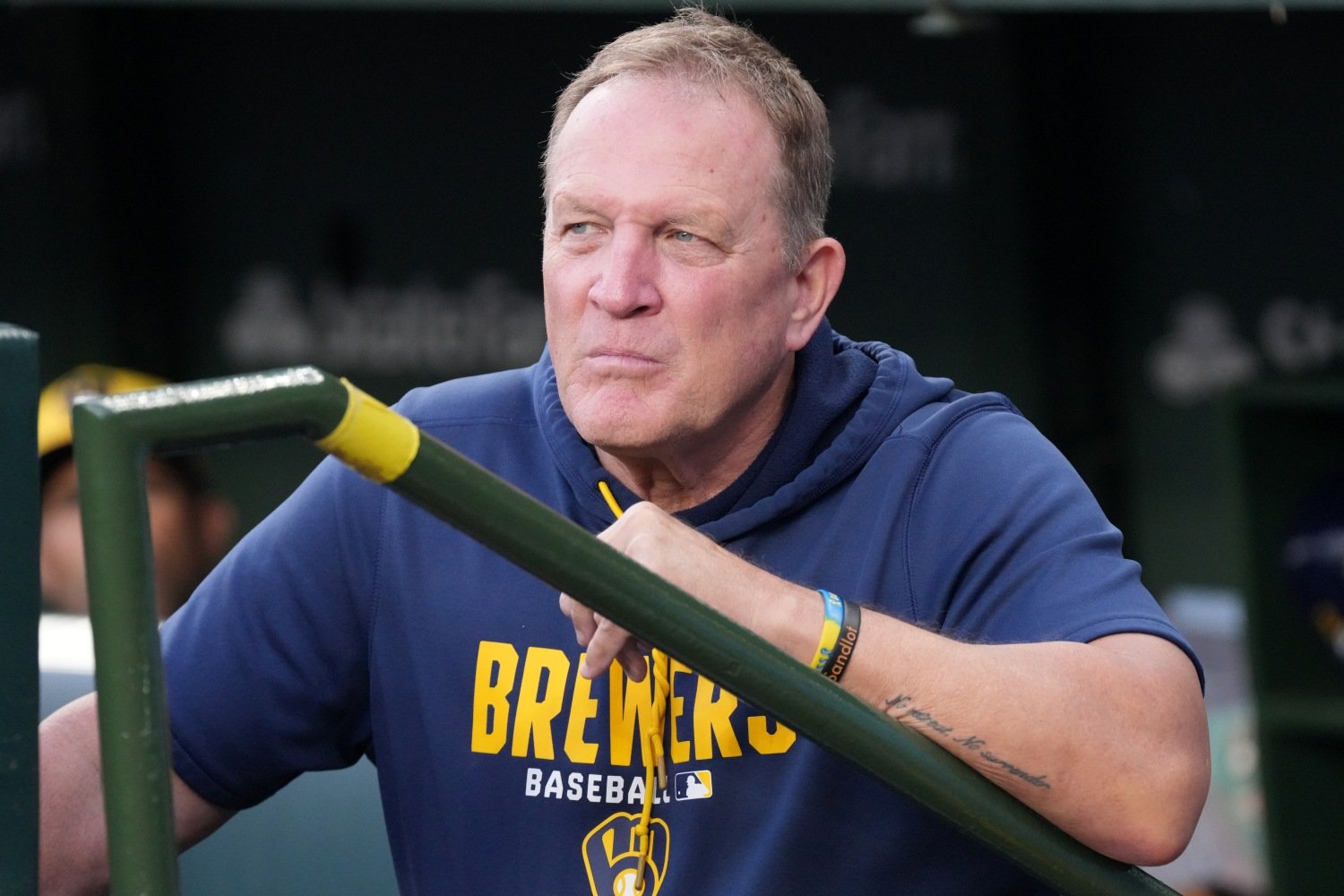 Jackson Chourio didn't get a great jump, and he paid for it. In the top of the fourth inning of Tuesday night's game in Chicago, Chourio tried to steal third base with one out, to position himself to score what would have been the first run of the game. Instead, though, he was thrown out by Cubs catcher Carson Kelly, sliding right into a deft tag by third baseman Alex Bregman. That was the injury. The insult, for Brewers manager Pat Murphy, came when he turned his head toward second base after Chourio was thwarted, and didn't see Brice Turang there. Turang, the trailing runner on the play, didn't follow Chourio, and remained at first base. That meant he wasn't even in scoring position, and there were two outs. A handful of pitches later, the inning was over. Murphy's agita can only have worsened in the bottom half of the frame. Robert Gasser issued a leadoff walk to Seiya Suzuki. Bregman hit a singularly weak bouncer to Gasser's left, but neither he nor Andrew Vaughn could get to the ball fast enough to make a play on it, putting two on with nobody out despite no healthy cuts being taken by Chicago. Tyrone Taylor cashed in the hosts' luck with a two-run double into the left-field corner. Things got even more frustrating, though, when Nico Hoerner hit a more conventional grounder toward first base. Vaughn ranged far to his right and made a fine play, but because he'd gone so far, the result was a play with slightly awkward timing as Gasser arrived to cover the bag. The hurler had trouble finding the base and arresting his momentum to wait for the ball, and the relatively long throw from Vaughn clanked off the lefty's glove. Hoerner reached on the error, and worse, Taylor came around to score. To his credit, Gasser bore down after that and escaped without further damage. Even as the fifth inning began, though, Murphy had justification for frustration. After two quick outs to start the top of the inning, Luis Lara hit a liner down the left-field line that (with two outs and nobody on base, and given Lara's speed) has to be a double. Taylor got over to the ball well and threw it as soon as possible back toward second base, but the peg was neither especially accurate nor especially strong. It didn't matter, though. Lara hadn't seen his opportunity; he held up at first base. Instead of being in scoring position, Lara was still two hits (or a stolen base and a hit, or an extra-base hit, but you get the point) from scoring the Crew's first run. Of course, that's when the Brewers demonstrated who they really are. Joey Ortiz and Cooper Pratt came up with the very back-to-back hits the team needed to get Lara home, after all. Chourio couldn't plunge home the knife thereafter, but in the sixth inning, the visitors did break through. Two ground balls that could have been outs turned into a single and a double to begin the inning. A fly ball down the right-field line wasn't caught. Suddenly, the Brewers had chased Matthew Boyd, tied the game, and had the go-ahead run in scoring position. Christian Yelich teed off on a Daniel Palencia slider, and just like that, the team had a lead they would only expand the rest of the way. This season, Murphy has held several players—Turang, Ortiz, Pratt, Gasser, David Hamilton, Brandon Sproat, Shane Drohan and more—accountable for lapses he considers unacceptable. He's been criticized for some of those choices, but the underlying reason for each of those actions traces back to something he expressed in spring training: this team has the highest potential of the three he's managed since taking the helm in 2024. They haven't consistently played to that potential. As Murphy has stressed at each turn, the shortfall is never in effort. A better word for what goes missing might be 'intensity,' or 'focus'. For many players on the roster, there's still a learning process taking place on a day-to-day basis—not only in how opponents will pitch them or which key mechanical adjustment will unlock their next level, but in how constant must be one's concentration within a game played at the highest level in the world. A half-second of hesitation, confusion or distraction can be fatal, and the only way to avoid those crucial failures is to remain on high alert from the first pitch to the last in every game. That's what makes the game so grueling; it's why the grind is so difficult to manage. Murphy has excelled at managing that grind, but he's been unable to stop the occasional crack from showing. What the skipper saw in February remains very much within this team. Turang, Chourio, Contreras, Jake Bauers and Garrett Mitchell have all looked like superstars at some points this season. Jacob Misiorowski and Kyle Harrison front perhaps the deepest and best pitching staff of Murphy's tenure. It's reflected in their record, too. If you don't watch any of the sausage get made, it's easy to wonder why Murphy seems a bit eager to come down on players who make certain kinds of mistakes. This is the best team in baseball, by run differential and by wins and losses. What's the big deal? As Murphy cracked (with a forgiving smile) to one reporter from a local TV station earlier this year when asked how great it must feel to be dominating the league: "Have you watched us play?" He doesn't mean that his squad has gotten lucky. They haven't. He just means that they can play considerably better than they actually have for big chunks of this season—and that they will absolutely need to do so, in order to avoid another October disappointment.
 -
Image courtesy of David Banks-Imagn Images Jackson Chourio didn't get a great jump, and he paid for it. In the top of the fourth inning of Tuesday night's game in Chicago, Chourio tried to steal third base with one out, to position himself to score what would have been the first run of the game. Instead, though, he was thrown out by Cubs catcher Carson Kelly, sliding right into a deft tag by third baseman Alex Bregman. That was the injury. The insult, for Brewers manager Pat Murphy, came when he turned his head toward second base after Chourio was thwarted, and didn't see Brice Turang there. Turang, the trailing runner on the play, didn't follow Chourio, and remained at first base. That meant he wasn't even in scoring position, and there were two outs. A handful of pitches later, the inning was over. Murphy's agita can only have worsened in the bottom half of the frame. Robert Gasser issued a leadoff walk to Seiya Suzuki. Bregman hit a singularly weak bouncer to Gasser's left, but neither he nor Andrew Vaughn could get to the ball fast enough to make a play on it, putting two on with nobody out despite no healthy cuts being taken by Chicago. Tyrone Taylor cashed in the hosts' luck with a two-run double into the left-field corner. Things got even more frustrating, though, when Nico Hoerner hit a more conventional grounder toward first base. Vaughn ranged far to his right and made a fine play, but because he'd gone so far, the result was a play with slightly awkward timing as Gasser arrived to cover the bag. The hurler had trouble finding the base and arresting his momentum to wait for the ball, and the relatively long throw from Vaughn clanked off the lefty's glove. Hoerner reached on the error, and worse, Taylor came around to score. To his credit, Gasser bore down after that and escaped without further damage. Even as the fifth inning began, though, Murphy had justification for frustration. After two quick outs to start the top of the inning, Luis Lara hit a liner down the left-field line that (with two outs and nobody on base, and given Lara's speed) has to be a double. Taylor got over to the ball well and threw it as soon as possible back toward second base, but the peg was neither especially accurate nor especially strong. It didn't matter, though. Lara hadn't seen his opportunity; he held up at first base. Instead of being in scoring position, Lara was still two hits (or a stolen base and a hit, or an extra-base hit, but you get the point) from scoring the Crew's first run. Of course, that's when the Brewers demonstrated who they really are. Joey Ortiz and Cooper Pratt came up with the very back-to-back hits the team needed to get Lara home, after all. Chourio couldn't plunge home the knife thereafter, but in the sixth inning, the visitors did break through. Two ground balls that could have been outs turned into a single and a double to begin the inning. A fly ball down the right-field line wasn't caught. Suddenly, the Brewers had chased Matthew Boyd, tied the game, and had the go-ahead run in scoring position. Christian Yelich teed off on a Daniel Palencia slider, and just like that, the team had a lead they would only expand the rest of the way. This season, Murphy has held several players—Turang, Ortiz, Pratt, Gasser, David Hamilton, Brandon Sproat, Shane Drohan and more—accountable for lapses he considers unacceptable. He's been criticized for some of those choices, but the underlying reason for each of those actions traces back to something he expressed in spring training: this team has the highest potential of the three he's managed since taking the helm in 2024. They haven't consistently played to that potential. As Murphy has stressed at each turn, the shortfall is never in effort. A better word for what goes missing might be 'intensity,' or 'focus'. For many players on the roster, there's still a learning process taking place on a day-to-day basis—not only in how opponents will pitch them or which key mechanical adjustment will unlock their next level, but in how constant must be one's concentration within a game played at the highest level in the world. A half-second of hesitation, confusion or distraction can be fatal, and the only way to avoid those crucial failures is to remain on high alert from the first pitch to the last in every game. That's what makes the game so grueling; it's why the grind is so difficult to manage. Murphy has excelled at managing that grind, but he's been unable to stop the occasional crack from showing. What the skipper saw in February remains very much within this team. Turang, Chourio, Contreras, Jake Bauers and Garrett Mitchell have all looked like superstars at some points this season. Jacob Misiorowski and Kyle Harrison front perhaps the deepest and best pitching staff of Murphy's tenure. It's reflected in their record, too. If you don't watch any of the sausage get made, it's easy to wonder why Murphy seems a bit eager to come down on players who make certain kinds of mistakes. This is the best team in baseball, by run differential and by wins and losses. What's the big deal? As Murphy cracked (with a forgiving smile) to one reporter from a local TV station earlier this year when asked how great it must feel to be dominating the league: "Have you watched us play?" He doesn't mean that his squad has gotten lucky. They haven't. He just means that they can play considerably better than they actually have for big chunks of this season—and that they will absolutely need to do so, in order to avoid another October disappointment. View full article
-
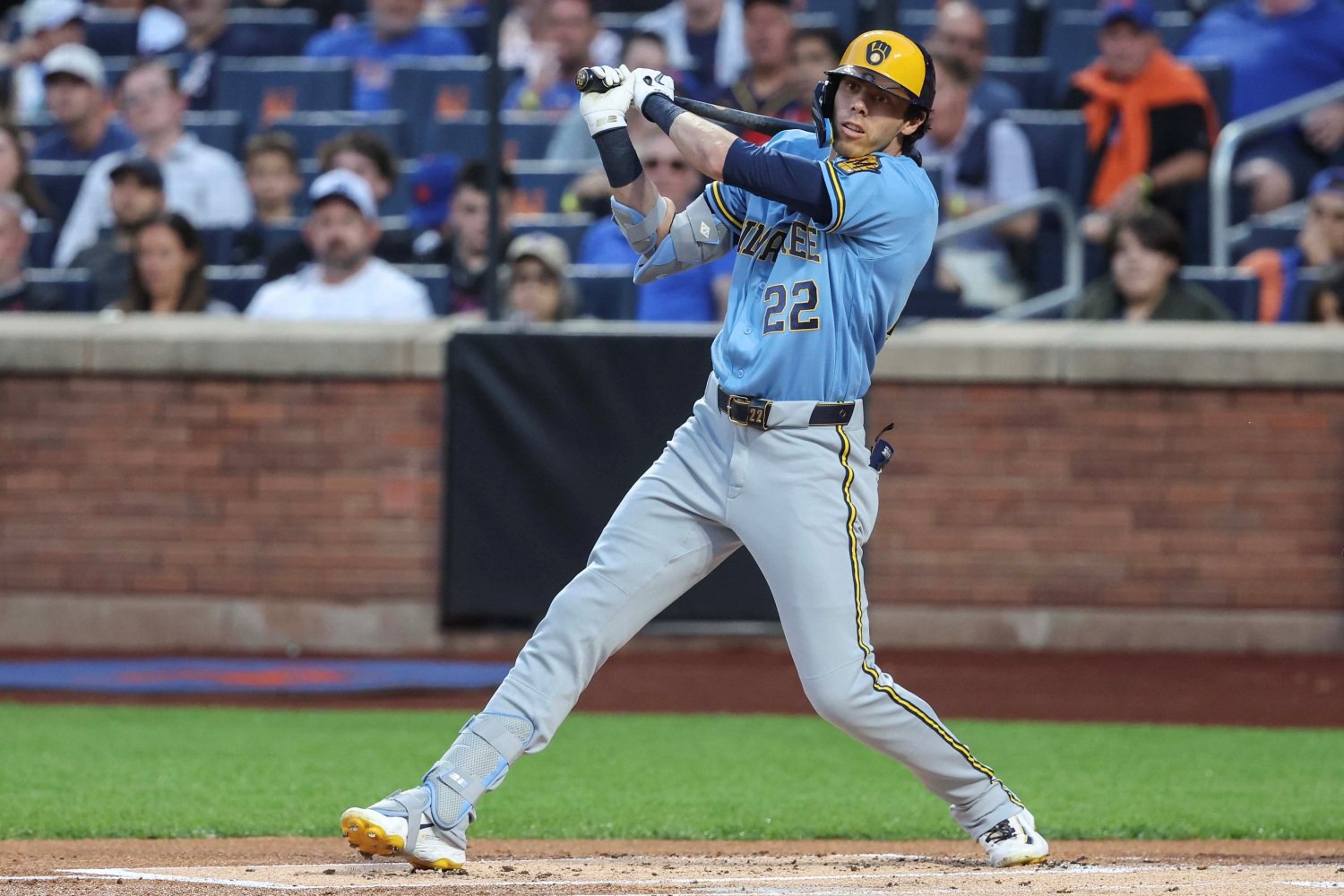 Even at his best, Christian Yelich comes with some limitations. He'll always hit the ball on the ground a lot. It's been a long time since he was a usable defender or a fast runner. More importantly, it's been rare to see Yelich at what feels anything like his best. Since he returned from a month on the injured list from mid-April through mid-May, Yelich has looked like he left some of himself on the shelf. In his first 71 games back, he batted an anemic .210/.296/.349, with a sclerotic swing. Lately, though, things have trended suddenly upward. Yelich's torrid 10-game run in the second half of August serves as a reminder that he's still a great hitter, underneath the piled-up effects of age and multiple injuries. The question is whether he can peel away enough of the layers of things that interfere with his talent to produce the way the team needs him to for the balance of this season. Some evidence, at least, suggests that he can. Squaring Up Balls in the Air Has Keyed Christian Yelich's Resurgence Some hitters struggle to generate power (or even batting average) because they lack bat speed or are unable to center the ball on their barrel. For those players, the missing ingredient in their pursuit of production is exit velocity. It's hard to hit the ball hard if you can't either swing fast or catch the ball flush with your bat. Yelich, however, belongs to a rival fraternity of struggling sluggers: the ones who have a great feel to hit and decent bat speed, but rarely bring those things to bear by hitting it hard in the air. When he's not going well, Yelich still occasionally hits the ball exceptionally hard, and he rarely goes through prolonged periods where he's truly producing weak contact. Rather, what he loses is the ability to drive the ball and elevate it at the same time. His hard contact all clusters on the ground. When he does hit fly balls, they're his least well-struck batted balls, and they become automatic outs. That was all happening for much of June and July, leaving Yelich spiraling. The dearth of production lingered into August, too. However, under the hood, he's been hitting the ball much more squarely this month, and much more often, that squared-up contact is coming on high line drives and fly balls. To see this happening, consider this chart from FanGraphs, which shows the frequency (the bubbles; bigger means more batted balls in that range) and a smoothed curve that describes the relationship between efficient Yelich's contact is and the launch angle of his batted balls. In yellow, we see a lot of fly balls hit in a productive launch-angle band (the red shaded box shows the ideal range at which to hit a ball to produce a home run), but not nearly squarely enough to produce hard-hit balls and positive outcomes. That's June and July. In blue, you can see him squaring the ball up considerably more overall, but especially on the balls he hits at launch angles over 10°. Thence has come his rediscovered power, along with plenty of singles that are possible only because he hit the ball with a little air under it, rather than on the ground. There are also some pitches he'd been pushing the other way earlier this season, but which he's found ways to turn on recently—as he did on this home run against the Mariners on August 18. WERaamFfWGw0TUFRPT1fQTFSUUJnRUJWQXNBRGxjQkJBQUhDUUFFQUZnR0FsZ0FBQUFBVkFRQVVBRUhDQVlB.mp4 Stance Changes Have Unlocked Small Swing Changes Yelich's stance is a bit more open this month, and he's a hair farther off the plate than he was earlier this year. The difference is subtle, but it's noticeable. Compare these shots of him from June (on the left) and mid-August (right), and you can see the difference in both his place in the batter's box and his hip and foot position. Being that bit open and creating a little more space between himself and the plate encourages Yelich to stride into the pitch more and cover the outer edge, without simply reaching out and flicking the ball, as you can see from these shots of him making contact on each pitch. These small adjustments have Yelich better able to cover not only the outer edge of the plate, but a pitcher's whole arsenal. Against fastballs. he can still let the ball travel and hit it the other way, without getting beaten and hitting it on the ground. Against softer stuff, meanwhile, he's in position to turn on the ball more, and the way he's had to alter his bat path to compensate for his move in the box and change in initial stance has him less likely to roll over. Don't expect a .900 OPS the rest of the way. Yelich is still a slightly diminished hitter, dealing with age and lingering injuries, and this hot streak might turn out to be just that. However, the fundamentals of his movements, approach and contact suggest that Yelich has survived this latest bout of near-obsolescence. He can still hit, and he's found a way to get back to hitting on lines and to areas where there's real damage to be done.
 -
Image courtesy of Wendell Cruz-Imagn Images Even at his best, Christian Yelich comes with some limitations. He'll always hit the ball on the ground a lot. It's been a long time since he was a usable defender or a fast runner. More importantly, it's been rare to see Yelich at what feels anything like his best. Since he returned from a month on the injured list from mid-April through mid-May, Yelich has looked like he left some of himself on the shelf. In his first 71 games back, he batted an anemic .210/.296/.349, with a sclerotic swing. Lately, though, things have trended suddenly upward. Yelich's torrid 10-game run in the second half of August serves as a reminder that he's still a great hitter, underneath the piled-up effects of age and multiple injuries. The question is whether he can peel away enough of the layers of things that interfere with his talent to produce the way the team needs him to for the balance of this season. Some evidence, at least, suggests that he can. Squaring Up Balls in the Air Has Keyed Christian Yelich's Resurgence Some hitters struggle to generate power (or even batting average) because they lack bat speed or are unable to center the ball on their barrel. For those players, the missing ingredient in their pursuit of production is exit velocity. It's hard to hit the ball hard if you can't either swing fast or catch the ball flush with your bat. Yelich, however, belongs to a rival fraternity of struggling sluggers: the ones who have a great feel to hit and decent bat speed, but rarely bring those things to bear by hitting it hard in the air. When he's not going well, Yelich still occasionally hits the ball exceptionally hard, and he rarely goes through prolonged periods where he's truly producing weak contact. Rather, what he loses is the ability to drive the ball and elevate it at the same time. His hard contact all clusters on the ground. When he does hit fly balls, they're his least well-struck batted balls, and they become automatic outs. That was all happening for much of June and July, leaving Yelich spiraling. The dearth of production lingered into August, too. However, under the hood, he's been hitting the ball much more squarely this month, and much more often, that squared-up contact is coming on high line drives and fly balls. To see this happening, consider this chart from FanGraphs, which shows the frequency (the bubbles; bigger means more batted balls in that range) and a smoothed curve that describes the relationship between efficient Yelich's contact is and the launch angle of his batted balls. In yellow, we see a lot of fly balls hit in a productive launch-angle band (the red shaded box shows the ideal range at which to hit a ball to produce a home run), but not nearly squarely enough to produce hard-hit balls and positive outcomes. That's June and July. In blue, you can see him squaring the ball up considerably more overall, but especially on the balls he hits at launch angles over 10°. Thence has come his rediscovered power, along with plenty of singles that are possible only because he hit the ball with a little air under it, rather than on the ground. There are also some pitches he'd been pushing the other way earlier this season, but which he's found ways to turn on recently—as he did on this home run against the Mariners on August 18. WERaamFfWGw0TUFRPT1fQTFSUUJnRUJWQXNBRGxjQkJBQUhDUUFFQUZnR0FsZ0FBQUFBVkFRQVVBRUhDQVlB.mp4 Stance Changes Have Unlocked Small Swing Changes Yelich's stance is a bit more open this month, and he's a hair farther off the plate than he was earlier this year. The difference is subtle, but it's noticeable. Compare these shots of him from June (on the left) and mid-August (right), and you can see the difference in both his place in the batter's box and his hip and foot position. Being that bit open and creating a little more space between himself and the plate encourages Yelich to stride into the pitch more and cover the outer edge, without simply reaching out and flicking the ball, as you can see from these shots of him making contact on each pitch. These small adjustments have Yelich better able to cover not only the outer edge of the plate, but a pitcher's whole arsenal. Against fastballs. he can still let the ball travel and hit it the other way, without getting beaten and hitting it on the ground. Against softer stuff, meanwhile, he's in position to turn on the ball more, and the way he's had to alter his bat path to compensate for his move in the box and change in initial stance has him less likely to roll over. Don't expect a .900 OPS the rest of the way. Yelich is still a slightly diminished hitter, dealing with age and lingering injuries, and this hot streak might turn out to be just that. However, the fundamentals of his movements, approach and contact suggest that Yelich has survived this latest bout of near-obsolescence. He can still hit, and he's found a way to get back to hitting on lines and to areas where there's real damage to be done. View full article
-
Image courtesy of Matthew O'Haren-Imagn Images The grind is going to affect you. There is no road from Game 1 to Game 162—let alone from Pitchers & Catchers to Parade Day—that avoids all the tolls and all the traffic jams that turn the dream job into a bit of a nightmare. There are going to be times when you’re hideously tired. There are going to be times when you’re either sidelined by an injury and fighting the mental battle of staying engaged with the game and your teammates, or playing through a nagging something and fighting the physical battle against the best competition on earth without being at your best. There are going to be times when off-field distraction or on-field frustration makes it impossible (or nearly so) to maintain the equanimity and the intensity that are required to succeed in this game. At certain points in the season, you can see the league feel the grind almost in unison. They get grumpier; they get sloppier. Arguments with umpires and tensions between teams rise. I notice this most in early June (when the campaign has been going for a while but real clarity about how it’ll go remains stubbornly out of reach) and around this time of year, just after the trade deadline. Checkpoints and milestones make the grind bearable; being just on the other side of one and knowing it’s a long way to the next one makes for tough sledding. Players might tell you they don’t pay much attention to trade rumors or care much what the front office does at the deadline, but they do pay attention, and they do care. Once the deadline passes, whether things went the way a given player wanted or not, they know that there’s no further transformation coming. Nothing is harder than living with yourself after you got what you wanted but didn’t feel the magical uplift you’d hoped for. We’re seeing some teams and players wear thin and start to strain over the last two weeks, as all of these effects have swirled together and the games and the miles traveled and the reps have piled up. Let’s do a little thought exercise together. If you were running a baseball ops department, and you acknowledged all of the above, how would you go about ameliorating it—not avoiding the impacts, but mitigating them, and maybe turning some of them from negatives into positives? I propose that if you start by trying to answer that question when you start to see the impacts, you’re already too late. The grind is going to affect you. Knowing that, what if you made a plan that addressed that eventuality and worked against it, in advance? This isn’t a problem unique to sports, so it’s not an area in which we have to wait and see what teams come up with. Without cleaving too closely to what could quickly become a fraught comparison, let’s look to another vocation in which big mental and physical hurdles are unavoidable and expected, and where lots of work has been done to move toward holistic handling of those issues: soldiers. The history of our world’s understanding of war trauma is too long and complicated to rehash here. Suffice it to say that an honest and non-judgmental approach to mitigating the damage war trauma can do is a relatively new thing under the sun. Since roughly the Vietnam War era, though, we’ve made steady and significant—you can never say ‘sufficient’ with something like this—progress, as a society. Greater empathy greets people who deal with post-traumatic stress; a wider array of treatment and growth opportunities await them. Over the last 20 years or so, there’s also been more work aimed not at reacting to war trauma, but at preparing oneself for it and handling it as it happens. “By 2008, soldiers received so-called Battlemind training before being deployed,” author Tom Roston wrote in his book The Writer’s Crusade: Kurt Vonnegut and the Many Lives of Slaughterhouse-Five. “Previously, the army only ran postdeployment health briefings.” Roston’s book is all about the Vonnegut book named in its title, but any book about that book is also about the Western understanding of war trauma and the sea change therein, especially since the publication of Vonnegut’s opus. It therefore spends a long time talking about “fully integrative” approaches to handling trauma, including attacking that trauma before, during and after soldiers’ deployment. The Battlemind training to which Roston referred there is no longer the state of the art, but it’s one tool in a box of them used by various branches of the military and non-governmental support organizations. It’s probably better rendered as BATTLEMIND, though, because it’s actually an acronym. BATTLEMIND stands for: Buddies: Connecting with fellow soldiers, rather than withdrawing Accountability Targeted Aggression, as opposed to inappropriate aggression Tactical Awareness, as opposed to hypervigilance Lethally Armed, responsible wielding of weaponry – Emotional Control, as opposed to anger or detachment Mission Operational Security, rather than secretiveness Individual Responsibility, rather than guilt Nondefensive driving, but not aggressive driving Discipline, not conflict These seminars and workshops were intended to prepare soldiers to balance the responsibilities of non-combat deployment, combat, and civilian life, by highlighting key areas in which generalizing from one of those contexts to the others could be dangerous. Some of the items in that list make little sense to someone who has never been anywhere near a combat zone. For instance, why is driving worthy of its own entry? Ask anyone with experience in such a place, though, and it becomes clear. You really do have to drive differently—not defensively, not predictably, but also not hyperaggressively—in many places where soldiers must go. It’s not one of the differences every young person preparing for a first deployment anticipates, and by making them aware of it in advance (as well as checking in on that item while they were in the field and in postdeployment debriefs), the program’s creators hoped to make soldiers more effective both in combat-zone settings and at home, afterward. It’s time for a crucial caveat: Plainly, being a ballplayer is not like being a soldier—not really. There is no meaningfully increased risk of death; nothing inherently and inescapably traumatic; and no more moral quandary in participating than in doing anything else for a living, really. Plenty of people will balk, with good reason, at any parallels drawn between one profession and the other. I don’t mean to imply that this model (again, at least partially abandoned by the army itself) is perfect for its own uses—let alone that it should be adapted to ballplayers and treated as a cure-all. However, I think an end-to-end plan to fight the grind could make more effective ballplayers, and perhaps turn the average ballplayer into a slightly more effective and upstanding person, to boot. Let’s begin by making a couple of tweaks to the acronym, by swapping out the items that matter to the military but not to baseball. While a ball in the hand of a talented pitcher or a bat in the hands of any big, strong adult can be deadly weapons, let’s take out the ‘L’, for Lethally Armed. Players don’t need specific training for the storage and contextualized use of their equipment. As you’d guess, we’ll also cut out the ‘N’, because line drives are neither defensive nor aggressive. In their place, though, we’ll add an ‘R’ after the ‘E’, for Rest and Recovery. Players already get lots of information and resources for dealing with injuries and maintaining their energy, but that should be incorporated into this kind of training, and it should be proactive, rather than reactive. We’ll also replace the ‘N’, this time with the phrase “Nasty on diamond, not away from it”. The resulting acronym works nicely; it’s BATTERMIND now. (Sorry, pitchers.) But what should this training look like? What form should it take; when should it begin; and how often should it take place? It would be ironic if training designed to moderate the effects of the grind actually added to them, by overloading players, so we’d better think this all the way through, even if it’s just a thought exercise. Here’s everything I’ve got. Sessions To do this right, you have to start by getting everyone together to introduce it. You hold a full-team meeting and seminar on what this training will be, early in spring training. Walking through each of the principles in a quick overview fashion, you give concrete examples and ask staff who had long playing careers to give brief statements on how their experience dovetails with a given principle. Be honest, right away, about how hard the long season is, but emphasize that this training is an opportunity to reduce the strain of it. For most of the season, though, the work is done in smaller groups. The staff in charge of leading it schedules sessions so that they’re seeing every player on a biweekly basis, but not all of them at the same time. That creates opportunities for styles of learning and teaching beyond simple lecture. Some sessions become roundtable discussions; others are prescribed and structured exercises. At the end of the year. Points of Emphasis Let’s walk back through the items of the acronym, with a baseball-specific lens fitted to them: Buddies: Soldiers become as much family to one another as friends, because of the bonding that takes place under the combination of such danger and constant proximity. Sport is one of the few areas of civilian life where a similar camaraderie develops between colleagues; these guys are together a lot and they have ample reason to think of things in terms of ‘us’ and ‘them’. However, the grind of the season (just like the grind of deployment) can make for a sense of loneliness that must be combatted. Players whose families are in another country or who can’t stay with them in the team’s home city during the season are especially prone to that, and smart phones have had the same isolating effects in clubhouses as in society as a whole. This element of the training should focus on encouraging genuine connection between teammates. A voluntary roommates program for road trips would be an interesting idea. Get-to-know-you things that ensure everyone on the team knows their teammates’ family and living situation and can check in with those who are at risk of being siloed are crucial. Accountability: This happens to be in the news right now, as the sports pundits babble over whether it was proper for Pat Murphy to remove Cooper Pratt from a game after he failed to put a bunt down in one at-bat and didn’t run hard out of the box on a shallow fly ball in the next. Because that form of accountability is visible and somewhat embarrassing for the player, it’s become a hot-button issue, but the truth beneath that debate is that taking a player out of one game is a very small punishment. As long as the team is supportive of any player it thus disciplines afterward, it’s not damaging, and it affirms the constancy of the team’s commitment to intensity and execution. That’s why the players on the team were so supportive of Murphy’s handling of the Pratt situation. Accountability means communicating in advance on what basis a player might suffer various consequences for actions, but more importantly, it’s about making all involved understand that they’re accountable to one another; it builds upon the interconnectedness that should be fostered by the Buddies piece. Targeted Aggression: This is where the benefits of this kind of training begin to spread off the field and into the player’s real life, but it certainly still has value on the field. Do you remember the Bronx Zoo Yankees? The 1980s Cocaine Mets? The Late Carlos Zambrano Cubs? Those clubs all found some success that was fueled by the intensity and outright aggression of key figures, but they were also riven by those players’ irresponsible behavior both on and off the field. Being aggressive is important in baseball, and the tenacity that fuels that aggressiveness has to burn even between games; it’s usually not a switch that can be flipped on and off. However, a good training module on this subject should help players develop a dimmer instead of a simple switch. That reduces instances of inappropriate on-field outbursts or lapses in concentration that lead to losses. More importantly, though, it also reduces the likelihood of brawls between teammates in the clubhouse, shouting matches between manager and player, or—this, most important of all, to the person and the world if not to the team—violent or aggressive behavior toward loved ones or strangers when not at the ballpark. Tactical Awareness: This one maps only imperfectly onto baseball. A soldier has to learn to be extremely aware of their environment, and that can transform into damaging hypervigilance once they’re back home and the danger becomes perceived, rather than real. It’s not the same in baseball. Players have to pay acute attention on the field, but not in a way that becomes counterproductive away from it. One key to this, however, would be helping players discern important information from noise, both on and off the field. Being aware of opponents talking or sending signals while filtering out crowd noise is important; ditto for hearing valid criticism when it comes in public but tuning out knuckleheads and people in your DMs shouting about their parlays. Emotional Control: The balance between equanimity and intensity is always difficult to strike in baseball, be it within a game or over a month. It’s important to care about every outcome, but not to care so much that it destabilizes you in either the long or the short term. Giving players a wider variety of tools, from mindfulness meditation to testimonials and counseling by former players, could be a big help. Rest and Recovery: Every player thinks they know a ton about how to preserve their energy, recover from workouts and be ready for the game each day. Every player has more to learn in this area. BATTERMIND training on this principle should focus on scheduling rest and off days farther in advance than players are comfortable with, to emphasize to them that it’s a long season and a long-term plan is needed. Mission Operational Security: Teaching soldiers the distinction between preserving “opsec” and being overly secretive with loved ones is a vital part of preparing them for a return to civilian life. It’s easy to understand that loose lips sink ships; it’s harder to know which things have to be kept to oneself and which are safe to share. This problem has a clearer set of parallels to life as a ballplayer than you might think. Many players become unpopular with or distrustful of the media because they worry that they’ll say too much; that makes open clubhouse times a daily dose of discomfort and antipathy for them. Some also struggle to talk about their work with their families, the way we all need to do sometimes. There should be lots of training on how to say more to the media and to worry about that less, and on how to leave work at work even in this all-consuming career, so conversations can be freer at home. Individual Responsibility: This overlaps with accountability, but it’s not the same thing. For soldiers, this is about learning not to be crushed by guilt, whether as a survivor of something that killed a friend or because of a real failure that put someone in danger. Baseball’s stakes are lower, but the risks take the same shape. Players often kick themselves for letting the team down after a loss; that’s ok. However, it’s important to take a balanced mental approach to such moments, and to remember that no one player’s performance will determine the fate of a team’s season. This is one place where this training might actually incorporate public-facing baseball stats in a productive way; there’s no greater cure for the solipsistic guilt of a morose player than to teach them about Win Probability Added and the concepts of value over replacement. Once you have a firm handle on those precepts, it’s impossible to ignore how diffuse the responsibility for wins and losses in this sport really is. Nasty on Diamond, not Away From It: This is similar to the question of targeted aggression, but it’s more about mindset than behavior. High-level competitiveness is a prerequisite for success in the majors. It’s often self-defeating once you step outside the clubhouse, though. Teaching players to cultivate their competitiveness—that is, to grow it, but to do so in a confined space and keep it from taking over their whole personality or world—has to be a part of this kind of training. Discipline: Like most military operations, ball clubs are hierarchical organizations. Players have to learn the importance of the chain of command and of when and how it’s appropriate to push for changes thereto. Often, it simply isn’t, and the challenge to the player is to accept something unpleasant in one isolated situation so as not to disrupt the cohesion of the team and its structure. Discussion about a change a player feels is necessary might need to wait longer than they’d like, and be done in a smaller setting than they initially prefer. What soldiers face and what ballplayers face are not similar at all. In a sense, though, the paradoxes BATTLEMIND was most designed to address exist for all of us; they're like the day-to-day experiences of civilian workers, in macrocosm instead of microcosm. We all have to live in two worlds, or more. We all have to deal with stressors and compartmentalize traumas, although soldiers face greater and ghastlier versions of that challenge than most of us do. This program is an admirable effort to name and address the places where we feel torn between the two selves we need to be and the two constituencies we need to serve, and to make room for appropriate handling of stress and its scarier cousins. Not all workplaces, unfortunately, feel the same responsibility or have the same capacity to engender real cohesion and to follow up assiduously to ensure the ongoing mental health of their employees as does the military—and even the military too often lets down those to whom it bears this responsibility, often because it has too little capacity. Baseball teams, however, are multi-billion-dollar organizations, with every incentive to do long-range work with their employees and almost endless capacity. This is how a team might comprehensively plan to keep players more focused, more prepared and less weary by late August, beginning in early February. It needs to be a program implemented with the goal of supporting the whole person, understanding that some of the best benefits might accrue to the player and their family, rather than to the club. One reason the military has moved away from BATTLEMIND is that it was designed to make more effective soldiers in theater, rather than primarily to produce healthier citizens at home; it didn’t meet that standard. However, it might actually have done more for those who went through it after they did get home, so if a team is willing to stipulate that a happier and healthier player is more likely to play well in future seasons and to stick around, they should be willing to invest in the program even if it first benefits the person when they’re not at the park. View full article
-
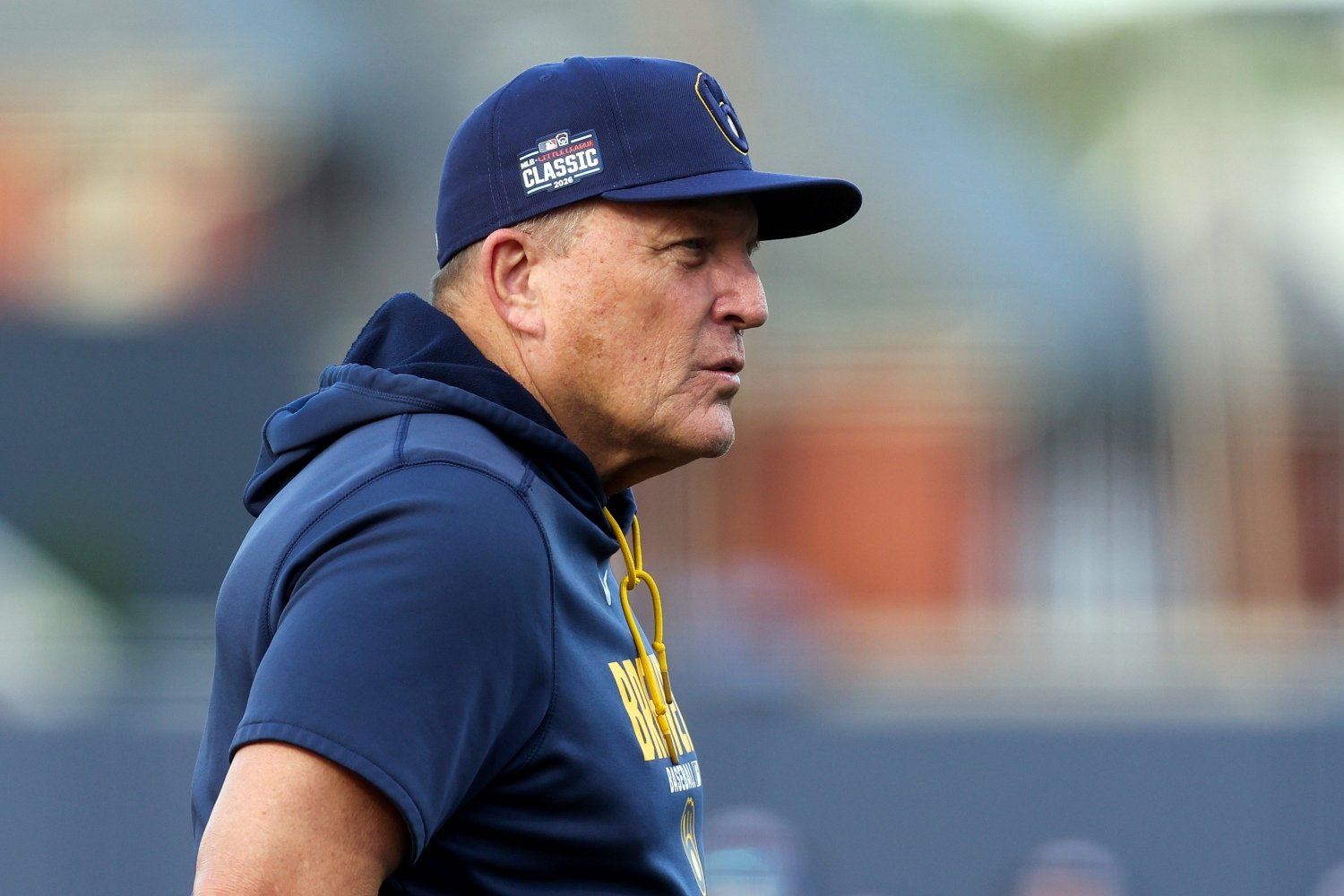 The grind is going to affect you. There is no road from Game 1 to Game 162—let alone from Pitchers & Catchers to Parade Day—that avoids all the tolls and all the traffic jams that turn the dream job into a bit of a nightmare. There are going to be times when you’re hideously tired. There are going to be times when you’re either sidelined by an injury and fighting the mental battle of staying engaged with the game and your teammates, or playing through a nagging something and fighting the physical battle against the best competition on earth without being at your best. There are going to be times when off-field distraction or on-field frustration makes it impossible (or nearly so) to maintain the equanimity and the intensity that are required to succeed in this game. At certain points in the season, you can see the league feel the grind almost in unison. They get grumpier; they get sloppier. Arguments with umpires and tensions between teams rise. I notice this most in early June (when the campaign has been going for a while but real clarity about how it’ll go remains stubbornly out of reach) and around this time of year, just after the trade deadline. Checkpoints and milestones make the grind bearable; being just on the other side of one and knowing it’s a long way to the next one makes for tough sledding. Players might tell you they don’t pay much attention to trade rumors or care much what the front office does at the deadline, but they do pay attention, and they do care. Once the deadline passes, whether things went the way a given player wanted or not, they know that there’s no further transformation coming. Nothing is harder than living with yourself after you got what you wanted but didn’t feel the magical uplift you’d hoped for. We’re seeing some teams and players wear thin and start to strain over the last two weeks, as all of these effects have swirled together and the games and the miles traveled and the reps have piled up. Let’s do a little thought exercise together. If you were running a baseball ops department, and you acknowledged all of the above, how would you go about ameliorating it—not avoiding the impacts, but mitigating them, and maybe turning some of them from negatives into positives? I propose that if you start by trying to answer that question when you start to see the impacts, you’re already too late. The grind is going to affect you. Knowing that, what if you made a plan that addressed that eventuality and worked against it, in advance? This isn’t a problem unique to sports, so it’s not an area in which we have to wait and see what teams come up with. Without cleaving too closely to what could quickly become a fraught comparison, let’s look to another vocation in which big mental and physical hurdles are unavoidable and expected, and where lots of work has been done to move toward holistic handling of those issues: soldiers. The history of our world’s understanding of war trauma is too long and complicated to rehash here. Suffice it to say that an honest and non-judgmental approach to mitigating the damage war trauma can do is a relatively new thing under the sun. Since roughly the Vietnam War era, though, we’ve made steady and significant—you can never say ‘sufficient’ with something like this—progress, as a society. Greater empathy greets people who deal with post-traumatic stress; a wider array of treatment and growth opportunities await them. Over the last 20 years or so, there’s also been more work aimed not at reacting to war trauma, but at preparing oneself for it and handling it as it happens. “By 2008, soldiers received so-called Battlemind training before being deployed,” author Tom Roston wrote in his book The Writer’s Crusade: Kurt Vonnegut and the Many Lives of Slaughterhouse-Five. “Previously, the army only ran postdeployment health briefings.” Roston’s book is all about the Vonnegut book named in its title, but any book about that book is also about the Western understanding of war trauma and the sea change therein, especially since the publication of Vonnegut’s opus. It therefore spends a long time talking about “fully integrative” approaches to handling trauma, including attacking that trauma before, during and after soldiers’ deployment. The Battlemind training to which Roston referred there is no longer the state of the art, but it’s one tool in a box of them used by various branches of the military and non-governmental support organizations. It’s probably better rendered as BATTLEMIND, though, because it’s actually an acronym. BATTLEMIND stands for: Buddies: Connecting with fellow soldiers, rather than withdrawing Accountability Targeted Aggression, as opposed to inappropriate aggression Tactical Awareness, as opposed to hypervigilance Lethally Armed, responsible wielding of weaponry – Emotional Control, as opposed to anger or detachment Mission Operational Security, rather than secretiveness Individual Responsibility, rather than guilt Nondefensive driving, but not aggressive driving Discipline, not conflict These seminars and workshops were intended to prepare soldiers to balance the responsibilities of non-combat deployment, combat, and civilian life, by highlighting key areas in which generalizing from one of those contexts to the others could be dangerous. Some of the items in that list make little sense to someone who has never been anywhere near a combat zone. For instance, why is driving worthy of its own entry? Ask anyone with experience in such a place, though, and it becomes clear. You really do have to drive differently—not defensively, not predictably, but also not hyperaggressively—in many places where soldiers must go. It’s not one of the differences every young person preparing for a first deployment anticipates, and by making them aware of it in advance (as well as checking in on that item while they were in the field and in postdeployment debriefs), the program’s creators hoped to make soldiers more effective both in combat-zone settings and at home, afterward. It’s time for a crucial caveat: Plainly, being a ballplayer is not like being a soldier—not really. There is no meaningfully increased risk of death; nothing inherently and inescapably traumatic; and no more moral quandary in participating than in doing anything else for a living, really. Plenty of people will balk, with good reason, at any parallels drawn between one profession and the other. I don’t mean to imply that this model (again, at least partially abandoned by the army itself) is perfect for its own uses—let alone that it should be adapted to ballplayers and treated as a cure-all. However, I think an end-to-end plan to fight the grind could make more effective ballplayers, and perhaps turn the average ballplayer into a slightly more effective and upstanding person, to boot. Let’s begin by making a couple of tweaks to the acronym, by swapping out the items that matter to the military but not to baseball. While a ball in the hand of a talented pitcher or a bat in the hands of any big, strong adult can be deadly weapons, let’s take out the ‘L’, for Lethally Armed. Players don’t need specific training for the storage and contextualized use of their equipment. As you’d guess, we’ll also cut out the ‘N’, because line drives are neither defensive nor aggressive. In their place, though, we’ll add an ‘R’ after the ‘E’, for Rest and Recovery. Players already get lots of information and resources for dealing with injuries and maintaining their energy, but that should be incorporated into this kind of training, and it should be proactive, rather than reactive. We’ll also replace the ‘N’, this time with the phrase “Nasty on diamond, not away from it”. The resulting acronym works nicely; it’s BATTERMIND now. (Sorry, pitchers.) But what should this training look like? What form should it take; when should it begin; and how often should it take place? It would be ironic if training designed to moderate the effects of the grind actually added to them, by overloading players, so we’d better think this all the way through, even if it’s just a thought exercise. Here’s everything I’ve got. Sessions To do this right, you have to start by getting everyone together to introduce it. You hold a full-team meeting and seminar on what this training will be, early in spring training. Walking through each of the principles in a quick overview fashion, you give concrete examples and ask staff who had long playing careers to give brief statements on how their experience dovetails with a given principle. Be honest, right away, about how hard the long season is, but emphasize that this training is an opportunity to reduce the strain of it. For most of the season, though, the work is done in smaller groups. The staff in charge of leading it schedules sessions so that they’re seeing every player on a biweekly basis, but not all of them at the same time. That creates opportunities for styles of learning and teaching beyond simple lecture. Some sessions become roundtable discussions; others are prescribed and structured exercises. At the end of the year. Points of Emphasis Let’s walk back through the items of the acronym, with a baseball-specific lens fitted to them: Buddies: Soldiers become as much family to one another as friends, because of the bonding that takes place under the combination of such danger and constant proximity. Sport is one of the few areas of civilian life where a similar camaraderie develops between colleagues; these guys are together a lot and they have ample reason to think of things in terms of ‘us’ and ‘them’. However, the grind of the season (just like the grind of deployment) can make for a sense of loneliness that must be combatted. Players whose families are in another country or who can’t stay with them in the team’s home city during the season are especially prone to that, and smart phones have had the same isolating effects in clubhouses as in society as a whole. This element of the training should focus on encouraging genuine connection between teammates. A voluntary roommates program for road trips would be an interesting idea. Get-to-know-you things that ensure everyone on the team knows their teammates’ family and living situation and can check in with those who are at risk of being siloed are crucial. Accountability: This happens to be in the news right now, as the sports pundits babble over whether it was proper for Pat Murphy to remove Cooper Pratt from a game after he failed to put a bunt down in one at-bat and didn’t run hard out of the box on a shallow fly ball in the next. Because that form of accountability is visible and somewhat embarrassing for the player, it’s become a hot-button issue, but the truth beneath that debate is that taking a player out of one game is a very small punishment. As long as the team is supportive of any player it thus disciplines afterward, it’s not damaging, and it affirms the constancy of the team’s commitment to intensity and execution. That’s why the players on the team were so supportive of Murphy’s handling of the Pratt situation. Accountability means communicating in advance on what basis a player might suffer various consequences for actions, but more importantly, it’s about making all involved understand that they’re accountable to one another; it builds upon the interconnectedness that should be fostered by the Buddies piece. Targeted Aggression: This is where the benefits of this kind of training begin to spread off the field and into the player’s real life, but it certainly still has value on the field. Do you remember the Bronx Zoo Yankees? The 1980s Cocaine Mets? The Late Carlos Zambrano Cubs? Those clubs all found some success that was fueled by the intensity and outright aggression of key figures, but they were also riven by those players’ irresponsible behavior both on and off the field. Being aggressive is important in baseball, and the tenacity that fuels that aggressiveness has to burn even between games; it’s usually not a switch that can be flipped on and off. However, a good training module on this subject should help players develop a dimmer instead of a simple switch. That reduces instances of inappropriate on-field outbursts or lapses in concentration that lead to losses. More importantly, though, it also reduces the likelihood of brawls between teammates in the clubhouse, shouting matches between manager and player, or—this, most important of all, to the person and the world if not to the team—violent or aggressive behavior toward loved ones or strangers when not at the ballpark. Tactical Awareness: This one maps only imperfectly onto baseball. A soldier has to learn to be extremely aware of their environment, and that can transform into damaging hypervigilance once they’re back home and the danger becomes perceived, rather than real. It’s not the same in baseball. Players have to pay acute attention on the field, but not in a way that becomes counterproductive away from it. One key to this, however, would be helping players discern important information from noise, both on and off the field. Being aware of opponents talking or sending signals while filtering out crowd noise is important; ditto for hearing valid criticism when it comes in public but tuning out knuckleheads and people in your DMs shouting about their parlays. Emotional Control: The balance between equanimity and intensity is always difficult to strike in baseball, be it within a game or over a month. It’s important to care about every outcome, but not to care so much that it destabilizes you in either the long or the short term. Giving players a wider variety of tools, from mindfulness meditation to testimonials and counseling by former players, could be a big help. Rest and Recovery: Every player thinks they know a ton about how to preserve their energy, recover from workouts and be ready for the game each day. Every player has more to learn in this area. BATTERMIND training on this principle should focus on scheduling rest and off days farther in advance than players are comfortable with, to emphasize to them that it’s a long season and a long-term plan is needed. Mission Operational Security: Teaching soldiers the distinction between preserving “opsec” and being overly secretive with loved ones is a vital part of preparing them for a return to civilian life. It’s easy to understand that loose lips sink ships; it’s harder to know which things have to be kept to oneself and which are safe to share. This problem has a clearer set of parallels to life as a ballplayer than you might think. Many players become unpopular with or distrustful of the media because they worry that they’ll say too much; that makes open clubhouse times a daily dose of discomfort and antipathy for them. Some also struggle to talk about their work with their families, the way we all need to do sometimes. There should be lots of training on how to say more to the media and to worry about that less, and on how to leave work at work even in this all-consuming career, so conversations can be freer at home. Individual Responsibility: This overlaps with accountability, but it’s not the same thing. For soldiers, this is about learning not to be crushed by guilt, whether as a survivor of something that killed a friend or because of a real failure that put someone in danger. Baseball’s stakes are lower, but the risks take the same shape. Players often kick themselves for letting the team down after a loss; that’s ok. However, it’s important to take a balanced mental approach to such moments, and to remember that no one player’s performance will determine the fate of a team’s season. This is one place where this training might actually incorporate public-facing baseball stats in a productive way; there’s no greater cure for the solipsistic guilt of a morose player than to teach them about Win Probability Added and the concepts of value over replacement. Once you have a firm handle on those precepts, it’s impossible to ignore how diffuse the responsibility for wins and losses in this sport really is. Nasty on Diamond, not Away From It: This is similar to the question of targeted aggression, but it’s more about mindset than behavior. High-level competitiveness is a prerequisite for success in the majors. It’s often self-defeating once you step outside the clubhouse, though. Teaching players to cultivate their competitiveness—that is, to grow it, but to do so in a confined space and keep it from taking over their whole personality or world—has to be a part of this kind of training. Discipline: Like most military operations, ball clubs are hierarchical organizations. Players have to learn the importance of the chain of command and of when and how it’s appropriate to push for changes thereto. Often, it simply isn’t, and the challenge to the player is to accept something unpleasant in one isolated situation so as not to disrupt the cohesion of the team and its structure. Discussion about a change a player feels is necessary might need to wait longer than they’d like, and be done in a smaller setting than they initially prefer. What soldiers face and what ballplayers face are not similar at all. In a sense, though, the paradoxes BATTLEMIND was most designed to address exist for all of us; they're like the day-to-day experiences of civilian workers, in macrocosm instead of microcosm. We all have to live in two worlds, or more. We all have to deal with stressors and compartmentalize traumas, although soldiers face greater and ghastlier versions of that challenge than most of us do. This program is an admirable effort to name and address the places where we feel torn between the two selves we need to be and the two constituencies we need to serve, and to make room for appropriate handling of stress and its scarier cousins. Not all workplaces, unfortunately, feel the same responsibility or have the same capacity to engender real cohesion and to follow up assiduously to ensure the ongoing mental health of their employees as does the military—and even the military too often lets down those to whom it bears this responsibility, often because it has too little capacity. Baseball teams, however, are multi-billion-dollar organizations, with every incentive to do long-range work with their employees and almost endless capacity. This is how a team might comprehensively plan to keep players more focused, more prepared and less weary by late August, beginning in early February. It needs to be a program implemented with the goal of supporting the whole person, understanding that some of the best benefits might accrue to the player and their family, rather than to the club. One reason the military has moved away from BATTLEMIND is that it was designed to make more effective soldiers in theater, rather than primarily to produce healthier citizens at home; it didn’t meet that standard. However, it might actually have done more for those who went through it after they did get home, so if a team is willing to stipulate that a happier and healthier player is more likely to play well in future seasons and to stick around, they should be willing to invest in the program even if it first benefits the person when they’re not at the park.
 -
Image courtesy of Wendell Cruz-Imagn Images CRACK! Hope you didn't take long to find your seat at Citi Field on Thursday night. If you did, you missed your first chance to glimpse greatness. Jackson Chourio hit Sean Manaea's first pitch through the left side of the infield for a single. He topped it a bit, in truth, and it was hit hard, but not searingly so. What stood out, if you did have your hot dog and your seat dried off and your head turned toward the plate, was just how violent a pass Chourio took at the pitch. His swing clocked in at 83.0 MPH. It's not unprecedented for a leadoff hitter to go up there with a malicious ambush in mind, but that's just the 11th time in the three-plus years of swing tracking that the first pitch of the game has been hit with that hard a swing for a hit of any kind. No one doubts Chourio's raw power—it's very impressive. But he's not normally going to show up on a list with guys like Kyle Schwarber, Nick Kurtz and Elly De La Cruz. Clearly, Chourio meant business. Sure enough, when he came up in the second, he was ready to unload on the first pitch again. His swing was a hair less fast this time, but the result was even more impressive: an opposite-field two-run homer on a meatball of a heater. By then, it should have been clear to you that you were in for one of those nights. The Mets, at least, must have felt it by then. Jacob Misiorowski was in control of things on the mound, and Chourio was on the attack. In his third plate appearance, Chourio stayed on the attack. Having learned his lesson, though, Manaea refused to give him another fastball. The first three pitches were sweepers, of which Chourio fouled off the first two before laying off the third. Finally, Manaea showed him the fastball, way off the outer edge—just forcing him to think about something other than another big, roundhouse sweeper coming straight at him. That's what the fifth pitch was, and Chourio laid off that, too. On 3-2, Manaea refused to give in—but he had to land the sweeper closer to the zone. It still made its way in off the plate, and Chourio couldn't do what he'd done to that heater in the second on it, but he got around and found enough of the barrel to hit the ball squarely, lining a one-hopper through the left side for his third hit of the night. Xzavion Curry was the only Mets hurler who got Chourio out all night. He left a BP fastball up on a 1-1 count and got lucky: Chourio cut loose with a vicious cut but got just underneath it. Alas, the poor thing, he had to face Chourio again, trying to keep the game within range on a night on which he didn't have his best stuff and the Mets needed length. Curry nibbled in his second showdown with Chourio, working away, away, away. Finally, on his second 2-2 offering, he threw a fastball well above the zone over the inner half—but Chourio wasn't going to pop one up again. He hit a laser over the wall in left-center, for his second homer of the day. Between his five turns and five hard-hit balls, Chourio made plays in the field, too. In the bottom of the fifth, he made a fine running catch on one line drive, and on another that was too far in front of him, he charged and picked a tricky in-between hop, then fired a one-hop strike to the plate for what could have been a run-saving out, but for a slightly errant swipe tag by Gary Sánchez. It was a wake-up call, for anyone still letting Chourio's greatness slip beneath their notice. This is a Hall of Famer in progress. How Jackson Chourio Already Compares to the Best Young Hitters Ever Perhaps that sounds like hyperbole. It isn't. The thing that makes baseball magical—that sucks you in and holds you in its hard blue glow all spring and summer and leaves you longing for it all winter, the same way you long for 9 PM sunsets—is its difficulty. Greatness is elusive, and it's hard-won, and sometimes, it's damnably subtle. The game defies solving, and it defies domination. For young players, especially, it defies anyone who aspires to consistency. There's so much to learn and so much to suffer in the game that it takes almost everyone until at least their mid-20s to find consistency, even if they stumble upon brilliance sooner than that. To wit, only 15 players since World War II have put together three seasons with at least 400 plate appearances and an OPS+ of 110 or higher through their age-22 seasons. This is the list, in chronological order: Eddie Mathews Mickey Mantle Al Kaline Frank Robinson Orlando Cepeda Vada Pinson Tony Conigliaro Johnny Bench Ken Griffey Jr. Álex Rodríguez Mike Trout Bryce Harper Carlos Correa Juan Soto Chourio Of this group, the only players who didn't go on to have Hall of Fame-worthy careers were Pinson, Conigliaro and Correa. Even those three had great, memorable careers, and but for injuries, each of them would probably be in (or, in Correa's case, en route there), too. Being a good hitter over this much playing time in the majors at this young an age is foolproof evidence of historic greatness. Chourio is not quite on Pete Crow-Armstrong's level this season, given all the value Crow-Armstrong provides on defense and on the bases and the way he's rapidly matured at the plate. Then again, Chourio is just a couple weeks short of two years younger than Crow-Armstrong. When we say he hasn't had an MVP-caliber season yet, the emphasis belongs on the 'yet', rather than the 'hasn't'. That's coming. Thursday night was just the latest warning flare. Beware, rest of the league. Chourio is coming for you. Jackson Chourio's Swing Adjustment Has Unlocked More Damage on Fastballs Beyond this one game, though, there's a bigger trend to observe. Chourio hasn't just sustained the success he enjoyed as soon as he reached the majors; he's burgeoning. This has been by far his best season yet. After his outburst in the series-clinching win over the Mets, he's batting .283/.345/.477 on the season, which would mark career bests in all three stats. The key to that step forward is a tweak to Chourio's swing, which has made him more dangerous to all fields and better able to cover the whole arsenal of most opposing pitchers. Here's a fastball Chourio saw against Boston's Garrett Crochet last season. It was right down the middle, on the first pitch of the at-bat, but Chourio only managed to foul it off. bmJNZ3lfWGw0TUFRPT1fVndoVVZsUUVCd1lBQ0FOUkFBQUhCRmNEQUZoUVZGSUFVMWRXQ1FaWEExVlhBUXRR.mp4 Now, here's a similar heater from José A. Ferrer of the Mariners, from earlier this month. It's not some 450-foot homer, but Chourio hits this pitch for a clean and well-struck single. NXk5UUJfWGw0TUFRPT1fVUFBQVVGd0RBZ29BREZOVEJ3QUhWMUplQUZrQkJsTUFDZ0VBVkZjTkJsQlhVbGRU.mp4 We could cherry-pick one particular pitch from each of two seasons to tell whatever story we want, but in this case, the contrast between these outcomes reflects a true transformation. On fastballs right down the middle in 2025, Chourio realized -2 runs in context-neutral value. He whiffed on 16.1% of his swings on those pitches, and even when he didn't do that (or stare at a called strike), his barrel wasn't on time and on target enough to generate as much positive value as a hitter should get from that kind of offering. This season, he's whiffed on only 4.9% of his swings at fastballs down the middle, and he's created 9 runs of positive value, overall. That's not counting what he added by riding Manaea's juicy heater out of the park Thursday night. To see the difference, let's put a couple of key moments within Chourio's swing side-by-side. First, here's the moment when Chourio's front heel lands in each swing. This is when he can start really hitting against his front side. It's subtle, but look at his hips in each picture. He's begun to turn them more in the swing this year; he's building torque from his lower half earlier. Now, here's another telling moment, from just a frame or two later in each video. This looks almost like two different moments in the swing, but I promise, it's functionally the same one in each. We can see the downstream effects of getting the hips turning around a stable core sooner: Chourio is more open with both his hips and his front shoulder on the right. But look at his hands, too. Last season, he was bringing them very low toward a pitch he read as being in the heart of the zone. That meant tucking his back elbow in very, very close to his side and flattening that back forearm, delaying any real power generation by the top hand until late in the stroke. This year, he's getting much earlier separation between hands and torso, and he's carrying the hands higher into the back part of the hitting zone. That means creating slightly more tilt from hands to barrel, and indeed, Chourio has a slightly steeper swing this year. He's slashing cleanly through the ball, in a way he couldn't quite do last season. Because of that slightly earlier activation of his lower half and his core, Chourio is getting around and working up through the ball more this year. He's also catching the ball a couple inches farther in front of himself than he was last season. Yet, he's not pulling the ball any more often—the opposite. We're seeing him make major strides in power production and quality of contact, but he's pulling it in the air less often than ever, and far less than the league does, on average. For those at all versed in this kind of hitting analysis, that should raise an eyebrow. This isn't normal. Hitters who rotate earlier, extend earlier and catch it farther out front also pull it more. Why isn't that happening with Chourio? Biomechanically, the explanation lies in that extra tilt. But there's a bigger explanation, too. Much of the change in Chourio's game this year lies not in his swing, but in how and when he's using it. His approach is as big an explainer of his evolution as his movements. In general, Chourio is swinging less often this year, almost across the board. He's still at a stage of his career in which he goes through long periods with big chase rates, when he seems not to be seeing the ball well, but his plan is getting better, and his zone is getting tighter and better-controlled. Before swinging at the first pitch so zealously and often Thursday night, his early-count swing rates were notably down this season. He doesn't expand as often late in counts, either. As a result, he's walking more this season, and not just because the ABS system has reduced the size of the strike zone. Specifically, though, Chourio has leaned into that steeper swing (literally, sometimes) by focusing more on pitches on the inner half, which tied him up with his former moves but which he can now hit squarely. He's not swinging more at pitches on the inner half, per se, but a greater percentage of the pitches he's swinging at are in that area, because he's really cut back on swings at pitches away—especially down and away. That, again, makes sense. When you have what's still a flatter-than-average swing and have made the conscious choice to get steeper with it and to open up more as you swing, you need to focus on hammering stuff from the middle of the plate in, and leave alone the pitches your swing no longer suits. Indeed, the big gains Chourio has realized in terms of hitting the ball hard this year have nearly all come on pitches in—especially up and in. But the secret to hitting inside pitching isn't to hook it, if you're a relatively flat swinger. Chourio has gotten steeper this year, but he's still a flat-swing guy. He's never going to be the one who buggy-whips underneath his front side and catches inside offerings far in front of himself. His swing tweaks (and a move of a couple inches away from the plate) have made enough room for him to put the barrel on inside pitches, and he can do it with his bat working uphill at the right angle to produce line drives and fly balls far more consistently than in the past. When he does so, though, the bat is usually still angled toward the opposite field; it's just how you keep hard contact fair when attacking inside pitching with this swing. The modern game has trended away from opposite-field power, and toward optimized swings that focus on lifting and pulling. Most players have to go through that optimization process and succeed according to formula, to thrive against the caliber of pitching that now suffuses the league. Chourio, however, is not most hitters. He's a future Hall of Famer, just coming into his own. That means freaky talent, and a bigger menu of ways to be great than most players have. It means he can now hit your fastball, no matter how hard or where you throw it, and it means he's ready to anchor the Brewers' offense for a third October running. Just get him from here to there healthy. View full article
-
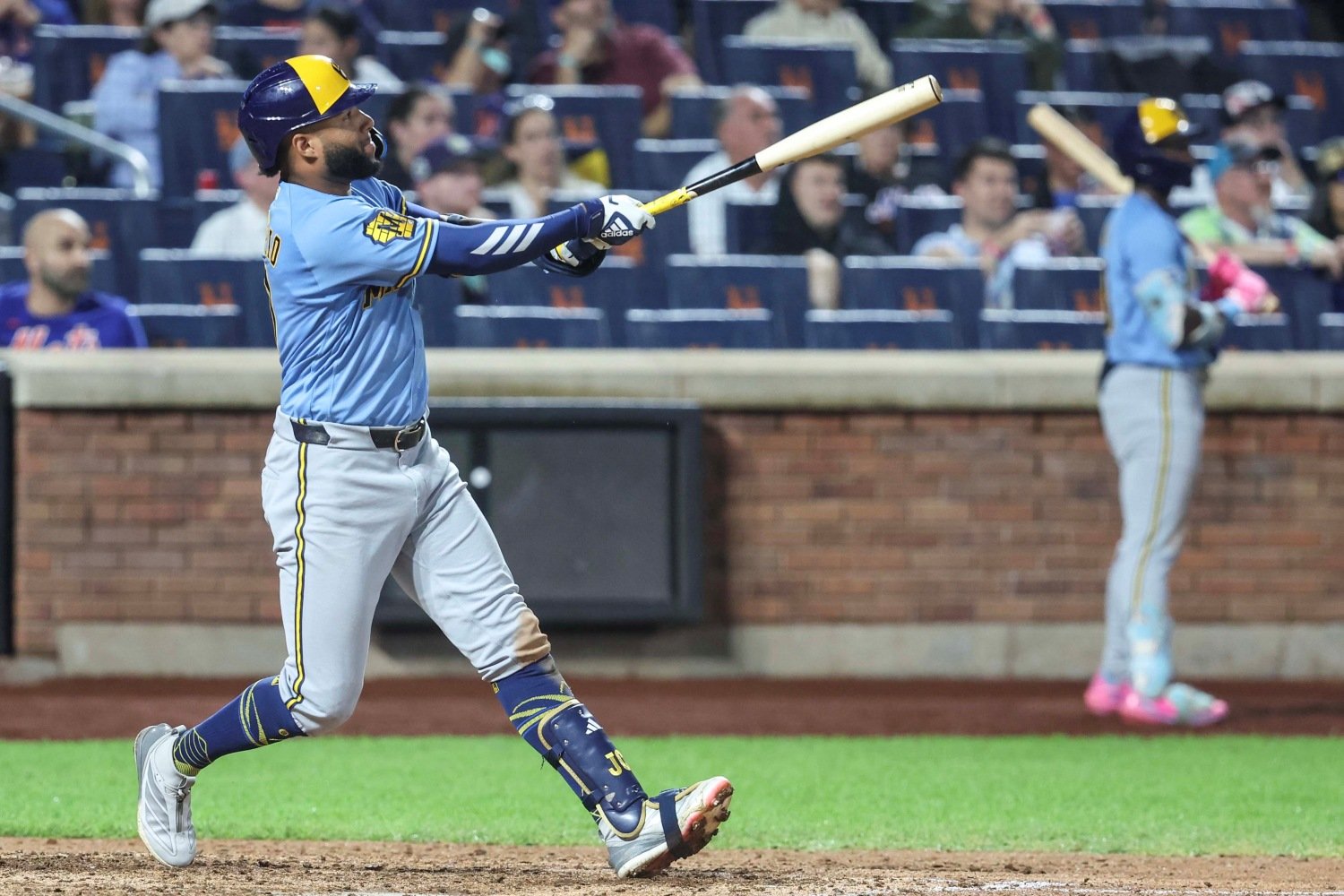 CRACK! Hope you didn't take long to find your seat at Citi Field on Thursday night. If you did, you missed your first chance to glimpse greatness. Jackson Chourio hit Sean Manaea's first pitch through the left side of the infield for a single. He topped it a bit, in truth, and it was hit hard, but not searingly so. What stood out, if you did have your hot dog and your seat dried off and your head turned toward the plate, was just how violent a pass Chourio took at the pitch. His swing clocked in at 83.0 MPH. It's not unprecedented for a leadoff hitter to go up there with a malicious ambush in mind, but that's just the 11th time in the three-plus years of swing tracking that the first pitch of the game has been hit with that hard a swing for a hit of any kind. No one doubts Chourio's raw power—it's very impressive. But he's not normally going to show up on a list with guys like Kyle Schwarber, Nick Kurtz and Elly De La Cruz. Clearly, Chourio meant business. Sure enough, when he came up in the second, he was ready to unload on the first pitch again. His swing was a hair less fast this time, but the result was even more impressive: an opposite-field two-run homer on a meatball of a heater. By then, it should have been clear to you that you were in for one of those nights. The Mets, at least, must have felt it by then. Jacob Misiorowski was in control of things on the mound, and Chourio was on the attack. In his third plate appearance, Chourio stayed on the attack. Having learned his lesson, though, Manaea refused to give him another fastball. The first three pitches were sweepers, of which Chourio fouled off the first two before laying off the third. Finally, Manaea showed him the fastball, way off the outer edge—just forcing him to think about something other than another big, roundhouse sweeper coming straight at him. That's what the fifth pitch was, and Chourio laid off that, too. On 3-2, Manaea refused to give in—but he had to land the sweeper closer to the zone. It still made its way in off the plate, and Chourio couldn't do what he'd done to that heater in the second on it, but he got around and found enough of the barrel to hit the ball squarely, lining a one-hopper through the left side for his third hit of the night. Xzavion Curry was the only Mets hurler who got Chourio out all night. He left a BP fastball up on a 1-1 count and got lucky: Chourio cut loose with a vicious cut but got just underneath it. Alas, the poor thing, he had to face Chourio again, trying to keep the game within range on a night on which he didn't have his best stuff and the Mets needed length. Curry nibbled in his second showdown with Chourio, working away, away, away. Finally, on his second 2-2 offering, he threw a fastball well above the zone over the inner half—but Chourio wasn't going to pop one up again. He hit a laser over the wall in left-center, for his second homer of the day. Between his five turns and five hard-hit balls, Chourio made plays in the field, too. In the bottom of the fifth, he made a fine running catch on one line drive, and on another that was too far in front of him, he charged and picked a tricky in-between hop, then fired a one-hop strike to the plate for what could have been a run-saving out, but for a slightly errant swipe tag by Gary Sánchez. It was a wake-up call, for anyone still letting Chourio's greatness slip beneath their notice. This is a Hall of Famer in progress. How Jackson Chourio Already Compares to the Best Young Hitters Ever Perhaps that sounds like hyperbole. It isn't. The thing that makes baseball magical—that sucks you in and holds you in its hard blue glow all spring and summer and leaves you longing for it all winter, the same way you long for 9 PM sunsets—is its difficulty. Greatness is elusive, and it's hard-won, and sometimes, it's damnably subtle. The game defies solving, and it defies domination. For young players, especially, it defies anyone who aspires to consistency. There's so much to learn and so much to suffer in the game that it takes almost everyone until at least their mid-20s to find consistency, even if they stumble upon brilliance sooner than that. To wit, only 15 players since World War II have put together three seasons with at least 400 plate appearances and an OPS+ of 110 or higher through their age-22 seasons. This is the list, in chronological order: Eddie Mathews Mickey Mantle Al Kaline Frank Robinson Orlando Cepeda Vada Pinson Tony Conigliaro Johnny Bench Ken Griffey Jr. Álex Rodríguez Mike Trout Bryce Harper Carlos Correa Juan Soto Chourio Of this group, the only players who didn't go on to have Hall of Fame-worthy careers were Pinson, Conigliaro and Correa. Even those three had great, memorable careers, and but for injuries, each of them would probably be in (or, in Correa's case, en route there), too. Being a good hitter over this much playing time in the majors at this young an age is foolproof evidence of historic greatness. Chourio is not quite on Pete Crow-Armstrong's level this season, given all the value Crow-Armstrong provides on defense and on the bases and the way he's rapidly matured at the plate. Then again, Chourio is just a couple weeks short of two years younger than Crow-Armstrong. When we say he hasn't had an MVP-caliber season yet, the emphasis belongs on the 'yet', rather than the 'hasn't'. That's coming. Thursday night was just the latest warning flare. Beware, rest of the league. Chourio is coming for you. Jackson Chourio's Swing Adjustment Has Unlocked More Damage on Fastballs Beyond this one game, though, there's a bigger trend to observe. Chourio hasn't just sustained the success he enjoyed as soon as he reached the majors; he's burgeoning. This has been by far his best season yet. After his outburst in the series-clinching win over the Mets, he's batting .283/.345/.477 on the season, which would mark career bests in all three stats. The key to that step forward is a tweak to Chourio's swing, which has made him more dangerous to all fields and better able to cover the whole arsenal of most opposing pitchers. Here's a fastball Chourio saw against Boston's Garrett Crochet last season. It was right down the middle, on the first pitch of the at-bat, but Chourio only managed to foul it off. bmJNZ3lfWGw0TUFRPT1fVndoVVZsUUVCd1lBQ0FOUkFBQUhCRmNEQUZoUVZGSUFVMWRXQ1FaWEExVlhBUXRR.mp4 Now, here's a similar heater from José A. Ferrer of the Mariners, from earlier this month. It's not some 450-foot homer, but Chourio hits this pitch for a clean and well-struck single. NXk5UUJfWGw0TUFRPT1fVUFBQVVGd0RBZ29BREZOVEJ3QUhWMUplQUZrQkJsTUFDZ0VBVkZjTkJsQlhVbGRU.mp4 We could cherry-pick one particular pitch from each of two seasons to tell whatever story we want, but in this case, the contrast between these outcomes reflects a true transformation. On fastballs right down the middle in 2025, Chourio realized -2 runs in context-neutral value. He whiffed on 16.1% of his swings on those pitches, and even when he didn't do that (or stare at a called strike), his barrel wasn't on time and on target enough to generate as much positive value as a hitter should get from that kind of offering. This season, he's whiffed on only 4.9% of his swings at fastballs down the middle, and he's created 9 runs of positive value, overall. That's not counting what he added by riding Manaea's juicy heater out of the park Thursday night. To see the difference, let's put a couple of key moments within Chourio's swing side-by-side. First, here's the moment when Chourio's front heel lands in each swing. This is when he can start really hitting against his front side. It's subtle, but look at his hips in each picture. He's begun to turn them more in the swing this year; he's building torque from his lower half earlier. Now, here's another telling moment, from just a frame or two later in each video. This looks almost like two different moments in the swing, but I promise, it's functionally the same one in each. We can see the downstream effects of getting the hips turning around a stable core sooner: Chourio is more open with both his hips and his front shoulder on the right. But look at his hands, too. Last season, he was bringing them very low toward a pitch he read as being in the heart of the zone. That meant tucking his back elbow in very, very close to his side and flattening that back forearm, delaying any real power generation by the top hand until late in the stroke. This year, he's getting much earlier separation between hands and torso, and he's carrying the hands higher into the back part of the hitting zone. That means creating slightly more tilt from hands to barrel, and indeed, Chourio has a slightly steeper swing this year. He's slashing cleanly through the ball, in a way he couldn't quite do last season. Because of that slightly earlier activation of his lower half and his core, Chourio is getting around and working up through the ball more this year. He's also catching the ball a couple inches farther in front of himself than he was last season. Yet, he's not pulling the ball any more often—the opposite. We're seeing him make major strides in power production and quality of contact, but he's pulling it in the air less often than ever, and far less than the league does, on average. For those at all versed in this kind of hitting analysis, that should raise an eyebrow. This isn't normal. Hitters who rotate earlier, extend earlier and catch it farther out front also pull it more. Why isn't that happening with Chourio? Biomechanically, the explanation lies in that extra tilt. But there's a bigger explanation, too. Much of the change in Chourio's game this year lies not in his swing, but in how and when he's using it. His approach is as big an explainer of his evolution as his movements. In general, Chourio is swinging less often this year, almost across the board. He's still at a stage of his career in which he goes through long periods with big chase rates, when he seems not to be seeing the ball well, but his plan is getting better, and his zone is getting tighter and better-controlled. Before swinging at the first pitch so zealously and often Thursday night, his early-count swing rates were notably down this season. He doesn't expand as often late in counts, either. As a result, he's walking more this season, and not just because the ABS system has reduced the size of the strike zone. Specifically, though, Chourio has leaned into that steeper swing (literally, sometimes) by focusing more on pitches on the inner half, which tied him up with his former moves but which he can now hit squarely. He's not swinging more at pitches on the inner half, per se, but a greater percentage of the pitches he's swinging at are in that area, because he's really cut back on swings at pitches away—especially down and away. That, again, makes sense. When you have what's still a flatter-than-average swing and have made the conscious choice to get steeper with it and to open up more as you swing, you need to focus on hammering stuff from the middle of the plate in, and leave alone the pitches your swing no longer suits. Indeed, the big gains Chourio has realized in terms of hitting the ball hard this year have nearly all come on pitches in—especially up and in. But the secret to hitting inside pitching isn't to hook it, if you're a relatively flat swinger. Chourio has gotten steeper this year, but he's still a flat-swing guy. He's never going to be the one who buggy-whips underneath his front side and catches inside offerings far in front of himself. His swing tweaks (and a move of a couple inches away from the plate) have made enough room for him to put the barrel on inside pitches, and he can do it with his bat working uphill at the right angle to produce line drives and fly balls far more consistently than in the past. When he does so, though, the bat is usually still angled toward the opposite field; it's just how you keep hard contact fair when attacking inside pitching with this swing. The modern game has trended away from opposite-field power, and toward optimized swings that focus on lifting and pulling. Most players have to go through that optimization process and succeed according to formula, to thrive against the caliber of pitching that now suffuses the league. Chourio, however, is not most hitters. He's a future Hall of Famer, just coming into his own. That means freaky talent, and a bigger menu of ways to be great than most players have. It means he can now hit your fastball, no matter how hard or where you throw it, and it means he's ready to anchor the Brewers' offense for a third October running. Just get him from here to there healthy.
 -
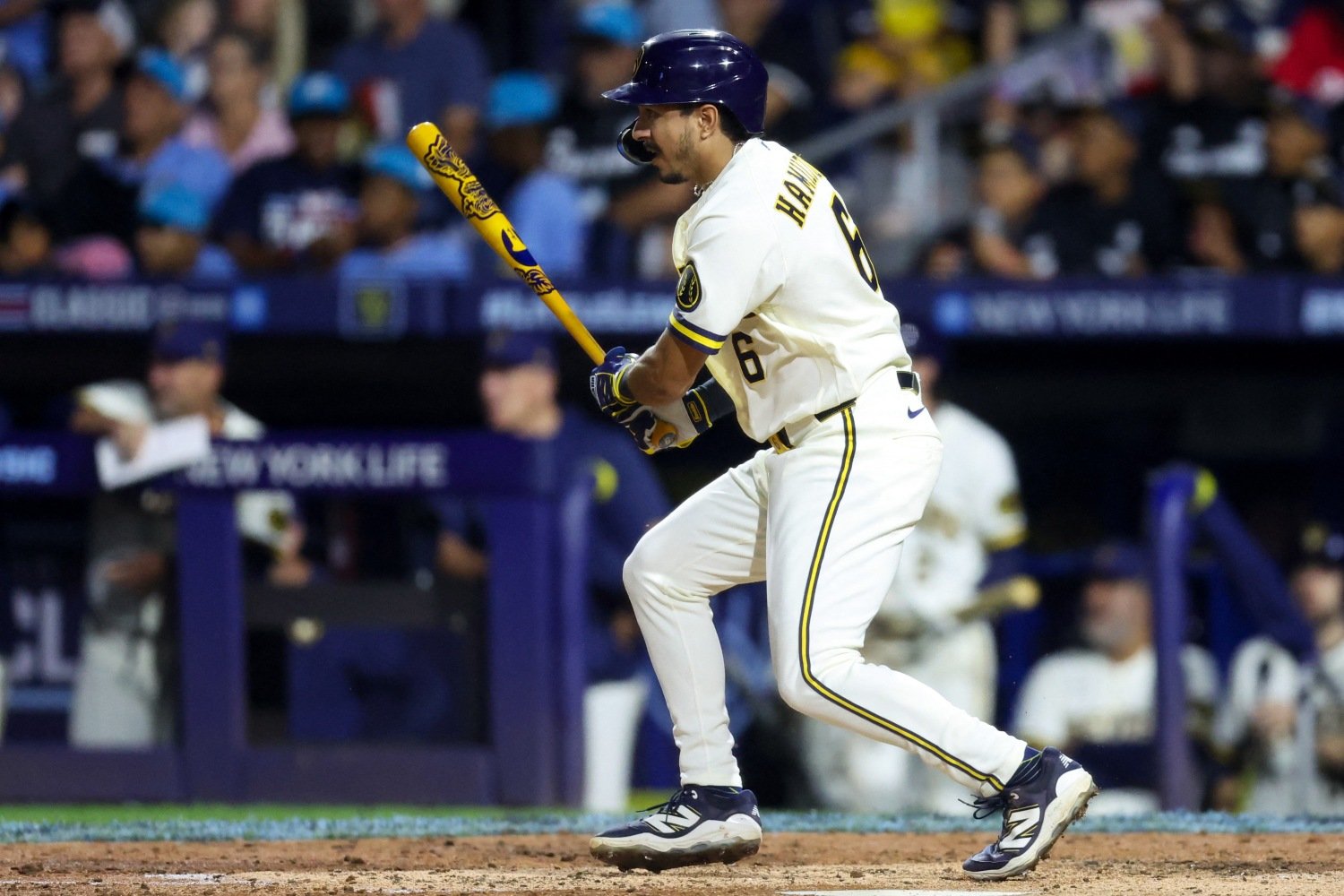 If you wanted to sum up David Hamilton's 2026 season in one play, you could do much worse than the ground ball Sean Murphy hit during the Brewers' loss to the team from near(ish) Atlanta in MLB's Little League Classic Sunday night in Williamsport, Penn. It was a tricky play. With runners on the corners and two outs, the slow-footed catcher hit a slow bouncer toward third base. Hamilton had been playing deep and guarding the line, respecting Murphy's ability to hit the ball hard and the risk of a second run scoring should he hit a double into the corner. That left a lot of ground for the speedy infielder to cover, but because Murphy moves so poorly, it should have been a relatively easy play. Hamilton got to the ball in fine shape—but then, things crashed to an ugly halt. Having taken a slightly errant angle on a ball that died faster than he'd expected on the soft turf of the Williamsport infield, Hamilton tried to come to a two-footed stop and pick the ball up with both hands. It was a late adjustment in response to that initial misread, but it made for an awkward stop—and his feet simply went out from under him. A big chunk of turf gave way, too, making clear that the player alone wasn't at fault. He'd had to adjust because of the field conditions; the conditions further betrayed him and put him on the seat of his pants. A run scored, and the inning continued. M3k2ampfV0ZRVkV3dEdEUT09X0F3a0RBUUlDWGxZQURsdFJCUUFBQWxKZkFBTURBQVFBQjFjTUJ3VlRVZ2RSVmxaUQ==.mp4 The metaphor for Hamilton's season was almost overwhelming. He started in a position from which he had a chance to succeed, and it was undoubtedly the best position for the team, but it asked a lot of him. He didn't make the play correctly, but he also paid a heavier price than seemed fair. That's what it's been like to watch him all year. The Brewers brought him in with a role in mind, and he's filled that role. He hasn't thrived in it, though, partially because it's not a role in which anyone is likely to thrive; partially because he hasn't quite held up his end of the bargain; and partially because of some rotten luck. While the Brewers have a tried-and-true system for the development and optimization of a certain type of player, Hamilton has proved not to be a perfect fit for that system. He's been left with some developmental whiplash, even at a phase of his career where 'development' ceases to be the word a player wants to associate with their progress. He's been asked to become more patient, hit more line drives, catch the ball deeper in the hitting zone and make more contact; he's managed that. However, he's lost what little pop he had in the process, and the gains in his plate discipline (on an outcome basis) haven't been what the Brewers surely hoped they would be. He's not walking enough to justify the way he's altered his swing itself. Part of the blame for that, though, falls on Hamilton, who has joined Team Swing Decisions and not made materially better ones. Meanwhile, in the field, he's been a colossal disappointment. The play above encapsulates some of the issue. Yes, the ball slowed down more than he expected, and yes, the softness of the ground makes that diamond different from most big-league infields. Had he turned his body correctly and charged the ball straight-on, though, he would have been able to deal with both complications and get the out. Stopping that way and fielding that ball with two hands is precisely the wrong way to do it; that needs to be an on-the-run, one-handed pick, be it barehand or glove. Hamilton took an initial angle that left him a smaller window in which he could field the ball that way, so when it was slower than he thought, he had to change to a more difficult form of playmaking. That's been his defense this year in a nutshell. You can see the special tools, but the fundamentals are often wrong by just enough to cause disaster. His throws are strong, but not always accurate. His range is excellent, but his hands aren't as quick or as soft as you would guess. The only place where Hamilton has come as advertised is on the bases, and even there, he hasn't been quite as aggressive or as efficient as the team might have hoped. Pat Murphy was effusive about Hamilton's potential in the spring, in a way that always seemed a bit too rosy for a player who had gotten so close to 30 without having a breakthrough. Sure enough, Hamilton hasn't delivered on that potential, even though you can still see it there, waiting to be tapped. Not all of that is Hamilton's fault. Playing mostly as a platoon option at two different positions that are each demanding, he's been denied any easy routine. He also dealt with an elbow issue for much of the season, and then tried to manage and rehab both that injury and his hamstring strain once the latter force him onto the injured list. He's tough, and he's worked hard for the team. The results haven't been there, but the club hasn't been disappointed in his work ethic or willingness to do what they ask of him. Still, one has to hope better days lie ahead for him. The Brewers need as many of their roster pieces functioning at a high level as is possible, come the postseason. Their patience with Hamilton could yet pay huge dividends, because the player Murphy described and envisioned earlier this year does peek out now and then, and he can be a game-wrecker—especially offensively. If he never takes to the difficult jobs he's been given, he could depart this winter, with the team sliding Joey Ortiz into that role next season as they make way for Jesús Made. For now, though, Hamilton remains in the medium-term plans. Thus, he needs to overcome the things the universe keeps putting in his way and make some good things happen.
 -
Image courtesy of Matthew O'Haren-Imagn Images If you wanted to sum up David Hamilton's 2026 season in one play, you could do much worse than the ground ball Sean Murphy hit during the Brewers' loss to the team from near(ish) Atlanta in MLB's Little League Classic Sunday night in Williamsport, Penn. It was a tricky play. With runners on the corners and two outs, the slow-footed catcher hit a slow bouncer toward third base. Hamilton had been playing deep and guarding the line, respecting Murphy's ability to hit the ball hard and the risk of a second run scoring should he hit a double into the corner. That left a lot of ground for the speedy infielder to cover, but because Murphy moves so poorly, it should have been a relatively easy play. Hamilton got to the ball in fine shape—but then, things crashed to an ugly halt. Having taken a slightly errant angle on a ball that died faster than he'd expected on the soft turf of the Williamsport infield, Hamilton tried to come to a two-footed stop and pick the ball up with both hands. It was a late adjustment in response to that initial misread, but it made for an awkward stop—and his feet simply went out from under him. A big chunk of turf gave way, too, making clear that the player alone wasn't at fault. He'd had to adjust because of the field conditions; the conditions further betrayed him and put him on the seat of his pants. A run scored, and the inning continued. M3k2ampfV0ZRVkV3dEdEUT09X0F3a0RBUUlDWGxZQURsdFJCUUFBQWxKZkFBTURBQVFBQjFjTUJ3VlRVZ2RSVmxaUQ==.mp4 The metaphor for Hamilton's season was almost overwhelming. He started in a position from which he had a chance to succeed, and it was undoubtedly the best position for the team, but it asked a lot of him. He didn't make the play correctly, but he also paid a heavier price than seemed fair. That's what it's been like to watch him all year. The Brewers brought him in with a role in mind, and he's filled that role. He hasn't thrived in it, though, partially because it's not a role in which anyone is likely to thrive; partially because he hasn't quite held up his end of the bargain; and partially because of some rotten luck. While the Brewers have a tried-and-true system for the development and optimization of a certain type of player, Hamilton has proved not to be a perfect fit for that system. He's been left with some developmental whiplash, even at a phase of his career where 'development' ceases to be the word a player wants to associate with their progress. He's been asked to become more patient, hit more line drives, catch the ball deeper in the hitting zone and make more contact; he's managed that. However, he's lost what little pop he had in the process, and the gains in his plate discipline (on an outcome basis) haven't been what the Brewers surely hoped they would be. He's not walking enough to justify the way he's altered his swing itself. Part of the blame for that, though, falls on Hamilton, who has joined Team Swing Decisions and not made materially better ones. Meanwhile, in the field, he's been a colossal disappointment. The play above encapsulates some of the issue. Yes, the ball slowed down more than he expected, and yes, the softness of the ground makes that diamond different from most big-league infields. Had he turned his body correctly and charged the ball straight-on, though, he would have been able to deal with both complications and get the out. Stopping that way and fielding that ball with two hands is precisely the wrong way to do it; that needs to be an on-the-run, one-handed pick, be it barehand or glove. Hamilton took an initial angle that left him a smaller window in which he could field the ball that way, so when it was slower than he thought, he had to change to a more difficult form of playmaking. That's been his defense this year in a nutshell. You can see the special tools, but the fundamentals are often wrong by just enough to cause disaster. His throws are strong, but not always accurate. His range is excellent, but his hands aren't as quick or as soft as you would guess. The only place where Hamilton has come as advertised is on the bases, and even there, he hasn't been quite as aggressive or as efficient as the team might have hoped. Pat Murphy was effusive about Hamilton's potential in the spring, in a way that always seemed a bit too rosy for a player who had gotten so close to 30 without having a breakthrough. Sure enough, Hamilton hasn't delivered on that potential, even though you can still see it there, waiting to be tapped. Not all of that is Hamilton's fault. Playing mostly as a platoon option at two different positions that are each demanding, he's been denied any easy routine. He also dealt with an elbow issue for much of the season, and then tried to manage and rehab both that injury and his hamstring strain once the latter force him onto the injured list. He's tough, and he's worked hard for the team. The results haven't been there, but the club hasn't been disappointed in his work ethic or willingness to do what they ask of him. Still, one has to hope better days lie ahead for him. The Brewers need as many of their roster pieces functioning at a high level as is possible, come the postseason. Their patience with Hamilton could yet pay huge dividends, because the player Murphy described and envisioned earlier this year does peek out now and then, and he can be a game-wrecker—especially offensively. If he never takes to the difficult jobs he's been given, he could depart this winter, with the team sliding Joey Ortiz into that role next season as they make way for Jesús Made. For now, though, Hamilton remains in the medium-term plans. Thus, he needs to overcome the things the universe keeps putting in his way and make some good things happen. View full article
-
Well, no, the best option they have at first is Bauers.
-
There's a chance both are gone. I think it's a small chance. In addition to everything they bring on the field, the team really likes what each brings in the clubhouse. This is one of those subtle places where I think you'll see this team evolve, as their success begets more success and their revenues rise: Where you might have seen them let both guys go a couple years ago, they'll keep one, even if it means raising the payroll $5-10 million.
-
Fear Of Missing Out envy, in this case
-
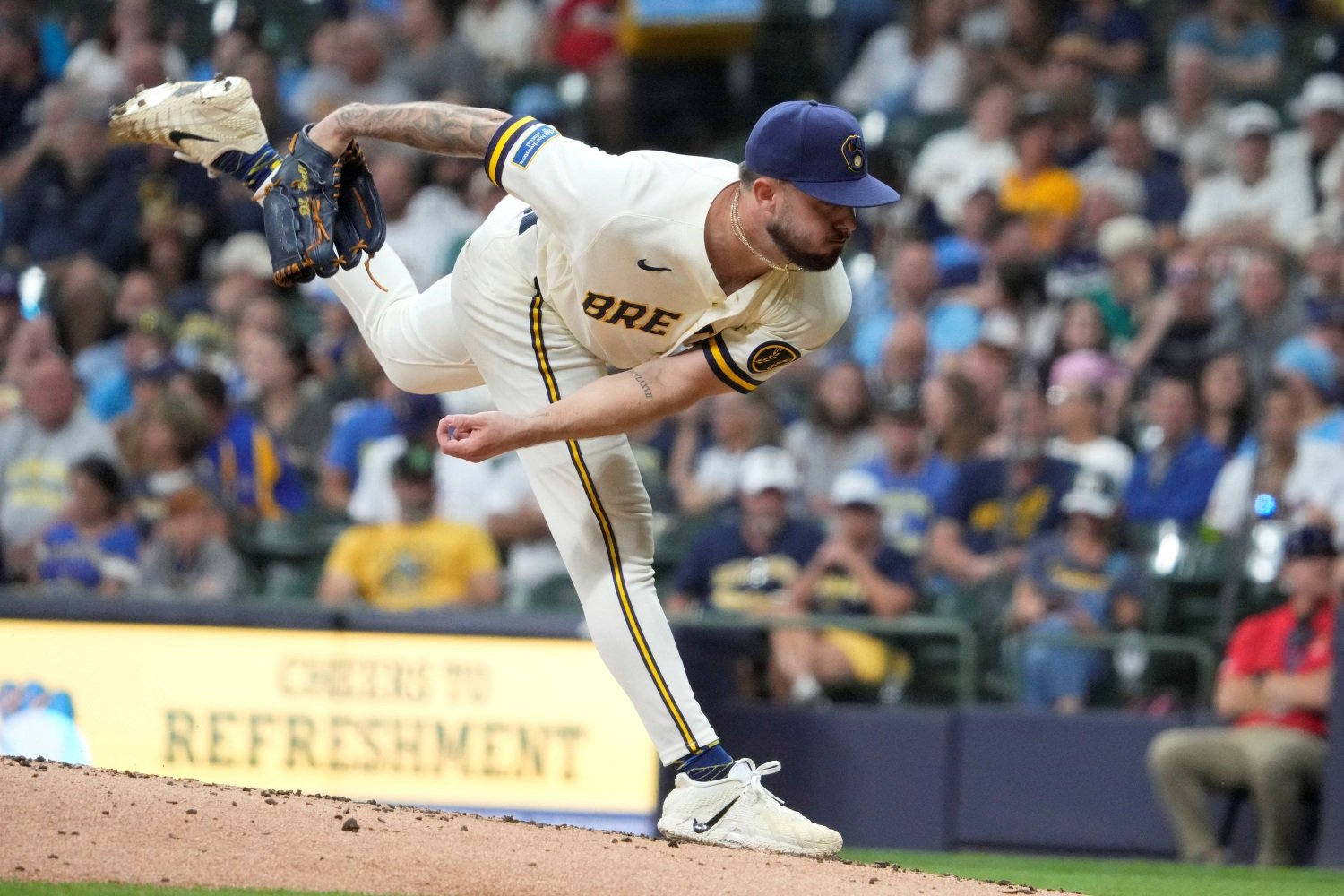 It was a bad night for the Brewers' latest two-player trade package. Dustin May's third start with the team went dreadfully, as the Mariners took out their frustrations over Tuesday's 22-0 whupping by chasing May after seven early runs. JoJo Romero is still on the injured list. The clock is ticking on getting value from that deal, since both May and Romero are impending free agents. Besides, it would have been nice to win that game, securing a series victory and widening the team's advantage over the Cubs after they lost Wednesday afternoon. For those willing to look beyond the final score, though, there was some real consolation to be found as the game unfolded. Joey Ortiz had three hits, including a home run, and his hot streak continues. In fact, it's only picking up steam. Since the promotion of Cooper Pratt that pushed Ortiz back to third base, the former Orioles farmhand is batting .302/.340/.519 in 142 plate appearances. He's not walking nearly as often as he did before that (6.3%, versus 11.8% prior to Pratt's call-up), but for Ortiz, walks aren't always a good sign. They often signal passivity, rather than real selectivity and a balanced approach at the plate. When Ortiz is focused on drawing walks, it's because he's not confident in his swing and because he's not able to get the bat head out and do damage. Over this recent stretch, he has 14 extra-base hits, more than doubling his season total in less playing time than he had before the transition. An aggressive Ortiz who's getting to the ball even a little bit farther out in front is the best version of the player, at least at this juncture of his career. It's helped that, of late, Ortiz's bat speed has trended up. Early this season, he struggled to generate the same lethal swings that made him enticing as a prospect, but that element is back in his game this summer. In a perfect world, a batter would create that extra whip without making a significant tradeoff in the shape of their swing. Ortiz isn't a perfect-world kind of hitter, though. He has an unusual profile, letting the ball get much deeper than most hitters with similarly flat swings. In some ways, it makes him dangerous and difficult to defend, but it's also the source of his inconsistency and occasional slumps. He's not a guy who comfortably generates bat speed the same way other hitters do; he's always making tradeoffs. Unsurprisingly, therefore, his boost in swing speed has come with a flattening of his bat path. What Ortiz has also done, though, is get rid of some of the bat wrap in his load. Early this year, you could see Ortiz counterrotate with his hands and shoulders even as his front foot came down, turning such that the end of his bat momentarily faced out toward the pitcher. That move creates considerable torque, but it also risks making you late. It makes your swing longer early, and it ever-so-slightly delays beginning your actual progress toward the ball. Nowadays, Ortiz isn't doing that as much. His move keeps the bat more neutral in its position before he starts to move his hands toward the hitting zone. When that does happen, there's a bit more snap to the hands. He can't create as steep a swing that way, but by generating the same bat speed and starting a hair earlier, he's getting to the ball with his bat working uphill more often than earlier this year—making the force he delivers to the ball pay off more handsomely. NXk5UUJfWGw0TUFRPT1fVlFaU0JnSUhBRmNBV1ZRQ1VRQUhBQUZWQUFNRVZBY0FWd05YQ1FaV0J3QUFDQVpV.mp4 For a few weeks this spring, it looked like Ortiz might not have any place in the Brewers' future. He was displaced positionally by Pratt, but if David Hamilton had been playing just a little better or Ortiz had responded just a little worse to that change, he might not even be in the majors right now. Because of Milwaukee's glut of infield options, he might still have to find his forever home somewhere else, but the last two months have made it clear that Ortiz can be a productive big-leaguer. Wednesday night offered the latest proof of his upside. One way or another, he's got a lot of value left to offer the team. Ditto, it seems, for DL Hall, who worked three shutout innings as the bullpen kept Seattle quiet. Over his last five appearances, Hall has fired eight frames of one-run ball, allowing two hits and two walks against eight strikeouts. Like Ortiz, Hall finds his success unconventionally. He's not a huge strikeout guy, and he walks more batters than is ideal, but he consistently limits damage by opposing batters. Earlier this summer, I wrote about the broad skill of swing disruption, using Statcast's swing timing and miss distance data. The piece focused on Aaron Ashby, but only because Hall was on the injured list at the time. It's Hall who best dominates batters in this specific sense. He's great at forcing them to slightly (only slightly, but that's often enough) mistime their swing, and at getting them to hit the ball off the end of the bat, and at getting them to hit the bottom third of the ball, which often results in lazy fly balls. Unconventional though he might be, Hall is now fully back in the groove, and he's more important to the team's bullpen than initially planned or hoped. His showing Wednesday night was the latest evidence that he's up to the task. The Brewers lost an ugly game, but it was just one. They're still in good shape as they try to sew up their fourth straight division title and secure a bye to the Division Series. The game also yielded reasons to hope that Ortiz and Hall can sustain their positive contributions, which is great news. Both players, acquired as a package like May and Romero but at the much higher cost of Corbin Burnes before the 2024 campaign, have multiple avenues by which they can help the team remain successful for several more seasons.
 -
Image courtesy of Michael McLoone-Imagn Images It was a bad night for the Brewers' latest two-player trade package. Dustin May's third start with the team went dreadfully, as the Mariners took out their frustrations over Tuesday's 22-0 whupping by chasing May after seven early runs. JoJo Romero is still on the injured list. The clock is ticking on getting value from that deal, since both May and Romero are impending free agents. Besides, it would have been nice to win that game, securing a series victory and widening the team's advantage over the Cubs after they lost Wednesday afternoon. For those willing to look beyond the final score, though, there was some real consolation to be found as the game unfolded. Joey Ortiz had three hits, including a home run, and his hot streak continues. In fact, it's only picking up steam. Since the promotion of Cooper Pratt that pushed Ortiz back to third base, the former Orioles farmhand is batting .302/.340/.519 in 142 plate appearances. He's not walking nearly as often as he did before that (6.3%, versus 11.8% prior to Pratt's call-up), but for Ortiz, walks aren't always a good sign. They often signal passivity, rather than real selectivity and a balanced approach at the plate. When Ortiz is focused on drawing walks, it's because he's not confident in his swing and because he's not able to get the bat head out and do damage. Over this recent stretch, he has 14 extra-base hits, more than doubling his season total in less playing time than he had before the transition. An aggressive Ortiz who's getting to the ball even a little bit farther out in front is the best version of the player, at least at this juncture of his career. It's helped that, of late, Ortiz's bat speed has trended up. Early this season, he struggled to generate the same lethal swings that made him enticing as a prospect, but that element is back in his game this summer. In a perfect world, a batter would create that extra whip without making a significant tradeoff in the shape of their swing. Ortiz isn't a perfect-world kind of hitter, though. He has an unusual profile, letting the ball get much deeper than most hitters with similarly flat swings. In some ways, it makes him dangerous and difficult to defend, but it's also the source of his inconsistency and occasional slumps. He's not a guy who comfortably generates bat speed the same way other hitters do; he's always making tradeoffs. Unsurprisingly, therefore, his boost in swing speed has come with a flattening of his bat path. What Ortiz has also done, though, is get rid of some of the bat wrap in his load. Early this year, you could see Ortiz counterrotate with his hands and shoulders even as his front foot came down, turning such that the end of his bat momentarily faced out toward the pitcher. That move creates considerable torque, but it also risks making you late. It makes your swing longer early, and it ever-so-slightly delays beginning your actual progress toward the ball. Nowadays, Ortiz isn't doing that as much. His move keeps the bat more neutral in its position before he starts to move his hands toward the hitting zone. When that does happen, there's a bit more snap to the hands. He can't create as steep a swing that way, but by generating the same bat speed and starting a hair earlier, he's getting to the ball with his bat working uphill more often than earlier this year—making the force he delivers to the ball pay off more handsomely. NXk5UUJfWGw0TUFRPT1fVlFaU0JnSUhBRmNBV1ZRQ1VRQUhBQUZWQUFNRVZBY0FWd05YQ1FaV0J3QUFDQVpV.mp4 For a few weeks this spring, it looked like Ortiz might not have any place in the Brewers' future. He was displaced positionally by Pratt, but if David Hamilton had been playing just a little better or Ortiz had responded just a little worse to that change, he might not even be in the majors right now. Because of Milwaukee's glut of infield options, he might still have to find his forever home somewhere else, but the last two months have made it clear that Ortiz can be a productive big-leaguer. Wednesday night offered the latest proof of his upside. One way or another, he's got a lot of value left to offer the team. Ditto, it seems, for DL Hall, who worked three shutout innings as the bullpen kept Seattle quiet. Over his last five appearances, Hall has fired eight frames of one-run ball, allowing two hits and two walks against eight strikeouts. Like Ortiz, Hall finds his success unconventionally. He's not a huge strikeout guy, and he walks more batters than is ideal, but he consistently limits damage by opposing batters. Earlier this summer, I wrote about the broad skill of swing disruption, using Statcast's swing timing and miss distance data. The piece focused on Aaron Ashby, but only because Hall was on the injured list at the time. It's Hall who best dominates batters in this specific sense. He's great at forcing them to slightly (only slightly, but that's often enough) mistime their swing, and at getting them to hit the ball off the end of the bat, and at getting them to hit the bottom third of the ball, which often results in lazy fly balls. Unconventional though he might be, Hall is now fully back in the groove, and he's more important to the team's bullpen than initially planned or hoped. His showing Wednesday night was the latest evidence that he's up to the task. The Brewers lost an ugly game, but it was just one. They're still in good shape as they try to sew up their fourth straight division title and secure a bye to the Division Series. The game also yielded reasons to hope that Ortiz and Hall can sustain their positive contributions, which is great news. Both players, acquired as a package like May and Romero but at the much higher cost of Corbin Burnes before the 2024 campaign, have multiple avenues by which they can help the team remain successful for several more seasons. View full article
-
Is Andrew Vaughn Too Short to Be a Viable First Baseman?
Matthew Trueblood posted an article in Brewers
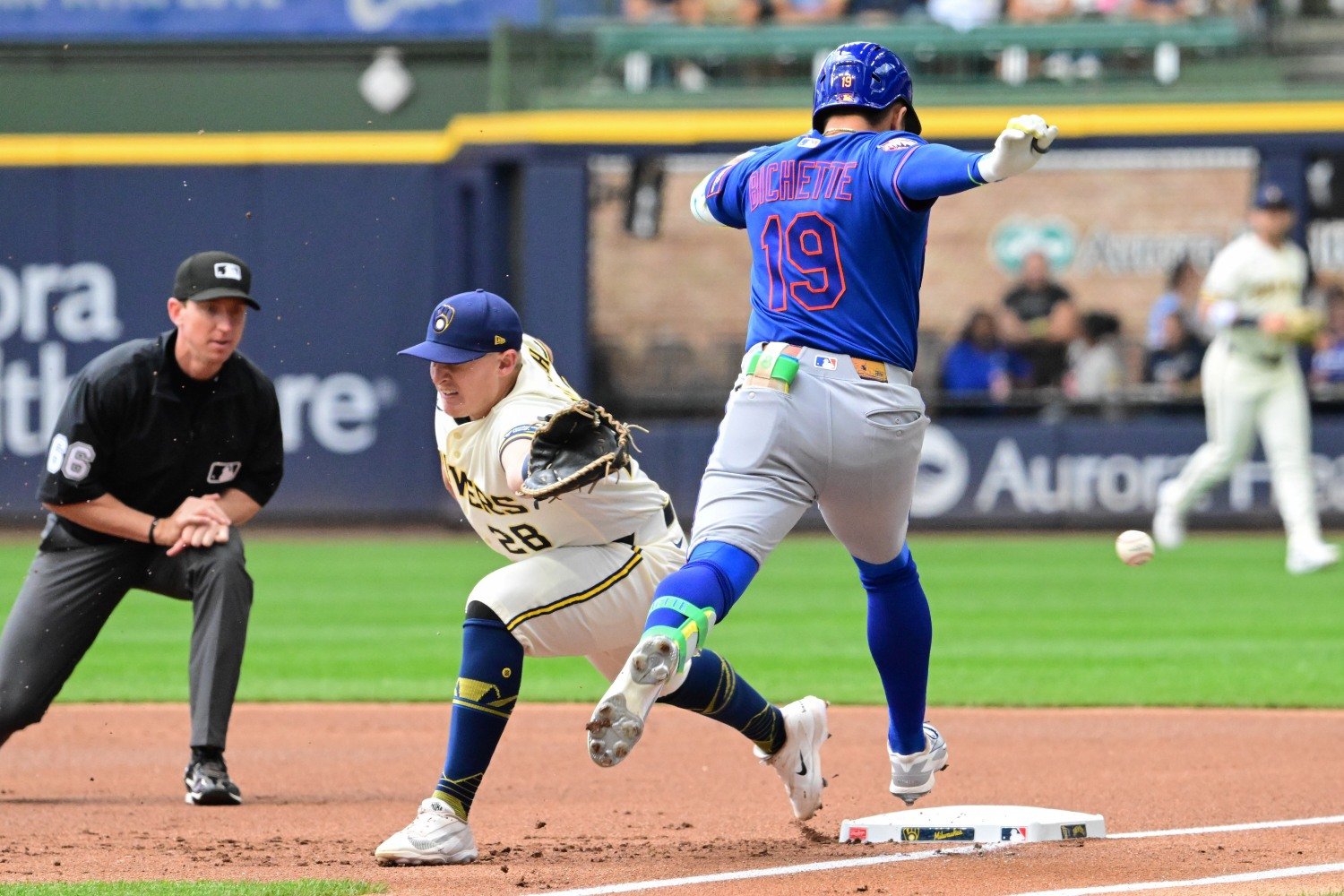 It's not easy to be a 5-foot-10 big-league first baseman. Anywhere on a baseball diamond, there are ways to make up for a lack of size or speed in certain ways, but the dimensions of the field and the timing of the game remain constant, and that creates real constraints for players based on their physical gifts and skills. Andrew Vaughn has spent time at third base for the Brewers recently and played a couple of games at second base for the White Sox earlier in his career. He's had slightly longer tours in each outfield corner. Because he's thickly built, slow and has a relatively weak arm, though, he's mostly been a first baseman, and he'll never fit neatly anywhere else. Unfortunately, the latest Statcast data on receiving throws at first base reveal why he's not a good fit at first, either. Of the 42 first basemen who have had 100 or more chances receiving throws this season, Vaughn ranks fourth-worst in Outs Above Average based on that skill, with -3. The three players who have racked up more negative value have all had more than double his number of opportunities. Pound for pound, he might be the worst receiver of infield throws in the game. Let's dig into the how and why of that. Baseball Savant breaks down Receiving OAA based on the type of play the first baseman in question is trying to make, as well as reporting a total. Included categories are: On Target: Throws that pass within a 2.5-foot of first base while also between 1 and 7 feet high Bounce: Throws that bounce at least 15 feet from the base en route to the first baseman Scoops: Throws that bounce between 5 and 15 feet from the base Low: Throws that arrive less than 1 foot above the ground High: Throws that arrive more than 7 feet above the ground Wide: Throws that arrive more than 2.5 feet wide of the base There's some slight overlap in these categories, because some scoops and bounces also go into the low or wide bin, but you get the idea. Breaking it down this way lets us study which players struggle with which types of throws. For Vaughn, unfortunately, the most glaring problems don't come on the balls farthest off the mark. There are some problems in that area, and we'll get to them in a bit, but the worst news is that only Phillies first baseman (now right fielder) Bryce Harper is the only player with a worse OAA on On Target throws this year. Vaughn has cost the Brewers 2.6 expected outs on plays that didn't feature an errant or challenging throw at all. Here's an example. SzRYMWVfWGw0TUFRPT1fQVFJQ0JsMVZWbE1BRDFzQVZnQUhWRkpSQUFNSFVsQUFWbEFCQVFGVVVsY0hVUU1B.mp4 Again, height is a negotiable constraint on the way a player handles first base, but it's not a fully escapable one. On this play, the speed of Eli White and the length of the throw Joey Ortiz had to make made it vital that Vaughn intercept the ball as soon as possible. He didn't get there soon enough. The sheer length of his stretch is limited by his height and the length of his arms and legs, but there's another factor, too. Watch his anchor foot, on the side of the base, and the way his body is oriented as a result. A taller (and/or left-handed) first baseman could have received this throw differently, as well as being able to stretch farther. Knowing the limitations of his stretch, when taking such a long throw from that across-the-diamond angle, Vaughn has to cheat toward the center of the bag so he can adjust and slide back to play throws just like this one. Other first basemen could have come more to the front corner of the bag and cut the throw off a foot sooner in flight; that would have made the difference here. Statcast estimates an expected out rate of almost 78% on that play, so Vaughn is docked by the metric for not being better positioned and better able to reach for the ball. Here's an even more straightforward case of a good throw going to waste because of Vaughn's positioning on the base. Yes, it would help if he were taller, but he also has to get to the front part of the base here. If he does, he's a crucial few inches closer to the incoming throw and makes the catch in time. OTdWNWxfWGw0TUFRPT1fQlZOVFVnVlNBRllBQ2dOVVZnQUhWVk1FQUFOVEFWSUFBbDFSQkZJQVVGVlhWUXRW.mp4 Even when he gets to the right part of the base and stretches almost heroically, though, sometimes the dimensions are just against him. Here, Luis Rengifo makes as strong a throw as he can under the circumstances, but Vaughn's height leaves too much time and space. Fernando Tatis Jr. outruns the throw and catch. QndSNmRfWGw0TUFRPT1fVlZkVkIxeFZVQW9BRFFBREJ3QUhVRkJVQUFBTlYxRUFBbGNEQ1FFSFVGWmRCbEZS.mp4 Often, in baseball, there's something you could have done better, even if making a given play would have been viciously difficult and no one would think of giving you an error. With Vaughn, we can sometimes see cases in which he simply couldn't do anything more—but someone else, with just a bit more leg length and wingspan to work with, could have converted the out. Here's another such case. TDY1cWJfWGw0TUFRPT1fQUFoVkIxZFhYMUFBQ2dZRlZ3QUhCVk5YQUZrSFZGUUFBRnhXVmdNR1VGZFdVbGRV.mp4 Though initially called an out, this one was overturned on review. That's how close plays like these often are, and why it matters more in this replay-review era than it might have 20 years ago. Watch the play a couple of times, and you can even imagine how one of the game's taller first basemen and better receivers would have made the play: a different angle, a longer reach, a quicker catch and an out that held up to slow-motion scrutiny. It's when his infielders are accurate that Vaughn's shortcomings (no pun intended) are most glaring, but of course, he's also ill-equipped to rescue a player who makes a high throw. MTZOYlZfWGw0TUFRPT1fVUZRQ1VnSU5CVkVBVzFGVFh3QUhCQVlFQUFBQ1dnQUFDbFVBQmdaV0JsWUFCQXBU.mp4 That goes down as a throwing error, and well it should. If Vaughn is the height of Freddie Freeman or Matt Olson, though, it's an out—a nervous-making one, but an out. Unfortunately, we also have to talk about how clumsy Vaughn often looks around the base. For a player whose professional experience has come mostly at the cold corner, he plays like it's a new spot for him sometimes. He's slow to reach the base, which is why he's sometimes not set up as well as he should be on it when preparing to catch the ball. It also leads him to get turned around and lose his balance on balls that would be much more catchable if he were bigger, but should be playable even at his size. MnI0QVFfWGw0TUFRPT1fVUFVRFZRZFJVZ0lBWEZKUkFBQUhCZ1VGQUZoVEJWZ0FVQUFFVlFzSENWZGNCd0JT.mp4 That slow decision-making even shows up on balls to his side of the diamond, and contributes to him reaching the base late and being improperly positioned for throws from Brice Turang when the second baseman has to range far toward first to make plays. Again, you can see how a bigger guy could still reach out and make up for his mistake, but the mistake is mostly that he was in such a bad position to begin with. TUFYRzFfWGw0TUFRPT1fVUZSVFVGVUdVQVlBV2dGV1Z3QUhVbFFDQUZrR1VWQUFBQWRUQ1ZVTVZWWURBVmNG.mp4 As you'd guess, Vaughn rates worse than average both on high throws and on wide ones. He's a plus scooper of throws in the dirt and navigator of long bounces, though. He takes proper advantage of his proximity to the ground when one of his teammates puts a throw there. That's not enough to balance out the lack of physical range (in three dimensions) on all other types of throws, but it's nice consolation. Alas, that's exactly where Jake Bauers struggles. The Brewers' bigger, more athletic, left-handed first baseman would rate as above-average, but for a few poor plays on which he's crouched awkwardly and unnecessarily when trying to pick low throws, with disastrous results. cU9sTmtfV0ZRVkV3dEdEUT09X0JRRlhBUVpRVXdRQVdWc0tYd0FIVnc4RUFGaFhXd0FBQndBQVZGSUFCRkVHVmxaZg==.mp4 The net effect of the Brewers' first base receiving has been to give up a few extra infield singles and foist a few unearned throwing errors on the rest of the infield defense this year. It's been ugly. Maybe you noticed this, in the clips above, but the negative impacts of those plays have also disproportionately fallen on the team's two best pitchers. Jacob Misiorowski and Kyle Harrison are two of the top three pitchers in the league this season in terms of OAA lost due to first base receiving, a strange quirk that underscores how good those two have been—but which also makes clear the urgency of fixing this issue (to whatever extent that's possible) come October. Bauers can operate much better mechanically on low throws and bouncers. Vaughn, however, is a trickier case. He might always be prone to leaking outs based on his size and the limitations of his range around the bag. It's one of the rare immutable realities of baseball, a sport that generally makes room for all body sizes and types. As the Brewers consider how to distribute their playing time at first base down the stretch and which (if either) of Bauers and Vaughn to keep this winter, this might be a tiebreaking consideration worthy of note.
 -
Image courtesy of Benny Sieu-Imagn Images It's not easy to be a 5-foot-10 big-league first baseman. Anywhere on a baseball diamond, there are ways to make up for a lack of size or speed in certain ways, but the dimensions of the field and the timing of the game remain constant, and that creates real constraints for players based on their physical gifts and skills. Andrew Vaughn has spent time at third base for the Brewers recently and played a couple of games at second base for the White Sox earlier in his career. He's had slightly longer tours in each outfield corner. Because he's thickly built, slow and has a relatively weak arm, though, he's mostly been a first baseman, and he'll never fit neatly anywhere else. Unfortunately, the latest Statcast data on receiving throws at first base reveal why he's not a good fit at first, either. Of the 42 first basemen who have had 100 or more chances receiving throws this season, Vaughn ranks fourth-worst in Outs Above Average based on that skill, with -3. The three players who have racked up more negative value have all had more than double his number of opportunities. Pound for pound, he might be the worst receiver of infield throws in the game. Let's dig into the how and why of that. Baseball Savant breaks down Receiving OAA based on the type of play the first baseman in question is trying to make, as well as reporting a total. Included categories are: On Target: Throws that pass within a 2.5-foot of first base while also between 1 and 7 feet high Bounce: Throws that bounce at least 15 feet from the base en route to the first baseman Scoops: Throws that bounce between 5 and 15 feet from the base Low: Throws that arrive less than 1 foot above the ground High: Throws that arrive more than 7 feet above the ground Wide: Throws that arrive more than 2.5 feet wide of the base There's some slight overlap in these categories, because some scoops and bounces also go into the low or wide bin, but you get the idea. Breaking it down this way lets us study which players struggle with which types of throws. For Vaughn, unfortunately, the most glaring problems don't come on the balls farthest off the mark. There are some problems in that area, and we'll get to them in a bit, but the worst news is that only Phillies first baseman (now right fielder) Bryce Harper is the only player with a worse OAA on On Target throws this year. Vaughn has cost the Brewers 2.6 expected outs on plays that didn't feature an errant or challenging throw at all. Here's an example. SzRYMWVfWGw0TUFRPT1fQVFJQ0JsMVZWbE1BRDFzQVZnQUhWRkpSQUFNSFVsQUFWbEFCQVFGVVVsY0hVUU1B.mp4 Again, height is a negotiable constraint on the way a player handles first base, but it's not a fully escapable one. On this play, the speed of Eli White and the length of the throw Joey Ortiz had to make made it vital that Vaughn intercept the ball as soon as possible. He didn't get there soon enough. The sheer length of his stretch is limited by his height and the length of his arms and legs, but there's another factor, too. Watch his anchor foot, on the side of the base, and the way his body is oriented as a result. A taller (and/or left-handed) first baseman could have received this throw differently, as well as being able to stretch farther. Knowing the limitations of his stretch, when taking such a long throw from that across-the-diamond angle, Vaughn has to cheat toward the center of the bag so he can adjust and slide back to play throws just like this one. Other first basemen could have come more to the front corner of the bag and cut the throw off a foot sooner in flight; that would have made the difference here. Statcast estimates an expected out rate of almost 78% on that play, so Vaughn is docked by the metric for not being better positioned and better able to reach for the ball. Here's an even more straightforward case of a good throw going to waste because of Vaughn's positioning on the base. Yes, it would help if he were taller, but he also has to get to the front part of the base here. If he does, he's a crucial few inches closer to the incoming throw and makes the catch in time. OTdWNWxfWGw0TUFRPT1fQlZOVFVnVlNBRllBQ2dOVVZnQUhWVk1FQUFOVEFWSUFBbDFSQkZJQVVGVlhWUXRW.mp4 Even when he gets to the right part of the base and stretches almost heroically, though, sometimes the dimensions are just against him. Here, Luis Rengifo makes as strong a throw as he can under the circumstances, but Vaughn's height leaves too much time and space. Fernando Tatis Jr. outruns the throw and catch. QndSNmRfWGw0TUFRPT1fVlZkVkIxeFZVQW9BRFFBREJ3QUhVRkJVQUFBTlYxRUFBbGNEQ1FFSFVGWmRCbEZS.mp4 Often, in baseball, there's something you could have done better, even if making a given play would have been viciously difficult and no one would think of giving you an error. With Vaughn, we can sometimes see cases in which he simply couldn't do anything more—but someone else, with just a bit more leg length and wingspan to work with, could have converted the out. Here's another such case. TDY1cWJfWGw0TUFRPT1fQUFoVkIxZFhYMUFBQ2dZRlZ3QUhCVk5YQUZrSFZGUUFBRnhXVmdNR1VGZFdVbGRV.mp4 Though initially called an out, this one was overturned on review. That's how close plays like these often are, and why it matters more in this replay-review era than it might have 20 years ago. Watch the play a couple of times, and you can even imagine how one of the game's taller first basemen and better receivers would have made the play: a different angle, a longer reach, a quicker catch and an out that held up to slow-motion scrutiny. It's when his infielders are accurate that Vaughn's shortcomings (no pun intended) are most glaring, but of course, he's also ill-equipped to rescue a player who makes a high throw. MTZOYlZfWGw0TUFRPT1fVUZRQ1VnSU5CVkVBVzFGVFh3QUhCQVlFQUFBQ1dnQUFDbFVBQmdaV0JsWUFCQXBU.mp4 That goes down as a throwing error, and well it should. If Vaughn is the height of Freddie Freeman or Matt Olson, though, it's an out—a nervous-making one, but an out. Unfortunately, we also have to talk about how clumsy Vaughn often looks around the base. For a player whose professional experience has come mostly at the cold corner, he plays like it's a new spot for him sometimes. He's slow to reach the base, which is why he's sometimes not set up as well as he should be on it when preparing to catch the ball. It also leads him to get turned around and lose his balance on balls that would be much more catchable if he were bigger, but should be playable even at his size. MnI0QVFfWGw0TUFRPT1fVUFVRFZRZFJVZ0lBWEZKUkFBQUhCZ1VGQUZoVEJWZ0FVQUFFVlFzSENWZGNCd0JT.mp4 That slow decision-making even shows up on balls to his side of the diamond, and contributes to him reaching the base late and being improperly positioned for throws from Brice Turang when the second baseman has to range far toward first to make plays. Again, you can see how a bigger guy could still reach out and make up for his mistake, but the mistake is mostly that he was in such a bad position to begin with. TUFYRzFfWGw0TUFRPT1fVUZSVFVGVUdVQVlBV2dGV1Z3QUhVbFFDQUZrR1VWQUFBQWRUQ1ZVTVZWWURBVmNG.mp4 As you'd guess, Vaughn rates worse than average both on high throws and on wide ones. He's a plus scooper of throws in the dirt and navigator of long bounces, though. He takes proper advantage of his proximity to the ground when one of his teammates puts a throw there. That's not enough to balance out the lack of physical range (in three dimensions) on all other types of throws, but it's nice consolation. Alas, that's exactly where Jake Bauers struggles. The Brewers' bigger, more athletic, left-handed first baseman would rate as above-average, but for a few poor plays on which he's crouched awkwardly and unnecessarily when trying to pick low throws, with disastrous results. cU9sTmtfV0ZRVkV3dEdEUT09X0JRRlhBUVpRVXdRQVdWc0tYd0FIVnc4RUFGaFhXd0FBQndBQVZGSUFCRkVHVmxaZg==.mp4 The net effect of the Brewers' first base receiving has been to give up a few extra infield singles and foist a few unearned throwing errors on the rest of the infield defense this year. It's been ugly. Maybe you noticed this, in the clips above, but the negative impacts of those plays have also disproportionately fallen on the team's two best pitchers. Jacob Misiorowski and Kyle Harrison are two of the top three pitchers in the league this season in terms of OAA lost due to first base receiving, a strange quirk that underscores how good those two have been—but which also makes clear the urgency of fixing this issue (to whatever extent that's possible) come October. Bauers can operate much better mechanically on low throws and bouncers. Vaughn, however, is a trickier case. He might always be prone to leaking outs based on his size and the limitations of his range around the bag. It's one of the rare immutable realities of baseball, a sport that generally makes room for all body sizes and types. As the Brewers consider how to distribute their playing time at first base down the stretch and which (if either) of Bauers and Vaughn to keep this winter, this might be a tiebreaking consideration worthy of note. View full article
-
Image courtesy of Jon Endow-Imagn Images Earlier this season, I wrote about the way Cooper Pratt emerged from his shell after a few weeks in the major leagues. When he first got the call to the bigs, he maintained a very deep contact point and a patient approach. He didn't cut loose with his 'A' swing very often. He was there to provide steady defense at an important position and to be a low-ceiling, high-floor eighth or ninth batter on most days. Once he got to about 80 plate appearances, though, the Brewers allowed him to get more aggressive. This is a pattern you can watch unfold multiple times, as you sift through the slew of young players the team has promoted over the last few years. Joey Ortiz, Brice Turang, and Sal Frelick all went through similar apprenticeships, even after reaching the majors. Jackson Chourio's was a more chaotic first month or two, given that he was a 20-year-old rookie and one of the highest-ceiling prospects in team history, but the same essential principles applied. The Brewers believe a hitter needs time to learn how they'll be pitched in the majors, and what getting hits against that pitching requires. They want them to learn the situational aspects of hitting in that crucible, and to prioritize seeing the ball well and making good swing decisions. Once those hurdles are cleared, the team gives the player the green light to be their more assertive self. That process is still playing out with Luis Lara, even though he's come to bat 98 times since being recalled early last month. Lara is young, and he's small, and his calling card is defense, but that's not why the team has yet to take the training wheels off him. It's simpler than that. Lara is a switch-hitter, which means he's only come up 77 times as a lefty and 21 times as a righty. He's still earlier in that transitional phase than his raw numbers imply. Recently, that's put the player and the team in a tough spot. Frelick has been on the injured list. Christian Yelich is active, but he's clearly in decline. Turang has sputtered a bit and battled nagging injuries, and Pratt, Ortiz and David Hamilton have all been in and out of the lineup with injuries of varying severities. That's created a vacuum where the club's elite offensive production used to be. It would be great if Lara could step forward and fill a portion of it. As far as the Brewers are concerned, though, it's not worth asking their young outfielder to change what he's been doing since coming up. He's not yet having tremendous success, but his approach to date—that deep contact point, very little chase, very little swing-and-miss—fits the roadmap to success. One of the luxuries of being in control of your division, as the Brewers always seem to be, is the ability to keep telling a player like Lara to do what they've been doing—to stay dedicated to development. More than most good teams, the Brewers are willing to give up a run or a win now and then for the promise of a five-fold return on the investment two years later. Lara is in that place right now. That decision is made even easier right now, though, by the fact that Lara has two swings to maintain and two approaches to learn. With a cushion in the NL Central and the best record in the National League, the Crew have been able to eschew the potential to turn the youngster into a more dynamic (but more erratic) offensive presence. They're not ready, yet, to have him start attacking the ball more aggressively or changing what he's looking for. They want him to be the best version of himself next year and in 2028, and that means asking him not to risk too much in pursuit of being the best version of himself in 2026. Before the year is out, that will change. Lara will tap into a little more power and start contributing more to the lineup down the stretch. For now, though, despite the injuries and struggles afflicting the team, Milwaukee is still counseling their rookie to stay within himself and learn the ropes. They've earned the option to do so. Even if he never does fully click this season, they'll be ok—and they'll be better off next season, too, as they pursue what could be a fifth straight division crown. View full article
-
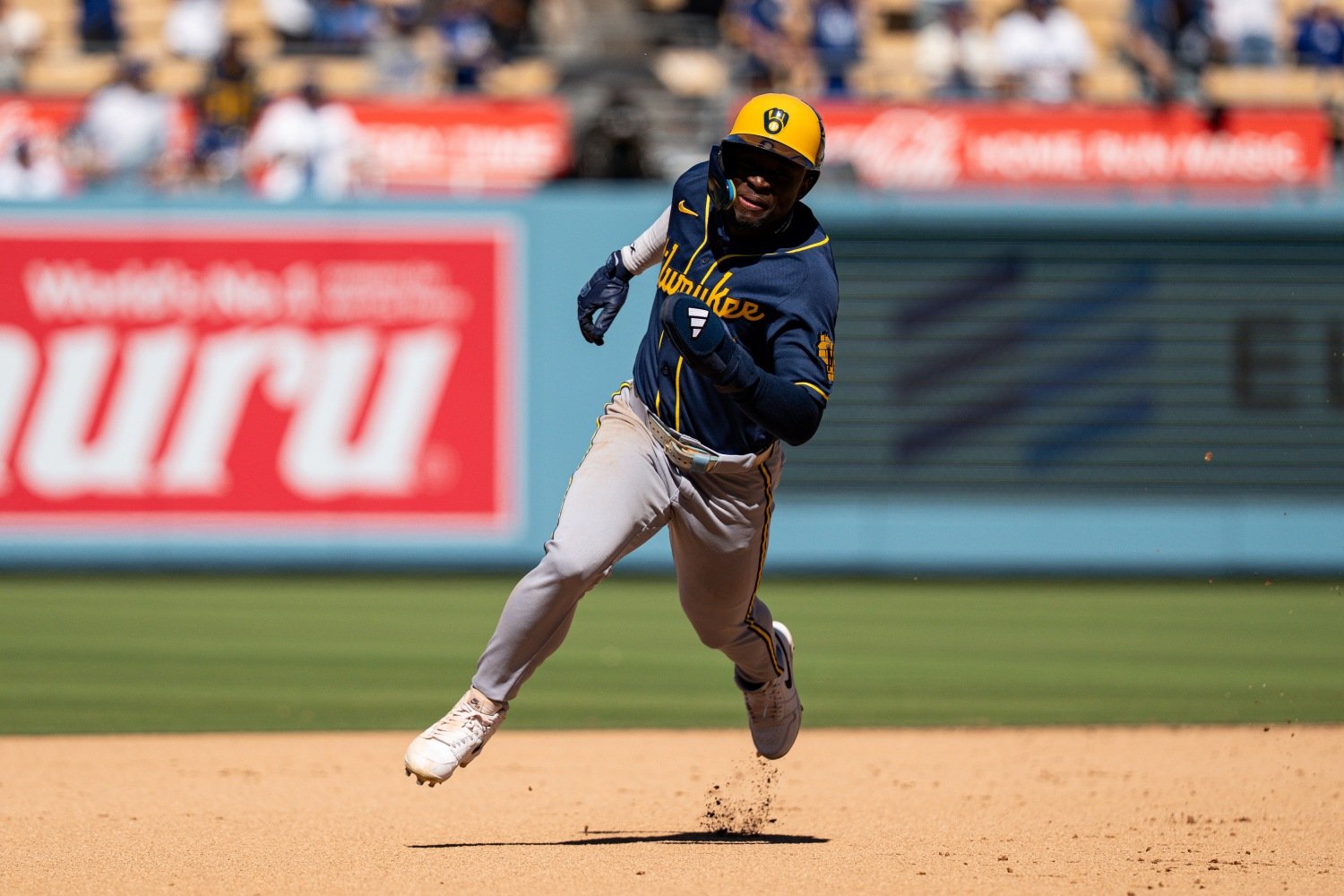 Earlier this season, I wrote about the way Cooper Pratt emerged from his shell after a few weeks in the major leagues. When he first got the call to the bigs, he maintained a very deep contact point and a patient approach. He didn't cut loose with his 'A' swing very often. He was there to provide steady defense at an important position and to be a low-ceiling, high-floor eighth or ninth batter on most days. Once he got to about 80 plate appearances, though, the Brewers allowed him to get more aggressive. This is a pattern you can watch unfold multiple times, as you sift through the slew of young players the team has promoted over the last few years. Joey Ortiz, Brice Turang, and Sal Frelick all went through similar apprenticeships, even after reaching the majors. Jackson Chourio's was a more chaotic first month or two, given that he was a 20-year-old rookie and one of the highest-ceiling prospects in team history, but the same essential principles applied. The Brewers believe a hitter needs time to learn how they'll be pitched in the majors, and what getting hits against that pitching requires. They want them to learn the situational aspects of hitting in that crucible, and to prioritize seeing the ball well and making good swing decisions. Once those hurdles are cleared, the team gives the player the green light to be their more assertive self. That process is still playing out with Luis Lara, even though he's come to bat 98 times since being recalled early last month. Lara is young, and he's small, and his calling card is defense, but that's not why the team has yet to take the training wheels off him. It's simpler than that. Lara is a switch-hitter, which means he's only come up 77 times as a lefty and 21 times as a righty. He's still earlier in that transitional phase than his raw numbers imply. Recently, that's put the player and the team in a tough spot. Frelick has been on the injured list. Christian Yelich is active, but he's clearly in decline. Turang has sputtered a bit and battled nagging injuries, and Pratt, Ortiz and David Hamilton have all been in and out of the lineup with injuries of varying severities. That's created a vacuum where the club's elite offensive production used to be. It would be great if Lara could step forward and fill a portion of it. As far as the Brewers are concerned, though, it's not worth asking their young outfielder to change what he's been doing since coming up. He's not yet having tremendous success, but his approach to date—that deep contact point, very little chase, very little swing-and-miss—fits the roadmap to success. One of the luxuries of being in control of your division, as the Brewers always seem to be, is the ability to keep telling a player like Lara to do what they've been doing—to stay dedicated to development. More than most good teams, the Brewers are willing to give up a run or a win now and then for the promise of a five-fold return on the investment two years later. Lara is in that place right now. That decision is made even easier right now, though, by the fact that Lara has two swings to maintain and two approaches to learn. With a cushion in the NL Central and the best record in the National League, the Crew have been able to eschew the potential to turn the youngster into a more dynamic (but more erratic) offensive presence. They're not ready, yet, to have him start attacking the ball more aggressively or changing what he's looking for. They want him to be the best version of himself next year and in 2028, and that means asking him not to risk too much in pursuit of being the best version of himself in 2026. Before the year is out, that will change. Lara will tap into a little more power and start contributing more to the lineup down the stretch. For now, though, despite the injuries and struggles afflicting the team, Milwaukee is still counseling their rookie to stay within himself and learn the ropes. They've earned the option to do so. Even if he never does fully click this season, they'll be ok—and they'll be better off next season, too, as they pursue what could be a fifth straight division crown.
 -
The Brewers Like Dustin May's Cutter a Lot, and With Good Reason
Matthew Trueblood posted an article in Brewers
 It's only been two starts, but the early returns suggest that the Brewers have a specific plan for Dustin May: throw your cutter more. No, more. No, even more than that. May, whom the team acquired just hours before the trade deadline on August 3, has allowed just 12 baserunners and three runs in 13 innings over his first two appearances for Milwaukee. The Crew prized him for the depth of his arsenal and his feel for moving the ball in all four directions, but while his best pitch (according to Baseball Prospectus's StuffPro) is his sweeper, it's the cutter the team has ratcheted up his usage of so far. As I often say, every pitcher is really two different creatures: one against same-handed batters and one against opposite-handed ones. For different reasons, the Brewers and May have elected to have him throw more cutters regardless of which type of batter he's facing, and the results speak for themselves. Let's drill down on their reasons for each change of gameplan. Against righties, May's exceptionally heavy sinker runs the show. During his stint with the Cardinals, however, he used that pitch to set up high four-seamers and sweepers that would run the opposite of the direction of his sinker. Since joining Milwaukee, the sinker has set the stage for the cutter, instead. It's a pitch May can keep on the plate and in the zone better, but as long as he executes each offering, the resulting contact is bound to be weak and harmless. Against lefties, the cutter was more prominent even while May pitched for St. Louis. His four-seamer and the cutter pair well to those batters. Since coming to Milwaukee, though, he's switched the roles of the two pitches. He's using the cutter as the primary offering, and then the four-seamer as the change of eye level. The Brewers do this more than almost any other team in the league: letting one of the more horizontal fastball shapes force hitters into a visual box, then throwing the four-seamer off that to make it harder to catch up to. The secret to both changes, though, is that May's cutter makes a better anchor pitch than most pitchers' do. Because of his size and extension, his relatively vanilla raw arm angle is more deceptive than the data initially suggests. That also changes what a hitter sees and expects out of his hand. According to Prospectus, batters are only likely to accurately identify the cutter 52.6% of the time. Meanwhile, the pitch his four-seamer and changeup are most frequently mistaken for is the cutter. May's ability to move the ball east and west, achieve depth on the breaking ball and find more carry on the four-seamer than most similar pitchers makes him an extremely high-upside addition to the starting rotation. His cutter is so firm (and his command of it to the glove-side edge of the plate is so good) that it sits neatly in the default position, allowing him to force both lefties and righties to cover a big strike zone and a wide variety of speeds and shapes by working off the cutter. Again, it's only been two starts. The matchups in his next two might dictate that May and whichever catcher is paired with him operate differently. So far, though, the returns on the Brewers' change to his pitch mix have been excellent. The team who most loves to attack with fastballs has a new hurler who thrives with three different flavors of fastball. It's a match made in heaven.
 -
Image courtesy of Jon Endow-Imagn Images It's only been two starts, but the early returns suggest that the Brewers have a specific plan for Dustin May: throw your cutter more. No, more. No, even more than that. May, whom the team acquired just hours before the trade deadline on August 3, has allowed just 12 baserunners and three runs in 13 innings over his first two appearances for Milwaukee. The Crew prized him for the depth of his arsenal and his feel for moving the ball in all four directions, but while his best pitch (according to Baseball Prospectus's StuffPro) is his sweeper, it's the cutter the team has ratcheted up his usage of so far. As I often say, every pitcher is really two different creatures: one against same-handed batters and one against opposite-handed ones. For different reasons, the Brewers and May have elected to have him throw more cutters regardless of which type of batter he's facing, and the results speak for themselves. Let's drill down on their reasons for each change of gameplan. Against righties, May's exceptionally heavy sinker runs the show. During his stint with the Cardinals, however, he used that pitch to set up high four-seamers and sweepers that would run the opposite of the direction of his sinker. Since joining Milwaukee, the sinker has set the stage for the cutter, instead. It's a pitch May can keep on the plate and in the zone better, but as long as he executes each offering, the resulting contact is bound to be weak and harmless. Against lefties, the cutter was more prominent even while May pitched for St. Louis. His four-seamer and the cutter pair well to those batters. Since coming to Milwaukee, though, he's switched the roles of the two pitches. He's using the cutter as the primary offering, and then the four-seamer as the change of eye level. The Brewers do this more than almost any other team in the league: letting one of the more horizontal fastball shapes force hitters into a visual box, then throwing the four-seamer off that to make it harder to catch up to. The secret to both changes, though, is that May's cutter makes a better anchor pitch than most pitchers' do. Because of his size and extension, his relatively vanilla raw arm angle is more deceptive than the data initially suggests. That also changes what a hitter sees and expects out of his hand. According to Prospectus, batters are only likely to accurately identify the cutter 52.6% of the time. Meanwhile, the pitch his four-seamer and changeup are most frequently mistaken for is the cutter. May's ability to move the ball east and west, achieve depth on the breaking ball and find more carry on the four-seamer than most similar pitchers makes him an extremely high-upside addition to the starting rotation. His cutter is so firm (and his command of it to the glove-side edge of the plate is so good) that it sits neatly in the default position, allowing him to force both lefties and righties to cover a big strike zone and a wide variety of speeds and shapes by working off the cutter. Again, it's only been two starts. The matchups in his next two might dictate that May and whichever catcher is paired with him operate differently. So far, though, the returns on the Brewers' change to his pitch mix have been excellent. The team who most loves to attack with fastballs has a new hurler who thrives with three different flavors of fastball. It's a match made in heaven. View full article
-
Could Brewers Issue Jake Bauers a Qualifying Offer This Fall?
Matthew Trueblood posted an article in Brewers
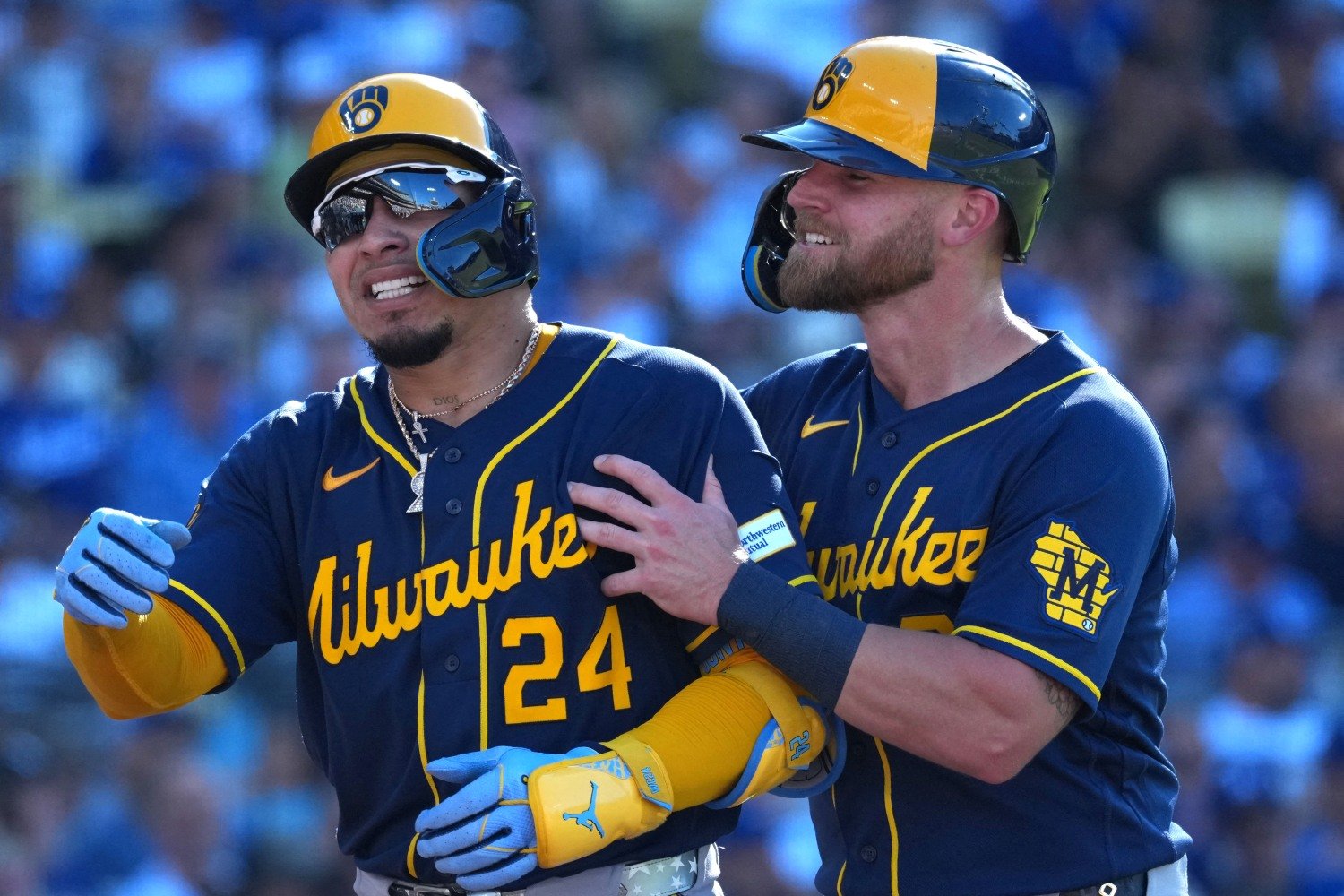 The Dodgers sent the best left-handed starting pitcher in baseball to the mound Sunday. For most of his career, Jake Bauers could plan on being on the bench on days like that. Instead, he was not only in the lineup, but on base all day, notching four hits in a convincing Brewers win. By the end of the contest, he was batting .275/.384/.500 for the season. He's already come to bat 448 times, hit 21 homers and drawn 65 walks, which are all career-highs. At age 30, he's hurtling toward a significant free-agent payday, just two years after being a castoff who had to limp back to the Brewers on a minor-league deal. Because Bauers has never been an in-demand free agent before, though, the Brewers will have one more chance to realize some value even when his contract expires at the end of this year's World Series. He's eligible to receive a qualifying offer, which is likely to be worth around $23 million for 2027. If the Brewers issue one (and if Bauers declines it), they could receive a significant draft pick as compensation when he signs elsewhere. It's rare that the Brewers elect to extend a qualifying offer to a departing free agent. Historically, they only do so with premium players whom they would earnestly love to keep, albeit only on terms the player is likely to exceed by shopping their services to the highest bidder. They issued QOs to Willy Adames after the 2024 campaign and to Brandon Woodruff last fall. Whenever there's a real question of whether to do so, though, they default to not doing it, because their budget makes a player earning that much a bit of a burden. For anyone other than a beloved cornerstone, it's hard to justify giving out over $20 million a year when the whole team will make less than $150 million. Bauers, then, will be an interesting test case. His production this season is as good or better than that of Pete Alonso last year, before he signed a lucrative five-year deal with the Orioles this winter—though Alonso didn't have the QO attached to him then, after having circled back to the Mets on a short-term deal with opt-outs included in the 2024-25 offseason when he did have that encumbrance. It's also better than that of Nick Castellanos, who signed a five-year deal with the Phillies after declining the Reds' QO in late 2021. Bauers is a better athlete than either Castellanos or Alonso, and isn't significantly older than they were when hitting free agency in those years. However, he doesn't have the same lengthy track record that both Alonso and Castellanos boasted at those times. From the player's perspective, this is a first (and likely only) chance to cash in at a high salary on a multi-year deal. Even if they produce the way Bauers has this year, few first basemen garner big offers or long-term commitments as they head toward their mid-30s. If the Brewers did extend Bauers a QO, he would face a dilemma. Taking the deal would probably mean eschewing a larger one. The Brewers, however, face their own dilemma. As much as they might trust and like Bauers, and as valuable as he has been this season, he'd have to be similarly brilliant next year to be worth $23 million in the context of their payroll. Should they gamble on either getting that great a return or having him turn down the offer, or should they simply wish him well and wave goodbye after the World Series? The big, lurking variable in that problem might be Andrew Vaughn—but not in the way you'd expect. Although his season has been rendered strange and frustrating by the broken hamate bone he suffered on Opening Day and Bauers usurping him in his absence, Vaughn is playing superbly again this year. He looks like a solid option at first base for 2027, should Bauers leave, and the Brewers do have one more year of club control over him. However, Vaughn is also making $7.65 million already this year, and despite the missed time, he figures to get near $10 million via arbitration if the team doesn't first trade or non-tender him in the second half of November. In Vaughn and Bauers, Milwaukee has two players who profile as great first basemen for 2027. Either would be an expensive solution, though, and keeping both probably isn't an option. That, oddly, frees the team up in its decision-making, because Bauers will hit free agency just after the World Series and they'll have to decide about the QO within days. Bauers himself will then have to decide whether to accept the offer over the ensuring fortnight, and all of that has to happen before the decision point comes on Vaughn's arbitration eligibility. The Brewers can (and should, barring some development between now and then that alters the state of play) extend a QO to Bauers, and then wait to see whether he accepts it or not. If he does, they can save whatever money they need to save by trading or non-tendering Vaughn. If he rejects the offer, they'll be in position to gain a draft pick when he signs elsewhere, and they can simply keep Vaughn. This fall will bring one last wave of value rippling out for the team, from the great achievements that were their trade for Vaughn and their work to help Bauers blossom this way. They just need the courage to extend the offer to Bauers, in order to redeem that final voucher.
 -
Image courtesy of Kirby Lee-Imagn Images The Dodgers sent the best left-handed starting pitcher in baseball to the mound Sunday. For most of his career, Jake Bauers could plan on being on the bench on days like that. Instead, he was not only in the lineup, but on base all day, notching four hits in a convincing Brewers win. By the end of the contest, he was batting .275/.384/.500 for the season. He's already come to bat 448 times, hit 21 homers and drawn 65 walks, which are all career-highs. At age 30, he's hurtling toward a significant free-agent payday, just two years after being a castoff who had to limp back to the Brewers on a minor-league deal. Because Bauers has never been an in-demand free agent before, though, the Brewers will have one more chance to realize some value even when his contract expires at the end of this year's World Series. He's eligible to receive a qualifying offer, which is likely to be worth around $23 million for 2027. If the Brewers issue one (and if Bauers declines it), they could receive a significant draft pick as compensation when he signs elsewhere. It's rare that the Brewers elect to extend a qualifying offer to a departing free agent. Historically, they only do so with premium players whom they would earnestly love to keep, albeit only on terms the player is likely to exceed by shopping their services to the highest bidder. They issued QOs to Willy Adames after the 2024 campaign and to Brandon Woodruff last fall. Whenever there's a real question of whether to do so, though, they default to not doing it, because their budget makes a player earning that much a bit of a burden. For anyone other than a beloved cornerstone, it's hard to justify giving out over $20 million a year when the whole team will make less than $150 million. Bauers, then, will be an interesting test case. His production this season is as good or better than that of Pete Alonso last year, before he signed a lucrative five-year deal with the Orioles this winter—though Alonso didn't have the QO attached to him then, after having circled back to the Mets on a short-term deal with opt-outs included in the 2024-25 offseason when he did have that encumbrance. It's also better than that of Nick Castellanos, who signed a five-year deal with the Phillies after declining the Reds' QO in late 2021. Bauers is a better athlete than either Castellanos or Alonso, and isn't significantly older than they were when hitting free agency in those years. However, he doesn't have the same lengthy track record that both Alonso and Castellanos boasted at those times. From the player's perspective, this is a first (and likely only) chance to cash in at a high salary on a multi-year deal. Even if they produce the way Bauers has this year, few first basemen garner big offers or long-term commitments as they head toward their mid-30s. If the Brewers did extend Bauers a QO, he would face a dilemma. Taking the deal would probably mean eschewing a larger one. The Brewers, however, face their own dilemma. As much as they might trust and like Bauers, and as valuable as he has been this season, he'd have to be similarly brilliant next year to be worth $23 million in the context of their payroll. Should they gamble on either getting that great a return or having him turn down the offer, or should they simply wish him well and wave goodbye after the World Series? The big, lurking variable in that problem might be Andrew Vaughn—but not in the way you'd expect. Although his season has been rendered strange and frustrating by the broken hamate bone he suffered on Opening Day and Bauers usurping him in his absence, Vaughn is playing superbly again this year. He looks like a solid option at first base for 2027, should Bauers leave, and the Brewers do have one more year of club control over him. However, Vaughn is also making $7.65 million already this year, and despite the missed time, he figures to get near $10 million via arbitration if the team doesn't first trade or non-tender him in the second half of November. In Vaughn and Bauers, Milwaukee has two players who profile as great first basemen for 2027. Either would be an expensive solution, though, and keeping both probably isn't an option. That, oddly, frees the team up in its decision-making, because Bauers will hit free agency just after the World Series and they'll have to decide about the QO within days. Bauers himself will then have to decide whether to accept the offer over the ensuring fortnight, and all of that has to happen before the decision point comes on Vaughn's arbitration eligibility. The Brewers can (and should, barring some development between now and then that alters the state of play) extend a QO to Bauers, and then wait to see whether he accepts it or not. If he does, they can save whatever money they need to save by trading or non-tendering Vaughn. If he rejects the offer, they'll be in position to gain a draft pick when he signs elsewhere, and they can simply keep Vaughn. This fall will bring one last wave of value rippling out for the team, from the great achievements that were their trade for Vaughn and their work to help Bauers blossom this way. They just need the courage to extend the offer to Bauers, in order to redeem that final voucher. View full article
-
Image courtesy of Jayne Kamin-Oncea-Imagn Images Where did that damn magic go? The Brewers—these Pat Murphy Brewers, who are some extension of the Craig Counsell version that emerged almost a decade ago but are a different thing, too; who are transcending what that team was and maybe what baseball teams themselves are—are supposed to have a durable magic that makes them unique. They hit with runners in scoring position. They string together gritty at-bats and line drives and bloopers. They drive you insane as they drive you, slowly, into the dirt. They beat you with timely hitting that no other team can produce as consistently. But suddenly, they couldn't produce it, either. The sweep in San Diego laid that bare. The Crew had 28 at-bats with runners in scoring position over three games, and collected just three hits. That's not even the half of it, though. It's been weeks of this: living life as a normal team. It sucks. It's hard. And it's been eroding their cushion in the NL Central. This team that has frequently felt like an exception to baseball's rigid rules of regression and sequencing and old-fashioned luck has been mortal, lately. Too many damn fastballs. It's the perpetual lament of Jack Stern and the bane of so many Brewers' fans existence. This team throws too many damn fastballs. They do it for good reasons. They're not bucking the prevailing trends of an ever-smarter league out of unbridled hubris. Still, it's a strategy that comes with costs, and sometimes, those costs are maddening. Sometimes, those costs feel avoidable and massive and far greater than the benefits. In the bottom of the sixth inning Thursday night, Antonio Senzatela and William Contreras decided to throw too many damn fastballs. Senzatela's cutter is about 5 MPH slower than his true heaters, a sinker and a four-seamer, and it works a bit like a slider. Throwing his cutter to Max Muncy wasn't such a terrible idea. But Contreras felt the pull back to the fastballs he loves to call, and he obeyed that pull too readily. When the cutter didn't go quite where Senzatela wanted it to, he tried to help his pitcher power his way out of trouble. A sixth straight hard pitch was plenty for Muncy. He got on time and launched a scoreboard-flipping three-run home run. It was too many damn fastballs, is all. A bad loss—a very, very bad loss. Another one. That's what this game was sure to be. After three losses in San Diego, this was going to be a fourth in a row. This team has kept winning, even while rendered mortal by their sudden lack of runners-in-scoring-position magic and even while throwing too many damn fastballs, but now, they're not winning. And those pesky Cubs won't stop coming. They lost Thursday in Washington, but they've been winning too much lately; they're closing the gap. This wouldn't just be any other bad loss. It would be one more lost opportunity for a much-needed turnaround win. Contreras was right back in the center of the frame. He's looking like the goat, even on a team that hasn't lost anything important and doesn't have to cast blame anywhere at the moment. The Dodgers' first run scored when Contreras tried to sweep a tag down on an incoming runner faster than the play required, and left the ball behind. Their other three scored when he wouldn't stop calling fastballs. And when he came up to lead off the ninth inning against Edwin Díaz, he did everything wrong. Of the three competitive pitches Díaz threw him, he swung at the one outside the zone and stared at the two that caught it. One up, one down. And then: magic. It all came rushing back, and, funny thing: it happened because Díaz threw too many damn fastballs. First, Joey Ortiz got one on the inner third and hit a line-drive single. It was just a spark, but you can't have fires without those. Next came David Hamilton, whom Díaz had right where he wanted him after he got a swing on a slider slicing in toward Hamilton's legs to get ahead 1-2. He tried another slider, but it was a bit less tempting, and Hamilton laid off. On the ensuing 2-2 offering, he went back to the fastball, and made another mistake. Another line drive; another single. A bit of real heat, now. Jackson Chourio has begun to show that locked-in understanding of the strike zone that was missing before. If he can hold onto that skill, he's headed for superstardom, after all. He didn't come up with a game-breaking long hit against Díaz, but he put together a great, gritty at-bat. Poor Díaz. He made mistakes to Ortiz and to Hamilton, but you're supposed to be able to get away with those against those guys. He executed superbly against Contreras, and other than missing the outside edge with a fastball on the fourth pitch, he executed everything against Chourio. Still, reaching out to protect the plate with two strikes, Chourio flipped a bloop single into right field, spoiling an out pitch of a slider. This is how the Brewers drive you crazy. Suddenly, the Brewers just needed one more hit to tie to the game. They just needed one more player to take a perfectly good pitch and ruin it. Garrett Mitchell did just that. Díaz hit the inside edge with a first-pitch fastball, but Mitchell knew that that would beget a biting slider headed down and in off the same plane on the next pitch. He got it, and he hit another line drive. Simple, but magical. It was time to get greedy. How back was the magic? Could the Crew actually take the lead? Dave Roberts tried to stop the bleeding by going to Alex Vesia and putting Jake Bauers in a left-on-left matchup. Maybe if Vesia had stuck to his own fastball, that would have worked. Unfortunately for the Dodgers, after getting ahead with two fastballs up and away, he got worried that Bauers would adjust and cover that pitch. He tried to get him out with a slider down. In fairness to Vesia, Bauers didn't hit a line drive. He didn't even dunk a blooper into the outfield. He hit the ball pretty much straight into the ground, but lo, it snuck through. Magic, made of line drives and bloopers. A few too many fastballs, but from the opponents this time. And after Trevor Megill slammed the door shut, Thursday night turned out to be a good win—a very, very good win. Another one. Every time you think what has made the Brewers unique is starting to falter, they flip the switch back on. Every time you think they might let up too much and get caught by the onrushing Cubs, they snatch an unexpected victory away in their last at-bat. Their resiliency might be their real magic, and unlike sequencing or batted-ball luck, it might be something they can sustain for a few more years. View full article

