-
Posts
154 -
Joined
-
Last visited
Content Type
Profiles
Forums
Blogs
Events
News
2026 Milwaukee Brewers Top Prospects Ranking
Milwaukee Brewers Videos
2022 Milwaukee Brewers Draft Picks
Milwaukee Brewers Free Agent & Trade Rumors, Notes, & Tidbits
Guides & Resources
2023 Milwaukee Brewers Draft Picks
2024 Milwaukee Brewers Draft Picks
The Milwaukee Brewers Players Project
2025 Milwaukee Brewers Draft Pick Tracker
Store
Downloads
Gallery
Everything posted by Stealofhome
-
That's what I was thinking, too. Perhaps there's a way to add in points for distances over 450 feet which would make a balance between hitting a lot and hitting a few very long. Or perhaps only count HR over a certain distance. Something like that could incentivize the longer home runs.
-
Then-Brewers AAA player Joey Meyer hit the longest verified HR in professional baseball history at 582 feet in 1987. An interesting story about it this year here. Christian Yelich has the longest for the Brewers in the Statcast era, also in Denver, at 499 feet. https://baseballsavant.mlb.com/sporty-videos?playId=0a69f2b8-97b9-43b2-80fc-7cce53f49a06
-
This is month-old news, but an interesting scenario with Thyago Vieira tipping pitches for the D-Backs, so his manager had him balk on purpose to move the runner over. https://www.mlb.com/dbacks/news/thyago-vieira-balks-on-purpose-in-d-backs-loss-to-white-sox From watching the video, it looks like Maldanado takes a few steps in toward the batter on offspeed pitches.
-
Is it possible to save blogs as drafts?
Stealofhome replied to Stealofhome's topic in Brewer Fanatic Issues & Suggestions
Yep, looks like that works. I added a test draft and it shows up as unpublished on my blog page, but I don't see it anywhere else. The Publish Time option goes away when that is toggled off. Thanks! -
Isolated Slugging, Exit Velocity, and Bat Speed
Stealofhome posted a blog entry in Breakdowns around the Bubbler
Introduce ISO Last time, I looked at how well a basic calculation like Speed Unit can compare to an in-depth statistic like Ultimate Base Running. It turns out that it does pretty well. How about bat speed and exit velocity? I have been told that Isolated Slugging is a is a crude measure of ball speed, but that was before Statcast was around. Isolated slugging is calculated as (2B + 2x3B + 3xHR)/AB, or SLG - AVG. Is that true? How about some other hitting statistics? How well can we estimate a hitter's bat speed or exit velocity based solely on basic hitting stats? This becomes an important exercise when we want to look at data during times and places when bat speed and exit velocity are not available. Baseball Savant makes it pretty easy to compare the yearly values of many of these statistics. I encourage you to follow this link to an interactive scatter plot and check out some of the correlations yourself. ISO and Exit Velocity Here's the first one I was most interested in. These are all individual player seasons and we can see a 0.36 correlation coefficient for the 1392 qualified player seasons since 2015. That means ISO accounts for just 36% of the variation in average exit velocity for a batter -- a crude measure indeed. But better than nothing, and there is a clear trend. But we can also look at the career values for the players during the Statcast era as well. That is actually a much stronger correlation. Clearly there is some seasonal variability, even in average exit velocity for batters. There are some speedsters down on the bottom left (Billy Hamilton, Dee Strange-Gordon, Billy Burns, and Victor Robles) and some of the game's top hitters in the top right (Shohei Ohtani, Aaron Judge, David Ortiz, and Mike Trout). Oneil Cruz stands out as having a lower ISO than expected based on his average exit velocity, and I'm not really sure what is happening with him. It doesn't appear that he is hitting a lot of ground balls, so perhaps he is just hitting the ball hard right at the fielders. I'll leave that as an exercise for the curious Pirates fan. William Contreras is the Brewer the farthest away from the average line. His ISO of 0.159 would predict an exit velocity of 88.5, but his actual exit velocity is 91.7. We might expect his slugging to increase a bit based on this. Barrels But exit velocity is not the end-all, be all. Some players track their "Barrels." Those are batted balls with the perfect combination of exit velocity and launch angle. This is Aaron Judge's realm, where he leads all players by nearly 5% over the last 9 years. This is actually an even better correlation. It makes sense--the better you strike the ball, the more likely you are to hit doubles, triples, and home runs. Bat Speed How does this compare to the newer statistic that we have in 2024 of bat speed? Exit velocity and bat speed are correlated to each other, but not perfectly. For instance, Christopher Morel is 6th in qualified hitters in bat speed this year at 76.3 mph, but his average exit velocity is 69th at 89.6. For the Brewers, Joey Ortiz stick out as someone whose average exit velocity would be expected to be higher based on his bat speed. His 74.4 mph, 46th-ranked bat speed doesn't align with his 204th ranked exit velocity of 87.9 mph. Despite swinging 8 mph harder than Turang, he produces almost the same exit velo. So far, ISO doesn't correlate very strongly to pure Bat Speed, but we do only have part of a year's worth of data. We've already seen the increase in quality from a full year to multiple year's worth of ISO and exit velocity. But ISO, Exit Velocity, Barrel%, and Bat Speed are not the only things we can compare. Bat Speed has even less of a correlation with wOBA than ISO, at 0.12 so far for qualified batters. Luis Arraez and Steven Kwan prove that a batter doesn't have to swing hard to be productive, and Brice Turang is looking to build his own career using a similar strategy. Historical Brewers I'll close this like the previous article, by looking at some of the top historical Brewers seasons for isolated slugging. These are players with the highest consistent exit velocities and highest barrel rates. But these values are not simply taken as the raw isolated slugging percentage. These values are calculated as a z-score, using the average and standard deviation of the league's ISO that year. Ryan Braun shows up twice, in 2007 and 2012, but not in his 2011 MVP year. Christian Yelich appears in 2019, but not his MVP season of 2018 (though he should have won that year anyway). Onto the minor league leaders: A rookie Rock shows up again, as he did for the abbreviated 1970's Speed Unit table. Finally, the top 5 per decade for both the Major and Minor Leagues:- 2 comments
-
- 1
-
-
- william contreras
- joey ortiz
- (and 4 more)
-
Is it possible to save blogs as drafts?
Stealofhome replied to Stealofhome's topic in Brewer Fanatic Issues & Suggestions
Yes I do. So can you toggle off the publish and then submit to effectively create a draft? I wasn't sure if that's what happened and didn't want to post something accidentally. -
I was particularly concerned when Chris Hook came out for a mound visit and then Freddy immediately gave up a double on the second pitch. Then Chris Hook said "that's why I wanted a fastball." Rock was on it all night that the Nationals were sitting on the slider. So Freddy, and William trying to be leaders in the clubhouse, are willingly disregarding the coach's instruction? It just seemed like a bad moment.
-
The Brewers are Fast but not Aggressive
Stealofhome posted a blog entry in Breakdowns around the Bubbler
Full disclosure: I'm not sure I have any real conclusions on this topic, I just had some analysis I wanted to share and virtually "think out loud." Raw data from Baseball Savant: Yearly Baserunning Value Total Baserunning Value Baserunning Value The Brewers have built an impressive and speedy roster, led by Garrett Mitchell, Jackson Chourio, Blake Perkins, and Brice Turang -- all with a sprint speed of over 29 feet per second. That value is calculated by Baseball Savant as: 29 feet per second would equate to an 11.3 second 100 meter time (not quite Olympic material), 19.8 mph, and a 4.14 40-yard dash (better than any recorded in NFL history). Of course, those times are not perfectly equal, since the difference between one and four seconds is an eternity in the world of sprinting, but it does put things in perspective. Along with raw sprint speed, Baseball Savant also calculates the run value for each base running opportunity: More on the stats at Tom Tango's site. Christian Yelich Christian Yelich is the Brewers' poster boy for creating runs on the base paths, with the 4th-most runner runs in MLB since 2016, behind Trea Turner, Kevin Kiermaier, and Billy Hamilton. He has done this, despite having a slower sprint speed than many others who have provided similar amounts of damage on the bases. Clearly, he is a smart and efficient runner. But much of the running value that he has provided is due to the fact that he is such a good hitter. He has a lot more opportunities to add value because he is on base more often than many others with similar speed profiles. If we look at the running value added per opportunity, his standing slips a bit. Since 2016, Yelich's sprint speed has ranged from 28.1 to 28.9 ft/sec, with a median of 28.4. If we look at the runners with a similar sprint speed, we find players like Brett Gardner and Ozzie Albies who have about the same sprint speed but are more aggressive than Yelich. Albies is an interesting comparison -- he has 75% fewer at-bats than Yelich, but is worth just 87% fewer baserunning runs. The difference seems to be in the value under runs lost on the basepath due to holding. That is, Yelich will not risk taking the extra base often enough. When compared to all other runners near his same speed over the past 8 years, Yelich has an average attempt rate. He attempts taking the extra base 40% of the time and runners with similar speed advance 39% of the time. Baseball Savant will take you right to the video of the plays where Yelich should have gone for the extra base and there are a few similarities. The highest run value lost of his holds is only -0.24 and is a misplay by a deep second basemen. But Yelich wasn't running hard enough out of the box to take advantage of it. (Not sure how to or if I can embed all of these videos, so they're left as links). https://baseballsavant.mlb.com/sporty-videos?playId=c4b987d2-c773-4fb6-854a-bced6446f78f There are other plays similar to this: https://baseballsavant.mlb.com/sporty-videos?playId=17811a50-aa96-401a-bc75-f3fa09a095f8 Looks like he is jogging out of the box, thinking it was a home run or an out. https://baseballsavant.mlb.com/sporty-videos?playId=a0aa8650-6d9d-4ee1-af05-d5c489da2cd9 Up by 8 in the game, so might have not been as aggressive, but didn't read the line drive properly to fall in. https://baseballsavant.mlb.com/sporty-videos?playId=8d4f2379-f72f-453c-9a4a-35a854f76046 Didn't read the fly ball well enough to know that it would fall. https://baseballsavant.mlb.com/sporty-videos?playId=5c068b59-4f5b-47a2-9a51-3753b60a7ff5 Didn't read the fly ball to score on one over the fielder's head. So it appears that Yelich will sometimes misjudge where the ball is hit, either on his own or other people's fly balls. There aren't a lot of egregious errors, but just so many of them that they add up. Brewers But I also wondered if the reduced aggression on the bases is something the team implements. It's hard to say that since they are currently 2nd in steals in all of MLB, but that is to be expected because of their team speed. Baseball Savant gives a statistic that shows how often the baserunner attempted to advance in comparison to the average runner. But that doesn't tell the whole story, since a faster baserunner is more likely to advance. So how do the Brewers compare to other runners with similar speed in the same situation? It does appear that all of the Brewers speedy runners are less aggressive than their counterparts when it comes to taking the extra base. Everyone, except for Blake Perkins. And his smart baserunning has led to an impressive amount of value on the bases for how few opportunities he has had. He would be worth nearly one run more if he hadn't run into an absolute perfect throw from Fernando Tatis Jr. https://baseballsavant.mlb.com/sporty-videos?playId=e99b100b-0f86-4232-a3cb-69a0cfcb8e8b Perhaps Jackson Chourio, Brice Turang, Sal Frelick, and even Christian Yelich could tweak their aggressiveness up 3-5% and add even more value stealing another 90 feet? But how is their aggression or passivity affecting them in terms of runs on the basepaths? Well that's where it's interesting and I'm not entirely sure how to parse this into a conclusion. If we take their running value and divide by opportunities to advance, we see some interesting trends. Blake Perkins is clearly very aggressive, but only average in comparison to runs per opportunity, though that is skewed by one good play from Tatis. But Jackson Chourio is very passive and also average in runs per opportunity. Brice Turang and Joey Ortiz are substantially below league average for their speed in terms of runs of advancing on the bases for the chances they get. But if we look at their runs of advancement when they try to go, now they are a little closer to league average at their speed. Both Turang and Ortiz come a bit closer to the average. So perhaps Ortiz, Turang, and Chourio can gain some lessons from Yelich on how to read balls a little better and take an extra base here and there. Perhaps Hoskins, Bauers, and Contreras can be a little more aggressive. The Brewers are currently ranked 8th in MLB for baserunning runs, oddly enough much of those coming from being too aggressive. They have four plays at the plate where they were thrown out, along with five more plays that lost at least -0.74 estimated runs. It appears that they could be more aggressive based on their speed, but have lost more runs than nearly any other team because of being too aggressive. If nothing else, it is an interesting jumping off point to discuss how the team has approached baserunning this year. -
Sixto Lezcano walks off the Cubs to win the Brewers 1980 home opener. 1e70c372-211900b9-6c496a42-csvm-diamondx64-asset_1280x720_59_4000K.mp4
-
Ryan Braun's 6th hit of the night wins the game for the Brewers in the bottom of the 18th inning. ee9cac84-842dd06c-19b7b47d-csvm-diamondx64-asset_1280x720_59_4000K.mp4
-
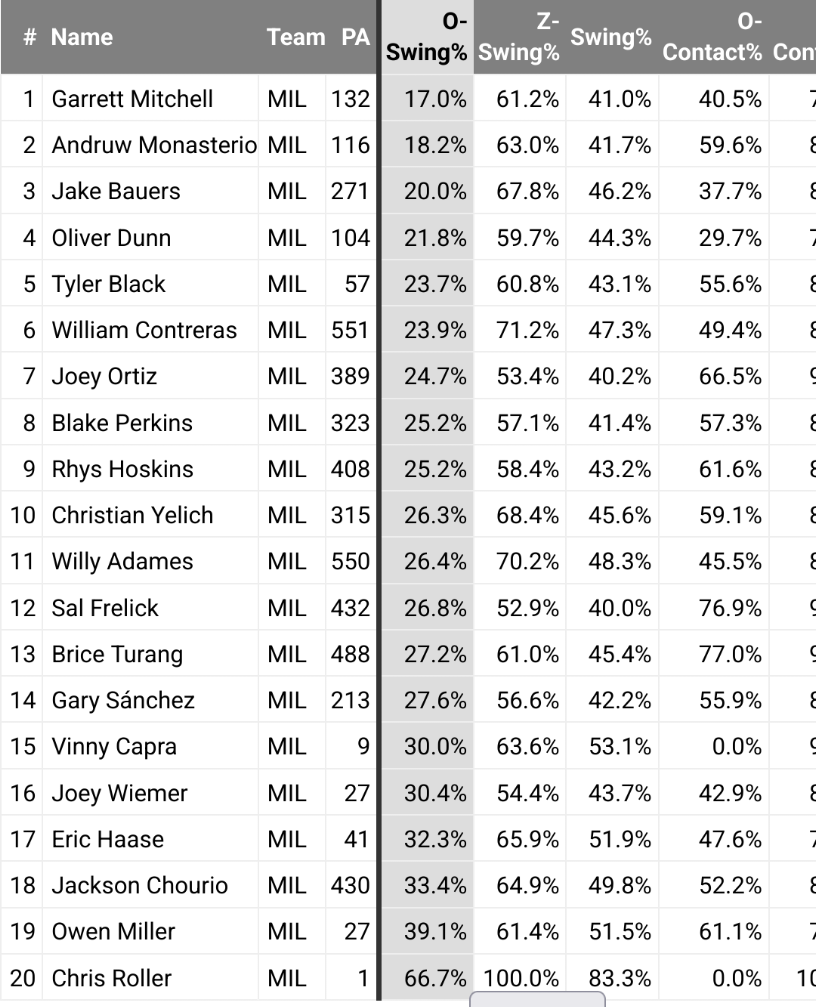
Wiemer always seems like he's surprised that pitchers can throw breaking balls. I remember a particular PA against Max Scherzer last year where he just toyed with him by throwing breaking balls - slider, change, slider, slider, fastball, curveball. It's like he's never expecting the pitch that will be thrown, like he needs to learn more about how pitchers sequence and approach him.
- 5 replies
-
- alexander cornielle
- manuel rodriguez
-
(and 3 more)
Tagged with:
-
Brewers (Civale) vs Dodgers (Glasnow): 7/5/24, 9:10pm
Stealofhome replied to Brock Beauchamp's topic in Archived Game Threads
Umpscorecards keeps track of this and according to them, the Brewers have lost 8 runs of favor this year, third worst in MLB, might also be hurt by Contreras' poor framing this year. -
Introductions All Around
Stealofhome commented on Stealofhome's blog entry in Breakdowns around the Bubbler
Thanks for the kind words--my advice is just to keep writing in whatever community section that allows you to submit and eventually someone will give you a shot. I'm jealous of your T-Mobile membership. I have to *gulp* pay for it every year! (The MLBPA discount helps, as well as the money I save on Mint Mobile). -
With all the discussion about Chris Capuano's gem against the Rockies this week, a highlight from his career. I couldn't find a video of his home run, so this is the best video of him batting: https://www.mlb.com/video/chris-capuano-walks?q=PlayId %3D "de112c0c-afff-4ed7-8c92-0a2012f9af99"&cp=CMS_FIRST&p=0 His last pitch resulted in a caught stealing: https://www.mlb.com/video/mallex-smith-caught-stealing-2nd-base-catcher-jonathan-lucroy-to-shortstop-jonathan-villar?q=PlayId %3D "b4e09752-ea78-4d45-bd85-702e759182cc"&cp=CMS_FIRST&p=0
-
After reading @TheIrrelevantWriter's introductory blog, I thought I would follow suit. My name is Chris and I'm currently living in New Mexico but grew up in southeastern Wisconsin. I was the only person in my family who was really interested in sports but somehow quickly became obsessed with baseball. I'd listen to the mid/late 90's games on WTMJ with Uecker and Jim Powell and collect the Brewers' cards from the local police officers. I only attended one or two Brewers games growing up and went to a handful more of Timber Rattlers games (cheaper tickets, probably). But somehow, I became obsessed with Roger Clemens and instead of following the local team, I was a Red Sox, Blue Jays, Yankees, and Astros fan. As such, and along with the Timber Rattlers being a Mariners affiliate at the time, my Brewer fandom was never very firmly entrenched. Then I moved to New Mexico and eventually discovered some of the new baseball stats that were becoming more popular, thanks to The Book by Tom Tango/MLG, and websites such as Fangraphs and Baseball Prospectus. I started to get more involved with the internet sabermetrics crowd on Twitter and eventually started writing some articles myself. That eventually took me to a Tampa Bay Rays blog, which opened the door to my Rays' fandom. After that, I started submitting articles to Fangraphs Community and Beyond the Box Score, the latter of which brought me on as a writer. That opened the door to a position at Baseball Prospectus, an article on ESPN, and a chapter in the 2015 Hardball Times Annual. Eventually that part of life was over and I hung up the keyboard for quite some time. With the advent of MLB.TV, having been more of a general baseball fan, I've been able to rekindle my Brewers fandom, which has been especially easy with their consistent competitive nature and "David beating Goliath" story line ever year. I eventually stumbled on this little corner of the internet and have appreciated both the analysis and the relationships that some have built with the actual organization. Having a beat writer with media access to the team and prospect writers who can talk to the players, along with a sense of community and willingness to discuss more than just surface metrics is just the place for me. I'm glad to be here and hope to help contribute to the discussion moving forward!
-
Allow me to introduce myself..
Stealofhome commented on TheIrrelevantWriter's blog entry in Irrelevant Writer
Awesome, I had a couple buddies go into the Army out of high school. Thank you for your service to the country and happy 4th of July! -
Allow me to introduce myself..
Stealofhome commented on TheIrrelevantWriter's blog entry in Irrelevant Writer
Thanks for introducing yourself - which branch did you serve in?