



Matt Breen
-
Posts
9,112 -
Joined
-
Last visited
-
Days Won
1
Content Type
Profiles
Forums
Blogs
Events
News
2026 Milwaukee Brewers Top Prospects Ranking
Milwaukee Brewers Videos
2022 Milwaukee Brewers Draft Picks
Milwaukee Brewers Free Agent & Trade Rumors, Notes, & Tidbits
Guides & Resources
2023 Milwaukee Brewers Draft Picks
2024 Milwaukee Brewers Draft Picks
The Milwaukee Brewers Players Project
2025 Milwaukee Brewers Draft Pick Tracker
2026 Milwaukee Brewers Draft Tracker: Picks & Bonuses
Store
Downloads
Gallery
Everything posted by Matt Breen
-
Canha to Detroit.... RHP Blake Holub to Brewers
Matt Breen replied to Jastro's topic in Milwaukee Brewers Talk
I think Canha would have been a nice 1B and/or DH for this club in 2024, but I understand the move. The team probably wants a 'power' bat at 1B/DH - and Canha was not that. He's a guy who will likely hit a dozen HRs and have a .250-.260 BA, and take a nice share of walks. That's not real sexy - especially for a guy at that position. I'm guessing we bring back Santana on a one-year deal for around $6-7m. Just a guess. -
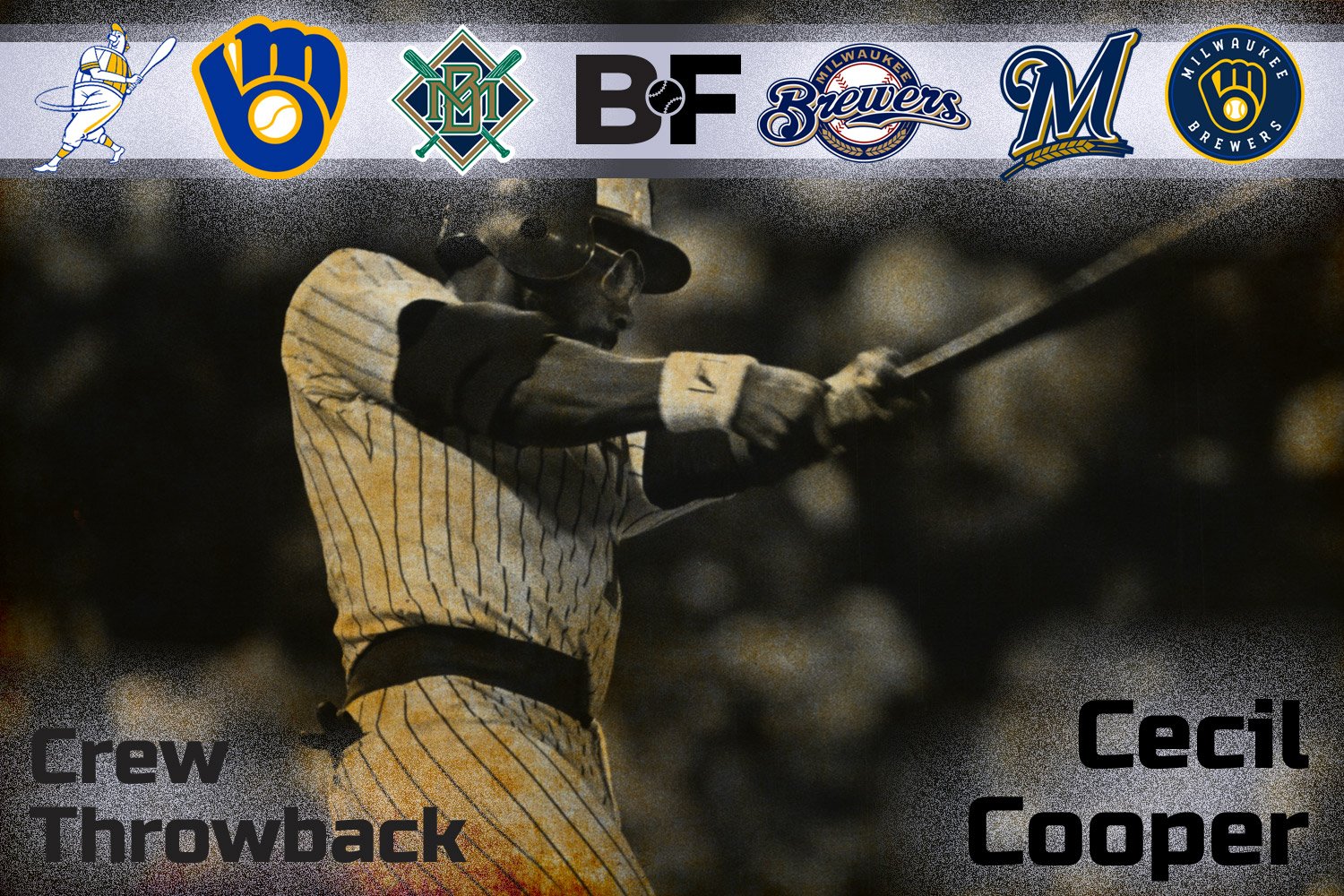 Cecil Celester Cooper was born in Brenham, Texas, on December 20, 1949. He was the youngest of 13 children. His father may have played in the Negro Leagues - but that story is a little murky. Cecil’s older brothers were accomplished baseball players - two of whom played for the barnstorming Indianapolis Clowns. One of his brothers - Sylvester - once caught Satchel Paige. The tall, lanky, left-handed hitting Cecil Cooper was drafted by the Boston Red Sox in the 6th round of the 1968 draft. And it was quickly apparent that Cecil Cooper could hit the ball. His minor league stops include batting averages of .336, .354, .379, and .452 (yes, .452, albeit on only 84 at-bats). His career minor league batting average was .327. Cooper made his major league debut in September of 1971 at 21. However, Cooper had a few obstacles breaking into the Red Sox lineup. Defensively, he struggled - limiting him to first base and designated hitter. The Sox moved an aging Carl Yastrzemski to first in 1973 and already had Orlando Cepeda at DH. Also, while Cooper hit for average, he didn’t have much power. He finally got a chance to stick with the Red Sox in 1974, getting 400+ at-bats and hitting a solid .275 with eight home runs. For the next two years, Cooper played semi-regularly - and continued to show modest - but emerging - power and high batting averages. He appeared primed to break out as a full-time player. And then, in December of 1976, Boston traded away Cooper to Milwaukee - bringing back their former first baseman (the slugging George Scott) along with outfielder Bernie Carbo. The trade was not popular with either club. And while Scott had a monster in 1977, Cooper became a legend in Milwaukee. Cooper hit .300 or better for seven straight years and averaged 20+ home runs. His stance closely mimicked that of the great Rod Carew, allowing him to become an excellent hitter to the opposite field. He even snagged a pair of Gold Gloves during that time. Cooper’s finest season was in 1980 when he hit a whopping .352 and led the majors in total bases and RBIs. He was a key cog in the great Brewer clubs of the era, rivaling Yount and Molitor. If Cooper had any chinks in his armor, it was his free-swinging approach at the plate. He just didn’t walk very often. But that is a minor ding when you are hitting .300+. As Cooper aged, his power faded - and eventually, his batting average. In 1985, at 35, he hit .293 with 16 home runs. The following season - his last full-time player - his numbers dropped to .258 and a dozen HRs. The Crew ran Cooper out for one more season, but his numbers only worsened. By mid-season, he was let go. No one wanted an aging first baseman with a fading bat - and thus, his career was over. Most men would die for Cecil Cooper’s career as a player: 2,192 hits, 248 HRs, and a .298 average. He appeared in five All-Star games, won two Gold Gloves, finished in the top 5 in MVP votes three times, and was a key World Series team member in 1982. Cooper’s stats are even more impressive when you consider he never really achieved full-time playing status until he arrived in Milwaukee. As a Brewer, he ranks at the top of many of the club’s hitting categories. He is 4th in bWAR, 3rd in batting average (.302), 5th in games played (1490), 6th in HRs (201) - the list goes on and on. His single-season average of .352 in 1980 is the team’s second-best, just behind Paul Molitor’s .353 in 1987. His ability and longevity place him in the top 10 of most Brewer records. The other impressive thing about Cooper was his contributions off the field. He was heavily involved in charity and community efforts. In 1983, he was awarded baseball’s coveted Roberto Clemente Award for humanitarian and community service. After his playing career was over, Cooper spent some time as an agent, then in 1996, joined the Brewers as farm director. He then turned to coaching - becoming Milwaukee’s bench coach in 2002. After a stint managing in the minors and another year as a bench coach in Houston, he was named the Astros manager, serving in that capacity from 2007-2009. He had middling success as a manager and was let go at the end of the 2009 season. After that, he retired. Cooper was inducted into the Brewer Walk of Fame in 2002 and was elected to the Wisconsin Athletic Hall of Fame in 2007. He now lives in Katy, Texas, with his wife Octavia. Cecil Cooper was a great player on some of the best teams in Brewer history. But he was a quiet, unassuming man - often overshadowed by his more flashy teammates and oversized personalities - such as Robin Yount, Paul Molitor, and Gorman Thomas. And even when Cooper had an amazing season, such as the year he hit .352, George Brett hit an astounding .390, limiting his exposure throughout baseball. No matter, Cecil Cooper was a rock in the Brewer lineup for a decade and just hitting year after year. His teammates loved him, and so did the fans. Please share your memories of Milwaukee Brewers great Cecil Cooper.
 -
Cecil Cooper could hit. From the moment he arrived in Milwaukee in 1977, he hit. Outside of Cooper, no one in club history has ever put together a run of hitting .300 or better for seven consecutive seasons. Image courtesy of Brewer Fanatic & Brock Beauchamp Cecil Celester Cooper was born in Brenham, Texas, on December 20, 1949. He was the youngest of 13 children. His father may have played in the Negro Leagues - but that story is a little murky. Cecil’s older brothers were accomplished baseball players - two of whom played for the barnstorming Indianapolis Clowns. One of his brothers - Sylvester - once caught Satchel Paige. The tall, lanky, left-handed hitting Cecil Cooper was drafted by the Boston Red Sox in the 6th round of the 1968 draft. And it was quickly apparent that Cecil Cooper could hit the ball. His minor league stops include batting averages of .336, .354, .379, and .452 (yes, .452, albeit on only 84 at-bats). His career minor league batting average was .327. Cooper made his major league debut in September of 1971 at 21. However, Cooper had a few obstacles breaking into the Red Sox lineup. Defensively, he struggled - limiting him to first base and designated hitter. The Sox moved an aging Carl Yastrzemski to first in 1973 and already had Orlando Cepeda at DH. Also, while Cooper hit for average, he didn’t have much power. He finally got a chance to stick with the Red Sox in 1974, getting 400+ at-bats and hitting a solid .275 with eight home runs. For the next two years, Cooper played semi-regularly - and continued to show modest - but emerging - power and high batting averages. He appeared primed to break out as a full-time player. And then, in December of 1976, Boston traded away Cooper to Milwaukee - bringing back their former first baseman (the slugging George Scott) along with outfielder Bernie Carbo. The trade was not popular with either club. And while Scott had a monster in 1977, Cooper became a legend in Milwaukee. Cooper hit .300 or better for seven straight years and averaged 20+ home runs. His stance closely mimicked that of the great Rod Carew, allowing him to become an excellent hitter to the opposite field. He even snagged a pair of Gold Gloves during that time. Cooper’s finest season was in 1980 when he hit a whopping .352 and led the majors in total bases and RBIs. He was a key cog in the great Brewer clubs of the era, rivaling Yount and Molitor. If Cooper had any chinks in his armor, it was his free-swinging approach at the plate. He just didn’t walk very often. But that is a minor ding when you are hitting .300+. As Cooper aged, his power faded - and eventually, his batting average. In 1985, at 35, he hit .293 with 16 home runs. The following season - his last full-time player - his numbers dropped to .258 and a dozen HRs. The Crew ran Cooper out for one more season, but his numbers only worsened. By mid-season, he was let go. No one wanted an aging first baseman with a fading bat - and thus, his career was over. Most men would die for Cecil Cooper’s career as a player: 2,192 hits, 248 HRs, and a .298 average. He appeared in five All-Star games, won two Gold Gloves, finished in the top 5 in MVP votes three times, and was a key World Series team member in 1982. Cooper’s stats are even more impressive when you consider he never really achieved full-time playing status until he arrived in Milwaukee. As a Brewer, he ranks at the top of many of the club’s hitting categories. He is 4th in bWAR, 3rd in batting average (.302), 5th in games played (1490), 6th in HRs (201) - the list goes on and on. His single-season average of .352 in 1980 is the team’s second-best, just behind Paul Molitor’s .353 in 1987. His ability and longevity place him in the top 10 of most Brewer records. The other impressive thing about Cooper was his contributions off the field. He was heavily involved in charity and community efforts. In 1983, he was awarded baseball’s coveted Roberto Clemente Award for humanitarian and community service. After his playing career was over, Cooper spent some time as an agent, then in 1996, joined the Brewers as farm director. He then turned to coaching - becoming Milwaukee’s bench coach in 2002. After a stint managing in the minors and another year as a bench coach in Houston, he was named the Astros manager, serving in that capacity from 2007-2009. He had middling success as a manager and was let go at the end of the 2009 season. After that, he retired. Cooper was inducted into the Brewer Walk of Fame in 2002 and was elected to the Wisconsin Athletic Hall of Fame in 2007. He now lives in Katy, Texas, with his wife Octavia. Cecil Cooper was a great player on some of the best teams in Brewer history. But he was a quiet, unassuming man - often overshadowed by his more flashy teammates and oversized personalities - such as Robin Yount, Paul Molitor, and Gorman Thomas. And even when Cooper had an amazing season, such as the year he hit .352, George Brett hit an astounding .390, limiting his exposure throughout baseball. No matter, Cecil Cooper was a rock in the Brewer lineup for a decade and just hitting year after year. His teammates loved him, and so did the fans. Please share your memories of Milwaukee Brewers great Cecil Cooper. View full article
-
I can understand it if the club looks to see what the market is for Adamas/Burnes/Woody/Williams. But that aside, they have a few things they need to decide: What is Tyler Black's role? Is he a 3B? A 2B? 1B? What? Figure this out to help shape the future. What's the future of Wiemer? I think an OF of Yelich, Frelick, Mitchell, Wiemer and Taylor would be nice. But the club let Joey sit a lot the last month or two. Do they believe he can be a key player? How do they get him untracked after he stumbled in the 2nd half of 2023. What's Turang's future? The guy has a glove, but will his bat ever play (his glove is going to be fine)? If the team doesn't think so they need to move on from him sooner than later. Personally, I'd like to see Gasser in the rotation next year. And I'd like Canha brought back. But so much depends on trades and options being picked up or not, etc.
-
Just hard to hear this. Things seemed to lining up nicely. Crap.
-
I just have to say it was a fun year. Frustrating at times, but still really fun. You win 90+ games - it's gonna be fun. Let's keep winning. We have the arms to shut down anyone. Exciting.
-
I'm guessing Pat C. gets the starting nod, but the team won't hesitate to give Marjon some reps if he ups his game. His defense would be welcome. Jackson would be fascinating because of his defensive ability as well, but his offense needs so much work. Pat C works best at this time. His defense is solid, not great - but passable. But he'll kill teams that just leave him open.
-
Really nice signing.
-
Jrue to Boston makes the Celtics better. But I expected them to do something. I'm still stunned that Miami didn't make a move for Dame. I think they believed no one would up their ante - which was a couple of firsts, Herro and some spare parts. Sources said the team was 'willing' to offer three first-round picks, Nikola Jović, pick swaps and multiple second-round picks. But being 'willing' doesn't mean they made the offer - and it may just be talk to try and make them not look bad. I think Portland's haul justifies their waiting and moving on from Miami. They got Ayton, Robert Williams, Brogdon, Toumani Camara, three first-round picks 2024 (Golden State, Top-4 protected), 2029 (Bucks and Celtics unprotected) and 2028 and 2030 Milwaukee pick swaps. In the end, I think Miami thought they could get Dame on the cheap. Credit Portland's GM for not caving. I think Lillard's agent calling around to teams and telling them not to trade for Dame was a dumb move. It made Portland not want to play ball with Miami.
-
I read a couple of write ups that say a Dame/Beasley backcourt is unlikely due to defensive shortcomings of such a pairing.
-
Financially, if the Crew keeps the band together (Burnes, Woody, Adames) I don't see them making any big moves (short of the owners increasing payroll). I think we lose Rowdy, Winker, Anderson, and Chaffin. Plus Voit, Urias, Bush and one or two other guys are gone. Those guys cost us around $25M this year. That should feed many of the arbitration raises our guys are due - and a few guys with options. I think they'll bring back Miley and Canha - and perhaps even Santana. That'll eat up most of our cap flexibility. We'll then bring in a few flyers - but nothing major. I just don't see the team adding much salary - but we shall see.
-
The more I think about the trade the happier I am. I just look back at the playoffs and saw our offense get shut down too many times. Good defensive teams found ways to stymie us at times - and we just couldn't always overcome that. I know we'll suffer defensively, but such is life. Just pray for good health, and this team could really rock.
-
Could play Middleton at guard and Crowder at forward.
-
That lineup could score a lot. I real lot. It's basically 'who do you guard'. The others feast.
-
So, what's our lineup with Holiday and Allen gone? Assuming we don't have any significant changes. Curious as to people's thoughts.
-
I heard rumors of the Bucks being interested in Dame, but I figured - no way. Wow. I love Jrue and will miss him, but this team needed another offensive machine - and they got it. The 1st round pick - and the two swaps - is brutal long term - but this is about winning a championship over the next two years - at a minimum. Key thing now is keeping everyone healthy - especially when the playoffs roll around. Wow. Exciting stuff.
-
To me you put Black at the position he'll thrive in. If it's 1B - then put him there. I just don't want the club to delude themselves and trot him out at a position there's almost no way he'll play long term. His bat will, I think, play anywhere.
-
✌️
-
I am appreciating the insights of people on these players. Thanks.
-
I have questions about three of our players. Just wondering if those in the know can offer some insight. Here you go: What is Tyler Black's position? He was drafted as 2B, but has played 3B most of this year. And he's dabbled some at 1B and OF. Most reports I've seen say his arm isn't particularly good - and he's pretty stiff as a fielder. Is he best back at 2B? Or moved to 1B? I see people say we should play him at 3B or wherever - and I'm wondering if that sort of thing is even realistic. What is Cam Devanney's defensive profile? I know he has played SS, but is it a position he can play in the majors? Is Payton Henry a decent potential major league catcher? Or is he more of a AAAA type guy? If the club loses Caritini - is Henry a realistic replacement for him in 2024? He had a nice 2023 - hitting nearly .300. But what's the realistic outlook for the guy. Thanks for any insights.
-
I struggle with Houser. I'm guessing he'll make around $5M next year. That's not terrible, but not good either. He certainly adds some experience to the mix. I can really go either way on him. Definitely keep the guy if they deal Burnes or Woody.
-
I was thinking something similar. I had suggested as a 2-year $15M deal a few weeks ago - but I'm guessing Canha's performance has upped that a little. Canha will be 35 next Feb., so I would really try and keep things to a two year deal. I like the guy to play 1B for a couple of years (assuming someone like Black isn't moved there). Plus he can sub in the OF and DH.
-
I'm going to keep things pretty simple for next year. Here we go: Resign Miley. There is a mutual option on him, but work out something to keep him going forward. Bring back Canha to play 1B. We have an $11.5M option, but that's likely too much. Perhaps work out a new deal - 2/$15M or something like that? The guy won't hit 30 HR, but he's a good shot to get 12-15 and hit .250ish - and take some walks. Plus he's not a bad fielder or baserunner. Just plug him in and enjoy the reliability. Give Tyler Black the 3B job. Perhaps this is an awful idea - I just don't know if he can handle things defensively at the corner. But we've been playing the guy there all year - so the team must think it's a possibility. I love his on base skills. One other option is putting him at 1B. Not sure how that's going (he's got a handful of appearances there this year). But I'd like to see his bat in the lineup. As 3B is such a black hole - this would be perfect for him (pun intended). A super sub player is always a possibility as well - 3B, 2B, 1B, DH. Cut the cord with Rowdy and Lauer. Probably Houser as well, but giving up pitching - even mediocre pitching, is always risky. Letting go of these three saves about $15M in Arby salaries. Give Gasser a spot in the rotation. Guy seems ready. So just roll the dice. Bring Ashby along slowly. I'd love to get him so he's ready to be in the rotation later in the year. I'm not trading anyone in this scenario, but it's certainly feasible. I'd look into it - but I wouldn't force anything. We can always move at the deadline if we falters. We can look into extending players - such as Burnes and Woodruff - but I won't speculate on that. I'd love to have those guys around longer. Here's the roster: C - Contreras, (Henry or Caratini or some other veteran) 1B - Canha 2B - Turang SS - Adames 3B - Black INF - Monasterio, Miller OF - Yelich, Mitchell, Frelick, Wiemer, Taylor DH can rotate between all the players on the roster. SP - Woodruff, Burnes, Miley, Peralta, Gasser, Ashby, Rea RP - Williams, Wilson, Payamps, Peguero, Milner, Megill, Uribe Fun to speculate.
-
Jackson ChourioSal FrelickJeferson QueroTyler BlackRobert GasserBrock WilkenJacob MisiorowskiAbner UribeCarlos F RodriguezEric Brown JrLuis LaraCooper PrattJosh KnothEric BitontiMike BoeveRobert MooreDaniel GuilarteLuke AdamsLogan HendersonFreddy Zamora
-
Thanks. Appreciate the insight.


