


Brewers Video
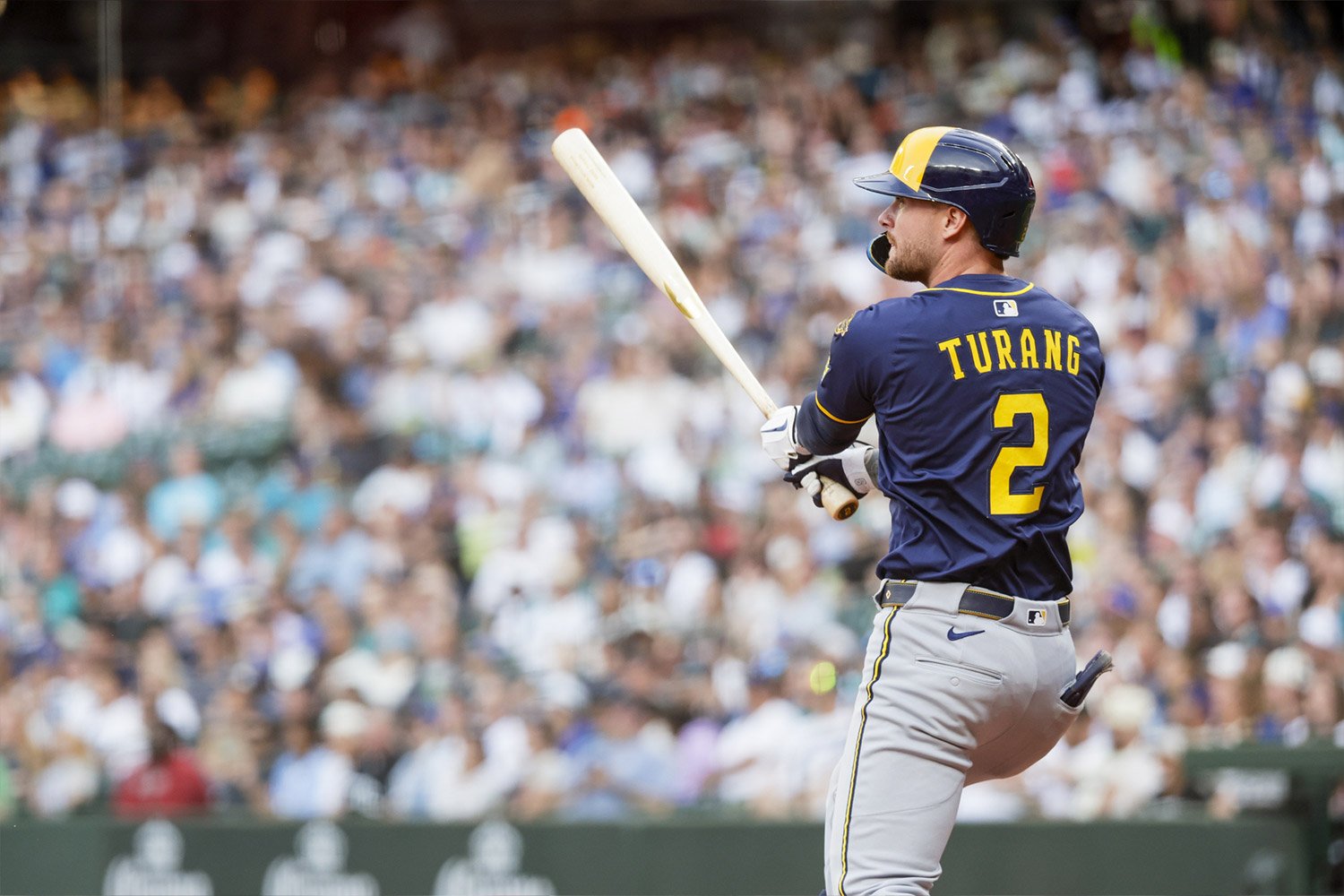
There's been a surprising spectacle during home batting practices this year at American Family Field: Brice Turang regularly launching home runs off the Loge Level bleachers in right field.
Most hitters drive the ball more in batting practice than they do in games, but Turang's pregame swings are more attention-grabbing. Listed at 5-foot-10 and 190 pounds and owning a career .338 slugging percentage, the Brewers' second baseman unleashes perhaps the most impressive left-handed power on the roster behind Christian Yelich.
It's the exact opposite of Turang's established in-game profile of a slap hitter who frequently punches line drives and ground balls up the middle or to the opposite field. According to Statcast, his 5% pull air rate this season is the third-lowest among qualified hitters. And yet, when he steps into the box for batting practice, Turang regularly turns into a bona fide slugger with legitimate pull-side power.
Float the possibility of hitting more home runs, and Turang will quickly downplay it. His goal, he maintains, is usually to hit a low line drive back up the middle. But between changes to his stance and swing and his batting practice approach, he has looked for a while like someone with at least one eye on attaining more power.
After his rookie season, Turang added 20 pounds of muscle but adopted a simplified, contact-oriented approach, which raised his floor as a hitter enough to pair nicely with his elite defense. This year, he has made all of the adjustments typical of a hitter looking to drive the ball more authoritatively. For starters, his batting stance is taller, narrower, and more open.

He has also raised his hands and reintroduced the leg kick he shelved last year.

Finally, he's swinging harder than ever. From 2024 to 2025, Turang has added 4 mph of bat speed on average, by far the highest increase among qualified hitters. All those changes have him hitting the ball much harder; his hard-hit rate has increased from 29.7% to an above-average 45.3%, which is also the greatest jump in baseball.
This version of Turang is more capable of damage. Beyond his batting practice swings, he's shown glimpses of what can happen on the rare occasions he pulls the ball in the air. Turang's average home run distance of 417 feet ranks fourth among hitters with at least five homers this year.
How much power do the Brewers think Turang has lying dormant beneath his in-game production?
"I think there's a lot," hitting coach Connor Dawson said.
Transferring it into games is among their long-term goals for Turang's development. As he continues to spray singles and doubles in the gaps in competitive settings, he and the hitting staff are working in the background on pulling more balls in the air to maximize his raw power.
"I think that's kind of the progression for him," Dawson said. "He's a hitter first, and he needs to be able to use the entire field and spray line drives around. But I think it's definitely something that's on the verge, is finding some more air pull, and I think it's something that's in there, too."
Pulling the ball in the air requires a hitter to make contact with a pitch farther out in front of the plate. That's easier said than done for Turang, who is accustomed to letting the ball get deep and hitting it farther back. Waiting back as part of an all-fields approach allows him to adjust mid-pitch to different speeds and locations and still be on time, all while working within the confines of his natural movement patterns.
"This is how his body moves and how he establishes, 'How can I read it all and still get to a number of different pitches and be on time?'" Pat Murphy said last month.
Turang can employ a contact point farther in front of the plate against batting-practice pitches that are mostly coming in at similar speeds. Artificially forcing it in competition leaves him unable to wait back on offspeed pitches.
"He can do it in batting practice, but how come he can't translate it into a game?" Murphy asked rhetorically. "Timing. Because the mechanism he uses to get down and get a swing off doesn't allow him to get there on 94 [mph]. So, how do we get him there on 94? 'Brice, just get your foot down earlier.' That's not it."
An unproductive July illustrated how hitting the ball farther in front hurts Turang if he is not getting there the proper way. His contact point relative to his body nudged forward about three inches, and he pulled 30.8% of his batted balls, yet his .560 OPS was his worst of any month this season. Turang has continued to ambush fastballs, but with the earlier contact point, he's been pulling off slower pitches for rollover groundouts and swings and misses.
| Month | Pitch Type | wOBA | xwOBA | Whiff% | Pull% | Launch Angle |
| March-June | Fastballs | .375 | .374 | 17.1% | 12.7% | 11 |
| March-June | Breaking | .244 | .303 | 18.9% | 36.2% | 8 |
| March-June | Offspeed | .293 | .277 | 31.7% | 24.0% | 2 |
| July | Fastballs | .396 | .363 | 17.9% | 11.1% | 13 |
| July | Breaking | .101 | .241 | 35.4% | 56.5% | -4 |
| July | Offspeed | .000 | .090 | 33.3% | 50.0% | -12 |
Intentionally or not, Turang has gotten away from doing what he does best in games. Developing new skills cannot come at the expense of existing strengths.
"This is the tricky part of development," Dawson said. "Especially for us, we're trying to win and develop, and you have to lean on your strengths while you're in-game. And right now, his strengths are spraying the ball around on a line."
Dawson sees Turang's bat speed gains as progress toward more repeatable air pull. Instead of catching the ball in front by cheating to it, swinging faster gets his barrel there more organically without having to change his thought process.
"There is this little progression there of some things are starting to click," he said. "I do think as he continues to increase bat speed, it will be much, much easier, because he'll have to stray less away from his approach because he's just swinging the bat faster."
There are still growing pains, though, which Turang has experienced throughout the season. His bat speed hasn't just increased overall, but has steadily climbed each month.

"I think the hardest part for a guy like that who makes a jump in bat speed is when they had less bat speed, they had this approach that made them successful, and generally it was deeper [contact point], opposite field, more middle, lower line drives," Dawson said. "And as guys gain bat speed, especially at a pretty rapid pace, it's not so easy to go, 'Okay, now I gotta push it out in front,' you know? So it's all got to blend together, and that doesn't happen at the snap of a finger."
Turang has already made incredible strides since his underwhelming debut season. With the tools for a unique and dynamic blend of defense, speed, and some raw power, his ceiling now looks even higher. It will just take some more time to unlock that pop.
"It's definitely something I think you've seen in BP," Dawson said, "but it's also something that's going to be a little bit slower progression. It's not linear."
"There'll be a lot more homers in there," Murphy said. "I think that's coming from Brice over time, but he has to figure that out."
Do you approve of the job the Brewers' front office is doing?

Follow Brewer Fanatic For Milwaukee Brewers News & Analysis



-
 6
6
-
 1
1


Recommended Comments
Create an account or sign in to comment
You need to be a member in order to leave a comment
Create an account
Sign up for a new account in our community. It's easy!
Register a new accountSign in
Already have an account? Sign in here.
Sign In Now