


Brewers Video
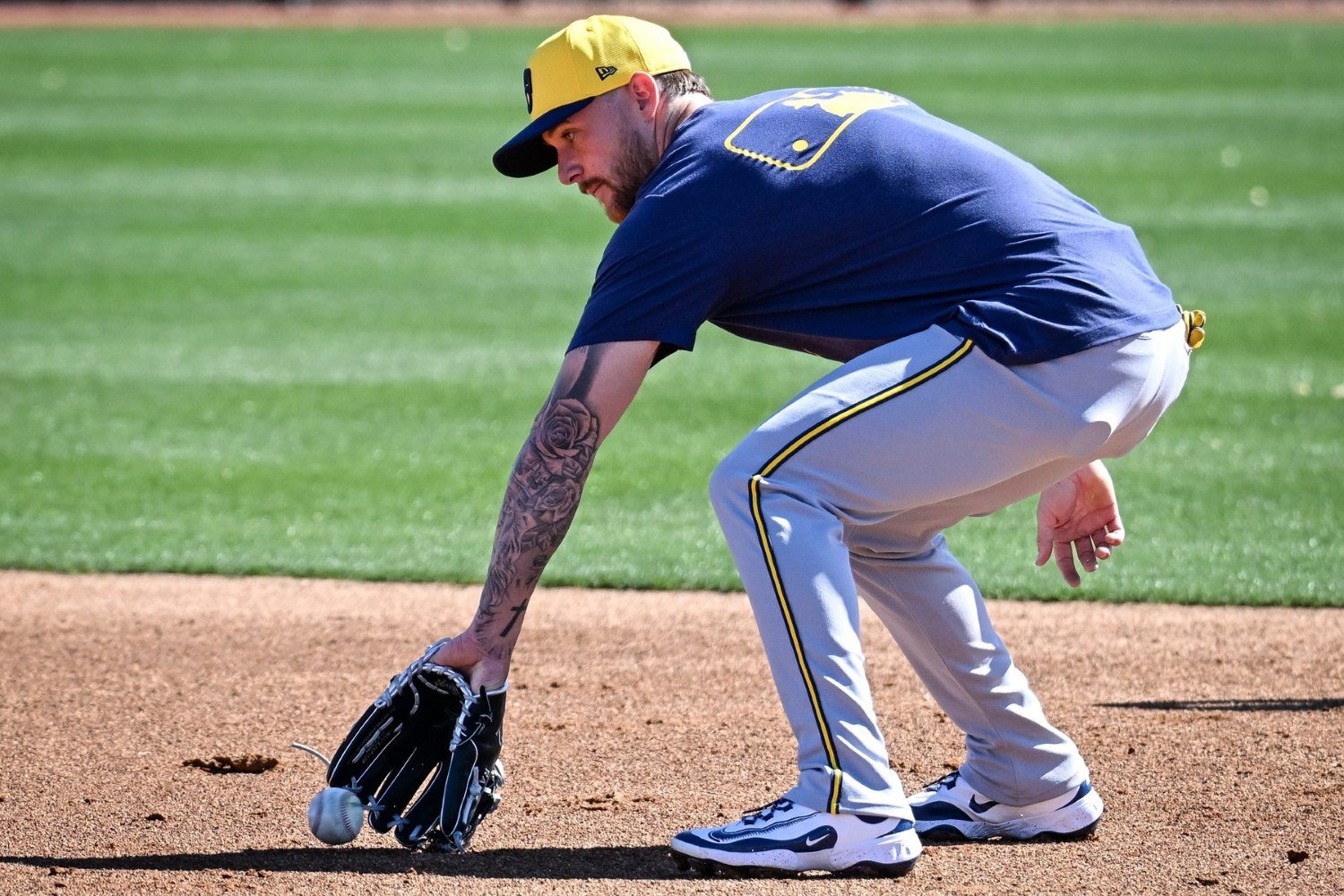
Milwaukee's speedy defensive whiz also has some latent offensive upside. Could the team capture it with an extension reminiscent of some others of the last decade?
His first full, uninterrupted big-league season set Brice Turang up to make some real money in MLB. The son of ex-player Brian Turang, Brice signed for $3.41 million out of high school in 2018, so his family is hardly hurting for money. Still, that was nearly seven years ago, and the real money—the generational, life-changing opportunity—has to be tantalizing for Turang. Because he got so much service time (but not quite a full season's worth) in 2023, Turang is five years from free agency, but just one more season from becoming eligible for salary arbitration.
On the other hand, Turang, 25, is not the kind of player you'd expect to age especially well. His strengths are speed and defense, along with putting the ball in play on a regular basis. Those skills get old while you're still young, and Turang can't hit free agency until the eve of his 30th birthday—at least not voluntarily. There's a better chance of the Brewers non-tendering Turang at some point during the remaining half-decade of control they have over him than there is of him hitting it truly huge in free agency.
Yet, in the short term, Turang has a lot of value to the team, and the Brewers have ample reason not only to ensure he's happy, but to secure cost certainty, so that the unwelcome moment when they might need to cut him to avoid handing out a big arbitration award never comes. Thus, this spring—this last year before Turang can start making more money via arbitration, as a Super Two player—is the right time for the team and the player to talk about a contract extension.
We're not talking a big deal, or one with the chance to stretch toward 10 years. This is not a Jackson Chourio situation, let alone a Christian Yelich or even a William Contreras one. Instead, the right Brewers-centric model for this kind of extension would be Freddy Peralta. Positionally, though, the comp is Ozzie Albies.
When Albies signed with the team from suburban Cobb County, Ga. in 2019, he was in a situation similar to Turang's, but with two things working for him (relative to Turang) and one working against him. He was considerably younger, and he was clearly better, having been an above-average hitter in over 900 MLB plate appearances at that point—as well as a fine fielder and baserunner, though not as good at either as Turang is. However, Albies was also five years from free agency, and he wasn't going to become eligible for arbitration until after 2020, so he would get to arbitration paydays a year later and enjoy one fewer trip through that process than Turang stands to. Albies also got barely 10% of the money Turang did at the entrypoint of professional baseball—$350,000, as opposed to that $3.41 million.
Thus, Albies and the Georgia club agreed on a seven-year deal worth at least $35 million, with two more club options tacked onto the end of it. Even if the deal stretches out to nine years and Albies remains with his team through 2027, the total value of the deal will rise only to $45 million. People howled about this deal at the time; it was one of the most team-friendly extensions in baseball history.
Turang and the Brewers aren't going to land in that same place. Because Turang is four years older now than Albies was then, and because he's not as good or powerful a hitter, there's no need for a deal as long. The value in a deal for Turang would be getting a payday at all, when there's every chance his big-league career won't include one if he doesn't seize his chance now. The value for the Brewers would have to partially take the form of extended team control, but it would also take the form of cost certainty.
Here's one plausible structure, totaling five years and $30 million guaranteed, with a chance to reach $57 million over seven seasons:
- 2025: $1 million
- 2026: $3 million
- 2027: $5 million
- 2028: $7 million
- 2029: $9.5 million
- 2030: $15.5 million club option ($4.5 million buyout)
- 2031: $16 million club option (no buyout)
That's also not a bad comp (with a bit of inflation, based on the time since then and the fact that Turang has one more year of service time than this player did) for the pact the Cardinals reached with Paul DeJong in the spring of 2018. That deal guaranteed him $26 million over six years and had a chance to reach $50 million over eight. It's roughly similar to Tim Anderson's deal with the White Sox around the same time, worth $25 million over six years with a chance to roughly double. Anderson was another former first-round pick who'd gotten a handsome bonus, though he was not as far removed from that payday as Turang now is from the one he got in 2018.
This deal would allow the Brewers to slot Turang (whose skill set and personality fit the team's gorgeously) into their lineup for the medium-term future, without committing them to him beyond his current term of team control or exposing them to the risk of a huge arbitration number in Year 3 or Year 4, based on his ability to hit for average and pile up steals and runs scored (or on what might rapidly become a high-earning shelf of defensive accolades, like 2024's Gold and Platinum Gloves).
For Turang, it would guarantee him that $30 million, at a moment when he looks likely to have a solid MLB career but unlikely to still be a highly valuable player when he reaches free agency. It would also protect him from some of the risks associated with the threat of a work stoppage between 2026 and 2027, and the uncertainty of the salary structure on the other side of that veil. It's not hard to make a case for the two sides to get together on a deal this spring—even if it will feel a bit more like a financial maneuver than a massive statement by the team, as the Yelich and Chourio deals were.
Do you approve of the job the Brewers' front office is doing?

Follow Brewer Fanatic For Milwaukee Brewers News & Analysis



-
 1
1


Recommended Comments
Create an account or sign in to comment
You need to be a member in order to leave a comment
Create an account
Sign up for a new account in our community. It's easy!
Register a new accountSign in
Already have an account? Sign in here.
Sign In Now