



Spencer Michaelis
-
Posts
1,119 -
Joined
-
Last visited
-
Days Won
17
Content Type
Profiles
Forums
Blogs
Events
News
2026 Milwaukee Brewers Top Prospects Ranking
Milwaukee Brewers Videos
2022 Milwaukee Brewers Draft Picks
Milwaukee Brewers Free Agent & Trade Rumors, Notes, & Tidbits
Guides & Resources
2023 Milwaukee Brewers Draft Picks
2024 Milwaukee Brewers Draft Picks
The Milwaukee Brewers Players Project
2025 Milwaukee Brewers Draft Pick Tracker
2026 Milwaukee Brewers Draft Tracker: Picks & Bonuses
Store
Downloads
Gallery
Everything posted by Spencer Michaelis
-
 We continue our MiLB Player of the Month series with our top six Relief Pitchers for the month of July. Image courtesy of Sierra Gatz, Biloxi Shuckers The Brewers minor league pitching was very impressive on the starting side of things, but the relievers stole the show this month, and the number one choice is likely no surprise. Let's begin with a couple of honorable mentions: HONORABLE MENTIONS RHP - Kevin Herget - Nashville Sounds - 6 G, 7.0 IP, 1-0, 0.00 ERA, 1.66 FIP, 0.86 WHIP, 3 H, 3 BB, 11 K RHP - Saul Sanchez - DSL Brewers 1 - 5 G, 7.0 IP, 2-0, 0.00 ERA, 3.20 FIP, 0.29 WHIP, 0 H , 2 BB, 7 K, 1 SV TOP SIX RELIEF PITCHERS FOR JULY #6 LHP - Russell Smith - Biloxi Shuckers - 8 G, 11 IP, 1-0, 0.00 ERA, 3.00 FIP, 0.73 WHIP, 5 H, 4 BB, 8 K, Unranked by all publications Smith was the Brewers third selection in the 2021 draft, and had unfortunately gotten off to a pretty tough start in pro ball. Drafted as a starter, Smith made the transition to the bullpen in 2023, and that seems to have been the correct call. He finished this past season with a 1.40 ERA over his final 19.1 innings, and carried that strong production into April of 2024. Smith’s velocity sat in the 91-93 range as a starter. Given his 6’7, 255 pound frame that was always a bit of a surprise. Since his move to the bullpen, that velocity has climbed more into the 95 MPH range with consistency. His huge frame allows for him to get down the mound, and generate a good amount of extension, though his stride isn’t quite as big as you might expect from someone his height. Smith’s changeup has been his best secondary since he was drafted, and that continues to be the case. However, his slider has transformed since his move to the bullpen. The shape is more of a slurve than a true slider, and it is now an above average pitch as well. Smith’s strikeout numbers weren’t great in July, though his 31.9% whiff rate was well above average for Double-A pitchers with at least seven innings, in the 76th percentile. Smith made up for his lack of strikeouts with a lot of soft contact, not allowing a single extra base hit on the month and only allowing four hits total. Smith will be Rule 5 eligible this winter, and will likely need a very strong finish to the season if he were to end up needing to be protected. July was a good step in the right direction for him. #5 RHP - Bayden Root - Wisconsin Timber Rattlers - 8 G, 11 IP, 1-0, 0.00 ERA, 3.00 FIP, 0.73 WHIP, 5 H, 4 BB, 8 K, Unranked by all publications Root signed with the Brewers as an undrafted free agent out of Oklahoma State, following the 2023 draft. He began his career at Ohio State before transferring to the other OSU for his final season, where he worked exclusively out of the bullpen. While he performed decently in college, the combination of age and being a relief only prospect kept Root from being drafted. What interested the Brewers was likely his pure stuff and his competitiveness. He’s a very fiery competitor who isn’t afraid to show some emotion after recording a big out. Root throws a two-seam fastball in the 94-95 range and with up to 19 inches of run on it. His best secondary is his mid-80s slider that gets up to 19 inches of glove side movement on it and can show very sharp break at times. He does also throw a four seam fastball that he can throw a bit harder than his two seam, though the metrics on the four seam aren’t great. He rounds out the repertoire with a mid-80s changeup that can also get up to 18 inches of run, he doesn’t use it much however, and it’s a pitch he hasn’t shown a propensity for being able to command. In July, Root did what he does. He’s not a huge strikeout pitcher, nor does he generate a ton of whiffs. Both were slightly below average for the level. He did limit his walks at a very high level, only walking 2.6% of the hitters he faced, which was 94th percentile for High-A pitchers with seven innings pitched. He generated grounders at a 45% rate, and that was in the 80th percentile. He is always on the attack, and rarely allows hard contact. Root continues to put up really solid numbers at every level he’s been at. It’s not a closer profile, but this type of profile can be useful in the middle innings. #4 RHP Justin Yeager - Biloxi Shuckers - 8 G, 11 IP, 1-0, 0.90 ERA, 2.36 FIP, 1.00 WHIP, 6 H, 4 BB, 11 K, 5 SV Unranked by all publications The third piece that the Brewers received in the notable Esteury Ruiz for William Contreras and Joel Payamps trade, Yeager was drafted in the 33rd round by the Braves in 2019. He spent a large portion of 2023 injured in the Brewers system, so we didn’t get to see much of what he had. He did get assigned to the Arizona Fall League, where he struggled to the tune of a 6.23 ERA. He’s mostly been healthy this year, and he has shown signs of being a potential bullpen piece down the road. Yeager’s mid-90’s fastball plays extremely well when he gets it up in the zone, due to an Induced Vertical Break averaging close to 20 inches. His slider sits in the 86-89 range and comes with a lot of late bite to it. Both pitches have the ability to be above average or better, but they can play down at times due to his lack of command. In July, Yeager led the organization in saves, with five. According to TruMedia, his whiff rate of 30.1% placed him in the 82nd percentile for Double-A pitchers with at least seven innings in July. His 28.2% strikeout rate was in the 86th percentile, and despite having some home run issues at times, Yeager did not allow a single extra base hit in the month. Yeager has been Rule 5 eligible each of the last two years. He will be again this winter. He probably won’t be protected, but he does have the type of stuff that teams will be interested in. It will be interesting to see if he gets an opportunity to pitch in Triple-A this season. #3 RHP - Dikember Sanchez - Carolina Mudcats - 8 G, 15 IP, 1-1, 0.60 ERA, 3.27 FIP, 0.73 WHIP, 9 H, 2 BB, 12 K, 1 SV Unranked by all publications Signed in the Brewers 2021 international class out of Venezuela, it has been a slow ascension for Sanchez. He spent two years in the Dominican Summer League before coming over to the Arizona Complex League in 2023. 2024 has been a breakout season of sorts for him, which was foreshadowed in 2023. He posted a 6.49 ERA, but his peripherals took a big step forward, raising his strikeout rate from 17.8 to 26.6% and lowering his walk rate from 16.1 to 12.9%. Sanchez throws four pitches, the majority of which move to his glove-side. He starts with what appears to be a cutter in the 91-93 range but has been up to 94 at times. He throws two different breaking balls. His go-to pitch when he needs a whiff is a mid-80’s short slider with some depth. He will also throw a slower curveball at times, often trying to land that for strikes. He has mixed in a changeup a few times according to the broadcast, but they may have just been breaking balls that backed up on him. Sanchez was called up to Carolina shortly before July started and his July went incredibly well. While his 21.1% strikeout rate was a bit below average, his whiff rate of 32.1% was in the 81st percentile for Low-A pitchers with at least seven innings pitched, and his 3.5% walk rate placed him in the 94th percentile for the month. Not only did he generate a lot of swing and miss, he also kept the ball on the ground at an elite rate. Batted balls were hit on the ground 67.4% of the time against Sanchez, which put him in the 97th percentile in July. Only 20 years old, Sanchez is definitely a name to keep an eye on moving forward. His stuff is good, his command has made huge strides, and he’s pitching well in full season ball. Rule 5 eligible in 2025, Sanchez is an arm they may be aggressive with next year, but for now he will likely remain in Carolina for this season. #2 RHP - Will Childers - Biloxi Shuckers - 7 G, 8.2 IP, 1-0, 1.04 ERA, 1.17 FIP, 0.81 WHIP, 6 H, 1 BB, 11 K Unranked by all publications Will Childers' father Matt was a Brewers draft pick in 1997 and debuted for the Brewers in 2002. Will was an undrafted signing after the 2022 draft after attending the University of Georgia, where he unfortunately spent the majority of his time injured after a strong freshman season. He spent his first year in the rehab process before appearing in his first professional games in June of 2023. Childers is mostly a two pitch pitcher at this point, though he may be using two different fastballs. His primary fastball is a four seamer with a lot of carry on it. He sits in the 94-96 MPH range with it, but he has topped out at 98. He uses the fastball at the top of the zone and above and gets a lot of swing and misses on it. At times you will see more run on the pitch and while it’s possible he’s mixing in a two-seamer, it’s also possible he’s just losing the release on his normal fastball. His other pitch is probably his best, and that’s a very sharp breaking ball in the mid-80’s. The breaker has a lot of depth, and some sweep as well. It’s a really good out pitch, but also one he has shown a proclivity for landing for strikes. Childers has the only ERA over one on this list, but his peripherals stack up with anybody in the system for the month. In fact, his 1.17 FIP was second in the organization of the 56 pitchers eligible for this list. He generated grounders at a 55% clip, which was in the 92nd percentile for Double-A pitchers with at least seven innings pitched. He also had a whiff rate of 31.9% which was 87th percentile, while posting a 94th percentile in strikeout and walk rates. Those came in at 34.4% and 3.1% respectively. Childers is a player to keep an eye on into next season. His fastball/breaking ball combination is one of the better ones in the system, and he could end up being an interesting bullpen piece down the road. #1 RHP - Craig Yoho - Biloxi Shuckers - 9 G, 10.0 IP, 1-1, 0.00 ERA, 0.76 FIP, 1.00 WHIP, 7 H , 3 BB, 19 K, 2 SV. The fourth Biloxi Shucker to make the list, the Double-A squad got an incredible month from their bullpen. The Brewers 8th round selection in the 2023 draft out of Indiana, Yoho is the only one of these arms that appears to already be slotted into a relief role in the future. At one time a position player in college, he transitioned to a two-way role for a couple of seasons, but after battling quite a few injuries, he finished his college career as a pitcher-only. 2023 was his first season focusing solely on pitching. So, despite his advanced age, he entered pro ball with some untapped potential. After an incredible start with the Timber Rattlers, he has already made his way to Double-A and has continued his dominance there. Yoho may not throw as hard as most elite relievers, only sitting in the 91-93 range with his fastball, but his pitch mix is as impressive as any pitcher in the system. He throws his fastball with nearly 20 inches of arm side run, a changeup that appears to be very similar to the Devin Williams “Airbender”, as well as a sweeping curveball and a high-80s cutter. You can read more about the pitch mix in this article from April 22nd. In July, Yoho may have had his most dominant month yet. His whiff rate of 46.9% was his highest in any month and put him in the 99th percentile for Double-A pitchers with at least seven innings. His 76.2% ground ball rate was also the highest of any month, and also was in the 99th percentile for Double-A pitchers. He did not allow an earned run, and had a strikeout to walk ratio of 6.33. Yoho seems like he could be in line for a legitimate MLB opportunity this season. Perhaps a sign that the organization is starting to look at him more closely was the fact that he pitched in back to back games for the first time this season on July 27th and 28th. If he’s not , a debut in early 2025 would seem to be likely. Let us know your thoughts below! Did we miss anybody? View full article
- 3 replies
-
- 1
-

-
- craig yoho
- will childers
- (and 5 more)
-
Brewers Minor League Relief Pitcher of the Month: July 2024
Spencer Michaelis posted an article in Minor Leagues
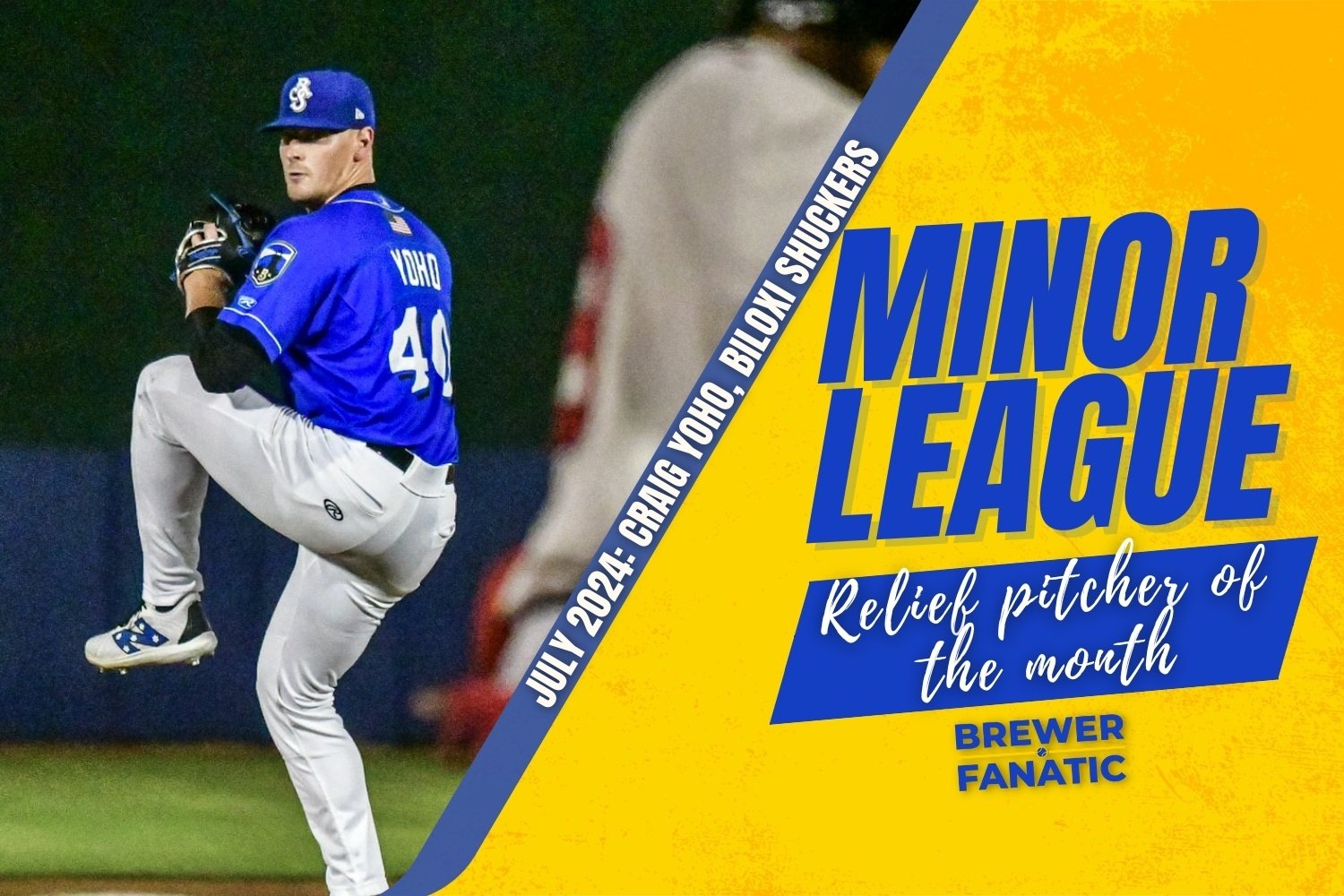 The Brewers minor league pitching was very impressive on the starting side of things, but the relievers stole the show this month, and the number one choice is likely no surprise. Let's begin with a couple of honorable mentions: HONORABLE MENTIONS RHP - Kevin Herget - Nashville Sounds - 6 G, 7.0 IP, 1-0, 0.00 ERA, 1.66 FIP, 0.86 WHIP, 3 H, 3 BB, 11 K RHP - Saul Sanchez - DSL Brewers 1 - 5 G, 7.0 IP, 2-0, 0.00 ERA, 3.20 FIP, 0.29 WHIP, 0 H , 2 BB, 7 K, 1 SV TOP SIX RELIEF PITCHERS FOR JULY #6 LHP - Russell Smith - Biloxi Shuckers - 8 G, 11 IP, 1-0, 0.00 ERA, 3.00 FIP, 0.73 WHIP, 5 H, 4 BB, 8 K, Unranked by all publications Smith was the Brewers third selection in the 2021 draft, and had unfortunately gotten off to a pretty tough start in pro ball. Drafted as a starter, Smith made the transition to the bullpen in 2023, and that seems to have been the correct call. He finished this past season with a 1.40 ERA over his final 19.1 innings, and carried that strong production into April of 2024. Smith’s velocity sat in the 91-93 range as a starter. Given his 6’7, 255 pound frame that was always a bit of a surprise. Since his move to the bullpen, that velocity has climbed more into the 95 MPH range with consistency. His huge frame allows for him to get down the mound, and generate a good amount of extension, though his stride isn’t quite as big as you might expect from someone his height. Smith’s changeup has been his best secondary since he was drafted, and that continues to be the case. However, his slider has transformed since his move to the bullpen. The shape is more of a slurve than a true slider, and it is now an above average pitch as well. Smith’s strikeout numbers weren’t great in July, though his 31.9% whiff rate was well above average for Double-A pitchers with at least seven innings, in the 76th percentile. Smith made up for his lack of strikeouts with a lot of soft contact, not allowing a single extra base hit on the month and only allowing four hits total. Smith will be Rule 5 eligible this winter, and will likely need a very strong finish to the season if he were to end up needing to be protected. July was a good step in the right direction for him. #5 RHP - Bayden Root - Wisconsin Timber Rattlers - 8 G, 11 IP, 1-0, 0.00 ERA, 3.00 FIP, 0.73 WHIP, 5 H, 4 BB, 8 K, Unranked by all publications Root signed with the Brewers as an undrafted free agent out of Oklahoma State, following the 2023 draft. He began his career at Ohio State before transferring to the other OSU for his final season, where he worked exclusively out of the bullpen. While he performed decently in college, the combination of age and being a relief only prospect kept Root from being drafted. What interested the Brewers was likely his pure stuff and his competitiveness. He’s a very fiery competitor who isn’t afraid to show some emotion after recording a big out. Root throws a two-seam fastball in the 94-95 range and with up to 19 inches of run on it. His best secondary is his mid-80s slider that gets up to 19 inches of glove side movement on it and can show very sharp break at times. He does also throw a four seam fastball that he can throw a bit harder than his two seam, though the metrics on the four seam aren’t great. He rounds out the repertoire with a mid-80s changeup that can also get up to 18 inches of run, he doesn’t use it much however, and it’s a pitch he hasn’t shown a propensity for being able to command. In July, Root did what he does. He’s not a huge strikeout pitcher, nor does he generate a ton of whiffs. Both were slightly below average for the level. He did limit his walks at a very high level, only walking 2.6% of the hitters he faced, which was 94th percentile for High-A pitchers with seven innings pitched. He generated grounders at a 45% rate, and that was in the 80th percentile. He is always on the attack, and rarely allows hard contact. Root continues to put up really solid numbers at every level he’s been at. It’s not a closer profile, but this type of profile can be useful in the middle innings. #4 RHP Justin Yeager - Biloxi Shuckers - 8 G, 11 IP, 1-0, 0.90 ERA, 2.36 FIP, 1.00 WHIP, 6 H, 4 BB, 11 K, 5 SV Unranked by all publications The third piece that the Brewers received in the notable Esteury Ruiz for William Contreras and Joel Payamps trade, Yeager was drafted in the 33rd round by the Braves in 2019. He spent a large portion of 2023 injured in the Brewers system, so we didn’t get to see much of what he had. He did get assigned to the Arizona Fall League, where he struggled to the tune of a 6.23 ERA. He’s mostly been healthy this year, and he has shown signs of being a potential bullpen piece down the road. Yeager’s mid-90’s fastball plays extremely well when he gets it up in the zone, due to an Induced Vertical Break averaging close to 20 inches. His slider sits in the 86-89 range and comes with a lot of late bite to it. Both pitches have the ability to be above average or better, but they can play down at times due to his lack of command. In July, Yeager led the organization in saves, with five. According to TruMedia, his whiff rate of 30.1% placed him in the 82nd percentile for Double-A pitchers with at least seven innings in July. His 28.2% strikeout rate was in the 86th percentile, and despite having some home run issues at times, Yeager did not allow a single extra base hit in the month. Yeager has been Rule 5 eligible each of the last two years. He will be again this winter. He probably won’t be protected, but he does have the type of stuff that teams will be interested in. It will be interesting to see if he gets an opportunity to pitch in Triple-A this season. #3 RHP - Dikember Sanchez - Carolina Mudcats - 8 G, 15 IP, 1-1, 0.60 ERA, 3.27 FIP, 0.73 WHIP, 9 H, 2 BB, 12 K, 1 SV Unranked by all publications Signed in the Brewers 2021 international class out of Venezuela, it has been a slow ascension for Sanchez. He spent two years in the Dominican Summer League before coming over to the Arizona Complex League in 2023. 2024 has been a breakout season of sorts for him, which was foreshadowed in 2023. He posted a 6.49 ERA, but his peripherals took a big step forward, raising his strikeout rate from 17.8 to 26.6% and lowering his walk rate from 16.1 to 12.9%. Sanchez throws four pitches, the majority of which move to his glove-side. He starts with what appears to be a cutter in the 91-93 range but has been up to 94 at times. He throws two different breaking balls. His go-to pitch when he needs a whiff is a mid-80’s short slider with some depth. He will also throw a slower curveball at times, often trying to land that for strikes. He has mixed in a changeup a few times according to the broadcast, but they may have just been breaking balls that backed up on him. Sanchez was called up to Carolina shortly before July started and his July went incredibly well. While his 21.1% strikeout rate was a bit below average, his whiff rate of 32.1% was in the 81st percentile for Low-A pitchers with at least seven innings pitched, and his 3.5% walk rate placed him in the 94th percentile for the month. Not only did he generate a lot of swing and miss, he also kept the ball on the ground at an elite rate. Batted balls were hit on the ground 67.4% of the time against Sanchez, which put him in the 97th percentile in July. Only 20 years old, Sanchez is definitely a name to keep an eye on moving forward. His stuff is good, his command has made huge strides, and he’s pitching well in full season ball. Rule 5 eligible in 2025, Sanchez is an arm they may be aggressive with next year, but for now he will likely remain in Carolina for this season. #2 RHP - Will Childers - Biloxi Shuckers - 7 G, 8.2 IP, 1-0, 1.04 ERA, 1.17 FIP, 0.81 WHIP, 6 H, 1 BB, 11 K Unranked by all publications Will Childers' father Matt was a Brewers draft pick in 1997 and debuted for the Brewers in 2002. Will was an undrafted signing after the 2022 draft after attending the University of Georgia, where he unfortunately spent the majority of his time injured after a strong freshman season. He spent his first year in the rehab process before appearing in his first professional games in June of 2023. Childers is mostly a two pitch pitcher at this point, though he may be using two different fastballs. His primary fastball is a four seamer with a lot of carry on it. He sits in the 94-96 MPH range with it, but he has topped out at 98. He uses the fastball at the top of the zone and above and gets a lot of swing and misses on it. At times you will see more run on the pitch and while it’s possible he’s mixing in a two-seamer, it’s also possible he’s just losing the release on his normal fastball. His other pitch is probably his best, and that’s a very sharp breaking ball in the mid-80’s. The breaker has a lot of depth, and some sweep as well. It’s a really good out pitch, but also one he has shown a proclivity for landing for strikes. Childers has the only ERA over one on this list, but his peripherals stack up with anybody in the system for the month. In fact, his 1.17 FIP was second in the organization of the 56 pitchers eligible for this list. He generated grounders at a 55% clip, which was in the 92nd percentile for Double-A pitchers with at least seven innings pitched. He also had a whiff rate of 31.9% which was 87th percentile, while posting a 94th percentile in strikeout and walk rates. Those came in at 34.4% and 3.1% respectively. Childers is a player to keep an eye on into next season. His fastball/breaking ball combination is one of the better ones in the system, and he could end up being an interesting bullpen piece down the road. #1 RHP - Craig Yoho - Biloxi Shuckers - 9 G, 10.0 IP, 1-1, 0.00 ERA, 0.76 FIP, 1.00 WHIP, 7 H , 3 BB, 19 K, 2 SV. The fourth Biloxi Shucker to make the list, the Double-A squad got an incredible month from their bullpen. The Brewers 8th round selection in the 2023 draft out of Indiana, Yoho is the only one of these arms that appears to already be slotted into a relief role in the future. At one time a position player in college, he transitioned to a two-way role for a couple of seasons, but after battling quite a few injuries, he finished his college career as a pitcher-only. 2023 was his first season focusing solely on pitching. So, despite his advanced age, he entered pro ball with some untapped potential. After an incredible start with the Timber Rattlers, he has already made his way to Double-A and has continued his dominance there. Yoho may not throw as hard as most elite relievers, only sitting in the 91-93 range with his fastball, but his pitch mix is as impressive as any pitcher in the system. He throws his fastball with nearly 20 inches of arm side run, a changeup that appears to be very similar to the Devin Williams “Airbender”, as well as a sweeping curveball and a high-80s cutter. You can read more about the pitch mix in this article from April 22nd. In July, Yoho may have had his most dominant month yet. His whiff rate of 46.9% was his highest in any month and put him in the 99th percentile for Double-A pitchers with at least seven innings. His 76.2% ground ball rate was also the highest of any month, and also was in the 99th percentile for Double-A pitchers. He did not allow an earned run, and had a strikeout to walk ratio of 6.33. Yoho seems like he could be in line for a legitimate MLB opportunity this season. Perhaps a sign that the organization is starting to look at him more closely was the fact that he pitched in back to back games for the first time this season on July 27th and 28th. If he’s not , a debut in early 2025 would seem to be likely. Let us know your thoughts below! Did we miss anybody?
- 3 comments
-
- 2
-
-

-
- craig yoho
- will childers
- (and 5 more)
-
Rodriguez was definitely supposed to be on my list for HM. Writing these while I’m at work can sometimes lead to an oversight on the HM’s, and I totally forgot to add his numbers. You know I’m a big fan of his lol. As for the Aquino/Fitpatrick part, I’ve been holding the minimum of 13 IP and at least one start made, as the qualifier for this list every month. I just have to put it somewhere. Aquino made it under those qualifiers, Fitzpatrick didn’t have enough innings. Edit: and on Rudy… the 5.38 FIP for the month was what kept him off the list.
- 8 replies
-
- 2
-
-
- kc hunt
- bishop letson
- (and 5 more)
-
Ask your favorite expert a question!
Spencer Michaelis replied to Playing Catch's topic in Brewers Minor League Talk
For me personally, I really try my best to wait for these guys to get stateside before I go too crazy with the rankings. However, I think there's a good chance of both of them starting in Carolina next year, and if they show out there for a month or two, top 5 could happen very quickly. -
Ask your favorite expert a question!
Spencer Michaelis replied to Playing Catch's topic in Brewers Minor League Talk
That was league wide. There are a few other names who get thrown out there with him, but Made and Pena have both been pretty universally called Top 5 and I've seen some people call them the top 2. Such a long way for those guys to go, but the early returns could not be better. -
Brewers Minor League Starting Pitcher of the Month: July 2024
Spencer Michaelis posted an article in Minor Leagues
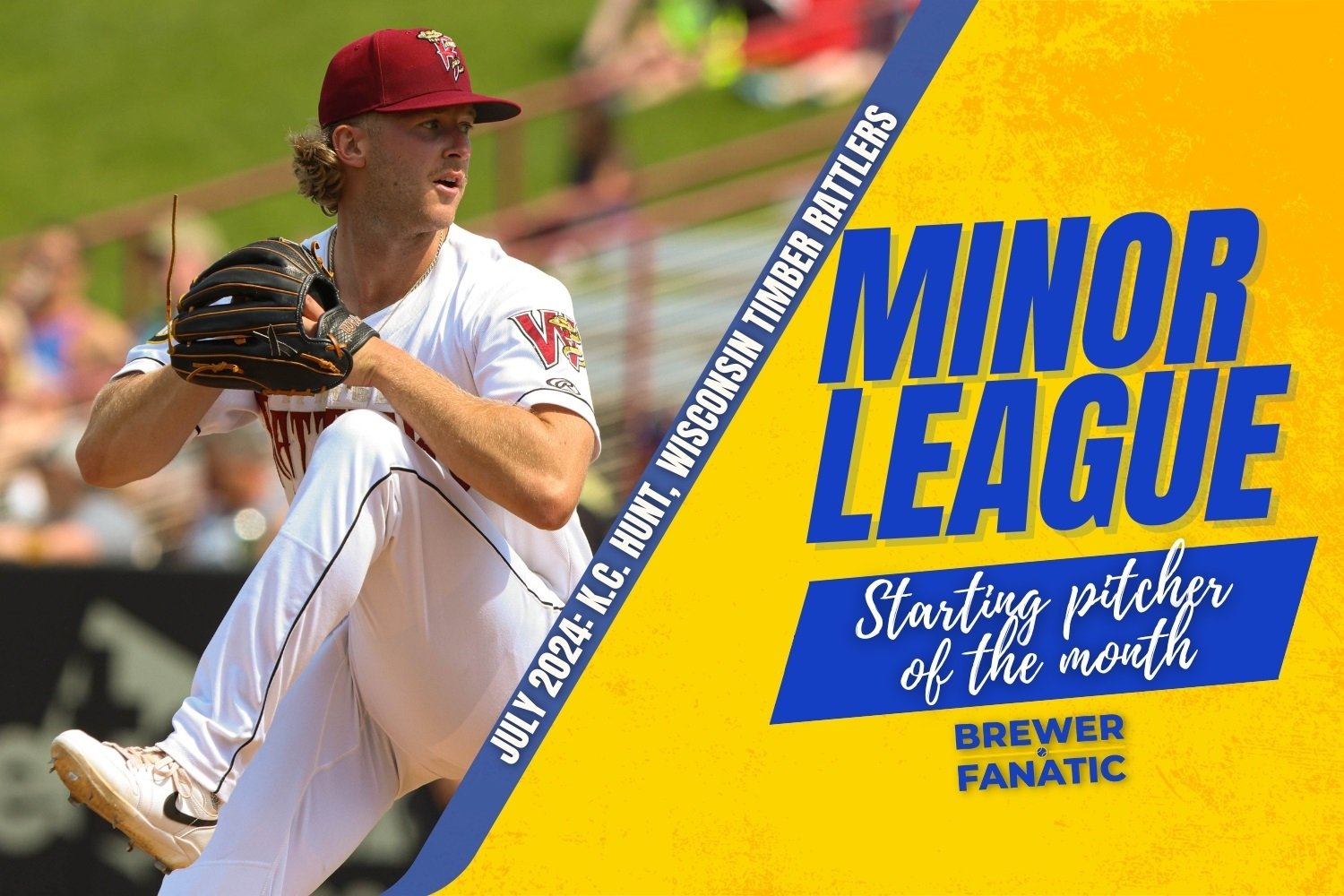 We will begin, as always, with a couple of honorable mentions from another successful month by the Brewers starting prospects. Honorable Mentions: RHP - Jacob Misiorowski - Biloxi Shuckers - 4 G, 4 GS, 19.1 IP, 1-1, 3.26 ERA, 4.98 FIP, 1.09 WHIP, 8 H , 13 BB, 27 K. RHP - Eric Prado - ACL Brewers - 3 G, 2 GS, 13.2 IP, 1-0, 1.98 ERA, 3.16 FIP, 0.88 WHIP, 8 H, 4 BB, 12 K. Unranked by all publications Some video of Prado here! TOP FIVE STARTING PITCHERS FOR JULY #5 RHP - Patricio Aquino - Wisconsin Timber Rattlers - 6 G, 2 GS, 22.2 IP, 1-0, 1.22 ERA, 2.87 FIP, 0.89 WHIP, 14 H, 6 BB, 19 K, 1 SV A member of the Brewers 2021 international signing class, Aquino signed for $16k and moved quickly, reaching full season ball last year and pitching with a lot of success, as evidenced by his 2.75 ERA. His results have taken a step back in High-A this season, but he has started to turn things around of late, and July was a great step in the right direction. Aquino’s fastball sits in the 92-94 range, but he can reach back for 95 or 96 at times as well, even touching 98 MPH on a stadium gun a few times this year. At only 21 years old, he may be able to develop a bit more consistency in terms of sitting in the mid-90’s, rather than just flashing that ability. His best pitch is his slider, which he throws on two different planes. He may be considering it as a slider and a curveball, though the slider version is more of a “slurve”. The breaking balls spin in the 2600 RPM range and generate a lot of whiffs, but is also the pitch he lands for strikes the best. His changeup has made some real strides this season, and he’s comfortable using it against right handed hitters, as well as lefties. In July, Aquino was used in relief as well as in a starting role. He wasn’t dominating by any means, but he was getting a lot of harmless fly balls. We will hope to see the strikeout numbers catch up to the pure stuff he has at some point, as his strikeout rate and whiff rates were both below average in July, as they have been over the course of the entire season. Aquino has shown flashes, and his surface numbers were very strong in July. He’s a name to watch moving forward, but the hope is that he will begin to generate more swing and miss. #4 LHP - Tate Kuehner - Wisconsin Timber Rattlers - 4 G, 4 GS, 18.2 IP, 2-1, 2.41 ERA, 3.10 FIP, 1.18 WHIP, 13 H, 9 BB, 20 K. Unranked by all publications The Brewers 7th round selection in 2023 out of Louisville, Kuehner was used in a swing man role by the Cardinals his senior year. He only threw three innings at the Complex League level last year after being drafted, but began the 2024 season with High-A Appleton where he has continued that swing man role, but in a more consistent starter role. Kuehner was sitting in the upper-80’s as a junior in college, but made a jump into the 92-95 range as a senior, which is where he is at now. He throws from a low slot, and started generating more run on the pitch his senior year. That slot allows the pitch to play well up in the zone due to the Vertical Approach Angle, and also to play down, because of the run. His best secondary offering is his low-80s sweeper, which has a lot of sweep, but also quite a bit of vertical drop and is his best swing and miss pitch. He mixes in a changeup as well, which appears to be in a better spot than where it was at Louisville, where he struggled to land any of his secondaries for strikes. In July he posted a whiff rate of 38.9%. His season long rate of 35.9% for the season puts him in the 4th percentile out of 371 High-A pitchers with at least 35 IP. His ground ball rate of 45.5% in July was a solid number, but doesn’t stand out in the crowd. Despite that, Kuehner only allowed two extra base hits (both doubles) in July. He also only allowed two in May, one in June and his 3.9% extra base hit rate is in the 92nd percentile in High-A for the season (minimum of 35 IP). Kuehner has been generating a lot of swings and misses, and on the occasions that the ball is put in play, it is rarely hit with authority. Kuehner’s next appearance will come as a Biloxi Shucker, as he was promoted at the end of the month. #3 RHP - Bishop Letson - Carolina Mudcats - 3 G, 2 GS, 13.1 IP, 0-1, 1.98 ERA, 2.21 FIP, 0.96 WHIP, 9 H, 4 BB, 17 K The Brewers 11th round selection in the 2023 draft, Letson has been one of the fastest risers on prospect lists this year. A bit of an older high school pick, he will turn 20 in September. Despite his somewhat advanced age at the time of the draft, Letson was seen as a very projectable arm that had the potential to break out over the next few years. That has proven to be the case in his first full season. Throwing both a four seamer that rides, and a two seamer with a good amount of run on it. At the time he was drafted, Letson was topping out at 93 MPH, and sitting more in the 89-91 range. This season he is sitting at 93-95 MPH and has even touched 98. A wiry 6’4 build and an athletic delivery allows him to generate as much extension as anyone at the Low-A level, helping that velocity play up even further. Letson throws a slider and a changeup for his secondaries. The low-80’s slider is the better of the two currently. He commands it well to both sides of the plate and can change the shape of it at times. It’s a big swing and miss pitch against righties, but also one he can land for strikes against lefties. His changeup is also used against both handed hitters, but in the opposite function, getting whiffs against lefties and backdooring it against righties. In July, Letson only made three appearances, likely in an attempt to limit his innings during his first full season of pro ball. He made the most of his opportunities though, going five and 5.2 innings in his two starts. His other appearance came in relief, though it was at the restart of a game that had been postponed the day prior, so he got to treat it like a start still. In that appearance he went three hitless, scoreless innings and struck out six. Overall, his July whiff rate was 32.3% and his strikeout rate was 32.1%. The whiff rate placed him in the 79th percentile for Low-A pitchers throwing at least 13 innings, and the strikeout rate in the 85th percentile. Letson will likely continue to have his innings limited this season, but this has been an extremely successful first four months of pro ball for him, and he has the type of talent to move pretty quickly for a high school pick. #2 RHP - Ayendy Bravo - DSL Brewers 1 - 5 G, 2 GS, 20.1 IP, 2-0, 0.44 ERA, 2.96 FIP, 0.84 WHIP, 11 H, 6 BB, 19 K Unranked by all publications Signed out of the Dominican Republic in this past January’s class, Bravo turned 17 a couple of weeks after signing. While the first month of his professional career had some bumps in the road, he turned in an extremely impressive July. An unheralded signing, his bonus went unreported, and there is not much information available to the public. With some social media investigating, we were able to find a TikTok showing some of his repertoire off. He appears to throw in the low-90’s with a firm fastball and an over the top delivery. He also mixes in an upper-70’s slider that takes a little more of a curveball shape, due to that previously mentioned arm slot. It’s unclear if he has more secondaries in his repertoire, but it’s certainly possible that he does. Bravo threw at least 3 2/3 innings in all five appearances, and struck out at least three in each outing. After striking out only 10.3% of hitters in June, he increased that number to 25.3% in July. His WHIP of 0.84 was the third best in the system for July. It’s so hard to project DSL level pitchers, but a solid strikeout to walk ratio is one of the better indicators, and Bravo had that in July. He seems like a candidate for the Complex League next year, though there will be limited spots available. #1 RHP - K.C. Hunt - Wisconsin Timber Rattlers - 3 G, 3 GS, 16.1 IP, 1-0, 1.10 ERA, 2.50 FIP, 0.92 WHIP, 10 H, 5 BB, 22 K. Unranked by all publications Taking home the number one spot in April’s version of the Reliever of the Month list, the 2023 Undrafted Free Agent signee transitioned to the rotation in June, and he has taken to it quite well so far. Hunt’s high-spin fastball sits in the 92-94 range and works well at the top of the zone, though he also does a good job of hitting the low and outside corner with the pitch. He has a four pitch mix and while the fastball is closer to average than great, his breaking balls are a different story. His mid-80’s bullet slider is a plus pitch that generates a ton of swing and miss. He also throws an upper 70’s curveball that is a little more inconsistent, but also flashes as a plus pitch and has a lot of depth to it. Hunt will also mix in a changeup on occasion. The changeup is a work in progress, but does give a hitter something else to think about. Hunt started his month with two dominant starts, first going 5.1 shutout innings against Beloit, striking out 10 in the process. His next time out he went six innings against West Michigan, allowing one earned run and striking out nine. Overall, his 34.9% strikeout rate was in the 88th percentile out of the 171 High-A pitchers throwing at least 13 innings in July, and his 35.9% whiff rate also put him in the 88th percentile. Hunt’s July was a continuation of a very impressive season, in which an Undrafted Free Agent from last year has gone from Low-A to High-A, and then made the transition from relieving to starting, never breaking stride along the way. A promotion to Double-A in the near future is hard to rule out. Please share your opinions! Do any of these names stand out?
- 8 comments
-
- 2
-
-
-
- kc hunt
- bishop letson
- (and 5 more)
-
We begin our MiLB Player of the Month series with our top five Starting Pitchers for the month of July. In order to qualify for the top five, there was a minimum requirement of 13 innings pitched and at least one start made. Image courtesy of Wisconsin Timber Rattlers We will begin, as always, with a couple of honorable mentions from another successful month by the Brewers starting prospects. Honorable Mentions: RHP - Jacob Misiorowski - Biloxi Shuckers - 4 G, 4 GS, 19.1 IP, 1-1, 3.26 ERA, 4.98 FIP, 1.09 WHIP, 8 H , 13 BB, 27 K. RHP - Eric Prado - ACL Brewers - 3 G, 2 GS, 13.2 IP, 1-0, 1.98 ERA, 3.16 FIP, 0.88 WHIP, 8 H, 4 BB, 12 K. Unranked by all publications Some video of Prado here! TOP FIVE STARTING PITCHERS FOR JULY #5 RHP - Patricio Aquino - Wisconsin Timber Rattlers - 6 G, 2 GS, 22.2 IP, 1-0, 1.22 ERA, 2.87 FIP, 0.89 WHIP, 14 H, 6 BB, 19 K, 1 SV A member of the Brewers 2021 international signing class, Aquino signed for $16k and moved quickly, reaching full season ball last year and pitching with a lot of success, as evidenced by his 2.75 ERA. His results have taken a step back in High-A this season, but he has started to turn things around of late, and July was a great step in the right direction. Aquino’s fastball sits in the 92-94 range, but he can reach back for 95 or 96 at times as well, even touching 98 MPH on a stadium gun a few times this year. At only 21 years old, he may be able to develop a bit more consistency in terms of sitting in the mid-90’s, rather than just flashing that ability. His best pitch is his slider, which he throws on two different planes. He may be considering it as a slider and a curveball, though the slider version is more of a “slurve”. The breaking balls spin in the 2600 RPM range and generate a lot of whiffs, but is also the pitch he lands for strikes the best. His changeup has made some real strides this season, and he’s comfortable using it against right handed hitters, as well as lefties. In July, Aquino was used in relief as well as in a starting role. He wasn’t dominating by any means, but he was getting a lot of harmless fly balls. We will hope to see the strikeout numbers catch up to the pure stuff he has at some point, as his strikeout rate and whiff rates were both below average in July, as they have been over the course of the entire season. Aquino has shown flashes, and his surface numbers were very strong in July. He’s a name to watch moving forward, but the hope is that he will begin to generate more swing and miss. #4 LHP - Tate Kuehner - Wisconsin Timber Rattlers - 4 G, 4 GS, 18.2 IP, 2-1, 2.41 ERA, 3.10 FIP, 1.18 WHIP, 13 H, 9 BB, 20 K. Unranked by all publications The Brewers 7th round selection in 2023 out of Louisville, Kuehner was used in a swing man role by the Cardinals his senior year. He only threw three innings at the Complex League level last year after being drafted, but began the 2024 season with High-A Appleton where he has continued that swing man role, but in a more consistent starter role. Kuehner was sitting in the upper-80’s as a junior in college, but made a jump into the 92-95 range as a senior, which is where he is at now. He throws from a low slot, and started generating more run on the pitch his senior year. That slot allows the pitch to play well up in the zone due to the Vertical Approach Angle, and also to play down, because of the run. His best secondary offering is his low-80s sweeper, which has a lot of sweep, but also quite a bit of vertical drop and is his best swing and miss pitch. He mixes in a changeup as well, which appears to be in a better spot than where it was at Louisville, where he struggled to land any of his secondaries for strikes. In July he posted a whiff rate of 38.9%. His season long rate of 35.9% for the season puts him in the 4th percentile out of 371 High-A pitchers with at least 35 IP. His ground ball rate of 45.5% in July was a solid number, but doesn’t stand out in the crowd. Despite that, Kuehner only allowed two extra base hits (both doubles) in July. He also only allowed two in May, one in June and his 3.9% extra base hit rate is in the 92nd percentile in High-A for the season (minimum of 35 IP). Kuehner has been generating a lot of swings and misses, and on the occasions that the ball is put in play, it is rarely hit with authority. Kuehner’s next appearance will come as a Biloxi Shucker, as he was promoted at the end of the month. #3 RHP - Bishop Letson - Carolina Mudcats - 3 G, 2 GS, 13.1 IP, 0-1, 1.98 ERA, 2.21 FIP, 0.96 WHIP, 9 H, 4 BB, 17 K The Brewers 11th round selection in the 2023 draft, Letson has been one of the fastest risers on prospect lists this year. A bit of an older high school pick, he will turn 20 in September. Despite his somewhat advanced age at the time of the draft, Letson was seen as a very projectable arm that had the potential to break out over the next few years. That has proven to be the case in his first full season. Throwing both a four seamer that rides, and a two seamer with a good amount of run on it. At the time he was drafted, Letson was topping out at 93 MPH, and sitting more in the 89-91 range. This season he is sitting at 93-95 MPH and has even touched 98. A wiry 6’4 build and an athletic delivery allows him to generate as much extension as anyone at the Low-A level, helping that velocity play up even further. Letson throws a slider and a changeup for his secondaries. The low-80’s slider is the better of the two currently. He commands it well to both sides of the plate and can change the shape of it at times. It’s a big swing and miss pitch against righties, but also one he can land for strikes against lefties. His changeup is also used against both handed hitters, but in the opposite function, getting whiffs against lefties and backdooring it against righties. In July, Letson only made three appearances, likely in an attempt to limit his innings during his first full season of pro ball. He made the most of his opportunities though, going five and 5.2 innings in his two starts. His other appearance came in relief, though it was at the restart of a game that had been postponed the day prior, so he got to treat it like a start still. In that appearance he went three hitless, scoreless innings and struck out six. Overall, his July whiff rate was 32.3% and his strikeout rate was 32.1%. The whiff rate placed him in the 79th percentile for Low-A pitchers throwing at least 13 innings, and the strikeout rate in the 85th percentile. Letson will likely continue to have his innings limited this season, but this has been an extremely successful first four months of pro ball for him, and he has the type of talent to move pretty quickly for a high school pick. #2 RHP - Ayendy Bravo - DSL Brewers 1 - 5 G, 2 GS, 20.1 IP, 2-0, 0.44 ERA, 2.96 FIP, 0.84 WHIP, 11 H, 6 BB, 19 K Unranked by all publications Signed out of the Dominican Republic in this past January’s class, Bravo turned 17 a couple of weeks after signing. While the first month of his professional career had some bumps in the road, he turned in an extremely impressive July. An unheralded signing, his bonus went unreported, and there is not much information available to the public. With some social media investigating, we were able to find a TikTok showing some of his repertoire off. He appears to throw in the low-90’s with a firm fastball and an over the top delivery. He also mixes in an upper-70’s slider that takes a little more of a curveball shape, due to that previously mentioned arm slot. It’s unclear if he has more secondaries in his repertoire, but it’s certainly possible that he does. Bravo threw at least 3 2/3 innings in all five appearances, and struck out at least three in each outing. After striking out only 10.3% of hitters in June, he increased that number to 25.3% in July. His WHIP of 0.84 was the third best in the system for July. It’s so hard to project DSL level pitchers, but a solid strikeout to walk ratio is one of the better indicators, and Bravo had that in July. He seems like a candidate for the Complex League next year, though there will be limited spots available. #1 RHP - K.C. Hunt - Wisconsin Timber Rattlers - 3 G, 3 GS, 16.1 IP, 1-0, 1.10 ERA, 2.50 FIP, 0.92 WHIP, 10 H, 5 BB, 22 K. Unranked by all publications Taking home the number one spot in April’s version of the Reliever of the Month list, the 2023 Undrafted Free Agent signee transitioned to the rotation in June, and he has taken to it quite well so far. Hunt’s high-spin fastball sits in the 92-94 range and works well at the top of the zone, though he also does a good job of hitting the low and outside corner with the pitch. He has a four pitch mix and while the fastball is closer to average than great, his breaking balls are a different story. His mid-80’s bullet slider is a plus pitch that generates a ton of swing and miss. He also throws an upper 70’s curveball that is a little more inconsistent, but also flashes as a plus pitch and has a lot of depth to it. Hunt will also mix in a changeup on occasion. The changeup is a work in progress, but does give a hitter something else to think about. Hunt started his month with two dominant starts, first going 5.1 shutout innings against Beloit, striking out 10 in the process. His next time out he went six innings against West Michigan, allowing one earned run and striking out nine. Overall, his 34.9% strikeout rate was in the 88th percentile out of the 171 High-A pitchers throwing at least 13 innings in July, and his 35.9% whiff rate also put him in the 88th percentile. Hunt’s July was a continuation of a very impressive season, in which an Undrafted Free Agent from last year has gone from Low-A to High-A, and then made the transition from relieving to starting, never breaking stride along the way. A promotion to Double-A in the near future is hard to rule out. Please share your opinions! Do any of these names stand out? View full article
- 8 replies
-
- 5
-
-
- kc hunt
- bishop letson
- (and 5 more)
-
Jeferson QueroJacob MisiorowskiTyler BlackBrock WilkenCooper PrattRobert GasserLogan HendersonYophery RodriguezEric BitontiLuis LaraLuke AdamsJosh KnothJesus MadeMike BoeveCraig YohoLuis PenaBishop LetsonBraylon PayneBryce MeccageBlake Burke Just have not had time to add notes or anything to this one, but here is another group of 19 I like quite a bit. All of these were in consideration for Top 20. I didn't include Levonas because he isn't signed, but if he does sign, he'd slot in around 13 for me. 21 RHP Brett Wichrowski 22 RHP Carlos Rodriguez 23 SS Eric Brown Jr 24 RHP K.C. Hunt 25 RHP Ryan Birchard 26 INF Juan Baez 27 OF Jose Anderson 28 INF Jadher Areinamo 29 RHP Shane Smith 30 RHP Yorman Galindez 31 SS Jorge Quintana 32 INF Dylan O'Rae 33 SS Filippo Di Turi 34 RHP Coleman Crow 35 RHP Manuel Rodriguez 36 LHP Tate Kuehner 37 1B Wes Clarke 38 RHP Alexander Cornielle 39 RHP Hayden Robinson
-
Episode 18: Post Trade Deadline, Can The Brewers Win The Division?
Spencer Michaelis posted an article in Podcasts
 In an extended episode, the guys recap the trade deadline and give their take on why it was a quiet one for the Brewers, break down some head-scratching decisions by Pat Murphy against the Braves, and discuss whether Milwaukee can hang onto its lead in the NL Central. Apple Podcasts: https://podcasts.apple.com/us/podcast/the-brewer-fanatic-podcast/id1740648724 Spotify: https://open.spotify.com/show/5CY8mWsQayqjDXqw9OT2Td\ iHeartRadio: https://www.iheart.com/podcast/263-the-brewer-fanatic-podcast-166534588/
 -
After a quiet trade deadline, let's dive into what the final two months of the season will look like for the Milwaukee Brewers. In an extended episode, the guys recap the trade deadline and give their take on why it was a quiet one for the Brewers, break down some head-scratching decisions by Pat Murphy against the Braves, and discuss whether Milwaukee can hang onto its lead in the NL Central. Apple Podcasts: https://podcasts.apple.com/us/podcast/the-brewer-fanatic-podcast/id1740648724 Spotify: https://open.spotify.com/show/5CY8mWsQayqjDXqw9OT2Td\ iHeartRadio: https://www.iheart.com/podcast/263-the-brewer-fanatic-podcast-166534588/ View full article
-
2024 Draft Signings Thread
Spencer Michaelis replied to Jake McKibbin's topic in MLB Draft & International Signings
I wish I had a number for you haha, if I did, I would say it. They will have the opportunity to throw $3+ mil at him so maybe that’ll work out. My understanding is more that he’s asking for money they no longer have, and it would take a change in demand for it to even be possible they can sign him (short of going over the 5% overage and losing next years first rounder of course). Still won’t rule it out, but I think the odds of him signing are less than 5%. -
 The guys break down the successful five game road trip to Minnesota and Chicago, discussing Jackson Chourio's huge two game series against the Twins, the Brewers proclivity for bunting against the Cubs, the upcoming bullpen roster crunch and much more! Apple Podcasts: https://podcasts.apple.com/us/podcast/the-brewer-fanatic-podcast/id1740648724 Spotify: https://open.spotify.com/show/5CY8mWsQayqjDXqw9OT2Td\ iHeartRadio: https://www.iheart.com/podcast/263-the-brewer-fanatic-podcast-166534588/
 -
After an incredible road trip, let's break down the week that was. The guys break down the successful five game road trip to Minnesota and Chicago, discussing Jackson Chourio's huge two game series against the Twins, the Brewers proclivity for bunting against the Cubs, the upcoming bullpen roster crunch and much more! Apple Podcasts: https://podcasts.apple.com/us/podcast/the-brewer-fanatic-podcast/id1740648724 Spotify: https://open.spotify.com/show/5CY8mWsQayqjDXqw9OT2Td\ iHeartRadio: https://www.iheart.com/podcast/263-the-brewer-fanatic-podcast-166534588/ View full article
-
2024 Draft Signings Thread
Spencer Michaelis replied to Jake McKibbin's topic in MLB Draft & International Signings
As far as I know, he hasn't completely shut off discussions but he's asking for "I don't want to sign money" meaning it's just an insane number he's throwing out. -
2024 Draft Signings Thread
Spencer Michaelis replied to Jake McKibbin's topic in MLB Draft & International Signings
I do think it's important to point out that the 2023 draft was abnormally loaded, due to the 5 round 2020 draft causing a lot of prep guys to go to school, and all becoming eligible at once in 2023. Along with a strong prep class to go with it. Worked out extremely well for the Brewers that year, but it was always gonna be tough to back up this year haha. That said, it will definitely feel like a bit of a let down. Nunnallee would be a good consolation prize, and I do like a lot of the day 3 arms, hoping they bring Broughton in especially (I think they will). -
2024 Draft Signings Thread
Spencer Michaelis replied to Jake McKibbin's topic in MLB Draft & International Signings
I think there were sign-ability concerns for him anywhere. Seems to me (purely my own guess here) that the Brewers were hoping they could change his mind, while not risking missing out on some of their other favorites. 67 seemed like the best spot to get the best combo of not missing out on some of your top targets, while not losing the pick completely if he doesn't sign (since it still defers to next year) and still having the money to take a shot at him at that point. -
2024 Draft Signings Thread
Spencer Michaelis replied to Jake McKibbin's topic in MLB Draft & International Signings
Now that the Pipeline podcast has talked about it and it's out there more, I feel comfortable saying that I was told Levonas was unlikely to sign about a week ago. Sounds like the Brewers called him on draft night and asked if he would sign for *well* over-slot and he said no. They decided to pick him anyway. My guess is that they liked him so much, they figured that if they can convince him, that would be great. If not, they would get an extra pick in 2025, in what is expected to be a better class. (In this scenario, the Brewers could end up with #68, their Comp Balance A pick, and a pick for Willy Adames signing elsewhere in next years draft) Not sure I fully agree with that strategy, but I would get the thought process. Levonas would've been my favorite pick in the draft, so I definitely see the appeal in hoping they could change his mind (and they still have time, you never know). Nunnallee was likely picked as insurance for Levonas once they realized just how difficult he could be to sign. FWIW, I've also heard Meccage is going to be around $1 million over-slot. -
Appreciate it! Definitely think being healthier has helped as well. That's always going to be part of the equation for him. It seems like whenever he gets going, he gets hurt shortly after. I agree on CFR and EBJ both being guys who I can't quite drop too far down the list, despite concerns. Doesn't hurt him that EBJ was the guy I wanted the Brewers to take with their pick that year. I like the Hamilton comp. Hamilton is probably a better base stealer but I agree that the glove is better for EBJ.
-
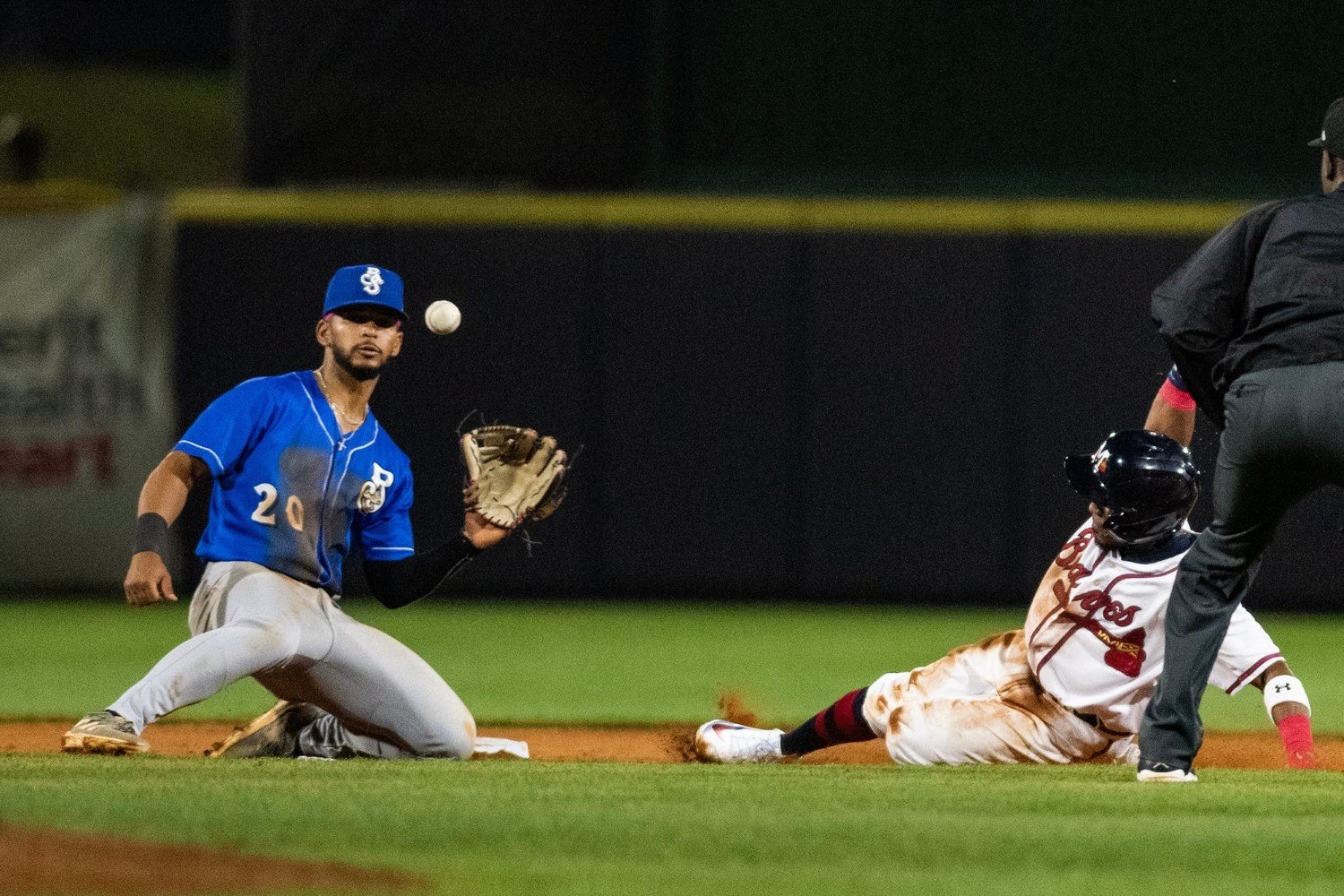
Eric Brown Jr has gotten off to a tumultuous start at Double-A Biloxi. His prospect status has tanked. Could a recent change to his stance help him get back on track? Image courtesy of Lauren Witte - Clarion Ledger I took notice of a change in the positioning of Eric Brown Jr's hands on Jun. 7, when he hit his first home run of the season. That led me to look back at prior game footage to try to figure out when, exactly, the change had happened. I came to the conclusion that Jun. 5 was the day he first debuted the new hand position, at least to its full extent. At the time of the change, Brown Jr was slashing .155/.231/.202, for a wRC+ of 33. He was only walking at a 7% clip, though he did limit his strikeout rate to 16.8%. To put it bluntly, he was off to a horrific start at the plate. While Brown was doing a pretty good job of keeping his defense up to par, and he was 9-for-12 on stolen base attempts, defense and baserunning can only take you so far. The bat has to be providing much better than 70% below league average for any player to be making a positive impact on the game. Having that batting line for any meaningful length of time in the minors means you're near the cliff; your professional future in the game is in jeopardy. These early season struggles are likely what convinced Brown to make the change in June, but what led him to this point? His hands were always in a somewhat weird spot (starting in front of his face), but he hadn’t struggled to anywhere near this extent at any point in his career. Below is a comparison of his load and swing from 2022 in the Complex League to 2023 with the Timber Rattlers (on top) and then earlier this year vs his new setup in 2024 (on bottom). Obviously, his first swing had a ton of moving parts in it. It looks somewhat Keston Hiura-esque on the lower half, and the upper half has a lot of hand movement to get into the launch position. However, this was his swing. It was athletic, and it was something he was comfortable with. While it could have caused timing issues, it had yet to do so. In the second clip, you see that he had really toned down the lower half heading into 2023, and while his hands were still out in front of him, they had less movement as well. In the third clip (which is from earlier this season), he seems to have lost athleticism in the swing, likely through the process of trying to simplify things even further. However, with his hands out in front still, and less power generated in the lower half, his bat speed was much slower than earlier in his career. In the fourth clip, we see some things clicking into place. The hands are starting behind his head, and there’s a bit more rhythm to the operation, helping him get back to a more natural-looking load and swing and get some of his bat speed back. If Brown was going to change his swing, there were likely to be some bumps in the road. He hit a big bump early in the season, but this new swing looks a lot cleaner and he looks a lot more comfortable with it. Which is great, of course, but what about the results? Giving him a few days to adjust to the change, let’s take a look at his stats from Jun. 11 through Jul. 22. In that time, Brown is slashing .275/.364/.418, which is good for a 129 wRC+ in the very pitcher-friendly Southern League. He has hit three home runs in that time, and is walking at an 11.2% clip, while keeping his strikeout rate down at 15%. Without access to batted-ball metrics at the Double-A level, we can’t say for certain that Brown Jr has been hitting the ball with more authority since Jun. 11, though he certainly appears to be. What we can do, though, is compare some of the more important offensive stats that we have access to through FanGraphs and TruMedia. The overall stats have improved, but you may be surprised by some of the batted-ball data. There hasn’t been a drastic change in his ground ball, fly ball, or line drive rates. In fact, he’s actually hitting a slightly lower percentage of line drives since the swing change. One important change is that he has lowered his popup rate from an awful 16% to a below-average 11.7%. Pop-ups are essentially a free out, just as much as a strikeout is, and he has cut that down, while increasing his actual fly-ball rate. Fly balls can turn into home runs and extra-base hits, as long as there is a little juice behind them. The surface-level numbers suggest to us that there is. Another stat that may surprise people is the difference in his rate of hitting the ball up the middle (Center%). His 41.5% rate before the change was in the 97th percentile in Double-A. For most of baseball’s existence, hitters have been told to “hit the ball up the middle,” and the implication is that they will find a lot of success doing so. The issue is that, unless you’re getting a lot of pitches over the heart of the plate, a propensity for hitting the ball up the middle at such a high rate actually often implies some timing issues. It says that you’re out in front of outside pitches a lot, and that you’re late and getting jammed on inside pitches. That’s not even touching on the fact that defensive positioning often takes away the middle of the field, in this day and age. Seeing Brown pulling the ball and going the opposite way more often since the change is a good sign. It implies that he’s both seeing the ball better, as well as being able to start his swing a bit later in the process. That gives him time to read the pitch and react accordingly. On the surface, this was seemingly a simple adjustment for Brown to make, but when you take into account where he started in 2022, this was the culmination of a lot of adjustments and a lot of tinkering. Hopefully, he’s found a comfortable setup and swing now, and it will only be smaller adjustments moving forward. Perhaps this sort of progression to go from the 2022 swing to the current one was always part of the plan. Perhaps it wasn’t. Regardless, it seems like he may have found the best combination of athleticism and simplicity for himself. If the results over the last six weeks are any indication, Brown could be making his way back up the prospect lists that he had fallen to the bottom of--or off of, completely. Had you given up on Brown? if so, does this give you some hope? Let us know what you think about the former first rounder! View full article
-
Has Eric Brown Jr Finally Found His Professional Swing?
Spencer Michaelis posted an article in Minor Leagues
 I took notice of a change in the positioning of Eric Brown Jr's hands on Jun. 7, when he hit his first home run of the season. That led me to look back at prior game footage to try to figure out when, exactly, the change had happened. I came to the conclusion that Jun. 5 was the day he first debuted the new hand position, at least to its full extent. At the time of the change, Brown Jr was slashing .155/.231/.202, for a wRC+ of 33. He was only walking at a 7% clip, though he did limit his strikeout rate to 16.8%. To put it bluntly, he was off to a horrific start at the plate. While Brown was doing a pretty good job of keeping his defense up to par, and he was 9-for-12 on stolen base attempts, defense and baserunning can only take you so far. The bat has to be providing much better than 70% below league average for any player to be making a positive impact on the game. Having that batting line for any meaningful length of time in the minors means you're near the cliff; your professional future in the game is in jeopardy. These early season struggles are likely what convinced Brown to make the change in June, but what led him to this point? His hands were always in a somewhat weird spot (starting in front of his face), but he hadn’t struggled to anywhere near this extent at any point in his career. Below is a comparison of his load and swing from 2022 in the Complex League to 2023 with the Timber Rattlers (on top) and then earlier this year vs his new setup in 2024 (on bottom). Obviously, his first swing had a ton of moving parts in it. It looks somewhat Keston Hiura-esque on the lower half, and the upper half has a lot of hand movement to get into the launch position. However, this was his swing. It was athletic, and it was something he was comfortable with. While it could have caused timing issues, it had yet to do so. In the second clip, you see that he had really toned down the lower half heading into 2023, and while his hands were still out in front of him, they had less movement as well. In the third clip (which is from earlier this season), he seems to have lost athleticism in the swing, likely through the process of trying to simplify things even further. However, with his hands out in front still, and less power generated in the lower half, his bat speed was much slower than earlier in his career. In the fourth clip, we see some things clicking into place. The hands are starting behind his head, and there’s a bit more rhythm to the operation, helping him get back to a more natural-looking load and swing and get some of his bat speed back. If Brown was going to change his swing, there were likely to be some bumps in the road. He hit a big bump early in the season, but this new swing looks a lot cleaner and he looks a lot more comfortable with it. Which is great, of course, but what about the results? Giving him a few days to adjust to the change, let’s take a look at his stats from Jun. 11 through Jul. 22. In that time, Brown is slashing .275/.364/.418, which is good for a 129 wRC+ in the very pitcher-friendly Southern League. He has hit three home runs in that time, and is walking at an 11.2% clip, while keeping his strikeout rate down at 15%. Without access to batted-ball metrics at the Double-A level, we can’t say for certain that Brown Jr has been hitting the ball with more authority since Jun. 11, though he certainly appears to be. What we can do, though, is compare some of the more important offensive stats that we have access to through FanGraphs and TruMedia. The overall stats have improved, but you may be surprised by some of the batted-ball data. There hasn’t been a drastic change in his ground ball, fly ball, or line drive rates. In fact, he’s actually hitting a slightly lower percentage of line drives since the swing change. One important change is that he has lowered his popup rate from an awful 16% to a below-average 11.7%. Pop-ups are essentially a free out, just as much as a strikeout is, and he has cut that down, while increasing his actual fly-ball rate. Fly balls can turn into home runs and extra-base hits, as long as there is a little juice behind them. The surface-level numbers suggest to us that there is. Another stat that may surprise people is the difference in his rate of hitting the ball up the middle (Center%). His 41.5% rate before the change was in the 97th percentile in Double-A. For most of baseball’s existence, hitters have been told to “hit the ball up the middle,” and the implication is that they will find a lot of success doing so. The issue is that, unless you’re getting a lot of pitches over the heart of the plate, a propensity for hitting the ball up the middle at such a high rate actually often implies some timing issues. It says that you’re out in front of outside pitches a lot, and that you’re late and getting jammed on inside pitches. That’s not even touching on the fact that defensive positioning often takes away the middle of the field, in this day and age. Seeing Brown pulling the ball and going the opposite way more often since the change is a good sign. It implies that he’s both seeing the ball better, as well as being able to start his swing a bit later in the process. That gives him time to read the pitch and react accordingly. On the surface, this was seemingly a simple adjustment for Brown to make, but when you take into account where he started in 2022, this was the culmination of a lot of adjustments and a lot of tinkering. Hopefully, he’s found a comfortable setup and swing now, and it will only be smaller adjustments moving forward. Perhaps this sort of progression to go from the 2022 swing to the current one was always part of the plan. Perhaps it wasn’t. Regardless, it seems like he may have found the best combination of athleticism and simplicity for himself. If the results over the last six weeks are any indication, Brown could be making his way back up the prospect lists that he had fallen to the bottom of--or off of, completely. Had you given up on Brown? if so, does this give you some hope? Let us know what you think about the former first rounder!
 -
2024 Draft Signings Thread
Spencer Michaelis replied to Jake McKibbin's topic in MLB Draft & International Signings
He's almost 20 years old already, will be next month I believe. Committed to North Florida. Swing looks solid and he was posting triple digit exit velo's off BP in 2023, but appears he struggled against good competition in the travel circuit. Would be a fun flier to take, for sure though. -
The Brewers have been excellent through their first 100-ish games. But what is in store for them in the second half? The guys discuss a sluggish finish into the All-Star break, what the second half could have in store, how the Brewers could manage a potential bullpen crunch, and more. Spencer also recaps how the Brewers did in this year's MLB Draft. Apple Podcasts: https://podcasts.apple.com/us/podcast/the-brewer-fanatic-podcast/id1740648724 Spotify: https://open.spotify.com/show/5CY8mWsQayqjDXqw9OT2Td\ iHeartRadio: https://www.iheart.com/podcast/263-the-brewer-fanatic-podcast-166534588/ View full article
-
Episode 16: Limping Into The Break & Second Half Preview
Spencer Michaelis posted an article in Podcasts
 The guys discuss a sluggish finish into the All-Star break, what the second half could have in store, how the Brewers could manage a potential bullpen crunch, and more. Spencer also recaps how the Brewers did in this year's MLB Draft. Apple Podcasts: https://podcasts.apple.com/us/podcast/the-brewer-fanatic-podcast/id1740648724 Spotify: https://open.spotify.com/show/5CY8mWsQayqjDXqw9OT2Td\ iHeartRadio: https://www.iheart.com/podcast/263-the-brewer-fanatic-podcast-166534588/
 -
When the baseball industry zigs, the Brewers often zag. In a draft that was considered to be slanted toward college bats, the Brewers only used one of their four Day One selections on a player fitting that description. Instead taking a high school bat in Round 1 and grabbing two prep pitchers with picks 57 and 67. Image courtesy of © Peter Ackerman / USA TODAY NETWORK What are the strengths and opportunities for improvement for these four players, as they begin their journey in pro baseball? Let’s explore. For each pick, you'll find their position, age, school, height, weight, handedness, and position on Jamie Cameron’s consensus board listed under their name. Braylon Payne, 17th Overall Pick OF, 17, Fort Bend Elkins HS (TX), 6’1, 180, L/L (56) The Brewers' selection of Payne was a surprise, to be sure. Ranked 56th on the consensus board, most saw his ceiling as being a potential late-20s or early-30s selection. The Brewers, once again, zagged in this scenario, taking the speedy outfielder at 17, and likely saved some money in the process. Payne’s profile is buoyed by his plus-plus speed. He posted an elite 6.28 time in the 60-yard dash as a Junior. His speed helps him play a really strong center field, though he relies too heavily on that sheer athleticism to be a plus defender at the moment. Still, he generally gets good jumps and takes solid routes. At the plate, Payne made some significant improvements over the course of the last two years. At one point, he was strictly a slap hitter, with a bat path tailored to hitting ground balls. While he certainly still has elements of that approach, he has flattened out the path a bit, and his hit tool is one of the better ones in the high school class. With his quick hands, he also began to show some ability to impact the ball this year (hitting three home runs his senior year), but his power is still likely to max out as fringe-average or average barring a much bigger change to his swing and approach. Bat-to-ball skills are already there for Payne, as well as a sound approach in terms of swing decisions. The Brewers will definitely need to see continued improvement in his ability to lift the ball and in his swing over the next three or four years, but the mold of a star is there for them to work with. While Payne’s defense and speed give him a relatively high floor for a prep player, his bat is still going to be the main factor driving his potential to have a successful major-league career, and there are still many questions about it. Blake Burke, 34th Overall Pick 1B, 21, Tennessee, 6’3, 240, L/L (49) Burke turned 21 about a month before the draft. Standing 6’3" and weighing 240 pounds, his frame and lack of speed confines him to a first-base only profile. Burke will not have any positional versatility, which means he is going to have to hit at a very high level. The good news? He is capable of hitting at that level. Burke has the appearance of your typical power-first “masher”, and that is certainly a big part of his profile, boasting arguably the most power in the entire class. Burke had 51 extra-base hits in 2024, including 20 home runs, one triple, and a Division I-best 30 doubles. He also showed exit velocities of up to 117 MPH on balls that left the yard. The impressive part of Burke’s offensive game is that he’s more than just a power threat. His hit tool grades out as around average, and could be a bit better. Burke limited strikeouts to a 14.9% clip in 2024 and has pretty good bat-to-ball skills in general. Breaking balls can give him trouble from time to time, and those will only be tougher in pro ball, but this isn’t a player who should have huge strikeout concerns. He is known to expand the zone more often than you would want to see, but that can be blamed on an inability to differentiate balls and strikes in the shadow zones. He’s not often flailing at pitches that are nowhere near the zone. Burke’s defense grades as well below average by most publications, but I see someone with pretty good hands. He’s mainly hurt by his general lack of athleticism limiting his range. Something of a Rowdy Tellez type, he shouldn’t make many errors, and should do well with picking bad throws, but won’t be able to get to too many balls that are outside of his wingspan. It’s an offense-first profile, but it’s the type of profile that could be a middle-of-the-order bat. He will be a fun bat to follow in the system, and could move pretty quickly at first. Bryce Meccage, 57th Overall Pick RHP, 18, Pennington HS (NJ), 6’4, 210, S/R (63) Meccage (pronounced like “message”) is a pick that feels very similar to the Josh Knoth selection in 2023. Both Northeast prep players (Knoth being from New York), Knoth could really spin the ball, and Meccage is known for a similar ability to generate spin. Both saw a jump in velocity heading into their senior seasons, too. Meccage has worked with Tread Athletics, a well-known organization that operates similarly to Driveline, since shortly after COVID in 2021. In a short feature on Tread’s YouTube page, Meccage said when he arrived at Tread he was sitting 84-86 on his fastball and had touched 89. He now sits 94-96 and has touched 98 MPH. His fastball is a solid offering, not only due to the velocity but thanks to his high spin rate on the pitch. He has struggled to find a consistent shape with it so far, which is something he will work to improve in pro ball. Meccage throws a slider in the low 80s with some sweep and some depth to it, with high spin rates as well. He also throws a curveball with more depth to it than the slider. The curve comes in a few ticks slower, sitting in the upper 70s. Meccage also throws a changeup in the mid-80s that he has improved significantly over the last couple of years, thanks in large part to Tread teaching him what they call a “kick change” to replace his old changeup. Meccage has solid command, but there's definitely room to grow in that regard. Finding consistency with his changeup and curveball, as well as improving his command will be paramount to his success, especially if he hopes to stick as a starting pitcher. Chris Levonas, 67th Overall Pick RHP, 18, Christian Brothers Academy (NJ), 6’2, 175, L/R (79) Levonas is yet another Northeast prep arm from New Jersey, though his profile is a bit different than those of Knoth and Meccage. Committed to Wake Forest, Levonas will likely receive a signing bonus well over slot value to sign. A five-pitch pitcher who throws a regular four-seam fastball as well as a cutter, Levonas has good qualities in both of them. The four-seam spins up to 2,600 RPM and has around 17” of induced vertical break, with another 10” of horizontal break--all while reaching up to 97 MPH, though it sits in the 92-93 range. It’s a good shape that plays up even more, due to the spin. His upper-80s cutter has had up to 5” of glove-side movement, which is really strong for a cutter. His breaking balls are both high-spin offerings, too. The low-80s slider, with around 13” of sweep, spins at nearly 2,900 RPM, and the mid-70s curveball (with -11 IVB and around the same amount of sweep as the slider) can spin up to 3,000 RPM. Levonas also started flashing a changeup more often this past year, and it has good life to it as well, though the velocity is only around 5 MPH lower than his average fastball. Levonas only weighs around 175 pounds right now, so he will add some mass over time, which could help him bump up that fastball velocity. His delivery is a really athletic one, with his stride looking similar to the way Freddy Peralta jumps down the mound, giving him a ton of extension for a 6’2" frame. The amount of movement in the delivery has caused some command issues as well, so that will be something he will be working to improve. If he can, he certainly has the repertoire to be a starter in the long term. What did you make of the Brewers Day One picks? Who are you excited to see debut in pro ball? Join in the discussion with a comment below. View full article
-
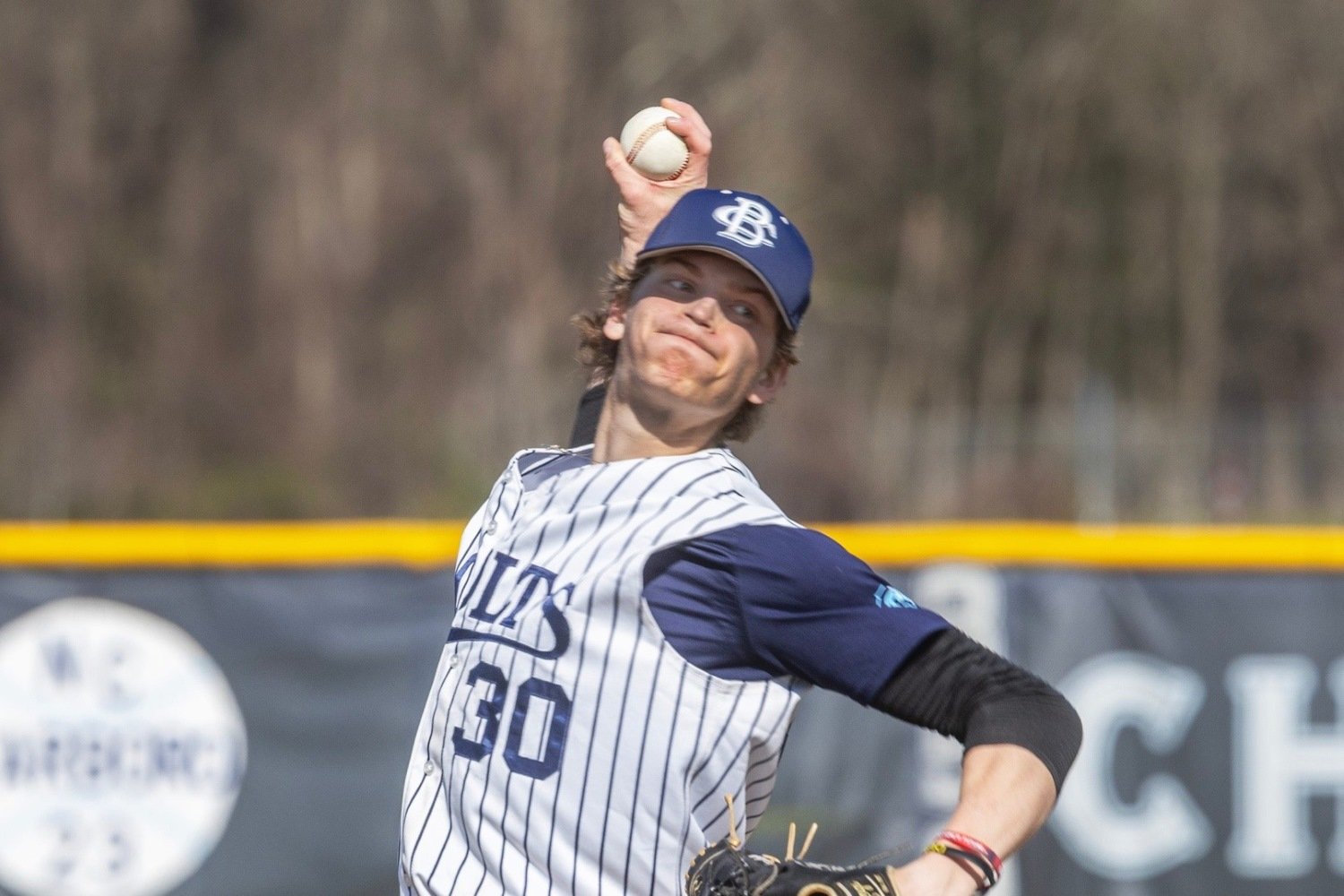 What are the strengths and opportunities for improvement for these four players, as they begin their journey in pro baseball? Let’s explore. For each pick, you'll find their position, age, school, height, weight, handedness, and position on Jamie Cameron’s consensus board listed under their name. Braylon Payne, 17th Overall Pick OF, 17, Fort Bend Elkins HS (TX), 6’1, 180, L/L (56) The Brewers' selection of Payne was a surprise, to be sure. Ranked 56th on the consensus board, most saw his ceiling as being a potential late-20s or early-30s selection. The Brewers, once again, zagged in this scenario, taking the speedy outfielder at 17, and likely saved some money in the process. Payne’s profile is buoyed by his plus-plus speed. He posted an elite 6.28 time in the 60-yard dash as a Junior. His speed helps him play a really strong center field, though he relies too heavily on that sheer athleticism to be a plus defender at the moment. Still, he generally gets good jumps and takes solid routes. At the plate, Payne made some significant improvements over the course of the last two years. At one point, he was strictly a slap hitter, with a bat path tailored to hitting ground balls. While he certainly still has elements of that approach, he has flattened out the path a bit, and his hit tool is one of the better ones in the high school class. With his quick hands, he also began to show some ability to impact the ball this year (hitting three home runs his senior year), but his power is still likely to max out as fringe-average or average barring a much bigger change to his swing and approach. Bat-to-ball skills are already there for Payne, as well as a sound approach in terms of swing decisions. The Brewers will definitely need to see continued improvement in his ability to lift the ball and in his swing over the next three or four years, but the mold of a star is there for them to work with. While Payne’s defense and speed give him a relatively high floor for a prep player, his bat is still going to be the main factor driving his potential to have a successful major-league career, and there are still many questions about it. Blake Burke, 34th Overall Pick 1B, 21, Tennessee, 6’3, 240, L/L (49) Burke turned 21 about a month before the draft. Standing 6’3" and weighing 240 pounds, his frame and lack of speed confines him to a first-base only profile. Burke will not have any positional versatility, which means he is going to have to hit at a very high level. The good news? He is capable of hitting at that level. Burke has the appearance of your typical power-first “masher”, and that is certainly a big part of his profile, boasting arguably the most power in the entire class. Burke had 51 extra-base hits in 2024, including 20 home runs, one triple, and a Division I-best 30 doubles. He also showed exit velocities of up to 117 MPH on balls that left the yard. The impressive part of Burke’s offensive game is that he’s more than just a power threat. His hit tool grades out as around average, and could be a bit better. Burke limited strikeouts to a 14.9% clip in 2024 and has pretty good bat-to-ball skills in general. Breaking balls can give him trouble from time to time, and those will only be tougher in pro ball, but this isn’t a player who should have huge strikeout concerns. He is known to expand the zone more often than you would want to see, but that can be blamed on an inability to differentiate balls and strikes in the shadow zones. He’s not often flailing at pitches that are nowhere near the zone. Burke’s defense grades as well below average by most publications, but I see someone with pretty good hands. He’s mainly hurt by his general lack of athleticism limiting his range. Something of a Rowdy Tellez type, he shouldn’t make many errors, and should do well with picking bad throws, but won’t be able to get to too many balls that are outside of his wingspan. It’s an offense-first profile, but it’s the type of profile that could be a middle-of-the-order bat. He will be a fun bat to follow in the system, and could move pretty quickly at first. Bryce Meccage, 57th Overall Pick RHP, 18, Pennington HS (NJ), 6’4, 210, S/R (63) Meccage (pronounced like “message”) is a pick that feels very similar to the Josh Knoth selection in 2023. Both Northeast prep players (Knoth being from New York), Knoth could really spin the ball, and Meccage is known for a similar ability to generate spin. Both saw a jump in velocity heading into their senior seasons, too. Meccage has worked with Tread Athletics, a well-known organization that operates similarly to Driveline, since shortly after COVID in 2021. In a short feature on Tread’s YouTube page, Meccage said when he arrived at Tread he was sitting 84-86 on his fastball and had touched 89. He now sits 94-96 and has touched 98 MPH. His fastball is a solid offering, not only due to the velocity but thanks to his high spin rate on the pitch. He has struggled to find a consistent shape with it so far, which is something he will work to improve in pro ball. Meccage throws a slider in the low 80s with some sweep and some depth to it, with high spin rates as well. He also throws a curveball with more depth to it than the slider. The curve comes in a few ticks slower, sitting in the upper 70s. Meccage also throws a changeup in the mid-80s that he has improved significantly over the last couple of years, thanks in large part to Tread teaching him what they call a “kick change” to replace his old changeup. Meccage has solid command, but there's definitely room to grow in that regard. Finding consistency with his changeup and curveball, as well as improving his command will be paramount to his success, especially if he hopes to stick as a starting pitcher. Chris Levonas, 67th Overall Pick RHP, 18, Christian Brothers Academy (NJ), 6’2, 175, L/R (79) Levonas is yet another Northeast prep arm from New Jersey, though his profile is a bit different than those of Knoth and Meccage. Committed to Wake Forest, Levonas will likely receive a signing bonus well over slot value to sign. A five-pitch pitcher who throws a regular four-seam fastball as well as a cutter, Levonas has good qualities in both of them. The four-seam spins up to 2,600 RPM and has around 17” of induced vertical break, with another 10” of horizontal break--all while reaching up to 97 MPH, though it sits in the 92-93 range. It’s a good shape that plays up even more, due to the spin. His upper-80s cutter has had up to 5” of glove-side movement, which is really strong for a cutter. His breaking balls are both high-spin offerings, too. The low-80s slider, with around 13” of sweep, spins at nearly 2,900 RPM, and the mid-70s curveball (with -11 IVB and around the same amount of sweep as the slider) can spin up to 3,000 RPM. Levonas also started flashing a changeup more often this past year, and it has good life to it as well, though the velocity is only around 5 MPH lower than his average fastball. Levonas only weighs around 175 pounds right now, so he will add some mass over time, which could help him bump up that fastball velocity. His delivery is a really athletic one, with his stride looking similar to the way Freddy Peralta jumps down the mound, giving him a ton of extension for a 6’2" frame. The amount of movement in the delivery has caused some command issues as well, so that will be something he will be working to improve. If he can, he certainly has the repertoire to be a starter in the long term. What did you make of the Brewers Day One picks? Who are you excited to see debut in pro ball? Join in the discussion with a comment below.

