



Spencer Michaelis
-
Posts
1,119 -
Joined
-
Last visited
-
Days Won
17
Content Type
Profiles
Forums
Blogs
Events
News
2026 Milwaukee Brewers Top Prospects Ranking
Milwaukee Brewers Videos
2022 Milwaukee Brewers Draft Picks
Milwaukee Brewers Free Agent & Trade Rumors, Notes, & Tidbits
Guides & Resources
2023 Milwaukee Brewers Draft Picks
2024 Milwaukee Brewers Draft Picks
The Milwaukee Brewers Players Project
2025 Milwaukee Brewers Draft Pick Tracker
2026 Milwaukee Brewers Draft Tracker: Picks & Bonuses
Store
Downloads
Gallery
Everything posted by Spencer Michaelis
-
10 Surprises of an Illustrious 2023 Brewers Minor League Season
Spencer Michaelis commented on Joseph Zarr's blog entry in What the Eyes See
Great work as always Joseph. You are the only Brewer fan I will concede the title of "Most Hours of Brewers MiLB.tv Watched" to 🤣- 5 comments
-
- 3
-

-

-
- tanner shears
- shane smith
- (and 3 more)
-
Jackson Chourio He's the man. He's locked in for up to a decade. I hope he's starting Opening Day in centerfield. It's going to be a fun time watching him grow at the MLB level.Jeferson Quero Always has been one of my favorites, had him top 3 early on in the 2022 season. He's a stud defender, great leader, and the bat could be quite good. Think he's up in 2024 unless one of Haase/Nola really rebound and also stay healthy.Jacob Misiorowski The arm talent is insane. Probably the best of any pitcher in the minor leagues. Can he hold up as a starter and can the command be serviceable? I lean more toward yes than no, but they're real concerns.Tyler Black He's ready for MLB at bats, not sure the Burnes deal makes it more likely that he makes the team than before the deal, but I still think he's got a good chance to be on the roster.Brock Wilken If you read my draft breakdown, you know I was a little down on Wilken's fit with the Brewers. Having seen him play in person twice while he was in Appleton, and watched him at all three levels... He's grown on me. Defense is still more eh, than good, but it's fine, I think the K's are going to start to show more at the upper levels. But he's more of a gamer than I expected, shows some good instincts on the bases, & hit tool is better than I thought too. Early batted ball data's also very good.DL Hall My breakdown on Hall are all in an article already, but my personal thoughts are that I believe in him being a starter. He made a significant change to his mechanics in 2023 and after that the command was *much* improved, and some of his stuff played better after the change too. I'm in on him being a mid to higher rotation arm.Joey Ortiz I'm high on Ortiz. I think the Brewers have their future SS, assuming Adames isn't extended. The glove is elite, and could be a gold glove level defender at short. Strong arm. I think the bat is going to be better than people expect. He hits the ball extremely hard and makes a ton of contact.Luis Lara I think this is a 70 grade defender in center field with hit-ability traits and more power that he will tap into as he matures. 60 grade baserunner but he's faster than that. Just needs to work on his jumps and that could turn to a 70 as well. Even if the power doesn't come, it's easy to see a lot of similarities to Sal Frelick, but as a switch hitter.Robert Gasser Most seasons we would have seen him in MLB. Post-Burnes deal, I think Gasser will get a real chance to make the rotation out of Spring Training. He should be a solid 3-5 starter with a good pitch mix and the re-found command.Carlos F Rodriguez I think we will most likely see Carlos in MLB at some point this season as well. Southern League Pitcher of the Year, the command will need to continue to get better, but he's a bulldog competitor with really good stuff and a starters mix.Eric Brown Jr Still a huge believer. Excited to see him do pretty well in the AFL, hopefully the start of better injury luck and overall health. I think he's an electric player to watch on the bases and in the field and that the bat is going to be there for him once he gets consistent reps. He started getting back into his legs with his swing in the AFL, which should help him get to some of the pop I think he has.Cooper Pratt Still hard to believe the Brewers got Pratt where they did. Huge upside in pretty much every facet. Will need to be patient with him, but the payoff could be a Gunnar Henderson type. In a few podcast appearances he has talked about gaining some good weight and seeing his exit velo's improve. A good start to adding that power.Yophery Rodriguez Slowed down toward the end of the DSL season. Not uncommon for players in their first season. I think he's the guy this far down that could make the leap to top 5 or so in the system by next year. Gorgeous swing, has the ability to tap into more power as he puts on weight. Already shown some real juice to the pull side and an ability to spray the ball all over the field. Should be solid on basepaths and in the field, arm isn't great but could allow him to move to a corner still.Josh Knoth Ceiling wise, only Miz, and maybe Hall have a higher ceiling in the system. Mid-Upper 90's fastball with great life, two nasty breaking balls. Really just need to see how it looks in pro ball, but he's one that has TOR stuff, which isn't easy to find.Luke Adams I remain extremely high on Adams, I think both his glove and his baserunning are heavily underrated. He might not be the most visually appealing player of all time, but I expect him to be able to get it done as he climbs the ladder.Jorge Quintana Switch hitter, in limited video both swings look pretty good. Reports could be a plus hit tool with a line drive swing. Expected to be able to stick at short, despite size. Excited to see how production follows up the reports.Logan Henderson Still surprised we never saw him in Appleton. I think they just wanted him to lead the Mudcats rotation during their playoff push. Best changeup in the system, fastball with ride that has jumped in velo since draft day. I want to see how it goes at tougher levels and if he can continue to stay healthy like he did in 2023. But this is a potential mid-rotation arm. Needs the slider to improve.Eric Bitonti Huge raw power, the strikeouts will be something to monitor. A very good athlete for his size, he's likely a third baseman, and could be a pretty solid one. Really a guy that I am in wait and see mode on, but the ceiling is very high if he can make contact consistently. Mike Boeve Big time hit tool, started to tap into the power more in pro ball. I think it's there, but it may not be there consistently for a year or so. Similar hitter to Tyler Black prior to his power breakout, but not going to steal bases like Black. Likely a better defender at third and second though, has cleaner actions, though still needs some work to be sure.Ryan Birchard I liked Birchard as a potential Brewers target from the start and I really loved this pick. He shows 60 grade stuff across the board in his FB/CV/SL mix. The fastball had an induced vertical break of 20" in the MLB Draft League which is elite. He can touch up to 98 with the fastball. The curve is a near 3000 RPM hammer and the slider is a 2500 RPM pitch with 12-15" of horizontal break. It's a tiny sample, but got some really strong reviews in instructs. Big time ceiling if he can stick as an SP. Here are the rest of my Top 60ish: I have the international guys that we have some information on with a preliminary ranking based on the small info and video we have. 21 RHP Coleman Crow 22 2B Oliver Dunn 23 RHP Bradley Blalock 24 SS Jesus Made 25 INF Juan Baez 26 RHP Patricio Aquino 27 INF Dylan O'Rae 28 SS Luis Peña 29 1B Wes Clarke 30 SS Joandruw Peña 31 INF Jadher Areinamo 32 RHP Tyler Woessner 33 RHP Jesus Rivero 34 RHP Will Rudy 35 RHP Bishop Letson 36 RHP Craig Yoho 37 1B Tayden Hall 38 2B Pedro Ibarguen 39 C Luis Corobo 40 SS Daniel Guilarte 41 SS Freddy Zamora 42 RHP Evan McKendry 43 RHP Alexander Cornielle 44 RHP Shane Smith 45 OF Blake Perkins 46 OF Carlos Rodriguez (OF) 47 RHP Enniel Cortez 48 LHP Victor Emiliano Garcia 49 C Matthew Wood 50 RHP Stiven Cruz 51 RHP Edwin Jimenez 52 OF Luis Castillo 53 SS Gregory Barrios 54 C Satchell Norman 55 Two Way Quinton Low 56 RHP Yorman Galindez 57 UTIL Noah Campbell 58 RHP Dalvin Bodre 59 SS Kevin Ereu 60 SS Josh Adamczewski
-
To trade, or not to trade, that was the question. On Thursday night, the Brewers chose to trade Corbin Burnes, and the one year of club control left on his deal, to the Baltimore Orioles. In exchange, they received a prospect package, including left-handed pitcher DL Hall. What did the Brewers find so intriguing in Hall? In a trade bound to receive backlash and questions, why are the Brewers “settling” for a post-hype pitcher in a trade that involved giving up one of the best pitchers in their franchise's history? Image courtesy of © Tommy Gilligan-USA TODAY Sports In normal conversation, answering any question with the one-word answer of “stuff” might cause some annoyance on the receiving end of that answer. If that conversation happened with your parents, you might have even found yourself in trouble. For the Brewers, that one-word answer pretty much sums up what they see in Hall and what they hope to build upon. Stuff. Prospect followers have likely heard DL Hall’s name before. At one point, he was seen as one of the fastest-rising pitching prospects in baseball. Some struggles in 2022 caused him to slip back off of many of the mainstream top 100 lists, but he rebounded nicely this past season, including a successful 19.1 innings out of the bullpen at the major league level. No longer qualifying as a prospect by service time standards, Baseball America (who only consider a prospect graduated when they reach the required 130 at-bats or 50 innings pitched plateau) still ranks Hall inside their top 100, as he checks in at 93. He likely would have re-appeared on other lists if he was still eligible. Hall’s “stuff” is one of a myriad of reasons that he was able to bounce back in 2023. Hall is equipped with an elite fastball that averaged 95.6 MPH in MLB in 2023 but has been a tick or two higher throughout his minor league career. Any left-handed pitcher who throws mid-upper 90’s with his fastball will raise some eyebrows. When it comes to Hall, the fastball has characteristics that could make it pretty interesting, even if he only threw it at 91 MPH. One of the most interesting characteristics is his release extension, which comes in at seven feet on average (92nd percentile in MLB during the 2023 season). This means the fastball appears to be a couple of miles per hour higher than the radar gun tells us. It also has a flat Vertical Approach Angle, allowing it to play extremely well at the zone's top. Eno Sarris’s “Stuff+” metric grades the fastball out as 121.5, which ranked 40th amongst pitchers to throw at least 50 fastballs last season. As Nick Pollack of Pitcher List showed in the Tweet below, he doesn’t throw it up in the zone often to right-handed hitters, which is likely something the Brewers will work to adjust. He generated whiffs on 30.2% of his fastballs at the MLB level in 2023, and it’s a pitch that could carry the repertoire even if his secondaries were lagging. The secondaries, however, are not lagging despite, as Curt Hogg pointed out, the fact that the slider did not generate the best results at the MLB level; Stuff+ and scouting grades across the board view Hall's slider as a plus pitch. Baseball America grades it as a 70-grade pitch, a technical "plus-plus." As Lance Brozdowski pointed out in the tweet below, Hall made a major change to the pitch throughout the season. Around June, Hall completely changed the shape of the slider. He added nine inches of drop to the pitch without losing any of its horizontal movement. This took the pitch from a solid offering to the type that gets a 70 grade. The poor results are certainly noteworthy, but it feels safe to say that they likely boiled down to the command of the pitch and it simply being a tiny sample size more than anything else. It doesn't stop with the slider, though. Hall also has a changeup, which grades out quite well by Baseball America, checking in with a 60 grade. Their notes state that the changeup “has developed later in his career into a plus pitch and represents his best offering to right-handed hitters.” While the slider has been primarily used against left-handed hitters, the changeup has been used exclusively against right-handed hitters at the major league level. Throughout Hall’s two stints in MLB, he has thrown 111 changeups, and 110 of them have come against righties. It’s a pitch that he appears to have had some pretty rough luck within MLB so far. In 2023, hitters batted .294 with a .550 slugging against it. The expected stats are much more in line with the Baseball America grade, though, with an xBA of .189 and an xSLG of .368. Hall also brings what Baseball America classifies as a 60-grade curveball. He had scrapped this pitch early in his minor league career but re-surfaced in 2022, and it appears to have been a good call to do so. There’s a separation between the slider and the curveball, not only in the velocity but also in the movement profile. Stuff+ is a bit lower on the curve than Baseball America, but it still has it as 106, meaning it’s above average. His repertoire grades out as having 3-4 plus pitches, or better, by almost every measure, and as Josh Norris points out with this Tweet, he joins Jacob Misiorowski in rarified prospect air with the quality of pitches Hall brings to the table. He hasn’t yet reached the ceiling he is capable of reaching because of a distinct lack of command, which Baseball America placed a 30 grade on. While Hall only walked hitters at a 6.2% rate out of the major league bullpen, that number was quite a bit higher in Triple-A, coming in at 13.8%. The positive is that Eno Sarris’s Location+ backs up the results he was getting in MLB, giving him an overall score of 106, which is above average. If Hall can carry over that level of command to the rotation and over a larger sample, reaching that ceiling starts to look more realistic. It’s easy to see why the Brewers targeted Hall in this return, with his tremendous upside that he mixes with a relatively safe floor. Hall is the type of pitcher that the Brewers have had a lot of success with in recent history. They may have a guy who can be a legitimate top-of-the-rotation arm if he can stick in the rotation. If the command never comes around enough to hold up as a starter, and assuming he remains healthy, the floor should be close to a high-leverage reliever. Perhaps even in the early-career Josh Hader type of role. What are your thoughts on Hall? Do you think he will reach his ceiling? View full article
-
What Are the Brewers Getting in Left-Handed Pitcher DL Hall?
Spencer Michaelis posted an article in Minor Leagues
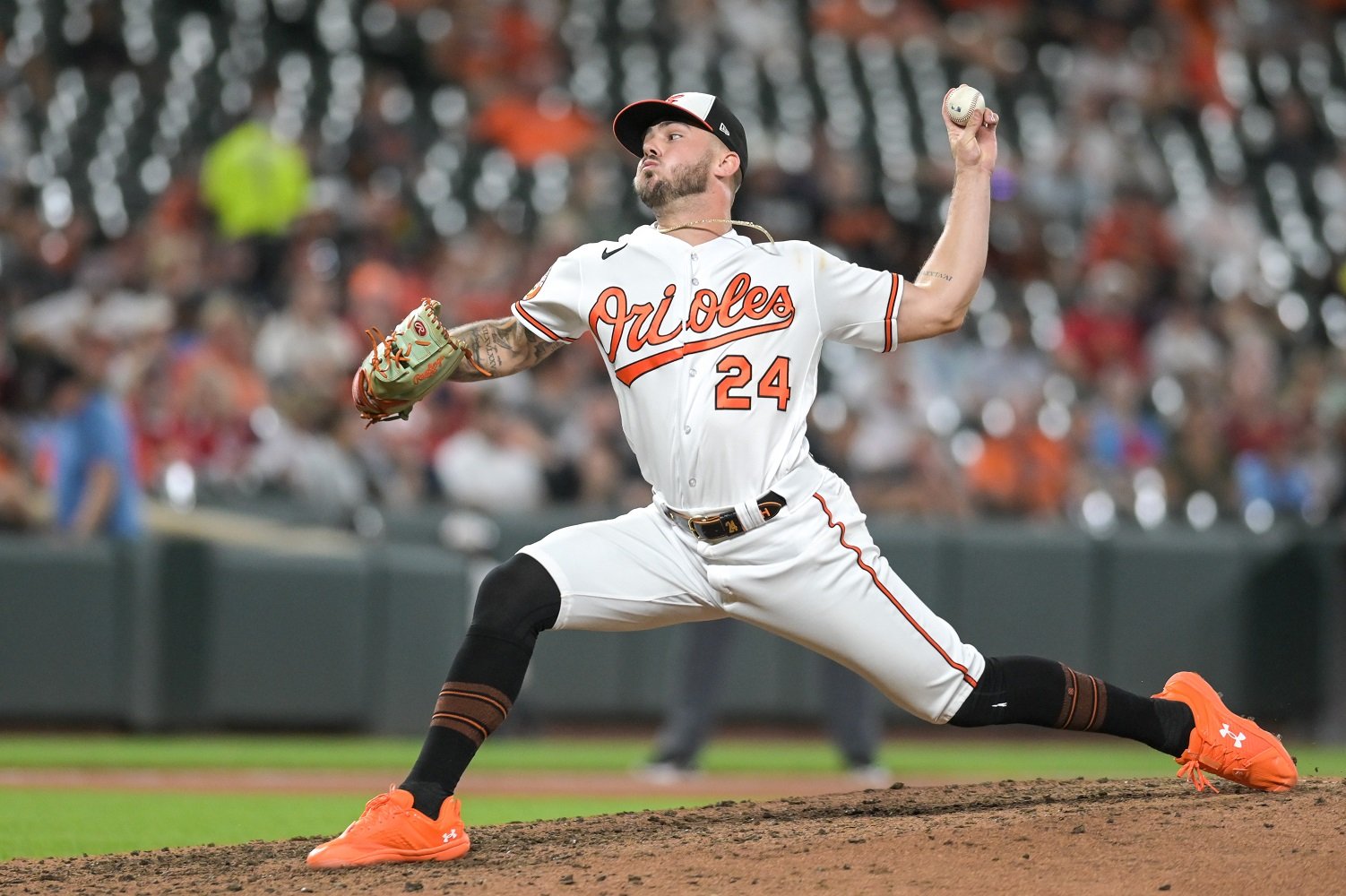 In normal conversation, answering any question with the one-word answer of “stuff” might cause some annoyance on the receiving end of that answer. If that conversation happened with your parents, you might have even found yourself in trouble. For the Brewers, that one-word answer pretty much sums up what they see in Hall and what they hope to build upon. Stuff. Prospect followers have likely heard DL Hall’s name before. At one point, he was seen as one of the fastest-rising pitching prospects in baseball. Some struggles in 2022 caused him to slip back off of many of the mainstream top 100 lists, but he rebounded nicely this past season, including a successful 19.1 innings out of the bullpen at the major league level. No longer qualifying as a prospect by service time standards, Baseball America (who only consider a prospect graduated when they reach the required 130 at-bats or 50 innings pitched plateau) still ranks Hall inside their top 100, as he checks in at 93. He likely would have re-appeared on other lists if he was still eligible. Hall’s “stuff” is one of a myriad of reasons that he was able to bounce back in 2023. Hall is equipped with an elite fastball that averaged 95.6 MPH in MLB in 2023 but has been a tick or two higher throughout his minor league career. Any left-handed pitcher who throws mid-upper 90’s with his fastball will raise some eyebrows. When it comes to Hall, the fastball has characteristics that could make it pretty interesting, even if he only threw it at 91 MPH. One of the most interesting characteristics is his release extension, which comes in at seven feet on average (92nd percentile in MLB during the 2023 season). This means the fastball appears to be a couple of miles per hour higher than the radar gun tells us. It also has a flat Vertical Approach Angle, allowing it to play extremely well at the zone's top. Eno Sarris’s “Stuff+” metric grades the fastball out as 121.5, which ranked 40th amongst pitchers to throw at least 50 fastballs last season. As Nick Pollack of Pitcher List showed in the Tweet below, he doesn’t throw it up in the zone often to right-handed hitters, which is likely something the Brewers will work to adjust. He generated whiffs on 30.2% of his fastballs at the MLB level in 2023, and it’s a pitch that could carry the repertoire even if his secondaries were lagging. The secondaries, however, are not lagging despite, as Curt Hogg pointed out, the fact that the slider did not generate the best results at the MLB level; Stuff+ and scouting grades across the board view Hall's slider as a plus pitch. Baseball America grades it as a 70-grade pitch, a technical "plus-plus." As Lance Brozdowski pointed out in the tweet below, Hall made a major change to the pitch throughout the season. Around June, Hall completely changed the shape of the slider. He added nine inches of drop to the pitch without losing any of its horizontal movement. This took the pitch from a solid offering to the type that gets a 70 grade. The poor results are certainly noteworthy, but it feels safe to say that they likely boiled down to the command of the pitch and it simply being a tiny sample size more than anything else. It doesn't stop with the slider, though. Hall also has a changeup, which grades out quite well by Baseball America, checking in with a 60 grade. Their notes state that the changeup “has developed later in his career into a plus pitch and represents his best offering to right-handed hitters.” While the slider has been primarily used against left-handed hitters, the changeup has been used exclusively against right-handed hitters at the major league level. Throughout Hall’s two stints in MLB, he has thrown 111 changeups, and 110 of them have come against righties. It’s a pitch that he appears to have had some pretty rough luck within MLB so far. In 2023, hitters batted .294 with a .550 slugging against it. The expected stats are much more in line with the Baseball America grade, though, with an xBA of .189 and an xSLG of .368. Hall also brings what Baseball America classifies as a 60-grade curveball. He had scrapped this pitch early in his minor league career but re-surfaced in 2022, and it appears to have been a good call to do so. There’s a separation between the slider and the curveball, not only in the velocity but also in the movement profile. Stuff+ is a bit lower on the curve than Baseball America, but it still has it as 106, meaning it’s above average. His repertoire grades out as having 3-4 plus pitches, or better, by almost every measure, and as Josh Norris points out with this Tweet, he joins Jacob Misiorowski in rarified prospect air with the quality of pitches Hall brings to the table. He hasn’t yet reached the ceiling he is capable of reaching because of a distinct lack of command, which Baseball America placed a 30 grade on. While Hall only walked hitters at a 6.2% rate out of the major league bullpen, that number was quite a bit higher in Triple-A, coming in at 13.8%. The positive is that Eno Sarris’s Location+ backs up the results he was getting in MLB, giving him an overall score of 106, which is above average. If Hall can carry over that level of command to the rotation and over a larger sample, reaching that ceiling starts to look more realistic. It’s easy to see why the Brewers targeted Hall in this return, with his tremendous upside that he mixes with a relatively safe floor. Hall is the type of pitcher that the Brewers have had a lot of success with in recent history. They may have a guy who can be a legitimate top-of-the-rotation arm if he can stick in the rotation. If the command never comes around enough to hold up as a starter, and assuming he remains healthy, the floor should be close to a high-leverage reliever. Perhaps even in the early-career Josh Hader type of role. What are your thoughts on Hall? Do you think he will reach his ceiling?
 -
It should. Black will have made the Baseball America Top 100 and the Pipeline list at that point. The rule states, "Players must be Top 100 in two of the lists compiled by MLB.com, Baseball America or ESPN to qualify."
-
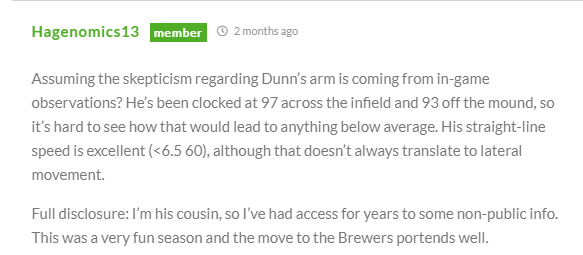
Not to say that the arm is great or anything, but I do recall seeing this comment on a Fangraphs article about Dunn. No way of truly knowing if this is his cousin, but what a weird thing to lie about if he isn't 🤣
- 4 replies
-
- 4
-
-
-
- oliver dunn
- brice turang
- (and 2 more)
-
He's too old to be thought of as a traditional prospect, but the Brewers have an infielder right on the fringe of the big leagues who could provide power and versatility from the left side of the plate in 2024. Image courtesy of © Mike De Sisti / The Milwaukee Journal Sentinel / USA TODAY NETWORK Acquired by the Brewers in a trade with Baltimore for cash in June 2022, Patrick Dorrian had gotten off to a really poor start in Triple-A Norfolk, sitting at a 43 wRC+ through 46 games. In the 48 games he played for the Sounds after the trade, he had a 126 wRC+ and showed some very interesting power flashes, making him a player to watch in 2023. Dorrian’s final numbers in 2023 don’t have the look of a post-hype breakout, at least at the surface level. He finished the season with an 89 wRC+, struck out in over 30 percent of his plate appearances and walked only 8.4 percent of the time. That strikeout rate placed him in the 6th percentile of Triple-A hitters with at least 200 plate appearances. The walk rate was in the 15th percentile. When taking only those surface-level numbers into account, it would be fair to wonder if Dorrian is even deserving of a Triple-A roster spot. Instead, I am going to explore whether or not Dorrian could make an impact at the highest level in 2024. First, Dorrian’s season-long stats can be broken down a bit to account for an extremely slow start and a poor ending, as well. He began the season on the Developmental List, before being activated Apr. 13. From that point through the end of April, Dorrian amassed 41 plate appearances, and came out of the month with a wRC+ of 8. His September was not much better, posting a wRC+ of 17 in 61 plate appearances. If you remove those 102 plate appearances, and only take his four-month stretch of May through August, Dorrian’s numbers look much better. In the 305 plate appearances he had during that stretch, he struck out at a 28.5% rate (rough, but theoretically livable) and had a wRC+ of 115. He also hit 20 of his 21 home runs during that period. His slow start and finish can’t be thrown out entirely, but it does add some context to his final numbers. Now that we have that additional context, let’s take a look at Dorrian’s splits in 2023 and see if anything pops out. A left-handed bat, he appears to be a definite platoon candidate, posting an .845 OPS against right-handed pitchers to go along with a 30.3% strikeout rate. Conversely, Dorrian put up a measly .513 OPS against southpaws, with a 34.9% strikeout rate. While the preference would certainly be for every player to be platoon-proof, teams like the Tampa Bay Rays have shown that there are ways to work around big splits like Dorrian’s. Take a look at the below heat maps for Dorrian showing how he slugged against right-handed pitchers and left-handed pitchers. (All heat maps and charts are courtesy of TruMedia.) SLG vs RHP SLG vs LHP Looking at those maps, it seems that while Dorrian can make a lefty pay when they make a major mistake, any semblance of execution will lead to very poor results. Against right-handed pitchers, though, there is a much wider range of red and green. He seems to struggle with low pitches, especially those that are low and away, but he does a lot of damage against pitches that are thigh-high and above and can cover both sides of the plate pretty well when the pitch is up in the zone. It seems clear (both from his surface level stats and the heat maps) that for Dorrian to be at his best, he will need to be facing right-handed pitchers as often as possible. Thus, we are only going to look at things from that perspective for the rest of this article--beginning with the quality of contact Dorrian has shown against righties. Now that we have honed further in on a certain split, the qualifier for any stat that is given will be based on a minimum of 150 plate appearances against right-handed pitchers. Among the 385 hitters who qualified, Dorrian stood out in a number of categories, especially when it comes to hitting the ball with authority. According to TruMedia, Dorrian’s average exit velocity of 91.2 was in the 95th percentile for qualifiers. Just as importantly, 54.1% of his batted balls were 95 MPH or higher, which was in the 97th percentile. Hitting the ball hard is always a good thing, but it’s a lot better if you’re combining that exit velocity with the ability to lift the ball. A TruMedia Barrel is defined as “a batted ball with an exit velocity >= 95 and a launch angle between 10 and 35 degrees.” Dorrian excelled in that regard as well, coming in with a 24.2% barrel rate, which placed him in the 88th percentile. He also led all 385 qualifiers with an average fly ball distance of 356 feet. When Dorrian hits the ball, it is often hit in a way that will bring him a lot of success. Even on a lot of his outs, he was hitting the ball well. He finished in the 98th percentile in “Hard Outs,” which is an out recorded on a ball hit at least 95 MPH and with a launch angle between 3 and 45 degrees. While that may sound like Dorrian simply had a lot of bad luck in 2023, and while he actually did, there is still more to it than just that. Given the strikeout rate issues mentioned earlier, you may have come to the conclusion that Dorrian has some swing-and-miss issues, and you would be correct in that assumption. His in-zone whiff rate of 29.5% was in the 2nd percentile. His swinging-strike rate of 19.1% was also in the 2nd percentile. Not only are they well below where you would hope a hitter would be, there simply aren’t many (if any) hitters who can succeed with that much swing-and-miss in their game. So what is giving him so much trouble? Is this something that can be fixed? In order to find the issues, we can look a bit deeper at his heat maps and break them down by pitch type. SLG vs RHP only (by pitch type) Looking at these heat maps, we see that Dorrian has quite a bit of red on three maps, in particular. He seems to be able to make solid contact with four-seam fastballs in all quadrants; he does very well with mistake changeups; and he does similarly well with curveballs in the zone. The two that stand out as concerns would be the two-seam/sinker and the slider. Cutters may give him some trouble as well, but the heat map isn’t as damning for that pitch as the other two. Based on those slugging heat maps, we now know which pitches he often does his damage on. Where does the whiff trouble come from? Let’s look at contact rates for those same six pitches. Interestingly, the amount of contact made for Dorrian does not correlate very well with the quality of contact or the results. Dorrian actually does a pretty good job of making contact on sliders and sinkers, but he didn't slug much against either. He doesn’t make very consistent contact on changeups or four-seamers, but slugs quite a bit against both. The only pitch that lines up all the way around is the curveball. He does not miss curveballs in the zone and he does it with hard, elevated contact as well. We can see all of the stats laid out in the chart below and that gives more context to what we see in the heat maps. What we see in this chart is that, despite the lower slugging numbers, Dorrian actually makes hard contact against both sliders and sinkers. The issue for Dorrian against sinkers is that he is pounding them into the ground. His Barrel rate of 12.1% is well below his average, and well below average for qualified hitters in Triple A. When it comes to the slider, there’s actually reason to believe he was pretty unlucky in 2023, posting a very strong Barrel rate of 23.5% and hitting the ball at the ideal launch angle between 10 and 30 degrees 41.2% of the time. Overall, there is reason to believe in Dorrian’s ability to hit all six of the main pitches. There is also some reason to worry with the majority of them. He will need to be able to elevate two-seamers, and he will need to be able to make more consistent contact with the four-seamers and changeups. Given the fact that he also fared well against velocity (.802 OPS against FB 95+ MPH), it’s hard to come away from this deep dive thinking that Dorrian would be incapable of hitting against MLB pitching, as long as his platoon splits are managed carefully. All of this is not even to mention the versatility Dorrian provides defensively. He spent at least 15 games at all four infield positions in 2023. The concern with him falls into the “Jack of All Trades, Master of None” category. He has pretty good hands; his range is good enough to handle the middle infield in a pinch; and his arm is average or better. But he doesn’t really excel at any one spot, and expecting even mediocre shortstop play at the MLB level would probably be pushing it. Luckily for him, a utility player often only needs to be serviceable at multiple spots, and he should be able to handle that. Dorrian may or may not help the Brewers in 2024. He’s certainly got his flaws. But he also has a lot of interesting characteristics that, if utilized correctly, could make him a useful player for the big-league club. Dorrian is a good reminder of why it doesn’t make much sense to complain about minor-league moves, especially based on a couple months of results. If Dorrian does end up making an impact, the replies to this Adam McCalvy tweet announcing the trade could be fun to look back on. Even if he never does impact MLB, he has shown that there was plenty of reason to take a shot on him. What are your thoughts on Dorrian? Do you believe he could impact the Brewers roster in 2024? Let us know below. View full article
-
Is Patrick Dorrian a Valuable Sleeper for the Brewers Infield?
Spencer Michaelis posted an article in Minor Leagues
 Acquired by the Brewers in a trade with Baltimore for cash in June 2022, Patrick Dorrian had gotten off to a really poor start in Triple-A Norfolk, sitting at a 43 wRC+ through 46 games. In the 48 games he played for the Sounds after the trade, he had a 126 wRC+ and showed some very interesting power flashes, making him a player to watch in 2023. Dorrian’s final numbers in 2023 don’t have the look of a post-hype breakout, at least at the surface level. He finished the season with an 89 wRC+, struck out in over 30 percent of his plate appearances and walked only 8.4 percent of the time. That strikeout rate placed him in the 6th percentile of Triple-A hitters with at least 200 plate appearances. The walk rate was in the 15th percentile. When taking only those surface-level numbers into account, it would be fair to wonder if Dorrian is even deserving of a Triple-A roster spot. Instead, I am going to explore whether or not Dorrian could make an impact at the highest level in 2024. First, Dorrian’s season-long stats can be broken down a bit to account for an extremely slow start and a poor ending, as well. He began the season on the Developmental List, before being activated Apr. 13. From that point through the end of April, Dorrian amassed 41 plate appearances, and came out of the month with a wRC+ of 8. His September was not much better, posting a wRC+ of 17 in 61 plate appearances. If you remove those 102 plate appearances, and only take his four-month stretch of May through August, Dorrian’s numbers look much better. In the 305 plate appearances he had during that stretch, he struck out at a 28.5% rate (rough, but theoretically livable) and had a wRC+ of 115. He also hit 20 of his 21 home runs during that period. His slow start and finish can’t be thrown out entirely, but it does add some context to his final numbers. Now that we have that additional context, let’s take a look at Dorrian’s splits in 2023 and see if anything pops out. A left-handed bat, he appears to be a definite platoon candidate, posting an .845 OPS against right-handed pitchers to go along with a 30.3% strikeout rate. Conversely, Dorrian put up a measly .513 OPS against southpaws, with a 34.9% strikeout rate. While the preference would certainly be for every player to be platoon-proof, teams like the Tampa Bay Rays have shown that there are ways to work around big splits like Dorrian’s. Take a look at the below heat maps for Dorrian showing how he slugged against right-handed pitchers and left-handed pitchers. (All heat maps and charts are courtesy of TruMedia.) SLG vs RHP SLG vs LHP Looking at those maps, it seems that while Dorrian can make a lefty pay when they make a major mistake, any semblance of execution will lead to very poor results. Against right-handed pitchers, though, there is a much wider range of red and green. He seems to struggle with low pitches, especially those that are low and away, but he does a lot of damage against pitches that are thigh-high and above and can cover both sides of the plate pretty well when the pitch is up in the zone. It seems clear (both from his surface level stats and the heat maps) that for Dorrian to be at his best, he will need to be facing right-handed pitchers as often as possible. Thus, we are only going to look at things from that perspective for the rest of this article--beginning with the quality of contact Dorrian has shown against righties. Now that we have honed further in on a certain split, the qualifier for any stat that is given will be based on a minimum of 150 plate appearances against right-handed pitchers. Among the 385 hitters who qualified, Dorrian stood out in a number of categories, especially when it comes to hitting the ball with authority. According to TruMedia, Dorrian’s average exit velocity of 91.2 was in the 95th percentile for qualifiers. Just as importantly, 54.1% of his batted balls were 95 MPH or higher, which was in the 97th percentile. Hitting the ball hard is always a good thing, but it’s a lot better if you’re combining that exit velocity with the ability to lift the ball. A TruMedia Barrel is defined as “a batted ball with an exit velocity >= 95 and a launch angle between 10 and 35 degrees.” Dorrian excelled in that regard as well, coming in with a 24.2% barrel rate, which placed him in the 88th percentile. He also led all 385 qualifiers with an average fly ball distance of 356 feet. When Dorrian hits the ball, it is often hit in a way that will bring him a lot of success. Even on a lot of his outs, he was hitting the ball well. He finished in the 98th percentile in “Hard Outs,” which is an out recorded on a ball hit at least 95 MPH and with a launch angle between 3 and 45 degrees. While that may sound like Dorrian simply had a lot of bad luck in 2023, and while he actually did, there is still more to it than just that. Given the strikeout rate issues mentioned earlier, you may have come to the conclusion that Dorrian has some swing-and-miss issues, and you would be correct in that assumption. His in-zone whiff rate of 29.5% was in the 2nd percentile. His swinging-strike rate of 19.1% was also in the 2nd percentile. Not only are they well below where you would hope a hitter would be, there simply aren’t many (if any) hitters who can succeed with that much swing-and-miss in their game. So what is giving him so much trouble? Is this something that can be fixed? In order to find the issues, we can look a bit deeper at his heat maps and break them down by pitch type. SLG vs RHP only (by pitch type) Looking at these heat maps, we see that Dorrian has quite a bit of red on three maps, in particular. He seems to be able to make solid contact with four-seam fastballs in all quadrants; he does very well with mistake changeups; and he does similarly well with curveballs in the zone. The two that stand out as concerns would be the two-seam/sinker and the slider. Cutters may give him some trouble as well, but the heat map isn’t as damning for that pitch as the other two. Based on those slugging heat maps, we now know which pitches he often does his damage on. Where does the whiff trouble come from? Let’s look at contact rates for those same six pitches. Interestingly, the amount of contact made for Dorrian does not correlate very well with the quality of contact or the results. Dorrian actually does a pretty good job of making contact on sliders and sinkers, but he didn't slug much against either. He doesn’t make very consistent contact on changeups or four-seamers, but slugs quite a bit against both. The only pitch that lines up all the way around is the curveball. He does not miss curveballs in the zone and he does it with hard, elevated contact as well. We can see all of the stats laid out in the chart below and that gives more context to what we see in the heat maps. What we see in this chart is that, despite the lower slugging numbers, Dorrian actually makes hard contact against both sliders and sinkers. The issue for Dorrian against sinkers is that he is pounding them into the ground. His Barrel rate of 12.1% is well below his average, and well below average for qualified hitters in Triple A. When it comes to the slider, there’s actually reason to believe he was pretty unlucky in 2023, posting a very strong Barrel rate of 23.5% and hitting the ball at the ideal launch angle between 10 and 30 degrees 41.2% of the time. Overall, there is reason to believe in Dorrian’s ability to hit all six of the main pitches. There is also some reason to worry with the majority of them. He will need to be able to elevate two-seamers, and he will need to be able to make more consistent contact with the four-seamers and changeups. Given the fact that he also fared well against velocity (.802 OPS against FB 95+ MPH), it’s hard to come away from this deep dive thinking that Dorrian would be incapable of hitting against MLB pitching, as long as his platoon splits are managed carefully. All of this is not even to mention the versatility Dorrian provides defensively. He spent at least 15 games at all four infield positions in 2023. The concern with him falls into the “Jack of All Trades, Master of None” category. He has pretty good hands; his range is good enough to handle the middle infield in a pinch; and his arm is average or better. But he doesn’t really excel at any one spot, and expecting even mediocre shortstop play at the MLB level would probably be pushing it. Luckily for him, a utility player often only needs to be serviceable at multiple spots, and he should be able to handle that. Dorrian may or may not help the Brewers in 2024. He’s certainly got his flaws. But he also has a lot of interesting characteristics that, if utilized correctly, could make him a useful player for the big-league club. Dorrian is a good reminder of why it doesn’t make much sense to complain about minor-league moves, especially based on a couple months of results. If Dorrian does end up making an impact, the replies to this Adam McCalvy tweet announcing the trade could be fun to look back on. Even if he never does impact MLB, he has shown that there was plenty of reason to take a shot on him. What are your thoughts on Dorrian? Do you believe he could impact the Brewers roster in 2024? Let us know below.
 -
It is possible it will change a bit for sure. The tough part about VAA is it doesn’t always correlate with the IVB (the inches of carry). It can be caused more by a low release point than simply by the carry of the ball. But it is definitely something we will have to watch.
-
Definitely an interesting article! My issue with it, is that there are very different shapes on every pitch. I like that they added a sweeper classification, because it is definitely a different pitch than anything else they have. But I also feel like you could start having a bunch of different names for four-seam fastballs if you wanted, given some ride, some run, some are plain flat. If we separate every pitch to the Nth degree, I feel like it'll just become too watered down eventually. It's definitely a hard balance to strike though lol, because I definitely get your point.
-
I am referring to that one as the sinker yes. In my opinion, two-seamers and sinkers are the same pitch. In fact, I believe MLB doesn't classify them as two-seamers anymore either. The fastball classifications they have are four-seam, cutter and sinker. It was always weird how they separated them to me, so I'm glad they've gone away from it haha.
-
Unfortunately I don’t think there Is one, single thing that will always translate to success, but outlier pitch metrics tend to give guys a better chance at success. The curveball also gets very poor results against it, from the hitters perspective, and moves more than any curve in baseball. The slider gets really poor contact and a lot of swing and miss as well. It’s not simply the way the pitch moves that’s interesting. Though I would personally argue that the quality of the pitches is more predictive of future success, as players progress through the upper levels, than their surface level results are. Edit: forgot to answer #2. I’m not sure anyone knows for sure, but Tommy John is a very routine procedure these days. It’s pretty much been perfected. Outside of the missed time it takes to rehab, there’s usually not much of a stepback for pitchers. Some even come back throwing harder. Shoulder injuries are the career killers these days.
-
I’d say next to zero for the chances of him becoming a MiLB FA. Unless his rehab goes horribly, I’d expect him to be on the 40 Man next offseason.
-
On Wednesday, the Brewers and Matt Arnold made their first trade with an old friend when David Stearns and the Mets agreed to send Coleman Crow to the Crew. In return, they received starting pitcher Adrian Houser and outfielder Tyrone Taylor. In this article, let's take a closer look at Crow. Image courtesy of © Mark J. Rebilas-USA TODAY Sports Coleman Crow was a 28th-round selection by the Angels in 2019, but he didn’t make his professional debut until 2021 due to COVID-19. He worked through the system over the next two years, starting in 2023 in Double A. He made four starts before going on the Injured List with an elbow issue that would eventually lead to Tommy John surgery. Despite the injury, he was dealt to the Mets in a trade for former Brewer Eduardo Escobar in late June. He underwent his procedure in August and will probably miss most (if not all) of the 2024 season. With knowledge of all of that, the Brewers still decided he was worth two respectable big-league players. What did they see in order to make this trade worthwhile from Milwaukee’s standpoint? They saw outlier spin and outlier movement to go along with solid command. Specifically, they saw major outlier qualities in his breaking balls. We would be remiss to ignore (as with any Southern League pitcher who threw in the first half of the season last year) that the spin rates and the movement on his pitches were inflated a bit due to the pre-tacked baseballs they were using. However, simply put, if you can spin the baseball, you can spin the baseball. Crow can do that. Looking first at his four-seam fastball, Crow only sits in the 90-92 range on the pitch, though he can sometimes bump it to 93 or 94. That type of velocity certainly won’t be blowing hitters away. However, his -4 degree Vertical Approach Angle (VAA) could still make the fastball relatively effective. VAA is a term and a measurement that has only existed for a few years. It measures the steepness at which the ball travels as it enters the zone. The average four-seam fastball in MLB the last couple of years has been around -5 degrees. While the difference of only one degree may not seem all that noteworthy, it is a much bigger difference than it appears on the surface. Batters have trained the majority of their lives against fastballs that come in around the average VAA. They are used to the ball following a somewhat predictable downward path based on gravity, speed, and spin. Connecting with any pitch requires a split-second decision. Batters often have to rely on the law of averages for how pitches move. That’s why outliers in either direction are valued so highly. Outliers play tricks on the eyes of hitters. A -4 degree fastball is much flatter than what most offensive players are used to, and it often causes them to swing under the ball. For example, Freddy Peralta is known for his “invisible fastball,” and a big reason for that is his VAA of -3.91 degrees on the pitch. Barring a jump in velocity, the fastball will probably never be more than an average offering, and he will most likely always be prone to some home run issues because of it. Still, the VAA is the reason it shouldn’t be a big enough issue to ruin his chances of starting. The breaking balls are Crow's real appeal, namely his curveball. Not only does he command it well, but according to Baseball America, “his curveball has some of the highest horizontal sweep and spin rate of any curve in baseball. It has the most glove-side run of any curveball in the upper levels, including the majors.” There isn’t much more that needs to be said about the pitch. It’s minimally a plus offering, if not better, and the pitch will likely carry him throughout his career. Crow also mixes in a slider with high spin numbers and a good amount of sweep. The slider has generated strong chase rates and created a lot of soft contact. It’s a pitch that some evaluators think he should throw more often to right-handed hitters, and a team like the Brewers is more likely to instruct him to do so than an organization like the Angels would have been. When he returns from his injury, it will be interesting to see which direction the Brewers take his pitch mix. Curt Hogg of the Milwaukee Journal Sentinel had a Twitter thread showing all three pitches discussed above. Beyond his primary, three-pitch mix, Crow also sprinkles in a sinker occasionally, as well as a changeup. Both are lagging behind the four-seam fastball and slider, and they are well behind the curveball. The development of either would benefit him greatly. Still, given his propensity for spinning breaking balls, he is most likely what is referred to as a “supinator” (meaning it’s easier for him to rotate his fingers on the outside of the ball) than a “pronator” (Devin Williams is a definite pronator, as he can rotate the ball the opposite direction better than almost anyone). That could prove a challenge when trying to develop the changeup specifically. The good news is that he could get by with just those three main pitches. While Crow will probably miss the 2024 season, there is reason to be excited about his potential. He possesses an arsenal that, combined with his strong command, could eventually make him a mid-rotation caliber starter. Adrian Houser and Tyrone Taylor were not a cheap price for an arm of this caliber. He will need further refinement of his fastball and slider and, more importantly, a clean recovery from Tommy John, but the pieces are there for Crow. The Brewers hope to help him combine those pieces to form an even larger piece of the puzzle. That is, the post-Burnes and Woodruff starting rotation puzzle. What are your thoughts on Crow? Do you feel better about the deal now that you have seen the upside he could bring? Let us know! View full article
-
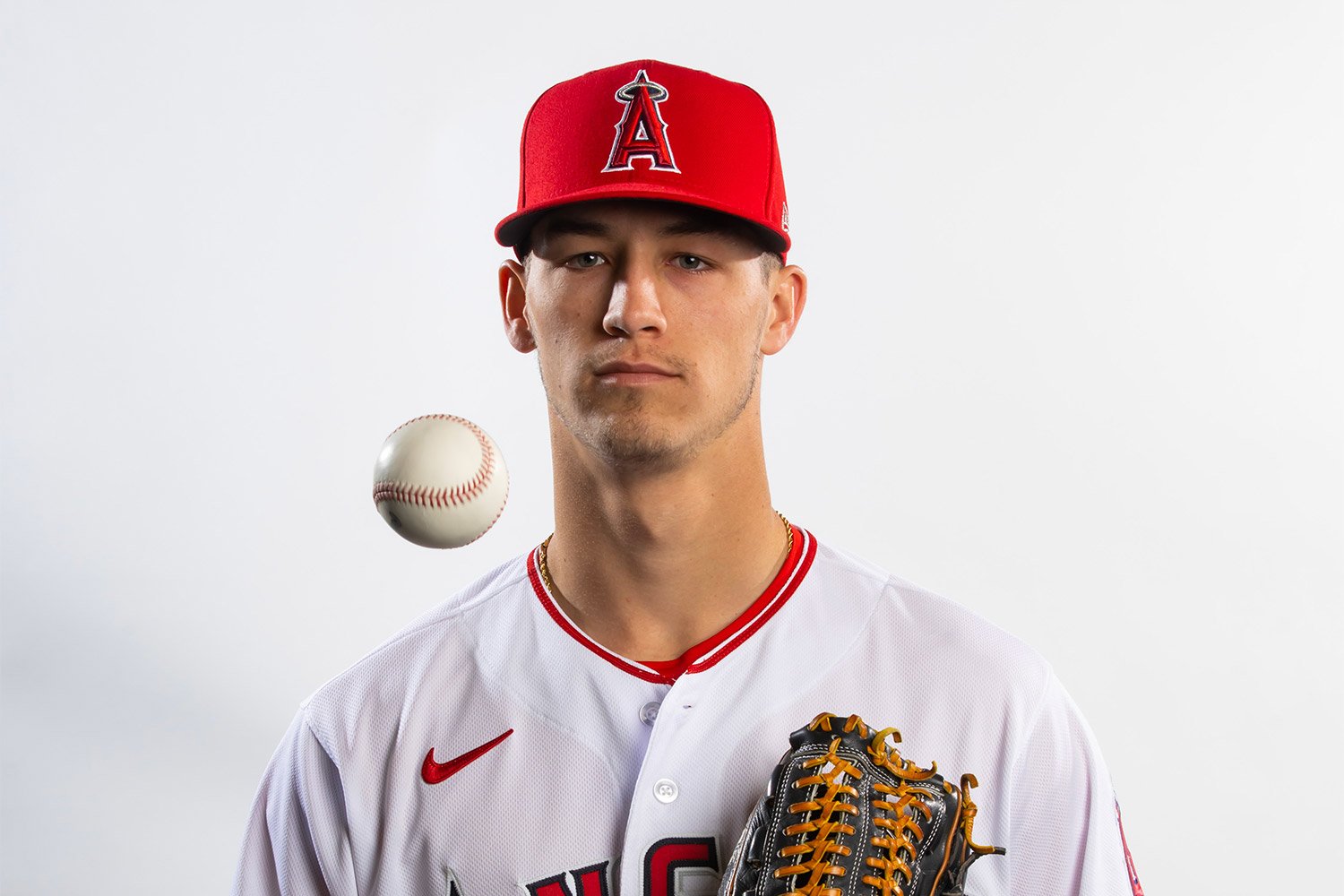 Coleman Crow was a 28th-round selection by the Angels in 2019, but he didn’t make his professional debut until 2021 due to COVID-19. He worked through the system over the next two years, starting in 2023 in Double A. He made four starts before going on the Injured List with an elbow issue that would eventually lead to Tommy John surgery. Despite the injury, he was dealt to the Mets in a trade for former Brewer Eduardo Escobar in late June. He underwent his procedure in August and will probably miss most (if not all) of the 2024 season. With knowledge of all of that, the Brewers still decided he was worth two respectable big-league players. What did they see in order to make this trade worthwhile from Milwaukee’s standpoint? They saw outlier spin and outlier movement to go along with solid command. Specifically, they saw major outlier qualities in his breaking balls. We would be remiss to ignore (as with any Southern League pitcher who threw in the first half of the season last year) that the spin rates and the movement on his pitches were inflated a bit due to the pre-tacked baseballs they were using. However, simply put, if you can spin the baseball, you can spin the baseball. Crow can do that. Looking first at his four-seam fastball, Crow only sits in the 90-92 range on the pitch, though he can sometimes bump it to 93 or 94. That type of velocity certainly won’t be blowing hitters away. However, his -4 degree Vertical Approach Angle (VAA) could still make the fastball relatively effective. VAA is a term and a measurement that has only existed for a few years. It measures the steepness at which the ball travels as it enters the zone. The average four-seam fastball in MLB the last couple of years has been around -5 degrees. While the difference of only one degree may not seem all that noteworthy, it is a much bigger difference than it appears on the surface. Batters have trained the majority of their lives against fastballs that come in around the average VAA. They are used to the ball following a somewhat predictable downward path based on gravity, speed, and spin. Connecting with any pitch requires a split-second decision. Batters often have to rely on the law of averages for how pitches move. That’s why outliers in either direction are valued so highly. Outliers play tricks on the eyes of hitters. A -4 degree fastball is much flatter than what most offensive players are used to, and it often causes them to swing under the ball. For example, Freddy Peralta is known for his “invisible fastball,” and a big reason for that is his VAA of -3.91 degrees on the pitch. Barring a jump in velocity, the fastball will probably never be more than an average offering, and he will most likely always be prone to some home run issues because of it. Still, the VAA is the reason it shouldn’t be a big enough issue to ruin his chances of starting. The breaking balls are Crow's real appeal, namely his curveball. Not only does he command it well, but according to Baseball America, “his curveball has some of the highest horizontal sweep and spin rate of any curve in baseball. It has the most glove-side run of any curveball in the upper levels, including the majors.” There isn’t much more that needs to be said about the pitch. It’s minimally a plus offering, if not better, and the pitch will likely carry him throughout his career. Crow also mixes in a slider with high spin numbers and a good amount of sweep. The slider has generated strong chase rates and created a lot of soft contact. It’s a pitch that some evaluators think he should throw more often to right-handed hitters, and a team like the Brewers is more likely to instruct him to do so than an organization like the Angels would have been. When he returns from his injury, it will be interesting to see which direction the Brewers take his pitch mix. Curt Hogg of the Milwaukee Journal Sentinel had a Twitter thread showing all three pitches discussed above. Beyond his primary, three-pitch mix, Crow also sprinkles in a sinker occasionally, as well as a changeup. Both are lagging behind the four-seam fastball and slider, and they are well behind the curveball. The development of either would benefit him greatly. Still, given his propensity for spinning breaking balls, he is most likely what is referred to as a “supinator” (meaning it’s easier for him to rotate his fingers on the outside of the ball) than a “pronator” (Devin Williams is a definite pronator, as he can rotate the ball the opposite direction better than almost anyone). That could prove a challenge when trying to develop the changeup specifically. The good news is that he could get by with just those three main pitches. While Crow will probably miss the 2024 season, there is reason to be excited about his potential. He possesses an arsenal that, combined with his strong command, could eventually make him a mid-rotation caliber starter. Adrian Houser and Tyrone Taylor were not a cheap price for an arm of this caliber. He will need further refinement of his fastball and slider and, more importantly, a clean recovery from Tommy John, but the pieces are there for Crow. The Brewers hope to help him combine those pieces to form an even larger piece of the puzzle. That is, the post-Burnes and Woodruff starting rotation puzzle. What are your thoughts on Crow? Do you feel better about the deal now that you have seen the upside he could bring? Let us know!
 -
Smichaelis9’s 2024 Payroll Blueprint
Spencer Michaelis replied to Spencer Michaelis's topic in Transaction Rumors & Proposals
I think the difference in opinion is that I don't have hardly any confidence in Turang moving forward. There were always a ton of red flags with his bat and I'm not convinced the defense will play up as much at short as it does at second. If he did get traded and Adames ended up leaving or being traded as well, I think you could at least find someone who would bring as much value as Turang at short without much of a struggle. At least to hold you over until hopefully one of the lower level guys or EBJ can separate themselves. -
Smichaelis9’s 2024 Payroll Blueprint
Spencer Michaelis replied to Spencer Michaelis's topic in Transaction Rumors & Proposals
Appreciate you taking the time to read, the thoughts and the compliment! The Murphy deal is probably higher than it would actually take, I just couldn't find any predictions for him and since I had plenty of space in my "budget" I definitely went on the higher end. I do think there's a lot more value to a good backup catcher though, more than most. Imo, it's the most important non-pitching position to have good depth at. As for Turang, I think I'd be a lot more surprised if he does hit, unfortunately. He was essentially a league average hitter from High-A to Triple-A in his final three full minor league seasons (wRC+ of 88, 99 and 108). I think if he can be a league average hitter at MLB that he would definitely have a lot of value at 2B. I'm just not super sold on it. I would absolutely love to be wrong. I think Adames is going to be able to fetch a lot more money than we may hope. The shortstop market is so bare this year and doesn't appear to be much better next year. But if an extension is possible at a reasonable rate, I am with you in saying I would love to see it. -
Smichaelis9’s 2024 Payroll Blueprint
Spencer Michaelis replied to Spencer Michaelis's topic in Transaction Rumors & Proposals
Appreciate that! I definitely get where you're coming from on the Turang trade. I have always been a bit lower on him, so didn't feel too bad about that, but I definitely get it. -
Smichaelis9’s 2024 Payroll Blueprint
Spencer Michaelis replied to Spencer Michaelis's topic in Transaction Rumors & Proposals
Yeah, tbh I decided to sign Murphy before I considered what the contract would actually be, and I have no idea if it would actually be around $10 mil. I couldn't find any predictions for his deal. I decided to go on the high end. That said, I do think there's a ton of value to having a good backup catcher and if funds aren't being allocated elsewhere, I have zero issue with solidifying that spot on a one year deal of any type. My guess as to what they will actually do is to simply bring Caratini back at this point. Especially with it looking like they're going to keep Burnes. -
Trade #1 BAL Acquires: RHP Corbin Burnes MIL Acquires: 3B/1B Coby Mayo, OF Dylan Beavers, RHP Trace Bright I believe the Brewers can trade Burnes and still be competitive in 2024. That's the aim of this trade. The Orioles receive the frontline starter they were missing in the playoffs this past season (though they will need to be convinced Burnes is that type of guy in the bigger moments). The Brewers acquire one of their starting corner infielders for 2024 in Mayo. Beavers was a guy the Brewers liked a lot in the draft a year and a half ago, and Bright has some really good stuff, but middling command at the moment. Someone who could impact the MLB rotation by 2025 with an uptick in the command, or become a helpful pen arm even if the command doesn't improve much. Trade #2 SEA Acquires: OF Garrett Mitchell, SS Freddy Zamora MIL Acquires: RHP Bryan Woo Both teams trade a strength for a relative weakness. The Brewers acquire a very talented young starter that could be part of the next era for this team. They are lacking some upper level pitching talent at the moment, especially in terms of sure-fire starters. Woo would really help fill that void that Woodruff and Burnes would be leaving behind. The Mariners acquire an outfielder that could form an incredible defensive outfield with J-Rod, and he does have a lot of interesting offensive qualities. This would obviously rely on the Mariners being enamored with Mitchell's tools, and it's hard to know how he's valued league wide. If they're on the higher side of the Mitchell evaluation, then they are likely interested in this type of deal. If they're on the lower side, they would likely decline without a second thought. Idk, I'm having fun here so I'll lean toward a shot of it being accepted. Trade #3 MIN Acquires: 2B/SS Brice Turang, RHP Yorman Galindez MIL Acquires: 2B Jorge Polanco Polanco adds some much needed power to the lineup, and does it at one of the worst offensive spots for the Brewers in 2023. For Minnesota, they're looking to shed some salary and Polanco is a clear candidate for that, so the return will likely need to be solid, but not spectacular. Polanco does have a team option for 2025 as well. Turang gives them a very solid defensive floor and at least a semi-interesting bat to work with to go along with some of the excitement that a post-hype prospect seems to bring teams. The Brewers also include a pretty interesting young pitcher in Galindez, with a very good curveball, in the deal to sweeten the pot a bit. Again, this is very dependent on how the Twins would view Turang and you may have to improve the secondary piece in the trade. Galindez is a guy I'm high on personally, but that doesn't mean the Twins are. Free Agency Free Agent Signing #1 RHP Luis Severino (1 year/$15 million) Severino has really struggled with health for a few years now, so definite risk here. When he is healthy and "on", very few compare to him in terms of their ability. A one year flier might not be enough to get it done, but if I were in his spot, there aren't many better organizations to sign a "prove it" deal with Free Agent Signing #2 C Tom Murphy (1 year/$10.0 million) Brewers could use a backup catcher, Murphy is coming off a couple of very strong seasons in that role with the Mariners. If Quero proves to be ready mid-season, or the Brewers are falling out of contention, then Murphy could be a very nice trade piece at the deadline. Free Agent Signing #3 1B/DH Carlos Santana (1 year/$8.0 million) Bringing Santana back because I think he's a good vet presence, has a good approach at the plate and should continue to be a decent hitter. I wouldn't want him hitting 3 or 4 anymore, but you could do a lot worse than Santana in the, for example, sixth spot. His defense at first is a plus as well. Summary The trades are iffy, and I totally get if people push back against them. Baseball is so reliant on each organizations assessment of a player, that it is foolish to believe we can really figure out what makes sense in both teams' eyes. For example, the A's thought that Esteury Ruiz was worth William Contreras, Joel Payamps and Justin Yeager. Nobody understood that even at the time of the trade, but they thought it was the best way to go. I feel like the Burnes trade is the most realistic, but if you told me the other two got made, I wouldn't be shocked. So, that's the logic there. Maybe somewhat surprisingly, Chourio, Black and Gasser (as well as Mayo) all make my OD roster, while Joey Wiemer gets a chance to get every day playing time in Nashville for now. I'd be expecting Black to play some first, some second and some third on this roster. The DH spot is very unlikely to be filled by the same player on a regular basis. Yelich, Contreras, Murphy, Santana, etc would all see time in that spot as well. Despite those four rookies all being relied upon (along with Frelick and a young arm in Woo), I am planning on this team competing in 2024. Think there's a good blend of youth and experience on this roster. The bullpen does not have much "shuttle" flexibility due to a lack of optionable arms, but neither did the 2023 version and they made it work just fine. There are bound to be injuries and other circumstances allowing some of the optionable pitchers to make appearances throughout the season. Aaron Ashby's ability to recover from his injury could swing some decisions this offseason as well. Healthy Ashby has some of the best stuff of any lefty in baseball. But as we know, shoulder injuries are very tough on pitchers. Last thing, even if this team were to struggle to contend, they would have teams knocking down the door to make deals with them at the deadline, with guys like Adames, Murphy, Polanco, Santana, etc. which would hopefully mean 2024 would be the only down year before a bounce back in 2025. C: William Contreras ($0.77M) 1B: Carlos Santana ($8.0M) 2B: Jorge Polanco ($10.50M) 3B: Coby Mayo ($0.77M) SS: Willy Adames ($12.40M) LF: Christian Yelich ($26.00M) CF: Jackson Chourio ($0.77M) RF: Sal Frelick ($0.77M) DH: Tyler Black ($0.77M) Bench OF: Tyrone Taylor ($1.70M) Utility: Jake Bauers ($1.70M) Utility: Andruw Monasterio ($0.77M) Backup C: Tom Murphy ($10.00M) SP1: Freddy Peralta ($5.50M) SP2: Luis Severino ($15.00M) SP3: Bryan Woo ($0.77M) SP4: Robert Gasser ($0.77M) SP5: Adrian Houser ($5.60M) CL: Devin Williams ($6.50M) RP: Abner Uribe ($0.77M) RP: Hoby Milner ($1.70M) RP: Bryse Wilson ($1.30M) RP: Joel Payamps ($1.70M) RP: Trevor Megill ($0.77M) RP: Elvis Peguero ($0.77M) RP: Colin Rea ($3.50M) Payroll is 14.59% under budget
-
Episodes 2-5 of the Cream City Club Podcast
Spencer Michaelis posted a blog entry in The Cream City Club Podcast
Hey everyone, I will try to do a better job of keeping up with this here, but we have released 4 more episodes of the podcast now. I have links and a brief description of all of them below, we'd love if you would check it out! Again, we are very open to feedback as well! For Brewers fans specifically, Episode 3 and 5 are likely the ones you will be most interested in 🙂 Links to the Podcast: Apple Podcasts: https://podcasts.apple.com/us/podcast/the-cream-city-club-podcast/id1715593489 Spotify: https://open.spotify.com/show/5vOSy8yXOjlqZqaooT26KR?si=148cc1bddabb49a0 YouTube: https://www.youtube.com/@TheCreamCityClubPod Episode 2 (Released on 11/13/2023) In this episode Gunner and Spencer assess Adrian Griffin's start as the Milwaukee Bucks head coach. What has gone right? What has gone wrong? Where should he go from here? They also discuss the Dame and Giannis pairing, Khris Middleton's health and answer a number of questions from listeners. Episode 3 (Released on 11/16/2023) In this episode Gunner and Spencer are joined by Jack Stern (@ByJackStern on Twitter) to discuss the managerial hiring of Pat Murphy, the transactions that have already taken place this offseason (including Colin Rea's return, as well as a trade that happened mid-pod). They also take a look forward at the rest of the offseason and answer some listener questions. Episode 4 (Released on 11/21/2023) In this episode Gunner and Spencer break down the Bucks 5 game winning streak and the changes they have seen. They also preview the Celtics game coming up on 11/22 and further discuss Damian Lillard's fit within the team and the defense, as well as the defense as a whole. Episode 5 (Released on 11/21/2023) In this episode Gunner and Spencer break down what Brandon Woodruff meant to the franchise and why the Brewers made the decision that they did. They also discussed the possibility of a Burnes trade and some of Burnes' recent comments about extensions and more (Spencer rants during this portion, in case that interests you). They talked about the Jake Bauers trade, and also mentioned some other potential trade candidates the Brewers could be interested in. -
Dunn is 19 for me
-
Hey everyone, I appreciate everybody following along with the prospect content I have been fortunate enough to put out on here. I wanted to let you all know that I and one of my friends from college, Gunner Amelunk, have started a podcast called The Cream City Club Podcast. It is out on Apple, Spotify, as well as YouTube. Our plan is to discuss the current happenings with the Brewers, as well as the Milwaukee Bucks. The goal will be to focus the episodes on one or the other though, so if you're not a Bucks fan you shouldn't have to listen to us ramble about them, while waiting to get to the Brewers content. The first episode released this morning on all three platforms, discussing (what else) the Craig Counsell situation. The links below will take you to the pod and if you would like to shoot us a follow on whatever platform you choose to use, as well as on Twitter/X the handle is @TheCreamCityPod and our personal handles are @smichaelis234 and @GunnerAmelunk . Apple Podcasts: https://podcasts.apple.com/us/podcast/the-cream-city-club-podcast/id1715593489 Spotify: https://open.spotify.com/show/5vOSy8yXOjlqZqaooT26KR?si=148cc1bddabb49a0 YouTube: https://www.youtube.com/@TheCreamCityClubPod If you ever have questions or prompts you would like us to discuss, the best place to do that would be at the podcast's Twitter handle, but my personal handle should work as well. Both of us are new to this (and you can probably tell in the first episode), so the hope is that the fluidity will get better as we go along. We are very open to feedback and appreciate any of you who give it a shot!
-
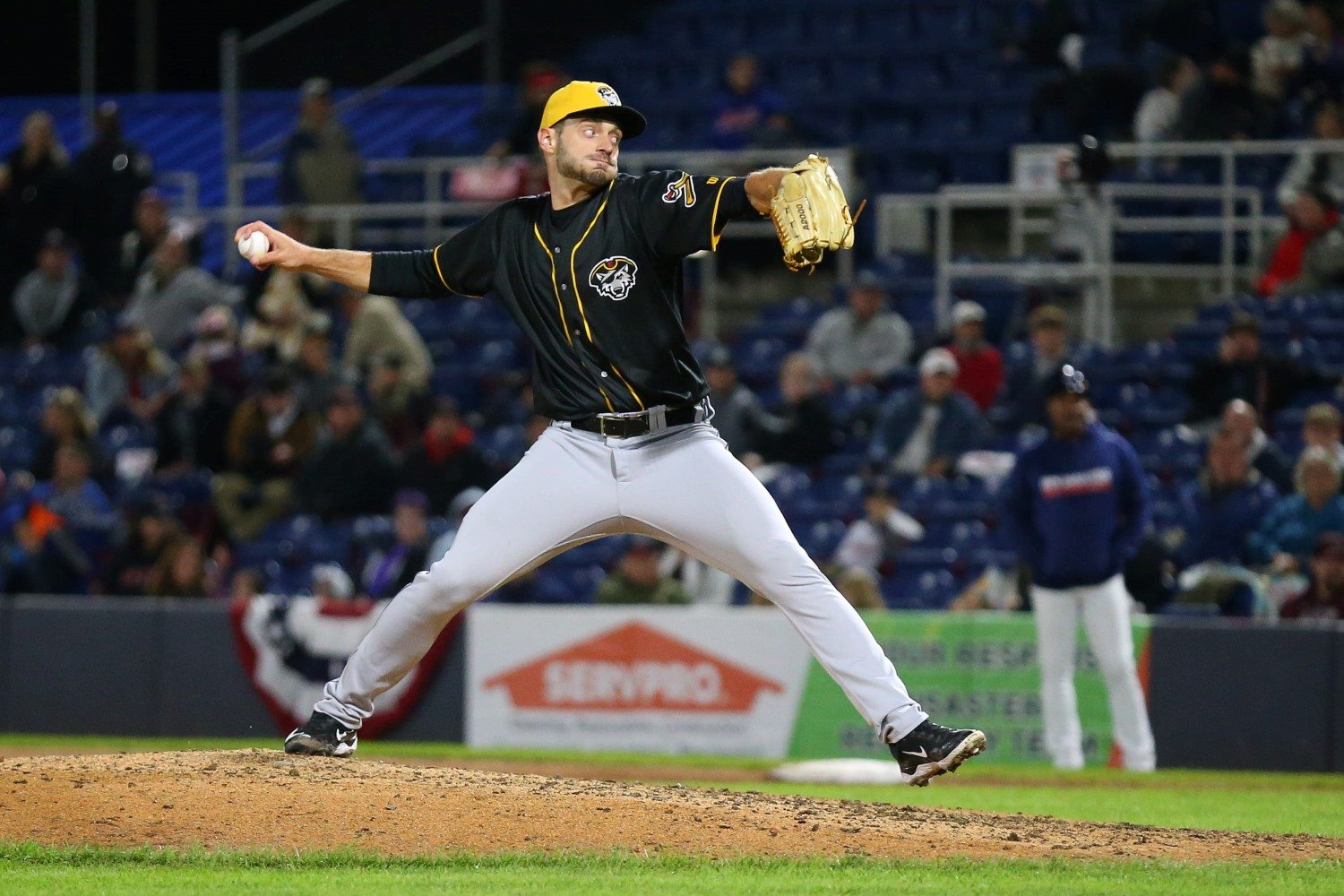 A former two-way player at Division II St. Edward's (TX), Blake Holub has an interesting delivery. He throws from a three-quarter slot that looks similar to how an outfielder throws. Holub sits in the 94-95 range with his fastball, and tops out at 97 miles per hour. The fastball has some natural cut to it, and it also has extreme ride. It’s a borderline plus pitch overall, and is the pitch the Brewers will likely continue to build his repertoire around. As for his secondaries, Holub throws a short, vertical-breaking slider that sits in the mid-to-upper 80s, as well as a splitter. The splitter he showed in 2023 appears to have replaced what used to be a more traditional changeup at the time he was drafted. It’s a pitch that he’s still learning to throw, but it shows signs of being a solid offering to generate whiffs. In 2022, Holub would mix in a curveball in the low 80s at times. The pitch was a bit “slurvy,” and it appears to have been scrapped in 2023. The Brewers have liked the combination of curveball/splitter or curveball/cutter in the past, so perhaps they will try to bring the hook back after some tweaking in their pitch lab. For now, you can expect Holub to be working primarily with his riding, cutting fastball, and mixing in both the slider and splitter. After a tough professional debut in 2022 wherein he posted a 6.23 ERA (struggles driven by a walk rate of 5.4 per nine innings), Holub saw quite a bit more success throughout his 2023 season. Splitting time between the Tigers' High-A and Double-A affiliates, Holub appeared in 18 games for the former and 30 for the latter. Pitching exclusively out of the bullpen, he posted a 3.03 ERA between the two levels, to go along with a solid 3.75 FIP. Holub also struck out a strong 10.5 per nine innings. What changed from 2022 to 2023 to yield such better results? Outside of the tweaks to his repertoire, Holub also showed tremendous improvement in his control. Holub cut that ugly walk rate by more than three full walks per nine frames, bringing it all the way down to 2.3 in 2023. While Holub did a great job of cutting down the free passes, his in-zone command will continue to be a work in progress. He does struggle to locate his secondaries at times, leaving them in vulnerable hitting zones. He didn’t get burned too often in High A, but that lack of command within the zone did start to hurt him a bit more at Double A. As he continues to climb through the system, continued improvement in that area will be paramount to his success. As a two-way player in college, this will only be Holub’s third season where he will be solely focused on pitching. There’s likely still more untapped potential in his arm than what would normally be expected from a 25-year-old prospect. Likely beginning 2024 at either Double A or Triple A, Holub doesn't need to be added to the 40-man roster until he is big-league ready, or when he becomes eligible for the Rule 5 Draft next winter, whichever comes first. He has the type of arm (as well as the previously mentioned projectability) where a 2024 MLB debut couldn't be ruled out--if he can get off to a strong start to his season at the upper levels.
 -
On Saturday, the Brewers made a trade involving a player who had quickly become a fan favorite during his two months with the franchise. They traded Mark Canha to the Detroit Tigers. In return, they received 25 year old right-handed reliever Blake Holub, a member of the Tigers' 2021 draft class. Image courtesy of © Jeff Miller / Special to the Press & Sun-Bulletin / USA TODAY NETWORK A former two-way player at Division II St. Edward's (TX), Blake Holub has an interesting delivery. He throws from a three-quarter slot that looks similar to how an outfielder throws. Holub sits in the 94-95 range with his fastball, and tops out at 97 miles per hour. The fastball has some natural cut to it, and it also has extreme ride. It’s a borderline plus pitch overall, and is the pitch the Brewers will likely continue to build his repertoire around. As for his secondaries, Holub throws a short, vertical-breaking slider that sits in the mid-to-upper 80s, as well as a splitter. The splitter he showed in 2023 appears to have replaced what used to be a more traditional changeup at the time he was drafted. It’s a pitch that he’s still learning to throw, but it shows signs of being a solid offering to generate whiffs. In 2022, Holub would mix in a curveball in the low 80s at times. The pitch was a bit “slurvy,” and it appears to have been scrapped in 2023. The Brewers have liked the combination of curveball/splitter or curveball/cutter in the past, so perhaps they will try to bring the hook back after some tweaking in their pitch lab. For now, you can expect Holub to be working primarily with his riding, cutting fastball, and mixing in both the slider and splitter. After a tough professional debut in 2022 wherein he posted a 6.23 ERA (struggles driven by a walk rate of 5.4 per nine innings), Holub saw quite a bit more success throughout his 2023 season. Splitting time between the Tigers' High-A and Double-A affiliates, Holub appeared in 18 games for the former and 30 for the latter. Pitching exclusively out of the bullpen, he posted a 3.03 ERA between the two levels, to go along with a solid 3.75 FIP. Holub also struck out a strong 10.5 per nine innings. What changed from 2022 to 2023 to yield such better results? Outside of the tweaks to his repertoire, Holub also showed tremendous improvement in his control. Holub cut that ugly walk rate by more than three full walks per nine frames, bringing it all the way down to 2.3 in 2023. While Holub did a great job of cutting down the free passes, his in-zone command will continue to be a work in progress. He does struggle to locate his secondaries at times, leaving them in vulnerable hitting zones. He didn’t get burned too often in High A, but that lack of command within the zone did start to hurt him a bit more at Double A. As he continues to climb through the system, continued improvement in that area will be paramount to his success. As a two-way player in college, this will only be Holub’s third season where he will be solely focused on pitching. There’s likely still more untapped potential in his arm than what would normally be expected from a 25-year-old prospect. Likely beginning 2024 at either Double A or Triple A, Holub doesn't need to be added to the 40-man roster until he is big-league ready, or when he becomes eligible for the Rule 5 Draft next winter, whichever comes first. He has the type of arm (as well as the previously mentioned projectability) where a 2024 MLB debut couldn't be ruled out--if he can get off to a strong start to his season at the upper levels. View full article

