



Spencer Michaelis
-
Posts
1,119 -
Joined
-
Last visited
-
Days Won
17
Content Type
Profiles
Forums
Blogs
Events
News
2026 Milwaukee Brewers Top Prospects Ranking
Milwaukee Brewers Videos
2022 Milwaukee Brewers Draft Picks
Milwaukee Brewers Free Agent & Trade Rumors, Notes, & Tidbits
Guides & Resources
2023 Milwaukee Brewers Draft Picks
2024 Milwaukee Brewers Draft Picks
The Milwaukee Brewers Players Project
2025 Milwaukee Brewers Draft Pick Tracker
2026 Milwaukee Brewers Draft Tracker: Picks & Bonuses
Store
Downloads
Gallery
Everything posted by Spencer Michaelis
-
 Yeah, I'd bet some of those Day Two college players only get 5 figures. I genuinely think you could see close to another $1 million or so saved on rounds 3-8. Though the 9th and 10th rounders I could see getting a bit more than $250,000 per.
 -
The Brewers stuck to a similar Day Three plan to the one they had in 2023: a lot of pitching, and a lot of high school players. Image courtesy of © Saul Young/News Sentinel / USA TODAY NETWORK By now, it's our own fault if it surprises us. Perennially one of the most aggressive teams in the league on the final day of the MLB Draft, the Brewers executed the same gameplan Tuesday. Round 11, Pick # 335: Caedmon Parker, RHP -- TCU Ranked the 220th-best player in the 2021 draft coming out of high school, Parker made his way to TCU, where he was used as both a starter and a reliever. After missing 2023 with Tommy John surgery, Parker mainly pitched out of the pen in 2024. His fastball sits in the 93-95 range, reaching back for a bit more, with a lot of life and some cut. He also throws an upper-80s cutter that can look like a slider at times. Parker completes the repertoire with a 12-6 curve that can reach 2,800 RPMs, and a changeup that lags behind the other offerings. His command (or lack thereof) will likely land him in the bullpen long-term, but he does have the ability to be stretched out. Round 12, Pick # 365: Tyson Hardin, RHP -- Mississippi State Hardin began his career at Daytona State College, playing two years there before transferring to Mississippi State. As a Bulldog, he pitched exclusively in relief and picked up three saves over his two seasons. A two-pitch pitcher, Hardin’s calling card is a mid-90s fastball with a ton of horizontal run, which he can run up to 97 MPH. Coming from his low arm slot, the fastball has a really interesting shape to it. His other pitch is a mid-80s slider that could use some improvement in its consistency. The fastball will carry the profile. Round 13, Pick # 395: Joey Broughton, LHP -- Northville HS (MI) Though Broughton is committed to Pitt, the Brewers will be hoping to sign him away. A late riser in the class, Broughton has a feel for spin that very few high schoolers have. His fastball has been up to 95 MPH, and it has a chance to be special. Generating up to 24.4” of Induced Vertical Break from a low release height, and spinning at 2,700 RPMs, the pitch is a unicorn. His upper-70s curveball isn’t quite the outlier that his fastball is, but it’s no slouch either, registering close to 3,000 RPMs with -11” of IVB and 17-18” of sweep. His changeup also shows good arm-side fade, sitting in the low-80s, though he has not used it much in games yet. If Broughton signs, his command will likely cause him some issues early on, but this is a very projectable arm with a ceiling as high as almost anybody in the class. Round 14, Pick # 425: James Nunnallee, C/OF -- Lightridge HS (VA) This Virginia commit was ranked on most national boards heading into the draft, coming in as high as No. 52 on ESPN’s list. The Brewers drafted him as a catcher, and whether he signs or heads to college, there’s a good chance he will start the next stage of his career behind the dish. Nunnallee is a very good athlete who will need some work on his receiving. His arm is below average for the position, as well. His athleticism should allow him to move to the outfield if needed, and he has spent some time in center field during his high school career. Nunnallee’s profile is largely carried by the fact that he’s just a solid overall hitter. He's flashed plus power, posting exit velocities of 105 at the MLB Combine, as well as having a strong hit tool with a good feel for the barrel. Round 15, Pick # 455: Travis Smith, RHP -- Kentucky Ranked 261st on Baseball America’s board for this year's draft, Smith is ranked 85th on their early 2025 draft board. Having spent the past few seasons at Kentucky, Smith is committed to transfer to Mississippi State next season, which could cause him to be a tough sign. The NIL era makes cases like this one a whole different animal than they used to be. Even a decade ago, buying a player out of a plan to transfer schools between seasons would be much easier. Smith's mid-90s sinker has helped him generate a lot of ground balls at Kentucky, and his mid-80s, high-spin breaking ball has induced some swing-and-miss, especially against right-handed hitters. Against lefties, Smith will bring out his mid-80s changeup, which is firm but has some late fading action. Round 16, Pick # 485: Jayden Dubanewicz, RHP -- Marjory Stoneman Douglas HS (FL) Committed to Florida, Dubanewicz’s Twitter seems to show that he is already living on campus, so he may be a tough sign for the Brewers. If he does have interest in signing, though, his appeal will be in the projectability. Standing 6’3" and weighing only 160 pounds, Dubanewicz is sitting in the low 90s, but has the type of frame to make a pretty big leap in the velocity department. His sweeping slider is his main secondary offering. Despite being very lanky, he’s got good control of his body, and commands his pitches pretty well. Round 17, Pick # 515: Cooper Malamazian, SS -- Nazareth Academy (IL) An Indiana commit, Malamazian is another in a long line of recent Day Three picks out of Midwest high schools. Area Scout Ginger Poulson clearly has a lot of trust within the organization, and with a recent track record of players like Luke Adams and Bishop Letson, well she should. Malamazian is a strong athlete, posting above-average running numbers in a showcase setting. His bat speed averaged over 76 MPH in batting practice, which shows that his max exit velocity of 99.4 is only scratching the surface of what he can become with some added strength and facing actual pitching, rather than in a batting practice setting. He shows good hands and a fluid approach to the ball in the field, and has the arm to stick at shortstop. Round 18, Pick # 545: Tyler Renz, RHP -- Fox Lane HS (NY) Renz is committed to St John’s, and has a lot of fans in the Northeast scouting community. He won’t turn 18 until late November. His 6’4" frame leaves a lot of projection to dream on, for a fastball that has already reached 92 with high spin and a good vertical approach angle. He mixes a slider and a curveball, though he classifies them as a cutter and slider. Renz will also mix in a changeup, but it lags far behind the other pitches. He is a project, but if he were to sign, it would be nice clay for the Brewers to attempt to mold. Round 19, Pick # 575: Noah Wech, RHP -- Manitowoc Lincoln HS (WI) Another Midwest prep player! Wech is the first Wisconsin high schooler to be drafted by the Brewers since 2010, when they selected Connor Fisk out of Grafton High School. This is more than a local flier. Wech is committed to Oklahoma State, which is a very good program. Equipped with a fastball that has been up to 96 MPH and averages around 19-20" of induced vertical break, and up to 7 feet of extension, Wech also throws a couple of good-looking secondaries. His sweeping slider is in the 82-84 MPH range, with spin rates around 2,700 RPM. He also mixes in a developing high-spin curveball with more depth to it than the slider, and a changeup that needs a lot of work. There is reliever risk in the profile, but also a ton of interesting traits. Round 20, Pick # 605: Henry Brummel, RHP -- Pontiac Township HS (IL) Poulson is doing her best DJ Khaled impression at this point, with the Brewers drafting *another one* from the Midwest prep ranks (point of clarification: I have been informed that Brummel is actually located in Area Scout Riley Bandelow's territory, not Poulson's, which really puts a damper on my DJ Khaled joke). Brummel is another Indiana commit, the third member of that potential class they have drafted over the past couple of days. Brummel has a lightning-fast arm, with a lot of effort in the delivery. His fastball has been up to 94 MPH this year, sitting more in the 91-92 range over the course of a start. His curveball sits in the 77-79 range, with more depth than his low-80s slider. Both have high spin rates and sharp movement. His low-80s changeup is a solid offering as well, showing some late fade and killing spin pretty well. It will be very interesting to see how many of these players the Brewers can sign. The first two days were a solid start to the class, but adding some of these players would go a long way toward solidifying another superb draft on paper. What did you think about the Brewers' Day Three? Any favorites from the group that you are really hoping will sign? Let us know! View full article
- 8 replies
-
- 2
-

-
- mlb draft 2024
- caedmon parker
- (and 2 more)
-
 By now, it's our own fault if it surprises us. Perennially one of the most aggressive teams in the league on the final day of the MLB Draft, the Brewers executed the same gameplan Tuesday. Round 11, Pick # 335: Caedmon Parker, RHP -- TCU Ranked the 220th-best player in the 2021 draft coming out of high school, Parker made his way to TCU, where he was used as both a starter and a reliever. After missing 2023 with Tommy John surgery, Parker mainly pitched out of the pen in 2024. His fastball sits in the 93-95 range, reaching back for a bit more, with a lot of life and some cut. He also throws an upper-80s cutter that can look like a slider at times. Parker completes the repertoire with a 12-6 curve that can reach 2,800 RPMs, and a changeup that lags behind the other offerings. His command (or lack thereof) will likely land him in the bullpen long-term, but he does have the ability to be stretched out. Round 12, Pick # 365: Tyson Hardin, RHP -- Mississippi State Hardin began his career at Daytona State College, playing two years there before transferring to Mississippi State. As a Bulldog, he pitched exclusively in relief and picked up three saves over his two seasons. A two-pitch pitcher, Hardin’s calling card is a mid-90s fastball with a ton of horizontal run, which he can run up to 97 MPH. Coming from his low arm slot, the fastball has a really interesting shape to it. His other pitch is a mid-80s slider that could use some improvement in its consistency. The fastball will carry the profile. Round 13, Pick # 395: Joey Broughton, LHP -- Northville HS (MI) Though Broughton is committed to Pitt, the Brewers will be hoping to sign him away. A late riser in the class, Broughton has a feel for spin that very few high schoolers have. His fastball has been up to 95 MPH, and it has a chance to be special. Generating up to 24.4” of Induced Vertical Break from a low release height, and spinning at 2,700 RPMs, the pitch is a unicorn. His upper-70s curveball isn’t quite the outlier that his fastball is, but it’s no slouch either, registering close to 3,000 RPMs with -11” of IVB and 17-18” of sweep. His changeup also shows good arm-side fade, sitting in the low-80s, though he has not used it much in games yet. If Broughton signs, his command will likely cause him some issues early on, but this is a very projectable arm with a ceiling as high as almost anybody in the class. Round 14, Pick # 425: James Nunnallee, C/OF -- Lightridge HS (VA) This Virginia commit was ranked on most national boards heading into the draft, coming in as high as No. 52 on ESPN’s list. The Brewers drafted him as a catcher, and whether he signs or heads to college, there’s a good chance he will start the next stage of his career behind the dish. Nunnallee is a very good athlete who will need some work on his receiving. His arm is below average for the position, as well. His athleticism should allow him to move to the outfield if needed, and he has spent some time in center field during his high school career. Nunnallee’s profile is largely carried by the fact that he’s just a solid overall hitter. He's flashed plus power, posting exit velocities of 105 at the MLB Combine, as well as having a strong hit tool with a good feel for the barrel. Round 15, Pick # 455: Travis Smith, RHP -- Kentucky Ranked 261st on Baseball America’s board for this year's draft, Smith is ranked 85th on their early 2025 draft board. Having spent the past few seasons at Kentucky, Smith is committed to transfer to Mississippi State next season, which could cause him to be a tough sign. The NIL era makes cases like this one a whole different animal than they used to be. Even a decade ago, buying a player out of a plan to transfer schools between seasons would be much easier. Smith's mid-90s sinker has helped him generate a lot of ground balls at Kentucky, and his mid-80s, high-spin breaking ball has induced some swing-and-miss, especially against right-handed hitters. Against lefties, Smith will bring out his mid-80s changeup, which is firm but has some late fading action. Round 16, Pick # 485: Jayden Dubanewicz, RHP -- Marjory Stoneman Douglas HS (FL) Committed to Florida, Dubanewicz’s Twitter seems to show that he is already living on campus, so he may be a tough sign for the Brewers. If he does have interest in signing, though, his appeal will be in the projectability. Standing 6’3" and weighing only 160 pounds, Dubanewicz is sitting in the low 90s, but has the type of frame to make a pretty big leap in the velocity department. His sweeping slider is his main secondary offering. Despite being very lanky, he’s got good control of his body, and commands his pitches pretty well. Round 17, Pick # 515: Cooper Malamazian, SS -- Nazareth Academy (IL) An Indiana commit, Malamazian is another in a long line of recent Day Three picks out of Midwest high schools. Area Scout Ginger Poulson clearly has a lot of trust within the organization, and with a recent track record of players like Luke Adams and Bishop Letson, well she should. Malamazian is a strong athlete, posting above-average running numbers in a showcase setting. His bat speed averaged over 76 MPH in batting practice, which shows that his max exit velocity of 99.4 is only scratching the surface of what he can become with some added strength and facing actual pitching, rather than in a batting practice setting. He shows good hands and a fluid approach to the ball in the field, and has the arm to stick at shortstop. Round 18, Pick # 545: Tyler Renz, RHP -- Fox Lane HS (NY) Renz is committed to St John’s, and has a lot of fans in the Northeast scouting community. He won’t turn 18 until late November. His 6’4" frame leaves a lot of projection to dream on, for a fastball that has already reached 92 with high spin and a good vertical approach angle. He mixes a slider and a curveball, though he classifies them as a cutter and slider. Renz will also mix in a changeup, but it lags far behind the other pitches. He is a project, but if he were to sign, it would be nice clay for the Brewers to attempt to mold. Round 19, Pick # 575: Noah Wech, RHP -- Manitowoc Lincoln HS (WI) Another Midwest prep player! Wech is the first Wisconsin high schooler to be drafted by the Brewers since 2010, when they selected Connor Fisk out of Grafton High School. This is more than a local flier. Wech is committed to Oklahoma State, which is a very good program. Equipped with a fastball that has been up to 96 MPH and averages around 19-20" of induced vertical break, and up to 7 feet of extension, Wech also throws a couple of good-looking secondaries. His sweeping slider is in the 82-84 MPH range, with spin rates around 2,700 RPM. He also mixes in a developing high-spin curveball with more depth to it than the slider, and a changeup that needs a lot of work. There is reliever risk in the profile, but also a ton of interesting traits. Round 20, Pick # 605: Henry Brummel, RHP -- Pontiac Township HS (IL) Poulson is doing her best DJ Khaled impression at this point, with the Brewers drafting *another one* from the Midwest prep ranks (point of clarification: I have been informed that Brummel is actually located in Area Scout Riley Bandelow's territory, not Poulson's, which really puts a damper on my DJ Khaled joke). Brummel is another Indiana commit, the third member of that potential class they have drafted over the past couple of days. Brummel has a lightning-fast arm, with a lot of effort in the delivery. His fastball has been up to 94 MPH this year, sitting more in the 91-92 range over the course of a start. His curveball sits in the 77-79 range, with more depth than his low-80s slider. Both have high spin rates and sharp movement. His low-80s changeup is a solid offering as well, showing some late fade and killing spin pretty well. It will be very interesting to see how many of these players the Brewers can sign. The first two days were a solid start to the class, but adding some of these players would go a long way toward solidifying another superb draft on paper. What did you think about the Brewers' Day Three? Any favorites from the group that you are really hoping will sign? Let us know!
- 8 comments
-
- 2
-
-
- mlb draft 2024
- caedmon parker
- (and 2 more)
-
Ask your favorite expert a question!
Spencer Michaelis replied to Playing Catch's topic in Brewers Minor League Talk
In terms of growth, it's really hard to speculate. I'd think the 16-17 year olds in particular have a decent chance of adding an inch or two in height, but not really sure. I don't think velocity is all that related to height though honestly. It's about ability to move and rotate more than anything else. I think a guy like Rodriguez will add a couple ticks by way of getting stronger, but probably never a big velo guy. I think there's more context needed for some of these things. How old are they relative to their league? Are they dealing with injury? Generally I'd usually prefer the player who is performing well more recently. -
Ask your favorite expert a question!
Spencer Michaelis replied to Playing Catch's topic in Brewers Minor League Talk
I'd guess that it will fall in the 10-15 range if national groups rank it soon, but I wouldn't be surprised to see it jump back into the Top 10 by this time next year. A lot of super interesting talent in the lower levels. -
Ask your favorite expert a question!
Spencer Michaelis replied to Playing Catch's topic in Brewers Minor League Talk
I have little to no concern with Wilken. EBJ in the last month has a 115 wRC+, so that's been very good to see, hoping to see him impact the ball more still and also to show that this is more than a hot month at the plate. I have concerns with him for sure. I think I'll be writing about a change he made a little over a month ago that may have helped spark the hot stretch. Something that has me cautiously optimistic. -
Ask your favorite expert a question!
Spencer Michaelis replied to Playing Catch's topic in Brewers Minor League Talk
Patrick is probably the one here. His stuff is good enough to make MLB starts, and the results have been so solid too. Holub has the type of stuff I could see getting picked, but I doubt they'd feel compelled to protect him unless he starts performing much better in Nashville. I like Cornielle quite a bit, but I think he probably makes it through without being picked this offseason as a starter who hasn't seen AA yet and doesn't have super big velo or anything like that. I could see him as someone they need to protect the following winter. -
Jack and Spencer are joined by MLB Draft expert Jamie Cameron in this week's episode! In the first half of this episode, the guys are joined by Jamie Cameron to discuss the upcoming MLB Draft from a Brewers perspective. During the second half, they go through the series losses to the Dodgers and Pirates, discuss another strong Tobias Myers outing, William Contreras’ defense, and more! Apple Podcasts: https://podcasts.apple.com/us/podcast/the-brewer-fanatic-podcast/id1740648724 Spotify: https://open.spotify.com/show/5CY8mWsQayqjDXqw9OT2Td\ iHeartRadio: https://www.iheart.com/podcast/263-the-brewer-fanatic-podcast-166534588/ View full article
-
 In the first half of this episode, the guys are joined by Jamie Cameron to discuss the upcoming MLB Draft from a Brewers perspective. During the second half, they go through the series losses to the Dodgers and Pirates, discuss another strong Tobias Myers outing, William Contreras’ defense, and more! Apple Podcasts: https://podcasts.apple.com/us/podcast/the-brewer-fanatic-podcast/id1740648724 Spotify: https://open.spotify.com/show/5CY8mWsQayqjDXqw9OT2Td\ iHeartRadio: https://www.iheart.com/podcast/263-the-brewer-fanatic-podcast-166534588/
 -
Ask your favorite expert a question!
Spencer Michaelis replied to Playing Catch's topic in Brewers Minor League Talk
I think it will depend. I think a couple more good starts and I'd bump him to AAA. I think there's a good chance we see him in the Milwaukee bullpen before years end though. Me personally, I think if you want him to start long term, moving him to the pen could make that more difficult. But I don't think he's going to be reliable enough to make starts this year, so if we see him I'd imagine it'll be a pen role. -
Ask your favorite expert a question!
Spencer Michaelis replied to Playing Catch's topic in Brewers Minor League Talk
I'd say all five of those guys are potential Day 1 guys this year (partially because it's a bit of a down year in terms of talent). Made, Pena and Bitonti are probably the most likely to go round 1. Anderson and Di Turi are probably a tier below, if I had to guess, could see them falling a bit lower than top 2 rounds. -
We continue our MiLB Player of the Month series with June's top five relief pitchers. Image courtesy of Neal Hock, Carolina Mudcats The Brewers' minor league pitching was very impressive on the starting side, and the relievers had many strong candidates as well. Beginning with a couple of honorable mentions: HONORABLE MENTIONS RHP - Dikember Sanchez - ACL Brewers and Carolina Mudcats - 5 G, 11.2 IP, 0-1, 2.31 ERA, 4.44 FIP, 1.03 WHIP, 7 H, 5 BB, 14 K, 1 SV RHP - Craig Yoho - Biloxi Shuckers - 8 G, 11 IP, 1-0, 2.45 ERA, 0.29 FIP, 1.00 WHIP, 7 H, 4 BB, 23 K He’s human, after all. One lousy outing, in which he allowed three earned runs in one inning, cost Yoho a spot on the list, but everyone has had the chance to read about him numerous times. He wanted to give some new names a chance to shine. TOP FIVE RELIEF PITCHERS FOR JUNE #5 RHP - Nick Merkel - Biloxi Shuckers - 7 G, 15.1 IP, 1-0, 1.76 ERA, 3.64 FIP, 0.78 WHIP, 7 H, 5 BB, 18 K Unranked by all publications Merkel was signed as an undrafted free agent in 2022 out of Central Methodist University, an NAIA school in Missouri. Checking in at 6’7 and weighing 255 pounds, Merkel has a fitting nickname, “Large Mammal,” that he even uses for his Twitter handle. Merkel moved quickly from Low-A to High-A last year and was assigned to Double-A to begin this season. While his size might give the impression of a fireballer, his fastball only sits in the low 90s, touching 93 at times. He appears to cut the fastball and run it at other times. It does a good job getting swing-and-miss when cut and gets grounders either way. He throws two breaking balls for his secondaries. His low-80s sweeping slider has been a great pitch against left-handed hitters. His upper 70s knuckle curve has a lot more depth to it, and he uses that more against right-handed hitters than he does against lefties. In June, Merkel did something very few pitchers could do. He was generating a ton of ground balls and a ton of whiffs. He posted a ridiculous 41.4% whiff rate, placing him in the 99th percentile for the level. While his walks were in a reasonable place in June, he hit four batters, so he was issuing free passes at a pretty high rate. At the same time, he generated ground balls at a 60% clip, which was in the 95th percentile for Double-A pitchers with at least ten innings in June, which helped him work around those free passes. Merkel is 26 years old, and shows signs of the peripheral numbers you are looking for in a middle reliever. He might be in line for a promotion to Triple-A at some point in the second half, even if the surface numbers might not blow anybody away. #4 LHP - Aaron Rund - Wisconsin Timber Rattlers - 8 G, 11.1 IP, 1-1, 1.23 ERA, 2.69 FIP, 0.89 WHIP, 7 H, 6 BB, 15 K Unranked by all publications Rund went undrafted in the 2023 draft out of Campbell University. After playing half a season with the Florence Y’alls of the Frontier League, he signed with the Brewers this past offseason. The recently turned 25-year-old has been in high-A all season and has pitched to a 1.32 ERA. Coming from a low, three-quarters arm slot that borders on being sidearm, Rund is a sinker-baller who mainly aims to get the ball on the ground. Sitting 93 on his fastball and getting up to 95, the pitch does what it intended, as his 55.7% ground ball rate for the season places him in the 93rd percentile for High-A. In terms of secondaries, Rund uses his slider the most often. The pitch sits in the 85-86 MPH range and mirrors his fastball well, giving hitters a long tail to worry about between the two pitches. He also throws an upper-70s curveball that is used less often but gives hitters another velocity band to worry about. At times, he appears to blend those two into a low-80s slurve. Based on how the catcher throws down signs, those are meant to be the slider. In June, Rund was great at what he’s usually good at. He didn’t generate hardly any swing and miss (1st percentile whiff rate), but he did land a ton of pitches for strikes, back-dooring sinkers, and landing breaking balls on corners. His called-strike rate of 36.8% was in the 96th percentile. He also improved his already strong ground ball rate, reaching 59.5% in June. There was minimal hard contact, and even when hitters did get one on the barrel, it was usually on the ground. Rund is 25 and posting an ERA of 1.32 so far at High-A. While he doesn’t have the stuff to be a closer down the road, he does have qualities that go a long way for a middle reliever. He will likely see time at Double-A at some point this season. #3 RHP - Chase Costello - Wisconsin Timber Rattlers - 7 G, 10 IP, 3-0, 1.80 ERA, 1.81 FIP, 0.90 WHIP, 6 H, 3 BB, 13 K Unranked by all publications Costello was another player brought into the organization out of independent ball, signing before the 2023 season. He spent time at LSU, St Thomas, and Stetson during college, eventually going undrafted and signing with the Boise Hawks of the Pioneer League. He had a solid, if unspectacular, season in Carolina last year and has carried over similar results to the 2024 season with the T-Rats. Unlike many indy ball signees, Costello was only 22 years old when he signed and is currently 24. His fastball sat in the 92-94 range in college but is now sitting 94-95 and touching 96 at times. It has a decent arm-side run, and he commands it relatively well. He also throws a changeup in the 82-84 range, which is probably his best pitch for generating swing and miss, though his command of the pitch comes and goes. His third pitch is a short slider in the 86-87 MPH range, though it lags behind the other two pitches and lacks consistency in movement and command. Costello mostly used his top two pitches in June to keep hitters off balance. His 36.5% whiff rate placed him in the 89th percentile at the level among pitchers who threw at least ten innings in June. His 36.1% strikeout rate put him in the 93rd percentile. He did have some batted-ball luck, and his outfielders showed up for him on a couple of run-saving plays in June, but his ability to generate swings and misses is what carried him to such a strong month. Costello is unlikely to move from High-A too soon, but if his June performance is a sign of things to come, he’s a name Brewers fans will want to keep an eye on. #2 RHP - Blake Holub - Biloxi Shuckers - 8 G, 10 IP, 1-0, 0.00 ERA, 1.18 FIP, 0.70 WHIP, 5 H, 2 BB, 14 K, 5 SV. Unranked by all publications Acquired in the Mark Canha trade this past offseason, Holub is the fourth pitcher on this list to take an irregular path to pro ball. Holub was a two-way player at Division II St Edwards University in Texas before the Tigers selected him in the 15th round in 2021. Holub began the year with Triple-A Nashville. Unfortunately, things didn't go well there, and he was sent down to Double-A in mid-May. He took that demotion as well as one can and had not allowed a single run at the level through the end of June. Coming from a very high, over-the-top slot, Holub has a fastball that sits in the mid-90s and has decent carry on it, along with a few inches of cut. He also adds seven feet of extension, which helps the velocity play up a bit higher. The Vertical Approach Angle is -5.6 in his Triple-A appearances, which means the carry he gets on the pitch doesn’t play up much, but it has been a solid pitch for him. His slider sits around 82-84 MPH and has decent characteristics, though it has been hit around a bit at the Triple-A level. He did not use his mid-80s splitter very often in Triple-A, but when he did, it was a fantastic pitch, and the characteristics grade out very well. He went to it more often in Double-A and reaped the benefits of that. Holub generated whiffs at a 42.9% clip in June, placing him in the 99th percentile for Double-A pitchers with at least ten innings pitched. His swinging strike rate of 21.2% was in the 98th percentile, and his overall strikeout rate placed him in the 96th percentile at 36.8%. Not only did he miss a lot of bats, but he also generated ground balls at a 54.5% rate, putting him in the 90th percentile. Holub got promoted back to Triple-A to begin July and allowed two earned runs in his first inning there. Something about that jump from Biloxi to Nashville is giving him problems, but he has shown he is above Double-A and should get ample opportunity to find his footing with the Sounds. #1 RHP - Aidan Maldonado - Carolina Mudcats - 9 G, 16 IP, 0-0, 0.00 ERA, 1.59 FIP, 0.44 WHIP, 6 H, 1 BB, 19 K, 2 SV. Unranked by all publications The Brewers 14th round selection in the 2022 draft out of the University of Minnesota, Maldonado was garnering some attention early in the spring of 2023 with his array of offspeed offerings. He got off to a strong start with Carolina but dealt with injuries and some ineffectiveness the rest of the way. A starter to begin the 2023 season, Maldonado has moved into a full-time relief role in 2024. His fastball is in the 92-94 range but seems to get on hitters more than the velocity would lead you to believe. Maldonado is a big-time “drop and drive” pitcher, and he gets really low into his back leg, causing the fastball to come out from a low slot and have strong carry through the zone. His delivery is also “herky-jerky” and has to be a tough sightline for hitters in the box, which also helps the pitch play up. Maldonado has leaned more on his curveball and changeup this year than he did last year. His curveball is an upper-70s offering with a good amount of depth. He seems comfortable landing it for strikes. The changeup sits in the low-80s and has a lot of sharp movement to the arm side and good depth. The changeup is the best offspeed offering he has. Maldonado has also thrown a slider at times. While he seems to struggle with the command, it would serve him well to use it more often, as it has good movement and sits in a different velocity band than the curve and changeup, coming in around 85-86. However, Maldonado didn’t need to use the slider too often in June. His three-pitch mix was done this month, as he struck out 19 hitters to only a single walk. That K: BB ratio put him in the 99th percentile for his level. Interestingly, despite his high strikeout total, he only generated whiffs at a 25.4% clip, the 30th percentile. He did land several pitches for strikes and had the second-highest foul ball rate at the level. When the ball did get put in play, it was often on the ground, as evidenced by his 58.8% ground ball rate. At 24 years old, Maldonado seems ready for the challenge of High-A, as even when the surface numbers weren’t great early on this season, his peripherals were in a very good place. Thanks for following along with this three-part series on the Brewers' minor league system. Let us know your thoughts below! Did we miss anybody? View full article
- 2 replies
-
- 2
-
-
- nick merkel
- aaron rund
- (and 3 more)
-
Brewers Minor League Relief Pitcher of the Month: June 2024
Spencer Michaelis posted an article in Minor Leagues
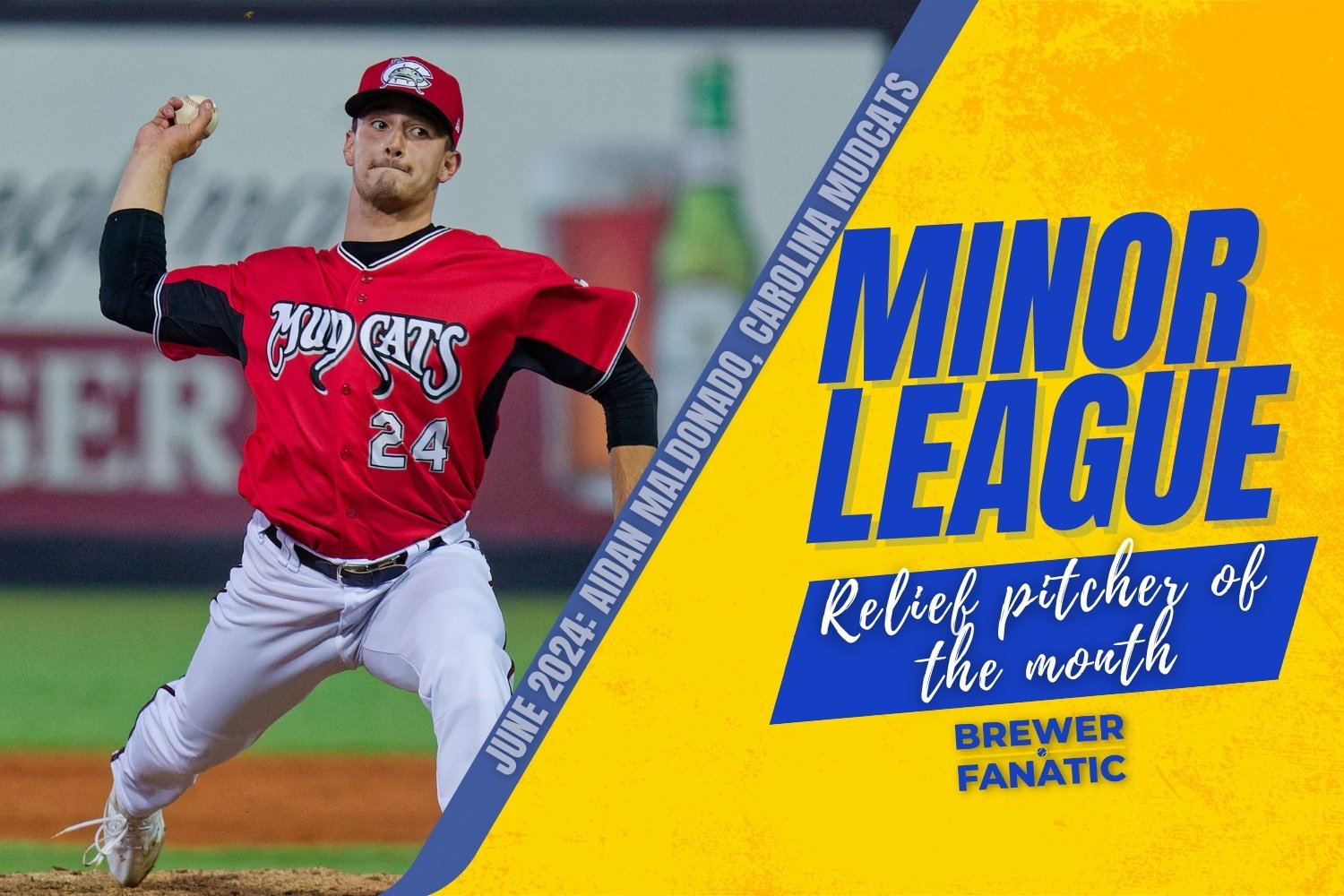 The Brewers' minor league pitching was very impressive on the starting side, and the relievers had many strong candidates as well. Beginning with a couple of honorable mentions: HONORABLE MENTIONS RHP - Dikember Sanchez - ACL Brewers and Carolina Mudcats - 5 G, 11.2 IP, 0-1, 2.31 ERA, 4.44 FIP, 1.03 WHIP, 7 H, 5 BB, 14 K, 1 SV RHP - Craig Yoho - Biloxi Shuckers - 8 G, 11 IP, 1-0, 2.45 ERA, 0.29 FIP, 1.00 WHIP, 7 H, 4 BB, 23 K He’s human, after all. One lousy outing, in which he allowed three earned runs in one inning, cost Yoho a spot on the list, but everyone has had the chance to read about him numerous times. He wanted to give some new names a chance to shine. TOP FIVE RELIEF PITCHERS FOR JUNE #5 RHP - Nick Merkel - Biloxi Shuckers - 7 G, 15.1 IP, 1-0, 1.76 ERA, 3.64 FIP, 0.78 WHIP, 7 H, 5 BB, 18 K Unranked by all publications Merkel was signed as an undrafted free agent in 2022 out of Central Methodist University, an NAIA school in Missouri. Checking in at 6’7 and weighing 255 pounds, Merkel has a fitting nickname, “Large Mammal,” that he even uses for his Twitter handle. Merkel moved quickly from Low-A to High-A last year and was assigned to Double-A to begin this season. While his size might give the impression of a fireballer, his fastball only sits in the low 90s, touching 93 at times. He appears to cut the fastball and run it at other times. It does a good job getting swing-and-miss when cut and gets grounders either way. He throws two breaking balls for his secondaries. His low-80s sweeping slider has been a great pitch against left-handed hitters. His upper 70s knuckle curve has a lot more depth to it, and he uses that more against right-handed hitters than he does against lefties. In June, Merkel did something very few pitchers could do. He was generating a ton of ground balls and a ton of whiffs. He posted a ridiculous 41.4% whiff rate, placing him in the 99th percentile for the level. While his walks were in a reasonable place in June, he hit four batters, so he was issuing free passes at a pretty high rate. At the same time, he generated ground balls at a 60% clip, which was in the 95th percentile for Double-A pitchers with at least ten innings in June, which helped him work around those free passes. Merkel is 26 years old, and shows signs of the peripheral numbers you are looking for in a middle reliever. He might be in line for a promotion to Triple-A at some point in the second half, even if the surface numbers might not blow anybody away. #4 LHP - Aaron Rund - Wisconsin Timber Rattlers - 8 G, 11.1 IP, 1-1, 1.23 ERA, 2.69 FIP, 0.89 WHIP, 7 H, 6 BB, 15 K Unranked by all publications Rund went undrafted in the 2023 draft out of Campbell University. After playing half a season with the Florence Y’alls of the Frontier League, he signed with the Brewers this past offseason. The recently turned 25-year-old has been in high-A all season and has pitched to a 1.32 ERA. Coming from a low, three-quarters arm slot that borders on being sidearm, Rund is a sinker-baller who mainly aims to get the ball on the ground. Sitting 93 on his fastball and getting up to 95, the pitch does what it intended, as his 55.7% ground ball rate for the season places him in the 93rd percentile for High-A. In terms of secondaries, Rund uses his slider the most often. The pitch sits in the 85-86 MPH range and mirrors his fastball well, giving hitters a long tail to worry about between the two pitches. He also throws an upper-70s curveball that is used less often but gives hitters another velocity band to worry about. At times, he appears to blend those two into a low-80s slurve. Based on how the catcher throws down signs, those are meant to be the slider. In June, Rund was great at what he’s usually good at. He didn’t generate hardly any swing and miss (1st percentile whiff rate), but he did land a ton of pitches for strikes, back-dooring sinkers, and landing breaking balls on corners. His called-strike rate of 36.8% was in the 96th percentile. He also improved his already strong ground ball rate, reaching 59.5% in June. There was minimal hard contact, and even when hitters did get one on the barrel, it was usually on the ground. Rund is 25 and posting an ERA of 1.32 so far at High-A. While he doesn’t have the stuff to be a closer down the road, he does have qualities that go a long way for a middle reliever. He will likely see time at Double-A at some point this season. #3 RHP - Chase Costello - Wisconsin Timber Rattlers - 7 G, 10 IP, 3-0, 1.80 ERA, 1.81 FIP, 0.90 WHIP, 6 H, 3 BB, 13 K Unranked by all publications Costello was another player brought into the organization out of independent ball, signing before the 2023 season. He spent time at LSU, St Thomas, and Stetson during college, eventually going undrafted and signing with the Boise Hawks of the Pioneer League. He had a solid, if unspectacular, season in Carolina last year and has carried over similar results to the 2024 season with the T-Rats. Unlike many indy ball signees, Costello was only 22 years old when he signed and is currently 24. His fastball sat in the 92-94 range in college but is now sitting 94-95 and touching 96 at times. It has a decent arm-side run, and he commands it relatively well. He also throws a changeup in the 82-84 range, which is probably his best pitch for generating swing and miss, though his command of the pitch comes and goes. His third pitch is a short slider in the 86-87 MPH range, though it lags behind the other two pitches and lacks consistency in movement and command. Costello mostly used his top two pitches in June to keep hitters off balance. His 36.5% whiff rate placed him in the 89th percentile at the level among pitchers who threw at least ten innings in June. His 36.1% strikeout rate put him in the 93rd percentile. He did have some batted-ball luck, and his outfielders showed up for him on a couple of run-saving plays in June, but his ability to generate swings and misses is what carried him to such a strong month. Costello is unlikely to move from High-A too soon, but if his June performance is a sign of things to come, he’s a name Brewers fans will want to keep an eye on. #2 RHP - Blake Holub - Biloxi Shuckers - 8 G, 10 IP, 1-0, 0.00 ERA, 1.18 FIP, 0.70 WHIP, 5 H, 2 BB, 14 K, 5 SV. Unranked by all publications Acquired in the Mark Canha trade this past offseason, Holub is the fourth pitcher on this list to take an irregular path to pro ball. Holub was a two-way player at Division II St Edwards University in Texas before the Tigers selected him in the 15th round in 2021. Holub began the year with Triple-A Nashville. Unfortunately, things didn't go well there, and he was sent down to Double-A in mid-May. He took that demotion as well as one can and had not allowed a single run at the level through the end of June. Coming from a very high, over-the-top slot, Holub has a fastball that sits in the mid-90s and has decent carry on it, along with a few inches of cut. He also adds seven feet of extension, which helps the velocity play up a bit higher. The Vertical Approach Angle is -5.6 in his Triple-A appearances, which means the carry he gets on the pitch doesn’t play up much, but it has been a solid pitch for him. His slider sits around 82-84 MPH and has decent characteristics, though it has been hit around a bit at the Triple-A level. He did not use his mid-80s splitter very often in Triple-A, but when he did, it was a fantastic pitch, and the characteristics grade out very well. He went to it more often in Double-A and reaped the benefits of that. Holub generated whiffs at a 42.9% clip in June, placing him in the 99th percentile for Double-A pitchers with at least ten innings pitched. His swinging strike rate of 21.2% was in the 98th percentile, and his overall strikeout rate placed him in the 96th percentile at 36.8%. Not only did he miss a lot of bats, but he also generated ground balls at a 54.5% rate, putting him in the 90th percentile. Holub got promoted back to Triple-A to begin July and allowed two earned runs in his first inning there. Something about that jump from Biloxi to Nashville is giving him problems, but he has shown he is above Double-A and should get ample opportunity to find his footing with the Sounds. #1 RHP - Aidan Maldonado - Carolina Mudcats - 9 G, 16 IP, 0-0, 0.00 ERA, 1.59 FIP, 0.44 WHIP, 6 H, 1 BB, 19 K, 2 SV. Unranked by all publications The Brewers 14th round selection in the 2022 draft out of the University of Minnesota, Maldonado was garnering some attention early in the spring of 2023 with his array of offspeed offerings. He got off to a strong start with Carolina but dealt with injuries and some ineffectiveness the rest of the way. A starter to begin the 2023 season, Maldonado has moved into a full-time relief role in 2024. His fastball is in the 92-94 range but seems to get on hitters more than the velocity would lead you to believe. Maldonado is a big-time “drop and drive” pitcher, and he gets really low into his back leg, causing the fastball to come out from a low slot and have strong carry through the zone. His delivery is also “herky-jerky” and has to be a tough sightline for hitters in the box, which also helps the pitch play up. Maldonado has leaned more on his curveball and changeup this year than he did last year. His curveball is an upper-70s offering with a good amount of depth. He seems comfortable landing it for strikes. The changeup sits in the low-80s and has a lot of sharp movement to the arm side and good depth. The changeup is the best offspeed offering he has. Maldonado has also thrown a slider at times. While he seems to struggle with the command, it would serve him well to use it more often, as it has good movement and sits in a different velocity band than the curve and changeup, coming in around 85-86. However, Maldonado didn’t need to use the slider too often in June. His three-pitch mix was done this month, as he struck out 19 hitters to only a single walk. That K: BB ratio put him in the 99th percentile for his level. Interestingly, despite his high strikeout total, he only generated whiffs at a 25.4% clip, the 30th percentile. He did land several pitches for strikes and had the second-highest foul ball rate at the level. When the ball did get put in play, it was often on the ground, as evidenced by his 58.8% ground ball rate. At 24 years old, Maldonado seems ready for the challenge of High-A, as even when the surface numbers weren’t great early on this season, his peripherals were in a very good place. Thanks for following along with this three-part series on the Brewers' minor league system. Let us know your thoughts below! Did we miss anybody?
- 2 comments
-
- 1
-
-
- nick merkel
- aaron rund
- (and 3 more)
-
We continue our MiLB Player of the Month series with June's top six Starting Pitchers. There is a minimum requirement of 15 innings pitched to qualify for the top six. Image courtesy of Wisconsin Timber Rattlers We will begin, as always, with a bunch of honorable mentions from an unbelievably successful month by the Brewers' starting prospects. Honorable Mentions: RHP - Christopher Peralta - DSL Brewers 2 - 4 G, 2 GS, 13.1 IP, 1-0, 1.35 ERA, 4.98 FIP, 1.20 WHIP, 10 H, 6 BB, 15 K RHP - Dariel Jaquez - DSL Brewers 1 - 4 G, 2 GS, 16 IP, 1-0, 1.69 ERA, 4.98 FIP, 1.13 WHIP, 9 H, 9 BB, 16 K, 1 SV RHP - Manuel Rodriguez - Carolina Mudcats - 4 G, 4 GS, 25 IP, 1-1, 2.52 ERA, 3.35 FIP, 1.12 WHIP, 26 H, 2 BB, 14 K RHP - Yujanyer Herrera - Wisconsin Timber Rattlers - 5 G, 5 GS, 26.2 IP, 4-0, 2.36 ERA, 3.98 FIP, 0.93 WHIP, 21 H, 11 BB, 23 K RHP - Chad Patrick - Nashville Sounds - 5 G, 3 GS, 27 IP, 3-0, 2.33 ERA, 3.16 FIP, 0.93 WHIP, 18 H, 7 BB, 30 K TOP SIX STARTING PITCHERS FOR JUNE #6 RHP - K.C. Hunt - Wisconsin Timber Rattlers - 4 G, 4 GS, 19 IP, 1-1, 2.37 ERA, 3.26 FIP, 1.05 WHIP, 15 H, 5 BB, 23 K Unranked by all publications Taking home the number one spot in April’s version of the Reliever of the Month list, the 2023 undrafted free agent signee transitioned to the rotation in June, and he has taken to it quite well so far. Hunt’s high-spin fastball sits in the 92-94 range and works well at the top of the zone, though he also does a good job of hitting the low and outside corner with the pitch. He has a four-pitch mix, and the secondaries are strong as well. His mid-80s bullet slider is a plus pitch that generates a ton of swing and miss. He also throws an upper 70s curveball that is a little more inconsistent but flashes as a plus pitch and has a ton of depth. Hunt will also mix in a changeup on occasion. The changeup isn’t great, but it gives a hitter something else to consider. In his first month as a starter, Hunt maintained a high whiff rate, not to the level he was showing as a reliever, but the 33.8% mark he posted was still in the 83rd percentile for High-A pitchers with at least 15 innings pitched. His 29.9% strikeout rate was in the 82nd percentile, and he kept the walks to a minimum. The month-long numbers would look much better if not for his third start of the month, in which he allowed two home runs and four earned runs over only three innings. He combined 16 innings and only one earned run in the other three starts. Hunt’s move to the rotation might slow his ascent through the minors, as he appeared to be on a fast track when he was coming out of the pen. However, the move to the rotation has catapulted him into legitimate prospect status, and he will likely find himself on some of the mid-season Top 30 updates. #5 RHP - Wenderlyn King - DSL Brewers 1 - 4 G, 4 GS, 17.2 IP, 1-1, 1.53 ERA, 3.21 FIP, 1.02 WHIP, 17 H, 1 BB, 21 K Unranked by all publications Signed out of the Dominican Republic in this past July’s class, King was making his professional debut this month, and the 18-year-old got it started with a bang. Equipped with a fastball that is reportedly in the 89-90 range and an ability to reach back for a bit more, King appears to rely heavily on his off-speed offerings. He throws a slider, a curveball, and a changeup. Based on the limited video available, the curveball and changeups appear to be his swing-and-miss pitches. Both have good depth and late movement. In June, King had a 21 to 1 strikeout-to-walk ratio, though that is a bit misleading considering he did hit seven batters with pitches. Still, a 21-to-8 strikeout to free pass ratio is strong for anybody in the DSL. He was able to induce seven double plays in the month. He highlighted the month with a ten-strikeout performance in his second career start on June 13th, only allowing one earned run in five innings. King got off to an incredible start to his professional career, and based on the limited video available, it looks like a starters profile. In-season promotions to the Arizona Complex League are not very common anymore, but he certainly appears to be on his way to starting 2025 stateside. #4 RHP - Enniel Cortez - ACL Brewers and Carolina Mudcats - 4 G, 4 GS, 18.0 IP, 1-0, 1.22 ERA, 4.03 FIP, 1.6 WHIP, 18 H, 4 BB, 16 K. Signed out of Nicaragua in January of 2023, and having only turned 18 on May 1st, the Brewers have aggressively moved Cortez. His first season was spent in the DSL, but he was assigned to the Arizona Complex League to start this season, and in mid-June, he was promoted to Low-A Carolina. The youngest pitcher in Low-A, Cortez’s fastball is already a really solid offering, sitting in the 91-93 range and touching 94 with a low release slot and some ride on the pitch. He throws an upper 70s sweeper as his best offering for whiffs against righties and an 83-85 MPH changeup. He’s shown an ability to throw the changeup backdoor to righties and use it as a swing-and-miss pitch against lefties. Along with the interesting three-pitch mix, Cortez shows signs of above-average command, potentially a plus. He has an 85-to-12 strikeout-to-walk ratio in his pro career, which is as strong as anybody in the system. He made two starts in the ACL and two in Carolina in June. In Carolina, he went four innings in each start and only allowed one earned run. He struck out nine and was landing pitches for strikes at a high level, which helped make up for a whiff rate of only 25.4%. He walked more in those eight innings than he is accustomed to, but full-season ball umpiring and hitters with more patience are the leading cause for that. He rarely missed badly; most of his pitches were competitive, even if they were out of the zone. As the youngest pitcher at the level, Cortez is likely going to spend an extended period there. He appears to be a very real prospect, though, and is someone to watch as a potential climber in the rankings. #3 RHP - Josh Knoth - Carolina Mudcats - 4 G, 4 GS, 19.2 IP, 2-0, 1.83 ERA, 3.49 FIP, 1.22 WHIP, 12 H, 12 BB, 22 K Selected with the 33rd overall pick in the 2023 draft, Knoth hails from New York and was one of the younger arms in the draft at only 17 on draft day. Knoth’s fastball comes around 94-95 and can reach 98 in short stints. It plays well up in the zone, in part due to the low release point he generates with his athletic delivery. What Knoth is primarily known for, though, is his ability to spin his two different breaking balls. His curveball grades out as a plus pitch, possibly better, as it spins at over 3,000 RPMs and has many late and sharp drops. His slider also spins at around 3,000 RPMs but has a bit of an inconsistent shape right now. It shows flashes of being an above-average offering at times. He will also mix in a very occasional changeup that shows flashes but needs to improve the consistency. Knoth has not yet faced a hitter younger than him in Carolina and managed to get through some expected bumps in the road at the start of the year while still putting up solid surface numbers. He put things together in June, though. His whiff rate of 30.8% and strikeout rate of 28.6% were above average for the level, but he did most of his work through soft contact. Knoth did not allow a single extra-base hit in June, which helped him work around the 12 walks he handed out. Knoth has a long development track in front of him, but the early signs of a potential major league starter are showing. He will likely spend the rest of 2024 in Carolina. #2 RHP - Logan Henderson - Biloxi Shuckers - 4 G, 4 GS, 21.2 IP, 4-0, 1.66 ERA, 2.44 FIP, 0.877 WHIP, 15 H, 4 BB, 29 K Henderson was the Brewers' fourth-round selection in 2021 out of McLennan Community College in Texas. At that point, he was committed to Texas A&M but chose to sign with the Brewers. His first year and a half after signing was injury-plagued, but he had a largely healthy 2023 in Low-A Carolina. Unfortunately, the injury bug did bite him again this year when he injured his oblique during the Spring Breakout game in March. He returned to play in May, pitching 4.2 innings at the Arizona Complex level and then another 6.2 dominant innings at High-A Wisconsin before being promoted to Double-A to begin June. Henderson’s changeup has always been his calling card. The low 80’s offering has some airbender qualities, averaging nearly 17 inches of break. It’s a plus pitch and his go-to secondary for generating swing and miss. Henderson's fastball went from averaging around 89-91 MPH in 2023 to being in the 92-94 range and getting up to 96. Not only has the velocity improved, but the pitch's shape has also. Formerly averaging around 14-16 inches of Induced Vertical Break (IVB), it is up to 18-19 inches on average this year and has surpassed 20 inches at times. Along with the improvement in his movement profile, his low release height has helped the fastball player even further with a -3.9 degree Vertical Approach Angle, an elite number. Both pitches could be considered plus or even better, and he commands them well above average. Henderson also throws a slider, which has made strides but isn’t used much. He may need to increase his usage to continue his path toward starting pitching, and the improvements in the pitch make it feasible for him to do so. Henderson was dominant in June, his first month at the Double-A level. He racked up whiffs and strikeouts with his fastball and changeup combo. His 32.7% whiff rate placed him in the 89th percentile for Double-A pitchers with at least 15 innings pitched. His 35.4% strikeout rate was in the 97th percentile. Henderson also did a fantastic job of limiting walks, and his 7.25 strikeout-to-walk ratio was in the 90th percentile as well. Two different ten-strikeout games highlighted his month, which matched his single-game high from last year. Henderson has been so dominant in Double-A, and his stuff has stepped forward so much already, the Brewers will likely consider pushing him to Triple-A quickly as well. It’s probably not super likely, but his fastball/changeup combination could play well in a pen role. So much so that he might be a candidate for an MLB promotion at some point this season. #1 LHP - Tate Kuehner - Wisconsin Timber Rattlers - 4 G, 4 GS, 22 IP, 2-0, 1.64 ERA, 2.75 FIP, 0.82 WHIP, 10 H, 8 BB, 25 K. Unranked by all publications The Brewers' 7th-round selection in 2023 out of Louisville, Kuehner, was used as a swingman by the Cardinals his senior year. He only threw three innings at the Complex League level last year after being drafted but began the 2024 season with High-A Appleton, where he has continued that swingman role but in a more consistent starter role. All four appearances in June were as a starter, and nine of twelve for the season have been starts. Kuehner was sitting in the upper-80’s as a junior in college but jumped into the 92-95 range as a senior, which is where he is now. He throws from a low slot and started generating more runs on the pitch his senior year. That slot allows the pitch to play well up in the zone due to the Vertical Approach Angle and down because of the run. His best secondary offering is his low-80s sweeper, which has a lot of sweep but also quite a bit of vertical drop and is his best swing-and-miss pitch. He mixes in a changeup as well, which appears to be in a better spot than where it was at Louisville, where he struggled to land any of his secondaries for strikes. In June, he posted a whiff rate of 35.8%, placing him in the 92nd percentile for High-A pitchers with at least 15 innings pitched. His 29.1% strikeout rate placed him in the 79th percentile. His ground ball rate of 46% in June was solid, but it doesn’t stand out among the crowd. Despite that, Kuehner only allowed one extra-base hit (a double) in June. He only allowed two in May, and his 1.9% extra-base hit rate is second in all of High-A over that period (minimum of 30 IP). Kuehner has been generating a lot of swings and misses. When the ball is put in play, it is rarely hit with authority. In terms of performance, Kuehner has been one of the biggest surprises so far this year, and he seems to be getting better each month. He started the season on a rough note, with an ERA over seven in April. After dealing with some walk issues in May, he cut his walk rate from 14.7% to 9.3% in June. His WHIP went from 2.18 in April to 1.24 in May and down to 0.82 in June. Kuehner is 23 years old, so he’s certainly a candidate to see Double-A at some point this year and given his continued development each month, he might be ready to make that jump very soon. Please share your opinions! Who should have made it that didn’t? Who made it but should not have? View full article
-
- 2
-
-
- kc hunt
- wenderlyn king
- (and 4 more)
-
Brewers Minor League Starting Pitcher of the Month: June 2024
Spencer Michaelis posted an article in Minor Leagues
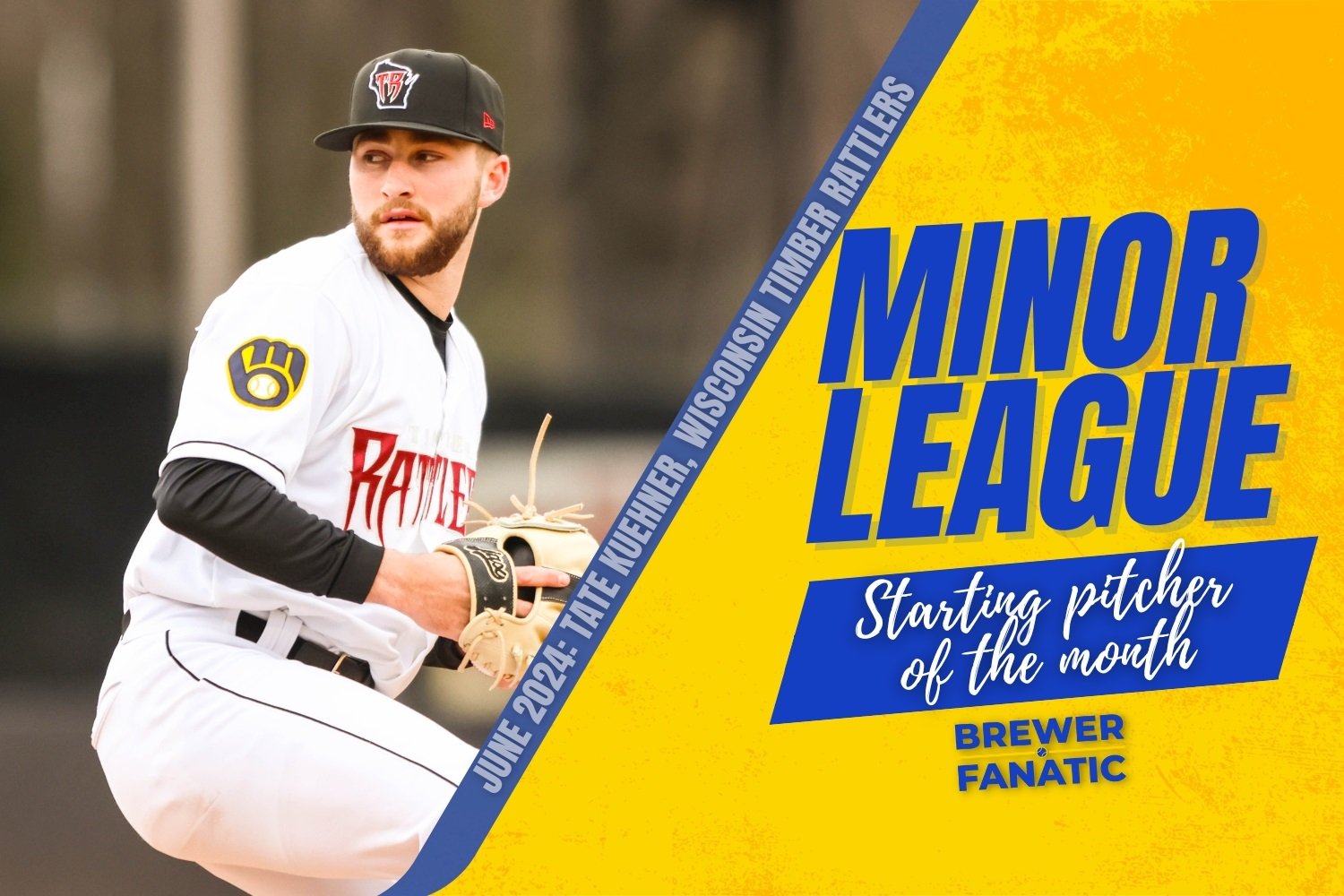 We will begin, as always, with a bunch of honorable mentions from an unbelievably successful month by the Brewers' starting prospects. Honorable Mentions: RHP - Christopher Peralta - DSL Brewers 2 - 4 G, 2 GS, 13.1 IP, 1-0, 1.35 ERA, 4.98 FIP, 1.20 WHIP, 10 H, 6 BB, 15 K RHP - Dariel Jaquez - DSL Brewers 1 - 4 G, 2 GS, 16 IP, 1-0, 1.69 ERA, 4.98 FIP, 1.13 WHIP, 9 H, 9 BB, 16 K, 1 SV RHP - Manuel Rodriguez - Carolina Mudcats - 4 G, 4 GS, 25 IP, 1-1, 2.52 ERA, 3.35 FIP, 1.12 WHIP, 26 H, 2 BB, 14 K RHP - Yujanyer Herrera - Wisconsin Timber Rattlers - 5 G, 5 GS, 26.2 IP, 4-0, 2.36 ERA, 3.98 FIP, 0.93 WHIP, 21 H, 11 BB, 23 K RHP - Chad Patrick - Nashville Sounds - 5 G, 3 GS, 27 IP, 3-0, 2.33 ERA, 3.16 FIP, 0.93 WHIP, 18 H, 7 BB, 30 K TOP SIX STARTING PITCHERS FOR JUNE #6 RHP - K.C. Hunt - Wisconsin Timber Rattlers - 4 G, 4 GS, 19 IP, 1-1, 2.37 ERA, 3.26 FIP, 1.05 WHIP, 15 H, 5 BB, 23 K Unranked by all publications Taking home the number one spot in April’s version of the Reliever of the Month list, the 2023 undrafted free agent signee transitioned to the rotation in June, and he has taken to it quite well so far. Hunt’s high-spin fastball sits in the 92-94 range and works well at the top of the zone, though he also does a good job of hitting the low and outside corner with the pitch. He has a four-pitch mix, and the secondaries are strong as well. His mid-80s bullet slider is a plus pitch that generates a ton of swing and miss. He also throws an upper 70s curveball that is a little more inconsistent but flashes as a plus pitch and has a ton of depth. Hunt will also mix in a changeup on occasion. The changeup isn’t great, but it gives a hitter something else to consider. In his first month as a starter, Hunt maintained a high whiff rate, not to the level he was showing as a reliever, but the 33.8% mark he posted was still in the 83rd percentile for High-A pitchers with at least 15 innings pitched. His 29.9% strikeout rate was in the 82nd percentile, and he kept the walks to a minimum. The month-long numbers would look much better if not for his third start of the month, in which he allowed two home runs and four earned runs over only three innings. He combined 16 innings and only one earned run in the other three starts. Hunt’s move to the rotation might slow his ascent through the minors, as he appeared to be on a fast track when he was coming out of the pen. However, the move to the rotation has catapulted him into legitimate prospect status, and he will likely find himself on some of the mid-season Top 30 updates. #5 RHP - Wenderlyn King - DSL Brewers 1 - 4 G, 4 GS, 17.2 IP, 1-1, 1.53 ERA, 3.21 FIP, 1.02 WHIP, 17 H, 1 BB, 21 K Unranked by all publications Signed out of the Dominican Republic in this past July’s class, King was making his professional debut this month, and the 18-year-old got it started with a bang. Equipped with a fastball that is reportedly in the 89-90 range and an ability to reach back for a bit more, King appears to rely heavily on his off-speed offerings. He throws a slider, a curveball, and a changeup. Based on the limited video available, the curveball and changeups appear to be his swing-and-miss pitches. Both have good depth and late movement. In June, King had a 21 to 1 strikeout-to-walk ratio, though that is a bit misleading considering he did hit seven batters with pitches. Still, a 21-to-8 strikeout to free pass ratio is strong for anybody in the DSL. He was able to induce seven double plays in the month. He highlighted the month with a ten-strikeout performance in his second career start on June 13th, only allowing one earned run in five innings. King got off to an incredible start to his professional career, and based on the limited video available, it looks like a starters profile. In-season promotions to the Arizona Complex League are not very common anymore, but he certainly appears to be on his way to starting 2025 stateside. #4 RHP - Enniel Cortez - ACL Brewers and Carolina Mudcats - 4 G, 4 GS, 18.0 IP, 1-0, 1.22 ERA, 4.03 FIP, 1.6 WHIP, 18 H, 4 BB, 16 K. Signed out of Nicaragua in January of 2023, and having only turned 18 on May 1st, the Brewers have aggressively moved Cortez. His first season was spent in the DSL, but he was assigned to the Arizona Complex League to start this season, and in mid-June, he was promoted to Low-A Carolina. The youngest pitcher in Low-A, Cortez’s fastball is already a really solid offering, sitting in the 91-93 range and touching 94 with a low release slot and some ride on the pitch. He throws an upper 70s sweeper as his best offering for whiffs against righties and an 83-85 MPH changeup. He’s shown an ability to throw the changeup backdoor to righties and use it as a swing-and-miss pitch against lefties. Along with the interesting three-pitch mix, Cortez shows signs of above-average command, potentially a plus. He has an 85-to-12 strikeout-to-walk ratio in his pro career, which is as strong as anybody in the system. He made two starts in the ACL and two in Carolina in June. In Carolina, he went four innings in each start and only allowed one earned run. He struck out nine and was landing pitches for strikes at a high level, which helped make up for a whiff rate of only 25.4%. He walked more in those eight innings than he is accustomed to, but full-season ball umpiring and hitters with more patience are the leading cause for that. He rarely missed badly; most of his pitches were competitive, even if they were out of the zone. As the youngest pitcher at the level, Cortez is likely going to spend an extended period there. He appears to be a very real prospect, though, and is someone to watch as a potential climber in the rankings. #3 RHP - Josh Knoth - Carolina Mudcats - 4 G, 4 GS, 19.2 IP, 2-0, 1.83 ERA, 3.49 FIP, 1.22 WHIP, 12 H, 12 BB, 22 K Selected with the 33rd overall pick in the 2023 draft, Knoth hails from New York and was one of the younger arms in the draft at only 17 on draft day. Knoth’s fastball comes around 94-95 and can reach 98 in short stints. It plays well up in the zone, in part due to the low release point he generates with his athletic delivery. What Knoth is primarily known for, though, is his ability to spin his two different breaking balls. His curveball grades out as a plus pitch, possibly better, as it spins at over 3,000 RPMs and has many late and sharp drops. His slider also spins at around 3,000 RPMs but has a bit of an inconsistent shape right now. It shows flashes of being an above-average offering at times. He will also mix in a very occasional changeup that shows flashes but needs to improve the consistency. Knoth has not yet faced a hitter younger than him in Carolina and managed to get through some expected bumps in the road at the start of the year while still putting up solid surface numbers. He put things together in June, though. His whiff rate of 30.8% and strikeout rate of 28.6% were above average for the level, but he did most of his work through soft contact. Knoth did not allow a single extra-base hit in June, which helped him work around the 12 walks he handed out. Knoth has a long development track in front of him, but the early signs of a potential major league starter are showing. He will likely spend the rest of 2024 in Carolina. #2 RHP - Logan Henderson - Biloxi Shuckers - 4 G, 4 GS, 21.2 IP, 4-0, 1.66 ERA, 2.44 FIP, 0.877 WHIP, 15 H, 4 BB, 29 K Henderson was the Brewers' fourth-round selection in 2021 out of McLennan Community College in Texas. At that point, he was committed to Texas A&M but chose to sign with the Brewers. His first year and a half after signing was injury-plagued, but he had a largely healthy 2023 in Low-A Carolina. Unfortunately, the injury bug did bite him again this year when he injured his oblique during the Spring Breakout game in March. He returned to play in May, pitching 4.2 innings at the Arizona Complex level and then another 6.2 dominant innings at High-A Wisconsin before being promoted to Double-A to begin June. Henderson’s changeup has always been his calling card. The low 80’s offering has some airbender qualities, averaging nearly 17 inches of break. It’s a plus pitch and his go-to secondary for generating swing and miss. Henderson's fastball went from averaging around 89-91 MPH in 2023 to being in the 92-94 range and getting up to 96. Not only has the velocity improved, but the pitch's shape has also. Formerly averaging around 14-16 inches of Induced Vertical Break (IVB), it is up to 18-19 inches on average this year and has surpassed 20 inches at times. Along with the improvement in his movement profile, his low release height has helped the fastball player even further with a -3.9 degree Vertical Approach Angle, an elite number. Both pitches could be considered plus or even better, and he commands them well above average. Henderson also throws a slider, which has made strides but isn’t used much. He may need to increase his usage to continue his path toward starting pitching, and the improvements in the pitch make it feasible for him to do so. Henderson was dominant in June, his first month at the Double-A level. He racked up whiffs and strikeouts with his fastball and changeup combo. His 32.7% whiff rate placed him in the 89th percentile for Double-A pitchers with at least 15 innings pitched. His 35.4% strikeout rate was in the 97th percentile. Henderson also did a fantastic job of limiting walks, and his 7.25 strikeout-to-walk ratio was in the 90th percentile as well. Two different ten-strikeout games highlighted his month, which matched his single-game high from last year. Henderson has been so dominant in Double-A, and his stuff has stepped forward so much already, the Brewers will likely consider pushing him to Triple-A quickly as well. It’s probably not super likely, but his fastball/changeup combination could play well in a pen role. So much so that he might be a candidate for an MLB promotion at some point this season. #1 LHP - Tate Kuehner - Wisconsin Timber Rattlers - 4 G, 4 GS, 22 IP, 2-0, 1.64 ERA, 2.75 FIP, 0.82 WHIP, 10 H, 8 BB, 25 K. Unranked by all publications The Brewers' 7th-round selection in 2023 out of Louisville, Kuehner, was used as a swingman by the Cardinals his senior year. He only threw three innings at the Complex League level last year after being drafted but began the 2024 season with High-A Appleton, where he has continued that swingman role but in a more consistent starter role. All four appearances in June were as a starter, and nine of twelve for the season have been starts. Kuehner was sitting in the upper-80’s as a junior in college but jumped into the 92-95 range as a senior, which is where he is now. He throws from a low slot and started generating more runs on the pitch his senior year. That slot allows the pitch to play well up in the zone due to the Vertical Approach Angle and down because of the run. His best secondary offering is his low-80s sweeper, which has a lot of sweep but also quite a bit of vertical drop and is his best swing-and-miss pitch. He mixes in a changeup as well, which appears to be in a better spot than where it was at Louisville, where he struggled to land any of his secondaries for strikes. In June, he posted a whiff rate of 35.8%, placing him in the 92nd percentile for High-A pitchers with at least 15 innings pitched. His 29.1% strikeout rate placed him in the 79th percentile. His ground ball rate of 46% in June was solid, but it doesn’t stand out among the crowd. Despite that, Kuehner only allowed one extra-base hit (a double) in June. He only allowed two in May, and his 1.9% extra-base hit rate is second in all of High-A over that period (minimum of 30 IP). Kuehner has been generating a lot of swings and misses. When the ball is put in play, it is rarely hit with authority. In terms of performance, Kuehner has been one of the biggest surprises so far this year, and he seems to be getting better each month. He started the season on a rough note, with an ERA over seven in April. After dealing with some walk issues in May, he cut his walk rate from 14.7% to 9.3% in June. His WHIP went from 2.18 in April to 1.24 in May and down to 0.82 in June. Kuehner is 23 years old, so he’s certainly a candidate to see Double-A at some point this year and given his continued development each month, he might be ready to make that jump very soon. Please share your opinions! Who should have made it that didn’t? Who made it but should not have?
-
- 1
-

-
- kc hunt
- wenderlyn king
- (and 4 more)
-
 The guys break down the Cubs series and 75% of the Rockies series (curse you, MLB schedule makers). They discuss Joel Payamps’ struggles, the grand slam binge, Colin Rea’s continued excellence, the Aaron Civale trade, and much more! Apple Podcasts: https://podcasts.apple.com/us/podcast/the-brewer-fanatic-podcast/id1740648724 Spotify: https://open.spotify.com/show/5CY8mWsQayqjDXqw9OT2Td\ iHeartRadio: https://www.iheart.com/podcast/263-the-brewer-fanatic-podcast-166534588/
 -
Jack and Spencer are back to talk Brewers! The guys break down the Cubs series and 75% of the Rockies series (curse you, MLB schedule makers). They discuss Joel Payamps’ struggles, the grand slam binge, Colin Rea’s continued excellence, the Aaron Civale trade, and much more! Apple Podcasts: https://podcasts.apple.com/us/podcast/the-brewer-fanatic-podcast/id1740648724 Spotify: https://open.spotify.com/show/5CY8mWsQayqjDXqw9OT2Td\ iHeartRadio: https://www.iheart.com/podcast/263-the-brewer-fanatic-podcast-166534588/ View full article
-
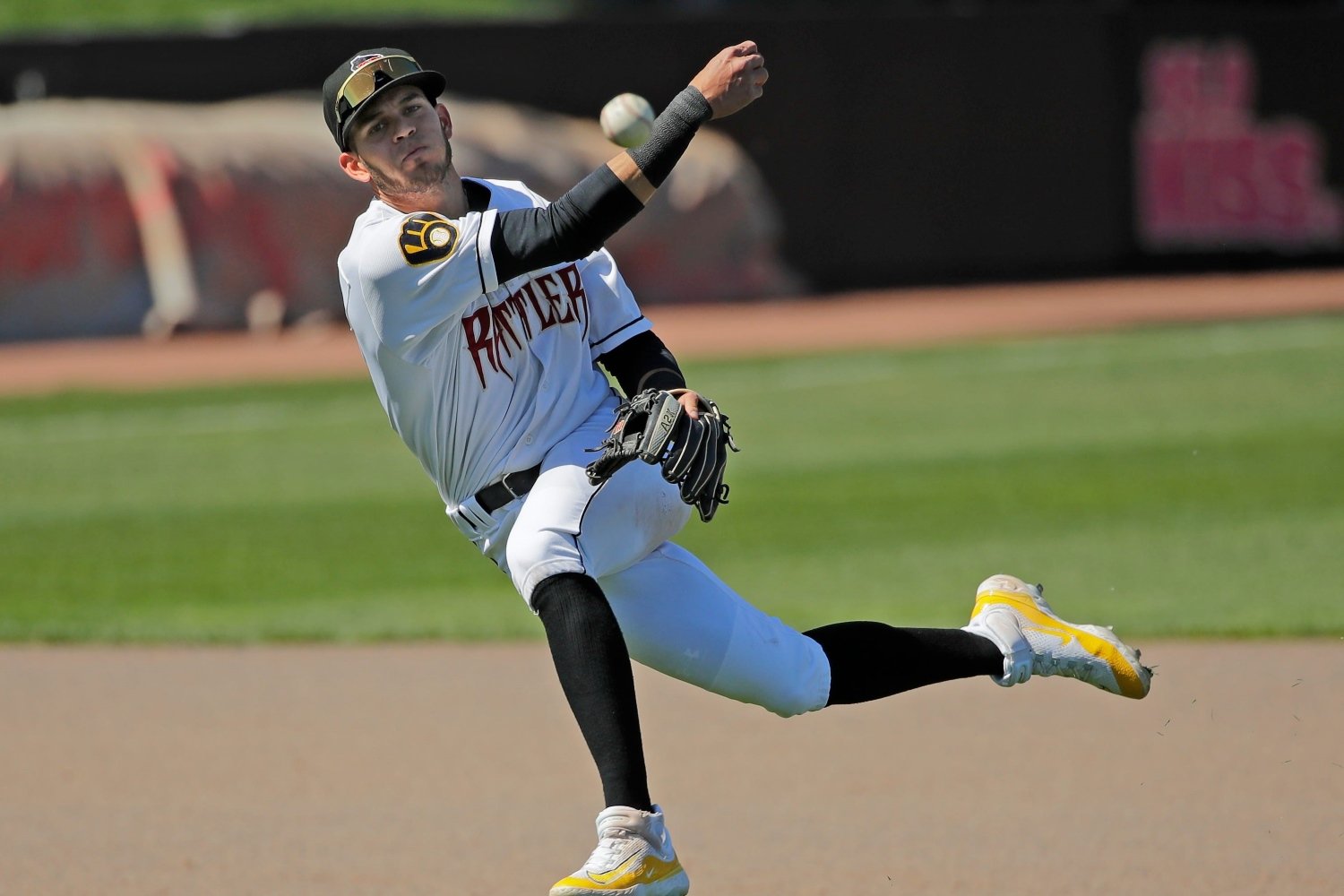 What are the Rays getting in Gregory Barrios? Signed in the same international free-agent class as Jackson Chourio, Barrios received the second-highest bonus ($1 million) in that class, behind only Chourio. Known for his glovework, he’s in the midst of an offensive breakout in 2024. After a slow start in the Dominican Summer League his first season, he stepped it up in 2022 and was a league-average hitter in the Arizona Complex League. Unfortunately, he followed that up with a 69 wRC+ in Low-A Carolina last season. While the results in Carolina were poor, Barrios did flash some of the tools you hope to see from young hitters. Despite a low walk rate, Barrios showed solid plate discipline and a good approach at the plate. He also demonstrated very strong bat-to-ball abilities, striking out at only a 13.5% clip. On top of that, he stole 32 bases. The approach is likely the reason the Brewers chose to be aggressive with his assignment in 2024, moving him up to High-A despite the lackluster results in 2023. Still only 20 years old this season, Barrios has proved that he was worthy of that assignment. At the time of the trade, Barrios was slashing .325/.367/.429 for a 125 wRC+. He has flashed some gap-to-gap power, with 17 doubles and two triples, while only striking out 9.4% of the time. Barrios does this with a short, compact swing that allows him to get the bat to inside pitches extremely consistently. Last year, he had some issues covering the outer third of the plate, for that same reason. In 2024, he’s shown a better ability to get to those outside pitches, while improving the batted-ball profile for a player with limited power as well. He has taken his 42% fly-ball rate and cut it to 31%. He’s improved his line drive rate from 20% to 26% as well. With his limited game power and athleticism, line drives and hard-hit ground balls will do him a lot better than fly balls, and that’s shown in the results. Barrios’ improved bat is important, because his defensive abilities are truly impressive. There is zero doubt that he is a shortstop moving forward. He can make some extraordinary plays that not many 20-year-olds would make, while also handling the routine plays with ease. The bat is going to need to continue to get better, but if it does, the Rays could have a solid prospect on their hands. Ripple Effect?s Barrios’ exit has opened up a spot on the Wisconsin Timber Rattlers roster--one that could be filled by 19-year-old prospect Cooper Pratt. Pratt has recently been named a Top 100 prospect by MLB Pipeline, as well as being named the lone Brewers representative at the Futures Game next weekend. His 144 wRC+ and strong defensive performance point to a player who is ready for the next challenge, and this trade clears the way for that to happen if the Brewers choose to go that route. Pratt is the player who could benefit the most directly, but the reason the Brewers were willing to part with a prospect like Barrios (outside of the obvious need for a starting pitcher and a chance to buy low on Civale), is the overall depth they have in the middle infield throughout their system. At the lower levels of full-season ball, alone, the Brewers have Pratt, Daniel Guilarte (in Low-A, ranked the team's #19 Prospect by MLB Pipeline), Jadher Areinamo (High-A, #21), and Filippo Di Turi (Low-A, #29), all of whom have spent a good amount of time at shortstop this season. If you look even further down the chain, the Brewers have three prospects generating a lot of hype in the Dominican Summer League as well. Jorge Quintana (#18 prospect), Luis Pena and Jesus Made are all playing a lot of shortstop thus far, and all three have a chance to stick at the position. Josh Adamczewski has also fared well in his first month of pro ball at the Arizona Complex level, posting a 146 wRC+. The depth is a bit less exciting at the upper levels, as Eric Brown Jr has struggled mightily at the plate in his first season at the Double-A level. Ethan Murray’s play has taken a step back in 2024 as well, and Freddy Zamora appears to be more organizational depth than a true prospect at this point. Still, all three of those players have prospect pedigree, and still have time to turn things around--especially in Brown’s case. Beyond all the players already in the organization, the Brewers also tend to draft at least one shortstop in every draft class, so there’s a good chance there will be another name added to this pool in a couple of weeks. More to Come? Does this change anything in regard to the Brewers potentially making more moves in the coming weeks? Outside of the fact that Barrios is no longer an available trade chip, this should not impact the Brewers' ability to continue to add to their major-league roster. As discussed above, the Brewers could afford to trade even more middle infield prospects, if that is what it takes. The organization likely won’t rank as highly in the upcoming prospect rankings, due to the graduations of players like Jackson Chourio and Joey Ortiz, but their depth stands out in comparison to a lot of other organizations at pretty much every position outside of catcher. Barrios could turn out to be a good player, but the Brewers have a lot of guys in a similar spot to him in terms of age and ability, and all at the same position. It’s unlikely that they were openly shopping Barrios, or any of the other names listed above, but the depth likely helped put the organization at ease when they did agree to the deal, and that same logic could be applied to most potential trades moving forward in July. What are your thoughts on Barrios? Are there any other names that stand out as potential movers in a deal this month?
 -
On Wednesday, the Brewers acquired starting pitcher Aaron CIvale from the Tampa Bay Rays. In return, they sent shortstop prospect Gregory Barrios to the Rays. Who is Barrios? Who else (and what else) might this move affect within the organization? Image courtesy of © Dan Powers/USA TODAY NETWORK-Wisconsin / USA TODAY NETWORK What are the Rays getting in Gregory Barrios? Signed in the same international free-agent class as Jackson Chourio, Barrios received the second-highest bonus ($1 million) in that class, behind only Chourio. Known for his glovework, he’s in the midst of an offensive breakout in 2024. After a slow start in the Dominican Summer League his first season, he stepped it up in 2022 and was a league-average hitter in the Arizona Complex League. Unfortunately, he followed that up with a 69 wRC+ in Low-A Carolina last season. While the results in Carolina were poor, Barrios did flash some of the tools you hope to see from young hitters. Despite a low walk rate, Barrios showed solid plate discipline and a good approach at the plate. He also demonstrated very strong bat-to-ball abilities, striking out at only a 13.5% clip. On top of that, he stole 32 bases. The approach is likely the reason the Brewers chose to be aggressive with his assignment in 2024, moving him up to High-A despite the lackluster results in 2023. Still only 20 years old this season, Barrios has proved that he was worthy of that assignment. At the time of the trade, Barrios was slashing .325/.367/.429 for a 125 wRC+. He has flashed some gap-to-gap power, with 17 doubles and two triples, while only striking out 9.4% of the time. Barrios does this with a short, compact swing that allows him to get the bat to inside pitches extremely consistently. Last year, he had some issues covering the outer third of the plate, for that same reason. In 2024, he’s shown a better ability to get to those outside pitches, while improving the batted-ball profile for a player with limited power as well. He has taken his 42% fly-ball rate and cut it to 31%. He’s improved his line drive rate from 20% to 26% as well. With his limited game power and athleticism, line drives and hard-hit ground balls will do him a lot better than fly balls, and that’s shown in the results. Barrios’ improved bat is important, because his defensive abilities are truly impressive. There is zero doubt that he is a shortstop moving forward. He can make some extraordinary plays that not many 20-year-olds would make, while also handling the routine plays with ease. The bat is going to need to continue to get better, but if it does, the Rays could have a solid prospect on their hands. Ripple Effect?s Barrios’ exit has opened up a spot on the Wisconsin Timber Rattlers roster--one that could be filled by 19-year-old prospect Cooper Pratt. Pratt has recently been named a Top 100 prospect by MLB Pipeline, as well as being named the lone Brewers representative at the Futures Game next weekend. His 144 wRC+ and strong defensive performance point to a player who is ready for the next challenge, and this trade clears the way for that to happen if the Brewers choose to go that route. Pratt is the player who could benefit the most directly, but the reason the Brewers were willing to part with a prospect like Barrios (outside of the obvious need for a starting pitcher and a chance to buy low on Civale), is the overall depth they have in the middle infield throughout their system. At the lower levels of full-season ball, alone, the Brewers have Pratt, Daniel Guilarte (in Low-A, ranked the team's #19 Prospect by MLB Pipeline), Jadher Areinamo (High-A, #21), and Filippo Di Turi (Low-A, #29), all of whom have spent a good amount of time at shortstop this season. If you look even further down the chain, the Brewers have three prospects generating a lot of hype in the Dominican Summer League as well. Jorge Quintana (#18 prospect), Luis Pena and Jesus Made are all playing a lot of shortstop thus far, and all three have a chance to stick at the position. Josh Adamczewski has also fared well in his first month of pro ball at the Arizona Complex level, posting a 146 wRC+. The depth is a bit less exciting at the upper levels, as Eric Brown Jr has struggled mightily at the plate in his first season at the Double-A level. Ethan Murray’s play has taken a step back in 2024 as well, and Freddy Zamora appears to be more organizational depth than a true prospect at this point. Still, all three of those players have prospect pedigree, and still have time to turn things around--especially in Brown’s case. Beyond all the players already in the organization, the Brewers also tend to draft at least one shortstop in every draft class, so there’s a good chance there will be another name added to this pool in a couple of weeks. More to Come? Does this change anything in regard to the Brewers potentially making more moves in the coming weeks? Outside of the fact that Barrios is no longer an available trade chip, this should not impact the Brewers' ability to continue to add to their major-league roster. As discussed above, the Brewers could afford to trade even more middle infield prospects, if that is what it takes. The organization likely won’t rank as highly in the upcoming prospect rankings, due to the graduations of players like Jackson Chourio and Joey Ortiz, but their depth stands out in comparison to a lot of other organizations at pretty much every position outside of catcher. Barrios could turn out to be a good player, but the Brewers have a lot of guys in a similar spot to him in terms of age and ability, and all at the same position. It’s unlikely that they were openly shopping Barrios, or any of the other names listed above, but the depth likely helped put the organization at ease when they did agree to the deal, and that same logic could be applied to most potential trades moving forward in July. What are your thoughts on Barrios? Are there any other names that stand out as potential movers in a deal this month? View full article
-
In episode 13 of the Brewer Fanatic Podcast, Spencer and Jack talk about the Brewers rotation and look forward to the Cubs coming to American Family Field. The guys recap the rest of the Brewers West Coast trip and a sweep of the Rangers at home, break down the recent pitching performances of Carlos Rodriguez, Tobias Myers, and Dallas Keuchel, and more. Apple Podcasts: https://podcasts.apple.com/us/podcast/the-brewer-fanatic-podcast/id1740648724 Spotify: https://open.spotify.com/show/5CY8mWsQayqjDXqw9OT2Td\ iHeartRadio: https://www.iheart.com/podcast/263-the-brewer-fanatic-podcast-166534588/ View full article
-
Episode 13: Sweeping The Champs & Here Come The Cubbies
Spencer Michaelis posted an article in Podcasts
 The guys recap the rest of the Brewers West Coast trip and a sweep of the Rangers at home, break down the recent pitching performances of Carlos Rodriguez, Tobias Myers, and Dallas Keuchel, and more. Apple Podcasts: https://podcasts.apple.com/us/podcast/the-brewer-fanatic-podcast/id1740648724 Spotify: https://open.spotify.com/show/5CY8mWsQayqjDXqw9OT2Td\ iHeartRadio: https://www.iheart.com/podcast/263-the-brewer-fanatic-podcast-166534588/
 -
The Keuchel addition is interesting, in that I think it makes it less likely they go after one of the Quintana/Stripling types, though if Keuchel doesn’t work out at all, they still might. But I could see him performing similar to those two, and without giving up anything but cash, hard to complain.
-
I'd be pretty thrilled with the first two picks. Short of Schmidt or Mayfield getting to 34, Oakie is probably my favorite realistic HS arm that could be there.
- 6 replies
-
- 1
-
-
- 2024 mlb draft
- cameron smith
- (and 1 more)
-
The Brewers are dealing with an inordinate number of injuries, as well as an ace who’s not quite performing up to the expectations laid upon him. They have continued piecing it together internally, but could an external addition be the next step? Image courtesy of © Lon Horwedel-USA TODAY Sports Jake McKibbin covered some of the players whom the Brewers could pursue (and who would be under control for multiple seasons) here, but what are the team's options in terms of shorter-term fixes? Let’s take a look at the different tiers of possible rental options, and throw out some potential offers to get the job done for each of them. The Big Fish This tier contains the bigger names: the starters who are having good seasons, and the ones who will likely be in the highest demand at the deadline. Luis Severino - Mets If you have been following the Mets this season, you know that Severino looks less likely to be dealt at the current moment than he did even one week prior. The Mets have been red-hot, and are now only two games under .500 after winning nine of their last 11. For this article, we are going to assume that they cool off a bit and decide to sell at the deadline. If they do, Luis Severino will be in high demand around the league. While his strikeout numbers are not where they once were, Severino is having a really strong season for the Mets. He made some changes to his repertoire this past offseason, and they are paying off to the tune of a 3.52 ERA. The biggest change that Severino made was to his fastball usage. Formerly employing primarily a four-seamer and a cutter, he introduced the sinker in 2022 but only used it at a 1% clip; he only upped that to 2.8% in 2023. In 2024, he is throwing it 23.7% of the time. This has lowered his fastball usage from what was 45% in 2023 to 36.7% in 2024. His groundball rate has risen 43.3% to 52.9% this year, and that has helped him tremendously. The sinker is a solid pitch, though it’s nothing special. What it has really done is allowed his four-seamer to play up a bit more than it had recently. With hitters seeing it less often, the expected slugging percentage on it has plunged, from .587 to .341 in the past year. The other major change he made was adding a sweeper, instead of strictly throwing a more traditional slider. The sweeper has 14.3 inches of horizontal movement, whereas the slider has 7.3 inches of it. Separating those two has not only helped the slider perform better, but the sweeper is arguably his best pitch this year. It has generated a 36.5% whiff rate and hitters are only slugging .167 against it. Severino won’t be cheap, by any means, but he also shouldn’t cost you any “top of the board” prospects. The Offer: RHP Bradley Blalock, INF Juan Baez and C Matthew Wood for Severino Jack Flaherty - Tigers The Tigers are currently six games back of a Wild Card spot, and appear to be on their way to being sellers at the deadline. Much like Severino, Flaherty is in the midst of a really strong season, after signing a one-year, “prove-it” deal with Detroit this offseason. In fact, Flaherty is having an even better season than Severino, currently sporting a 3.01 ERA with a strikeout to walk ratio of 9.1 for the season. He's actually underperforming on the surface, when compared to his FIP of 2.63 and his xERA of 2.68. Flaherty has mostly been a three-pitch pitcher this year, throwing his four-seam fastball 44.8% of the time, his slider 31.1% of the time, and his knuckle curve 18.6% of the time. He'll also mix in a rare changeup or sinker, but both have usage rates under 4%. In terms of four-seam fastballs, Flaherty’s whiff rate of 27.1% is well above average. His whiff rates of 41.3% and 41.7% on the slider and knuckle-curve are elite. That slider whiff rate places him ninth in baseball among qualified pitchers, and the knuckle-curve whiff rate is fourth among all curveballs. As you can see below, despite a lot of his fastballs being in the hitting zone, the life of the pitch and the threat of the two breakers has allowed him to be on the attack with the fastball. Worrying less about pinpoint control has helped him cut down the walks. Flaherty will probably cost quite a bit to acquire. He will have numerous suitors, and an argument could very easily be made against making the below trade, but this is probably close to what it would cost to make the move. The Offer: OF Luis Lara, RHP Tyler Woessner and INF Filippo Di Turi for Flaherty Nathan Eovaldi - Rangers The Rangers don’t seem like a team that should be selling at the deadline, but at the time this article is being written, they’re five games out of the Wild Card and 7.5 back in their division. Eovaldi has a vesting option for 2025 that has a chance to hit. He needs to get to 156 innings pitched this season for the option to vest. He currently sits at 60, so if he remains healthy, he would have an outside chance. For the purpose of this article, however, we will assume that the pick-up would be in a rental capacity for the Brewers. Back in 2018, there were some rumors connecting the Brewers and Eovaldi, but nothing very substantial. Eventually, he was traded to the Red Sox instead, and he ended up pitching really well down the stretch, helping the Red Sox win the World Series. If he’s available, he’s another high ceiling possibility for the Brewers. Currently posting an ERA of 3.14 and a FIP of 3.67, Eovaldi would slot into the top two pitchers in the rotation upon arrival. His four-seam fastball sits in the mid-90s and generates an impressive number of ground balls. Half the balls in play against it are grounders, which ranks in the 96th percentile for four-seam fastballs. The shape is more in line with a two-seamer, it gets a lot of run on the pitch and has more sink than ride. Because of this, it actually plays better at the bottom of the zone than at the top, though he has been able to generate grounders with it in all quadrants of the zone. His best secondary is an upper-80s splitter that he throws nearly a third of the time, generating a 40% whiff rate against it (per TruMedia), as well as a 61% ground-ball rate. He also throws an upper-70s curveball (15% of the time) that gets whiffs at a strong 35% rate, while really limiting the hard contact against it more than any other pitch he throws. The rest of his repertoire consists of a cutter and a slider. The cutter is used about 10% of the time and sits in the low 90s. The slider is only used once in a while, and it has not performed well when he does break it out. Eovaldi has a deep repertoire, strong results and the potential to possibly be around for a year and a half if he surpasses his innings threshold this year. He won’t be cheap. Because they likely plan to compete next year, the Rangers may consider players who could help them in MLB right away, as well. The Offer: RHP Bradley Blalock, INF Juan Baez and RHP Elvis Peguero + a PTBNL or Cash depending on if the option vests or not Mid-Tier Rentals These are pitchers who aren’t quite having the seasons of Severino, Flaherty and Eovaldi, but who would still be considered upgrades over the available starters the Brewers currently have. Yusei Kikuchi - Blue Jays Kikuchi could probably have a case made for him to be placed in the “Big Fish” tier. He has the upside to be one of the better pitchers in this article. At one point considered a pretty big disappointment after signing with the Mariners, he had a pretty decent final season in Seattle and was able to turn that into a three-year deal with the Blue Jays. This is the final year of that deal, and the Blue Jays are six games back in the Wild Card race right now, making him a potential mover, and one who would likely generate quite a bit of interest throughout the league. At this time sporting a 3.65 ERA, Kikuchi ranks in the 63rd percentile in whiff rate, which doesn’t stand out as anything special, but if you dig in a bit further, he has done it in a very interesting way. His four-seam fastball gets whiffs at a 26.3% rate, which (per TruMedia) ranks in the 76th percentile for pitchers who have thrown at least 100 fastballs in 2024. His changeup whiff rate of 35.8% is in the 72nd percentile. The pitches that have tanked the overall whiff rate are his breaking balls. His curveball only ranks in the 22nd percentile at 25.5%, and his slider is in the 21st percentile at 25.9%. Breaking balls tend to be big swing-and-miss pitches, but for Kikuchi, they act a bit differently. For Kikuchi, his breaking balls generate a lot of grounders. His slider gets grounders at a 54.3% rate, which places him in the 85th percentile in baseball. The curveball generates them at a 47.8% clip, and that places him in the 69th percentile in that regard. It’s a bit of a different profile, but Kikuchi has two pitches that he can get a lot of swing-and-miss with, and two that get a lot of grounders, but fewer swings and misses. The changeup does however do a really good job of both of those things, with a 60% ground ball rate. If the Brewers were to acquire Kikuchi, they might have him use the changeup more often than he currently does. The Offer: RHP Jesus Rivero, LHP Russell Smith and INF Daniel Guilarte for Kikuchi Andrew Heaney - Rangers Another Rangers arm, Heaney is not having as strong a season as Eovaldi, nor should he cost as much to acquire. Of the names listed so far, Heaney’s 4.21 ERA would rank the lowest. He would, however, still be a solid addition to the Brewers rotation. Heaney throws from a pretty low slot, which helps him throw his fastball at a -4.14 degree Vertical Approach Angle (VAA). This really helps the pitch play up in the zone. When he throws to the upper third of the zone, his whiff rate on the four seam is 28.8%. When he throws it in the zone, in the middle or lower thirds, it only has an 11% whiff rate. The good news is that he’s well aware of this, and does a good job keeping the pitch at, or above the top of the zone for the most part. Heaney’s slider generates whiffs at a very strong 36.7% and is often the secondary pitch he goes to when he is looking for a strikeout. His changeup is one that he locates really well, consistently putting it low and away to righty hitters. It’s more of a weak contact pitch than a pitch that he uses to try to get hitters to swing and miss. He used to throw a curveball as his main secondary, but he has only thrown it 3% of the time this year. The upside isn’t as high as some of the other names on this list, but Heaney could be a definite rotation solidifier for a team that could use some stability in that role. The Offer: 3B Oliver Dunn and RHP Yerlin Rodriguez for Heaney Inning Eaters These are the arms that wouldn’t thrill anyone, but can be expected to help get through the season by being available and willing/able to give you 5-6 innings pretty much every outing and could play above their abilities with the Brewers defensive unit playing behind them. Jose Quintana - Mets Quintana would certainly fall under the “less exciting” umbrella, compared to the names above, but he could fit well into the Brewers run prevention system. He does come with a similar caveat to Luis Severino, which is that we don’t know if the Mets will actually be selling or not. It has not been a strong season for Quintana, but he does a decent job of staying in the strike zone, and has been average or better in walk rate every year of his career outside of 2019 and 2021. He will throw strikes, and he gets ground balls at a 46% clip, which puts him in the 65th percentile this season. This wouldn’t be an exciting pick up, but it would give the Brewers an experienced arm who could sufficiently eat innings for the team. The Offer: OF Carlos D. Rodriguez for Quintana Ross Stripling - A’s A similar option to Quintana, but this time on a team that definitely will not be competing this year, Stripling could be a good fit for the Brewers as well Like quintana, Stripling usually does a good job limiting walks. This year he ranks in the 90th percentile, walking only 4.8% of hitters he faces. He also has done a good job of limiting barrels. With only a 4.4% barrel rate against him. He does this by generating an above average amount of chases. Those chases lead to a lot of soft contact, though he does not miss many bats, even when they do go fishing outside of the zone. Much like Quintana, you would be buying Stripling with the idea that his ERA is inflated due to some bad luck, and due to having a much worse defense behind him in Oakland than the one he would have in Milwaukee. As well as for the inning eating factor. The Offer: UTIL Noah Campbell for Stripling Wrap-Up Most Brewers fans are expecting a starter to be added, and for good reason. As much fun as a Garrett Crochet would be, those types of moves are not often in the Brewers plans. It seems more likely that they will go the route of filling the rotation with a steady presence by picking up a rental or two. Do any of these names stand out to you? What do you think of the offers laid out for these players? Too much? Not enough? Let us know! View full article
- 3 replies
-
- 1
-
-
- jack flaherty
- nathan eovaldi
- (and 2 more)
-
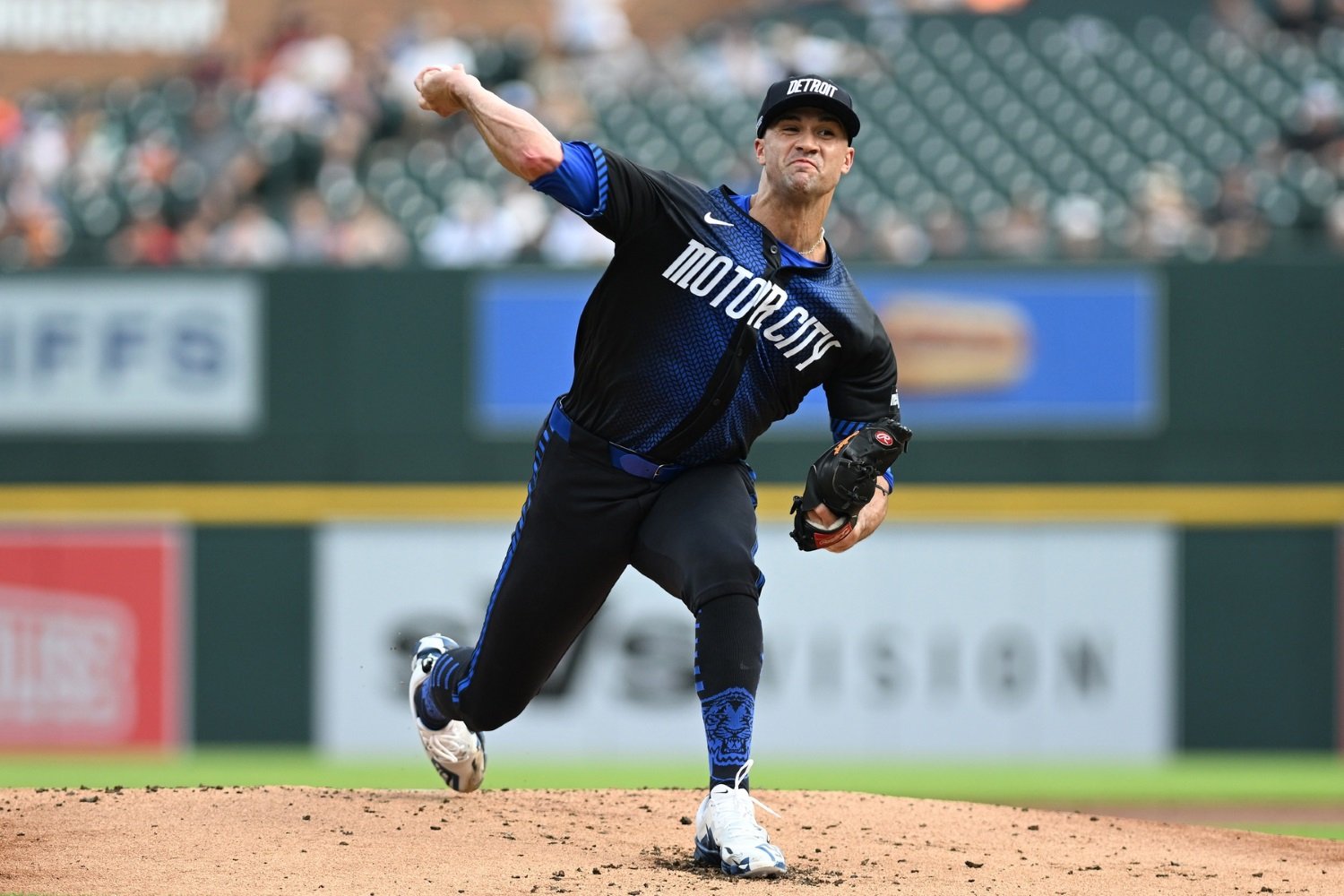 Jake McKibbin covered some of the players whom the Brewers could pursue (and who would be under control for multiple seasons) here, but what are the team's options in terms of shorter-term fixes? Let’s take a look at the different tiers of possible rental options, and throw out some potential offers to get the job done for each of them. The Big Fish This tier contains the bigger names: the starters who are having good seasons, and the ones who will likely be in the highest demand at the deadline. Luis Severino - Mets If you have been following the Mets this season, you know that Severino looks less likely to be dealt at the current moment than he did even one week prior. The Mets have been red-hot, and are now only two games under .500 after winning nine of their last 11. For this article, we are going to assume that they cool off a bit and decide to sell at the deadline. If they do, Luis Severino will be in high demand around the league. While his strikeout numbers are not where they once were, Severino is having a really strong season for the Mets. He made some changes to his repertoire this past offseason, and they are paying off to the tune of a 3.52 ERA. The biggest change that Severino made was to his fastball usage. Formerly employing primarily a four-seamer and a cutter, he introduced the sinker in 2022 but only used it at a 1% clip; he only upped that to 2.8% in 2023. In 2024, he is throwing it 23.7% of the time. This has lowered his fastball usage from what was 45% in 2023 to 36.7% in 2024. His groundball rate has risen 43.3% to 52.9% this year, and that has helped him tremendously. The sinker is a solid pitch, though it’s nothing special. What it has really done is allowed his four-seamer to play up a bit more than it had recently. With hitters seeing it less often, the expected slugging percentage on it has plunged, from .587 to .341 in the past year. The other major change he made was adding a sweeper, instead of strictly throwing a more traditional slider. The sweeper has 14.3 inches of horizontal movement, whereas the slider has 7.3 inches of it. Separating those two has not only helped the slider perform better, but the sweeper is arguably his best pitch this year. It has generated a 36.5% whiff rate and hitters are only slugging .167 against it. Severino won’t be cheap, by any means, but he also shouldn’t cost you any “top of the board” prospects. The Offer: RHP Bradley Blalock, INF Juan Baez and C Matthew Wood for Severino Jack Flaherty - Tigers The Tigers are currently six games back of a Wild Card spot, and appear to be on their way to being sellers at the deadline. Much like Severino, Flaherty is in the midst of a really strong season, after signing a one-year, “prove-it” deal with Detroit this offseason. In fact, Flaherty is having an even better season than Severino, currently sporting a 3.01 ERA with a strikeout to walk ratio of 9.1 for the season. He's actually underperforming on the surface, when compared to his FIP of 2.63 and his xERA of 2.68. Flaherty has mostly been a three-pitch pitcher this year, throwing his four-seam fastball 44.8% of the time, his slider 31.1% of the time, and his knuckle curve 18.6% of the time. He'll also mix in a rare changeup or sinker, but both have usage rates under 4%. In terms of four-seam fastballs, Flaherty’s whiff rate of 27.1% is well above average. His whiff rates of 41.3% and 41.7% on the slider and knuckle-curve are elite. That slider whiff rate places him ninth in baseball among qualified pitchers, and the knuckle-curve whiff rate is fourth among all curveballs. As you can see below, despite a lot of his fastballs being in the hitting zone, the life of the pitch and the threat of the two breakers has allowed him to be on the attack with the fastball. Worrying less about pinpoint control has helped him cut down the walks. Flaherty will probably cost quite a bit to acquire. He will have numerous suitors, and an argument could very easily be made against making the below trade, but this is probably close to what it would cost to make the move. The Offer: OF Luis Lara, RHP Tyler Woessner and INF Filippo Di Turi for Flaherty Nathan Eovaldi - Rangers The Rangers don’t seem like a team that should be selling at the deadline, but at the time this article is being written, they’re five games out of the Wild Card and 7.5 back in their division. Eovaldi has a vesting option for 2025 that has a chance to hit. He needs to get to 156 innings pitched this season for the option to vest. He currently sits at 60, so if he remains healthy, he would have an outside chance. For the purpose of this article, however, we will assume that the pick-up would be in a rental capacity for the Brewers. Back in 2018, there were some rumors connecting the Brewers and Eovaldi, but nothing very substantial. Eventually, he was traded to the Red Sox instead, and he ended up pitching really well down the stretch, helping the Red Sox win the World Series. If he’s available, he’s another high ceiling possibility for the Brewers. Currently posting an ERA of 3.14 and a FIP of 3.67, Eovaldi would slot into the top two pitchers in the rotation upon arrival. His four-seam fastball sits in the mid-90s and generates an impressive number of ground balls. Half the balls in play against it are grounders, which ranks in the 96th percentile for four-seam fastballs. The shape is more in line with a two-seamer, it gets a lot of run on the pitch and has more sink than ride. Because of this, it actually plays better at the bottom of the zone than at the top, though he has been able to generate grounders with it in all quadrants of the zone. His best secondary is an upper-80s splitter that he throws nearly a third of the time, generating a 40% whiff rate against it (per TruMedia), as well as a 61% ground-ball rate. He also throws an upper-70s curveball (15% of the time) that gets whiffs at a strong 35% rate, while really limiting the hard contact against it more than any other pitch he throws. The rest of his repertoire consists of a cutter and a slider. The cutter is used about 10% of the time and sits in the low 90s. The slider is only used once in a while, and it has not performed well when he does break it out. Eovaldi has a deep repertoire, strong results and the potential to possibly be around for a year and a half if he surpasses his innings threshold this year. He won’t be cheap. Because they likely plan to compete next year, the Rangers may consider players who could help them in MLB right away, as well. The Offer: RHP Bradley Blalock, INF Juan Baez and RHP Elvis Peguero + a PTBNL or Cash depending on if the option vests or not Mid-Tier Rentals These are pitchers who aren’t quite having the seasons of Severino, Flaherty and Eovaldi, but who would still be considered upgrades over the available starters the Brewers currently have. Yusei Kikuchi - Blue Jays Kikuchi could probably have a case made for him to be placed in the “Big Fish” tier. He has the upside to be one of the better pitchers in this article. At one point considered a pretty big disappointment after signing with the Mariners, he had a pretty decent final season in Seattle and was able to turn that into a three-year deal with the Blue Jays. This is the final year of that deal, and the Blue Jays are six games back in the Wild Card race right now, making him a potential mover, and one who would likely generate quite a bit of interest throughout the league. At this time sporting a 3.65 ERA, Kikuchi ranks in the 63rd percentile in whiff rate, which doesn’t stand out as anything special, but if you dig in a bit further, he has done it in a very interesting way. His four-seam fastball gets whiffs at a 26.3% rate, which (per TruMedia) ranks in the 76th percentile for pitchers who have thrown at least 100 fastballs in 2024. His changeup whiff rate of 35.8% is in the 72nd percentile. The pitches that have tanked the overall whiff rate are his breaking balls. His curveball only ranks in the 22nd percentile at 25.5%, and his slider is in the 21st percentile at 25.9%. Breaking balls tend to be big swing-and-miss pitches, but for Kikuchi, they act a bit differently. For Kikuchi, his breaking balls generate a lot of grounders. His slider gets grounders at a 54.3% rate, which places him in the 85th percentile in baseball. The curveball generates them at a 47.8% clip, and that places him in the 69th percentile in that regard. It’s a bit of a different profile, but Kikuchi has two pitches that he can get a lot of swing-and-miss with, and two that get a lot of grounders, but fewer swings and misses. The changeup does however do a really good job of both of those things, with a 60% ground ball rate. If the Brewers were to acquire Kikuchi, they might have him use the changeup more often than he currently does. The Offer: RHP Jesus Rivero, LHP Russell Smith and INF Daniel Guilarte for Kikuchi Andrew Heaney - Rangers Another Rangers arm, Heaney is not having as strong a season as Eovaldi, nor should he cost as much to acquire. Of the names listed so far, Heaney’s 4.21 ERA would rank the lowest. He would, however, still be a solid addition to the Brewers rotation. Heaney throws from a pretty low slot, which helps him throw his fastball at a -4.14 degree Vertical Approach Angle (VAA). This really helps the pitch play up in the zone. When he throws to the upper third of the zone, his whiff rate on the four seam is 28.8%. When he throws it in the zone, in the middle or lower thirds, it only has an 11% whiff rate. The good news is that he’s well aware of this, and does a good job keeping the pitch at, or above the top of the zone for the most part. Heaney’s slider generates whiffs at a very strong 36.7% and is often the secondary pitch he goes to when he is looking for a strikeout. His changeup is one that he locates really well, consistently putting it low and away to righty hitters. It’s more of a weak contact pitch than a pitch that he uses to try to get hitters to swing and miss. He used to throw a curveball as his main secondary, but he has only thrown it 3% of the time this year. The upside isn’t as high as some of the other names on this list, but Heaney could be a definite rotation solidifier for a team that could use some stability in that role. The Offer: 3B Oliver Dunn and RHP Yerlin Rodriguez for Heaney Inning Eaters These are the arms that wouldn’t thrill anyone, but can be expected to help get through the season by being available and willing/able to give you 5-6 innings pretty much every outing and could play above their abilities with the Brewers defensive unit playing behind them. Jose Quintana - Mets Quintana would certainly fall under the “less exciting” umbrella, compared to the names above, but he could fit well into the Brewers run prevention system. He does come with a similar caveat to Luis Severino, which is that we don’t know if the Mets will actually be selling or not. It has not been a strong season for Quintana, but he does a decent job of staying in the strike zone, and has been average or better in walk rate every year of his career outside of 2019 and 2021. He will throw strikes, and he gets ground balls at a 46% clip, which puts him in the 65th percentile this season. This wouldn’t be an exciting pick up, but it would give the Brewers an experienced arm who could sufficiently eat innings for the team. The Offer: OF Carlos D. Rodriguez for Quintana Ross Stripling - A’s A similar option to Quintana, but this time on a team that definitely will not be competing this year, Stripling could be a good fit for the Brewers as well Like quintana, Stripling usually does a good job limiting walks. This year he ranks in the 90th percentile, walking only 4.8% of hitters he faces. He also has done a good job of limiting barrels. With only a 4.4% barrel rate against him. He does this by generating an above average amount of chases. Those chases lead to a lot of soft contact, though he does not miss many bats, even when they do go fishing outside of the zone. Much like Quintana, you would be buying Stripling with the idea that his ERA is inflated due to some bad luck, and due to having a much worse defense behind him in Oakland than the one he would have in Milwaukee. As well as for the inning eating factor. The Offer: UTIL Noah Campbell for Stripling Wrap-Up Most Brewers fans are expecting a starter to be added, and for good reason. As much fun as a Garrett Crochet would be, those types of moves are not often in the Brewers plans. It seems more likely that they will go the route of filling the rotation with a steady presence by picking up a rental or two. Do any of these names stand out to you? What do you think of the offers laid out for these players? Too much? Not enough? Let us know!
- 3 comments
-
- 1
-
-
- jack flaherty
- nathan eovaldi
- (and 2 more)


