



Spencer Michaelis
-
Posts
1,119 -
Joined
-
Last visited
-
Days Won
17
Content Type
Profiles
Forums
Blogs
Events
News
2026 Milwaukee Brewers Top Prospects Ranking
Milwaukee Brewers Videos
2022 Milwaukee Brewers Draft Picks
Milwaukee Brewers Free Agent & Trade Rumors, Notes, & Tidbits
Guides & Resources
2023 Milwaukee Brewers Draft Picks
2024 Milwaukee Brewers Draft Picks
The Milwaukee Brewers Players Project
2025 Milwaukee Brewers Draft Pick Tracker
2026 Milwaukee Brewers Draft Tracker: Picks & Bonuses
Store
Downloads
Gallery
Everything posted by Spencer Michaelis
-
 The Brewers had a volatile week of baseball, let's dive into the details. Jack and Spencer discuss the recent two series stretch against the White Sox and Phillies, what can be gleaned from those six games, whether people should be concerned about the offense, Aaron Ashby’s return, and much more. Apple Podcasts: https://podcasts.apple.com/us/podcast/the-brewer-fanatic-podcast/id1740648724 Spotify: https://open.spotify.com/show/5CY8mWsQayqjDXqw9OT2Td\ iHeartRadio: https://www.iheart.com/podcast/263-the-brewer-fanatic-podcast-166534588/ View full article
 -
Hunt was actually on my list for the honorable mentions and it appears I completely forgot to include him… whoops! I’m a big believer as well though, have been since you turned me onto him lol. Those breaking balls are ridiculous.
-
Brewers Minor League Relief Pitcher of the Month: May 2024
Spencer Michaelis posted an article in Minor Leagues
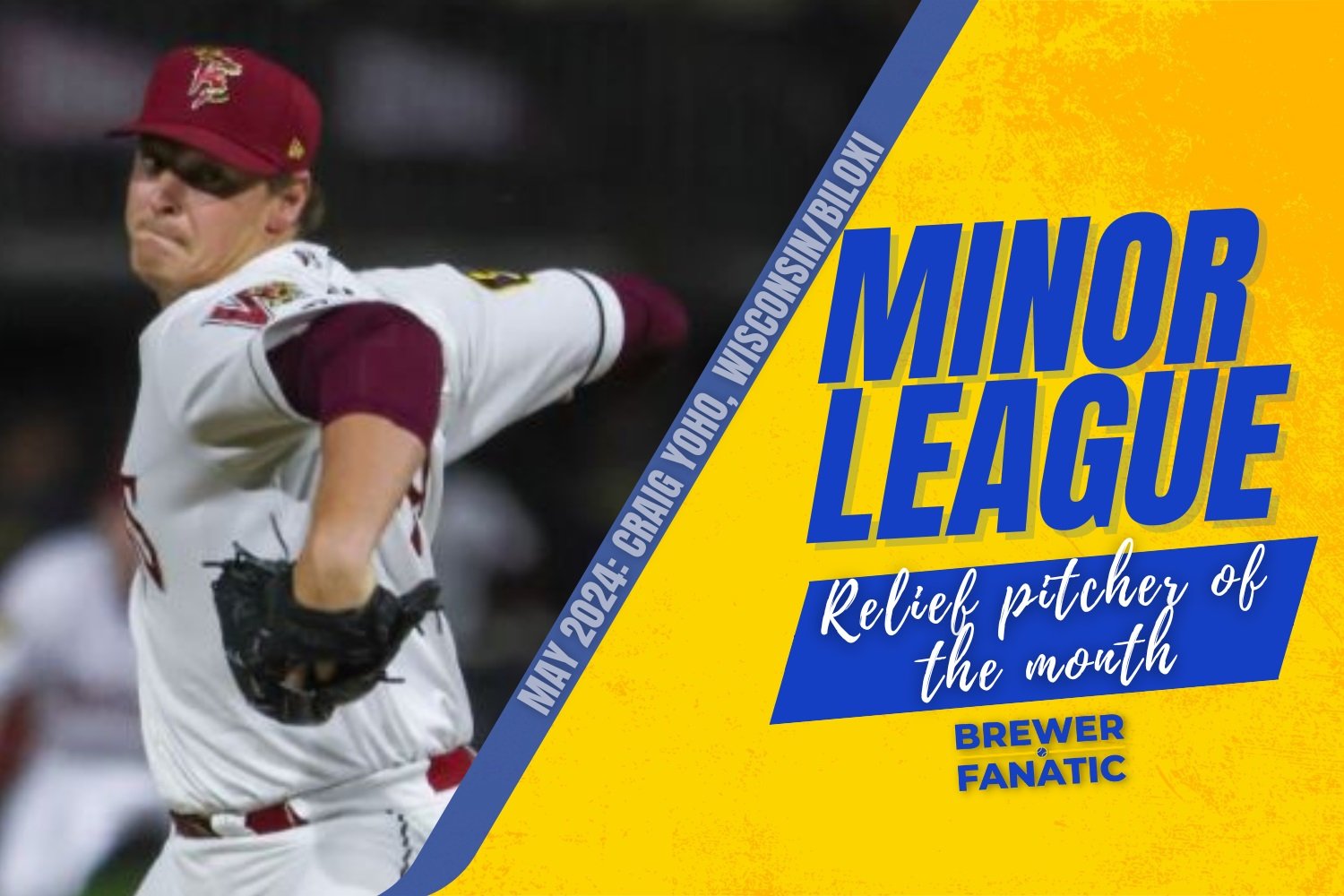 The Brewers' minor league pitching was very impressive on the starting side of things this month, and the relievers had a lot of strong candidates as well. Beginning with a few honorable mentions: HONORABLE MENTIONS RHP - Jeferson Figueroa - Carolina Mudcats - 5 G, 8.0 IP, 1-0, 2.25 ERA, 4.82 FIP, 1.13 WHIP, 4 H , 5 BB, 16 K Figueroa was the Brewers' 32nd round pick in 2019 (which was the last draft that expanded beyond round 20) as a high schooler out of Florida. Currently showing a fastball with life at the top of the zone and touching 96-97 at times, he also throws a wipeout slider. He generated whiffs on 43.1% of swings in May. RHP - Kaleb Bowman - Biloxi Shuckers - 8 G, 19.1 IP, 2-1, 2.33 ERA, 3.62 FIP, 0.72 WHIP, 11 H, 3 BB, 11 K Bowman was signed out of Independent ball before the 2023 season and performed well at High-A in 2023, and has continued that strong performance through the first two months of 2024 with Biloxi, mainly by limiting walks and extra-base hits. RHP - James Meeker - Nashville Sounds - 10 G, 13.2 IP, 1-0, 1.32 ERA, 4.22 FIP, 1.24 WHIP, 9 H, 8 BB, 14 K Another Indy ball signing for the Brewers back in 2021, Meeker throws a four-seam, cutter, sinker, and slider and mixes them all. None stand out as above average, and he’s more of a sum of his parts pitcher, but he continues to get the job done at every level. TOP FOUR RELIEF PITCHERS FOR MAY #4 LHP - Anfernny Reyes - 7 G, 11.1 IP, 2-2, 1.59 ERA, 2.09 FIP, 0.88 WHIP, 8 H, 2 BB, 10 K Unranked by all publications Reyes was signed out of the Dominican Republic in August of 2021, at 17 years old. After a great first season in the Dominican Summer League in 2022 finishing with a 1.54 ERA in 11 starts. He moved stateside in 2023 where he continued to post solid, if unspectacular, numbers as a reliever in the Arizona Complex League, finishing with a 4.85 ERA. He returned to the level in 2024 and got off to a tremendous start in May. Unfortunately, there has been little to no information on Reyes put out to the public, so all we know about him is that he throws left-handed and has been able to rack up strikeouts at a pretty solid rate. He continued to rack up those punchouts in May, striking out batters at a very strong 32.7% for the month. That number placed him 15th at the rookie level out of 140 pitchers with at least 12 innings. Reyes is already 20 years old, and seems like a candidate for a promotion to Carolina soon, based both on his performance and the advanced age for the level. Hopefully, then we will be able to learn more about what he's doing to get all of this swing and miss! #3 RHP - Sam Gardner - Biloxi Shuckers - 7 G, 13.2 IP, 0-1, 1.98 ERA, 1.26 FIP, 0.88 WHIP, 10 H , 2 BB, 17 K Unranked by all publications Gardner graduated from Murray State in 2021, and after going undrafted following his senior season he signed with the Gateway Grizzlies of the Frontier League. The Brewers purchased him from the Grizzlies in early June of 2023 and he had a strong finish to the season. He continued that run in the Australian Winter League this past offseason when he only allowed one earned run in 22.2 innings while striking out 50 batters for an absurd 19.9 K/9. This earned him a Double-A assignment to start the season where he has gotten off to a really strong start. Gardner throws a fastball that sits in the 93-94 range and can get up a bit higher at times. The fastball works well at the top of the zone. He plays off of that fastball with a curveball that sits in the high 70s. The curve he can both land for strikes, as well as throw it out of the zone to get hitters to chase. It’s his put-away pitch, and might even be his primary pitch as he uses it quite a bit. In May, Gardner was able to continue doing what he does best; racking up strikeouts and limiting walks. His 8.5 K/BB ratio placed him in the 95th percentile among Double-A pitchers with at least seven innings in May. He generated whiffs at an above-average rate of 31.7%, which placed him in the 73rd percentile. However, in two-strike counts, his whiff rate balloons to 41.2% which is in the 95th percentile. He aims to get soft contact early in counts and then knows how to put a hitter away when he has him in pitcher’s counts. Unfortunately, Gardner ended the month on the 7-Day IL for the Shuckers, and we are currently unsure of what his return timeline is looking like. Once he does return, he’s a definite candidate for Nashville with him being 27 years old and having so much success with Biloxi. #2 RHP - Bayden Root - Carolina Mudcats and Wisconsin Timber Rattlers - 9 G, 12.1 IP, 1-0, 0.73 ERA, 2.79 FIP, 1.38 WHIP, 10 H, 7 BB, 16 K, 4 SV. Unranked by all publications Root signed with the Brewers as an undrafted free agent out of Oklahoma State, following the 2023 draft. He began his career at Ohio State before transferring to the other OSU for his final season, where he worked exclusively out of the bullpen. While he performed decently in college, the combination of age and being a relief only prospect kept Root from being drafted. What interested the Brewers was likely his pure stuff and his competitiveness. He’s a very fiery competitor who isn’t afraid to show some emotion after recording a big out.. Root throws a two-seam fastball in the 94-95 range with up to 19 inches of run on it. His best secondary is his mid-80s slider that gets up to 19 inches of glove-side movement on it and can show very sharp breaks at times. He also throw a four-seam fastball that he can throw a bit harder than his two-seam, though the metrics on the four-seam aren’t great. He rounds out the repertoire with a mid-80s changeup that can also get up to 18 inches of run, though he doesn’t use it much and it’s a pitch he hasn’t shown a propensity for being able to command. Root’s first eight appearances of the month came as a member of the Mudcats, before being promoted to High-A for his final outing. Root did not generate a ton of whiffs (39th percentile), though his strikeout rate of 30.8% placed him in the 78th percentile for Low-A and High-A pitchers who threw at least seven innings in May. What he did do well though, was keep the ball out of the air. His 65.5% ground ball rate placed him in the 98th percentile for the month and helped him to only allow one extra-base hit (a double) for the entire month. He did walk hitters a bit too often, coming in at a 13.5% clip, but even if you walk a lot of guys, you can limit the damage with strikeouts and ground balls which is what Root did to get through the month. Having just been promoted to High-A, Root will likely be there for a while as he continues to work on sharpening his command. He has the stuff to be a pretty decent reliever if he can be in and around the zone more often. #1 RHP - Craig Yoho - Wisconsin Timber Rattlers - 8 G, 12.1 IP, 0-0, 0.73 ERA, 1.65 FIP, 0.73 WHIP, 5 H , 4 BB, 21 K, 4 SV. Unranked by all publications The Brewers 8th round selection in the 2023 draft out of Indiana, Yoho is the only one of these arms that appears to already be slotted into a relief role in the future. At one time a position player in college, he transitioned to a two-way role for a couple of seasons, but after battling quite a few injuries, he finished his college career as a pitcher only. 2023 was his first season focusing solely on pitching. Because of his lack of experience, despite his advanced age, he likely came into pro ball with some untapped potential. Yoho may not throw as hard as most elite relievers, only sitting in the 91-93 range with his fastball, but his pitch mix is as impressive as any pitcher in the system. He throws his fastball with nearly 20 inches of arm side run, a changeup that appears to be very similar to the Devin Williams “Airbender”, as well as a sweeping curveball and a high-80s cutter. You can read more about the pitch mix in this article from April 22nd. As he did when he took second place on this list in April, Yoho used his four pitches to keep hitters off balance all month. Per Tru-Media he racked up a whiff rate of 44.4%, which placed him in the 98th percentile among High-A pitchers with seven or more innings. Under those same qualifications, Yoho was in the 98th percentile for called strike rate, coming in at 41.5%. He was freezing hitters and landing his pitches in the zone as often as anybody, and when they did swing, there was not much contact. That is a good place to be as a pitcher, and that’s not to mention that when hitters did make contact, it was on the ground 60% of the time, which also placed him in the 93rd percentile. While Yoho did finally allow an earned run in May, hitters still looked completely hopeless against Yoho in both April and May. Yoho has been promoted to Double-A as of this article being published, and his first outing was two innings pitched, no hits, no free passes, and five strikeouts. The only runner that reached was on an error. Yoho could impact the Brewers bullpen this year, but even if he doesn’t get to MLB it would seem that Double-A could be a short stop for him and Nashville could be in the cards soon. Thanks for following along with this three-part series on the Brewers minor league system. Let us know your thoughts below! Did we miss anybody?
- 3 comments
-
- 1
-

-
- craig yoho
- bayden root
- (and 5 more)
-
Yesavage to the Cubs makes me sad, but I’d love the Cam Smith pick.
-
We continue our Player of the Month series with our top four Relief Pitchers in the Brewers system for the month of May. Image courtesy of Wisconsin Timber Rattlers The Brewers' minor league pitching was very impressive on the starting side of things this month, and the relievers had a lot of strong candidates as well. Beginning with a few honorable mentions: HONORABLE MENTIONS RHP - Jeferson Figueroa - Carolina Mudcats - 5 G, 8.0 IP, 1-0, 2.25 ERA, 4.82 FIP, 1.13 WHIP, 4 H , 5 BB, 16 K Figueroa was the Brewers' 32nd round pick in 2019 (which was the last draft that expanded beyond round 20) as a high schooler out of Florida. Currently showing a fastball with life at the top of the zone and touching 96-97 at times, he also throws a wipeout slider. He generated whiffs on 43.1% of swings in May. RHP - Kaleb Bowman - Biloxi Shuckers - 8 G, 19.1 IP, 2-1, 2.33 ERA, 3.62 FIP, 0.72 WHIP, 11 H, 3 BB, 11 K Bowman was signed out of Independent ball before the 2023 season and performed well at High-A in 2023, and has continued that strong performance through the first two months of 2024 with Biloxi, mainly by limiting walks and extra-base hits. RHP - James Meeker - Nashville Sounds - 10 G, 13.2 IP, 1-0, 1.32 ERA, 4.22 FIP, 1.24 WHIP, 9 H, 8 BB, 14 K Another Indy ball signing for the Brewers back in 2021, Meeker throws a four-seam, cutter, sinker, and slider and mixes them all. None stand out as above average, and he’s more of a sum of his parts pitcher, but he continues to get the job done at every level. TOP FOUR RELIEF PITCHERS FOR MAY #4 LHP - Anfernny Reyes - 7 G, 11.1 IP, 2-2, 1.59 ERA, 2.09 FIP, 0.88 WHIP, 8 H, 2 BB, 10 K Unranked by all publications Reyes was signed out of the Dominican Republic in August of 2021, at 17 years old. After a great first season in the Dominican Summer League in 2022 finishing with a 1.54 ERA in 11 starts. He moved stateside in 2023 where he continued to post solid, if unspectacular, numbers as a reliever in the Arizona Complex League, finishing with a 4.85 ERA. He returned to the level in 2024 and got off to a tremendous start in May. Unfortunately, there has been little to no information on Reyes put out to the public, so all we know about him is that he throws left-handed and has been able to rack up strikeouts at a pretty solid rate. He continued to rack up those punchouts in May, striking out batters at a very strong 32.7% for the month. That number placed him 15th at the rookie level out of 140 pitchers with at least 12 innings. Reyes is already 20 years old, and seems like a candidate for a promotion to Carolina soon, based both on his performance and the advanced age for the level. Hopefully, then we will be able to learn more about what he's doing to get all of this swing and miss! #3 RHP - Sam Gardner - Biloxi Shuckers - 7 G, 13.2 IP, 0-1, 1.98 ERA, 1.26 FIP, 0.88 WHIP, 10 H , 2 BB, 17 K Unranked by all publications Gardner graduated from Murray State in 2021, and after going undrafted following his senior season he signed with the Gateway Grizzlies of the Frontier League. The Brewers purchased him from the Grizzlies in early June of 2023 and he had a strong finish to the season. He continued that run in the Australian Winter League this past offseason when he only allowed one earned run in 22.2 innings while striking out 50 batters for an absurd 19.9 K/9. This earned him a Double-A assignment to start the season where he has gotten off to a really strong start. Gardner throws a fastball that sits in the 93-94 range and can get up a bit higher at times. The fastball works well at the top of the zone. He plays off of that fastball with a curveball that sits in the high 70s. The curve he can both land for strikes, as well as throw it out of the zone to get hitters to chase. It’s his put-away pitch, and might even be his primary pitch as he uses it quite a bit. In May, Gardner was able to continue doing what he does best; racking up strikeouts and limiting walks. His 8.5 K/BB ratio placed him in the 95th percentile among Double-A pitchers with at least seven innings in May. He generated whiffs at an above-average rate of 31.7%, which placed him in the 73rd percentile. However, in two-strike counts, his whiff rate balloons to 41.2% which is in the 95th percentile. He aims to get soft contact early in counts and then knows how to put a hitter away when he has him in pitcher’s counts. Unfortunately, Gardner ended the month on the 7-Day IL for the Shuckers, and we are currently unsure of what his return timeline is looking like. Once he does return, he’s a definite candidate for Nashville with him being 27 years old and having so much success with Biloxi. #2 RHP - Bayden Root - Carolina Mudcats and Wisconsin Timber Rattlers - 9 G, 12.1 IP, 1-0, 0.73 ERA, 2.79 FIP, 1.38 WHIP, 10 H, 7 BB, 16 K, 4 SV. Unranked by all publications Root signed with the Brewers as an undrafted free agent out of Oklahoma State, following the 2023 draft. He began his career at Ohio State before transferring to the other OSU for his final season, where he worked exclusively out of the bullpen. While he performed decently in college, the combination of age and being a relief only prospect kept Root from being drafted. What interested the Brewers was likely his pure stuff and his competitiveness. He’s a very fiery competitor who isn’t afraid to show some emotion after recording a big out.. Root throws a two-seam fastball in the 94-95 range with up to 19 inches of run on it. His best secondary is his mid-80s slider that gets up to 19 inches of glove-side movement on it and can show very sharp breaks at times. He also throw a four-seam fastball that he can throw a bit harder than his two-seam, though the metrics on the four-seam aren’t great. He rounds out the repertoire with a mid-80s changeup that can also get up to 18 inches of run, though he doesn’t use it much and it’s a pitch he hasn’t shown a propensity for being able to command. Root’s first eight appearances of the month came as a member of the Mudcats, before being promoted to High-A for his final outing. Root did not generate a ton of whiffs (39th percentile), though his strikeout rate of 30.8% placed him in the 78th percentile for Low-A and High-A pitchers who threw at least seven innings in May. What he did do well though, was keep the ball out of the air. His 65.5% ground ball rate placed him in the 98th percentile for the month and helped him to only allow one extra-base hit (a double) for the entire month. He did walk hitters a bit too often, coming in at a 13.5% clip, but even if you walk a lot of guys, you can limit the damage with strikeouts and ground balls which is what Root did to get through the month. Having just been promoted to High-A, Root will likely be there for a while as he continues to work on sharpening his command. He has the stuff to be a pretty decent reliever if he can be in and around the zone more often. #1 RHP - Craig Yoho - Wisconsin Timber Rattlers - 8 G, 12.1 IP, 0-0, 0.73 ERA, 1.65 FIP, 0.73 WHIP, 5 H , 4 BB, 21 K, 4 SV. Unranked by all publications The Brewers 8th round selection in the 2023 draft out of Indiana, Yoho is the only one of these arms that appears to already be slotted into a relief role in the future. At one time a position player in college, he transitioned to a two-way role for a couple of seasons, but after battling quite a few injuries, he finished his college career as a pitcher only. 2023 was his first season focusing solely on pitching. Because of his lack of experience, despite his advanced age, he likely came into pro ball with some untapped potential. Yoho may not throw as hard as most elite relievers, only sitting in the 91-93 range with his fastball, but his pitch mix is as impressive as any pitcher in the system. He throws his fastball with nearly 20 inches of arm side run, a changeup that appears to be very similar to the Devin Williams “Airbender”, as well as a sweeping curveball and a high-80s cutter. You can read more about the pitch mix in this article from April 22nd. As he did when he took second place on this list in April, Yoho used his four pitches to keep hitters off balance all month. Per Tru-Media he racked up a whiff rate of 44.4%, which placed him in the 98th percentile among High-A pitchers with seven or more innings. Under those same qualifications, Yoho was in the 98th percentile for called strike rate, coming in at 41.5%. He was freezing hitters and landing his pitches in the zone as often as anybody, and when they did swing, there was not much contact. That is a good place to be as a pitcher, and that’s not to mention that when hitters did make contact, it was on the ground 60% of the time, which also placed him in the 93rd percentile. While Yoho did finally allow an earned run in May, hitters still looked completely hopeless against Yoho in both April and May. Yoho has been promoted to Double-A as of this article being published, and his first outing was two innings pitched, no hits, no free passes, and five strikeouts. The only runner that reached was on an error. Yoho could impact the Brewers bullpen this year, but even if he doesn’t get to MLB it would seem that Double-A could be a short stop for him and Nashville could be in the cards soon. Thanks for following along with this three-part series on the Brewers minor league system. Let us know your thoughts below! Did we miss anybody? View full article
-
I agree on Smith. Now that he's starting, he's moving up my list pretty quickly. Yoho will be in the reliever version of the article 🙂
- 3 replies
-
- 1
-
-
- alexander cornielle
- shane smith
- (and 3 more)
-
Brewers Minor League Starting Pitcher of the Month: May 2024
Spencer Michaelis posted an article in Minor Leagues
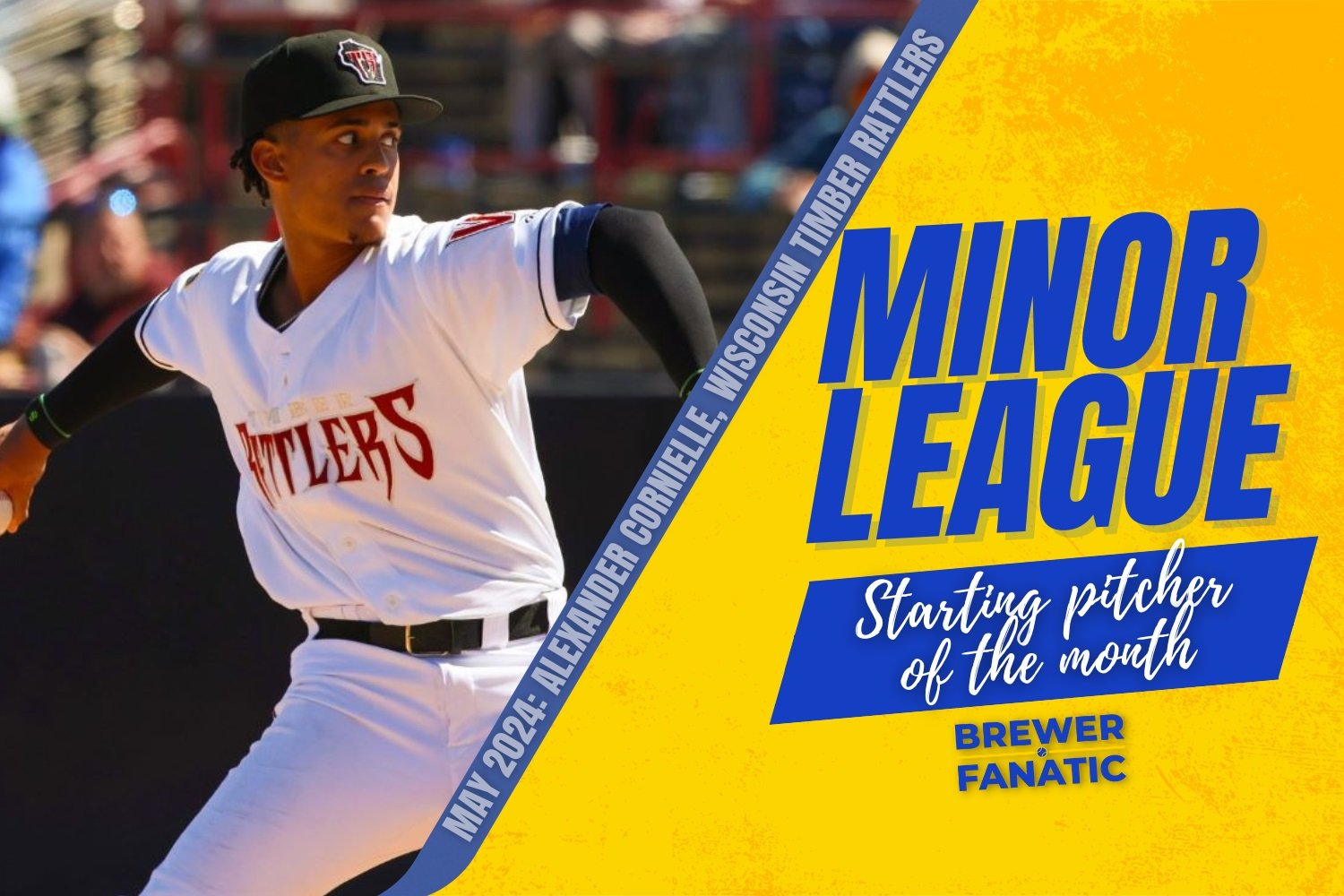 Not quite as strong a month as it was in April for the starters, but there were still quite a few candidates for this month's top five. We will begin, as always, with a few honorable mentions. Honorable Mentions: RHP - Hayden Robinson - ACL Brewers - 5 G, 3 GS, 15.1 IP, 0-0, 2.93 ERA, 3.94 FIP, 1.30 WHIP, 13 H , 7 BB, 21 K. RHP - Carlos F Rodriguez - Nashville Sounds - 5 G, 5 GS, 29.2 IP, 3-1, 3.03 ERA, 4.52 FIP, 1.18 WHIP, 21 H , 7 BB, 33 K. RHP - Melvin Hernandez - ACL Brewers - 4 G, 2 GS, 13.2 IP, 0-0, 3.29 ERA, 3.60 FIP, 1.24 WHIP, 14 H , 3 BB, 18 K. TOP 5 STARTING PITCHERS FOR MAY #5 RHP - Jacob Misiorowski - Biloxi Shuckers - 5 G, 5 GS, 21.0 IP, 0-1, 1.71 ERA, 3.56 FIP, 1.67 WHIP, 17 H, 18 BB, 26 K. The Brewers' second-round selection in the 2022 draft has one of the highest ceilings in all of baseball. A Junior College standout from Crowder College in Missouri, Misiorowski is a freak athlete on the mound, with long levers and a blazing fastball. Those traits have carried him into the top 50 on pretty much every publication's Top 100 lists. In May, Misiorowski showed the ceiling, and also some of the concerns with his profile. Sporting a fastball that reaches triple digits, but sits in the 96-98 range the majority of the time, Misiorowski’s fastball is about more than just the velocity. At 6’7 he generates up to 7’6” of extension. For reference, Bryan Hudson is averaging 7’4” of extension and ranks in the 98th percentile. He also throws the fastball from an extremely low release height for somebody as tall as him, which also helps the fastball play up. His slider has been seen as his best secondary offering, and it is a very good pitch, sitting in the low-90s and misses a lot of bats. His mid-80s curveball made a huge leap in 2023. It has late drop, with above-average sweep, and hitters take it for a lot of strikes because of how tough it is to pick up. It probably surpassed the slider as the best secondary. Both of them have shown signs of being plus pitches. In May, Misiorowski used his pure stuff to allow him to work around having nearly a walk rate of 18.8%. Some of his stuff is so filthy that umpires struggle with calling strikes on borderline pitches, but he did also have quite a few misses that were uncompetitive. The reason he was able to get through these starts with such a strong ERA, despite all the baserunners, was his ability to generate swing and miss. His whiff rate of 36.2% was 10th in Double-A for pitchers with at least 15 innings pitched in May (per TruMedia). Misiorowski’s pure stuff is ready for MLB innings, but as he showed in May, the command still has a ways to go. He would likely be able to work around the command issues in a bullpen role, but if the plan is to continue starting he may be more than a year away from big league starts still. Either way, there are not many arms as talented as his and one way or another he will likely make a positive impact for the Brewers in the coming years. #4 RHP - Chad Patrick - Nashville Sounds - 5 G, 5 GS, 29.1 IP, 3-1, 2.15 ERA, 3.74 FIP, 1.23 WHIP, 25 H, 11 BB, 31 K. Unranked by all publications Patrick was acquired this past offseason in a one-for-one trade that saw Abraham Toro go to the Oakland Athletics. He had been traded from Arizona to Oakland in exchange for Old Friend Jace Peterson this past trade deadline. At 25 years old and without any true standout pitches, the trade felt like a bit of a flier at the time. Patrick’s performance so far this season has shown that there might be more than what originally met the eye. Patrick’s primary pitch is a cutter in the 86-89 range, a pitch that gets more swing and miss than most cutters do. He had a whiff rate of 29% on the cutter in May, while using it 35% of the time. His four seam fastball was used around 30% of the time, and while the average velocity on it is only around 92-93 he was able to get whiffs on 39% of the swings against it in May. He does this with a low release slot and a -4.4 Vertical Approach Angle that helps the fastball play well up in the zone or above. He also throws a changeup in the mid-80s, a low 90’s sinker and a low 80’s slider in for a five pitch mix. For the month, Patrick was causing hitters to swing and miss at a very high rate on a per-pitch basis, with a swinging strike rate of 14.3%, which placed him in the 90th percentile for Triple-A pitchers with at least 15 innings. His walk numbers were more reasonable than some of the other pitchers that made this list, but he did struggle a bit with the extra base hit, as he allowed six doubles, two triples and two home runs. His pitch qualities will likely always lead to the ball being elevated, so he will always need to miss some bats to help combat the damage that he will inevitably run into at times. In May he did exactly that. Given the Brewers lack of healthy starting depth at the moment, Patrick seems to have moved himself into consideration to get an opportunity, if another starter underperforms or is injured. #3 LHP - Tate Kuehner - Wisconsin Timber Rattlers - 4 G, 3 GS, 17 IP, 2-0, 1.59 ERA, 3.65 FIP, 1.24 WHIP, 11 H, 10 BB, 21 K. Unranked by all publications The Brewers 7th round selection in 2023 out of Louisville, Kuehner was used in a swing man role by the Cardinals his senior year. He only threw three innings at the Complex League level last year after being drafted, but began the 2024 season with High-A Appleton where he has continued that swing man role, but in a more consistent starter role. Five of his eight appearances have come in a starting role and three of four in May. Kuehner was sitting in the upper-80’s as a junior in college, but made a jump into the 92-95 range as a senior, which is where he is at now. He throws from a very low slot, and started generating more run on the pitch his senior year. That slot allows the pitch to play well up in the zone due to the Vertical Approach Angle, and also to play down, because of the run. His best secondary offering is his low-80s sweeper, which has a lot of sweep, but also quite a bit of vertical drop and is his best swing and miss pitch. He mixes in a changeup as well, which appears to be in a better spot than where it was at Louisville, where he struggled to land any of his secondaries for strikes. In May he posted a whiff rate of 34%, placing him in the 87th percentile for High-A pitchers with at least 15 innings pitched. His 30.9% strikeout rate placed him in the 83rd percentile. He didn’t generate ground balls at the same level as he had in April, but he did still do a good job of limiting the extra base hits, allowing one home run and one double. Not unlike a lot of the pitchers on this list, the one knock on his month would fall in the “too many walks” category. His 14.7% walk rate was in the 8th percentile. However, he was able to work around those issues to have strong surface level results and find his way onto this list. Kuehner is 23 years old, so he’s certainly a candidate to see Double-A at some point this year, though it might behoove the Brewers to allow him to continue to work through some of his walk issues at the lower level in Appleton. #2 RHP - Shane Smith - Biloxi Shuckers - 6 G, 3 GS, 22 IP, 1-1, 2.86 ERA, 1.50 FIP, 1.09 WHIP, 18 H , 6 BB, 29 K, 1 SV An undrafted free agent that was signed out of Wake Forest following the 2021 MLB Draft, Smith seems to have been a great find by the Brewers scouting department. The Demon Deacons closer in the COVID-shortened 2020 season, Smith had grabbed hold of a starting spot in 2021 before he suffered a season ending UCL injury after only two starts. His loss in this case appears to have been the Brewers gain. Smith only threw three innings in 2022 as he was rehabbing from the Tommy John surgery he had undergone while at Wake Forest. With a fastball that sits in the 94-95 range, reaching as high as 97, Smith has been able to hold that type of velocity even as he throws more pitches and more innings. His low-80’s curveball has fantastic characteristics as well, with a shape and velocity reminiscent of Sonny Gray’s curveball. He also throws a slider less often than the curve, in the mid-80’s. It’s a shorter slider that has very little horizontal movement, but late, sharp vertical movement. In 2023, he flew through the system, in a strictly relief role, going from Low-A Carolina and making it all the way to AA Biloxi, which is where he began this year as well. In April he had still been in a strict relief role. However when May began, he was starting to stretch those relief appearances out. His first three outings were of three innings apiece. At that point he began making starts, and his final three outings were in a starting role. In those three starts, Smith posted a 2.84 ERA with 15 strikeouts in 13 innings. Smith generated a 31% whiff rate in May which put him in the 76th percentile for Double-A pitchers with at least 15 innings. His called strike rate of 37.5% placed him in the 97th percentile, and is largely carried by his ability to command his fastball, as well as to drop his curveball in at the bottom of the zone. His overall strikeout rate of 33.3% for the month also placed in the 97th percentile. His ability to strike hitters out, while also limiting walks and not allowing any home runs helped contribute to the FIP that checked in over a run lower than his ERA for the month. Smith’s move to the rotation is extremely interesting. He had the appearance of a reliever who could potentially impact the Brewers this season, but he would obviously carry more potential value if he can stick as a mid-rotation type of starter. Either way, one has to wonder if a promotion to AAA Nashville is on the horizon, and whether this is an arm we still might see in Milwaukee this season. #1 RHP – Alexander Cornielle – Wisconsin Timber Rattlers - 4 G, 4 GS, 23.2 IP, 2-0, 0.76 ERA, 3.63 FIP, 0.89 WHIP, 10 H, 11 BB, 19 K. Unranked by all publications Cornielle was signed by the Brewers in the 2019 International signing class and at first was moving quickly through the system, making it all the way to High-A in 2022. He spent all of 2023 back with the Timber Rattlers and returned there again this season. After a slow start in April, Cornielle had a very strong May to take the top spot in this month’s article. For the past couple of seasons, he has been sitting in the 89-92 range on his four seam fastball. Cornielle mentioned in an interview with Brewer Fanatic’s Seth Stohs that one of the reasons for his successful May was a slight uptick in his velocity due to a more enhanced focus on his throwing program and with the help of his pitching coach to smooth out some of his mechanics. He touched 95 MPH multiple times in May, something we had not seen much (or possibly any) of in the past, and it was sitting more 92-93, rather than 89-92. The fastball plays well at the top of the zone, and appears to get a good amount of ride. His cutter usually sits in the mid 80’s but was touching 88-89 at times in May. He rounds out his repertoire with a low-80’s slider/sweeper and a changeup in the upper 80’s as well. In the aforementioned interview, Cornielle also mentioned that he used his entire pitch mix more often in May, and believes that helped contribute to his success as well. Beginning the month with 20 consecutive scoreless innings, Cornielle did not allow a run until the third inning of his final start on May 26th. In his first three starts he went six, seven and five scoreless. He struck out six, seven and four in those starts, respectively. The only real blemish on the month for Cornielle was the number of walks. His 12.1% walk rate for the month is higher than you would hope for it to be, but even with that number he did such a fantastic job limiting base hits that his WHIP was still only 0.89. He wasn’t generating a lot of swing and miss, but he did a fantastic job limiting hard contact. For the month he only allowed three extra base hits, all of which were doubles. Courtesy of TruMedia, Cornielle’s 0.79 ERA ranked seventh in all of High-A for the month of May (min. 15 IP). Cornielle will be Rule 5 eligible this offseason, and if he continues to perform anywhere close to what he showed in May, he could be a candidate for a promotion to Double-A at some point. Please share your opinions! Who should have made it that didn’t? Who made it, but should not have?
- 3 comments
-
- 1
-
-
- alexander cornielle
- shane smith
- (and 3 more)
-
We continue our MiLB Player of the Month series with our top five Starting Pitchers for the month of May. Image courtesy of Wisconsin Timber Rattlers Not quite as strong a month as it was in April for the starters, but there were still quite a few candidates for this month's top five. We will begin, as always, with a few honorable mentions. Honorable Mentions: RHP - Hayden Robinson - ACL Brewers - 5 G, 3 GS, 15.1 IP, 0-0, 2.93 ERA, 3.94 FIP, 1.30 WHIP, 13 H , 7 BB, 21 K. RHP - Carlos F Rodriguez - Nashville Sounds - 5 G, 5 GS, 29.2 IP, 3-1, 3.03 ERA, 4.52 FIP, 1.18 WHIP, 21 H , 7 BB, 33 K. RHP - Melvin Hernandez - ACL Brewers - 4 G, 2 GS, 13.2 IP, 0-0, 3.29 ERA, 3.60 FIP, 1.24 WHIP, 14 H , 3 BB, 18 K. TOP 5 STARTING PITCHERS FOR MAY #5 RHP - Jacob Misiorowski - Biloxi Shuckers - 5 G, 5 GS, 21.0 IP, 0-1, 1.71 ERA, 3.56 FIP, 1.67 WHIP, 17 H, 18 BB, 26 K. The Brewers' second-round selection in the 2022 draft has one of the highest ceilings in all of baseball. A Junior College standout from Crowder College in Missouri, Misiorowski is a freak athlete on the mound, with long levers and a blazing fastball. Those traits have carried him into the top 50 on pretty much every publication's Top 100 lists. In May, Misiorowski showed the ceiling, and also some of the concerns with his profile. Sporting a fastball that reaches triple digits, but sits in the 96-98 range the majority of the time, Misiorowski’s fastball is about more than just the velocity. At 6’7 he generates up to 7’6” of extension. For reference, Bryan Hudson is averaging 7’4” of extension and ranks in the 98th percentile. He also throws the fastball from an extremely low release height for somebody as tall as him, which also helps the fastball play up. His slider has been seen as his best secondary offering, and it is a very good pitch, sitting in the low-90s and misses a lot of bats. His mid-80s curveball made a huge leap in 2023. It has late drop, with above-average sweep, and hitters take it for a lot of strikes because of how tough it is to pick up. It probably surpassed the slider as the best secondary. Both of them have shown signs of being plus pitches. In May, Misiorowski used his pure stuff to allow him to work around having nearly a walk rate of 18.8%. Some of his stuff is so filthy that umpires struggle with calling strikes on borderline pitches, but he did also have quite a few misses that were uncompetitive. The reason he was able to get through these starts with such a strong ERA, despite all the baserunners, was his ability to generate swing and miss. His whiff rate of 36.2% was 10th in Double-A for pitchers with at least 15 innings pitched in May (per TruMedia). Misiorowski’s pure stuff is ready for MLB innings, but as he showed in May, the command still has a ways to go. He would likely be able to work around the command issues in a bullpen role, but if the plan is to continue starting he may be more than a year away from big league starts still. Either way, there are not many arms as talented as his and one way or another he will likely make a positive impact for the Brewers in the coming years. #4 RHP - Chad Patrick - Nashville Sounds - 5 G, 5 GS, 29.1 IP, 3-1, 2.15 ERA, 3.74 FIP, 1.23 WHIP, 25 H, 11 BB, 31 K. Unranked by all publications Patrick was acquired this past offseason in a one-for-one trade that saw Abraham Toro go to the Oakland Athletics. He had been traded from Arizona to Oakland in exchange for Old Friend Jace Peterson this past trade deadline. At 25 years old and without any true standout pitches, the trade felt like a bit of a flier at the time. Patrick’s performance so far this season has shown that there might be more than what originally met the eye. Patrick’s primary pitch is a cutter in the 86-89 range, a pitch that gets more swing and miss than most cutters do. He had a whiff rate of 29% on the cutter in May, while using it 35% of the time. His four seam fastball was used around 30% of the time, and while the average velocity on it is only around 92-93 he was able to get whiffs on 39% of the swings against it in May. He does this with a low release slot and a -4.4 Vertical Approach Angle that helps the fastball play well up in the zone or above. He also throws a changeup in the mid-80s, a low 90’s sinker and a low 80’s slider in for a five pitch mix. For the month, Patrick was causing hitters to swing and miss at a very high rate on a per-pitch basis, with a swinging strike rate of 14.3%, which placed him in the 90th percentile for Triple-A pitchers with at least 15 innings. His walk numbers were more reasonable than some of the other pitchers that made this list, but he did struggle a bit with the extra base hit, as he allowed six doubles, two triples and two home runs. His pitch qualities will likely always lead to the ball being elevated, so he will always need to miss some bats to help combat the damage that he will inevitably run into at times. In May he did exactly that. Given the Brewers lack of healthy starting depth at the moment, Patrick seems to have moved himself into consideration to get an opportunity, if another starter underperforms or is injured. #3 LHP - Tate Kuehner - Wisconsin Timber Rattlers - 4 G, 3 GS, 17 IP, 2-0, 1.59 ERA, 3.65 FIP, 1.24 WHIP, 11 H, 10 BB, 21 K. Unranked by all publications The Brewers 7th round selection in 2023 out of Louisville, Kuehner was used in a swing man role by the Cardinals his senior year. He only threw three innings at the Complex League level last year after being drafted, but began the 2024 season with High-A Appleton where he has continued that swing man role, but in a more consistent starter role. Five of his eight appearances have come in a starting role and three of four in May. Kuehner was sitting in the upper-80’s as a junior in college, but made a jump into the 92-95 range as a senior, which is where he is at now. He throws from a very low slot, and started generating more run on the pitch his senior year. That slot allows the pitch to play well up in the zone due to the Vertical Approach Angle, and also to play down, because of the run. His best secondary offering is his low-80s sweeper, which has a lot of sweep, but also quite a bit of vertical drop and is his best swing and miss pitch. He mixes in a changeup as well, which appears to be in a better spot than where it was at Louisville, where he struggled to land any of his secondaries for strikes. In May he posted a whiff rate of 34%, placing him in the 87th percentile for High-A pitchers with at least 15 innings pitched. His 30.9% strikeout rate placed him in the 83rd percentile. He didn’t generate ground balls at the same level as he had in April, but he did still do a good job of limiting the extra base hits, allowing one home run and one double. Not unlike a lot of the pitchers on this list, the one knock on his month would fall in the “too many walks” category. His 14.7% walk rate was in the 8th percentile. However, he was able to work around those issues to have strong surface level results and find his way onto this list. Kuehner is 23 years old, so he’s certainly a candidate to see Double-A at some point this year, though it might behoove the Brewers to allow him to continue to work through some of his walk issues at the lower level in Appleton. #2 RHP - Shane Smith - Biloxi Shuckers - 6 G, 3 GS, 22 IP, 1-1, 2.86 ERA, 1.50 FIP, 1.09 WHIP, 18 H , 6 BB, 29 K, 1 SV An undrafted free agent that was signed out of Wake Forest following the 2021 MLB Draft, Smith seems to have been a great find by the Brewers scouting department. The Demon Deacons closer in the COVID-shortened 2020 season, Smith had grabbed hold of a starting spot in 2021 before he suffered a season ending UCL injury after only two starts. His loss in this case appears to have been the Brewers gain. Smith only threw three innings in 2022 as he was rehabbing from the Tommy John surgery he had undergone while at Wake Forest. With a fastball that sits in the 94-95 range, reaching as high as 97, Smith has been able to hold that type of velocity even as he throws more pitches and more innings. His low-80’s curveball has fantastic characteristics as well, with a shape and velocity reminiscent of Sonny Gray’s curveball. He also throws a slider less often than the curve, in the mid-80’s. It’s a shorter slider that has very little horizontal movement, but late, sharp vertical movement. In 2023, he flew through the system, in a strictly relief role, going from Low-A Carolina and making it all the way to AA Biloxi, which is where he began this year as well. In April he had still been in a strict relief role. However when May began, he was starting to stretch those relief appearances out. His first three outings were of three innings apiece. At that point he began making starts, and his final three outings were in a starting role. In those three starts, Smith posted a 2.84 ERA with 15 strikeouts in 13 innings. Smith generated a 31% whiff rate in May which put him in the 76th percentile for Double-A pitchers with at least 15 innings. His called strike rate of 37.5% placed him in the 97th percentile, and is largely carried by his ability to command his fastball, as well as to drop his curveball in at the bottom of the zone. His overall strikeout rate of 33.3% for the month also placed in the 97th percentile. His ability to strike hitters out, while also limiting walks and not allowing any home runs helped contribute to the FIP that checked in over a run lower than his ERA for the month. Smith’s move to the rotation is extremely interesting. He had the appearance of a reliever who could potentially impact the Brewers this season, but he would obviously carry more potential value if he can stick as a mid-rotation type of starter. Either way, one has to wonder if a promotion to AAA Nashville is on the horizon, and whether this is an arm we still might see in Milwaukee this season. #1 RHP – Alexander Cornielle – Wisconsin Timber Rattlers - 4 G, 4 GS, 23.2 IP, 2-0, 0.76 ERA, 3.63 FIP, 0.89 WHIP, 10 H, 11 BB, 19 K. Unranked by all publications Cornielle was signed by the Brewers in the 2019 International signing class and at first was moving quickly through the system, making it all the way to High-A in 2022. He spent all of 2023 back with the Timber Rattlers and returned there again this season. After a slow start in April, Cornielle had a very strong May to take the top spot in this month’s article. For the past couple of seasons, he has been sitting in the 89-92 range on his four seam fastball. Cornielle mentioned in an interview with Brewer Fanatic’s Seth Stohs that one of the reasons for his successful May was a slight uptick in his velocity due to a more enhanced focus on his throwing program and with the help of his pitching coach to smooth out some of his mechanics. He touched 95 MPH multiple times in May, something we had not seen much (or possibly any) of in the past, and it was sitting more 92-93, rather than 89-92. The fastball plays well at the top of the zone, and appears to get a good amount of ride. His cutter usually sits in the mid 80’s but was touching 88-89 at times in May. He rounds out his repertoire with a low-80’s slider/sweeper and a changeup in the upper 80’s as well. In the aforementioned interview, Cornielle also mentioned that he used his entire pitch mix more often in May, and believes that helped contribute to his success as well. Beginning the month with 20 consecutive scoreless innings, Cornielle did not allow a run until the third inning of his final start on May 26th. In his first three starts he went six, seven and five scoreless. He struck out six, seven and four in those starts, respectively. The only real blemish on the month for Cornielle was the number of walks. His 12.1% walk rate for the month is higher than you would hope for it to be, but even with that number he did such a fantastic job limiting base hits that his WHIP was still only 0.89. He wasn’t generating a lot of swing and miss, but he did a fantastic job limiting hard contact. For the month he only allowed three extra base hits, all of which were doubles. Courtesy of TruMedia, Cornielle’s 0.79 ERA ranked seventh in all of High-A for the month of May (min. 15 IP). Cornielle will be Rule 5 eligible this offseason, and if he continues to perform anywhere close to what he showed in May, he could be a candidate for a promotion to Double-A at some point. Please share your opinions! Who should have made it that didn’t? Who made it, but should not have? View full article
- 3 replies
-
- 4
-
-

-
- alexander cornielle
- shane smith
- (and 3 more)
-
Appreciate it 😂 Curt and JR are a lot of fun. Was definitely an enjoyable experience.
-
It's the Brewer Fanatic Podcast! Jack and Spencer discuss the Boston series, Craig Counsell’s return, openers, mustaches, the Blake Perkins Game and much more. Apple Podcasts: https://podcasts.apple.com/us/podcast/the-brewer-fanatic-podcast/id1740648724 Spotify: https://open.spotify.com/show/5CY8mWsQayqjDXqw9OT2Td\ iHeartRadio: https://www.iheart.com/podcast/263-the-brewer-fanatic-podcast-166534588/ View full article
-
 Jack and Spencer discuss the Boston series, Craig Counsell’s return, openers, mustaches, the Blake Perkins Game and much more. Apple Podcasts: https://podcasts.apple.com/us/podcast/the-brewer-fanatic-podcast/id1740648724 Spotify: https://open.spotify.com/show/5CY8mWsQayqjDXqw9OT2Td\ iHeartRadio: https://www.iheart.com/podcast/263-the-brewer-fanatic-podcast-166534588/
 -
 Jack and Spencer recap a tough start to the road trip, Pat Murphy’s decision-making in the Marlins series, Robert Gasser’s outlook, and more. Apple Podcasts: https://podcasts.apple.com/us/podcast/the-brewer-fanatic-podcast/id1740648724 Spotify: https://open.spotify.com/show/5CY8mWsQayqjDXqw9OT2Td\ iHeartRadio: https://www.iheart.com/podcast/263-the-brewer-fanatic-podcast-166534588/
 -
The Brewers stumbled a little this week and there's a lot to talk about. Jack and Spencer recap a tough start to the road trip, Pat Murphy’s decision-making in the Marlins series, Robert Gasser’s outlook, and more. Apple Podcasts: https://podcasts.apple.com/us/podcast/the-brewer-fanatic-podcast/id1740648724 Spotify: https://open.spotify.com/show/5CY8mWsQayqjDXqw9OT2Td\ iHeartRadio: https://www.iheart.com/podcast/263-the-brewer-fanatic-podcast-166534588/ View full article
-
Fastball is sitting in the mid-90's this year, he had a really good curveball last year but that was pretty much it for secondaries. His slider has made huge strides and he's now mixing the breaking balls in a ton, at different speeds and shapes, along with that mid-90's velo. He's having a legit breakout season in my opinion.
-
 Jack and Spencer discuss another successful homestand, an offensive onslaught, Robert Gasser's debut, Jake Bauers breaking out at the plate, and much more. Apple Podcasts: https://podcasts.apple.com/us/podcast/the-brewer-fanatic-podcast/id1740648724 Spotify: https://open.spotify.com/show/5CY8mWsQayqjDXqw9OT2Td\ iHeartRadio: https://www.iheart.com/podcast/263-the-brewer-fanatic-podcast-166534588/
 -
Episode 7: Revenge of Jake Bauers
Spencer Michaelis posted a topic in Brewer Fanatic Front Page News
Are the Brewers good again? Yes, they probably are. Jack and Spencer discuss another successful homestand, an offensive onslaught, Robert Gasser's debut, Jake Bauers breaking out at the plate, and much more. Apple Podcasts: https://podcasts.apple.com/us/podcast/the-brewer-fanatic-podcast/id1740648724 Spotify: https://open.spotify.com/show/5CY8mWsQayqjDXqw9OT2Td\ iHeartRadio: https://www.iheart.com/podcast/263-the-brewer-fanatic-podcast-166534588/ View full article -
 Jack and Spencer react to a challenging road trip, vouch for more playing time for Joey Ortiz, address concerns with Sal Frelick, and more. Apple Podcasts: https://podcasts.apple.com/us/podcast/the-brewer-fanatic-podcast/id1740648724 Spotify: https://open.spotify.com/show/5CY8mWsQayqjDXqw9OT2Td\ iHeartRadio: https://www.iheart.com/podcast/263-the-brewer-fanatic-podcast-166534588/
 -
Jack and Spencer catch up with the Brewers after the Royals series and analyze the current roster. Jack and Spencer react to a challenging road trip, vouch for more playing time for Joey Ortiz, address concerns with Sal Frelick, and more. Apple Podcasts: https://podcasts.apple.com/us/podcast/the-brewer-fanatic-podcast/id1740648724 Spotify: https://open.spotify.com/show/5CY8mWsQayqjDXqw9OT2Td\ iHeartRadio: https://www.iheart.com/podcast/263-the-brewer-fanatic-podcast-166534588/ View full article
-
Brewers Minor League Relief Pitcher of the Month - April 2024
Spencer Michaelis posted an article in Minor Leagues
 The qualifications for making this list were a minimum of seven innings pitched, and all appearances had to be made out of the bullpen. We begin with quite a few honorable mentions: HONORABLE MENTIONS LHP - Rob Zastryzny - Nashville Sounds - 10 G, 10.1 IP, 3-0, 1.74 ERA, 1.06 FIP, 0.39 WHIP, 3 H, 1 BB, 15 K Zastryzny deserved to be on this list due to his performance, but as a 32 year old, he was left off. Apologies for the ageism, Rob. LHP - Adam Seminaris - Biloxi Shuckers - 5 G, 14.2 IP, 0-0, 1.84 ERA, 2.03 FIP, 1.02 WHIP, 10 H, 5 BB, 17 K, 1 SV Acquired as part of the Hunter Renfroe deal prior to the 2023 offseason, Seminaris got off to a bad start in Biloxi last season. He began to put it together before hitting the IL for an extended period of time. He got off to a fantastic start in April, narrowly missing the top 5. RHP - Nick Merkel - Biloxi Shuckers - 7 G, 11.1 IP, 2-2, 1.59 ERA, 2.09 FIP, 0.88 WHIP, 8 H, 2 BB, 10 K Merkel was last June’s Reliever of the Month and you can learn more about the 6’7 man nicknamed “Large Mammal” within that article. RHP - Kaleb Bowman - Biloxi Shuckers - 6 G, 7.0 IP, 2-2, 1.29 ERA, 2.18 FIP, 1.29 WHIP, 6 H, 3 BB, 10 K Bowman was signed out of Independent ball prior to the 2023 season and performed well at High-A in 2023. Per Tru-Media, his 43.3% whiff rate was in the 97th percentile for Double-A pitchers with at least seven innings thrown in April. TOP FIVE RELIEF PITCHERS FOR APRIL #5 RHP - Enoli Paredes - Nashville Sounds - 11 G, 13.0 IP, 1-0, 1.38 ERA, 1.60 FIP, 1.00 WHIP, 8 H , 5 BB, 21 K, 2 SV. Unranked by all publications The 28-year-old Paredes was signed as a minor-league free agent this past offseason by the Brewers. After his performance in April, he looks like he could be an option for the major league club soon. Paredes is largely a two-pitch pitcher. He threw his four-seam fastball around 48% of the time in April, and his slider about 42% of the time. The four seamer only gets around 13 inches of Induced Vertical Break, but it comes in at a -4.2 degree Vertical Approach Angle, allowing it to play pretty well at the top of the zone. The pitch averages around 94.6 MPH, and has been up to 96. He was able to generate a whiff rate of 40.6% on the four seam in April. His other main pitch, the slider, generated a whiff rate of 37%. This is the pitch he commands best and per Tru-Media, he actually used it more often than the fastball when the count was even, or he was behind in the count. Paredes also mixes in a rare sinker, though it doesn’t have very good characteristics and there is probably a reason he uses it under 10% of the time. It can be used to help keep hitters guessing just a bit more at the plate though, and that seems to be how he deployed it in April. After his performance in April, and considering the number of arms the Brewers have already cycled through in MLB, Paredes looks like he could be an option for the major league club soon. #4 RHP - Yerlin Rodriguez - Wisconsin Timber Rattlers - 8 G, 8.0 IP, 1-0, 1.08 ERA, 4.56 FIP, 0.84 WHIP, 2 H, 9 BB, 12 K, 4 SV. Signed as part of the Brewers 2019 international signing class, Rodriguez was one of the breakout arms in 2023. He finished the campaign with a 4.00 ERA, but his stuff took a big step forward. One of the largest fastball increases in all of baseball from 2022, Yerlin went from averaging 92.1 in 2022 to averaging 96.5 MPH in 2023, per Baseball America. His fastball regularly sits in the mid-upper 90’s now and has touched 99. He did post some triple digit fastballs in 2023, so he has that in the tank. It works well up in the zone, though he also seems to throw a fastball with a bit more sink at times. His slider is a wipeout offering that has reached 3000 RPM’s a number of times and sits in the mid-80’s. Rodriguez also mixes in a cutter in the 90 MPH range that he seems to command as well as any of his pitches. There were reports that he was working on a splitter this offseason, though he has not appeared to break that out in games yet. It’s a somewhat similar profile to that of Abner Uribe, though he doesn’t quite have the ability to reach 102+ like Uribe. Unfortunately for Rodriguez, he has had similar issues with throwing strikes to those that Uribe has battled throughout his career. In April Rodriguez was unable to curb the control issues and issued nine walks in his 8 1/3 innings. The good news was that hitters weren’t able to do anything whenever Rodriguez was in, or around, the zone. His 44.6% whiff rate placed him in the 97th percentile for High-A pitchers with at least seven innings, per Tru-Media. His 58.3% ground ball rate was also in the 88th percentile. While the walks piled up, he did only allow two hits, which helped him avoid giving up any runs for the month. As his 4.56 FIP suggests, Rodriguez will need to improve upon those walk numbers moving forward if he wants to continue to see this type of success in the ERA column. Rodriguez has the stuff to advance quickly through the system, but command will be the tool that ends up deciding where he goes and how fast he goes there. #3 LHP - Russell Smith - Biloxi Shuckers - 5 G, 8.1 IP, 0-0, 2.16 ERA, 0.44 FIP, 0.96 WHIP, 6 H , 2 BB, 15 K Unranked by all publications Smith was the Brewers third selection in the 2021 draft, and had unfortunately gotten off to a pretty tough start in pro ball. Drafted as a starter, Smith made the transition to the bullpen in 2023, and that seems to have been the correct call. He finished this past season with a 1.40 ERA over his final 19.1 innings, and carried that strong production into April of 2024. Smith’s velocity sat in the 91-93 range as a starter. Given his 6’7, 255 pound frame that was always a bit of a surprise. Since his move to the bullpen, that velocity has climbed more into the 95 MPH range with consistency. His huge frame allows for him to get down the mound, and generate a good amount of extension, though his stride isn’t quite as big as you might expect from someone his height. Smith’s changeup has been his best secondary since he was drafted, and that continues to be the case. However, his slider has transformed since his move to the bullpen. The shape is more of a slurve than a true slider, and it is now an above average pitch as well. Per Tru-Media, Smith struck Double-A hitters out at a 45.5% clip In April, which placed him in the 97th percentile for pitchers throwing seven or more innings at the level. His 37.1% whiff rate was good for the 85th percentile, and his strikeout to walk ratio of 7.5 was good for the 93rd percentile. His final outing of the month was his worst, and it brought his ERA up, but his ability to strike hitters out, avoid walks and avoid the home run ball gave him the best FIP of any Brewers reliever in April. Smith is going to be Rule 5 eligible this offseason, meaning the Brewers will have to decide if he’s worth protecting and putting on the 40 man roster. If he continues this type of production, he will be somebody that they push to Nashville to get a better idea of how close he is. #2 RHP - Craig Yoho - Wisconsin Timber Rattlers - 8 G, 8.0 IP, 1-0, 0.00 ERA, 0.94 FIP, 0.62 WHIP, 3 H , 2 BB, 16 K, 3 SV. Unranked by all publications The Brewers 8th round selection in the 2023 draft out of Indiana, Yoho is the only one of these arms that appears to already be slotted into a relief role in the future. At one time a position player in college, he transitioned to a two-way role for a couple of seasons, but after battling quite a few injuries, he finished his college career as a pitcher-only. He and Yerlin Rodriguez have been splitting the closer role in Appleton so far in 2024, and the results have been quite good. Yoho may not throw as hard as most elite relievers, only sitting in the 91-93 range with his fastball, but his pitch mix is as impressive as any pitcher in the system. He throws his fastball with nearly 20 inches of arm side run, a changeup that appears to be very similar to the Devin Williams “Airbender”, as well as a curveball and a cutter. You can read more about the pitch mix in this article from April 22nd. Yoho used his four pitches to keep hitters off balance all month. Per Tru-Media he racked up a whiff rate of 46%, which placed him in the 98th percentile among High-A pitchers with seven or more innings. Under those same qualifications, Yoho was in the 100th percentile for called strike rate, coming in at 47.6%. He was freezing hitters and landing his pitches in the zone as often as anybody, and when they did swing, there was not much contact. That is a good place to be as a pitcher, and that’s not to mention that when hitters did make contact, it was on the ground 63.6% of the time, which also placed him in the 94th percentile. Hitters were simply hopeless against Yoho in April. Yoho is 24 years old, and is clearly a step above his competition. This past offseason, Baseball America actually tagged him as a potential fast mover, who could impact the Brewers major league bullpen at some point this year. If that is going to happen, he likely needs to move to Double-A soon. Even if they don’t plan for him to move quite that fast, Double-A would present a better challenge for him. #1 RHP - K.C. Hunt - Carolina Mudcats - 5 G, 11.1 IP, 2-0, 0.00 ERA, 1.33 FIP, 0.62 WHIP, 5 H , 2 BB, 18 K Unranked by all publications Hunt beat out a number of very qualified candidates for the number one spot this month. Signed as an Undrafted Free Agent following last year's draft, Hunt has gotten himself off to a fantastic start in pro ball. In 4 1/3 innings with the Arizona Complex League Brewers at the end of 2023, Hunt did give up a few runs, but followed that up with a scoreless April to begin 2024. Hunt’s high-spin fastball sits in the 92-94 range and works well at the top of the zone, though he also does a good job of hitting the low and outside corner with the pitch. He has a four pitch mix though, and the secondaries are all strong as well. His curveball stands out more than the rest, a true hammer of a pitch that he throws in the 76-78 range. He gets a lot of his chases with the pitch, but is also comfortable landing it for strikes. His slider is a sharper and shorter offering that sits in the 83-84 range and has been a good swing and miss pitch for him as well. Hunt also uses a changeup that is thrown a bit harder than the slider and shows flashes of being a good option, particularly against left-handed hitters. He is not afraid to use any of the pitches against righties or lefties. Hunt’s April was highlighted by his outing on April 17th, going three scoreless and hitless innings while striking out four. He only allowed one baserunner in that outing, by way of a walk (one of only two walks he allowed the entire month). Hunt’s 40.9% strikeout rate put him in the 93rd percentile for pitchers with at least seven innings pitched in Low-A. His walk rate of 4.5% was in the 92nd percentile, making him one of only six pitchers to rank in the 90th percentile or higher in both of those categories. Hunt limited walks, racked up strikeouts and only allowed five hits, none of which were of the extra base variety. Hunt has been utterly dominant at Low-A. Given his advanced age, it seems that he should be pushed to High-A, and perhaps will even have a chance to follow the Shane Smith path of 2023, making it to Double-A by the end of the season. Thanks for following along with this three part series on the Brewers minor league system. Let us know your thoughts below! Did we miss anybody?
- 3 comments
-
- 2
-
-
- enoli paredes
- yerlin rodriguez
- (and 5 more)
-
We close out our Minor League Player of the Month series with our top five Relief Pitchers for the month of April. The Brewers minor league pitching was extremely impressive on the starting side of things, but the relievers may have had an even more impressive month collectively. Image courtesy of Neal Hock, Carolina Mudcats The qualifications for making this list were a minimum of seven innings pitched, and all appearances had to be made out of the bullpen. We begin with quite a few honorable mentions: HONORABLE MENTIONS LHP - Rob Zastryzny - Nashville Sounds - 10 G, 10.1 IP, 3-0, 1.74 ERA, 1.06 FIP, 0.39 WHIP, 3 H, 1 BB, 15 K Zastryzny deserved to be on this list due to his performance, but as a 32 year old, he was left off. Apologies for the ageism, Rob. LHP - Adam Seminaris - Biloxi Shuckers - 5 G, 14.2 IP, 0-0, 1.84 ERA, 2.03 FIP, 1.02 WHIP, 10 H, 5 BB, 17 K, 1 SV Acquired as part of the Hunter Renfroe deal prior to the 2023 offseason, Seminaris got off to a bad start in Biloxi last season. He began to put it together before hitting the IL for an extended period of time. He got off to a fantastic start in April, narrowly missing the top 5. RHP - Nick Merkel - Biloxi Shuckers - 7 G, 11.1 IP, 2-2, 1.59 ERA, 2.09 FIP, 0.88 WHIP, 8 H, 2 BB, 10 K Merkel was last June’s Reliever of the Month and you can learn more about the 6’7 man nicknamed “Large Mammal” within that article. RHP - Kaleb Bowman - Biloxi Shuckers - 6 G, 7.0 IP, 2-2, 1.29 ERA, 2.18 FIP, 1.29 WHIP, 6 H, 3 BB, 10 K Bowman was signed out of Independent ball prior to the 2023 season and performed well at High-A in 2023. Per Tru-Media, his 43.3% whiff rate was in the 97th percentile for Double-A pitchers with at least seven innings thrown in April. TOP FIVE RELIEF PITCHERS FOR APRIL #5 RHP - Enoli Paredes - Nashville Sounds - 11 G, 13.0 IP, 1-0, 1.38 ERA, 1.60 FIP, 1.00 WHIP, 8 H , 5 BB, 21 K, 2 SV. Unranked by all publications The 28-year-old Paredes was signed as a minor-league free agent this past offseason by the Brewers. After his performance in April, he looks like he could be an option for the major league club soon. Paredes is largely a two-pitch pitcher. He threw his four-seam fastball around 48% of the time in April, and his slider about 42% of the time. The four seamer only gets around 13 inches of Induced Vertical Break, but it comes in at a -4.2 degree Vertical Approach Angle, allowing it to play pretty well at the top of the zone. The pitch averages around 94.6 MPH, and has been up to 96. He was able to generate a whiff rate of 40.6% on the four seam in April. His other main pitch, the slider, generated a whiff rate of 37%. This is the pitch he commands best and per Tru-Media, he actually used it more often than the fastball when the count was even, or he was behind in the count. Paredes also mixes in a rare sinker, though it doesn’t have very good characteristics and there is probably a reason he uses it under 10% of the time. It can be used to help keep hitters guessing just a bit more at the plate though, and that seems to be how he deployed it in April. After his performance in April, and considering the number of arms the Brewers have already cycled through in MLB, Paredes looks like he could be an option for the major league club soon. #4 RHP - Yerlin Rodriguez - Wisconsin Timber Rattlers - 8 G, 8.0 IP, 1-0, 1.08 ERA, 4.56 FIP, 0.84 WHIP, 2 H, 9 BB, 12 K, 4 SV. Signed as part of the Brewers 2019 international signing class, Rodriguez was one of the breakout arms in 2023. He finished the campaign with a 4.00 ERA, but his stuff took a big step forward. One of the largest fastball increases in all of baseball from 2022, Yerlin went from averaging 92.1 in 2022 to averaging 96.5 MPH in 2023, per Baseball America. His fastball regularly sits in the mid-upper 90’s now and has touched 99. He did post some triple digit fastballs in 2023, so he has that in the tank. It works well up in the zone, though he also seems to throw a fastball with a bit more sink at times. His slider is a wipeout offering that has reached 3000 RPM’s a number of times and sits in the mid-80’s. Rodriguez also mixes in a cutter in the 90 MPH range that he seems to command as well as any of his pitches. There were reports that he was working on a splitter this offseason, though he has not appeared to break that out in games yet. It’s a somewhat similar profile to that of Abner Uribe, though he doesn’t quite have the ability to reach 102+ like Uribe. Unfortunately for Rodriguez, he has had similar issues with throwing strikes to those that Uribe has battled throughout his career. In April Rodriguez was unable to curb the control issues and issued nine walks in his 8 1/3 innings. The good news was that hitters weren’t able to do anything whenever Rodriguez was in, or around, the zone. His 44.6% whiff rate placed him in the 97th percentile for High-A pitchers with at least seven innings, per Tru-Media. His 58.3% ground ball rate was also in the 88th percentile. While the walks piled up, he did only allow two hits, which helped him avoid giving up any runs for the month. As his 4.56 FIP suggests, Rodriguez will need to improve upon those walk numbers moving forward if he wants to continue to see this type of success in the ERA column. Rodriguez has the stuff to advance quickly through the system, but command will be the tool that ends up deciding where he goes and how fast he goes there. #3 LHP - Russell Smith - Biloxi Shuckers - 5 G, 8.1 IP, 0-0, 2.16 ERA, 0.44 FIP, 0.96 WHIP, 6 H , 2 BB, 15 K Unranked by all publications Smith was the Brewers third selection in the 2021 draft, and had unfortunately gotten off to a pretty tough start in pro ball. Drafted as a starter, Smith made the transition to the bullpen in 2023, and that seems to have been the correct call. He finished this past season with a 1.40 ERA over his final 19.1 innings, and carried that strong production into April of 2024. Smith’s velocity sat in the 91-93 range as a starter. Given his 6’7, 255 pound frame that was always a bit of a surprise. Since his move to the bullpen, that velocity has climbed more into the 95 MPH range with consistency. His huge frame allows for him to get down the mound, and generate a good amount of extension, though his stride isn’t quite as big as you might expect from someone his height. Smith’s changeup has been his best secondary since he was drafted, and that continues to be the case. However, his slider has transformed since his move to the bullpen. The shape is more of a slurve than a true slider, and it is now an above average pitch as well. Per Tru-Media, Smith struck Double-A hitters out at a 45.5% clip In April, which placed him in the 97th percentile for pitchers throwing seven or more innings at the level. His 37.1% whiff rate was good for the 85th percentile, and his strikeout to walk ratio of 7.5 was good for the 93rd percentile. His final outing of the month was his worst, and it brought his ERA up, but his ability to strike hitters out, avoid walks and avoid the home run ball gave him the best FIP of any Brewers reliever in April. Smith is going to be Rule 5 eligible this offseason, meaning the Brewers will have to decide if he’s worth protecting and putting on the 40 man roster. If he continues this type of production, he will be somebody that they push to Nashville to get a better idea of how close he is. #2 RHP - Craig Yoho - Wisconsin Timber Rattlers - 8 G, 8.0 IP, 1-0, 0.00 ERA, 0.94 FIP, 0.62 WHIP, 3 H , 2 BB, 16 K, 3 SV. Unranked by all publications The Brewers 8th round selection in the 2023 draft out of Indiana, Yoho is the only one of these arms that appears to already be slotted into a relief role in the future. At one time a position player in college, he transitioned to a two-way role for a couple of seasons, but after battling quite a few injuries, he finished his college career as a pitcher-only. He and Yerlin Rodriguez have been splitting the closer role in Appleton so far in 2024, and the results have been quite good. Yoho may not throw as hard as most elite relievers, only sitting in the 91-93 range with his fastball, but his pitch mix is as impressive as any pitcher in the system. He throws his fastball with nearly 20 inches of arm side run, a changeup that appears to be very similar to the Devin Williams “Airbender”, as well as a curveball and a cutter. You can read more about the pitch mix in this article from April 22nd. Yoho used his four pitches to keep hitters off balance all month. Per Tru-Media he racked up a whiff rate of 46%, which placed him in the 98th percentile among High-A pitchers with seven or more innings. Under those same qualifications, Yoho was in the 100th percentile for called strike rate, coming in at 47.6%. He was freezing hitters and landing his pitches in the zone as often as anybody, and when they did swing, there was not much contact. That is a good place to be as a pitcher, and that’s not to mention that when hitters did make contact, it was on the ground 63.6% of the time, which also placed him in the 94th percentile. Hitters were simply hopeless against Yoho in April. Yoho is 24 years old, and is clearly a step above his competition. This past offseason, Baseball America actually tagged him as a potential fast mover, who could impact the Brewers major league bullpen at some point this year. If that is going to happen, he likely needs to move to Double-A soon. Even if they don’t plan for him to move quite that fast, Double-A would present a better challenge for him. #1 RHP - K.C. Hunt - Carolina Mudcats - 5 G, 11.1 IP, 2-0, 0.00 ERA, 1.33 FIP, 0.62 WHIP, 5 H , 2 BB, 18 K Unranked by all publications Hunt beat out a number of very qualified candidates for the number one spot this month. Signed as an Undrafted Free Agent following last year's draft, Hunt has gotten himself off to a fantastic start in pro ball. In 4 1/3 innings with the Arizona Complex League Brewers at the end of 2023, Hunt did give up a few runs, but followed that up with a scoreless April to begin 2024. Hunt’s high-spin fastball sits in the 92-94 range and works well at the top of the zone, though he also does a good job of hitting the low and outside corner with the pitch. He has a four pitch mix though, and the secondaries are all strong as well. His curveball stands out more than the rest, a true hammer of a pitch that he throws in the 76-78 range. He gets a lot of his chases with the pitch, but is also comfortable landing it for strikes. His slider is a sharper and shorter offering that sits in the 83-84 range and has been a good swing and miss pitch for him as well. Hunt also uses a changeup that is thrown a bit harder than the slider and shows flashes of being a good option, particularly against left-handed hitters. He is not afraid to use any of the pitches against righties or lefties. Hunt’s April was highlighted by his outing on April 17th, going three scoreless and hitless innings while striking out four. He only allowed one baserunner in that outing, by way of a walk (one of only two walks he allowed the entire month). Hunt’s 40.9% strikeout rate put him in the 93rd percentile for pitchers with at least seven innings pitched in Low-A. His walk rate of 4.5% was in the 92nd percentile, making him one of only six pitchers to rank in the 90th percentile or higher in both of those categories. Hunt limited walks, racked up strikeouts and only allowed five hits, none of which were of the extra base variety. Hunt has been utterly dominant at Low-A. Given his advanced age, it seems that he should be pushed to High-A, and perhaps will even have a chance to follow the Shane Smith path of 2023, making it to Double-A by the end of the season. Thanks for following along with this three part series on the Brewers minor league system. Let us know your thoughts below! Did we miss anybody? View full article
- 3 replies
-
- 4
-
-
-
- enoli paredes
- yerlin rodriguez
- (and 5 more)
-
 Jack and Spencer break down a homestand filled with controversial umpiring, Abner Uribe’s future after his demotion to Triple-A, and more. They also preview the upcoming series against the Cubs. You can subscribe to the Brewer Fanatic Podcast below: Apple Podcasts: https://podcasts.apple.com/us/podcast/the-brewer-fanatic-podcast/id1740648724 Spotify: https://open.spotify.com/show/5CY8mWsQayqjDXqw9OT2Td iHeartRadio: https://www.iheart.com/podcast/263-the-brewer-fanatic-podcast-166534588/
 -
Episode 5 of The Brewer Fanatic Podcast featuring Jack Stern and Spencer Michaelis. Jack and Spencer break down a homestand filled with controversial umpiring, Abner Uribe’s future after his demotion to Triple-A, and more. They also preview the upcoming series against the Cubs. You can subscribe to the Brewer Fanatic Podcast below: Apple Podcasts: https://podcasts.apple.com/us/podcast/the-brewer-fanatic-podcast/id1740648724 Spotify: https://open.spotify.com/show/5CY8mWsQayqjDXqw9OT2Td iHeartRadio: https://www.iheart.com/podcast/263-the-brewer-fanatic-podcast-166534588/ View full article
-
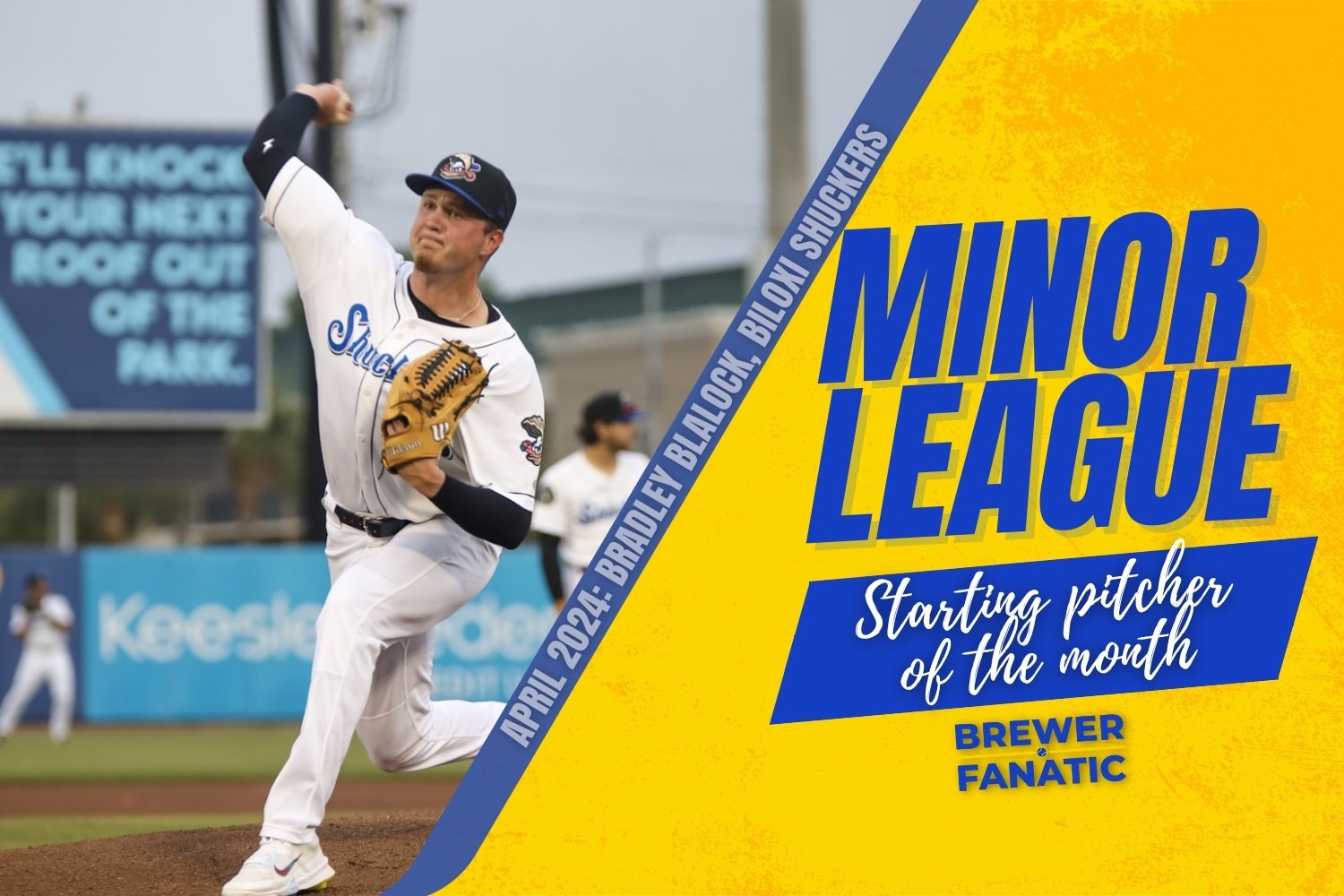 To begin with a small disclaimer, the Mudcats complicated the choices by having a lot of “tandem” starts. This led to a number of pitchers with starter innings, but with very few, if any, starts. Because of this a very scientific cutoff of 13 IP was set in order to be eligible for the list. We begin with a few honorable mentions, who may have made the list in a different month. Honorable Mentions RHP - Tobias Myers - Nashville Sounds - 4 G, 3 GS, 16.2 IP, 2-1, 1.62 ERA, 3.87 FIP, 1.08 WHIP, 11 H , 7 BB, 22 K. RHP - TJ Shook - Biloxi Shuckers - 4 G, 4 GS, 18.2 IP, 1-2, 2.89 ERA, 2.56 FIP, 1.18 WHIP, 15 H , 7 BB, 25 K. RHP - Manuel Rodriguez - Carolina Mudcats - 4 G, 4 GS, 20.0 IP, 1-2, 3.15 ERA, 3.70 FIP, 0.95 WHIP, 15 H , 2 BB, 18 K. TOP 5 STARTING PITCHERS FOR APRIL #5 RHP - Brett Wichrowski - Wisconsin Timber Rattlers - 4 G, 4 GS, 14.2 IP, 0-1, 2.45 ERA, 2.43 FIP, 1.09 WHIP, 13 H, 3 BB, 21 K. Unranked by all publications The Brewers 13th round selection in last year's draft, Wichrowski has been one of the hottest names in prospect circles since he showed up in Arizona for spring training. Drafted out of Bryant University, Wichrowski was splitting time between starting and relieving in college. This is a pitcher that any organization could have drafted and signed for his $100,000 signing bonus less than a year ago, Wichrowski is now viewed as a potential Top 10 prospect in a loaded Brewers system. Previously sitting in the 91-93 MPH range with his fastball (topping out at 96), Wichrowski showed up this spring and was sitting 96-98 and got up to 101 with his fastball. Being that those were shorter stints, that velocity hasn’t quite held up in Appleton, where he is sitting more in the 94-96 range, though he has still touched 98. He is mixing in two different fastballs, with a four seamer and a sinker both in his repertoire. Beyond his velocity improvements, his already solid slider in college has become an absolute weapon. This is a plus-plus offering with a ton of sharp, sweeping movement. Much like his fastball though, he seems to throw two different versions of the slider. One being the sharp sweeper that is thrown in the upper 70’s for the most part. The other one has a bit of a cutter shape to it, or a shorter slider. The shorter one comes in around 85. He also mixes in a changeup that he seems to add and subtract velocity from as well. The most noticeable part of Wichrowski’s game is that he’s a pitcher, he’s not a “thrower”. He adds and subtracts velocity, he mixes the shapes and the planes on his pitches, and he did all of those things in April, while showing tremendous command at the same time. He did struggle a bit with the extra base hit in April, allowing six doubles and a home run, and that will be something to monitor. Outside of that, Wichrowski struck hitters out at a 33.9% rate and walked them at a 4.8% rate. Those placed him in the 85th and 88th percentile respectively, per Tru-Media, amongst High-A starters with at least 13 innings in April. Wichrowski was rewarded for his strong month plus, going back to spring training as well, with a promotion to Double-A Biloxi. The 13th rounder only needed 14 1/3 professional innings to make it to Double-A. The Brewers may have found the best value in the entire draft with his selection. #4 RHP - Tyler Woessner - Biloxi Shuckers - 4 G, 4 GS, 20.1 IP, 0-1, 2.66 ERA, 1.92 FIP, 1.18 WHIP, 20 H , 4 BB, 29 K. The Brewers sixth round selection in the 2022 draft, Woessner was quite a bit older than the average JUCO arm when he was drafted. He had a solid, if unspectacular season in Appleton in 2023, posting an ERA of 4.02. He arrived at spring training showing off an increase in his velocity, and the Brewers saw enough to start him in Double-A. He rewarded them with a fantastic start to the season. Woessner throws the kitchen sink at hitters, though he does it with multiple above average offerings. His two fastballs have been sitting in the 94-96 MPH range, and he has been able to hold that into the sixth inning and as his pitch count climbs up to 70-80 pitches. He had touched 99 in spring, but that was in a shorter stint. He throws both a riding four seamer up in the zone, as well as a sinker that he uses more often down in the zone. His breaking balls are his best offerings presently, with two different slider shapes (a sweeper and a shorter slider) both generating a lot of swing and miss. His curveball is a knuckle-curve and has also been a good putaway pitch for him. Woessner also mixes in a changeup that shows pretty good depth at times. It’s a six pitch mix, and it gave Double-A hitters fits in April. Courtesy of Tru-Media, Woessner finished the month in the 93rd percentile for whiff rate at 37.3%, as well as strikeout rate at 34.5%. His ability to get swing and miss was a welcome sight, as that was one area of his game that was somewhat in question coming into the year. Not only did he get a lot of swing and miss but he did it without having any control issues to go with it, as evidenced by only handing out four walks. His Strikeout-to-Walk ratio of 7.25 was in the 91st percentile for Double-A starters in April. Woessner was promoted to Nashville on April 30th, and looks like an arm that could potentially impact the Brewers MLB roster at some point if he continues to produce anything close to what he showed in April. #3 RHP - Yujanyer Herrera - Carolina Mudcats - 4 G, 0 GS, 17.0 IP, 3-0, 2.12 ERA, 1.64 FIP, 0.94 WHIP, 10 H, 6 BB, 27 K. Unranked by all publications Herrera was signed as part of the 2019 international signing class. When he was promoted to Carolina during the 2022 season, Herrera was only 18. This aggressive promotion, mixed with some preliminary knowledge of his pitch mix, had Herrera checking a lot of boxes for a potential breakout. Unfortunately, he followed the promotion with command struggles and quite a bit of loud contact allowed. Thus, he headed into the 2024 season without much attention. Despite the fact that he hasn’t actually made a start, In April, Herrera appeared to be on a mission to regain that attention. He used his four pitch mix of fastball, changeup, slider and curveball to largely dominate his competition. You can read more about the pitch mix itself in this article from April 22nd. The ability to generate a lot of swings and misses showed up as a theme for most of the pitchers on this list and Herrera was no exception. Herrera used his mid 90’s fastball and array of breaking balls and changeups to generate a 41.8% whiff rate for the month, placing him in the 92nd percentile for Low-A pitchers who threw at least 13 innings (per Tru-Media). His strikeout rate of 42.2% placed him in the 96th percentile. When he wasn’t missing bats, Herrera was also able to keep the ball in the ballpark, only allowing three extra base hits, none of which left the yard. Herrera’s month was highlighted by a nine strikeout performance in only four innings on April 12th. He only allowed one baserunner, which came by way of a base hit. After such an impressive month, the Brewers have once again made an aggressive promotion with Herrera, bumping him up a level to High-A where he will make his next appearance for the Wisconsin Timber Rattlers. #2 RHP - Yorman Galindez - Carolina Mudcats - 4 G, 4 GS, 13.0 IP, 0-0, 2.08 ERA, 2.91 FIP, 1.00 WHIP, 13 H, 7 BB, 24 K. Unranked by all publications Signed by the Brewers in the 2022 international signing class out of Venezuela, Galindez was 19 at the time of his signing and is 21 now. After being aggressively promoted to Carolina last season, he seems to have made a leap in 2024. While his fastball previously sat in the low 90’s and touched 94, it has been sitting in the 94-95 range in this season. It appears to have some run on it, but it still plays well at the top of the zone. His best pitch though, is his hammer of a curveball. He appears to be comfortable throwing it in any count. He can land it for strikes or use it as his out pitch to generate whiffs out of the zone. However, the pitch that might have helped him make the leap more than anything else, is his slider. Previously a distant third offering for him, the slider seems to be coming into its own as a really strong third pitch. The pitch has sweep, and the improvement it has seen has really helped Galindez attack east and west, rather than only being able to go north and south as he had in the past. Galindez continues the trend of pitchers on this list who generated a lot of whiffs. According to Tru-Media, Galindez’s strikeout rate of 45.3% ranked in the 97th percentile for Low-A starters (minimum of 13 innings pitched) in April, and his whiff rate of 47% was also in the 97th percentile. He was generating swings and misses at a ridiculous level. While seven walks in 13 innings is a bit too high, Galindez didn’t let the walks become a bigger issue because he only allowed six total hits, two of which were extra base hits. The combination of swing and miss to go along with his ground ball rate of 61.9%, which was in the 92nd percentile, placed him in some pretty impressive company. Aside from Galindez, only Quinn Matthews and George Klassen ranked in the 90th percentile or better in both whiff rate and ground ball rate for Low-A pitchers. Both Matthews and Klassen are seen as two of the fastest rising pitching prospects in baseball and both of them are at least one year older than Galindez. Galindez’s strong start and the fact that he did have some experience in Low-A prior to this season, make him another potential candidate for an early promotion to Appleton. #1 RHP - Bradley Blalock - Biloxi Shuckers - 4 G, 4 GS, 20.0 IP, 3-1, 1.35 ERA, 3.15 FIP, 0.85 WHIP, 17 H, 5 BB, 15 K. Blalock was acquired from the Red Sox in a one-for-one trade of Luis Urias at the 2023 trade deadline. A 32nd round selection of the Sox in 2019, Blalock has risen through the ranks, despite having Tommy John surgery in 2022. When he returned from the surgery his stuff had taken a step forward, and despite the fact Blalock was only able to make four starts for the Brewers High-A affiliate after being acquired, the organization thought highly enough of him to protect him from the Rule 5 draft this offseason by adding him to the 40 man roster. If his April is any indication, they made the correct choice. Blalock is pitching above High-A for the first time in his career, and based on his performance he has been up to the challenge. He began the year on a 17 inning scoreless streak, generating loads of weak contact and some swing and miss as well. April finished on a lower note for him, going only three innings with three earned runs allowed in his final start, but this still kept his ERA at an impressive 1.35 for the month. Blalock’s best pitch is his fastball. His fastball is sitting in the 94-96 range this season, while at times generating an otherworldly 23 inches of induced vertical break and tends to sit more in the 20 inch range. A reminder that anything over 18 inches is considered an outlier in terms of the amount of ride he is getting. His over-the-top delivery could admittedly take some of the effectiveness away from that extremely high IVB, but at the same time his delivery helps his two breaking balls play up a bit as it allows him to hide the ball a bit longer than most pitchers. Throwing both a slider and a curveball, you can seemingly flip a coin to figure out which one will be better on any given night. Both show flashes of being above average pitches, but he has seemed to struggle to get both of them going at the same time, in the same game. He also mixes in a changeup which he commands really well, though the shape of the pitch leaves something to be desired. Blalock’s generally strong command helps all four of his pitches play up, and his 6.7% walk rate in April was well above average for the Double-A level. Blalock did lack the punch-outs the other pitchers on this list were able to amass, with only a 20% strikeout rate. This seemingly can be attributed to hitters going to the plate and just trying to get the ball in play against him. Hitters were consistently off balance and he was able to cause a lot of mistimed swings. There was very little hard contact allowed. Strikeouts may not be a huge part of his game moving forward, but with his combination of pure stuff and strong command, it does seem likely that they will increase over time. Already on the 40 man, Blalock could be a candidate for a Triple-A promotion in the near future, especially as the Brewers and Sounds continue to cycle through pitchers, leaving Nashville short-handed at times. Please share your opinions! Who should have made it that didn’t? Who made it, but should not have?
- 2 comments
-
- 1
-
-
- bradley blalock
- yorman galindez
- (and 5 more)
-
We continue our Minor League Player of the Month series with our top five Starting Pitchers for the month of April. A very impressive showing from the Brewers affiliates. Image courtesy of Joshua Sumrall, Biloxi Shuckers To begin with a small disclaimer, the Mudcats complicated the choices by having a lot of “tandem” starts. This led to a number of pitchers with starter innings, but with very few, if any, starts. Because of this a very scientific cutoff of 13 IP was set in order to be eligible for the list. We begin with a few honorable mentions, who may have made the list in a different month. Honorable Mentions RHP - Tobias Myers - Nashville Sounds - 4 G, 3 GS, 16.2 IP, 2-1, 1.62 ERA, 3.87 FIP, 1.08 WHIP, 11 H , 7 BB, 22 K. RHP - TJ Shook - Biloxi Shuckers - 4 G, 4 GS, 18.2 IP, 1-2, 2.89 ERA, 2.56 FIP, 1.18 WHIP, 15 H , 7 BB, 25 K. RHP - Manuel Rodriguez - Carolina Mudcats - 4 G, 4 GS, 20.0 IP, 1-2, 3.15 ERA, 3.70 FIP, 0.95 WHIP, 15 H , 2 BB, 18 K. TOP 5 STARTING PITCHERS FOR APRIL #5 RHP - Brett Wichrowski - Wisconsin Timber Rattlers - 4 G, 4 GS, 14.2 IP, 0-1, 2.45 ERA, 2.43 FIP, 1.09 WHIP, 13 H, 3 BB, 21 K. Unranked by all publications The Brewers 13th round selection in last year's draft, Wichrowski has been one of the hottest names in prospect circles since he showed up in Arizona for spring training. Drafted out of Bryant University, Wichrowski was splitting time between starting and relieving in college. This is a pitcher that any organization could have drafted and signed for his $100,000 signing bonus less than a year ago, Wichrowski is now viewed as a potential Top 10 prospect in a loaded Brewers system. Previously sitting in the 91-93 MPH range with his fastball (topping out at 96), Wichrowski showed up this spring and was sitting 96-98 and got up to 101 with his fastball. Being that those were shorter stints, that velocity hasn’t quite held up in Appleton, where he is sitting more in the 94-96 range, though he has still touched 98. He is mixing in two different fastballs, with a four seamer and a sinker both in his repertoire. Beyond his velocity improvements, his already solid slider in college has become an absolute weapon. This is a plus-plus offering with a ton of sharp, sweeping movement. Much like his fastball though, he seems to throw two different versions of the slider. One being the sharp sweeper that is thrown in the upper 70’s for the most part. The other one has a bit of a cutter shape to it, or a shorter slider. The shorter one comes in around 85. He also mixes in a changeup that he seems to add and subtract velocity from as well. The most noticeable part of Wichrowski’s game is that he’s a pitcher, he’s not a “thrower”. He adds and subtracts velocity, he mixes the shapes and the planes on his pitches, and he did all of those things in April, while showing tremendous command at the same time. He did struggle a bit with the extra base hit in April, allowing six doubles and a home run, and that will be something to monitor. Outside of that, Wichrowski struck hitters out at a 33.9% rate and walked them at a 4.8% rate. Those placed him in the 85th and 88th percentile respectively, per Tru-Media, amongst High-A starters with at least 13 innings in April. Wichrowski was rewarded for his strong month plus, going back to spring training as well, with a promotion to Double-A Biloxi. The 13th rounder only needed 14 1/3 professional innings to make it to Double-A. The Brewers may have found the best value in the entire draft with his selection. #4 RHP - Tyler Woessner - Biloxi Shuckers - 4 G, 4 GS, 20.1 IP, 0-1, 2.66 ERA, 1.92 FIP, 1.18 WHIP, 20 H , 4 BB, 29 K. The Brewers sixth round selection in the 2022 draft, Woessner was quite a bit older than the average JUCO arm when he was drafted. He had a solid, if unspectacular season in Appleton in 2023, posting an ERA of 4.02. He arrived at spring training showing off an increase in his velocity, and the Brewers saw enough to start him in Double-A. He rewarded them with a fantastic start to the season. Woessner throws the kitchen sink at hitters, though he does it with multiple above average offerings. His two fastballs have been sitting in the 94-96 MPH range, and he has been able to hold that into the sixth inning and as his pitch count climbs up to 70-80 pitches. He had touched 99 in spring, but that was in a shorter stint. He throws both a riding four seamer up in the zone, as well as a sinker that he uses more often down in the zone. His breaking balls are his best offerings presently, with two different slider shapes (a sweeper and a shorter slider) both generating a lot of swing and miss. His curveball is a knuckle-curve and has also been a good putaway pitch for him. Woessner also mixes in a changeup that shows pretty good depth at times. It’s a six pitch mix, and it gave Double-A hitters fits in April. Courtesy of Tru-Media, Woessner finished the month in the 93rd percentile for whiff rate at 37.3%, as well as strikeout rate at 34.5%. His ability to get swing and miss was a welcome sight, as that was one area of his game that was somewhat in question coming into the year. Not only did he get a lot of swing and miss but he did it without having any control issues to go with it, as evidenced by only handing out four walks. His Strikeout-to-Walk ratio of 7.25 was in the 91st percentile for Double-A starters in April. Woessner was promoted to Nashville on April 30th, and looks like an arm that could potentially impact the Brewers MLB roster at some point if he continues to produce anything close to what he showed in April. #3 RHP - Yujanyer Herrera - Carolina Mudcats - 4 G, 0 GS, 17.0 IP, 3-0, 2.12 ERA, 1.64 FIP, 0.94 WHIP, 10 H, 6 BB, 27 K. Unranked by all publications Herrera was signed as part of the 2019 international signing class. When he was promoted to Carolina during the 2022 season, Herrera was only 18. This aggressive promotion, mixed with some preliminary knowledge of his pitch mix, had Herrera checking a lot of boxes for a potential breakout. Unfortunately, he followed the promotion with command struggles and quite a bit of loud contact allowed. Thus, he headed into the 2024 season without much attention. Despite the fact that he hasn’t actually made a start, In April, Herrera appeared to be on a mission to regain that attention. He used his four pitch mix of fastball, changeup, slider and curveball to largely dominate his competition. You can read more about the pitch mix itself in this article from April 22nd. The ability to generate a lot of swings and misses showed up as a theme for most of the pitchers on this list and Herrera was no exception. Herrera used his mid 90’s fastball and array of breaking balls and changeups to generate a 41.8% whiff rate for the month, placing him in the 92nd percentile for Low-A pitchers who threw at least 13 innings (per Tru-Media). His strikeout rate of 42.2% placed him in the 96th percentile. When he wasn’t missing bats, Herrera was also able to keep the ball in the ballpark, only allowing three extra base hits, none of which left the yard. Herrera’s month was highlighted by a nine strikeout performance in only four innings on April 12th. He only allowed one baserunner, which came by way of a base hit. After such an impressive month, the Brewers have once again made an aggressive promotion with Herrera, bumping him up a level to High-A where he will make his next appearance for the Wisconsin Timber Rattlers. #2 RHP - Yorman Galindez - Carolina Mudcats - 4 G, 4 GS, 13.0 IP, 0-0, 2.08 ERA, 2.91 FIP, 1.00 WHIP, 13 H, 7 BB, 24 K. Unranked by all publications Signed by the Brewers in the 2022 international signing class out of Venezuela, Galindez was 19 at the time of his signing and is 21 now. After being aggressively promoted to Carolina last season, he seems to have made a leap in 2024. While his fastball previously sat in the low 90’s and touched 94, it has been sitting in the 94-95 range in this season. It appears to have some run on it, but it still plays well at the top of the zone. His best pitch though, is his hammer of a curveball. He appears to be comfortable throwing it in any count. He can land it for strikes or use it as his out pitch to generate whiffs out of the zone. However, the pitch that might have helped him make the leap more than anything else, is his slider. Previously a distant third offering for him, the slider seems to be coming into its own as a really strong third pitch. The pitch has sweep, and the improvement it has seen has really helped Galindez attack east and west, rather than only being able to go north and south as he had in the past. Galindez continues the trend of pitchers on this list who generated a lot of whiffs. According to Tru-Media, Galindez’s strikeout rate of 45.3% ranked in the 97th percentile for Low-A starters (minimum of 13 innings pitched) in April, and his whiff rate of 47% was also in the 97th percentile. He was generating swings and misses at a ridiculous level. While seven walks in 13 innings is a bit too high, Galindez didn’t let the walks become a bigger issue because he only allowed six total hits, two of which were extra base hits. The combination of swing and miss to go along with his ground ball rate of 61.9%, which was in the 92nd percentile, placed him in some pretty impressive company. Aside from Galindez, only Quinn Matthews and George Klassen ranked in the 90th percentile or better in both whiff rate and ground ball rate for Low-A pitchers. Both Matthews and Klassen are seen as two of the fastest rising pitching prospects in baseball and both of them are at least one year older than Galindez. Galindez’s strong start and the fact that he did have some experience in Low-A prior to this season, make him another potential candidate for an early promotion to Appleton. #1 RHP - Bradley Blalock - Biloxi Shuckers - 4 G, 4 GS, 20.0 IP, 3-1, 1.35 ERA, 3.15 FIP, 0.85 WHIP, 17 H, 5 BB, 15 K. Blalock was acquired from the Red Sox in a one-for-one trade of Luis Urias at the 2023 trade deadline. A 32nd round selection of the Sox in 2019, Blalock has risen through the ranks, despite having Tommy John surgery in 2022. When he returned from the surgery his stuff had taken a step forward, and despite the fact Blalock was only able to make four starts for the Brewers High-A affiliate after being acquired, the organization thought highly enough of him to protect him from the Rule 5 draft this offseason by adding him to the 40 man roster. If his April is any indication, they made the correct choice. Blalock is pitching above High-A for the first time in his career, and based on his performance he has been up to the challenge. He began the year on a 17 inning scoreless streak, generating loads of weak contact and some swing and miss as well. April finished on a lower note for him, going only three innings with three earned runs allowed in his final start, but this still kept his ERA at an impressive 1.35 for the month. Blalock’s best pitch is his fastball. His fastball is sitting in the 94-96 range this season, while at times generating an otherworldly 23 inches of induced vertical break and tends to sit more in the 20 inch range. A reminder that anything over 18 inches is considered an outlier in terms of the amount of ride he is getting. His over-the-top delivery could admittedly take some of the effectiveness away from that extremely high IVB, but at the same time his delivery helps his two breaking balls play up a bit as it allows him to hide the ball a bit longer than most pitchers. Throwing both a slider and a curveball, you can seemingly flip a coin to figure out which one will be better on any given night. Both show flashes of being above average pitches, but he has seemed to struggle to get both of them going at the same time, in the same game. He also mixes in a changeup which he commands really well, though the shape of the pitch leaves something to be desired. Blalock’s generally strong command helps all four of his pitches play up, and his 6.7% walk rate in April was well above average for the Double-A level. Blalock did lack the punch-outs the other pitchers on this list were able to amass, with only a 20% strikeout rate. This seemingly can be attributed to hitters going to the plate and just trying to get the ball in play against him. Hitters were consistently off balance and he was able to cause a lot of mistimed swings. There was very little hard contact allowed. Strikeouts may not be a huge part of his game moving forward, but with his combination of pure stuff and strong command, it does seem likely that they will increase over time. Already on the 40 man, Blalock could be a candidate for a Triple-A promotion in the near future, especially as the Brewers and Sounds continue to cycle through pitchers, leaving Nashville short-handed at times. Please share your opinions! Who should have made it that didn’t? Who made it, but should not have? View full article
- 2 replies
-
- 2
-
-
- bradley blalock
- yorman galindez
- (and 5 more)
-
I was watching live this time! He looks very good right now. May or may not be featured in a certain relief pitcher of the month article in the next day or two 🙂


