Jake McKibbin
-
Posts
2,394 -
Joined
-
Last visited
-
Days Won
6
Content Type
Profiles
Forums
Blogs
Events
News
2026 Milwaukee Brewers Top Prospects Ranking
Milwaukee Brewers Videos
2022 Milwaukee Brewers Draft Picks
Milwaukee Brewers Free Agent & Trade Rumors, Notes, & Tidbits
Guides & Resources
2023 Milwaukee Brewers Draft Picks
2024 Milwaukee Brewers Draft Picks
The Milwaukee Brewers Players Project
2025 Milwaukee Brewers Draft Pick Tracker
2026 Milwaukee Brewers Draft Tracker: Picks & Bonuses
Store
Downloads
Gallery
Everything posted by Jake McKibbin
-
Image courtesy of © Katie Stratman-Imagn Images Tobias Myers's changeup was a key factor behind his breakout in 2024. Here was a pitcher whose fastball could survive at the top of the strike zone, thanks to big induced vertical break (IVB, or "Rise") and some velocity gains, but was quite hittable if it dropped down in the strike zone. His high arm slot meant that the IVB didn't play as well as the raw stuff numbers might suggest, and he needed something to keep hitters off that pitch. Last year, he played around with a cutter, but that offering struggled to miss bats and had a high expected weighted on-base average (xwOBA) against it. The changeup was a very strong offering for him, as well, but he only used it 11% of the time; he struggled to command it with any authority. It was a unicorn shape, almost rising as it approached the plate. That meant it tunnelled very well with his four-seam fastball, while being around 11 miles per hour slower out of the hand. His profile was similar to that of Lucas Giolito, at his best, with the combination of a high slot on a rising fastball and a changeup that used velocity separation instead of movement. If we look at Pitch Profiler's dynamic dead zone map, which contrasts the actual movement of the pitch (solid-colored circles) with the expected movement based on spin and release angle, we can see how that pitch deviates from the hitter's expectation. Myers has quite a unique arsenal, in that his pitches all deviate quite significantly from that perception. The four-seam fastball cuts a lot; his curveball is straighter, but with more depth; and the changeup gets an unusual amount of ride. That being said, only two of his pitches last season were classified as having above-average Stuff+ ratings in Jeremy Maschino's model, while the rest graded out quite poorly: The ideal solution this year would have been for Myers to continue developing that feel for his changeup in the offseason, using it more in games this season and reducing the cutter usage. The problem is, that feel just never materialized. He threw his changeup just 3.3% of the time early in the season before being demoted to the minor leagues. When he reached Triple A, up until June 1, Myers threw it just 6.5% of the time, while landing it in the strike zone just one out of every six times he threw it. He had no control of the pitch, and despite great results when he did elicit swings, without feel, it was only a supplementary offering. Enter: the split-change. Myers has found an immediate comfort with his new changeup variant, and it's really showing. Since returning to the major-league club in July, Myers has thrown his changeup 26.5% of the time, while landing it in the strike zone 56.2% of the time. Usually, the correlation would be that more in-zone pitches would equal fewer swings and misses and more damage, especially if that pitch is thrown more often. Not in this case, though, with Myers producing a lower xwOBA on contact and a higher whiff rate so far since his return to the staff than he did throughout 2024. Yes, it's a small sample size of not even 50 pitches, but it's clear that Myers has found something here. He's managed to retain a similar shape as 2024, with high induced vertical break for a changeup, but he has killed a little more of the spin and created more deviation from the expected movement path. The results put this new version of the change in the mix with some of the best offspeed pitches in baseball. It's a huge weapon that allows him to keep hitters off-balance, and off of his fastball, while opening up a plethora of sequencing options that he's comfortable using to both left- and right-handed hitters. He's so comfortable, in fact, that his last two games have seen usage rates of over 40%, becoming his main pitch in lieu of the four-seam fastball. This is the Tobias Myers we caught glimpses of in 2024, but with a dominant non-fastball in his arsenal, the next step might be to move him from the multi-inning relief role he's filled recently to more of a short-burst, high-leverage gig, as needed. He's becoming more promising as a playoff weapon, the more he shows that that changeup can dominate. On the other hand, with a crowded stretch in the schedule here and starting depth always worth worrying about, the Brewers may try to stretch Myers out and bring him back to round out their rotation on the expanded rosters come September. That could be part of a plan to go to six starters. His recent changeup in tow, he's a great arm in any of a few potential roles. What do you think of Myers's changeup? Have you been impressed with his recent outings? Let us know your thoughts in the comments below! View full article
-
Wed. 8/20 - Upper Levels Home, Lower Away
Jake McKibbin replied to Jim Goulart's topic in Brewers Minor League Talk
I'd love to disagree, but I can't really argue anything right now. That swing has my mind all scrambling, the poetry and violence in combination are seriously impressive -
This guy knows the score
-
Update: it's a balmy 12:50 here in Bangor, NI and we are Ready. To. Rock. Let's go boys!
-
2026 International Free Agent Market
Jake McKibbin replied to Jake McKibbin's topic in MLB Draft & International Signings
I feel like I've cheated by beating you to the initial post given all this fabulous research haha -
So Baseball America has some profiles up on some players who they have inked as going to the Brewers. It's behind a paywall so I'll not share everything but here are some details 24. Diego Frontado, SS, Venezuela Frontado has a good history of in game performance, good plate discipline and pitch recognition and seems to put the ball in play a lot with some projectability for 20+ HR power. He's also a plus runner with a strong arm and a chance to stick at shortstop with good hands and movements in the 6 hole, but a lot will depend on his growth from what's quite a solid build 28. Jose Rodriguez, SS, Venezuela One of the best defensive players in the class, he's wiry at 6'1 and 160 lbs and a penchant for some acrobatic plays. Short swing, solid bat to ball skills but not a ton of power projection expected (some of which may be down to the frame, but its apparently a very short swing)
-
Honestly I'm kind of enjoying the nerves for the next two games, good preparation for the playoffs (given however this finishes out, the Brewers should have October baseball) So with that in mind, and given I live in Northern Ireland, I'm contemplating staying up and watching the game at 1 AM What d you guys think? Worth it? Hearts for yes, thumbs down for a "yeah, nah" @Brock BeauchampIf you let me use polls in future, I 100% will not abuse that power 👀
-
Kenny Fenelon with his fifth homer of the DSL season
-
Ben, you've been a blessing this year! Loved the reports!
- 2 replies
-
- 2
-

-
- frandy lafond
- cristian montilla
- (and 2 more)
-
Sun. 8/17: Early Evening Action Aplenty
Jake McKibbin replied to Jim Goulart's topic in Brewers Minor League Talk
-
The Brewers have been on record saying they usually attempt steals due to the pitcher, not the catchers arm and made it a big point of emphasis with their own staff this past offsesson
-
Image courtesy of © Benny Sieu-Imagn Images Brandon Woodruff's form since returning from what could have been a career-ending injury has been beyond the wildest dreams of even his most fervent fans. The grizzled bulldog has a 2.29 ERA through 35 1/3 innings pitched, despite hurling the ball at lower velocities than his career norms. He's been making hitters look silly and has pummelled the strike zone, resulting in 45 strikeouts against just six walks. Even more impressively, his fastball seems to be ticking upward from one game to the next, a scary thing for opposing hitters. Woodruff's arsenal is dominated by his four-seamer/sinker combination, preferring the sinker to right-handers and the four-seamer to lefties. Both of these offerings are returning some ludicrous swing-and-miss rates, thanks to the command of both pitches—numbers made all the more impressive by how consistently Woodruff is pounding the strike zone with each. Woodruff isn't dancing around hitters. He's going right at them, blowing them away time and again. With such a fastball-heavy approach, you might think that hitters would begin to square him up as he goes through the order a second and third time, but in fact, the opposite has proven true. Woodruff's fastball seems to take an inning or so to ramp up, sitting 90-91 mph early in his starts before living around 94-95 mph from the third inning on. Perhaps this plays a part in his success as he works through an order, but his results there are startling: Woodruff has a 33.3% strikeout rate the third time through an order and has given up just one walk in the 21 hitters he's faced. That's a small sample size, but we should also note how his stuff has played better the second time through. He grows into the game as it goes on, and that third time through is vital in playoff games. True, Woodruff has been a bit prone to the home run ball when he misses his spot, but the lack of walks and hits (he has a 0.68 WHIP on the season) means that those long balls haven't done a lot of damage. Let's contrast this with the presumed playoff starter, Freddy Peralta: Peralta has been dominant in the first inning, but slowly seen that wear away, to the point that you would feel unsure about him in the second inning as hitters adjust to his stuff—never mind the third time through an order. It's not a horrible set of numbers, and most pitchers do regress the third time through, but in Game 1, you want a pitcher to go more than five innings if possible. The Brewers' set-up with Aaron Ashby and DL Hall allows them to cover from short starts better than most, but it isn't ideal. Peralta also has a habit of occasionally throwing games away. If his fastball command is even slightly off, he seems to spray it around, getting into a lot of deep counts and issuing a lot of walks. He, too, can be prone to the long ball. Despite possessing some of the best stuff in the league, Peralta doesn't inspire quite the same level of confidence as Woodruff, who you know will continue to pound the strike zone and force hitters to beat him. Woodruff is the only pitcher the Brewers would consider starting in Game 1 of the playoffs over Peralta. Experience matters in these situations, and Peralta has been the undisputed leader of this staff since Woodruff's shoulder surgery. That being said, Woodruff's experience and mindset are perfectly suited to the pressure of a playoff series, and Pat Murphy could start him without having anyone (even Peralta) ask any especially hard questions about it. Brandon Woodruff's stuff is getting nastier with each outing. He's shown himself to be consistently dominant, even when seeing hitters a third time through, should that be needed. He's a bulldog, and he would set a tone for the Brewers in the 2025 playoffs while creating one of those full-circle moments from his injury heartbreak in September of 2023. Who would you like to see in game one of a playoff series? Does the third time through an order matter as much in a short series? Would your answer change depending on whether it's a Wild Card Series game or a Division Series game? Let us know your thoughts in the comments below! View full article
-
Should Brandon Woodruff Be Milwaukee Brewers' Game 1 Playoff Starter?
Jake McKibbin posted an article in Brewers
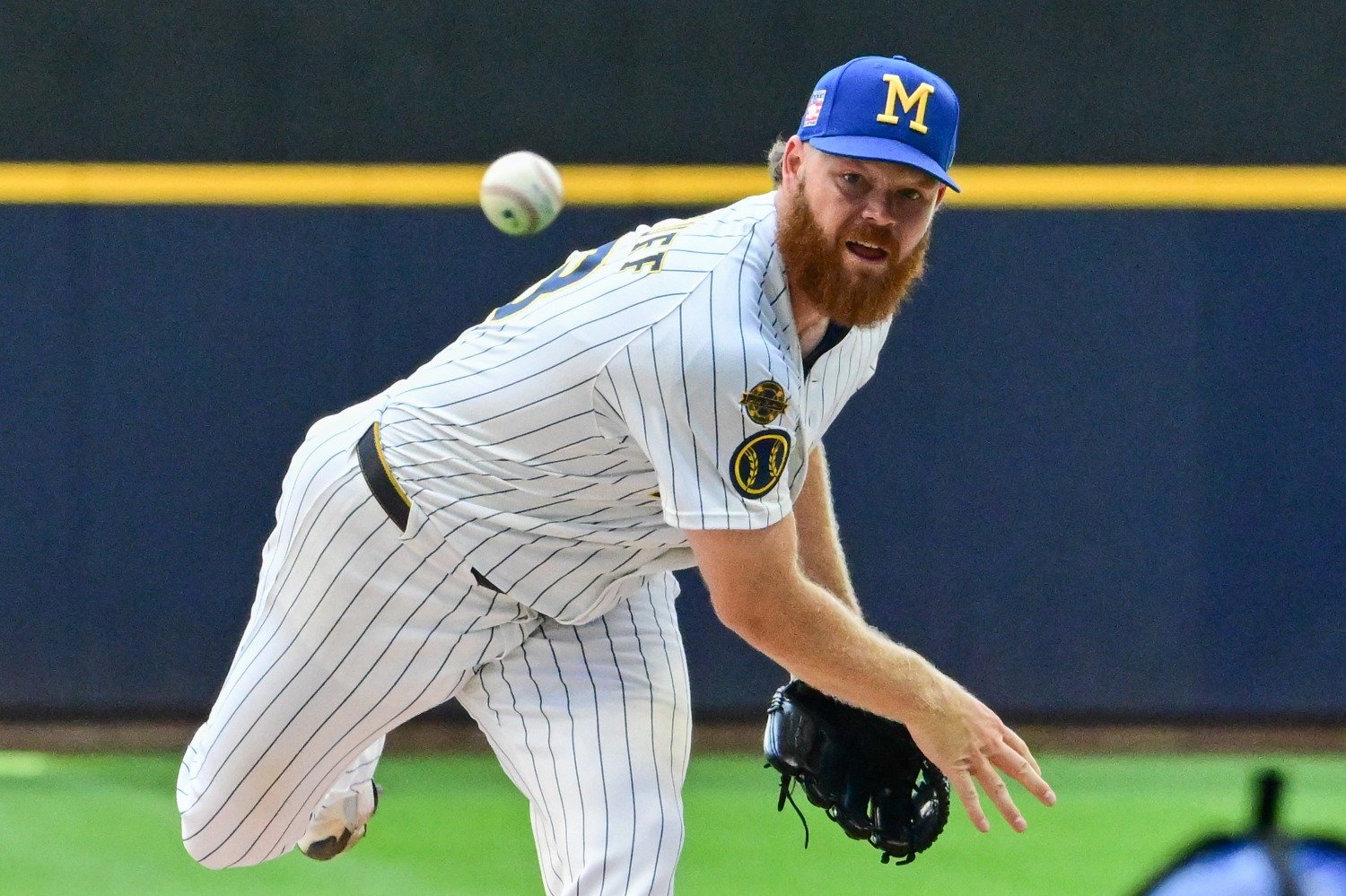 Brandon Woodruff's form since returning from what could have been a career-ending injury has been beyond the wildest dreams of even his most fervent fans. The grizzled bulldog has a 2.29 ERA through 35 1/3 innings pitched, despite hurling the ball at lower velocities than his career norms. He's been making hitters look silly and has pummelled the strike zone, resulting in 45 strikeouts against just six walks. Even more impressively, his fastball seems to be ticking upward from one game to the next, a scary thing for opposing hitters. Woodruff's arsenal is dominated by his four-seamer/sinker combination, preferring the sinker to right-handers and the four-seamer to lefties. Both of these offerings are returning some ludicrous swing-and-miss rates, thanks to the command of both pitches—numbers made all the more impressive by how consistently Woodruff is pounding the strike zone with each. Woodruff isn't dancing around hitters. He's going right at them, blowing them away time and again. With such a fastball-heavy approach, you might think that hitters would begin to square him up as he goes through the order a second and third time, but in fact, the opposite has proven true. Woodruff's fastball seems to take an inning or so to ramp up, sitting 90-91 mph early in his starts before living around 94-95 mph from the third inning on. Perhaps this plays a part in his success as he works through an order, but his results there are startling: Woodruff has a 33.3% strikeout rate the third time through an order and has given up just one walk in the 21 hitters he's faced. That's a small sample size, but we should also note how his stuff has played better the second time through. He grows into the game as it goes on, and that third time through is vital in playoff games. True, Woodruff has been a bit prone to the home run ball when he misses his spot, but the lack of walks and hits (he has a 0.68 WHIP on the season) means that those long balls haven't done a lot of damage. Let's contrast this with the presumed playoff starter, Freddy Peralta: Peralta has been dominant in the first inning, but slowly seen that wear away, to the point that you would feel unsure about him in the second inning as hitters adjust to his stuff—never mind the third time through an order. It's not a horrible set of numbers, and most pitchers do regress the third time through, but in Game 1, you want a pitcher to go more than five innings if possible. The Brewers' set-up with Aaron Ashby and DL Hall allows them to cover from short starts better than most, but it isn't ideal. Peralta also has a habit of occasionally throwing games away. If his fastball command is even slightly off, he seems to spray it around, getting into a lot of deep counts and issuing a lot of walks. He, too, can be prone to the long ball. Despite possessing some of the best stuff in the league, Peralta doesn't inspire quite the same level of confidence as Woodruff, who you know will continue to pound the strike zone and force hitters to beat him. Woodruff is the only pitcher the Brewers would consider starting in Game 1 of the playoffs over Peralta. Experience matters in these situations, and Peralta has been the undisputed leader of this staff since Woodruff's shoulder surgery. That being said, Woodruff's experience and mindset are perfectly suited to the pressure of a playoff series, and Pat Murphy could start him without having anyone (even Peralta) ask any especially hard questions about it. Brandon Woodruff's stuff is getting nastier with each outing. He's shown himself to be consistently dominant, even when seeing hitters a third time through, should that be needed. He's a bulldog, and he would set a tone for the Brewers in the 2025 playoffs while creating one of those full-circle moments from his injury heartbreak in September of 2023. Who would you like to see in game one of a playoff series? Does the third time through an order matter as much in a short series? Would your answer change depending on whether it's a Wild Card Series game or a Division Series game? Let us know your thoughts in the comments below!
 -
Image courtesy of © Benny Sieu-Imagn Images The Brewers bunch of "Average Joes" are on a franchise-altering tear. They've won 48 out of their last 64 games and lead the league in full-season record by five games. Having looked like potential trade deadline sellers in the middle of May, this is a remarkable turnaround—without any one, easy explanation. They're not being carried by a triumvirate of Freddie Freeman, Mookie Betts and Shohei Ohtani, or any hitter who will even get down-ballot MVP votes this season. Yet, they've scored more runs than any other team but the Toronto Blue Jays in that 64-game stretch. Simultaneously, no one on the Brewers staff is likely to get serious Cy Young votes (perhaps some down-ballot ones). Yet, since the start of the season (including blow-up outings from Elvin Rodriguez, Connor Thomas, Nestor Cortes and more), they're second in the NL for runs allowed, and one off the leadership. It's miraculous that the Brewers have performed this way without outstanding seasons from their offensive stars, and without barrages of home runs. It defies all modern orthodoxy on how an offense should be constructed. Is it a lucky 64-game stretch? Is it even possible to be merely lucky for that length of time? Or have the Brewers cracked baseball's code? We've heard the "win today" mantra preached by Pat Murphy since he became the manager, and it's a message the Brewers are really taking to heart. They've created a team thriving on the belief that they are the best team in baseball, despite the plucky underdog tag that the rest of baseball appears to have branded them with. They believe they're capable of winning any game in any situation, and that belief has fueled a historic run. Where Are All These Runs Coming From? It's an offense defined by plate discipline, and in that comes their consistency. Home run binges can come and go, but consistent, high-quality plate appearances are more controllable for the hitter. That brings about several advantages. Since May 18, the Brewers have (per FanGraphs): The lowest chase rate in baseball Fifth-best walk rate Fourth-lowest strikeout rate Second-best wRC+ Second-best OPS Second-best on-base percentage All of these, for a team that propels itself with elite pitching, gives an opportunity for consistent offensive pressure and production. They get on base, put the ball in play, and strangle your offense when they take a lead. There's been a lot of talk about the Brewers scrappy nature on the offensive side of the ball, but there hasn't been nearly enough praise for the pitching performances that have been even better. It's been one dominant start after another, but two players in particular have taken the Brewers to a whole new height. Why is No One Lauding This Rotation as the Key Ingredient in Their Success? Brandon Woodruff's stuff has not been at his pre-injury levels, with his fastballs sitting a few ticks down from where he's historically been. It appears to be trending upward from game to game, and perhaps that dearth of velocity is overshadowing just how dominant he's been. Jacob Misiorowski made the All-Star Game after just five starts, showing some of the most electric raw stuff in all of baseball and having somehow found genuine command of his arsenal. This organization has a reputation for taking the Jose Quintana types of this world and making them play up with the defense behind them. They did it with Chad Patrick earlier in the season, and both Quintana and Quinn Priester are the beneficiaries of that defense. What no one is talking about is how utterly overpowering this rotation has become since Woodruff and Misiorowski joined the pitching staff. Again, using that date of May 18, the Brewers have: The best ERA in baseball The second-best strikeout rate in baseball The second-best Fielder Independent Pitching (FIP) in baseball Ummm... and the Defense? Yes, the Brewers have a phenomenal defensive unit, ranking second-best in Outs Above Average (OAA) and third-best for Fielding Run Value (FRV), but it's not the only reason for their success as a defensive unit anymore. They're electric when called upon, but with the hydra of Woodruff, Misiorowski and Freddy Peralta, good luck even putting the ball in play. In summation, much has been made of what statistics the Brewers are putting up, but perhaps not enough has been done to look into how they're putting those numbers out. They have an offensive formula that has created one of the most consistent offenses in baseball since mid-May, a pitching staff with the most overpowering stuff in all of baseball, and a defensive unit that ranks top-five over that span in two of the three main fielding metrics. One overlooked portion of "winning the small margins" is how the Brewers, after a focus point in the offseason, have worked with their pitchers and William Contreras to limit the running game. They've caught 38% of would-be base stealers, and have only seen 61 attempts against them this season. Extra bases don't come cheaply against this team. It's one example of a host of small details that allow the Brewers to consistently win on the margins. The wider conversation still appears to be on the home run potency of the Brewers and how that will feature in the playoffs. They've proved of late that their model works. Perhaps we should all be revelling in this iteration of Brewers baseball, in what's turned out to be quite the summer of passion and entertainment. Some moments are difficult to replicate over a larger sample size, and there certainly have been some smiles from Lady Luck. The execution of Blake Perkins's throw and the tag from Contreras were faultless on Friday evening, but if Starling Marte had half a foot more as a lead from second base, he would have scored. It was a bang-bang play that could have gone either way. Contreras crushed a ball to right field on Saturday that was unfortunate to register an out, but the pitch clock reprieve gave him a second chance and he took full advantage. Still, when you do so many things right on the baseball field (commanding outlier raw stuff on the mound, controlling the running game, elite outfield coverage defensively and consistently putting the ball in play), you put yourself in a position to take advantage of opportunities that come along. The Brewers are the only team since May 18 to rank in the top 5 of Weighted Runs Created (wRC+), Earned Run Average (ERA), Fielder Independent Pitching (FIP) and Outs Above Average (OAA), to show just how well-rounded this team truly is. Solo shots don't do permanent damage (as the Mets found out, to their chagrin, this weekend). Instead, with constant pressure on the base paths, at the plate, defensively, and with this upside of three potential aces in the rotation, the Brewers have the means to win in a variety of different ways, and that allows them to avoid some of the long slumps in the ups and downs of a baseball season. There is a skill in capitalizing on big moments in games; it's a mental fortification not everyone possesses. The Brewers appear to have it in abundance, even if it won't always pay off to the extent it did in the Mets series. With such an incredible starting rotation and a shutdown bullpen (I haven't even talked about the exploits of Abner Uribe and Trevor Megill), the Brewers don't need to score truckloads of runs to win. It just so happens they're revelling in the big moments and doing so, anyway. While some regression may be expected (such winning runs are historically difficult to maintain), make no mistake about it: this Milwaukee Brewers team is the best team in baseball, regardless of luck. They may have had some fortune at times, but their skillset has allowed them to maximize that fortune. View full article
- 5 replies
-
- 2
-

-
-
- freddy peralta
- william contreras
- (and 2 more)
-
Are the Brewers Lucky, or Are They Just an Extraordinary Team?
Jake McKibbin posted an article in Brewers
 The Brewers bunch of "Average Joes" are on a franchise-altering tear. They've won 48 out of their last 64 games and lead the league in full-season record by five games. Having looked like potential trade deadline sellers in the middle of May, this is a remarkable turnaround—without any one, easy explanation. They're not being carried by a triumvirate of Freddie Freeman, Mookie Betts and Shohei Ohtani, or any hitter who will even get down-ballot MVP votes this season. Yet, they've scored more runs than any other team but the Toronto Blue Jays in that 64-game stretch. Simultaneously, no one on the Brewers staff is likely to get serious Cy Young votes (perhaps some down-ballot ones). Yet, since the start of the season (including blow-up outings from Elvin Rodriguez, Connor Thomas, Nestor Cortes and more), they're second in the NL for runs allowed, and one off the leadership. It's miraculous that the Brewers have performed this way without outstanding seasons from their offensive stars, and without barrages of home runs. It defies all modern orthodoxy on how an offense should be constructed. Is it a lucky 64-game stretch? Is it even possible to be merely lucky for that length of time? Or have the Brewers cracked baseball's code? We've heard the "win today" mantra preached by Pat Murphy since he became the manager, and it's a message the Brewers are really taking to heart. They've created a team thriving on the belief that they are the best team in baseball, despite the plucky underdog tag that the rest of baseball appears to have branded them with. They believe they're capable of winning any game in any situation, and that belief has fueled a historic run. Where Are All These Runs Coming From? It's an offense defined by plate discipline, and in that comes their consistency. Home run binges can come and go, but consistent, high-quality plate appearances are more controllable for the hitter. That brings about several advantages. Since May 18, the Brewers have (per FanGraphs): The lowest chase rate in baseball Fifth-best walk rate Fourth-lowest strikeout rate Second-best wRC+ Second-best OPS Second-best on-base percentage All of these, for a team that propels itself with elite pitching, gives an opportunity for consistent offensive pressure and production. They get on base, put the ball in play, and strangle your offense when they take a lead. There's been a lot of talk about the Brewers scrappy nature on the offensive side of the ball, but there hasn't been nearly enough praise for the pitching performances that have been even better. It's been one dominant start after another, but two players in particular have taken the Brewers to a whole new height. Why is No One Lauding This Rotation as the Key Ingredient in Their Success? Brandon Woodruff's stuff has not been at his pre-injury levels, with his fastballs sitting a few ticks down from where he's historically been. It appears to be trending upward from game to game, and perhaps that dearth of velocity is overshadowing just how dominant he's been. Jacob Misiorowski made the All-Star Game after just five starts, showing some of the most electric raw stuff in all of baseball and having somehow found genuine command of his arsenal. This organization has a reputation for taking the Jose Quintana types of this world and making them play up with the defense behind them. They did it with Chad Patrick earlier in the season, and both Quintana and Quinn Priester are the beneficiaries of that defense. What no one is talking about is how utterly overpowering this rotation has become since Woodruff and Misiorowski joined the pitching staff. Again, using that date of May 18, the Brewers have: The best ERA in baseball The second-best strikeout rate in baseball The second-best Fielder Independent Pitching (FIP) in baseball Ummm... and the Defense? Yes, the Brewers have a phenomenal defensive unit, ranking second-best in Outs Above Average (OAA) and third-best for Fielding Run Value (FRV), but it's not the only reason for their success as a defensive unit anymore. They're electric when called upon, but with the hydra of Woodruff, Misiorowski and Freddy Peralta, good luck even putting the ball in play. In summation, much has been made of what statistics the Brewers are putting up, but perhaps not enough has been done to look into how they're putting those numbers out. They have an offensive formula that has created one of the most consistent offenses in baseball since mid-May, a pitching staff with the most overpowering stuff in all of baseball, and a defensive unit that ranks top-five over that span in two of the three main fielding metrics. One overlooked portion of "winning the small margins" is how the Brewers, after a focus point in the offseason, have worked with their pitchers and William Contreras to limit the running game. They've caught 38% of would-be base stealers, and have only seen 61 attempts against them this season. Extra bases don't come cheaply against this team. It's one example of a host of small details that allow the Brewers to consistently win on the margins. The wider conversation still appears to be on the home run potency of the Brewers and how that will feature in the playoffs. They've proved of late that their model works. Perhaps we should all be revelling in this iteration of Brewers baseball, in what's turned out to be quite the summer of passion and entertainment. Some moments are difficult to replicate over a larger sample size, and there certainly have been some smiles from Lady Luck. The execution of Blake Perkins's throw and the tag from Contreras were faultless on Friday evening, but if Starling Marte had half a foot more as a lead from second base, he would have scored. It was a bang-bang play that could have gone either way. Contreras crushed a ball to right field on Saturday that was unfortunate to register an out, but the pitch clock reprieve gave him a second chance and he took full advantage. Still, when you do so many things right on the baseball field (commanding outlier raw stuff on the mound, controlling the running game, elite outfield coverage defensively and consistently putting the ball in play), you put yourself in a position to take advantage of opportunities that come along. The Brewers are the only team since May 18 to rank in the top 5 of Weighted Runs Created (wRC+), Earned Run Average (ERA), Fielder Independent Pitching (FIP) and Outs Above Average (OAA), to show just how well-rounded this team truly is. Solo shots don't do permanent damage (as the Mets found out, to their chagrin, this weekend). Instead, with constant pressure on the base paths, at the plate, defensively, and with this upside of three potential aces in the rotation, the Brewers have the means to win in a variety of different ways, and that allows them to avoid some of the long slumps in the ups and downs of a baseball season. There is a skill in capitalizing on big moments in games; it's a mental fortification not everyone possesses. The Brewers appear to have it in abundance, even if it won't always pay off to the extent it did in the Mets series. With such an incredible starting rotation and a shutdown bullpen (I haven't even talked about the exploits of Abner Uribe and Trevor Megill), the Brewers don't need to score truckloads of runs to win. It just so happens they're revelling in the big moments and doing so, anyway. While some regression may be expected (such winning runs are historically difficult to maintain), make no mistake about it: this Milwaukee Brewers team is the best team in baseball, regardless of luck. They may have had some fortune at times, but their skillset has allowed them to maximize that fortune.
- 5 comments
-
- 2
-
-
- freddy peralta
- william contreras
- (and 2 more)
-
They're also likely (now that he can retain rookie eligibility in 2026) to promote Bubba Chandler this weekend against the Chicago Cubs
-
Since firing Derek Shelton, the Pirates are 39-42
-
With Senga it all comes down to his forkball. It's rarely in the zone, and he's happy walking guys given he gets a ton of ground balls with it, but if you can force him into the strike zone with either his four seamer or cutter there's damage to be had. Both have been crushed since his return from the IL and he hasn't been commanding them to the edges all that well. If the Brewers can lay off that fork, good things will follow Far easier said than done mind, the spin axis so closely resembles his fastball.
-
Thurs. 8/7 - Myers Gets a Start. Tobias, Too!
Jake McKibbin replied to Jim Goulart's topic in Brewers Minor League Talk
Kenny Fenelon with his fourth home run of this years DSL season -
Thurs. 8/7 - Myers Gets a Start. Tobias, Too!
Jake McKibbin replied to Jim Goulart's topic in Brewers Minor League Talk
Its my favourite headline this year, beautiful use of language -
Much as Adam is a fantastic beat writer, the full credit to this should go to @wiguy94who spotted it roughly 12 nanoseconds after the trade was complete. He's been saying as much for over a month now. Its based on his service time being reduced because of his time in Triple A, and he won't accrue 6 years of service time now until 2027
-
Image courtesy of © Brett Davis-Imagn Images Freddy Peralta's raw stuff has never been in question, using a low release height with great induced vertical break on his mid-90's fastball that should be devilishly troublesome for hitters to square up. His hammer curveball and slider both grade out well, while his changeup has been devastating thus far in 2025 against both left-handed and right-handed hitters alike. The problem for Peralta has, as always, been that he can get wild with his pitches, especially in two-strike counts where he almost seems to consider it mandatory that he throw some waste pitches to "reset" a hitter's eyeline or hope for a guaranteed out if they do swing. His location on the four-seamer against the Braves on Tuesday was really wild, as noted by Dom Cotroneo: That's certainly a big part of the equation, but there's another problem. Fastball Freddy's pitches are some of the easiest to recognize out of the hand in baseball per Jeremy Maschino's "Match+" metrics, which assess how each pitch blends with its counterparts using all sorts of data from release points, spin and movement profiles: Not a single one of his pitches cracks a league average rating of 100 in the Match+ tracker, with two main offerings in the fastball and curveball sitting comfortably a full standard deviation away from the league average. In layman's terms, this would be a 40 grade or worse on the 20-80 scouting scale for how those pitches blend with the rest of his offerings. The result is that hitters can take pitches out of the strike zone with ease because they can identify each pitch with greater ease than normal. If it's a fastball and looks high, they're not going to mistake it for a curveball that drops into the zone. Thomas Nestico's TJ Stats graphs show that Peralta's chase rates on each pitch are mostly a little below league average, a number that should be in the upper echelon of starting pitchers when you consider the raw stuff and the sheer number of hitters Freddy Peralta finds himself in. His swing and miss rates when hitters chase are absurd, with over 50% of swings on chases outside the zone being missed entirely against each pitch of his curveball (55.7%), changeup (50.5%), and (yes, this is real) his slider (82.4%). In short, if Peralta can induce hitters to chase, he'll often put them away. His arsenal just isn't deceptive enough to do so with any regularity, and as such, Peralta needs to find ways to survive inside the strike zone more often. As much as the slider might be tempting to throw even more often, here's why it won't work: The graph above shows how, when the pitch on the x-axis (bottom) is thrown, it would then tunnel if followed by the pitch on the y-axis (left-hand side). So if a four-seam fastball is thrown, it has an 83 Match+ if followed by a slider, 66 if followed by a curveball, and 95 if followed by a changeup. Changeups and fastballs usually sequence together wonderfully, but Peralta's fastball has limited arm-side movement, and he drops his arm angle by 10° when throwing the changeup, meaning it looks different out of the hand quite quickly compared to most changeup/fastball combinations. That being said, its performance in sequences following the fastball has been notable for the uncomfortable swings it has generated to both right-handed and left-handed hitters. The graph shows that the curveball doesn't play off the fastball at all (almost a 20-grade deception rating) while the slider is better but still not a strong pitch in terms of deception. The problem Peralta has is that he doesn't trust his breaking pitches inside the strike zone at all, as you can see in the TJStats model for 2025, meaning he feels the fastball is the only pitch that can live inside the strike zone. That's not necessarily been the case: As you can see above, if Peralta avoids the middle stripe of the strike zone, his slider and curveball pay quite well in the zone. There are two benefits to this: the first is that he can feel comfortable targeting these earlier in counts and not relying solely on the fastball to pound the strike zone; secondly, when ahead, Peralta doesn't have to be as cautious as he is with his breaking pitches, which often end up as wild, waste offerings. He can afford to aim at the edge of the strike zone, and if he misses by six inches, he'll be just fine from a results standpoint while also being close enough to the zone to get perhaps an actual chase in those 0-2 and 1-2 counts. He'll get more swings, more efficient outs, and, to boot, those pitches have seen far less damage than his fastball, which has been picked out of the hand and squared up with some regularity in 2025 (in part because it only functions well at the top of the strike zone): Incorporating more of his breaking and off-speed pitches earlier in counts, and feeling comfortable with them inside the strike zone, could go a long way to Freddy Peralta being a genuine ace in a rotation that looks stacked with them. They may occasionally get hit hard as hitters hone in on a change in approach, but the benefits for Peralta should far outweigh the negatives. What do you think of Freddy Peralta's recent performances? Would u like to see him be more aggressive inside the strike zone? Or do you think his cat and mouse games are the best way to get consistent performances out of him? Let us know your thoughts in the comments below! View full article
-
Freddy Peralta's Lack of Deception & Variety Is Limiting His Ceiling
Jake McKibbin posted an article in Brewers
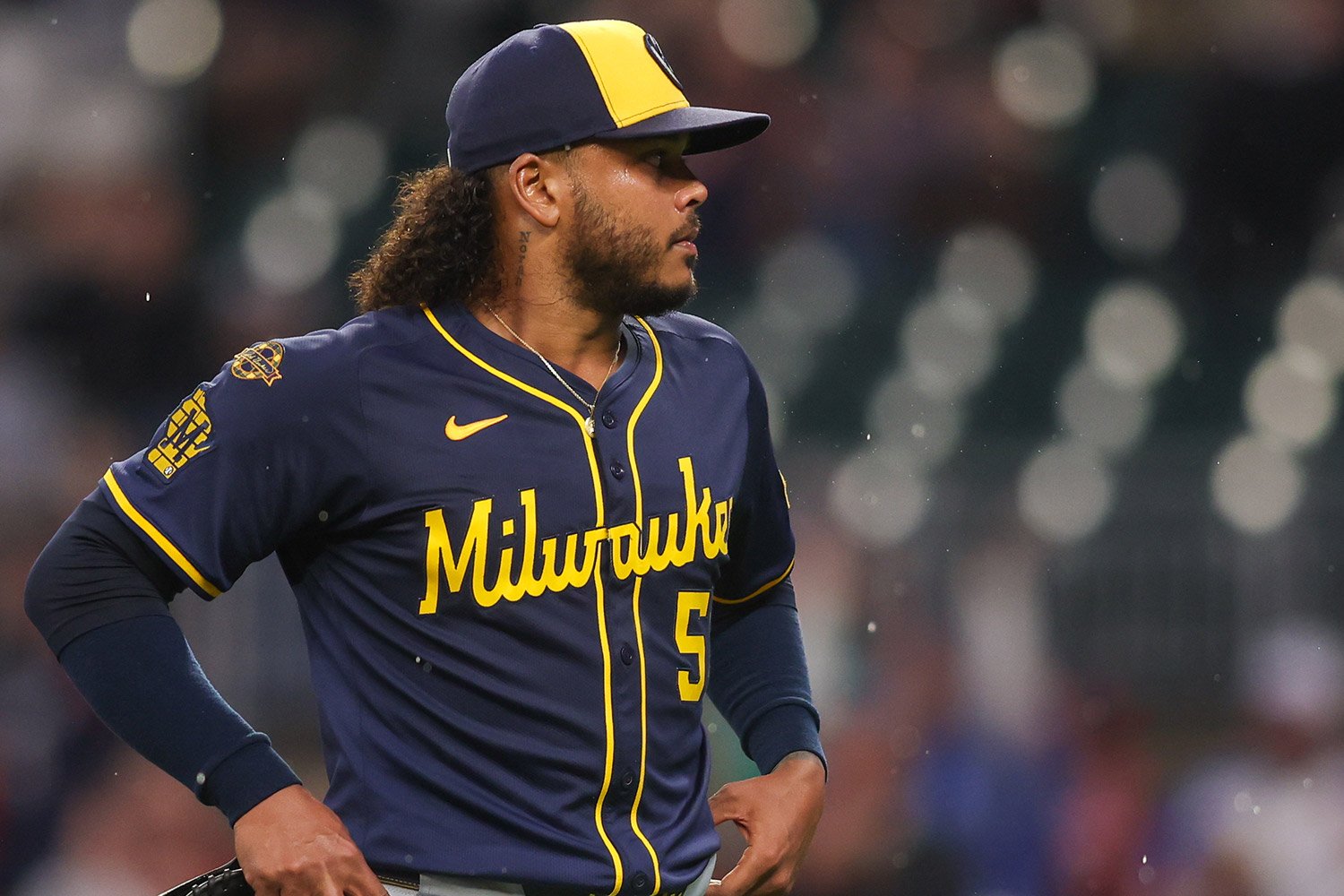 Freddy Peralta's raw stuff has never been in question, using a low release height with great induced vertical break on his mid-90's fastball that should be devilishly troublesome for hitters to square up. His hammer curveball and slider both grade out well, while his changeup has been devastating thus far in 2025 against both left-handed and right-handed hitters alike. The problem for Peralta has, as always, been that he can get wild with his pitches, especially in two-strike counts where he almost seems to consider it mandatory that he throw some waste pitches to "reset" a hitter's eyeline or hope for a guaranteed out if they do swing. His location on the four-seamer against the Braves on Tuesday was really wild, as noted by Dom Cotroneo: That's certainly a big part of the equation, but there's another problem. Fastball Freddy's pitches are some of the easiest to recognize out of the hand in baseball per Jeremy Maschino's "Match+" metrics, which assess how each pitch blends with its counterparts using all sorts of data from release points, spin and movement profiles: Not a single one of his pitches cracks a league average rating of 100 in the Match+ tracker, with two main offerings in the fastball and curveball sitting comfortably a full standard deviation away from the league average. In layman's terms, this would be a 40 grade or worse on the 20-80 scouting scale for how those pitches blend with the rest of his offerings. The result is that hitters can take pitches out of the strike zone with ease because they can identify each pitch with greater ease than normal. If it's a fastball and looks high, they're not going to mistake it for a curveball that drops into the zone. Thomas Nestico's TJ Stats graphs show that Peralta's chase rates on each pitch are mostly a little below league average, a number that should be in the upper echelon of starting pitchers when you consider the raw stuff and the sheer number of hitters Freddy Peralta finds himself in. His swing and miss rates when hitters chase are absurd, with over 50% of swings on chases outside the zone being missed entirely against each pitch of his curveball (55.7%), changeup (50.5%), and (yes, this is real) his slider (82.4%). In short, if Peralta can induce hitters to chase, he'll often put them away. His arsenal just isn't deceptive enough to do so with any regularity, and as such, Peralta needs to find ways to survive inside the strike zone more often. As much as the slider might be tempting to throw even more often, here's why it won't work: The graph above shows how, when the pitch on the x-axis (bottom) is thrown, it would then tunnel if followed by the pitch on the y-axis (left-hand side). So if a four-seam fastball is thrown, it has an 83 Match+ if followed by a slider, 66 if followed by a curveball, and 95 if followed by a changeup. Changeups and fastballs usually sequence together wonderfully, but Peralta's fastball has limited arm-side movement, and he drops his arm angle by 10° when throwing the changeup, meaning it looks different out of the hand quite quickly compared to most changeup/fastball combinations. That being said, its performance in sequences following the fastball has been notable for the uncomfortable swings it has generated to both right-handed and left-handed hitters. The graph shows that the curveball doesn't play off the fastball at all (almost a 20-grade deception rating) while the slider is better but still not a strong pitch in terms of deception. The problem Peralta has is that he doesn't trust his breaking pitches inside the strike zone at all, as you can see in the TJStats model for 2025, meaning he feels the fastball is the only pitch that can live inside the strike zone. That's not necessarily been the case: As you can see above, if Peralta avoids the middle stripe of the strike zone, his slider and curveball pay quite well in the zone. There are two benefits to this: the first is that he can feel comfortable targeting these earlier in counts and not relying solely on the fastball to pound the strike zone; secondly, when ahead, Peralta doesn't have to be as cautious as he is with his breaking pitches, which often end up as wild, waste offerings. He can afford to aim at the edge of the strike zone, and if he misses by six inches, he'll be just fine from a results standpoint while also being close enough to the zone to get perhaps an actual chase in those 0-2 and 1-2 counts. He'll get more swings, more efficient outs, and, to boot, those pitches have seen far less damage than his fastball, which has been picked out of the hand and squared up with some regularity in 2025 (in part because it only functions well at the top of the strike zone): Incorporating more of his breaking and off-speed pitches earlier in counts, and feeling comfortable with them inside the strike zone, could go a long way to Freddy Peralta being a genuine ace in a rotation that looks stacked with them. They may occasionally get hit hard as hitters hone in on a change in approach, but the benefits for Peralta should far outweigh the negatives. What do you think of Freddy Peralta's recent performances? Would u like to see him be more aggressive inside the strike zone? Or do you think his cat and mouse games are the best way to get consistent performances out of him? Let us know your thoughts in the comments below!