Jake McKibbin
-
Posts
2,450 -
Joined
-
Last visited
-
Days Won
6
Content Type
Profiles
Forums
Blogs
Events
News
2026 Milwaukee Brewers Top Prospects Ranking
Milwaukee Brewers Videos
2022 Milwaukee Brewers Draft Picks
Milwaukee Brewers Free Agent & Trade Rumors, Notes, & Tidbits
Guides & Resources
2023 Milwaukee Brewers Draft Picks
2024 Milwaukee Brewers Draft Picks
The Milwaukee Brewers Players Project
2025 Milwaukee Brewers Draft Pick Tracker
2026 Milwaukee Brewers Draft Tracker: Picks & Bonuses
Store
Downloads
Gallery
Everything posted by Jake McKibbin
-
Good question! That would be Luis Lara Other outliers include Brock Wilken (best EV's in camp, but 35% whiff rate) Jesus made (40% whiff rate, 90+ mph EV on the right hand side) Sal Frelick on the left with second lowest EV's in camp
- 5 replies
-
- 2
-

-
- bishop letson
- brandon sproat
- (and 1 more)
-
3 Brewers Players Opening the Most Eyes in Spring Training
Jake McKibbin posted an article in Brewers
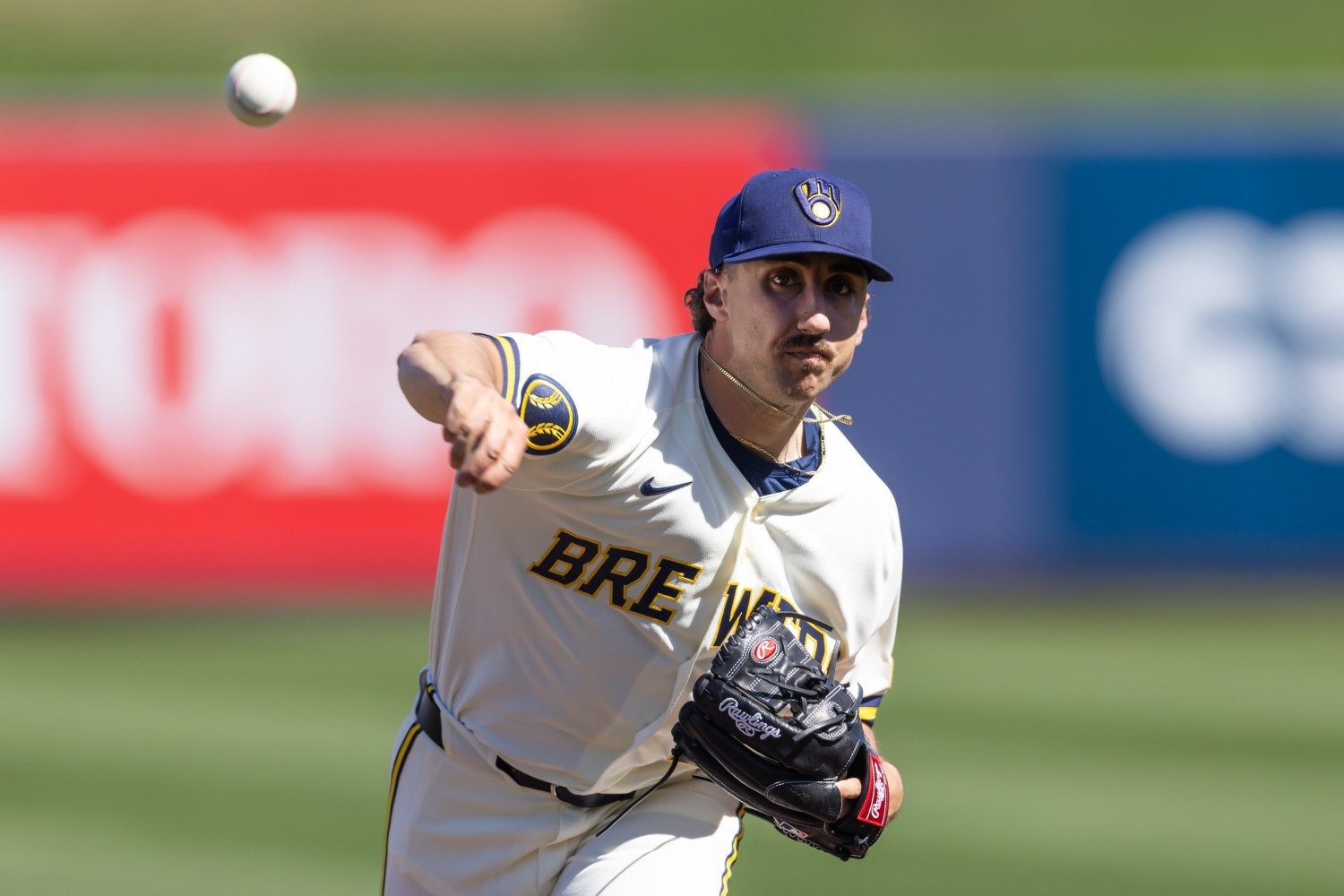 We know that batting averages and OPSes mean very little in spring. As Brewers fans remember well, the adventures of Vinny Capra proved to have no correlation with his performance in the regular season. He hit six home runs in the spring of 2025 and was gone from the organization by the middle of May. Pitchers aren't game-planning. Their command is hardly dialed-in, and that leaves opportunities for hitters to excel in a small sample. After four long, lonely, starving months without baseball activity, it's easy to get carried away, but that doesn't mean we have nothing to get excited about. If you're a Brewers fan, it's quite the contrary. Let's have a look at those who are making strides from their last competitive action, and why each offers a reason for positivity for a team that reached the NLCS in 2025. Brandon Sproat Brandon Sproat came over as part of the Freddy Peralta trade and has hit the ground running. Possessing a full, diverse arsenal that perhaps wasn't showcased enough by the Mets in 2025 during his cup of coffee, Sproat showed exactly how the Brewers plan to use him in 2026. Sproat has converted what was already a hard 88-mph slider into a mid-90s cutter (touching 95 mph at times) and blended the four-seamer he was renowned for in the minor leagues with the complementary sinker and cutter that the Brewers prize so dearly. While the stuff grades don't pop off the page, the hitters' swings—and the simple eye test—suggest that his combination of power and movement is valuable. He threw nearly all his fastballs for strikes, but didn't land his secondary stuff in the zone in his first game in the Cactus League. There will be far more nuance in the regular season, but the most intriguing part was the swing-and-miss element of Sproat's arsenal. He conceded two hard-hit balls—one on an upper-third four-seam fastball and the other on a back-up sweeper—but when he executed, he missed bats. Sproat struck out 17 in 20 2/3 innings last year in the major leagues, which would once have counted as dominant but doesn't open any eyes anymore. Changes to his pitch mix should increase the deception in his arsenal, and perhaps allow everything to play up. It's too early to tell, but it bears watching as spring progresses. Bishop Letson Letson has been a name on evaluators' lips for a while, struggling to stay on the field with regularity but showcasing extension, movement, command and a deep enough arsenal to generate some early hype in his young professional career. Over the offseason, his fastball has added several ticks, and the result is monstrous: Letson's fastball has averaged almost 97 mph this spring, with extreme vertical "rise" for his arm angle; plus extension; and big-time spin. It's a fastball that could be dominant. So far, he doesn't know how to tunnel it with his other offerings, using a higher release point than the rest of his arsenal to get behind the ball. That's one reason why he prefers to lead with his slider. The changeup will be key for Letson going forward, offering him an alternative out pitch to left-handed hitters, against whom a slider is typically less effective. The pitch shows good characteristics, but he'll need to improve his feel for it as he matures. Health is the main concern for Letson, but if he can stay on the field, there might be a top-of-the-rotation arm to dream on. Brandon Lockridge Lockridge appeared, initially, to be a throwaway piece in the deal that sent Nestor Cortes and Jorge Quintana to the Padres at the 2025 trade deadline. His elite speed seemed unlikely to make up for a dearth of power, but rumors did spread that the Brewers were higher on Lockridge than most. This spring, we've seen some of the fruits of this. Of Brewers to have seen over 50 pitches, only one player (Brock Wilken) has a higher average exit velocity, and only two hitters (Brice Turang and David Hamilton) have swung and missed less often. In the chart below, Lockridge's emblem is the one in the top left: Turang is Lockridge's closest comparison on this chart, also whiffing very little (just once in camp so far) without quite as much contact as Lockridge in the small sample. In case you're concerned about Vinny Capra comparisons, Capra averaged 94 mph exit velocities but did swing and miss 22% of the time last year. Lockridge won't tear through the league the way he did through early spring training games, but he's been creating hard hits across the strike zone. That changes his profile substantially. The Brewers are no strangers to an outfielder making strides, Blake Perkins being the most recent example of an unheralded pickup making a meaningful impact. Lockridge's potential is greater, but of course, we'll need a larger sample before locking in any observations. Have you noticed any other standouts in spring training that have impressed? Have you enjoyed any of the prospects making appearances, from Brock Wilken to Jesus Made? Let us know your thoughts below!
- 5 comments
-
- 5
-
-
- bishop letson
- brandon sproat
- (and 1 more)
-
Image courtesy of © Mark J. Rebilas-Imagn Images We know that batting averages and OPSes mean very little in spring. As Brewers fans remember well, the adventures of Vinny Capra proved to have no correlation with his performance in the regular season. He hit six home runs in the spring of 2025 and was gone from the organization by the middle of May. Pitchers aren't game-planning. Their command is hardly dialed-in, and that leaves opportunities for hitters to excel in a small sample. After four long, lonely, starving months without baseball activity, it's easy to get carried away, but that doesn't mean we have nothing to get excited about. If you're a Brewers fan, it's quite the contrary. Let's have a look at those who are making strides from their last competitive action, and why each offers a reason for positivity for a team that reached the NLCS in 2025. Brandon Sproat Brandon Sproat came over as part of the Freddy Peralta trade and has hit the ground running. Possessing a full, diverse arsenal that perhaps wasn't showcased enough by the Mets in 2025 during his cup of coffee, Sproat showed exactly how the Brewers plan to use him in 2026. Sproat has converted what was already a hard 88-mph slider into a mid-90s cutter (touching 95 mph at times) and blended the four-seamer he was renowned for in the minor leagues with the complementary sinker and cutter that the Brewers prize so dearly. While the stuff grades don't pop off the page, the hitters' swings—and the simple eye test—suggest that his combination of power and movement is valuable. He threw nearly all his fastballs for strikes, but didn't land his secondary stuff in the zone in his first game in the Cactus League. There will be far more nuance in the regular season, but the most intriguing part was the swing-and-miss element of Sproat's arsenal. He conceded two hard-hit balls—one on an upper-third four-seam fastball and the other on a back-up sweeper—but when he executed, he missed bats. Sproat struck out 17 in 20 2/3 innings last year in the major leagues, which would once have counted as dominant but doesn't open any eyes anymore. Changes to his pitch mix should increase the deception in his arsenal, and perhaps allow everything to play up. It's too early to tell, but it bears watching as spring progresses. Bishop Letson Letson has been a name on evaluators' lips for a while, struggling to stay on the field with regularity but showcasing extension, movement, command and a deep enough arsenal to generate some early hype in his young professional career. Over the offseason, his fastball has added several ticks, and the result is monstrous: Letson's fastball has averaged almost 97 mph this spring, with extreme vertical "rise" for his arm angle; plus extension; and big-time spin. It's a fastball that could be dominant. So far, he doesn't know how to tunnel it with his other offerings, using a higher release point than the rest of his arsenal to get behind the ball. That's one reason why he prefers to lead with his slider. The changeup will be key for Letson going forward, offering him an alternative out pitch to left-handed hitters, against whom a slider is typically less effective. The pitch shows good characteristics, but he'll need to improve his feel for it as he matures. Health is the main concern for Letson, but if he can stay on the field, there might be a top-of-the-rotation arm to dream on. Brandon Lockridge Lockridge appeared, initially, to be a throwaway piece in the deal that sent Nestor Cortes and Jorge Quintana to the Padres at the 2025 trade deadline. His elite speed seemed unlikely to make up for a dearth of power, but rumors did spread that the Brewers were higher on Lockridge than most. This spring, we've seen some of the fruits of this. Of Brewers to have seen over 50 pitches, only one player (Brock Wilken) has a higher average exit velocity, and only two hitters (Brice Turang and David Hamilton) have swung and missed less often. In the chart below, Lockridge's emblem is the one in the top left: Turang is Lockridge's closest comparison on this chart, also whiffing very little (just once in camp so far) without quite as much contact as Lockridge in the small sample. In case you're concerned about Vinny Capra comparisons, Capra averaged 94 mph exit velocities but did swing and miss 22% of the time last year. Lockridge won't tear through the league the way he did through early spring training games, but he's been creating hard hits across the strike zone. That changes his profile substantially. The Brewers are no strangers to an outfielder making strides, Blake Perkins being the most recent example of an unheralded pickup making a meaningful impact. Lockridge's potential is greater, but of course, we'll need a larger sample before locking in any observations. Have you noticed any other standouts in spring training that have impressed? Have you enjoyed any of the prospects making appearances, from Brock Wilken to Jesus Made? Let us know your thoughts below! View full article
- 5 replies
-
- 1
-

-
- bishop letson
- brandon sproat
- (and 1 more)
-
Hi Jack! Curious to hear your thoughts, but what do you think makes his delivery so deceptive?
-
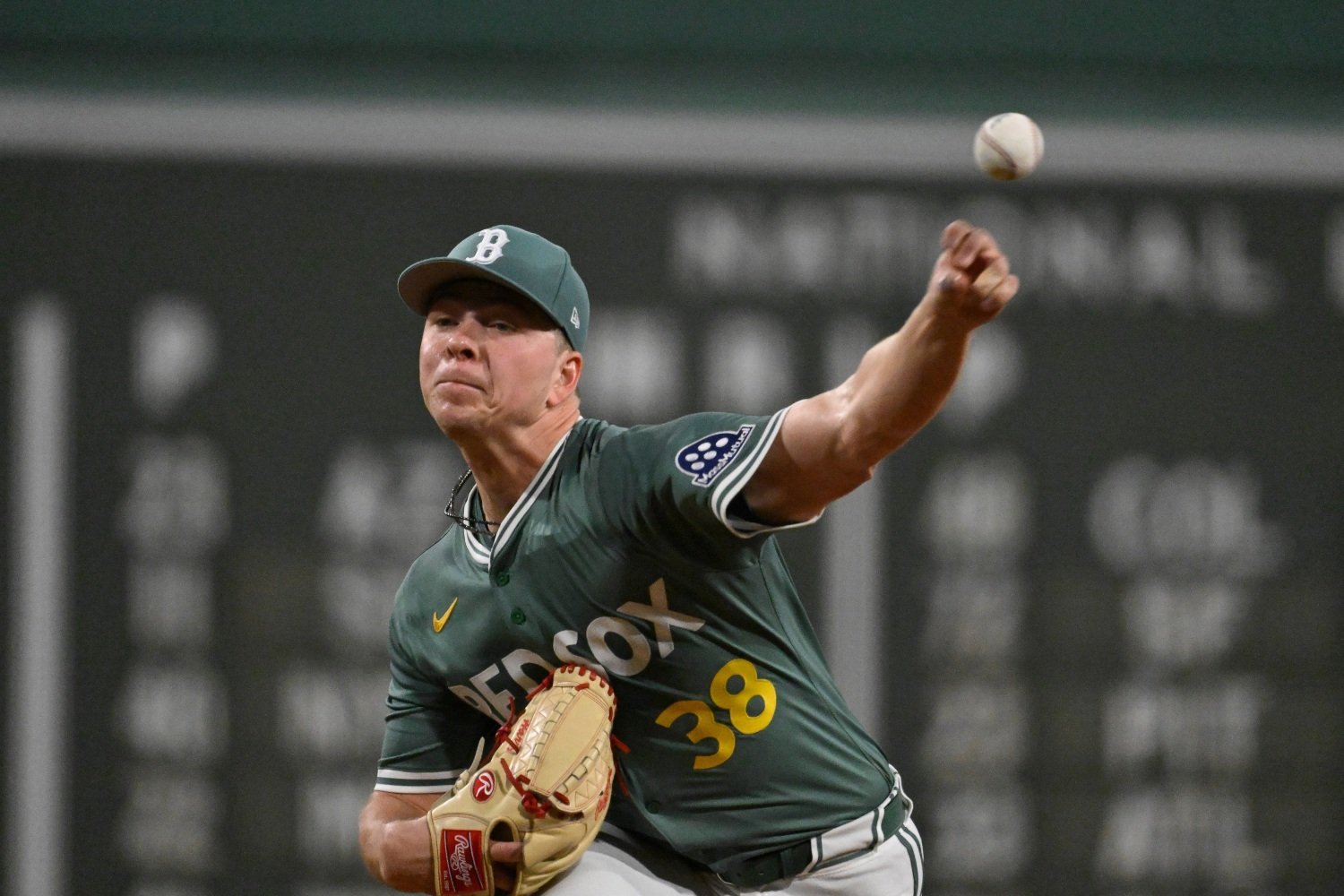 While he was with the San Francisco Giants, Kyle Harrison was predominantly a four-seam fastball and "slurve" pitcher, adding the occasional changeup to right-handed hitters. For large parts of his development through the minor leagues, Harrison overpowered hitters with his funky low-slot delivery and the deception of that heater-slurve combo. In the low minors, he missed lots of bats, and he peaked as the No. 18 prospect in baseball, according to MLB Pipeline in 2023. Here's the blurb that went with that lofty ranking. Harrison debuted with the Giants in 2024, posting a 4.56 ERA in 124 1/3 innings pitched, and saw his overall swing-and-miss rates drop while he consistently struggled with walks. His three-pitch mix proved less potent against the best hitters in the world, and after spending time on the shuttle for the Giants in 2025 between Triple A and the major leagues, Harrison was part of the return in the Rafael Devers trade with Boston. The Boston Red Sox Do Boston Red Sox Things Boston is known for being an organization heavily focused on secondary pitches, and keen to limit fastball usage. Although the Brewers prefer to lean on the heater, they also like pitch diversification, so it's no shock that the two teams match up well on pitcher evaluations. Milwaukee got Quinn Priester from Boston last April, to patch their desperately injury-diminished starting rotation. Now, they've picked up Harrison, after a similar transformation during a similarly short time with the Sox. Harrison's fastball usage shifted dramatically in his small sample of big-league appearances with the Red Sox, compared to those with the Giants: His velocity dipped—perhaps from the long season, as we can also see his extension shortening after the trade. That's worth keeping an eye on. However, Harrison also made some fascinating deeper adjustments. Transforming from a three-pitch mix and using four-seam fastballs 65% of the time to throwing just 46% four-seam fastballs and incorporating more slurves, cutters and sinkers made a big change to the quality of contact against Harrison. While his whiff rates weren't as strong, he was getting more chases and just a .280 xwOBACON (a statistic measuring the likely damage on contact), which would be an elite mark over a larger sample. The changeup is particularly notable. After joining the Red Sox, Harrison changed his grip from a one-seam orientation into a kick-change, something the Brewers haven't seen much of within their player development system. This version usually creates more depth, but also more inconsistent movement, making it difficult to command at times. When it's right, the kick-change will produce negative induced vertical break numbers (IVB) with ease, and in Triple A, Harrison's approached -10 inches of IVB on occasion, with an overall three inches of extra drop on average. The San Francisco Quandary The Giants have recently had a number of high-profile, talented arms pass through their system with enormous hype, but have trouble translating that onto the big-league mound. Despite an elite defensive catcher in Patrick Bailey and a pitcher's park, it hasn't come together. Perhaps it's time to question their development processes. One additional change Harrison made after going to the Red Sox lay in how he used his slurve. The Giants were adamantly and rigidly calling it to one side of the plate, down and away from lefties and toward the back foot of righties., The Red Sox encouraged him to open up both sides of the plate to complement his enhanced arsenal. The goal here was to elicit more confusion in the hitter's eye as to what pitch was coming his way, and the deception worked. He learned to land the pitch for strikes and backdoor it, as well as being able to bury it near the right-handed batter's box. Harrison located the slurve in the zone more often, got more chase, and still maintained a higher quality of contact against the pitch than he managed with San Francisco in the first half of the year. He's never likely to be a strikeout artist in the majors, but his strong movement, funky delivery, and a wider pitch mix can make him a true all-around pitcher. The majority of Harrison's Triple-A games came for the Red Sox, and they paint a picture of what he might look like at his best: Harrison does have some walk issues. As with Priester, there might be a mechanical tweak in mind to clean up his delivery, but with his ability to garner chase, limit hard contact and miss bats both in and out of the strike zone, there is a lot to like about Kyle Harrison—especially in an organization like the Milwaukee Brewers.
 -
Image courtesy of © Eric Canha-Imagn Images While he was with the San Francisco Giants, Kyle Harrison was predominantly a four-seam fastball and "slurve" pitcher, adding the occasional changeup to right-handed hitters. For large parts of his development through the minor leagues, Harrison overpowered hitters with his funky low-slot delivery and the deception of that heater-slurve combo. In the low minors, he missed lots of bats, and he peaked as the No. 18 prospect in baseball, according to MLB Pipeline in 2023. Here's the blurb that went with that lofty ranking. Harrison debuted with the Giants in 2024, posting a 4.56 ERA in 124 1/3 innings pitched, and saw his overall swing-and-miss rates drop while he consistently struggled with walks. His three-pitch mix proved less potent against the best hitters in the world, and after spending time on the shuttle for the Giants in 2025 between Triple A and the major leagues, Harrison was part of the return in the Rafael Devers trade with Boston. The Boston Red Sox Do Boston Red Sox Things Boston is known for being an organization heavily focused on secondary pitches, and keen to limit fastball usage. Although the Brewers prefer to lean on the heater, they also like pitch diversification, so it's no shock that the two teams match up well on pitcher evaluations. Milwaukee got Quinn Priester from Boston last April, to patch their desperately injury-diminished starting rotation. Now, they've picked up Harrison, after a similar transformation during a similarly short time with the Sox. Harrison's fastball usage shifted dramatically in his small sample of big-league appearances with the Red Sox, compared to those with the Giants: His velocity dipped—perhaps from the long season, as we can also see his extension shortening after the trade. That's worth keeping an eye on. However, Harrison also made some fascinating deeper adjustments. Transforming from a three-pitch mix and using four-seam fastballs 65% of the time to throwing just 46% four-seam fastballs and incorporating more slurves, cutters and sinkers made a big change to the quality of contact against Harrison. While his whiff rates weren't as strong, he was getting more chases and just a .280 xwOBACON (a statistic measuring the likely damage on contact), which would be an elite mark over a larger sample. The changeup is particularly notable. After joining the Red Sox, Harrison changed his grip from a one-seam orientation into a kick-change, something the Brewers haven't seen much of within their player development system. This version usually creates more depth, but also more inconsistent movement, making it difficult to command at times. When it's right, the kick-change will produce negative induced vertical break numbers (IVB) with ease, and in Triple A, Harrison's approached -10 inches of IVB on occasion, with an overall three inches of extra drop on average. The San Francisco Quandary The Giants have recently had a number of high-profile, talented arms pass through their system with enormous hype, but have trouble translating that onto the big-league mound. Despite an elite defensive catcher in Patrick Bailey and a pitcher's park, it hasn't come together. Perhaps it's time to question their development processes. One additional change Harrison made after going to the Red Sox lay in how he used his slurve. The Giants were adamantly and rigidly calling it to one side of the plate, down and away from lefties and toward the back foot of righties., The Red Sox encouraged him to open up both sides of the plate to complement his enhanced arsenal. The goal here was to elicit more confusion in the hitter's eye as to what pitch was coming his way, and the deception worked. He learned to land the pitch for strikes and backdoor it, as well as being able to bury it near the right-handed batter's box. Harrison located the slurve in the zone more often, got more chase, and still maintained a higher quality of contact against the pitch than he managed with San Francisco in the first half of the year. He's never likely to be a strikeout artist in the majors, but his strong movement, funky delivery, and a wider pitch mix can make him a true all-around pitcher. The majority of Harrison's Triple-A games came for the Red Sox, and they paint a picture of what he might look like at his best: Harrison does have some walk issues. As with Priester, there might be a mechanical tweak in mind to clean up his delivery, but with his ability to garner chase, limit hard contact and miss bats both in and out of the strike zone, there is a lot to like about Kyle Harrison—especially in an organization like the Milwaukee Brewers. View full article
-
Image courtesy of © Benny Sieu-Imagn Images Garrett Mitchell is the epitome of a tantalising baseball player. With incredible athleticism, a feel for the big moments, and raw power to all fields, there is very little he couldn't achieve on the baseball field. To answer some under-the-hood concerns with his swing path (centered around conquering the high fastball), Mitchell made some changes in the 2024-25 offseason, with the goal of a more rounded, consistent profile and the ability to make better contact across the strike zone. I covered some of the changes he needed to make here in November 2024—soon after which we saw a video of Mitchell from Driveline. There, he worked on creating a flatter plane to the ball, staying tight and working behind the ball. It seems he didn't lose any of his pop in doing so: How Did He Handle The High Fastball In 2025? It's important to remember this is a very small sample—just a month's at-bats—but there were some notable changes in his whiff rates from 2024 compared to the 2025 season, especially in the upper third of the strike zone: Let's restrict our focus to four-seam fastballs only, and include just the middle and upper portions of the strike zone, to see how Mitchell fared. Again, this is a small sample due to Mitchell's season-derailing injuries, but the changes are significant. Mitchell's quality and quantity of contact against four-seam fastballs soared in this small sample of 25 qualified offerings, with an improved attack angle in his swing bearing proof of a changing process. His exit velocities were up, his whiff rates were way down, and his expected batting average and slugging metrics showcased his output well. If we limit this sample to just the top of the strike zone (again, an even smaller size), Mitchell's whiff rate dropped from 48% to 33%, with an average exit velocity of 95.0 mph. If we include sinkers and cutters in these locations to increase the sample size, the same story repeats itself: Mitchell is whiffing less and finding better launch angles, thanks to improved attack angles in his swing. With Mitchell's keen eye at the plate, he doesn't need to do damage on pitches in the upper third of the zone; he just needs to be able to make contact and stay in an at-bat. He made real strides here in 2025, and it should hold him in good stead for 2026, if he can maintain that new swing path after another shoulder surgery last summer. The Timing Trade-Off This was a large change to Mitchell's swing—the type of change that's been the downfall of many others with swing-and-miss concerns (see: Joey Wiemer). While working in cages and at Driveline was beneficial to bed in his adjusted swing path, it's likely that his focus on breaking and off-speed pitches took a back seat. Mitchell was still adjusting to his timing on non-fastballs as spring training rolled around and continued in season, which reduced some of the damage we've become accustomed to. While Mitchell did struggle with high fastballs in 2024, you threw breaking pitches inside the strike zone at your peril. Thankfully, nobody warned Phil Maton about that: Interestingly, this is where Mitchell took a step back. With the majority of his off-season work centered around the high fastball, Mitchell struggled to time up anything off-speed. Only three of his 13 batted balls against breaking pitches inside the strike zone had a launch angle between 0° and 30°, and not one was between 5° and 25°. He was late getting to pitches, but this appears more of a timing issue than a mechanical one. His attack angle was largely similar to his production in 2024, and his hard-hit rate was still quite productive; he just wasn't catching these offerings out in front of him with the same regularity. Mitchell's timing should have improved with playing time, a boon painfully removed from his 2025 season in May, but all the indicators are there for Mitchell, if he can just stay on the field, to break out in a big way during 2026. His bat speed was higher. He was making contact with high fastballs, and punishing those that missed over the heart of the plate. We saw those under-the-hood developments from Mitchell that we've been itching for, even though the surface results didn't quite match up to those indices. If he can stay on the field, Mitchell's ceiling is still as high as anyone on this team. View full article
-
Are You Ready to Dream on Garrett Mitchell One More Time?
Jake McKibbin posted an article in Brewers
 Garrett Mitchell is the epitome of a tantalising baseball player. With incredible athleticism, a feel for the big moments, and raw power to all fields, there is very little he couldn't achieve on the baseball field. To answer some under-the-hood concerns with his swing path (centered around conquering the high fastball), Mitchell made some changes in the 2024-25 offseason, with the goal of a more rounded, consistent profile and the ability to make better contact across the strike zone. I covered some of the changes he needed to make here in November 2024—soon after which we saw a video of Mitchell from Driveline. There, he worked on creating a flatter plane to the ball, staying tight and working behind the ball. It seems he didn't lose any of his pop in doing so: How Did He Handle The High Fastball In 2025? It's important to remember this is a very small sample—just a month's at-bats—but there were some notable changes in his whiff rates from 2024 compared to the 2025 season, especially in the upper third of the strike zone: Let's restrict our focus to four-seam fastballs only, and include just the middle and upper portions of the strike zone, to see how Mitchell fared. Again, this is a small sample due to Mitchell's season-derailing injuries, but the changes are significant. Mitchell's quality and quantity of contact against four-seam fastballs soared in this small sample of 25 qualified offerings, with an improved attack angle in his swing bearing proof of a changing process. His exit velocities were up, his whiff rates were way down, and his expected batting average and slugging metrics showcased his output well. If we limit this sample to just the top of the strike zone (again, an even smaller size), Mitchell's whiff rate dropped from 48% to 33%, with an average exit velocity of 95.0 mph. If we include sinkers and cutters in these locations to increase the sample size, the same story repeats itself: Mitchell is whiffing less and finding better launch angles, thanks to improved attack angles in his swing. With Mitchell's keen eye at the plate, he doesn't need to do damage on pitches in the upper third of the zone; he just needs to be able to make contact and stay in an at-bat. He made real strides here in 2025, and it should hold him in good stead for 2026, if he can maintain that new swing path after another shoulder surgery last summer. The Timing Trade-Off This was a large change to Mitchell's swing—the type of change that's been the downfall of many others with swing-and-miss concerns (see: Joey Wiemer). While working in cages and at Driveline was beneficial to bed in his adjusted swing path, it's likely that his focus on breaking and off-speed pitches took a back seat. Mitchell was still adjusting to his timing on non-fastballs as spring training rolled around and continued in season, which reduced some of the damage we've become accustomed to. While Mitchell did struggle with high fastballs in 2024, you threw breaking pitches inside the strike zone at your peril. Thankfully, nobody warned Phil Maton about that: Interestingly, this is where Mitchell took a step back. With the majority of his off-season work centered around the high fastball, Mitchell struggled to time up anything off-speed. Only three of his 13 batted balls against breaking pitches inside the strike zone had a launch angle between 0° and 30°, and not one was between 5° and 25°. He was late getting to pitches, but this appears more of a timing issue than a mechanical one. His attack angle was largely similar to his production in 2024, and his hard-hit rate was still quite productive; he just wasn't catching these offerings out in front of him with the same regularity. Mitchell's timing should have improved with playing time, a boon painfully removed from his 2025 season in May, but all the indicators are there for Mitchell, if he can just stay on the field, to break out in a big way during 2026. His bat speed was higher. He was making contact with high fastballs, and punishing those that missed over the heart of the plate. We saw those under-the-hood developments from Mitchell that we've been itching for, even though the surface results didn't quite match up to those indices. If he can stay on the field, Mitchell's ceiling is still as high as anyone on this team.
 -
You might notice a correlation between spring training and my article output 👀 Aww thanks Matt! Glad you're enjoying the content!
-
Image courtesy of © Mark Hoffman/USA Today Network via Imagn Images Brandon Woodruff had to transform in 2025, to make up for diminished velocity. Averaging between 96-97 mph since his debut on his four-seam fastball, there were concerns he might be sitting at 91-92 mph in 2025, and that mandated a total change in his arsenal. Instead of blowing fastballs past hitters with impunity, Woodruff had to add wrinkles to his arsenal. The main alteration was to separate his slider into a hard cutter and a sweeper. Instead of leaning more into his breaking pitches (as you might expect with the lower average velocity), Woodruff continued to lead with his two primary fastballs—the sinker and four-seamer—to begin the year. However, as the season progressed,an interesting change occurred. From the middle of August on, Woodruff's cutter usage surged: Despite his marvelous surface-level numbers upon returning to the majors, there were some lurking problems. His four-seamer was proving tough to make contact with, but when hitters managed to touch it, they were doing more damage than one would like. In fact, both the sinker and four-seam fastball regressed in August, showing higher xwOBAs in the time during which Woodruff reduced his cutter usage. The Tunnelling Effect The main reason for the hard slider/cutter's introduction was to give hitters a third hard pitch for which to look, loosening their focal point and making it harder to barrel him up. If we look at Pitch Profiler's match+ diagram and decision point matrix below, you can see two things: The first observation is that, at the decision point, if all pitches begin at the same location, the only slight deviation is in the changeup (green) and curveball (blue). The other three pitches are so on top of one another that you can hardly differentiate which is which. If we see the same arsenal at the point the pitch passes the plate, all three fastballs are in vastly different locations. Secondly, studying the Match+ heatmap, you can see a glowing red box in the bottom right, which shows how each fastball (FC, FF, SI) interacts with its counterparts. This model estimates that the deceptiveness of these offerings is 10-12% above league average. In short, the cutter worked in its initial role as a wrinkle, helping both his sinker and four-seam fastball play up. At that point, the Brewers and Woodruff appeared to realize that the shape and command of the cutter was far better than they had expected. Just How Good Is Brandon Woodruff's Cutter? Over the last month of the season, Woodruff's cutter emerged as his primary fastball, culminating in his positively cutter-happy final September start. It's possible he relied on the pitch partially because of fatigue that day, but even prior to that, we saw it with around the same usage as his other fastball variants. Out of all cutters that comprised at least 15% of a starting pitcher's arsenal and were thrown over 150 times in 2025, Woodruff's ranked 15th in whiff rate. That would place him in the 82nd percentile—not bad for a player throwing the offering for the first time. Above, you can see the expected movement (shaded areas) compared to the actual movement (circles) for his pitches, and note the cutter, in brown. Woodruff has a tendency to get more rise on nearly all of his offerings than expected based on his velocity and arm angles. That's one reason for the massive swing-and-miss rate he can get, even when pounding the strike zone. Woodruff's cutter leads the way with almost five inches more induced vertical break than the model would consider "dead zone" for his physical characteristics—a figure that will directly correlate with more swings and misses, even when hitters pick up the pitch. As a standalone pitch, he doesn't have many plus grades, coming in around a 50 grade across the stuff+ metrics on average, but again, it's how the pitch plays with the rest of his arsenal, especially the four-seam fastball: The cutter tunnels beautifully, but comes in roughly 4 mph slower than his four-seamer, with five inches more drop and five inches more movement to the glove side. Over this period (the chart above is over his final month), hitters were routinely making weaker contact with the cutter, while they were getting underneath the four-seamer for lazier fly balls. It also opened up the strike zone with some routine targets: Woodruff appears to start nearly all of his pitches over the heart of the plate, and let the movement do its magic from there. The cutter breaks in toward left-handed batters, the sinker away from them, and the four-seamer has enough movement to avoid barrels and still garner whiffs even on meatballs down the middle. He might like to throw the four-seamer higher in the zone, but his three-fastball mix gives him a lot of cover. To put all of this in perspective, Woodruff's cutter had a better whiff rate and better quality of contact metrics in 2025 than Corbin Burnes managed in 2024. What Can We Expect In 2026? Losing Woodruff to a lat injury near the end of the regular season was tough to bear for the NLCS-bound team, but the conversations suggested that this was an injury bound to occur at some point in the rehab process. The timing was merely unfortunate. There's hope of a resurgence in his velocity, similar to what Aaron Ashby experienced in 2024 in the wake of a very similar procedure on his shoulder. Factoring that across his three fastballs suggests a very fascinating mix for Woodruff to play with, should it come to fruition in 2026, with just a couple of extra ticks to each fastball and the changeup: Even with his diminished arsenal, Woodruff ranked fifth among starters with over 500 pitches thrown in 2025 for in-zone whiff rates, putting him in the company of pitchers like Blake Snell, Tarik Skubal, Paul Skenes and Zack Wheeler. If Woodruff can stay healthy, the ceiling could be even greater than what we saw in 2021. Even if the velocity never fully returns, Woodruff has showcased the variety and command to be a successful leader of the rotation, producing the lowest expected batting average, slugging, wOBA and wOBACON of his career, as well as a career-low walk rate. He's older, and his raw stuff has been diminished by his age and injuries, but he's also learned quite a bit about his craft and evolved into a better overall pitcher. With the return of his arm speed,. the sky is his only limit. View full article
-
 Brandon Woodruff had to transform in 2025, to make up for diminished velocity. Averaging between 96-97 mph since his debut on his four-seam fastball, there were concerns he might be sitting at 91-92 mph in 2025, and that mandated a total change in his arsenal. Instead of blowing fastballs past hitters with impunity, Woodruff had to add wrinkles to his arsenal. The main alteration was to separate his slider into a hard cutter and a sweeper. Instead of leaning more into his breaking pitches (as you might expect with the lower average velocity), Woodruff continued to lead with his two primary fastballs—the sinker and four-seamer—to begin the year. However, as the season progressed,an interesting change occurred. From the middle of August on, Woodruff's cutter usage surged: Despite his marvelous surface-level numbers upon returning to the majors, there were some lurking problems. His four-seamer was proving tough to make contact with, but when hitters managed to touch it, they were doing more damage than one would like. In fact, both the sinker and four-seam fastball regressed in August, showing higher xwOBAs in the time during which Woodruff reduced his cutter usage. The Tunnelling Effect The main reason for the hard slider/cutter's introduction was to give hitters a third hard pitch for which to look, loosening their focal point and making it harder to barrel him up. If we look at Pitch Profiler's match+ diagram and decision point matrix below, you can see two things: The first observation is that, at the decision point, if all pitches begin at the same location, the only slight deviation is in the changeup (green) and curveball (blue). The other three pitches are so on top of one another that you can hardly differentiate which is which. If we see the same arsenal at the point the pitch passes the plate, all three fastballs are in vastly different locations. Secondly, studying the Match+ heatmap, you can see a glowing red box in the bottom right, which shows how each fastball (FC, FF, SI) interacts with its counterparts. This model estimates that the deceptiveness of these offerings is 10-12% above league average. In short, the cutter worked in its initial role as a wrinkle, helping both his sinker and four-seam fastball play up. At that point, the Brewers and Woodruff appeared to realize that the shape and command of the cutter was far better than they had expected. Just How Good Is Brandon Woodruff's Cutter? Over the last month of the season, Woodruff's cutter emerged as his primary fastball, culminating in his positively cutter-happy final September start. It's possible he relied on the pitch partially because of fatigue that day, but even prior to that, we saw it with around the same usage as his other fastball variants. Out of all cutters that comprised at least 15% of a starting pitcher's arsenal and were thrown over 150 times in 2025, Woodruff's ranked 15th in whiff rate. That would place him in the 82nd percentile—not bad for a player throwing the offering for the first time. Above, you can see the expected movement (shaded areas) compared to the actual movement (circles) for his pitches, and note the cutter, in brown. Woodruff has a tendency to get more rise on nearly all of his offerings than expected based on his velocity and arm angles. That's one reason for the massive swing-and-miss rate he can get, even when pounding the strike zone. Woodruff's cutter leads the way with almost five inches more induced vertical break than the model would consider "dead zone" for his physical characteristics—a figure that will directly correlate with more swings and misses, even when hitters pick up the pitch. As a standalone pitch, he doesn't have many plus grades, coming in around a 50 grade across the stuff+ metrics on average, but again, it's how the pitch plays with the rest of his arsenal, especially the four-seam fastball: The cutter tunnels beautifully, but comes in roughly 4 mph slower than his four-seamer, with five inches more drop and five inches more movement to the glove side. Over this period (the chart above is over his final month), hitters were routinely making weaker contact with the cutter, while they were getting underneath the four-seamer for lazier fly balls. It also opened up the strike zone with some routine targets: Woodruff appears to start nearly all of his pitches over the heart of the plate, and let the movement do its magic from there. The cutter breaks in toward left-handed batters, the sinker away from them, and the four-seamer has enough movement to avoid barrels and still garner whiffs even on meatballs down the middle. He might like to throw the four-seamer higher in the zone, but his three-fastball mix gives him a lot of cover. To put all of this in perspective, Woodruff's cutter had a better whiff rate and better quality of contact metrics in 2025 than Corbin Burnes managed in 2024. What Can We Expect In 2026? Losing Woodruff to a lat injury near the end of the regular season was tough to bear for the NLCS-bound team, but the conversations suggested that this was an injury bound to occur at some point in the rehab process. The timing was merely unfortunate. There's hope of a resurgence in his velocity, similar to what Aaron Ashby experienced in 2024 in the wake of a very similar procedure on his shoulder. Factoring that across his three fastballs suggests a very fascinating mix for Woodruff to play with, should it come to fruition in 2026, with just a couple of extra ticks to each fastball and the changeup: Even with his diminished arsenal, Woodruff ranked fifth among starters with over 500 pitches thrown in 2025 for in-zone whiff rates, putting him in the company of pitchers like Blake Snell, Tarik Skubal, Paul Skenes and Zack Wheeler. If Woodruff can stay healthy, the ceiling could be even greater than what we saw in 2021. Even if the velocity never fully returns, Woodruff has showcased the variety and command to be a successful leader of the rotation, producing the lowest expected batting average, slugging, wOBA and wOBACON of his career, as well as a career-low walk rate. He's older, and his raw stuff has been diminished by his age and injuries, but he's also learned quite a bit about his craft and evolved into a better overall pitcher. With the return of his arm speed,. the sky is his only limit.
 -
Would you prefer the Brewers favour contact, slap hitters over a bit of pop this offseason?
-
Image courtesy of © Jim Rassol-Imagn Images Jett Williams's feel for hitting is the tool scouts have most openly questioned during his time in pro ball. Most notably, Eric Longenhagen of FanGraphs tagged just a 30 present value on Williams's contact ability, on the 20-80 scale. Longenhagen cited a steep swing plane without a lot of adjustability, and that's difficult to argue with. There's some evidence, though, that Williams has an exceptionally advanced approach—and thus, that he's more adaptable than he first appears. A couple of things stood out immediately on this front. The first is that Williams's in-zone contact rate was a troubling 78% during his stint in Triple A. The second is his out-of-zone contact rate of 65%, which is well above average. One of Williams's best traits is his discipline around the strike zone. He rarely chases, but even when he does, he can foul off pitches and extend at-bats. For someone with a stiff swing and poor maneuverability, you would expect his contact rates outside the strike zone to be considerably worse. Independent analyst Thomas Nestico has an estimated model for pitch locations without Statcast that seems to be a solid approximation of reality. Even at Double A, his in-zone contact rate sagged as the season progressed. At the same time, we began to see some changes to Williams's batted-ball profile. He pulled the ball more this season than he had before that, at 47.5%, and he cleared more fences, averaging a home run for every 19 at-bats in Triple A. He traded some contact skills for a more pull-happy approach, but that changed when he got to two strikes. Most hitters are nearly as likely to swing and miss with two strikes as in any other count, with the added likelihood of chasing a pitch offset by the more defensive swings taken by the hitter. Williams, however, whiffs a lot less with two strikes than he does early in the count. The chart below shows the average whiff rate per swing when at zero, one and two strikes: There are some small samples here, particularly with the curveball and changeup, but the piece I find most intriguing is the swing-and-miss against four-seam fastballs. As Longenhagen mentioned, Williams has a steep swing that he uses to elevate to the pull side; that should create problems with high fastballs. That proved not to be the case with Williams. Nor was he merely fouling off more pitches. He put more balls in play per swing, which suggests that his swing-and-miss concerns might be more of an approach-based decision than a mechanical weakness. This is reminiscent of a new coach on the Brewers staff. Daniel Vogelbach had the lowest swing rates in the league, happy to work himself into two-strike counts and put the ball in play, but he was looking to do damage in zero- and one-strike counts. Williams might not have Vogelbach's raw power, but he does have an above-average 90th-percentile exit velocity, and with his heavy pull-side approach, the result could be the same. A better comp, perhaps, would be former second baseman Ian Kinsler, another diminutive but sturdy right-handed hitter who used both a pull-focused approach and good athleticism to carve out a long, impressive career. The approach will require some maturation, and perhaps there are some mechanical tweaks to allow Williams to find a blend where he can still access the pull-side power but cut down on whiffs early in counts. If he struggles, he could modulate his approach and become a truly contact-oriented hitter, just like Brice Turang did in 2024. With his speed and defensive cover, Williams will have time to find the mold that fits him best in the major leagues; he might have a higher floor than many believe. View full article
-
 Jett Williams's feel for hitting is the tool scouts have most openly questioned during his time in pro ball. Most notably, Eric Longenhagen of FanGraphs tagged just a 30 present value on Williams's contact ability, on the 20-80 scale. Longenhagen cited a steep swing plane without a lot of adjustability, and that's difficult to argue with. There's some evidence, though, that Williams has an exceptionally advanced approach—and thus, that he's more adaptable than he first appears. A couple of things stood out immediately on this front. The first is that Williams's in-zone contact rate was a troubling 78% during his stint in Triple A. The second is his out-of-zone contact rate of 65%, which is well above average. One of Williams's best traits is his discipline around the strike zone. He rarely chases, but even when he does, he can foul off pitches and extend at-bats. For someone with a stiff swing and poor maneuverability, you would expect his contact rates outside the strike zone to be considerably worse. Independent analyst Thomas Nestico has an estimated model for pitch locations without Statcast that seems to be a solid approximation of reality. Even at Double A, his in-zone contact rate sagged as the season progressed. At the same time, we began to see some changes to Williams's batted-ball profile. He pulled the ball more this season than he had before that, at 47.5%, and he cleared more fences, averaging a home run for every 19 at-bats in Triple A. He traded some contact skills for a more pull-happy approach, but that changed when he got to two strikes. Most hitters are nearly as likely to swing and miss with two strikes as in any other count, with the added likelihood of chasing a pitch offset by the more defensive swings taken by the hitter. Williams, however, whiffs a lot less with two strikes than he does early in the count. The chart below shows the average whiff rate per swing when at zero, one and two strikes: There are some small samples here, particularly with the curveball and changeup, but the piece I find most intriguing is the swing-and-miss against four-seam fastballs. As Longenhagen mentioned, Williams has a steep swing that he uses to elevate to the pull side; that should create problems with high fastballs. That proved not to be the case with Williams. Nor was he merely fouling off more pitches. He put more balls in play per swing, which suggests that his swing-and-miss concerns might be more of an approach-based decision than a mechanical weakness. This is reminiscent of a new coach on the Brewers staff. Daniel Vogelbach had the lowest swing rates in the league, happy to work himself into two-strike counts and put the ball in play, but he was looking to do damage in zero- and one-strike counts. Williams might not have Vogelbach's raw power, but he does have an above-average 90th-percentile exit velocity, and with his heavy pull-side approach, the result could be the same. A better comp, perhaps, would be former second baseman Ian Kinsler, another diminutive but sturdy right-handed hitter who used both a pull-focused approach and good athleticism to carve out a long, impressive career. The approach will require some maturation, and perhaps there are some mechanical tweaks to allow Williams to find a blend where he can still access the pull-side power but cut down on whiffs early in counts. If he struggles, he could modulate his approach and become a truly contact-oriented hitter, just like Brice Turang did in 2024. With his speed and defensive cover, Williams will have time to find the mold that fits him best in the major leagues; he might have a higher floor than many believe.
 -
I think that's exactly what happened, small sample and to just lean into his best offerings as much as possible
-
How Did Brandon Sproat Adapt to Dominate in the Second Half of 2025?
Jake McKibbin posted an article in Brewers
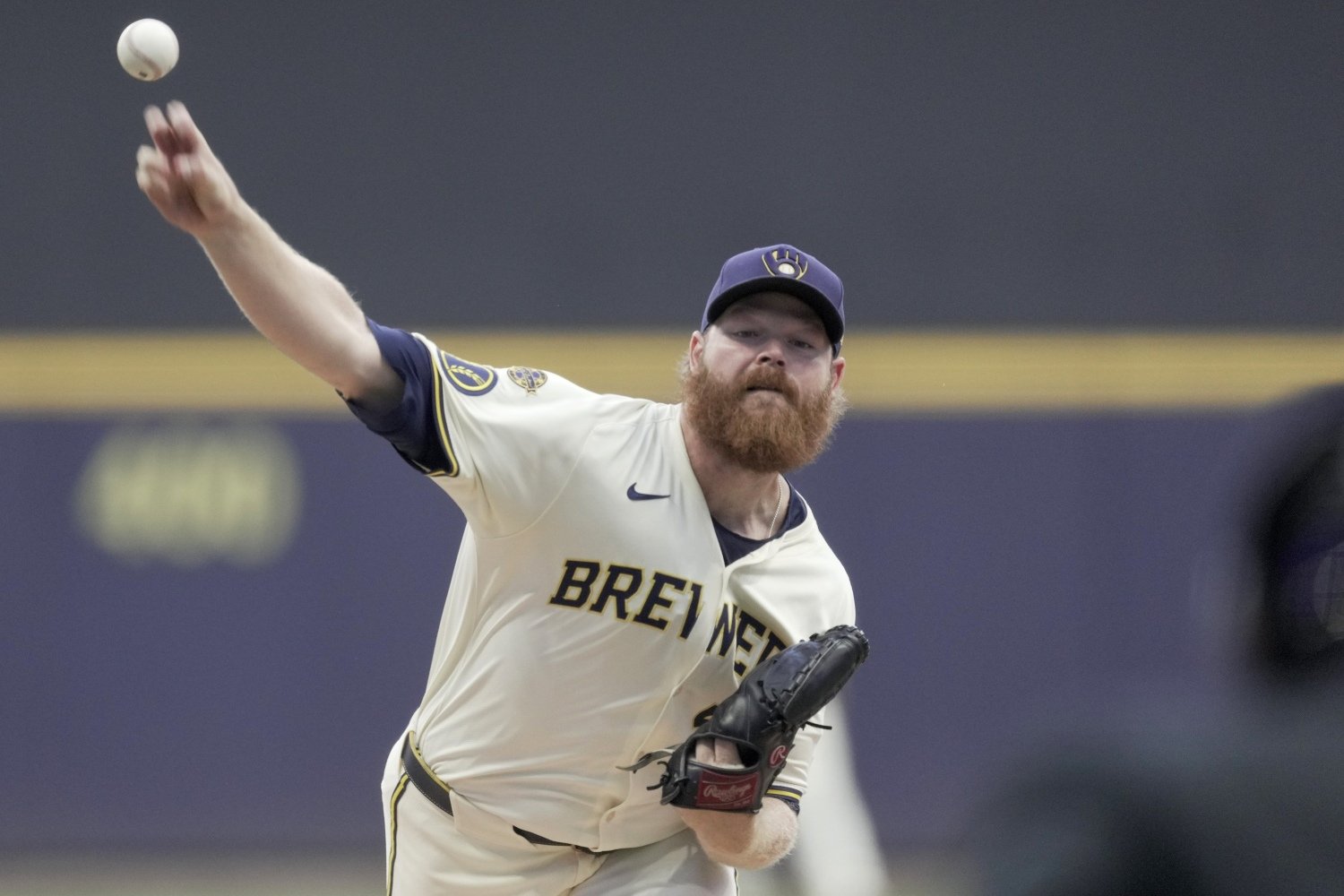
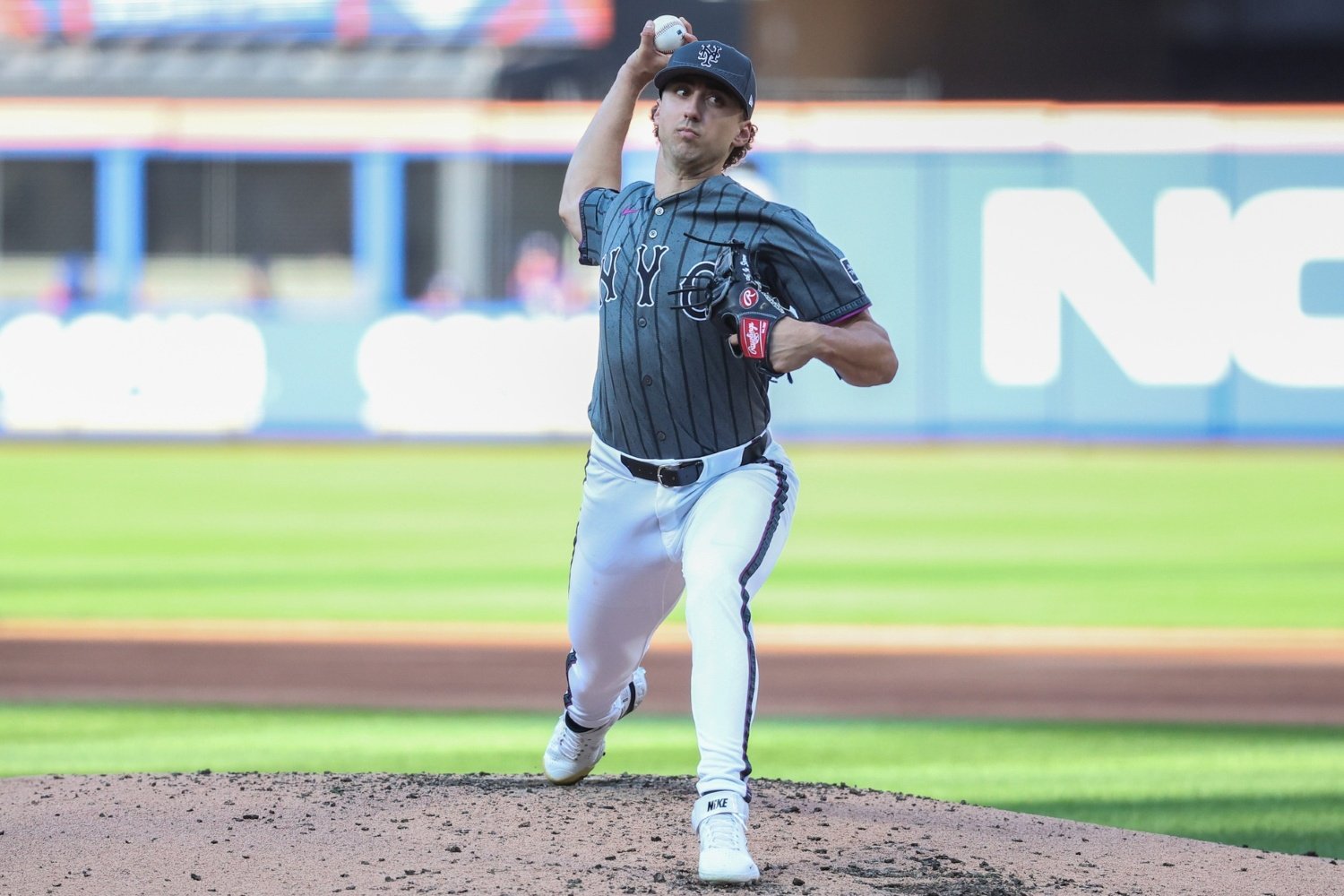 Brandon Sproat has been a big name on prospect lists since his entry into pro ball, using a fastball that can touch triple digits and a diverse mix of secondaries to provide adequate strikeouts and limit hard contact. In some ways, last year didn't go to plan, as he had an unsightly 5.95 ERA in late June. At that point, he had 43 strikeouts and 32 walks in 62 innings pitched on the season. From that date on, however, he began to tweak his arsenal, with tremendous results. He dominated hitters, with 70 strikeouts and just 21 walks in his next 59 innings to post a sparkling 2,44 ERA. How Did Sproat Address His Platoon Problems? Sproat's main problem was how he handled left-handed batters. His sinker and sweeper are somewhat neutralized by opposite-handed hitters, so he had to do some problem-solving. First of all, the shape on his four-seamer changed, targeting less horizontal break and getting greater separation from his sinker on the rare occasions when he used the latter to lefties. This also had the added benefit of allowing him to cramp left-handers up and in, before dialling in the changeup off that pitch. Pitch profiler's dynamic dead zone chart shows the difference in expected movement (based on pitch type and the pitcher's arm slot) and actual movement of a pitch. That fastball doesn't get much ride, but it does get a couple of inches of cutting action that can make all the difference in reducing barrels. Notice, in looking at the plots from earlier, that nearly all of the pitches with significant relative cut came in that second sample, from later in the season. He likes to work in a fairly traditional way, starting the majority of his pitches to lefties on the inner half of the plate. The four-seam fastball can work anywhere in the zone, but his command is a bit loose, leading to more pitches in the heart of the plate than would be ideal. That being said, the added "cut" helps it avoid barrels, while the changeup fades to the outer third and the curveball drops sharply to induce chases. The changeup and four-seam are inextricably linked, each protecting the other. He only uses his primary fastball 35% of the time to left-handed hitters, meaning they can't sit on that offering. His arsenal's diversity is a key factor in his success, and his raw stuff is enough to transform him from a mere "kitchen sink" pitcher to a potential mid-rotation arm. All of his pitches can be effective inside the strike zone, with unusually high in-zone rates for both his changeup and curveball compared to MLB averages. Being able to throw at least three pitches for strikes (and having a firm heater to lead that bundle) should allow Sproat to get out lefties even at the big-league level. What About Against Right-Handers? Intriguingly, Sproat diversified his arsenal more against right-handers as well, going from a sinker-heavy approach to a more balanced mix, incorporating his four-seam fastball more and overall presenting a more comprehensive pitch mix. Interestingly, although his curveball has a quite different release point (as Matt Trueblood observed here), he found some success using it more often against right-handers. One of the reasons most pitchers do better against same-handed hitters is that it's tougher for those hitters to pick up their release point; perhaps Sproat realized that he could exploit that advantage better. Looking at the above split, a few things jump out. First of all, there's less cluster between his four-seamer and sinker, with the additional cutting shape I referenced earlier giving the heater separation from the sinker. Combine that with the tick upward in velocity, and you can see how, despite using the four-seam fastball more often in the second half and more regularly inside the strike zone, he maintained the effective results it showed in the first half regarding whiff rate and contact quality. On its own, the four-seam fastball has a subpar shape with high velocity, but with his sinker keeping the batter honest, the four-seamer manages to add a wrinkle that enhances his profile. For comparison, we can look at someone like Logan Webb, who also has a subpar four-seamer. He uses the four-seamer less than Sproat, but when played off one of the best sinkers in baseball (and please ignore the sinker grade, this offering has proven tough to measure for most Stuff+ models as there's no one shape that makes it effective), it's got a 55.6% whiff rate in that small sample. He used it even more to left-handers, also to good success. The main takeaways here are: It's a distinct shape, compared to Webb's sinker; and Webb gets almost 3" less rise than Sproat, and his four-seam is overall slower and less impressive in isolation. Sproat still has an arsenal where he throws fastballs less than 50% of the time, and it's interesting to see him lean away from the traditional Stuff+ darlings (his sweeper and slider) in the second half for more variety, integrating the curveball just enough to keep hitters honest. A more diffuse pitch mix paid dividends. The Big-League Picture Upon reaching the big leagues, Sproat actually eliminated a lot of the arsenal changes he made in the minors, leaning heavily into his sinker and sweeper to both left- and right-handed hitters. Although he managed the quality of contact well (his sinker really is something), he struggled to miss bats with any regularity; that could present a problem over a larger sample size. It will be fascinating to see how the Brewers approach Sproat—whether they isolate his best offerings like the Mets did, and in a similar vein to how they started with Quinn Priester, or lean into his variety more and try to access more of the upside in his arsenal. It will be something intriguing to follow as spring training begins in just a couple of weeks.
 -
Image courtesy of © Wendell Cruz-Imagn Images Brandon Sproat has been a big name on prospect lists since his entry into pro ball, using a fastball that can touch triple digits and a diverse mix of secondaries to provide adequate strikeouts and limit hard contact. In some ways, last year didn't go to plan, as he had an unsightly 5.95 ERA in late June. At that point, he had 43 strikeouts and 32 walks in 62 innings pitched on the season. From that date on, however, he began to tweak his arsenal, with tremendous results. He dominated hitters, with 70 strikeouts and just 21 walks in his next 59 innings to post a sparkling 2,44 ERA. How Did Sproat Address His Platoon Problems? Sproat's main problem was how he handled left-handed batters. His sinker and sweeper are somewhat neutralized by opposite-handed hitters, so he had to do some problem-solving. First of all, the shape on his four-seamer changed, targeting less horizontal break and getting greater separation from his sinker on the rare occasions when he used the latter to lefties. This also had the added benefit of allowing him to cramp left-handers up and in, before dialling in the changeup off that pitch. Pitch profiler's dynamic dead zone chart shows the difference in expected movement (based on pitch type and the pitcher's arm slot) and actual movement of a pitch. That fastball doesn't get much ride, but it does get a couple of inches of cutting action that can make all the difference in reducing barrels. Notice, in looking at the plots from earlier, that nearly all of the pitches with significant relative cut came in that second sample, from later in the season. He likes to work in a fairly traditional way, starting the majority of his pitches to lefties on the inner half of the plate. The four-seam fastball can work anywhere in the zone, but his command is a bit loose, leading to more pitches in the heart of the plate than would be ideal. That being said, the added "cut" helps it avoid barrels, while the changeup fades to the outer third and the curveball drops sharply to induce chases. The changeup and four-seam are inextricably linked, each protecting the other. He only uses his primary fastball 35% of the time to left-handed hitters, meaning they can't sit on that offering. His arsenal's diversity is a key factor in his success, and his raw stuff is enough to transform him from a mere "kitchen sink" pitcher to a potential mid-rotation arm. All of his pitches can be effective inside the strike zone, with unusually high in-zone rates for both his changeup and curveball compared to MLB averages. Being able to throw at least three pitches for strikes (and having a firm heater to lead that bundle) should allow Sproat to get out lefties even at the big-league level. What About Against Right-Handers? Intriguingly, Sproat diversified his arsenal more against right-handers as well, going from a sinker-heavy approach to a more balanced mix, incorporating his four-seam fastball more and overall presenting a more comprehensive pitch mix. Interestingly, although his curveball has a quite different release point (as Matt Trueblood observed here), he found some success using it more often against right-handers. One of the reasons most pitchers do better against same-handed hitters is that it's tougher for those hitters to pick up their release point; perhaps Sproat realized that he could exploit that advantage better. Looking at the above split, a few things jump out. First of all, there's less cluster between his four-seamer and sinker, with the additional cutting shape I referenced earlier giving the heater separation from the sinker. Combine that with the tick upward in velocity, and you can see how, despite using the four-seam fastball more often in the second half and more regularly inside the strike zone, he maintained the effective results it showed in the first half regarding whiff rate and contact quality. On its own, the four-seam fastball has a subpar shape with high velocity, but with his sinker keeping the batter honest, the four-seamer manages to add a wrinkle that enhances his profile. For comparison, we can look at someone like Logan Webb, who also has a subpar four-seamer. He uses the four-seamer less than Sproat, but when played off one of the best sinkers in baseball (and please ignore the sinker grade, this offering has proven tough to measure for most Stuff+ models as there's no one shape that makes it effective), it's got a 55.6% whiff rate in that small sample. He used it even more to left-handers, also to good success. The main takeaways here are: It's a distinct shape, compared to Webb's sinker; and Webb gets almost 3" less rise than Sproat, and his four-seam is overall slower and less impressive in isolation. Sproat still has an arsenal where he throws fastballs less than 50% of the time, and it's interesting to see him lean away from the traditional Stuff+ darlings (his sweeper and slider) in the second half for more variety, integrating the curveball just enough to keep hitters honest. A more diffuse pitch mix paid dividends. The Big-League Picture Upon reaching the big leagues, Sproat actually eliminated a lot of the arsenal changes he made in the minors, leaning heavily into his sinker and sweeper to both left- and right-handed hitters. Although he managed the quality of contact well (his sinker really is something), he struggled to miss bats with any regularity; that could present a problem over a larger sample size. It will be fascinating to see how the Brewers approach Sproat—whether they isolate his best offerings like the Mets did, and in a similar vein to how they started with Quinn Priester, or lean into his variety more and try to access more of the upside in his arsenal. It will be something intriguing to follow as spring training begins in just a couple of weeks. View full article
-
Michael, you are a god of Brewers lore 🙇♂️
-
I absolutely could if people would like that, but prior history along with our editor in chiefs inside track suggests the Brewers will want a replacement for him as part of the return. Picking the second or third pieces in a trade is that much more volatile given each headliner would be valued differently and thus the return package behind that headliner would differ, but if its something the forum wants I can absolutely do that. I agree on San Diego unless the Brewers really like their upside arms in the lower minors behind a Vasquez type. In a similar vein, I do wonder about Cam Caminiti as part of any package from the Braves, he's a very very interesting arm if further from the Majors. Regarding the Mets, I'm not sold on Tong yet, there's upside but also reason to be wary at the highest level for now. I think the pitcher would headline, especially as the Brewers do like Durbin at third with a lefty complement for certain arm angles, but its a possibility for sure
- 16 replies
-
- 1
-
-
- emmett sheehan
- freddy peralta
- (and 4 more)
-
Image courtesy of © Benny Sieu-Imagn Images As we reported at Brewer Fanatic earlier this month, the Brewers are focused on landing controllable starting pitching in return for Freddy Peralta. The impending free agent has attracted a vast number of suitors, due to his paltry $8-million salary in 2026 and off the back of his third straight 200-strikeout season. Last year, he recorded a 2.70 ERA and 5.5 bWAR. Peralta's consistency—his on-field performance and his off-field leadership—mean that the price will be high, but who are the names being thrown around by his most commonly linked suitors? Brandon Sproat - RHP, New York Mets, #87 Just Baseball Prospect Perhaps the most commonly linked name from the Mets system, Sproat was a helium prospect entering 2025. He endured some struggles before finding his groove at the end of the year in Triple A, but eventually got a cup of coffee in the majors. Sproat had a 4.79 ERA in just over 20 innings for the parent club, but that came with a FIP of just 2.80, showing solid potential to miss barrels. Coming out of a low three-quarters slot, Sproat's high-velocity four-seam fastball ran into problems with poor shape, and he's since morphed into a sinker-dominant, ground-ball pitcher. His best offering is his 85-mph slider, using seam-shifted wake. His low arm angle compensates for some struggles with spinning the baseball, and his results ticked up in the second half of the season. His main issue is the lack of fastball whiffs, but a solid array of pitches behind the sinker—all of which performed well in Triple A—forms a deceptive mix, blending the slider, sweeper, changeup and a curveball to create an arsenal that's tough to pick up and tough to square up. He might not rack up strikeouts at a high level, and as a ground ball-oriented pitcher, his ceiling would therefore be lower than Peralta's. However, he's controllable through at least 2031, and the Brewers can make the most of that profile with their infield defense. Jonah Tong - RHP, New York Mets, #37 Just Baseball Prospect Jonah Tong is another high-profile arm in the Mets system, with a uniquely intense delivery and arsenal. Tong would, by consensus, be preferred across most outlets to Sproat, with a higher ceiling and better command of his arsenal despite larger struggles once he reached the Mets rotation. Tong had a 7.71 ERA in 18 2/3 innings, but he did show a far better whiff rate, and his unique profile is certainly fascinating to a Brewers rotation without a lot of quality off-speed pitches to boast. Tong's arsenal grades out exceptionally well from a deception and stuff perspective. His release point is almost identical for each of his pitches, as you can see from the icon in the top left, while his whiff rates in a short sample at Triple A were impressive on both the fastball and changeup. His delivery, meanwhile, evokes Tim Lincecum. NXkyMTBfWGw0TUFRPT1fQkFSVlhWVUFWQW9BQVZFQkJRQUhCMUFEQUZsWFZRY0FWQVlEQUFVRkNWWldCZ29I.mp4 Tong only throws one fastball, but it is of a far higher quality than Sproat's, and his changeup increases its effectiveness even further as the two pitches blend well before separating late. As with Brewers prospect Logan Henderson, Tong's slider and curveball could use some refining, but if he can develop a true third pitch—especially a genuine out pitch to right-handers, to whom the slider proved ineffective in the early returns—the sky is the limit for Tong. Over-the-top deliveries can make it difficult to generate lateral movement, and the Brewers might be wary of Tong's effectiveness against same-handed hitters, unless Chris Hook sees something with which he can work. If the Brewers landed Tong instead of Sproat, any supplemental pieces would likely be lower-level. Peyton Tolle - LHP, Boston Red Sox, #33 Just Baseball Prospect Perhaps the best prospect on this list, Tolle ticks a lot of boxes for the Milwaukee Brewers. He averages just under 96 mph from the left side, combining a low arm slot with above-average induced vertical break and almost 7.5 feet of extension, meaning his fastball plays extremely well. Tolle also possesses a 90-mph cutter that he uses to keep hitters off his fastball, and almost 70% of his pitches are one of those two offerings. When he wants to switch things up, Tolle has a slider, a curveball and a changeup, all of which look solid from a Stuff+ standpoint—although the release points aren't identical. Tolle has almost 10° of arm angle difference between his cutter/changeup combo and the fastball/curveball combination, and that might have implications down the line Another exceptional part of Tolle's game is his command. He walked just 3.4% of hitters in his short time in Triple A, despite the tighter strike zone from the ABS challenge system. He has plus stuff and plus command. If he can link the arsenal together a little further, Tolle could be a star. As such, the Red Sox will be in no hurry to trade him away. JR Ritchie - RHP, Atlanta Braves, Just Baseball #94 Prospect Ritchie is probably the least exciting of the names listed here. His fastballs don't grade out particularly strongly, especially when the full arsenal is categorized correctly. (As with many pitchers with large arsenals, Statcast can struggle to decipher which pitch is which.) Throwing a four-seamer, sinker and cutter, Ritchie is an effective kitchen-sink operator on the mound. In his slider and curveball, he boasts two solid breaking pitches to which to turn to prevent hitters from sitting on his heater. He has a low arm slot, with consistent release points that really allow it to play up. The four-seamer, especially, can get whiffs at the top of the zone, but it can also find the barrel if he misses his spots. Ritchie pitched 140 innings in 2025, with a combined 2.64 ERA, including a 3.02 ERA at Triple A. However, his peripherals don't stack up quite so nicely, with a 4.15 FIP at the highest level of the minor leagues and a double-digit walk rate creeping in at both Double A and Triple A. This certainly creates some concern for the profile without the gaudy strikeout numbers to offset those walks, and a 14-percentage point difference between his strikeout and walk rates is nothing to shout about. Ritchie may have tired as the season went on, having thrown just 49 innings in 2024 and really stretching himself in 2025. He's a high-floor arm more likely to fit the back end than the front end of a rotation, but he does have good feel to spin the ball and has developed a strong arsenal of pitches moving in a variety of different directions. The further he got from Tommy John surgery, the better his stuff got. Emmet Sheehan - RHP, Los Angeles Dodgers - Not prospect eligible I'm sure many would throw up at the thought of the Dodgers becoming even more of a behemoth in 2026, but it's futile to ignore the suitability of their controllable MLB arms. River Ryan has a high-velocity fastball (with poor shape) but failed to get much swing-and-miss at the major-league level, albeit with excellent secondaries. Gavin Stone used the kitchen-sink approach to limit barrels well in 2024, before injury struck. However, if the Brewers really wanted to push the Dodgers, they could demand a one-for-one trade of Emmett Sheehan for Peralta. Sheehan had an electric 2025, but in a fully healthy rotation, it's difficult to see him finding an everyday position among the Dodgers' big-money signings. From a low three-quarters slot, Sheehan has phenomenal riding life on his fastball, with high induced vertical break for his release point and one of the flattest vertical approach angles in baseball. Averaging almost 96 mph, it may be one of the most underrated pitches in the game, while his tight gyro slider, two-plane curveball and changeup are all plus pitches. The Brewers are loath to do one-for-one deals, and prefer to spread their risk more in any return. If the opportunity of a challenge trade opened up in this case, however, they would have to seriously consider what they could manage with five more years of control of a potentially elite arm. So, Which Pitcher Should Get You Most Excited? Of the listed top-100 prospects and major league-ready arms the Brewers might be able to chase down, Tolle would be the most exciting. His command of the strike zone and above-average stuff are exciting and there is further development to dream on. Would any of these pitchers pique your interest in a Peralta deal? Which would you trade for, if all were on the table? Let us know your thoughts in the comment section below! View full article
- 16 replies
-
- 1
-
-
- emmett sheehan
- freddy peralta
- (and 4 more)
-
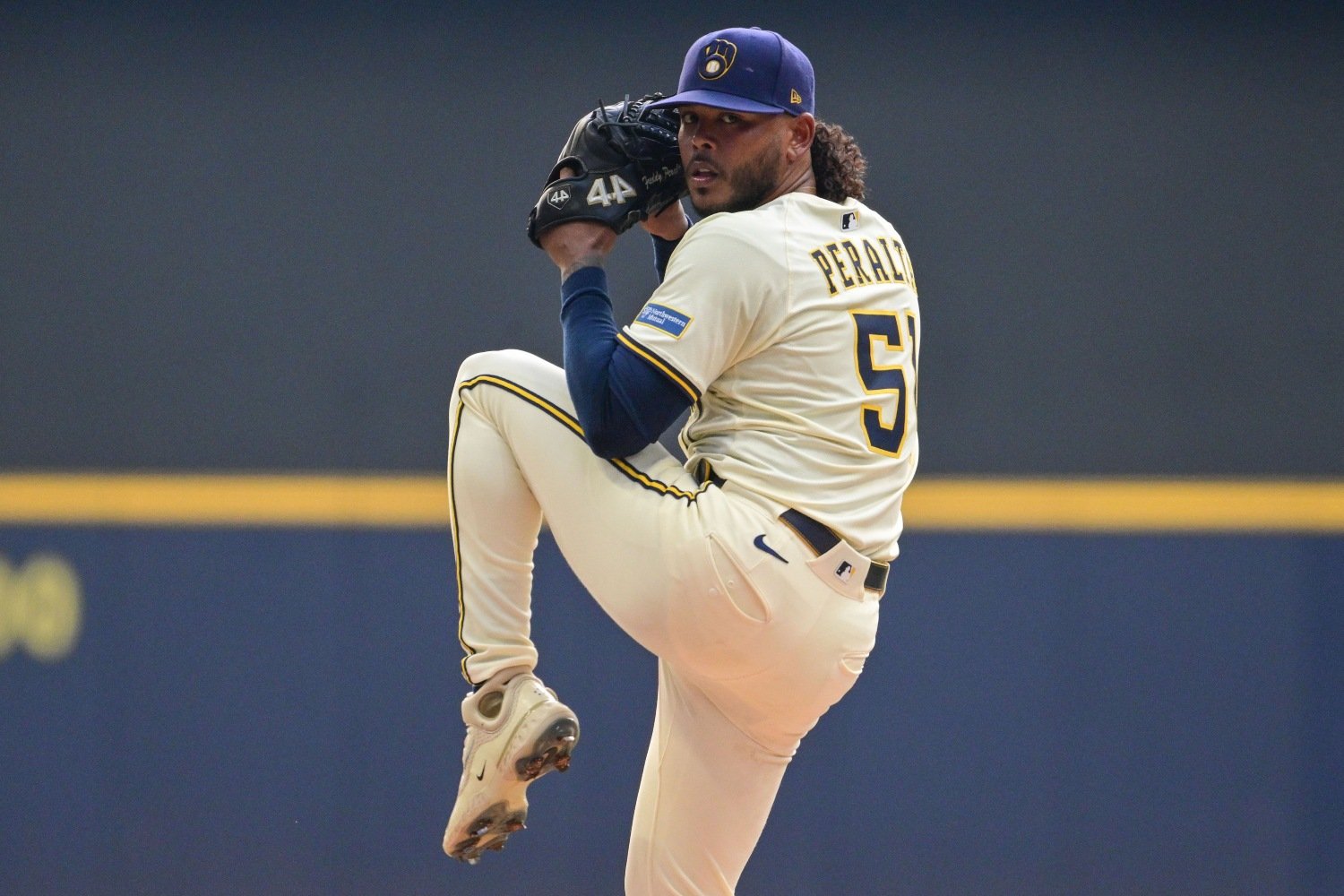 As we reported at Brewer Fanatic earlier this month, the Brewers are focused on landing controllable starting pitching in return for Freddy Peralta. The impending free agent has attracted a vast number of suitors, due to his paltry $8-million salary in 2026 and off the back of his third straight 200-strikeout season. Last year, he recorded a 2.70 ERA and 5.5 bWAR. Peralta's consistency—his on-field performance and his off-field leadership—mean that the price will be high, but who are the names being thrown around by his most commonly linked suitors? Brandon Sproat - RHP, New York Mets, #87 Just Baseball Prospect Perhaps the most commonly linked name from the Mets system, Sproat was a helium prospect entering 2025. He endured some struggles before finding his groove at the end of the year in Triple A, but eventually got a cup of coffee in the majors. Sproat had a 4.79 ERA in just over 20 innings for the parent club, but that came with a FIP of just 2.80, showing solid potential to miss barrels. Coming out of a low three-quarters slot, Sproat's high-velocity four-seam fastball ran into problems with poor shape, and he's since morphed into a sinker-dominant, ground-ball pitcher. His best offering is his 85-mph slider, using seam-shifted wake. His low arm angle compensates for some struggles with spinning the baseball, and his results ticked up in the second half of the season. His main issue is the lack of fastball whiffs, but a solid array of pitches behind the sinker—all of which performed well in Triple A—forms a deceptive mix, blending the slider, sweeper, changeup and a curveball to create an arsenal that's tough to pick up and tough to square up. He might not rack up strikeouts at a high level, and as a ground ball-oriented pitcher, his ceiling would therefore be lower than Peralta's. However, he's controllable through at least 2031, and the Brewers can make the most of that profile with their infield defense. Jonah Tong - RHP, New York Mets, #37 Just Baseball Prospect Jonah Tong is another high-profile arm in the Mets system, with a uniquely intense delivery and arsenal. Tong would, by consensus, be preferred across most outlets to Sproat, with a higher ceiling and better command of his arsenal despite larger struggles once he reached the Mets rotation. Tong had a 7.71 ERA in 18 2/3 innings, but he did show a far better whiff rate, and his unique profile is certainly fascinating to a Brewers rotation without a lot of quality off-speed pitches to boast. Tong's arsenal grades out exceptionally well from a deception and stuff perspective. His release point is almost identical for each of his pitches, as you can see from the icon in the top left, while his whiff rates in a short sample at Triple A were impressive on both the fastball and changeup. His delivery, meanwhile, evokes Tim Lincecum. NXkyMTBfWGw0TUFRPT1fQkFSVlhWVUFWQW9BQVZFQkJRQUhCMUFEQUZsWFZRY0FWQVlEQUFVRkNWWldCZ29I.mp4 Tong only throws one fastball, but it is of a far higher quality than Sproat's, and his changeup increases its effectiveness even further as the two pitches blend well before separating late. As with Brewers prospect Logan Henderson, Tong's slider and curveball could use some refining, but if he can develop a true third pitch—especially a genuine out pitch to right-handers, to whom the slider proved ineffective in the early returns—the sky is the limit for Tong. Over-the-top deliveries can make it difficult to generate lateral movement, and the Brewers might be wary of Tong's effectiveness against same-handed hitters, unless Chris Hook sees something with which he can work. If the Brewers landed Tong instead of Sproat, any supplemental pieces would likely be lower-level. Peyton Tolle - LHP, Boston Red Sox, #33 Just Baseball Prospect Perhaps the best prospect on this list, Tolle ticks a lot of boxes for the Milwaukee Brewers. He averages just under 96 mph from the left side, combining a low arm slot with above-average induced vertical break and almost 7.5 feet of extension, meaning his fastball plays extremely well. Tolle also possesses a 90-mph cutter that he uses to keep hitters off his fastball, and almost 70% of his pitches are one of those two offerings. When he wants to switch things up, Tolle has a slider, a curveball and a changeup, all of which look solid from a Stuff+ standpoint—although the release points aren't identical. Tolle has almost 10° of arm angle difference between his cutter/changeup combo and the fastball/curveball combination, and that might have implications down the line Another exceptional part of Tolle's game is his command. He walked just 3.4% of hitters in his short time in Triple A, despite the tighter strike zone from the ABS challenge system. He has plus stuff and plus command. If he can link the arsenal together a little further, Tolle could be a star. As such, the Red Sox will be in no hurry to trade him away. JR Ritchie - RHP, Atlanta Braves, Just Baseball #94 Prospect Ritchie is probably the least exciting of the names listed here. His fastballs don't grade out particularly strongly, especially when the full arsenal is categorized correctly. (As with many pitchers with large arsenals, Statcast can struggle to decipher which pitch is which.) Throwing a four-seamer, sinker and cutter, Ritchie is an effective kitchen-sink operator on the mound. In his slider and curveball, he boasts two solid breaking pitches to which to turn to prevent hitters from sitting on his heater. He has a low arm slot, with consistent release points that really allow it to play up. The four-seamer, especially, can get whiffs at the top of the zone, but it can also find the barrel if he misses his spots. Ritchie pitched 140 innings in 2025, with a combined 2.64 ERA, including a 3.02 ERA at Triple A. However, his peripherals don't stack up quite so nicely, with a 4.15 FIP at the highest level of the minor leagues and a double-digit walk rate creeping in at both Double A and Triple A. This certainly creates some concern for the profile without the gaudy strikeout numbers to offset those walks, and a 14-percentage point difference between his strikeout and walk rates is nothing to shout about. Ritchie may have tired as the season went on, having thrown just 49 innings in 2024 and really stretching himself in 2025. He's a high-floor arm more likely to fit the back end than the front end of a rotation, but he does have good feel to spin the ball and has developed a strong arsenal of pitches moving in a variety of different directions. The further he got from Tommy John surgery, the better his stuff got. Emmet Sheehan - RHP, Los Angeles Dodgers - Not prospect eligible I'm sure many would throw up at the thought of the Dodgers becoming even more of a behemoth in 2026, but it's futile to ignore the suitability of their controllable MLB arms. River Ryan has a high-velocity fastball (with poor shape) but failed to get much swing-and-miss at the major-league level, albeit with excellent secondaries. Gavin Stone used the kitchen-sink approach to limit barrels well in 2024, before injury struck. However, if the Brewers really wanted to push the Dodgers, they could demand a one-for-one trade of Emmett Sheehan for Peralta. Sheehan had an electric 2025, but in a fully healthy rotation, it's difficult to see him finding an everyday position among the Dodgers' big-money signings. From a low three-quarters slot, Sheehan has phenomenal riding life on his fastball, with high induced vertical break for his release point and one of the flattest vertical approach angles in baseball. Averaging almost 96 mph, it may be one of the most underrated pitches in the game, while his tight gyro slider, two-plane curveball and changeup are all plus pitches. The Brewers are loath to do one-for-one deals, and prefer to spread their risk more in any return. If the opportunity of a challenge trade opened up in this case, however, they would have to seriously consider what they could manage with five more years of control of a potentially elite arm. So, Which Pitcher Should Get You Most Excited? Of the listed top-100 prospects and major league-ready arms the Brewers might be able to chase down, Tolle would be the most exciting. His command of the strike zone and above-average stuff are exciting and there is further development to dream on. Would any of these pitchers pique your interest in a Peralta deal? Which would you trade for, if all were on the table? Let us know your thoughts in the comment section below!
- 16 comments
-
- 3
-
-
- emmett sheehan
- freddy peralta
- (and 4 more)
-
 The wide variety of statistical nuance around baseball today, with different websites measuring performance amongst various categories in different ways, can confuse anyone, and it's challenging to know which stats are most relevant. Batting averages, on-base percentage, and slugging percentage only tell so much, and with that in mind, we've devised a list of those stats that are most relevant to assessing how well a player is performing. Today, baseball fans are bombarded with an ever-increasing landscape of statistical numbers from FanGraphs, Baseball-Reference, Baseball Prospectus, Trumedia, and Baseball Savant that can make it difficult to understand a player's contribution on the field entirely. With various ways of calculating a player's value, even between sites, we could simplify this process so you can decide which metrics most apply to how you view baseball. Here is a glossary of all the baseball terminology you need to know for your baseball journey, the knowledge you may want to know, and the background pieces that are simply cool to understand, from a breakdown of the different ways websites calculate Wins Above Replacement (WAR) to, the hitting stats to pay attention to and how much defensive value a player can have. Table of Contents (click to jump to section) What are WAR (Wins Above Replacement) and WARP (Wins Above Replacement Player)? How Baseball-Reference WAR And FanGraphs WAR Are Calculated Why does WARP differ so much from FanGraphs and Baseball-Reference? Which site (FanGraphs, Baseball-Reference, or Baseball Prospectus) is Superior with WAR? Offensive Statistics Pitching Statistics Fielding Statistics Catcher Statistics What are WAR (Wins Above Replacement) and WARP (Wins Above Replacement Player)? WAR is critiqued and analyzed more than any other stat in baseball, if only because different organizations in the form of Baseball Prospectus, FanGraphs, and Baseball-Reference create versions that interpret it differently. It's one of the most complex statistics provided by the sabermetric era, but it needs to be, as it attempts to bring every player's contribution down to one single number. Wins above replacement is a statistic that explains how much better a player is than your average replacement-level player, not the average performance level in the major leagues, which is important to note as we go forward. So, for example, last season, per Baseball-Reference's algorithm, Aaron Judge was worth 10 wins more than if the Yankees had brought up a standard player from their minor league affiliate in Triple-A to take his place. To put this in perspective, a team of entirely replacement-level players would be expected to win around 41-50 games in a 162-game season. WAR captures various elements, such as a player's position on the field, their fielding, hitting, and pitching performance, their speed on the basepaths, and everything else they can or can’t do on the field, to come up with one metric that describes their entire performance. One of the best things about this statistic is how you can accumulate WAR in various ways, from being a defensive stud in a key position to dominating from the pitching mound or hitting monstrous home runs day after day. Wins Above Replacement is not an entirely accurate statistic in the form of saying that a player with 4.5 WAR is definitely better than a player with 4.2 WAR. Still, by providing ranges, we can better group players to discuss their value. That said, a 6.5 WAR player compared with a 4.2 WAR player gives you confidence that the former had the better season and was more valuable, WAR becomes an incredibly useful metric. Ranges of Value in WAR 0-1 WAR - Usually, the contribution of a bench player or relief pitcher 2-3 WAR - An average full-time position player or starting pitcher at the major league level 4-6 WAR - An All-Star caliber player 7+ WAR - An MVP candidate As mentioned earlier, each website comes to a final value slightly differently. If we take Boby Witt Jr as an example, he was awarded: 7.1 WAR from Baseball-Reference 8.0 WAR from FanGraphs 4.8 WARP from Baseball Prospectus Each baseball standard puts different values based on different hitting, pitching, and fielding statistics that cause these differences, some of which you may agree with more than others. So, let’s get into it: How Baseball-Reference WAR And FanGraphs WAR Are Calculated Baseball-Reference uses pitching runs allowed (all runs, not just the “earned” ones). In contrast, FanGraphs uses a stat called Fielder Independent Pitching (FIP), which is calculated based on a pitcher's walks, home runs, and strikeouts, eliminating fielder involvement. As a result, Baseball-Reference tends to value pitching more than FanGraphs, especially those who don't lean solely on strikeouts and walks and instead use weak contact and their defense to get hitters out. The hitting and base running metrics are generally very similar, so there isn't much difference in the result. Both use a derivative of WOBA called “weighted runs above average.” Baseball-Reference uses Defensive Runs Saved (DRS) for defensive WAR, whereas FanGraphs uses Fielding Run Value (FRV). FRV is considered slightly superior because it's based more on long-term averages. In contrast, DRS uses a more aggressive scoring system that doesn't account for shifts and instead assumes where defenders should be situated. This means a shifted second baseman will be penalized if a ball goes through the second base gap. In summary, there isn't a whole lot of difference between how both sites calculate their respective wins above replacement. However, a slight majority would prefer Baseball-Reference, especially in regard to pitching numbers, where “runs allowed” seems a better base to start with than Fielder Independent Pitching (FIP) and encompasses more qualities involved in pitching, although it does then favor pitchers on better defensive teams. Why does WARP differ so much from FanGraphs and Baseball-Reference? Baseball Prospectus differs more from the two more common metrics as they attempt to refine some of the base stats. Instead of using “runs allowed” for pitching like Baseball-Reference, they use “Deserved Run Average” (DRA), which focuses on a pitcher's expected contribution more than their actual results. This takes the ballpark, defense, and quality of the opponent out of the equation. Defensively, they are based around Fielding Runs Above Average (FRAA), which uses less zone-based coverage analytics and instead focuses on plays made compared to the league average. This includes information on the base situation, batter handedness, ground ball tendencies of the hitter, etc., essentially stepping back and saying, “Did the fielder make the play?” as the crux of their calculations. BP uses Deserved Runs Created (DRC+), which grades hitters based on their expected contribution in each given situation. It attempts to delve beneath surface stats and see how much credit should be given to the hitter for each play depending on context (such as park factors and opposition). Baseball Prospectus WARP also attempts to clarify what outcomes are affected by an individual in isolation compared to other players; for example, Shohei Ohtani would gain less differential for hitting a home run against Lance Lynn in a blowout than if he hit a walk-off home run against Gerrit Cole. Which site (FanGraphs, Baseball-Reference, or Baseball Prospectus) is Superior with WAR? Ultimately, this comes down to personal preference as to how you view the stats that make up WAR for each individual site. It could be that you like how Baseball Prospectus considers situational baseball more, how Baseball-Reference ranks pitchers, or how FanGraphs assesses fielders. Ultimately, an amalgamation of all three and their rankings will give you a good idea of how valuable a player is over an entire season. Most people look towards Baseball-Reference and FanGraphs first, but that could result from being earlier into the WAR sweepstakes than Prospectus. Remember that a debate over how you see players is fun because it’s a debate, and everyone can have their own opinions. These WAR calculations are not infallible, and they show how differently even computers can see things on the field. Offensive Statistics Table of Contents (click to jump to individual statistic) Batting Average Slugging Percentage On-Base Percentage On-Base Plus Slugging (OPS) Stolen Bases Hard Hite Rate & Average Exit Velocity Sweet Spot Rate Barrel Percentage Weighted On-Base Average (wOBA) Whiff Rate Chase Rate Barrel Percentage Weighted On-Base Average (wOBA) Expected Statistics (xBA, xSLG, xWOBA, etc) Strikeout Percentage Walk Percentage Ground Ball Rate OPS+ & wRC+ Other Stats Scoring runs can be done in various ways on a Baseball field, using various skills of athleticism, intelligence, and technical excellence. While the hitting portion is the most vital of the mix, base running instincts and intelligence can factor into close games, as can game awareness of what your team needs in each specific at-bat. As such, we can calculate a player's offensive contribution in many ways. The Basic Baseball Stats What Is Batting Average (BA)? An old-school metric, batting average, assesses how often a hitter is projected to get on base per at-bat (to the thousandth digit). A .326 batting average estimates that a hitter will hit his way on base 326 times over a 1000-at-bat sample size. It used to be that anyone who hit .300 was considered an above-average hitter in MLB. However, that number has become more the possession of the elite in recent seasons. In the 2000s, baseball averaged 39.7 hitters above the .300 mark per year; in the 2010s, this dropped to 22.1, and in 2025, the mark was just… seven. Hitters averaged just .245 as a whole on the season, with the decrease arising largely as a result of drastic improvements in the quality of pitchers with their ever-increasing velocity and movement, which in turn led to organizations searching for the powerful, extra-base hitting approach at the plate to take advantage of pitcher mistakes. Ranges Elite - .300+ Excellent - .280 to .299 Above average - .255 to .279 Average - .235 to .254 Below average - .210 to .234 Poor - Below .210 Batting average still has its merits in assessing a hitter's value. Still, luck can influence it in terms of where the ball gets hit and doesn't necessarily drive in or create the same runs if a hitter doesn't have the power to hit extra bases regularly. That being said, Jacob Wilson had a throwback performance compared to previous eras, lending hope that hitting for average alone will still be a point of variety for MLB players moving forward. By recording a high average of .311, his OPS (I’ll explain this briefly) was .799, giving him 3.0 Wins Above Replacement (or WAR, also getting to this shortly) on the season. In short, batting average still adds value to a team, if not being the all-encompassing statistic it used to be perceived as. 2025 MLB League Leaders .331 Aaron Judge .311 Bo Bichette .311 Jacob Wilson .309 George Springer .304 Jeremy Peña Strongly Linked Background Stats - Sweet Spot Percentage, Hard Hit Rate, Strikeout Rate What is Slugging Percentage (SLG)? Slugging percentage assesses a batter's ability to notch extra-base hits (i.e., doubles, triples, and big booming home runs). The formula is: (total singles+(2*total doubles)+(3*total triples)+(4*total home runs)/total at-bats Slugging percentage is affected by batting average, in that a higher batting average gives you a higher base for your slugging percentage, and has led to some spin-off statistics such as ISO (isolated power, which we’ll come to in a bit) to work out just how regularly a hitter obtains extra bases. Organizations have heavily dialed in on this as a way to drive in runs without needing three or four singles in an inning, which has become extraordinarily difficult to do. When you reach second base, you are usually just one single away from scoring. Home runs are great ways to put up big innings that can decide a game with a single blow, so slugging is a useful tool for assessing a hitter's effectiveness throughout the year. Slugging percentage is also a big part of the OPS measure, which is widely used as a total measure of a hitter's performance. Ranges Elite - .520 + Excellent - .480 to .520 Good - .440 to .479 Average - .390 to .439 Below Average - .360 to .389 Poor - Below .360 The league average slugging percentage in 2025 was .404, yet the truly elite separate themselves from the pack in this statistic. Here are the top qualified sluggers for 2025: 2025 MLB League Leaders Aaron Judge - .688 Shohei Ohtani - .622 Cal Raleigh - .589 Kyle Schwarber - .563 George Springer - .560 Strongly Linked Background Stats - Average Exit Velocity, Barrel Rate, Hard Hit Rate What is On-Base Percentage (OBP)? This is a marker for how often a player gets on base per plate appearance (note that a plate appearance is different from an at-bat), whether that be via a hit, a walk, or a pitch. It does not include errors by the defensive team. However, it shows no difference between hitting a single or being nailed by a fastball to the midriff. The size of the statistical number is mainly created from the players' batting averages. However, some players have incredible plate discipline or poor hitting skills, and they can catch up to their rivals by being patient at the plate. Juan Soto, for example, had a batting average of .263 but an on-base percentage of .396, which was third in the majors. Some players have a knack for leaving pitches that are off the plate and working the “count” in their favor; others have a seeming knack for getting hit by pitches, but either way, it all adds up. Ranges Elite - .390+ Excellent - .360 to .389 Good - .335 to .359 Average - .315 to .334 Below Average - .295 to .314 Poor - Below .295 2025 MLB League Leaders Aaron Judge - .457 George Springer - .399 Juan Soto - .396 Shohei Ohtani - .392 Geraldo Perdomo - .389 Strongly Linked Background Stats: Sweet Spot Rate, Swing and Miss Rate, Walk Rate What is On-Base Plus Slugging (OPS)? As previously alluded to, this stat is used by the vast majority of baseball players to get a basic view of hitting performance. It combines a hitter's on-base percentage with their slugging percentage, two uniquely different skill sets that are key markers for scoring runs. A balance of patience at the plate, a strong hit tool, and a power bat are rare in baseball. However, it's interesting to note that three of the “elite” on-base percentages were in the top five for slugging percentage in 2025. Good hitters are good at everything, and those who can hit the ball out of the park are often pitched around as a result of their "fear factor". Ranges Elite - .900+ Excellent - .810 to .899 Good - .750 to .809 Average - .690 to .749 Below Average - .650 to .689 Poor - Below .650 Anyone with an OPS of over 1.000 is likely to be in the thick of an MVP race, something both of this year's MVPs (Aaron Judge and Shohei Ohtani) achieved. It’s almost become a prerequisite in recent seasons, although some have done it differently. You can use a strong hit tool to boost the floor of both your on-base percentage and your slugging percentage, like George Springer, or you can rip the ball out of the ballpark on a regular basis like Aaron Judge and Shohei Ohtani. 2025 MLB League Leaders Aaron Judge - 1.144 (WOW!) Shohei Ohtani - 1.014 George Springer - .959 Cal Raleigh - .948 Kyle Schwarber - .928 OPS is far and away the most commonplace tool baseball fans use, and it provides as effective a summary as you could hope for. Measuring a hitter's plate discipline (their ability to swing at balls only in the strike zone), their ability to make quality contact with the ball, and their ability to hit for those big extra-base hits regularly, OPS brings together all the key components that make a hitter effective into one statistic. One key thing that requires OPS to be contextualized; it’s not adjusted for ballpark or era, which makes it useful for comparisons within the same year but often isn’t useful when comparing a player from the 1930s to a player in the 1990s, or even to comparing it with numbers from the infamous steroid era. Stolen Bases In short, a stolen base is when a hitter tries to go from one base to the next (i.e., second base from first base) without the hitter doing anything in the batter’s box. Once a pitcher starts his throwing motion, he has to throw to the catcher, who then tries to throw to the base being stolen before the base runner reaches it. The plays are often split-second plays, with mere fractions deciding whether the base runner is safe and reached the base on time. Base stealing was on the wane for some time in the 2000s and 2010s due to analytics suggesting a player needed to be extraordinarily efficient (80%+ success rate) to add value this way. Last season saw a drop-off in stolen bases as teams appeared to be more steadfast in their defense against the threat. Pitchers were quicker to get the ball into a catchers glove and were tougher for baserunners to get good "reads" off, and it created an interesting development where getting good reads was almost as important as having speed to begin with (see Juan Soto and Josh Naylor). Naylor used his baseball instincts to predict when a pitcher was throwing to gain an extra step, and despite an average sprint speed in the 3rd percentile of baseball, he stole 30 bases last season. Ranges 0 to 5 - Kind of slow 6 to 15 - Solid speed, but nothing to write home about 16 to 25 - A Good base stealer 26 to 40 - Almost elite speed; pitchers and catchers will be twitchy with them on base with good instincts 41+ - Elite speed and base-stealing instincts Base stealing is simply fun to watch and adds variety to the spectacle of baseball. Stealing second base and getting into “scoring position” is a fantastic way to create runs for your team, and it’s no surprise that with slightly friendlier rules, some teams are taking full advantage. League Leaders Jose Ramirez - 44 Juan Soto - 38 Oneil Cruz - 38 Bobby Witt Jr - 38 Elly de la Cruz - 37 The Key Background Statistics What are Hard Hit Rate and Average Exit Velocity? Combining these two statistics is a fantastic way to determine which hitters are regularly making quality contact. As the name suggests, average exit velocity calculates the average speed at which a ball leaves a hitter's bat. While it does tell you how regularly a hitter squares up the baseball, it is a good indicator of power. Average Exit Velocity Ranges Elite - 92+ mph Excellent - 90.5 to 92 mph Above average - 89 to 90.5 mph Average - 87.5 to 89 mph Below average - 86.5 to 87.5 mph Poor - Below 86.5 mph The stat on its own doesn't always indicate a player's ability to hit for extra bases, as hitting the ball hard into the ground will likely be stopped by the infield. However, alongside a hitter's ground ball rate, it can be a strong background stat for both slugging percentage and batting average. Hard hit rate calculates how often a player makes contact with a ball in play; they hit the ball harder than 95 mph. This is when hitting a ball harder begins to matter, as in 2018, hitters had a batting average of .524 on hard-hit balls while hitting just .219 on “weakly” hit balls. Hard hit rate has a strong correlation to batting average and slugging percentage, and combined with launch angle stats and average exit velocity, it is a very handy indicator of a player's hitting performance. Hard Hit Percentage Ranges Elite - 52%+ Excellent - 48% to 52% Above average - 45% to 48% Average - 41% to 45% Below Average - 38% to 41% Poor - Below 38% As a hitter, your objective at the plate is to hit the ball hard when you step up to the plate and let the rest take care of itself over the course of a long season. As such, these two stats are key markers that relate to actual on-field performance for hitters and are regularly used to assess both current ability and developmental potential. What is a Player's "Sweet Spot Rate"? This calculation assesses how often a player hits a ball at optimum launch angles (from 8° to 32°). It is used in tandem with hard hit rate to assess whether the hitter is creating quality contact and reaching the outfield with regularity. Sweet spot percentage has a huge correlation with batting average, even without considering how hard the balls are hit. Mike Trout, one of baseballs most feared hitters when healthy, led in this statistic in 2025. Hitters are more likely to get on base the more often they can reach the outfield, and hitting it over the infield is usually a better bet than hitting through them with the defensive ranges in the modern age. It also has links with slugging, particularly when paired with exit velocity metrics. To get extra bases, the ball should fly into gaps in the outfield or clear the fence, which requires lifting the ball in the air. Ranges Elite - 40%+ Excellent - 37.5% to 40% Above average - 36% to 37.5% Average - 34% to 36% Below Average - 32.5% to 34% Poor - Below 32.5% One outlier is the National League runner-up in batting average, Ronald Acuna Jr., whose 33.6% sweet spot rate was good enough for 80th out of 133 hitters in 2023. Acuna made up for this by hitting the ball harder than anyone and putting the ball in play at an absurd rate. What is a Player's “Barrel Percentage”? Another statistical amalgamation, barrel rate, combines sweet spot rate and hard hit percentage to show how often a hitter hits a ball above 95 mph at optimum launch angles. It's a stat geared toward hitting extra bases and closely aligned with slugging ability and projection. As the leading slugger in 2025, it's no surprise to see Aaron Judge top the barrel rate with an astounding 19.6%. Ranges Elite - 16%+ Excellent - 12.5% to 16% Above Average - 10.5% to 12.5% Average - 8% to 10.5% Below Average - 6% to 8% Poor - Below 6% The ability to hit the ball hard and aerially regularly is a difficult skill, but indicative of a quality slugger. Hence, the leaderboard is filled with names like Aaron Judge, Juan Soto, and Kyle Schwarber, all of whom are likely to be perennial 30-home-run hitters. What is Weighted On-Base Average (wOBA)? They are designed to measure a player's overall contribution to run scoring by factoring in the run values of various events (e.g., a double is worth X, a single is worth Y, and a walk is worth Z) and averaging this value over a player's plate appearances. It sounds complicated, but essentially, this metric is supposed to assign a total value for the hitter offensively during the season and is a very solid statistic for doing so, given the data complexity behind it. All that really needs to be known is that wOBA cares not just about how you get on base but also how you get on base when assigning value. Ranges Elite - .400+ Excellent - .360 to .400 Above Average - .345 to .360 Average - .332 to .345 Below Average - .315 to .332 Poor - Below .320 2025 MLB League Leaders Aaron Judge - .463 Shohei Ohtani - .418 George Springer - .408 Cal Raleigh - .392 Kyle Schwarber - .301 The top five hitters in WOBA are arguably the most dangerous in baseball in 2025, making it an accurate representation of hitting ability and a useful tool for assessing a player. What is a “Whiff Rate”? As you can imagine, how often a player swings and misses (or “whiffs") is an excellent indicator of whether they strike out frequently and whether they are likely to have high batting averages and on-base percentages. The best four hitters at making contact are also players closely associated with winning or being future batting title winners. Ranges Elite - Under 15% Excellent - 15% to 18.5% Above Average - 18.5% to 22% Average - 22% to 25% Below Average - 25% to 28% Poor - Above 28% Usually, hitters with high contact rates have relatively short, flat swings that lend themselves to swinging later and with less torque, meaning they don’t hit the ball as hard as often, reducing their slugging potential. The top five in 2023 are unlikely to ever be in contention for a home run crown: 2023 MLB League Leaders Luis Arraez - 5.3% Steven Kwan - 8.7% Jacob Wilson - 9.6% Nico Hoerner - 11.2% Geraldo Perdomo - 12.0% What is a Chase Rate? Chase rates are the number of times a player will swing at a pitch outside the strike zone anyway. Making good contact is far easier inside the strike zone, so enticing a chase is extremely attractive to pitchers. Chasing is often linked with more strikeouts and lower walk rates, making it harder to get on base. In contrast, players with good plate discipline can work the count in their favor, usually getting easier pitches to hit or taking a walk with more regularity if they don’t. Good chase rates have some correlation to good walk rates and better batting averages, but not as close as you may think. However, it’s still helpful in assessing whether a hitter is comfortable at the plate and has knowledge of their strike zone. Ranges Elite - Below 19% Excellent - 19% to 23.5% Above Average - 23.5% to 26.5% Average - 26.5% to 29% Below Average - 29% to 31% Poor - Above 31% 2023 MLB League Leaders Juan Soto - 15.9% Gleyber Torres - 17.1% Trent Grisham - 17.3% Kyle Tucker - 17.6% TJ Friedl - 18.1% What are Expected Statistics (xBA, xSLG, xWOBA, etc)? These use batted-ball data to estimate a hitter's outcome based solely on how hard, how far, and what launch angle they hit the ball. This data is compared with data from previous years to estimate how likely a particular batted ball is to get a hit or what the likely outcome is. The strengths of these statistics are in their simplicity; as I mentioned earlier, a hitter steps up to the plate to hit the ball as hard and as far through the air as possible in most cases, which these expected stats measure perfectly. They do not account for customized fielding positions or the ball's direction. This is vital given the outer edge of the outfield fence can be as short as 330ft, while dead center field is usually 400+ ft. So, to one part of the park, a 340 ft fly ball is a home run; to another part of the field, it's a fly out. This all means that a hitter who goes up the center more often will likely have a higher set of expected stats than his actuals due to hitting into a larger area. Over the course of a season, these expected numbers usually balance out to indicate whether a hitter was lucky or unlucky during the year. These stats are particularly useful in predicting future outbreaks or slumps based on batted ball data and, ultimately, align well with what people see on the field. The ranges used for each expected data point are usually contrasted with the players' actual results and are in line with the actual statistics listed above. At the end of 2025, they predicted that Salvador Perez had a rather unlucky season, with a batting average 33 points lower than estimated figures, meaning he could take off with a little more luck (although his slow foot speed might have an effect here, struggling to get to first base as quickly as, say, Elly de la Cruz would). On the other hand, Jeremy Peña and Trea Turner would be considered fortunate with batting averages 34 points above their expected numbers. What does Strikeout Percentage (K%) tell us? How often a hitter strikes out can be down to extreme swing-and-miss problems, an overly patient approach at the plate, and sometimes a combination of the two. It’s pretty self-explanatory, so to the ranges: Ranges Elite - Below 12% Excellent - 12% to 16% Above Average - 16% to 19% Average - 19% to 22% Below Average - 22% to 24% Poor - Below 24% 2025 MLB League Leaders Luis Arraez - 3.1% Jacob Wilson - 7.5% Nico Hoerner - 7.6% Steven Kwan - 8.7% Caleb Durbin - 9.9% What does Walk Percentage (BB%) tell us? Again, an obvious statistical measurement that plays heavily into on-base percentage, it can be a benefactor of an overly passive approach at the plate, which is why walk and strikeout rates are often put side by side when analyzing a hitter. Walk rates are useful for identifying a player who knows their own strike zone well, but it can also be boosted by a passive approach (players might take a lot of called strikes as well), or a player who is struggling with their quality of contact and fighting to produce in some capacity (such as Marcell Ozuna or occasionally Christian Yelich in the past). Most commonly, its pitchers want to avoid pitching to them unless absolutely necessary due to the danger they present. Ranges Elite - Above 14% Excellent - 11% to 14% Above Average - 9.5% to 11% Average - 8% to 9.5% Below Average - 6.5% to 8% Poor - Below 6.5% 2025 MLB League Leaders Aaron Judge - 18.3% Juan Soto - 17.8% Marcell Ozuna - 15.9% Mike Trout - 15.6% Rafael Devers - 15.4% Why Does Ground Ball Rate Matter? Ground Balls have a lower expected batting average and slugging percentage compared with line drives, partly because hitting into the ground takes speed out of the ball and because you have to get through the infield rather than over it. As such, players with high ground ball rates can struggle to access high slugging numbers, no matter how hard they hit it. Christian Yelich is a prime example of someone smacking the cover off the ball,l but too often hits it into the ground for his power to play up the way it should. Among the league's lowest ground ball hitters are Cal Raleigh, Spencer Torkelson, Willy Adames, and Seiya Suzuki, all players who deal in damage with high slugging marks and are happy to trade off some contact ability for more aerial balls in play. On the other hand, Yandy Diaz, Christian Yelich, and William Contreras are all good at putting the ball in play, but while they can hit the ball hard, many experts believe they could take off power-wise should they find a way to elevate it with more regularity. Diaz alone had an .848 OPS with 25 home runs last season despite the high ground ball rate. Ranges Elite - Below 35% Excellent - 35% to 37.5% Above Average - 37.5% to 40% Average - 40% to 43% Below Average - 43% to 45% Poor - Above 45% What are OPS+ and WRC+? Weighted Runs Created Plus (WRC+) and OPS+ are interesting stats as a basis for comparison because they assess a players total for each statistic as a comparison to the league and ballpark they are playing, with a “100” mark being league average, and a “120” mark being 20% above league average. Recent seasons involving numerous rule changes affecting the hitting environment and some parks considerably more hitter-friendly than their counterparts have become vital ways of ranking a hitter. A .900 OPS, as earlier mentioned, was considerably more common in 2004 than in 2022, meaning a .912 OPS by Hideki Matsui for the Yankees achieved a 137 OPS+. In contrast, Ketel Marte had an .893 OPS in 2025, resulting in an OPS+ score of 145, eight points higher than Matsui, because the hitting environment was more challenging in 2025. Weighted Runs Created is a statistic attempting to isolate the total offensive value a player provides their team, whether from hitting or running on the basepaths. It attempts to measure a player's total offensive value in the form of runs and then weights that are compared to the league average. WRC+ has become a valuable tool as many heavy sluggers lose value on the basepaths. At the same time, the more fleet-footed athletes often struggle to create the power to clear fences with regularity, meaning both have ways to create runs using their talents. Running the basepaths doesn’t necessarily mean stealing bases; it can also mean avoiding double plays or reaching third base from first base when the hitter singles. Other Statistics What is Isolated Power (ISO)? Standing for Isolated Power, this stat is simply the slugging percentage minus the batting average. It’s a handy tool when used with other statistics, but not incredibly valuable. The most useful application is in hitters with extreme batting averages, with a high ISO demonstrating a hitter's propensity to do damage when they hit their way on base. A standard measurement for this stat is that anything over .200 is a strong number. What is K-BB%? Many scouts review prospects using a combined stat comparing the number of strikeouts to the number of walks, and this ability translates well to the major leagues. Coming through the minor leagues, eyes are usually on players who walk as much as or more than they strike out, but in the major leagues, that would be considered elite. That would be considered average if a player walks 75% as much as he strikes out. What does Solid Contact % mean? It is not quite a barrel but constitutes a ball hit in the air and stuck well enough to have a reasonable chance at landing for a hit. Some players like Steven Kwan may not have the average exit velocities for regular barrels. However, they put the ball in the outfield dirt at a strong rate to make up for it. This is a handy stat for assessing players with a hit tool vastly outperforming their power tool. Why does Pull/Center/Oppo % matter? It splits up how often a player hits each third of the field. Pull-side dominant hitters are usually power players looking to clear the fences, but they have to swing slightly earlier and, as a result, can swing and miss more. Swinging to the opposite field allows you to swing later, often leading to a higher batting average. If you’ve heard commentators referring to “opposite field approach,” that’s why. It’s also an approach players tend to lock into more often in a two-strike count. What Does a Percentile Exit Velocity Mean? Some people move further away from average exit velocity on the assumption that whether a ball hits 90-95mph doesn’t make as much of a difference in hitting some balls 80mph and some 110mph. Modern baseball thinking prioritizes home runs and extra-base hits significantly more than mere singles. As such, the ability to have a high 90th percentile exit velocity is considered a better evaluator than a 50th percentile (normal) average exit velocity. In reality, both could be used in tandem with each other, but it’s an extra tool that’s becoming more commonly referenced in today’s game, and the extra base effect is why. Pitching Statistics Table of Contents (click to jump to individual statistic) What Is ERA? What is a Good Strikeout Rate (K%)? What Is A Good Walk Rate? Whiff Rate Chase Rate Pitcher WHIP Movement Profiles BABIP Induced Vertical Break Vertical Approach Angle Pitcher Extension Release Point There are two types of pitchers: Starting pitchers, who throw a large number of pitches each appearance and get four to five days off between starts, and relievers, who pitch more regularly but over far shorter periods. Relievers “relieve” the starting pitcher and finish the game, usually after the fifth or sixth innings. They are considered less valuable than a good starting pitcher because, amongst other reasons, they pitch fewer innings over the course of a season. That being said, both types add value in their ways, and having an effective bullpen of relievers is a big part of consistently winning baseball games. The difference between them is that they often have more pitching variations to throw because they’ll be facing the same hitter on two or even three different occasions. Like hitters, pitchers have various ways of getting hitters out, whether blowing them away with unhittable stuff (which refers to a combination of pitch velocity and movement), maneuvering them into uncomfortable positions to create weak content, or using pinpoint command to stay away from the barrel of the bat. These can all be successful methodologies in the big leagues, which means you need to be aware of a variety of statistics when assessing a player’s ability for their style of getting outs. Basic Baseball Pitching Statistics What is ERA? An earned run average (ERA) attempts to credit a pitcher with the runs they are responsible for by totaling up all runs conceded while on the mound, removing those that scored due to fielding mistakes, and averaging it over a nine-inning span. A player with an ERA of four averages four “earned” runs conceded over nine innings. Elite relievers regularly hold lower ERAs than elite starting pitchers, but the ranges are similar for what one would consider an effective pitcher. Ranges Elite - 2.80 ERA and Below Excellent - 2.81 ERA to 3.40 ERA Above Average - 3.40 ERA to 3.80 ERA Average - 3.81 ERA to 4.30 ERA Below Average - 4.31 ERA to 4.80 ERA Poor - Above 4.80 ERA Another interesting part of this statistic is that a pitcher only gets credit for runners. He is allowed on base if they score. If a starting pitcher gets “relieved” with runners on first and second base and the reliever lets both men score, the starting pitcher gets credited with the runs allowed. League Leaders (Starters Only) Paul Skenes - 1.97 (WOW!) Tarik Skubal - 2.21 Hunter Brown - 2.43 Yoshinobu Yamamoto - 2.49 Cristopher Sanchez - 2.50 What is a Good Strikeout Rate (K%)? A strikeout rate establishes how often a hitter strikes out the opposing hitter. Strikeouts are a highly valued commodity in the baseball world, as raw “stuff” will get outs no matter where you go, and as such, it is an accessible performance predictor. We've seen some gaudy totals late in this category, with pitchers getting nastier arsenals than ever. Strikeouts are a good indicator of ability, as, in regard to the defensive team, the pitcher entirely controls them. Strikeouts also mean that hitters struggle to even make contact with the ball, and often lead to poorer contact rates when hitters do manage to hit the ball. This measurement has overtaken the previous “strikeouts per nine” statistic because “K/9” could feature 27 strikeouts while giving up infinite hits and walks, whereas the strikeout rate avoids these anomalies altogether. Ranges Elite - 29% and above Excellent - 27% to 29% Above Average - 25% to 27% Average - 23% to 25% Below Average - 21% to 23% Poor - Below 21% League Leaders (Starting Pitchers) Tarik Skubal - 32.2% Garrett Crochet - 31.3% Dylan Cease - 29.8% Paul Skenes - 29.5% Yoshinobu Yamamoto - 29.4% Strongly Linked Background Statistics: Chase Rate, Whiff Rate Strikeout percentage doesn’t provide quite enough information, but it does provide a good measure of a player’s raw stuff. As mentioned earlier, the ability to miss bats is key to long-term success at the major league level for most. The other element is your ability to command your pitches, which means locating them inside the zone when you want to and to different parts of the zone when you want to, which may lead to your next question… What Is A Good Walk Rate? Often used as a gauge of command, it doesn’t quite tell how effective a player is at hitting his spots inside the zone, but walks per nine innings does tell you if a pitcher can be wayward at times. Some recent Cy Youngs (notably Blake Snell in 2023) have flirted with this statistic, lending some belief that walks aren’t quite as damaging as they used to be in today’s era of nasty pitching stuff, however for the vast majority not walking hitters and finding the strike zone with regularity generally lends itself well to prolonged success over the course of a season. Similarly to strikeout rate, walks per nine (BB/9) has been slowly phased out in recent years as a result of the percentages being less prone to anomalies, in that a hitter may face (hypothetically) 100 hitters and give up just three walks, which is three walks per nine (average) but is actually an elite 3% walk rate per hitter. Ranges Elite - Below 5% Excellent - 5% to 6% Above Average - 6% to 7% Average - 7% to 8% Below Average - 8% to 9% Poor - Above 9% League Leaders (Starting Pitchers) Zack Littell - 4.2% Tarik Skubal - 4.4% Brandon Pfaadt - 4.8% Bryson Woo - 4.9% Sonny Gray - 5.0% Usually, a combination of walk rate and strikeout rate will give a good feel for the truly elite pitchers, with the pitching arsenal to miss bats while also locating the strike zone at a strong clip that forces hitters to hit their way on base. Not every successful pitcher follows this model, but it’s one reason why Corbin Burnes and Gerrit Cole have been so successful in their recent Cy Young Seasons. How is Fielder Independent Pitching (FIP) different from ERA? Fielder Independent Pitching (or FIP) is an attempt to quantify a pitcher’s performance by taking fielders almost entirely out of it, measuring them based on walks, strikeouts, home runs, and infield fly balls (which are virtually guaranteed outs). In doing so, they remove any of the plays made by fielders and have proven over a strong sample size to be a good indicator of a pitcher's ability. Due to the relative lack of sources on which its results are based, it should be treated as an addendum to ERA rather than a replacement for it, and it’s important to note that it doesn’t help analyze the more crafty pitchers, who rely on creating soft contact rather than striking out hitters. They can be more volatile as a result, but pitchers like Randy Vasquez or Jameson Taillon just aren’t assessed fairly by this statistic, no matter how few walks they issue. Ranges Elite - 3.00 and Below Excellent - 3.00 to 3.40 Above Average - 3.40 to 3.80 Average - 3.81 to 4.30 Below Average - 4.31 to 4.80 Poor - Above 4.80 League Leaders Paul Skenes - 2.36 Tarik Skubal - 2.45 Cristopher Sanchez - 2.55 Logan Webb - 2.60 Garrett Crochet - 2.89 The Key Background Statistics What is a “Whiff” Rate? A pitcher's whiff rate refers to the percentage of opposing hitters who swing and miss the ball entirely. It's a strong indicator of good movement and velocity on their pitches, which leads to good strikeout rates. Striking out a hitter is the best way to guarantee an out and is highly coveted by baseball teams. It also bears a correlation to weaker contact at the edges of the bat, usually leading to outs in that way, too. Certain pitch types are more likely to get swings and misses than others, with a four-seam fastball usually more efficient here than a two-seamer (or sinker), the addendum being that because hitters hit fewer ground balls on a four-seam fastball, it can lead to more home runs. For some pitchers, such as Dylan Cease or Spencer Strider, this statistic is vital to how they perform, whereas for others, like Sandy Alcantara, it’s less important. Ranges Elite - Above 35% Excellent - 30% to 35% Above Average - 27% to 30% Average - 24% to 27% Below Average - 22% to 24% Poor - Below 22% League Leaders (Starting Pitchers) Dylan Cease - 33.4% Logan Gilbert - 32.9% Tarik Skubal - 32.5% Zack Wheeler - 31.9% Jesus Luzardo - 30.8% Whiff rate is used a lot by scouts and analysts as a predictive tool to highlight a pitcher's potential (or lack of). As such, it's a valuable tool in your arsenal to make your mind up about a pitcher. However, there is a gap in its capability, as mentioned above; some pitchers rely on slight movements on their pitches, alongside elite command, to get weak contact on a regular basis for their fielding unit. These pitchers rarely grade out well in whiff rate, but can be incredibly valuable to their teams. Nick Pivetta had only a 24.6% whiff rate in 2025 but still produced a sparkling 2,87 ERA in the year, showing missing bats isn't everything. What are Chase Rates? Chase rates are a percentage value of the number of times a hitter swings at a pitch that isn’t in the strike zone. A hitter with a lot of movement on their pitches or high velocity can often entice more chases than a league-average arm, making it a quality statistic for evaluating a pitcher’s raw stuff. Batting averages and other statistics drop off significantly when the ball is outside the strike zone, so encouraging more swings on these pitches is incredibly advantageous for the pitcher. High chase rates often bear a lot of correlation to high strikeout numbers. Ranges Elite - 33% and Above Excellent - 31% to 33% Above Average - 29% to 31% Average - 27% to 29% Below Average - 25% to 27% Poor - Below 25% League Leaders Tarik Skubal - 35.1% Bailey Ober - 33.8% Nick Lodolo - 32.8% Merrill Kelly - 32.8% Garrett Crochet - 32.6% One interesting note about the league leaders is that not all of them are strikeout artists. While it is more difficult to make contact at pitches outside the strike zone, this also means that weaker contact is likely to come from chasing pitches in those locations. Early in an at-bat, one could argue that weak contact is more valuable than a swing and miss, as the former will get a weak ball in play that likely results in an out, while the latter extends the at-bat for future pitches and swings. Bailey Ober is a master of this, garnering elite chase rates but only a 24.6% whiff rate. What is a Pitcher's “WHIP”? WHIP stands for “Walks and hits per inning pitched” and is a very valuable backup statistic for one simple reason: over the course of a 162-game season, the more traffic a pitcher sees on the bases, the more likely he is to give up runs. A home run is worth just one run if there’s no one on base. The best pitchers in the league, time and time again, have the best WHIP statistics, and it’s something front offices rely heavily on as an indicator. It’s one reason why pitchers who walk a lot of batters don’t get those big contracts (such as Blake Snell). With a limited sample size, it’s a fantastic indicator of future results and definitely something you should keep an eye on in your favorite team. It does have a couple of issues in that it doesn’t include hit-by-pitches as part of the calculations. Luis Severino of the Athletics would have seen his WHIP jump from 1.30 to 1.40, and some of the wilder pitchers would be more prone to this. More importantly, however, it doesn’t quantify the extra bases these hits give up or the situational aspect. A walk with the bases loaded, or a single with a runner in scoring position, is far more damaging. In the end, despite all the underlying complexities of how we rank pitchers, baseball is as simple as runs scored vs runs given up. Ranges Elite - Below 0.95 Excellent - 0.95 to 1.05 Above Average - 1.05 to 1.15 Average - 1.15 to 1.25 Below Average - 1.25 to 1.40 Poor - Above 1.40 League Leaders Nathan Eovaldi - 0,85 Tarik Skubal - 0.89 Jacob DeGrom - 0.92 Bryan Woo - 0.93 Zack Wheeler - 0.94 What Movement Profiles Should You Look For? A movement profile is a term used to describe the way in which a pitch moves through the air off a straight path. However, it can be confusing because each pitch ideally moves in different ways. As such, here’s what you should look for when talking about each of these pitches, as well as where they are often thrown in the zone: Four-seam fastballs have backspin, which creates an odd effect of fighting against gravity, which is often called the “Magnus effect.” This creates a rising effect that you will sometimes hear mentioned, and it works best when thrown at high velocity up in the strike zone. Sliders are the most common “breaking” pitch thrown; for right-handed pitchers, to a right-handed hitter, they will move down and away from the hitter. They function best with late diving action on them and move both horizontally and vertically away from the hitter for maximum effect. They are best thrown where their movement goes, down and away from the zone. Sliders (or any off-speed/breaking pitch) that’re left up in the strike zone are referred to as “hanging” and are much easier to hit and hit hard. Changeups/splitters are usually characterized by low spin rates, looking like a fastball, but the low spin and finger placement slow down the pitch. It is often used for opposite-handed hitters (i.e., a right-handed pitcher to a left-handed hitter) as the movement profile, in that case, makes it tail down and away from the hitter. The lack of spin is something to look out for; less spin means more movement, and it can be a difficult pitch to develop, but the change in speed can make it very effective. Again, it’s best located down in the zone. Curveballs are the other common breaking pitch, and there are multiple variations of them in 12-6 (referencing the arms of a clock) or hammer curves. In terms of spin rates, anything over 3,000 RPM on average is considered elite. Curveballs are paired well with rising four-seam fastballs, with extreme vertical drop; they are best located down in the strike zone. Sinkers, or two-seamers, have a slightly different grip to four-seam fastballs and present a markedly different pitch with downward and horizontal movement that would move towards same-handed hitters. Pitchers usually attempt to keep them down in the zone and encourage hitters to swing over the top of them, creating a lot of ground balls for their defense. Sweepers are a variation of the slider that prioritizes horizontal sweeping movement over the vertical drop that a traditional slider creates. They are used most effectively against same-handed hitters, curving violently away from the strike zone, and are best located on the outer edge of the strike zone in this case. Cutters are the other common fastball variation, trading a little bit of velocity in most cases but moving opposite to a sinker, going away from same-handed hitters. Again, they work best down in the strike zone, though they can play up almost anywhere due to the movement away from the hitter. There are other lesser-used pitches, such as screwballs, the eephus, forkballs, slurves, etc., but the main arsenal of MLB players consists of those listed above. Here are the pitch locations from 2025 for left-hander Wade Miley (the view on the diagrams below is from behind the plate), which will hopefully give an idea of where pitchers want to throw more often than not. As you can see, the four-seam fastball is often located up in the zone, and the rest of the arsenal is designed to mirror that fastball at the point of release, then move away to different locations, preferably on the edges of the strike zone. Skenes' raw stuff is so good he can afford to live inside the strike zone more than most, but you can still see that his breaking pitches are commonly on the outer lines of the strike zone. What Does “BABIP” Mean? A hitter's or pitcher's Batting Average on Balls In Play (or BABIP) is used as a means to see how fortunate or unfortunate that player has been in a certain time period. As a hitter, the end goal usually constitutes hitting a ball hard and in the air, but you could be unfortunate and find a fielder more often than others, which is what BABIP will tell you. It’s the batting average of a hitter/pitcher when you remove strikeouts and home runs, only taking into account balls that land in the field of play. This is a high-level statistic and can be manipulated by several factors. Some pitchers are more likely to give up ground balls than fly balls, and the expected outcome of each would be vastly different, especially when removing home runs. It also doesn't include the speed of the hitter, with Salvador Perez far less likely to reach first base on a ground ball compared to Bobby Witt Jr. It also helps to have a high-quality defense behind you to make plays compared to a below-average one. It also doesn't account for how well a pitcher generates sub-optimal contact on their pitches, and for that reason, it’s not a surprise to see some excellent pitchers filling the top five in BABIP. Finally, it can be exploited by fly ball pitchers in a friendly environment. Shota Imanaga would have experienced some of this with the wind blowing in at Wrigley Field in 2025 on a regular basis. Ranges Very Lucky - Below .260 Slightly Fortunate - .260 to .280 Average - .280 to .300 Slightly Unlucky - .300 to .320 Very Unlucky - .320 to .340 Which Deity Have You Upset - Above .340 Luckiest Pitchers Shota Imanaga - .219 Carlos Rodon - .228 Jacob DeGrom - .230 Nick Pivetta - .235 Bryan Woo - .238 The Modern-Day Pitching Statistics As with everything, analysis develops over time, becoming more detailed and finding more patterns that can help ascertain just how good a player is, dialing into what makes a fastball effective, what makes a batter swing and miss, and what presents an issue as the competition improves through the levels of the minor leagues. Of late, several statistics have come into the light that focus on what makes a fastball effective, and these relate to how a pitch defies gravity. Think of it like this: if someone lobs a tennis ball to you from five yards away, your brain will calculate from past experience where that ball is likely to be and where your hands should go to catch the ball. This calculation includes an idea of how gravity will make the ball drop. The two statistics below are ways to see how well a four-seam fastball can resist gravity and stay “up” for longer, causing hitters to swing underneath the ball. What Does Induced Vertical Break (IVB) Mean? In an era when fastball velocity was considered the be-all and end-all of the pitch, it used to flummox fans how hitters would swing and miss with regularity at slower fastballs. Induced Vertical Break has been spoken about for the last few years as a new metric to explain this, with high spin rates causing a magnus effect that makes the ball appear as if it’s rising (hence the term “rising fastball”). The ball is still affected by gravity, but to a hitter’s eyes, it appears as though it hovers longer than it should, which causes the hitter to swing underneath the ball. IVB is most effective when thrown high up in the strike zone or above the zone, where it plays havoc with the hitter’s eyes, and has led an effort to maximize both the spin and spin efficiency on pitches to enhance this rising effect. You’ll see with the leaders below how a large IVB bears a big correlation to a successful four-seam fastball. It is important to note that it can be harder to get higher movement with higher velocity, as a high spin rate will have more effect on a slow pitch than a faster one. These statistics are most useful in comparison with the pitch type and what you want the pitch to do. For example, a curveball is more useful if it drops further rather than "rising", so the a negative IVB would be attractive for those pitches, and there are all sorts of tunnelling and pitch sequencing considerations to throw in there, but for now lets focus on four-seam fastballs as those are often a primary pitch with direct links to creating that rising effect. Ranges Elite - 18.0” and Above Excellent - 17” to 18” Above Average - 16” - 17” Average - 15.0” to 16” Below Average - 14” to 15” Poor - Below 14” League Leaders (150 Innings Pitched) Nick Pivetta - 19.7" Ryne Nelson - 19.2" Ryan Pepiot - 19.1" Justin Verlander - 18.6" Dylan Cease - 18,.5" Each of the above names is known for a dominant four-seam fastball, regardless of the speed at which they throw it; showing IVB is a very valuable statistic in measuring the potential of a four-seam fastball in the big leagues. That being said, it is a contextual statistic; higher arm angles are easier to generate an induced vertical break from, but are less deceptive to hitters. You can see below just how many different arm angles there are in baseball, ranging from below 0 degrees to very "over-the-top". Marrying a good level of induced vertical break compared with your arm angle is the goal, which is where the next statistic comes in. Why Does A Vertical Approach Angle (VAA) Do? Vertical Approach Angle is the next step on from induced vertical break, looking at what angle the pitch enters the strike zone at. Trying to further classify that “rising fastball” by taking in the induced vertical break alongside the angles a pitch is thrown from and a variety of other factors to quantify how deceptive the fastball is, VAA has found an even stronger correlation than IVB with fastballs that play better than their velocities indicate. Pitches closest to 0° or “flat” as they enter the strike zone cause more swing and misses on fastballs than those with a more downward trajectory. On top of in-zone swing and misses, it also directly affects how often hitters will chase pitches above the strike zone because of that hovering effect, with the hitter’s brain naturally anticipating gravity to have a bigger impact than it actually does. It’s a very new stat, arriving in the public sphere from September 2022, and again has a very distinct link to hitters swinging and missing at pitches up in the strike zone. Here are the league leaders in VAA with over 120 innings pitched compared with the average velocities and the whiff rate against their four-seam fastballs (note that a “minus” indicates the ball is dropping as it reaches the strike zone, as nearly all pitches are) League Leaders (120 Innings Pitched) Joe Ryan: -3.83° VAA, 92.3 mph average, 28.7% Whiff Rate Freddy Peralta: -3.88° VAA, 94.4 mph average, 29.2% Whiff Rate Andrew Heaney: -3.94° VAA, 92.5 mph Average, 25.6% Whiff Rate Luis Castillo: -4.00° VAA, 96.3 mph average, 33.0% Whiff Rate So why is there such a fuss around VAA? Well, if we take Freddy Peralta and Luis Castillo’s four-seam fastballs, they both have elite whiff rates and low VAAs, and yet they have induced vertical breaks of 15.2” and 14”, respectively, which would grade out as average and poor. Thus, it’s clear that IVB can’t cover the reasons for fastballs' deceptive quality in totality, but the vertical approach angle does explain how these two pitchers have been so successful behind their primary offerings, making it of extra statistical relevance. When looking up prospects in the minors, a low VAA should be considered a real weapon when they reach the big leagues. In an ideal world, a combination of both induced vertical break and vertical approach angle would be ideal, with anyone elite in either category suggesting that they could be highly effective if used correctly. Ranges (on four-seam fastballs) Elite: Above -4.10° Excellent: -4.10° to -4.40° Above Average: -4.40° to -4.60° Average: -4.60° to -4.90° Below Average: -4.90° to -5.10° Poor: Below -5.10° What Is "Non-Magnus Movement" (Or "Seam Shifted Wake") and why is it so valuable? There is one more recent development looking at pitch movement. While a lot of how a pitch moves comes down to how the baseball is spinning, there is another factor at play, too. A baseball is not perfectly round in shape, and as a result, the air path around the baseball can be influenced by the prominent seams and their position on the pitch being thrown. Some pitches benefit more from this than others, and new grips are appearing to take advantage of what is commonly referred to as "seam-shifted wake", including what's termed a "kick-change" variation. This type of movement is invaluable because it happens later, and there's no way for a hitter to pick up the movement as they can with the spin of a baseball. It is perhaps best advertised on a low-spinning pitch, the knuckleball. With so little spin, you can see how easily the air ow around the ball is changing the direction of the pitch multiple times in the same pitch even: Rob Friedman (@pitchingninja) • Instagram reel WWW.INSTAGRAM.COM 20K likes, 90 comments - pitchingninja on December 27, 2022: "RA Dickey’s Crazy Knuckleballs (slow mo/close up) 🦋 #mlb #baseball #pitching". This occurs with higher-spinning pitches too, although that is slightly more difficult to judge until lately, but Jeremy Maschino is able to help on this front. Let's take Logan Webb, one of the best proponents of two pitches majorly affected by seam-shifted wake: the sinker and the sweeper. In fact, Webb capitalizes on the same effect on his changeup as well, and it's a key factor in how difficult he's been to square up in recent seasons: You can see above (pitch classifications are in the colour of the box at the bottom) how Maschino splits the magnus (spin-related) and non-magnus (seam-related) movement, showing how Webb gets phenomenal extra rise on his sweeper and drop on both his sinker and his changeup. While Maschino's model gives solid overall pitch grades to Webb's main three offerings, it's the non-magnus movement that makes them so difficult to predict and square up with the barrel of the bat. The next time someone mentions seam-shifted wake, you'll know exactly what they're talking about! Other Pitching Statistics How Does Extension Help a Pitcher? Let’s face it: not everyone can throw 100 mph fastballs on repeat like some these days, but good extension off the mound can bridge the gap somewhat. A pitcher must begin their motion 60 ft and 6 inches from the hitter, but by striding forward in their throwing motion, they can generate both momentum and close the gap to the hitter. The extension is measured by how far from the mound a pitch is released, with the theory being that releasing the ball closer to the batter's box decreases the amount of time they have to react to the incoming pitch. Some shorter pitches would stand out in this category, but overall, it gives a big boost to the taller pitchers whose stride is that much greater than their more minute counterparts. The generally accepted rule is that a pitcher’s “perceived velocity” will increase by 1.7 mph for every extra foot of extension off the mound. Ranges Elite - Above 7.4 ft Excellent - 7.0 ft to 7.4 ft Above Average - 6.6 ft to 7.0 ft Average - 6.3 ft to 6.6 ft Below Average - 5.9 ft to 6.3 ft Poor - Below 5.9 ft League Leaders Logan Gilbert - 7.6 feet Tyler Glasnow - 7.6 feet Jacob Misiorowski - 7.6 feet Alexis Diaz - 7.5 feet Devin Williams - 7.5 feet There are some smaller advantages to shorter extensions. Hitters will have more time to pick up a pitch and recognise it; that pitch also has more time from which to move. Aaron Ashby is a strong proponent of this, using a shorter stride that reduced his "perceived velocity" but allows his entire, high-spin, bending arsenal to move even more as a result of the extra two feet of travel. How Does the “Release Point” Help A Pitcher? As with most athletes, while technical fundamentals remain mostly the same from player to player, the outlying components can be quite different (such as watching Roger Federer and Rafael Nadal hit a forehand in tennis). In baseball, this can be something to celebrate, with pitchers throwing from different locations that make each quite a unique challenge for hitters. The average major league pitcher threw the ball from one foot eleven inches horizontally away from the mound and five feet nine inches vertically from the ground. Amongst this are a great variety of pitchers, from “submarine” arms who throw from barely a foot off the ground to players throwing wide of their body and enhancing the angle with which it arrives at the plate. Each unique arm brings its own strengths and limitations, so you’ll often find that the better pitching staffs have a great array of techniques amongst them, allowing them to match up effectively to varying hitters. Fielding Statistics Table of Contents (click to jump to individual statistic) Outs Above Average (OAA) Defensive Runs Saved (DRS) Ultimate Zone Rating (UZR) Fielding Percentage Fielding metrics have become more precise over the last five years or so, based on old-fashioned fielding percentages, in an effort to bring fielding ratings in line with what the eye test suggested. Statistics such as Outs Above Average (OAA), Defensive Runs Saved (DRS), and Ultimate Zone Rating (UZR) attempt to include a player’s range, arm strength, and throwing accuracy in their rankings. They manage to fill in the gaps that the eye test fails in as well, in that if you’re watching a player make diving plays all the time, he may look sensational, while other players with better range will make those same plays without needing to sprawl out. The Analytical Defensive Statistics How Does Outs Above Average (OAA) Work? Outs Above Average attempts to quantify the value of an “out” and has different metrics for infielders and outfielders, given that they have very different requirements. They use a catch probability based on the distance a player has to run, exit velocity, launch angle, and direction of running to work out how likely an outfielder is to make a catch. Say, for example, a catch has a 40% probability of being made; if the defender succeeds, he gets +0.6 points; if he fails, he loses -0.4 points. Over the course of a season, the sheer volume of events provides a reliable assessment of the most valuable fielders. Statcast measures the outfielder's time to the ball and can break it down by their reaction time, initial jump (i.e., their first few steps), and how efficient their route is to the ball. Infielders require different data points, using the distance a defender has to travel to the ball, the distance they must throw to the base the hitter is running to, and also takes into account the positioning of the infielder, which is vital in today’s game, with defensive setup changing from one hitter to the next. Statcast also tries to quantify in which directions a player moves best and pick if they struggle with reads or movement, either laterally or vertically. As you can see below in the league leaders, outs above average believe infielders have a greater probability of defensively affecting the game. Ranges Elite - Above 18 Excellent - 15-18 Above Average - 9 to 15 Average - 4 to 9 Below Average - 0 to 4 Poor - Below 0 League Leaders Bobby Witt Jr - 24 Ke'Bryan Hayes - 22 Cedanne Rafaela - 22 Masyn Winn - 21 Pete Crow-Armstrong - 21 What is Defensive Runs Saved (DRS), And How Does It Differ From OAA? Defensive Runs Saved uses a different premise for calculating a defender’s ability, using runs instead of merely outs. They calculate the “runs saved” in a variety of situations, including bunts, double plays, defensive arm runs, and, most importantly, “rPM,” which assesses a fielder's range and ability to convert a batted ball into an out. It’s a complicated measurement, as quantifying whether a run is actually saved would require knowledge of all possible future events, but it has proven exceptionally effective in rating defensive abilities. One flaw is that, unlike OAA, DRS does not adjust for positional adjustments by the defenders and merely sees the likelihood of plays being made as if the defender is in a neutral position. For teams that like to tinker with their setups, this can be detrimental to the overall rating applied to the player. On the other hand, as previously mentioned, baseball comes down to runs scored vs runs conceded, and DRS does a better job of this than outs above average. A great catch with no one on base compared to when the bases are loaded has markedly different effects on the game, but whether that scenario is under the control of the defender potentially shouldn't factor into their overall evaluation. Created and found in the fielding bible, both DRS and OAA would have similar rankings in the eyes of professionals and the public for their quality of assessments. It doesn’t apply any positional boosts/penalties; instead, it simply compares players only to their own positions. By that note, a first baseman could end up with a higher DRS than a shortstop, but that’s not to say they’re a more valuable defensive player, given the sheer volume of difficult plays an average shortstop would have to deal with. Ranges (Without Positional Adjustments) Elite - 15+ DRS Excellent - 10 to 15 DRS Above Average - 5 to 10 DRS Average - 0 to 5 DRS Below Average - 0 to -5 DRS Poor - Below -5 DRS League Leaders (Without Positional Adjustments) Steven Kwan - 22 Cedanne Rafaela - 20 Ke'Bryan Hayes - 19 Patrick Bailey - 19 Mookie Betts - 17 As you can see, there is a greater variety of positions leading the way with DRS in comparison to OAA, with a center fielder, right fielder, second base, third base, and catcher represented in the top five. Whether that makes it a better judge of ability is up for interpretation, though there are positional adjustments like UZR would use (see below) when factoring DRS into WAR calculations. What is Fielding Run Value (FRV), And How Does It Compare? Fielding Run Value is perhaps the easiest metric to understand. Statcast data assesses similar plays made previously in terms of location, exit velocity, etc., to see how much better or worse this fielder did than previous fielders had managed. Like DRS, it bases the aforementioned expected success rates on the fielder being in a neutral position, so any form of shifting may come at a cost to the defender. Essentially, FVR divides the baseball field into a multitude of zones and assigns each fielding position responsibility for its own set of zones, hence where the rigidity comes from. This may even out over the course of a season, with the funky starting positions benefiting and hindering at various times over 162 games, but it can impinge on the accuracy of the fielder and penalize or reward them unjustly. They also use errors and double-play runs saved to enhance their model's accuracy, and statcast own metrics to assess catchers. It does appear to disproportionately value catching compared to the other two models. FVR also attempts to put a run value to defense instead of comparing players only with others in their position, just like DRS would do. Then, they add a set “positional adjustment” (as can DRS) depending on the position played to give a true reflection of the value of the player’s defense. The flat rates are as follows for a full season of games: Catcher: +12.5 First Base: -12.5 Second Base: +2.5 Third Base: +2.5 Shortstop: +7.5 Left Field: -7.5 Center Field: +2.5 Right Field: -7.5 DH: -17.5 This should also help provide some vague idea of the most valuable defensive positions in baseball, but the positional adjustments are mostly used to better convert the defensive abilities into WAR numbers. Ranges (Without Positional Adjustments) Elite: 12+ Excellent: 8 to 12 Above Average: 2 to 8 Average: -2 to 2 Below Average: -2 to -8 Poor: Below -8 League Leaders (FRV) Patrick Bailey - 31 Alejandro Kirk - 22 Cedanne Rafaela - 22 Pete-Crow Armstrong - 21 Bobby Witt Jr - 20 The list of league leaders is quite helter-skelter and not particularly in line with the sentiment of baseball experts. Although they attempt to quantify things similarly to DRS, the end results show a large disparity, which results in it being a less highly regarded statistic in comparison to OAA and DRS. The Other Fielding Statistics Fielding Percentage Fielding percentage is the most basic fielding stat out there, and it used to be the be-all and end-all of fielding metrics. It tries to see how many errors a player commits, calculated as (putouts + assists)/(putouts + assists + errors). There are some big issues with this. However, one issue is that it is up to one scorer to decide the fine line between an error and a difficult, unlikely play. Scorers are renowned for almost never assigning an error to an outfielder for misreading balls in the air. The other is that it does not account for range. Imagine you have two athletes, one weighing 350 lbs and the other weighing 200 lbs; the 350-lb behemoth has a ball hit right at him, which he bobbles and makes an error on, while the 200-lb man covers 5 yards in no time to make a great play, but bobbles the ball and is ruled an error. Both of these are scored the same way, but it would be entirely unfair to rate them as equal defenders. Finally, throwing errors can often be a combination of two parts. Most first basemen can scoop balls that bounce in front of them, but a poor first baseman can make mistakes that charge his teammate with a throwing error. Baseball is a team sport, and sometimes errors just aren’t the correct way to measure defensive ability. That being said, one thing fielding percentages (as well as regular error counts) will do is show up high error totals. Juan Baez of the Brewers minor league system in 2023 had 12 errors in just 72 chances at shortstop for the ACL Brewers, an error once every six attempts, which is wholly unplayable at any level, no matter how you frame it. Catcher Defensive Statistics Table of Contents (click to jump to individual statistic) Pitch Framing Blocks Above Average Pop Time Catchers are the most important defensive players on the field, relied heavily upon to call the pitches and manage the game while stopping pitches from getting past them and trying to catch and “frame” pitches so that they appear more like a strike to the umpire. On top of all this, they need incredibly strong arms and quick reaction times to throw out would-be base stealers. Catching is a hard grind of a job, but those who do it well get recognition far beyond what their WAR totals can show. Statcast has come up with several measurements over the last few years that give a far better indication of the position's defensive influence. However, calling games is still assessed based on reputation and rumor rather than any measurable statistic. What Do Pitch Framing Metrics Tell Us? The area just outside the strike zone is called the “shadow,” and it’s an area where many catchers try to fool umpires into believing the pitch is inside the zone. Statcast has recently come along with a tool that allows us to see how often a catcher is able to fool the umpire in each of these shadow zones: Most catchers are stronger in some areas than others, favoring one side over the other, but regardless, this skill can be incredibly beneficial to the pitching staff by making their strike zone larger. Statcast then went on to quantify how many runs this would have saved their team on average over the course of a season. Ranges Elite: Above 45% Excellent: 43%-45% Above Average: 42%-43% Average: 41-42% Below Average: 39%-41% Poor: Below 39% The difference between an average arm and the elite, 52.9% from Patrick Bailey in 2023, was estimated at a whopping 16 defensive runs. League Leaders Austin Hedges - 48.6% Patrick Bailey - 47.7% Tyler Heineman - 47.3% Alejandro Kirk - 47.1% Pedro Pages - 44.7% How Valuable Is (Blocks Above Average) For A Catcher? Blocks Above Average reviews how often a catcher stops a difficult pitch from getting past them and the number of runs this saves over the course of the season. A more miniscule form of defensive run prevention, it is nevertheless essential in preventing runners on the basepaths from advancing cheaply. Taking the league leader in Blocks Above Average (BAA), it was estimated that they saved just four defensive runs over the season, which shows how much more valuable defensive framing is. Ranges Elite: Above 12 BAA Excellent: 7 to12 BAA Above Average: 2 to 7 BAA Average: -2 to 2 BAA Below Average: -2 to -6 BAA Poor: Below -6 BAA League Leaders Alejandro Kirk - 21 Danny Jansen - 14 Tyler Stephenson - 10 Dillon Dingler - 10 Sean Murphy - 8 What Is “Pop Time” For A Catcher? Perhaps the most vital part of controlling base stealers, pop time measures how quickly, on average, a catcher can receive the ball, set their feet, and throw the ball to second base. It’s measured as the time from the point of receiving the pitch to the moment the infielder catches the ball. In calculating this, it’s important to differentiate between players stealing second base and players stealing third base. Third base is closer to the catcher, and therefore, pop times will be lower, while most steals happen at second base, and it’s the pop times most people would quote and focus on. Pop time as a statistic is more valuable than a caught stealing percentage simply because it isolates the catcher’s involvement and removes the speed of the incoming pitch (slow breaking pitches are easier to steal on for obvious reasons) and the tagging ability of the infielder receiving the ball. The one thing it doesn’t do is include a wayward throw, so if the infielder has to stretch or dive, this may cause them to miss the runner but isn’t assessed as part of pop times. Ranges (to Second Base) Elite: Under 1.90 seconds Excellent: 1.90 to 1.94 seconds Above Average: 1.94 to 1.96 seconds Average: 1.96 to 1.98 seconds Below Average: 1.98 seconds to 2.01 seconds Poor: Above 2.10 seconds League Leaders (to second base) J.T. Realmuto - 1.86 seconds Patrick Bailey - 1.86 seconds Endry Rodriguez - 1.86 seconds Luis Torrens - 1.86 seconds Eric Haase - 1.87 seconds While catching is made up of various components, framing is the most valuable quantifiable statistic for their defensive impact due to the large number of occasions in which their framing skills are used. A pitcher may only get 40-50 attempts to catch a runner stealing a base, but will receive thousands of pitches over the course of a season. Patrick Bailey, despite having a 9th-percentile Blocks Above Average rate. Gabriel Moreno had a more varied ability, being slightly below average in framing but in the upper echelons of both Blocks Above Average and pop times, which resulted in him catching nine more base stealers than your average catcher. Then you have J.T. Realmuto, who was elite both in blocks above average and had the best pop times in the league, but was one of the worst framers in baseball and produced negative defensive value on the season. The long and short of it is that you don’t have to be the best framer to be a strong defensive catcher, but you definitely can’t be the worst framer.
 -
2025-26 Offseason Around the League Thread
Jake McKibbin replied to sveumrules's topic in Milwaukee Brewers Talk
Having done a lot of research this offseason, I'm still of the opinion that rediscovering that weird, rising action he had on his changeup with Baltimore is key for him, both in how it masks his fastball and generates whiffs of its own. Looking back to 2022, before injuries started really kicking in, he had a solitary game in triple A vs Charlotte Knights where he was repeatedly 98-99 mph and with a slider 88-89 mph on average. You can have a look below sure! (PS ignore some of the xWOBA stuff, it doesn't really tell the full story in a small sample for 2022)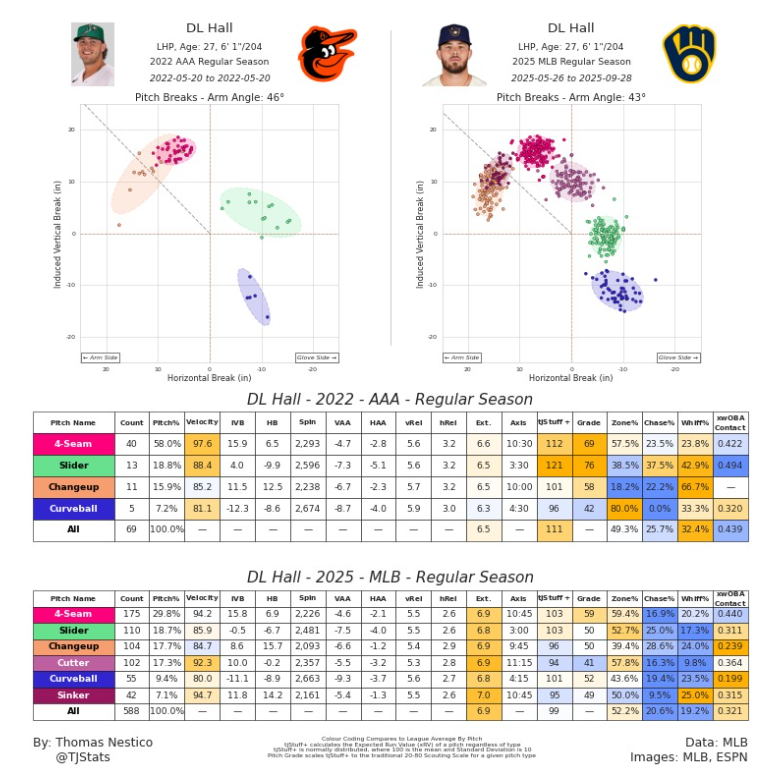
-
2025-26 Offseason Around the League Thread
Jake McKibbin replied to sveumrules's topic in Milwaukee Brewers Talk
Developing Baseball (@developingbaseball) • Instagram photos and videos WWW.INSTAGRAM.COM 55 likes, 3 comments - developingbaseball on January 14, 2026: "The facilities we work with have some absolute flame throwers. Here’s... DL Hall 🔥 -
Misc. Offseason Updates - AFL, Winter Leagues
Jake McKibbin replied to Spencer Michaelis's topic in Brewers Minor League Talk
Developing Baseball (@developingbaseball) • Instagram photos and videos WWW.INSTAGRAM.COM 55 likes, 3 comments - developingbaseball on January 14, 2026: "The facilities we work with have some absolute flame throwers. Here’s... Swipe across, Bryce Meccage touching around 97 mph this off-season apparently