Jake McKibbin
-
Posts
2,450 -
Joined
-
Last visited
-
Days Won
6
Content Type
Profiles
Forums
Blogs
Events
News
2026 Milwaukee Brewers Top Prospects Ranking
Milwaukee Brewers Videos
2022 Milwaukee Brewers Draft Picks
Milwaukee Brewers Free Agent & Trade Rumors, Notes, & Tidbits
Guides & Resources
2023 Milwaukee Brewers Draft Picks
2024 Milwaukee Brewers Draft Picks
The Milwaukee Brewers Players Project
2025 Milwaukee Brewers Draft Pick Tracker
2026 Milwaukee Brewers Draft Tracker: Picks & Bonuses
Store
Downloads
Gallery
Everything posted by Jake McKibbin
-
Image courtesy of © Matt Krohn-Imagn Images We've been here before. Garrett Mitchell may be one of the most polarizing players in the Brewers organization, combining tantalizing upside with glaring weaknesses. He's the type of player capable of dominating a playoff series matchup, or draining offensive momentum. We saw the Pirates destroy him with high fastballs a few weeks ago, and the results haven't been pretty overall. Including yesterday's home run, Mitchell has hit .281/.284/.303 over the last 30 days, with a 35,2% strikeout rate. Combined with Mitchell scuffling in the outfield (-5 Defensive Runs Saved (DRS), according to Sports Info Solutions) while trying to be careful to avoid diving on his weak shoulder, there has been a justifiably loud murmuring about whether Mitchell is fit to be an almost everyday player in the major leagues. Despite that, there has been some data to suggest that Mitchell has been improving, without the results to show for it. If we look at his rolling swing and miss rate on pitches inside the strike zone, there's some clear progress being made: We can see a steady trendline in the above graph, culminating in Mitchell (over his last 60 in-zone swings) being in the 50th percentile in MLB for contact rate. At points in the season, Mitchell's in-zone contact rate dropped below 60%, so to see it now approaching 85% marks an extreme transformation. Why hasn't this translated to results? Well, the problem is two-fold. Mitchell's strikeout rate has always garnered a lot of attention, but his ground ball rate has historically been a cause for concern, as well. He had a 55.8% ground ball rate in 2024, dropped to 46.5% in 2025, and is currently at 51.5% this year. No matter how hard you hit the ball, if you're hitting the majority of balls on the ground or low line drives, you will be susceptible to bad luck and rely on finding holes. Those holes are bigger if you hit a ball 115 MPH, but major-league infields are so good that you need to find the outfield grass to be consistent in this game. It should come as no surprise, then, that Mitchell's sweet-spot rate (the rate at which he finds ideal launch angles on his batted balls) almost perfectly mirrors his overall production: Mitchell got off to a rip-roaring start, before finding himself in a funk as he tried to cut down on the swing-and-miss. He was late on a lot of balls and pounding them into the ground, before recently making some better contact and seeing some extra bases as a result. There's one other problem. Mitchell is still striking out an awful lot despite the reduced whiff rate, with his 40-plate appearance rolling average sitting exactly on his season average of 37%: So, how has the zone contact improved to this extent and his chase rates also improved, but his actual strikeouts haven't changed? There are a couple of ways. Perhaps Mitchell is just not swinging as much? Or perhaps he's lasting longer in at-bats, fouling off pitches before eventually whiffing? Let's take a look! Up to April 19, Mitchell had swung at 25 high fastballs. He fouled off 13 of those pitches and whiffed on the other 12. In a two-strike count, you could force Mitchell into a swing, and he wasn't doing any damage in those locations. The ball wasn't even being put in play. Over the last month, he's swung at a lot more fastballs, and been targeted more heavily, but the whiff hasn't been as bad as we thought: Out of 91 high four-seam fastballs, Mitchell has swung and missed on just 20 of them, good for a 21.9% whiff rate. Initially, these resulted in more foul balls, and, when he did put the ball in play (note the numbers below the EVs are not balls in play, just the pitches located to that section), he's been hitting rockets: The problem is, while Mitchell has been getting his bat to the high fastball more often, he's being forced to do so more often. Pitchers (especially righties, working up and away) have worked him there more frequently. Mitchell hasn't whiffed in the last month on a lefty's four-seam fastball, but right-handers have found it easier to pound that spot. On top of that, Mitchell appears to have been so dialed into the high fastball that he's struggled against his bread-and-butter breaking pitches, with skyrocketing ground ball rates and high whiff rates against changeups and sliders. There's an implied question to parse here. Is Mitchell getting a hold of the high fastball only because he's expecting it on each and every pitch? Or can he find a balance where he can handle breaking pitches and off-speed offerings, while still managing the fastball? Hitting at the highest level of the sport is a chess match, and Mitchell showing off on Sunday with his home run against Bailey Ober is one way to place doubt in a pitcher's mind. If he can continue to progress against the high fastball and force pitchers into a more nuanced approach, that bodes well for him, but to avoid the streaky results, he will need to be capable of more than just selling out for one particular offering at a time. After all, everyone else in the league throws harder than Ober, which makes it easier for them to put Mitchell in the rocking chair. The initial signs are good. He's making more contact than ever, and he's not doing it by just stopping himself from swinging. There are more foul balls, and he'll need to turn those into actual balls in play more often, but the trend lines are pointing upward across the last month, and a little confidence can go a long way. If he can find that adjustability to cover more than just one offering at a time, the second half of 2026 could be a very fun time for Mitchell. View full article
-
Jesus MadeLuis PenaJett WilliamsCooper PrattLogan HendersonJeferson QueroLuis LaraBishop LetsonAndrew FischerBraylon PayneMarco DingesJosh AdamczewskiBlake BurkeTyson HardinBrock WilkenBrady EbelJD ThompsonJosh KnothLuke AdamsManuel Rodriguez
-
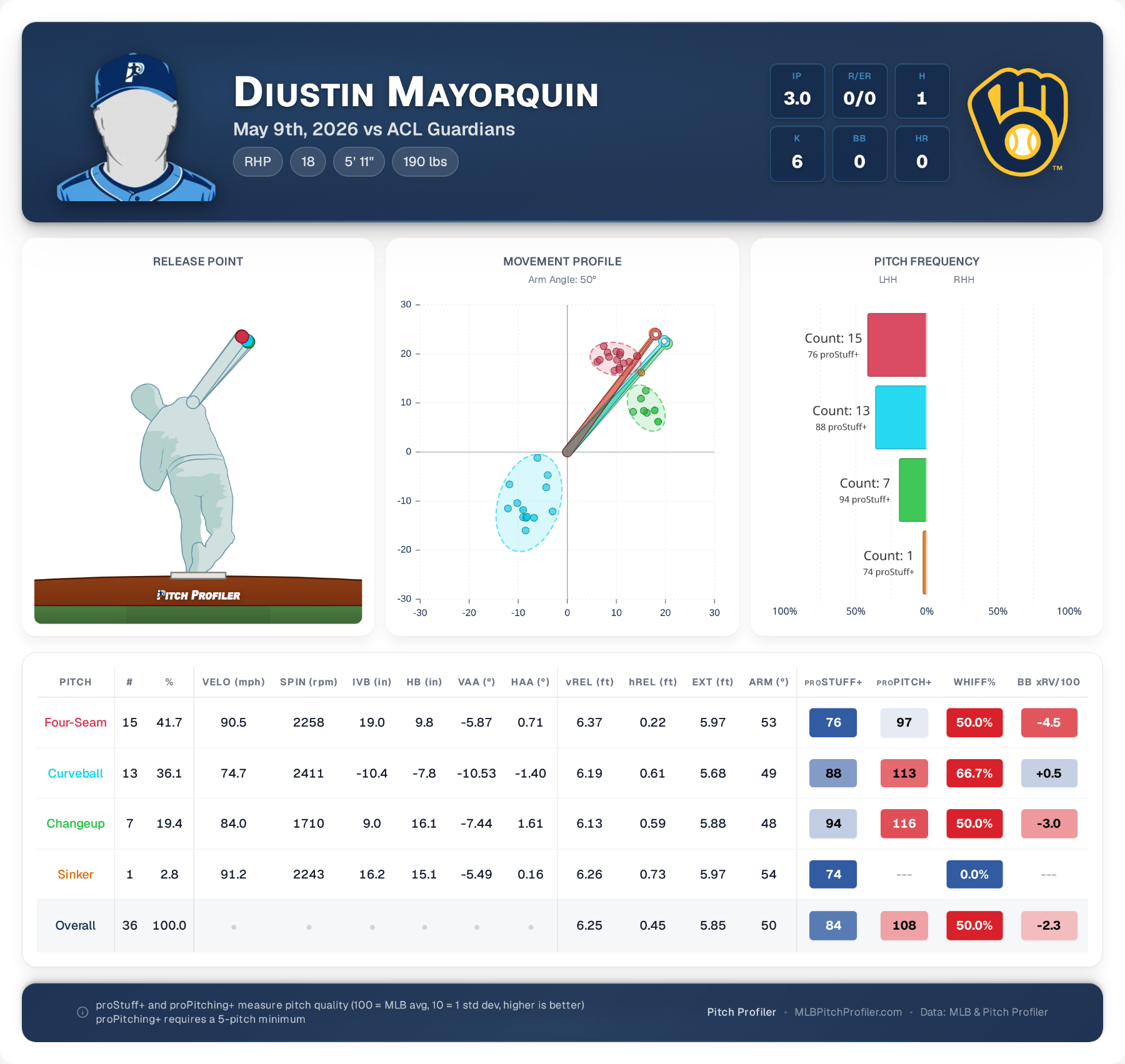
Ignoring the ratings for now, as they're almost entirely rated to velocity (and average IVB for the arm slot) but something about Mayorquin is really fascinating. Tons of whiff, six strikeouts in three innings, just an impressive all round showing from the 18 year old
-
I actually emailed them about this, probably get lost in the melee but its a little frustrating and probably an easy fix
-
CJ Hughes homer coming off the bat at 98.3 mph and going 404 feet is somewhat surprising, not sure I've seen a sub-100 mph ball go that far before. Perfect launch angle but does slightly make me question some of the data coming through Its not impossible, but on only four occasions has a hitter hit a ball sub-99 mph outside of Colorado and hit a home run further than CJ Hughes managed to. Oddly enough, each of the occurrences (and the ones tied for 404 fit with Hughes which would extend the sample size to 6 hitters) happened in either 2015 or 2017. He must have back-spun that ball like crazy
-
Cristopher Acosta is a more aggressive promotion than I expected, have we heard anything about him stateside in extended ST?
- 4 replies
-
- 1
-

-
- jett williams
- jeferson quero
- (and 2 more)
-
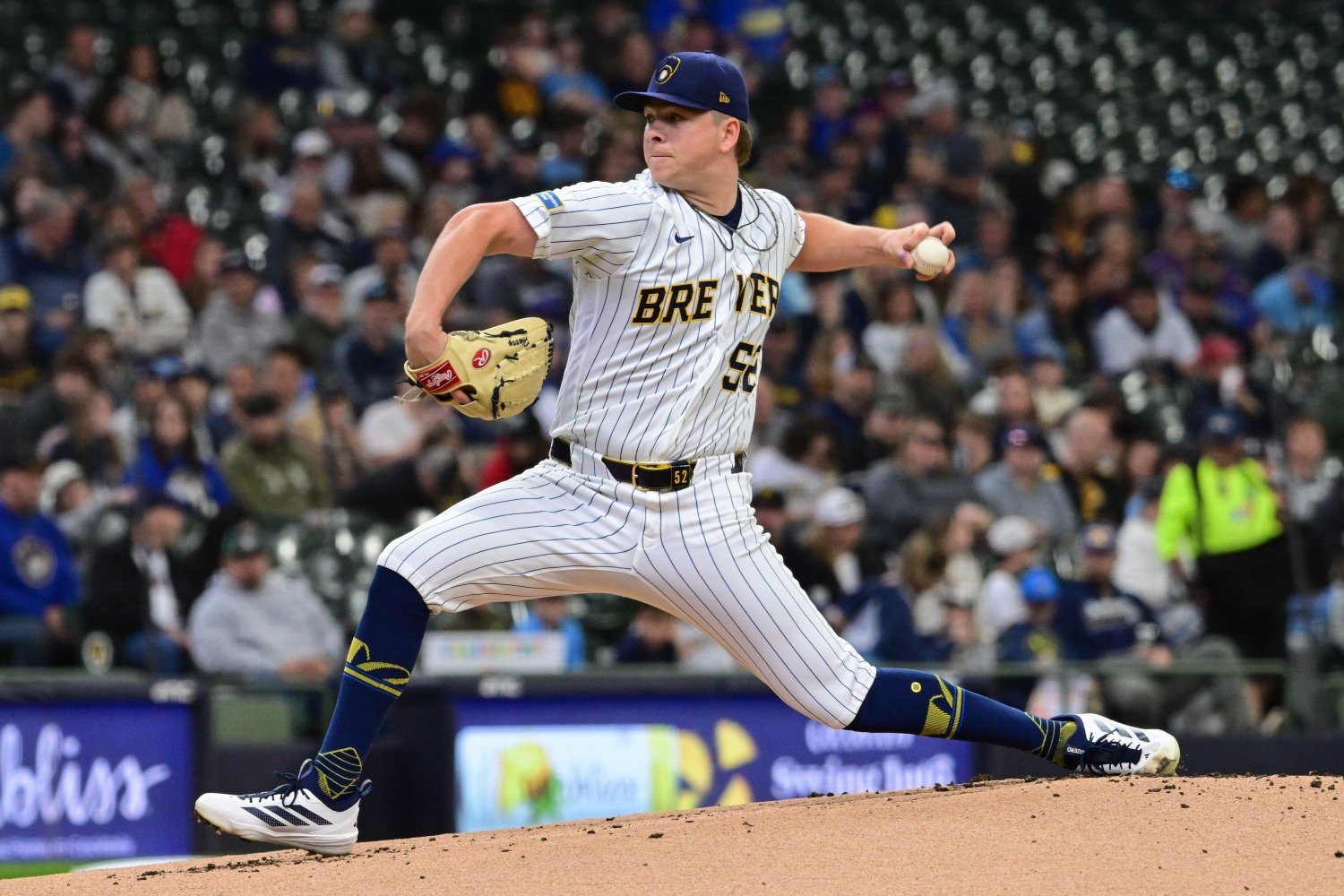 If you put the phrase "side of the rubber" in the Brewer Fanatic search tool, you'll be inundated with a plethora of Matthew Trueblood articles. The Brewers have used this with aplomb in the past to change how pitches tunnel as they approach home plate, and to change the angles they arrive at to either keep them over home plate for longer or shorter periods of time, and Matt loves to write about it. In Kyle Harrison's case, what they've managed to do is create an angle for him to pitch from that really emphasises his breaking ball, while creating an even more unique fastball for the hitter to deal with. It's a familiar formula; I just beat Matt to writing about it this time. Fastballs aren't straight. The majority of true four-seam fastballs have an element of tailing action, moving toward the pitcher's arm side. Harrison was already an outlier in this respect because of his low arm slot, which traditionally makes getting a fastball to "rise" more difficult and emphasizes that tailing action. Where some pitchers try to cut their fastballs and emphasize the vertical movement, Harrison has an outlier combination of both vertical and horizontal movement. The only starter in baseball with a comparable fastball from the left side is Cole Ragans, with 17" of induced vertical break and 13.6" of horizontal break. That's quite the comparison, with Ragans's four-seamer performing to an expected batting average of just .188 in 2025. It feels important to preface this article by also admiring how the Brewers have put in a lot of work to clean up Harrison's delivery, and have managed to access more induced vertical break than ever. He averaged 13" with the Red Sox in 2025 and is now up to 15" on average. That makes a heck of a difference in the batted-ball quality for opposing batters. Now, on to the juicy stuff. If we compare the pitch chart above for 2026 with his chart from 2025, there are some notable changes. The breaking pitches are breaking slightly less; the fastball is rising more; there's been a small change in arm angle; and, of course, the changeup profile was altered when he moved to a "kick-change". What I'd like to focus on, however, is the HAA, or the horizontal approach angle. There's been a lot of talk about vertical approach angles on fastballs, making them appear as though they're still rising by the time the pitch reaches the plate. Vertical approach angle is affected by spin rates, arm angles and location (i.e., there will be a lower vertical approach angle on pitches at the top of the zone than at the bottom). Horizontal approach angles, accordingly, are affected by arm angles, release points and horizontal break. When talking about the usefulness of this approach angle, imagine yourself in a batter's box, with a coach lobbing balls toward you. The first coach lobs from right in front of you, and your brain finds it easy to pick up the point at which you'll make contact. Now, imagine the coach changes position and throws from a 45° angle. That ball is now coming toward you at a different trajectory, and your brain is forced to decipher movement on two planes. We have to remember as well that, although the ABS system uses a two-dimensional "pane" to assess whether a pitch is a ball or strike at a fixed point halfway from the front of the plate to the back, hitters have different positions within the batter's box that can change the point at which they impact the ball. Most make contact significantly in front of the ABS zone, which can neutralise some of the angular momentum of a pitch, but there is an interesting tradeoff. Waiting farther back in the box to make contact will reduce the vertical approach angle of a pitch, as gravity has more time to win its battle with a fastball's spin, but it exacerbates the sweeping horizontal angle of an incoming pitch. It's this secondary movement that Harrison's move across the rubber optimizes for his two main offerings. On the fastball, where previously it actually entered the zone quite straight, it's now boring in on the right-handed hitter, with his changeup as a real threat to veer the other way. As for the slurve, this is perhaps the most meaningful change. The graph below highlights the relationship between Harrison's horizontal approach angle and his hard-hit rate: We can see a clear correlation between Harrison's slurve performance in each of his seasons in the big leagues, tying in well with the line of best fit. While the regression line expects some, well, regression, this season, it still predicts that the slurve will be measurably more successful with an increased horizontal approach angle (HAA). In short, the more the slurve is sweeping across the front of the strike zone, the more Harrison can avoid barrels and reduce the quantity of hard-hit balls. While there are some changes in locations with the slurve, the quality of contact seems to be controlled more by its change in shape, based on a new angle. In 2025, the pitch had an expected Weighted On-Base Average (an overall expected metric covering strikeouts, quality of contact, walks, etc) of .356. That figure was .347 across a larger sample in 2024, and .402 in 2023. In 2026, his xWOBA is just .197 on the pitch. It's a small-ish sample, but the trend lines suggest a direct correlation between his HAA and the quality of contact given up, such that we should expect this to continue. One final point based on his last start. Looking at the 2026 pitch map, his slurve has been anything but a consistent, downward-breaking shape throughout the season. He's seen it back up quite regularly and failed to get that downward movement. In his last start, however, you can see how much tighter and more consistent the slurve shape was, with how clustered together the blue dots are: As a result, the whiff rate skyrocketed. He could command it better as a result, finding locations in the shadow areas that encouraged chase and some really uncomfortable swings. He showed that, even with the early success of his slurve, there's more in the tank. The Brewers have made some simple adjustments that have allowed yet another pitcher to take a leap forward. It's almost comical at this point. And Harrison is taking full advantage of the H&H Car Wash. Have you enjoyed Kyle Harrison's start to the season? And perhaps for myself, do you enjoy these kinds of analytical pieces? Let me know your thoughts in the comments below!
 -
Image courtesy of © Benny Sieu-Imagn Images If you put the phrase "side of the rubber" in the Brewer Fanatic search tool, you'll be inundated with a plethora of Matthew Trueblood articles. The Brewers have used this with aplomb in the past to change how pitches tunnel as they approach home plate, and to change the angles they arrive at to either keep them over home plate for longer or shorter periods of time, and Matt loves to write about it. In Kyle Harrison's case, what they've managed to do is create an angle for him to pitch from that really emphasises his breaking ball, while creating an even more unique fastball for the hitter to deal with. It's a familiar formula; I just beat Matt to writing about it this time. Fastballs aren't straight. The majority of true four-seam fastballs have an element of tailing action, moving toward the pitcher's arm side. Harrison was already an outlier in this respect because of his low arm slot, which traditionally makes getting a fastball to "rise" more difficult and emphasizes that tailing action. Where some pitchers try to cut their fastballs and emphasize the vertical movement, Harrison has an outlier combination of both vertical and horizontal movement. The only starter in baseball with a comparable fastball from the left side is Cole Ragans, with 17" of induced vertical break and 13.6" of horizontal break. That's quite the comparison, with Ragans's four-seamer performing to an expected batting average of just .188 in 2025. It feels important to preface this article by also admiring how the Brewers have put in a lot of work to clean up Harrison's delivery, and have managed to access more induced vertical break than ever. He averaged 13" with the Red Sox in 2025 and is now up to 15" on average. That makes a heck of a difference in the batted-ball quality for opposing batters. Now, on to the juicy stuff. If we compare the pitch chart above for 2026 with his chart from 2025, there are some notable changes. The breaking pitches are breaking slightly less; the fastball is rising more; there's been a small change in arm angle; and, of course, the changeup profile was altered when he moved to a "kick-change". What I'd like to focus on, however, is the HAA, or the horizontal approach angle. There's been a lot of talk about vertical approach angles on fastballs, making them appear as though they're still rising by the time the pitch reaches the plate. Vertical approach angle is affected by spin rates, arm angles and location (i.e., there will be a lower vertical approach angle on pitches at the top of the zone than at the bottom). Horizontal approach angles, accordingly, are affected by arm angles, release points and horizontal break. When talking about the usefulness of this approach angle, imagine yourself in a batter's box, with a coach lobbing balls toward you. The first coach lobs from right in front of you, and your brain finds it easy to pick up the point at which you'll make contact. Now, imagine the coach changes position and throws from a 45° angle. That ball is now coming toward you at a different trajectory, and your brain is forced to decipher movement on two planes. We have to remember as well that, although the ABS system uses a two-dimensional "pane" to assess whether a pitch is a ball or strike at a fixed point halfway from the front of the plate to the back, hitters have different positions within the batter's box that can change the point at which they impact the ball. Most make contact significantly in front of the ABS zone, which can neutralise some of the angular momentum of a pitch, but there is an interesting tradeoff. Waiting farther back in the box to make contact will reduce the vertical approach angle of a pitch, as gravity has more time to win its battle with a fastball's spin, but it exacerbates the sweeping horizontal angle of an incoming pitch. It's this secondary movement that Harrison's move across the rubber optimizes for his two main offerings. On the fastball, where previously it actually entered the zone quite straight, it's now boring in on the right-handed hitter, with his changeup as a real threat to veer the other way. As for the slurve, this is perhaps the most meaningful change. The graph below highlights the relationship between Harrison's horizontal approach angle and his hard-hit rate: We can see a clear correlation between Harrison's slurve performance in each of his seasons in the big leagues, tying in well with the line of best fit. While the regression line expects some, well, regression, this season, it still predicts that the slurve will be measurably more successful with an increased horizontal approach angle (HAA). In short, the more the slurve is sweeping across the front of the strike zone, the more Harrison can avoid barrels and reduce the quantity of hard-hit balls. While there are some changes in locations with the slurve, the quality of contact seems to be controlled more by its change in shape, based on a new angle. In 2025, the pitch had an expected Weighted On-Base Average (an overall expected metric covering strikeouts, quality of contact, walks, etc) of .356. That figure was .347 across a larger sample in 2024, and .402 in 2023. In 2026, his xWOBA is just .197 on the pitch. It's a small-ish sample, but the trend lines suggest a direct correlation between his HAA and the quality of contact given up, such that we should expect this to continue. One final point based on his last start. Looking at the 2026 pitch map, his slurve has been anything but a consistent, downward-breaking shape throughout the season. He's seen it back up quite regularly and failed to get that downward movement. In his last start, however, you can see how much tighter and more consistent the slurve shape was, with how clustered together the blue dots are: As a result, the whiff rate skyrocketed. He could command it better as a result, finding locations in the shadow areas that encouraged chase and some really uncomfortable swings. He showed that, even with the early success of his slurve, there's more in the tank. The Brewers have made some simple adjustments that have allowed yet another pitcher to take a leap forward. It's almost comical at this point. And Harrison is taking full advantage of the H&H Car Wash. Have you enjoyed Kyle Harrison's start to the season? And perhaps for myself, do you enjoy these kinds of analytical pieces? Let me know your thoughts in the comments below! View full article
-
Also, looking under the hood, but keep an eye on Brady Ebel's at bats. Some of the background stats have me wondering if he's not that far off, there's some very positive signs in there. The downside is you'll probably catch some other Warbirds AB's, which are really not pretty (Jose Anderson 50% strikeout rate, 47% whiff rate, I see you)
-
He also has a 54.4% contact rate according to Fangraphs. That's honestly wild
-
That sounds delightfully seductive
-
Image courtesy of © Benny Sieu-Imagn Images Twenty-one games into the season, key relievers Aaron Ashby, Ángel Zerpa and Abner Uribe are all on pace for 85 or more innings. As all three are hurlers the Brewers expect to rely on heavily as the year develops, their early usage raises some concerns. Ashby was the most-used reliever in baseball this time last week, while Uribe and Zerpa have each pitched 10 times already. The first month of the season traditionally sees a more varied use of the bullpen arms. In one sense, the Brewers have this, with five different pitchers already at 10 innings or more. However, while DL Hall and Grant Anderson have been innings sponges, too much work is being left to the guys the team needs to be fresh come October. Because of a few short starts and a lack of trust in Jake Woodford, the Brewers haven't been able to stay away from their 'A' relievers even on days when they tried to do so. As a perfect example, over the weekend, Woodford forced Pat Murphy to use Uribe after the Brewers gave him a five-run lead with six outs to go. Woodford managed just four outs and left a bases-loaded mess for Uribe to clean up, with the winning run at the plate. What constitutes bullpen overuse? One of the best ways to limit bullpen mismanagement is to provide a variety of capable, reliable arms who can get outs in almost any situation. With a cap of 13 pitchers on a roster (unless you have Shohei Ohtani, in which case you can have 14), the Brewers are limited to eight relievers. Using spot starters and pushing back starters in the rotation can bring this down to seven options; that's when things get especially tenuous. With a rubber arm whom you trust to go multiple innings on either side of a blowout, you can get away with this. Since Woodford has been untrustworthy and Hall has been inefficient, though, Murphy has been compelled to go with more back-to-backs from key pitchers. Putting this in perspective, Milwaukee threw 634 2/3 innings out of the pen last year, a number dropping to 600 when you exclude the innings pitched by a starter following an opener (mostly Quinn Priester). That means that the average game requires 11 outs from the bullpen; getting them out of six or even seven guys consistently quickly gets thorny. Looking at last year's collection of guys who cycled through (Tobias Myers, Connor Thomas, Bryan Hudson, Erick Fedde, Rob Zastryzny, et al), there are probably 120 innings of work picked up from relievers covering short-term injuries. For the other 480 innings, things can get dicey; if you have just six relievers splitting the load, that would be 80 innings per arm, whereas with a full trusted cohort of eight relievers, you average a far more acceptable 60 innings per reliever. Here's how Uribe's swinging strike rate trended throughout 2025; pay attention to what happened after he surpassed 65 appearances: That range—60-65 games—is the benchmark the Brewers should strive for, noting how Uribe struggled after that point. We saw similar declines with Ashby and Jared Koenig after a heavy workload. How Do The Brewers Limit Such Innings? There is one very obvious solution. The Brewers will want someone capable of going multiple innings, especially in the middle of games, who can be trusted to prevent the floodgates opening either with a big lead or a larger deficit. It would need to be someone who is stretched out, with solid stuff and command to get outs consistently. Properly conceptualized, this is the perfect place in which to give a young hurler some time and space to develop in the big leagues. The Brewers have a number of such arms, being absolutely blessed with rotation depth. Priester is on the mend and building back up with Nashville now, targeting a return around the middle of May. When he returns, Chad Patrick or Brandon Sproat could be pushed to the bullpen. In the meantime, Robert Gasser, Logan Henderson and Shane Drohan could all fill this role with aplomb. Each of them are on the 40-man roster; has appeared for the Brewers; and is stretched out enough to take on the workload. At the front of the list might be Drohan, who notably entered his last "start" behind an opener. He'd seem to be the best situated for that kind of role, based on a number of factors. Logan Henderson's unique, effective fastball and deadly changeup would be another option, coming from the right side with the type of stuff that can mow hitters down. It limits his exposure the third time through an order, but can give him space to test his slurve in the big leagues while leaning on his bread-and-butter offerings. The Brewers' plethora of young, talented arms need some big-league experience to continue their development. Brandon Woodruff and Corbin Burnes filled similar long-relief roles when they were called up and did so with aplomb, allowing them to develop and assimilate while priming them to break out the following season. More importantly, they ate innings and provided results. Murphy's circle of trust is a small, closed circle. Breaking into it isn't easy. Woodford is almost certainly not getting in there now, and the last man in the bullpen is more important than one would think. Having a viable, high-quality arm for multi-inning relief alongside Ashby might be the best solution for all involved, and each of Henderson, Drohan and Gasser could provide that. How do you assess the Brewers early bullpen usage? Can you see them using one of their younger arms to fill a need, or would they prefer to keep them stretched out in Nashville? Let us know your thoughts in the comments below! View full article
-
How Can the Brewers Bullpen Balance "Win Tonight" with "Win In October"?
Jake McKibbin posted an article in Brewers
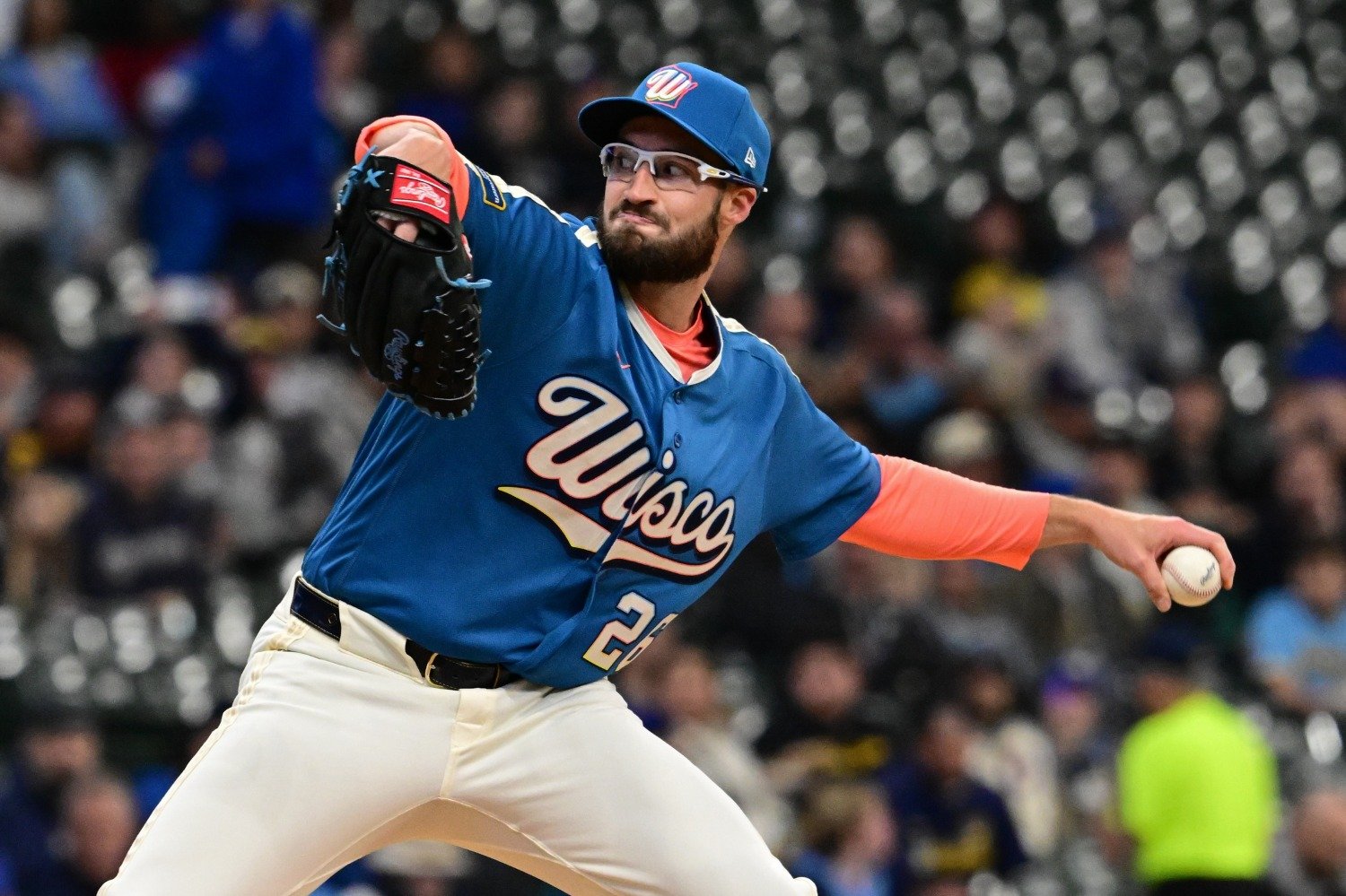 Twenty-one games into the season, key relievers Aaron Ashby, Ángel Zerpa and Abner Uribe are all on pace for 85 or more innings. As all three are hurlers the Brewers expect to rely on heavily as the year develops, their early usage raises some concerns. Ashby was the most-used reliever in baseball this time last week, while Uribe and Zerpa have each pitched 10 times already. The first month of the season traditionally sees a more varied use of the bullpen arms. In one sense, the Brewers have this, with five different pitchers already at 10 innings or more. However, while DL Hall and Grant Anderson have been innings sponges, too much work is being left to the guys the team needs to be fresh come October. Because of a few short starts and a lack of trust in Jake Woodford, the Brewers haven't been able to stay away from their 'A' relievers even on days when they tried to do so. As a perfect example, over the weekend, Woodford forced Pat Murphy to use Uribe after the Brewers gave him a five-run lead with six outs to go. Woodford managed just four outs and left a bases-loaded mess for Uribe to clean up, with the winning run at the plate. What constitutes bullpen overuse? One of the best ways to limit bullpen mismanagement is to provide a variety of capable, reliable arms who can get outs in almost any situation. With a cap of 13 pitchers on a roster (unless you have Shohei Ohtani, in which case you can have 14), the Brewers are limited to eight relievers. Using spot starters and pushing back starters in the rotation can bring this down to seven options; that's when things get especially tenuous. With a rubber arm whom you trust to go multiple innings on either side of a blowout, you can get away with this. Since Woodford has been untrustworthy and Hall has been inefficient, though, Murphy has been compelled to go with more back-to-backs from key pitchers. Putting this in perspective, Milwaukee threw 634 2/3 innings out of the pen last year, a number dropping to 600 when you exclude the innings pitched by a starter following an opener (mostly Quinn Priester). That means that the average game requires 11 outs from the bullpen; getting them out of six or even seven guys consistently quickly gets thorny. Looking at last year's collection of guys who cycled through (Tobias Myers, Connor Thomas, Bryan Hudson, Erick Fedde, Rob Zastryzny, et al), there are probably 120 innings of work picked up from relievers covering short-term injuries. For the other 480 innings, things can get dicey; if you have just six relievers splitting the load, that would be 80 innings per arm, whereas with a full trusted cohort of eight relievers, you average a far more acceptable 60 innings per reliever. Here's how Uribe's swinging strike rate trended throughout 2025; pay attention to what happened after he surpassed 65 appearances: That range—60-65 games—is the benchmark the Brewers should strive for, noting how Uribe struggled after that point. We saw similar declines with Ashby and Jared Koenig after a heavy workload. How Do The Brewers Limit Such Innings? There is one very obvious solution. The Brewers will want someone capable of going multiple innings, especially in the middle of games, who can be trusted to prevent the floodgates opening either with a big lead or a larger deficit. It would need to be someone who is stretched out, with solid stuff and command to get outs consistently. Properly conceptualized, this is the perfect place in which to give a young hurler some time and space to develop in the big leagues. The Brewers have a number of such arms, being absolutely blessed with rotation depth. Priester is on the mend and building back up with Nashville now, targeting a return around the middle of May. When he returns, Chad Patrick or Brandon Sproat could be pushed to the bullpen. In the meantime, Robert Gasser, Logan Henderson and Shane Drohan could all fill this role with aplomb. Each of them are on the 40-man roster; has appeared for the Brewers; and is stretched out enough to take on the workload. At the front of the list might be Drohan, who notably entered his last "start" behind an opener. He'd seem to be the best situated for that kind of role, based on a number of factors. Logan Henderson's unique, effective fastball and deadly changeup would be another option, coming from the right side with the type of stuff that can mow hitters down. It limits his exposure the third time through an order, but can give him space to test his slurve in the big leagues while leaning on his bread-and-butter offerings. The Brewers' plethora of young, talented arms need some big-league experience to continue their development. Brandon Woodruff and Corbin Burnes filled similar long-relief roles when they were called up and did so with aplomb, allowing them to develop and assimilate while priming them to break out the following season. More importantly, they ate innings and provided results. Murphy's circle of trust is a small, closed circle. Breaking into it isn't easy. Woodford is almost certainly not getting in there now, and the last man in the bullpen is more important than one would think. Having a viable, high-quality arm for multi-inning relief alongside Ashby might be the best solution for all involved, and each of Henderson, Drohan and Gasser could provide that. How do you assess the Brewers early bullpen usage? Can you see them using one of their younger arms to fill a need, or would they prefer to keep them stretched out in Nashville? Let us know your thoughts in the comments below!
- 2 comments
-
- 2
-
-
- jake woodford
- robert gasser
- (and 2 more)
-
Image courtesy of © Mark Hoffman/Milwaukee Journal Sentinel / USA TODAY NETWORK via Imagn Images Jacob Misiorowski is the ace of the Brewers staff. Even after covering 5 1/3 innings of work while feeling visibly sick on Tuesday evening, he's striking out 37.5% of batters on the season, while inducing an expected batting average of just .178. He's faced some misfortune in his 3.32 ERA so far from the quality of contact he's given up, and even then, five of his eight runs allowed have come in his final inning of work in games. It's not uncommon for pitchers to continue building up and adjusting to the workload of 100-plus pitches, and in half of his outings to date, Misiorowski has been pitching sick. That's not to give an excuse for the young hurler; these are issues many pitchers have to deal with. It does, however, show just what Misiorowski is capable of, and he's made clear strides early on this season. He's allowing fewer barrelled balls and lower exit velocities, and seems to have an altogether different way of using his arsenal. As you might expect, it all comes down to his fastball. Misiorowski lets this set the tone early, generating above-average ride and extreme velocity from a low release height and big extension down the mound. If you could build a four-seam fastball in a lab, this is what it would look like. The interesting part here is that he's finding the zone less often with it. Usually, pitchers use their fastballs to get ahead in counts, hitting the zone 55% of the time or more with them. Misiorowski, who battled command throughout the minors, tried to find more control with his fastball and follow this template, to mixed results. While he found the zone more often (as you can see below) on his four-seamer, his cutter/slider, and his curveball, he was getting less chase and less effective results. He's getting more swing and miss thus far in 2026 across each of his three primary offerings—by getting out of the zone with the heater more, denying hitters early contact. You might say "Jake, of course they'll miss more if they're swinging on pitches outside the strike zone." You'd be correct, but the way Misiorowski has adapted to make that work—to miss more bats and rack up strikeouts, rather than watching hitters spit on his not-so-tempting out-of-zone pitches and draw lots of walks—shows impressive command, going beyond simple control. Despite some early problems with fatigue (including three consecutive walks to finish his outing against the Red Sox), his walk rate is lower across his first three starts than he managed in 2026. This is a small sample, but by encouraging more chase on his fastball and his slider, he's managing to avoid free passes when fit and firing. The key element here is how much his fastball rises, compared to what a hitter expects. With elite induced vertical break (or spin-related movement) and his low release point, Misiorowski has a fastball that comes in flatter than a hitter perceives. What looks like a strike at the top of the zone can finish several inches above that zone, and hitters have little time to adjust, due to the speed at which the pitch is thrown. In 2025, only the slider could really protect against the fastball. The curveball, to land in the strike zone, had to pop out of his hand, tunneling quite differently. If he can live with that fastball slightly above the zone, the results in how his pitches tunnel is stark, as shown by FanGraphs's pitch pairing model. If Misiorowski is getting chases above the strike zone with his fastball, every offering around his primary pitch can tunnel off that and be in and around the zone for a long time before breaking away. It means hitters have a tougher time identifying the pitch thrown by the time they make their swing decision, and it's resulted in some uglier swings and more whiffs than ever. If that fastball is lower in the zone, all of a sudden the curveball, if tunnelled, becomes a non-factor in the swing decision, and if not tunnelled, it becomes far easier to pick up out of the hand. It isn't just the swing-and-miss that's been different early on. The bat-tracking data against Misiorowski's arsenal so far has dramatically improved as well: While there is some small sample size here, Misiorowski has faced big bat speed merchants like Vladimir Guerrero Jr., Colson Montgomery, James Wood and Roman Anthony thus far in 2026. His average bat speed faced is down over 1 MPH, while the fast swing rate, attack angles and attack directions all indicate later swings and more uncomfortable at-bats. Hitters are struggling to access good attack angles with their bat paths. They've shortened their swings to make contact with his fastball, and are late, anyway, with a 4° attack direction going to the opposite field. Placing in the top 5 across each of these six statistics highlights just how uncomfortable hitters are with Misiorowski on the mound. Other leaders in these categories include Nolan McLean, Kevin Gausman, Dylan Cease, Cam Schlittler and Sandy Alcantara. That's elite company, which should be no surprise. Finally, Misiorowski showed against the Red Sox that he doesn't have to live outside the zone. Knowing he had limited capacity for a large pitch count, Misiorowski pounded the strike zone, particularly with his slider and curveball. He can find the zone when he needs to, but his low in-zone rate so far this season (on top of the success he's had with it) would indicate this is a plan, and one that he's executing effectively to date. How well it holds up against top offenses like the Dodgers will be fascinating to see, but for now, Misiorwoski is showing serious strides towards becoming a bona fide ace. Have you enjoyed watching Misiorowski this year? Have you noticed any real changes? Let us know your thoughts in the comments below! View full article
-
How is Jacob Misiorowski Forcing Some of the Ugliest Swings in Baseball?
Jake McKibbin posted an article in Brewers
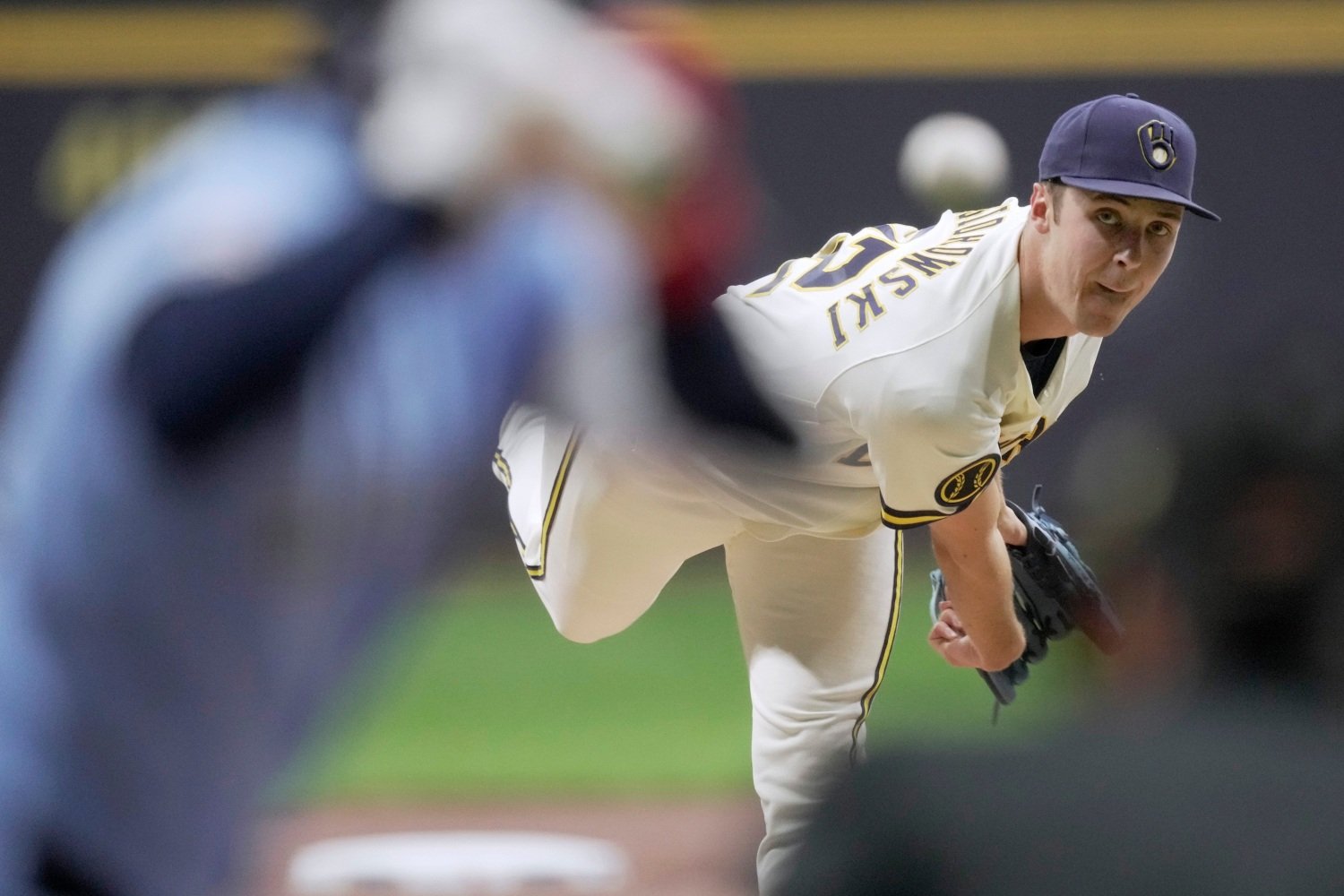 Jacob Misiorowski is the ace of the Brewers staff. Even after covering 5 1/3 innings of work while feeling visibly sick on Tuesday evening, he's striking out 37.5% of batters on the season, while inducing an expected batting average of just .178. He's faced some misfortune in his 3.32 ERA so far from the quality of contact he's given up, and even then, five of his eight runs allowed have come in his final inning of work in games. It's not uncommon for pitchers to continue building up and adjusting to the workload of 100-plus pitches, and in half of his outings to date, Misiorowski has been pitching sick. That's not to give an excuse for the young hurler; these are issues many pitchers have to deal with. It does, however, show just what Misiorowski is capable of, and he's made clear strides early on this season. He's allowing fewer barrelled balls and lower exit velocities, and seems to have an altogether different way of using his arsenal. As you might expect, it all comes down to his fastball. Misiorowski lets this set the tone early, generating above-average ride and extreme velocity from a low release height and big extension down the mound. If you could build a four-seam fastball in a lab, this is what it would look like. The interesting part here is that he's finding the zone less often with it. Usually, pitchers use their fastballs to get ahead in counts, hitting the zone 55% of the time or more with them. Misiorowski, who battled command throughout the minors, tried to find more control with his fastball and follow this template, to mixed results. While he found the zone more often (as you can see below) on his four-seamer, his cutter/slider, and his curveball, he was getting less chase and less effective results. He's getting more swing and miss thus far in 2026 across each of his three primary offerings—by getting out of the zone with the heater more, denying hitters early contact. You might say "Jake, of course they'll miss more if they're swinging on pitches outside the strike zone." You'd be correct, but the way Misiorowski has adapted to make that work—to miss more bats and rack up strikeouts, rather than watching hitters spit on his not-so-tempting out-of-zone pitches and draw lots of walks—shows impressive command, going beyond simple control. Despite some early problems with fatigue (including three consecutive walks to finish his outing against the Red Sox), his walk rate is lower across his first three starts than he managed in 2026. This is a small sample, but by encouraging more chase on his fastball and his slider, he's managing to avoid free passes when fit and firing. The key element here is how much his fastball rises, compared to what a hitter expects. With elite induced vertical break (or spin-related movement) and his low release point, Misiorowski has a fastball that comes in flatter than a hitter perceives. What looks like a strike at the top of the zone can finish several inches above that zone, and hitters have little time to adjust, due to the speed at which the pitch is thrown. In 2025, only the slider could really protect against the fastball. The curveball, to land in the strike zone, had to pop out of his hand, tunneling quite differently. If he can live with that fastball slightly above the zone, the results in how his pitches tunnel is stark, as shown by FanGraphs's pitch pairing model. If Misiorowski is getting chases above the strike zone with his fastball, every offering around his primary pitch can tunnel off that and be in and around the zone for a long time before breaking away. It means hitters have a tougher time identifying the pitch thrown by the time they make their swing decision, and it's resulted in some uglier swings and more whiffs than ever. If that fastball is lower in the zone, all of a sudden the curveball, if tunnelled, becomes a non-factor in the swing decision, and if not tunnelled, it becomes far easier to pick up out of the hand. It isn't just the swing-and-miss that's been different early on. The bat-tracking data against Misiorowski's arsenal so far has dramatically improved as well: While there is some small sample size here, Misiorowski has faced big bat speed merchants like Vladimir Guerrero Jr., Colson Montgomery, James Wood and Roman Anthony thus far in 2026. His average bat speed faced is down over 1 MPH, while the fast swing rate, attack angles and attack directions all indicate later swings and more uncomfortable at-bats. Hitters are struggling to access good attack angles with their bat paths. They've shortened their swings to make contact with his fastball, and are late, anyway, with a 4° attack direction going to the opposite field. Placing in the top 5 across each of these six statistics highlights just how uncomfortable hitters are with Misiorowski on the mound. Other leaders in these categories include Nolan McLean, Kevin Gausman, Dylan Cease, Cam Schlittler and Sandy Alcantara. That's elite company, which should be no surprise. Finally, Misiorowski showed against the Red Sox that he doesn't have to live outside the zone. Knowing he had limited capacity for a large pitch count, Misiorowski pounded the strike zone, particularly with his slider and curveball. He can find the zone when he needs to, but his low in-zone rate so far this season (on top of the success he's had with it) would indicate this is a plan, and one that he's executing effectively to date. How well it holds up against top offenses like the Dodgers will be fascinating to see, but for now, Misiorwoski is showing serious strides towards becoming a bona fide ace. Have you enjoyed watching Misiorowski this year? Have you noticed any real changes? Let us know your thoughts in the comments below!
 -
I had the same thought, commercials finished just as the ball cleared the fence
-
Groin and hamstring are close enough, sometimes a hamstring strain can feel like the back of your abductor. Honestly it's probably better, the hamstring can just sap explosiveness
-
Image courtesy of © William Purnell-Imagn Images Brandon Sproat probably couldn't imagine a worse start to his Brewers tenure. With under 7 innings pitched and 11 earned runs to his name after two starts, Sproat needs to show some progress over his next few starts; Robert Gasser and Logan Henderson are waiting in the wings. The question is: How can he turn things around? Initially, PitchProfiler seems to suggest that Sproat lacks a dominant fastball, and hitters are finding it too easy to time both it and his secondary offerings. Looking a little closer, however (specifically at the graph in the top right), that's not entirely true. Sinkers rarely get glowing grades from stuff models, because even good sinkers don't have the same correlation with swing-and-miss as (say) a four-seam fastball or curveball would. That being said, Sproat's sinker has some wicked bowling ball-like movement, producing a 104 Stuff+ rating to right-handers. The rub: an ugly 87 Stuff+ to left-handers. That's a big disparity, and it prompted me to look a little deeper. The Brewers love fastballs almost more than any other team in baseball, but that sinker won't consistently play well on its own to lefties, without excellent command. This is where the Brewers and Mets have differed in their approach. The Mets used a pitch pattern more similar to Logan Webb, utilizing a changeup and sinker tandem that have similar movement profiles but different velocity bands. The pitches look very similar, but the change in velocity makes Webb one of the best ground ball merchants in the sport. In his brief time in the big leagues with the Mets last year, Sproat featured his changeup, curveball and four-seamer, at the expense of the sinker. So far, the Brewers have him trying to make the sinker work, despite that pitch's almost universally stark platoon splits. They've preferred the new, harder slider (or cutter) over the changeup; it's a pitch that fits their traditional approach well. Alas, because the cutter and sinker have such a large difference in how much they move, the cutter is getting hit. Across 27 pitches (small sample size alert), lefties have cracked two homers and have a .744 expected weighted on-base average (xwOBA) against the cutter. (Remember, xwOBA is scaled to on-base percentage, so a .744 is video game-level violence.) When the pitch is being primarily used to come inside on lefties, it has to be located and set up well enough to survive those danger zones. So far, Sproat doesn't have that. He's nervously approaching left-handers at present, falling behind a lot and nibbling with the sinker. He's living down and away in the strike zone, but falling behind in counts has proved devastating for him. The fastballs just don't play over the heart of the plate to opposite-handed hitters, and he's struggled to get swings and misses on all but the changeup to lefties. The changeup has dropped from 25% to 11% usage in 2026, and it hasn't been located well enough to play off his sinker; pairing those pitches productively is always difficult. As you can see from the first graphic, these pitches move almost identically, and the changeup is only 5 MPH slower. The velocity separation would ideally be larger, but the changeup has managed to miss bats. Hopefully, it's something he feels more comfortable using against left-handers in his next two starts, but he'll also need a different way to set it up. The main issue for Sproat is the walks. He's faced 19 left-handed batters and walked six of them, compared to three strikeouts, with five hits on top of that. It's a result of a fastball he doesn't feel comfortable pounding the strike zone with, and the lack of a genuine out pitch in two-strike counts. The changeup may solve the latter, but it will be fascinating to see if the Brewers adjust his fastball mix, too, including getting back to more four-seam fastballs. It's also worth noting that Sproat has been caught by Gary Sánchez and Jeferson Quero in his first two starts. How William Contreras calls the game might be different, and the presence he provides behind the dish could help Sproat as he continues to ease into his role as a major-league pitcher. Two things can be true at once. Sproat has been bogged down by nerves across his first two starts, showing more erratic command as a result. He could tighten up how he's attacking hitters to weather the storm better and come out the other side with better results. The raw velocity and movement are there, but piecing it together has involved a steep learning curve for him at this level. How quickly he can navigate that curve will go a long way to deciding where he's playing baseball in May and June. View full article
-
Does Brandon Sproat Need to Tweak His Arsenal Against Lefties?
Jake McKibbin posted an article in Brewers
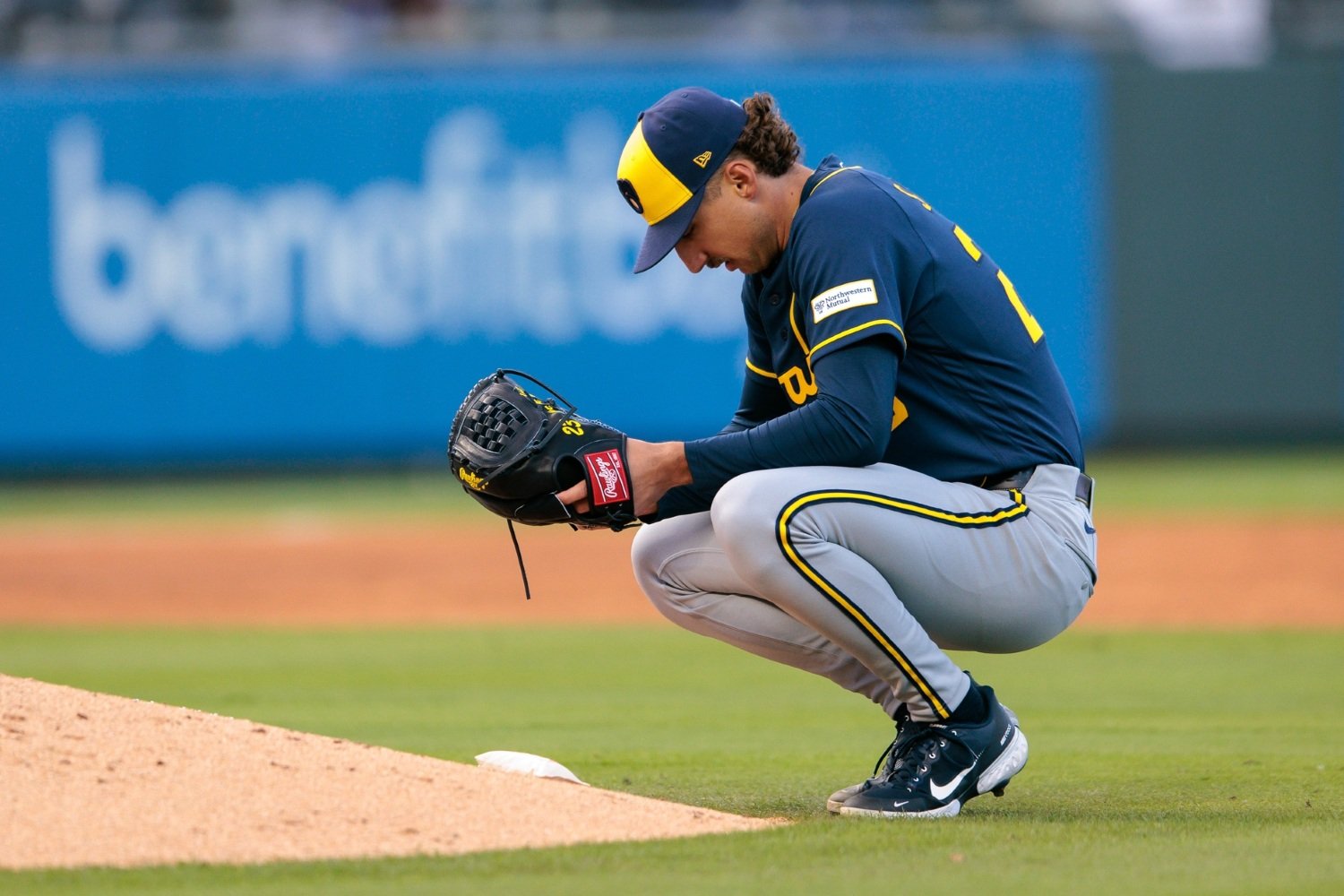 Brandon Sproat probably couldn't imagine a worse start to his Brewers tenure. With under 7 innings pitched and 11 earned runs to his name after two starts, Sproat needs to show some progress over his next few starts; Robert Gasser and Logan Henderson are waiting in the wings. The question is: How can he turn things around? Initially, PitchProfiler seems to suggest that Sproat lacks a dominant fastball, and hitters are finding it too easy to time both it and his secondary offerings. Looking a little closer, however (specifically at the graph in the top right), that's not entirely true. Sinkers rarely get glowing grades from stuff models, because even good sinkers don't have the same correlation with swing-and-miss as (say) a four-seam fastball or curveball would. That being said, Sproat's sinker has some wicked bowling ball-like movement, producing a 104 Stuff+ rating to right-handers. The rub: an ugly 87 Stuff+ to left-handers. That's a big disparity, and it prompted me to look a little deeper. The Brewers love fastballs almost more than any other team in baseball, but that sinker won't consistently play well on its own to lefties, without excellent command. This is where the Brewers and Mets have differed in their approach. The Mets used a pitch pattern more similar to Logan Webb, utilizing a changeup and sinker tandem that have similar movement profiles but different velocity bands. The pitches look very similar, but the change in velocity makes Webb one of the best ground ball merchants in the sport. In his brief time in the big leagues with the Mets last year, Sproat featured his changeup, curveball and four-seamer, at the expense of the sinker. So far, the Brewers have him trying to make the sinker work, despite that pitch's almost universally stark platoon splits. They've preferred the new, harder slider (or cutter) over the changeup; it's a pitch that fits their traditional approach well. Alas, because the cutter and sinker have such a large difference in how much they move, the cutter is getting hit. Across 27 pitches (small sample size alert), lefties have cracked two homers and have a .744 expected weighted on-base average (xwOBA) against the cutter. (Remember, xwOBA is scaled to on-base percentage, so a .744 is video game-level violence.) When the pitch is being primarily used to come inside on lefties, it has to be located and set up well enough to survive those danger zones. So far, Sproat doesn't have that. He's nervously approaching left-handers at present, falling behind a lot and nibbling with the sinker. He's living down and away in the strike zone, but falling behind in counts has proved devastating for him. The fastballs just don't play over the heart of the plate to opposite-handed hitters, and he's struggled to get swings and misses on all but the changeup to lefties. The changeup has dropped from 25% to 11% usage in 2026, and it hasn't been located well enough to play off his sinker; pairing those pitches productively is always difficult. As you can see from the first graphic, these pitches move almost identically, and the changeup is only 5 MPH slower. The velocity separation would ideally be larger, but the changeup has managed to miss bats. Hopefully, it's something he feels more comfortable using against left-handers in his next two starts, but he'll also need a different way to set it up. The main issue for Sproat is the walks. He's faced 19 left-handed batters and walked six of them, compared to three strikeouts, with five hits on top of that. It's a result of a fastball he doesn't feel comfortable pounding the strike zone with, and the lack of a genuine out pitch in two-strike counts. The changeup may solve the latter, but it will be fascinating to see if the Brewers adjust his fastball mix, too, including getting back to more four-seam fastballs. It's also worth noting that Sproat has been caught by Gary Sánchez and Jeferson Quero in his first two starts. How William Contreras calls the game might be different, and the presence he provides behind the dish could help Sproat as he continues to ease into his role as a major-league pitcher. Two things can be true at once. Sproat has been bogged down by nerves across his first two starts, showing more erratic command as a result. He could tighten up how he's attacking hitters to weather the storm better and come out the other side with better results. The raw velocity and movement are there, but piecing it together has involved a steep learning curve for him at this level. How quickly he can navigate that curve will go a long way to deciding where he's playing baseball in May and June.
 -
Love these Terry, thanks man!
-
Poetic
-
I'll have to remember that.. tbh, Jason probably does this far better than me
-
 While this was highly enjoyable for me, I can't leave you completely bereft of content, so please enjoy a throwback to perhaps the greatest April Fool's day prank of all time:
 -
Image courtesy of © Michael McLoone-Imagn Images While this was highly enjoyable for me, I can't leave you completely bereft of content, so please enjoy a throwback to perhaps the greatest April Fool's day prank of all time: View full article
-
The catchers interference is so Brewers. Stolen base attempt in a pressure situation, rookie catcher overreaching. Just building pressure and creating tension amongst the defense