



Jack Stern
-
Posts
766 -
Joined
-
Last visited
-
Days Won
2
Content Type
Profiles
Forums
Blogs
Events
News
2026 Milwaukee Brewers Top Prospects Ranking
Milwaukee Brewers Videos
2022 Milwaukee Brewers Draft Picks
Milwaukee Brewers Free Agent & Trade Rumors, Notes, & Tidbits
Guides & Resources
2023 Milwaukee Brewers Draft Picks
2024 Milwaukee Brewers Draft Picks
The Milwaukee Brewers Players Project
2025 Milwaukee Brewers Draft Pick Tracker
2026 Milwaukee Brewers Draft Tracker: Picks & Bonuses
Store
Downloads
Gallery
Everything posted by Jack Stern
-
 The Brewers have made their first trade deadline acquisition, snagging an underperforming reliever with some of the best stuff in baseball. Image courtesy of © John Leyba-USA TODAY Sports The Brewers have made their first trade deadline acquisition, snagging an underperforming reliever with some of the best stuff in baseball. The Brewers joined the increasing flurry of trade deadline action on Saturday afternoon, acquiring right-handed reliever Nick Mears from the Colorado Rockies for prospects Bradley Blalock and Yujanyer Herrera. "It came together really quickly," General Manager Matt Arnold said of the deal. "We had a lot of conversations over the last several days, and Nick Mears kept coming up in conversation. The ability to access that kind of arm, we felt like it made a lot of sense." Mears has split his five-year career between the Pittsburgh Pirates and the Rockies, posting a 4.93 ERA (93 ERA+) in 95 innings. He carries an unsightly 5.56 ERA (81 ERA+) in 45 ⅓ innings for Colorado this year, but that mark does not accurately characterize the caliber of his stuff, nor how he has thrown the ball in 2024. The 27-year-old possesses a power fastball that averages 96.7 mph, with 17.3 inches of induced vertical break. It's frequently crossed the 20-inch threshold of elite ride. Due to Mears' near seven-foot extension, its average perceived velocity is 98 mph. Both his slider and curveball feature exceptional depth, and the former has induced whiffs on 52.6% of swings while holding opponents to a .253 wOBA. FanGraphs’ Stuff+ metric assigns Mears’ arsenal a 130 rating, which ranks 16th among 181 qualified relievers this year. That stuff has played better than his ERA would indicate. Mears has struck out 28.1% of hitters faced while allowing hard contact on just 29.6% of batted balls. His 2.59 FIP, 3.00 xERA, 3.37 SIERA, and 86 DRA- all indicate that he’s pitched like an above-average reliever. Mears is due for positive regression, but there is also room for the Brewers to channel even more of his upside. "Ultimately, we need real performance, not just underlying performance," Arnold said, "but we think there are a lot of ingredients to tap into here. He’s got electric stuff with a lot of upside." The Brewers could unlock that potential by optimizing Mears' secondary pitches. Because both of his breaking balls feature above-average depth with minimal lateral movement, there is a case to be made for consolidating the two into one pitch. Trevor Megill ditched his slider and turned his curveball into a shorter and harder breaking ball, and it became one of the driving factors behind his breakout as a high-leverage weapon. Mears is under club control through the 2027 season via arbitration, so he could be a long-term asset in the bullpen should things transpire how Milwaukee is hoping. "We’re excited about him hopefully helping us for the next several years," said Arnold, who added that Mears' precise role in the bullpen is yet to be determined. In return, the Brewers parted with Blalock, who worked as a starter in Double-A Biloxi but profiled best as a reliever in the long run. The 20-year-old Herrera made it to High-A Wisconsin while working in a hybrid role, posting a 2.91 ERA in 68 minor-league innings. It’s a solid acquisition for a Brewers team in need of innings. If Matt Arnold and company do not find the prices for starting pitching to their liking, it would not be surprising to see them load up the bullpen for the stretch run. View full article
-
 The Brewers joined the increasing flurry of trade deadline action on Saturday afternoon, acquiring right-handed reliever Nick Mears from the Colorado Rockies for prospects Bradley Blalock and Yujanyer Herrera. "It came together really quickly," General Manager Matt Arnold said of the deal. "We had a lot of conversations over the last several days, and Nick Mears kept coming up in conversation. The ability to access that kind of arm, we felt like it made a lot of sense." Mears has split his five-year career between the Pittsburgh Pirates and the Rockies, posting a 4.93 ERA (93 ERA+) in 95 innings. He carries an unsightly 5.56 ERA (81 ERA+) in 45 ⅓ innings for Colorado this year, but that mark does not accurately characterize the caliber of his stuff, nor how he has thrown the ball in 2024. The 27-year-old possesses a power fastball that averages 96.7 mph, with 17.3 inches of induced vertical break. It's frequently crossed the 20-inch threshold of elite ride. Due to Mears' near seven-foot extension, its average perceived velocity is 98 mph. Both his slider and curveball feature exceptional depth, and the former has induced whiffs on 52.6% of swings while holding opponents to a .253 wOBA. FanGraphs’ Stuff+ metric assigns Mears’ arsenal a 130 rating, which ranks 16th among 181 qualified relievers this year. That stuff has played better than his ERA would indicate. Mears has struck out 28.1% of hitters faced while allowing hard contact on just 29.6% of batted balls. His 2.59 FIP, 3.00 xERA, 3.37 SIERA, and 86 DRA- all indicate that he’s pitched like an above-average reliever. Mears is due for positive regression, but there is also room for the Brewers to channel even more of his upside. "Ultimately, we need real performance, not just underlying performance," Arnold said, "but we think there are a lot of ingredients to tap into here. He’s got electric stuff with a lot of upside." The Brewers could unlock that potential by optimizing Mears' secondary pitches. Because both of his breaking balls feature above-average depth with minimal lateral movement, there is a case to be made for consolidating the two into one pitch. Trevor Megill ditched his slider and turned his curveball into a shorter and harder breaking ball, and it became one of the driving factors behind his breakout as a high-leverage weapon. Mears is under club control through the 2027 season via arbitration, so he could be a long-term asset in the bullpen should things transpire how Milwaukee is hoping. "We’re excited about him hopefully helping us for the next several years," said Arnold, who added that Mears' precise role in the bullpen is yet to be determined. In return, the Brewers parted with Blalock, who worked as a starter in Double-A Biloxi but profiled best as a reliever in the long run. The 20-year-old Herrera made it to High-A Wisconsin while working in a hybrid role, posting a 2.91 ERA in 68 minor-league innings. It’s a solid acquisition for a Brewers team in need of innings. If Matt Arnold and company do not find the prices for starting pitching to their liking, it would not be surprising to see them load up the bullpen for the stretch run.
-
- 1
-

-
- nick mears
- bradley blalock
- (and 1 more)
-
This year's trade market is sparse on conventional sellers. Matt Arnold confirmed a few days before the deadline that it could prompt some unconventional swaps of players from contending rosters. The Brewers profile as a team that would make such a deal. Image courtesy of © Matt Blewett-USA TODAY Sports This year's trade market is sparse on conventional sellers. Matt Arnold confirmed a few days before the deadline that it could prompt some unconventional swaps of players from contending rosters. The Brewers profile as a team that would make such a deal. The expansion of MLB’s playoffs to 12 teams has altered the structure of baseball’s midseason trade market the past couple of seasons. Only seven teams enter Saturday more than six games back of a postseason birth, and few clubs appear to be clear-cut sellers. Most are on the bubble, residing in the gray area between buyer and seller. The result is a trade deadline that is difficult for most clubs to navigate. Even teams like the Brewers that are firmly in the buyer category find themselves limited in the number of players they can acquire at a reasonable cost. Teams may have to become more creative to overcome that. Instead of the traditional seller-buyer agreement to exchange MLB talent and prospects, expect more teams to swap players from their big-league rosters. With more teams eyeing playoff spots at the deadline, more of the movement may involve teams trading from the deepest position of their roster to bolster the weakest. Matt Arnold confirmed in a media session on Friday that the Brewers have discussed such deals with other clubs. “I think there are a lot of teams [in contention] right now,” Arnold said. “We’ve had a lot of different conversations [discussing] need-for-need, surplus-for-surplus type of deals that could help teams in contention.” The Brewers have surpluses at multiple positions from which to draw. Even after Christian Yelich’s injury, the 40-man roster features a deep stable of outfielders. Fansided’s Robert Murray reported Friday that Garrett Mitchell’s name has been part of trade talks. The red flags in Mitchell’s offensive profile (namely his struggles to make contact and elevate the ball) and his already-checkered injury history can be used as reasons for and against a trade. He will not draw an exceptional return, but there’s a case to be made for moving him before risking it falling further. It’s more feasible to think the Brewers will trade one or multiple big-league relievers. Devin Williams and Joe Ross will likely return within the next few days, and DL Hall and J.B. Bukauskas may not be far behind. All four arms are on the 60-day injured list, so the Brewers must create space for them on the 40-man roster when they return. Non-optionable arms like Hoby Milner, Joel Payamps, and Rob Zastryzny could become supplementary pieces in trades. This is not to say that surplus-for-surplus moves will be Arnold’s main avenue for acquiring the starting pitcher or left-handed bat atop the Brewers’ shopping list. Rather, it would be unsurprising (if not expected) to see at least one big-league player moved in a deal. As for Milwaukee’s overarching approach to the deadline, little has changed. The front office constantly searches for upgrades but acts with a balance between present and future. “It's always a balance between today and tomorrow, right?” Arnold said. “It's how much we want to borrow from tomorrow to try to win today, and how do we do that responsibly." View full article
-
Brewers Could Deal From Big-League Surpluses as Trade Deadline Nears
Jack Stern posted an article in Brewers
 The expansion of MLB’s playoffs to 12 teams has altered the structure of baseball’s midseason trade market the past couple of seasons. Only seven teams enter Saturday more than six games back of a postseason birth, and few clubs appear to be clear-cut sellers. Most are on the bubble, residing in the gray area between buyer and seller. The result is a trade deadline that is difficult for most clubs to navigate. Even teams like the Brewers that are firmly in the buyer category find themselves limited in the number of players they can acquire at a reasonable cost. Teams may have to become more creative to overcome that. Instead of the traditional seller-buyer agreement to exchange MLB talent and prospects, expect more teams to swap players from their big-league rosters. With more teams eyeing playoff spots at the deadline, more of the movement may involve teams trading from the deepest position of their roster to bolster the weakest. Matt Arnold confirmed in a media session on Friday that the Brewers have discussed such deals with other clubs. “I think there are a lot of teams [in contention] right now,” Arnold said. “We’ve had a lot of different conversations [discussing] need-for-need, surplus-for-surplus type of deals that could help teams in contention.” The Brewers have surpluses at multiple positions from which to draw. Even after Christian Yelich’s injury, the 40-man roster features a deep stable of outfielders. Fansided’s Robert Murray reported Friday that Garrett Mitchell’s name has been part of trade talks. The red flags in Mitchell’s offensive profile (namely his struggles to make contact and elevate the ball) and his already-checkered injury history can be used as reasons for and against a trade. He will not draw an exceptional return, but there’s a case to be made for moving him before risking it falling further. It’s more feasible to think the Brewers will trade one or multiple big-league relievers. Devin Williams and Joe Ross will likely return within the next few days, and DL Hall and J.B. Bukauskas may not be far behind. All four arms are on the 60-day injured list, so the Brewers must create space for them on the 40-man roster when they return. Non-optionable arms like Hoby Milner, Joel Payamps, and Rob Zastryzny could become supplementary pieces in trades. This is not to say that surplus-for-surplus moves will be Arnold’s main avenue for acquiring the starting pitcher or left-handed bat atop the Brewers’ shopping list. Rather, it would be unsurprising (if not expected) to see at least one big-league player moved in a deal. As for Milwaukee’s overarching approach to the deadline, little has changed. The front office constantly searches for upgrades but acts with a balance between present and future. “It's always a balance between today and tomorrow, right?” Arnold said. “It's how much we want to borrow from tomorrow to try to win today, and how do we do that responsibly."
-
The Brewers have had some success with playing small ball this year, but they applied it unsuccessfully (and in extreme proportions) against the Cubs this week. That approach should not continue. Image courtesy of © David Banks-USA TODAY Sports The Brewers have had some success with playing small ball this year, but they applied it unsuccessfully (and in extreme proportions) against the Cubs this week. That approach should not continue. After putting up eight runs in each of their first two games out of the All-Star break, the Brewers scored just five times in a three-game series win over the Cubs at Wrigley Field. Throughout those low-scoring affairs, they turned frequently to a play that has become a larger component of their offensive repertoire this year: the bunt. The Brewers are second in baseball this year in bunt attempts (90) and third in bunts laid down (41). Because their roster contains several speedy hitters who can put down solid bunts and beat them out for singles, it makes sense for them to try it more than most teams. A surprise bunt can also send an infield defense into a scramble and influence the positioning of those fielders in subsequent plate appearances. "But what’s amazing is, how many bunts where we put it out there, pull back, and how that leads to a result," Pat Murphy said on Sunday. "People don’t measure that; you can’t measure it. The immeasurable effect of the unsuccessful bunt attempt." Still, the bunt’s value is limited. Sacrifice bunting is detrimental to scoring chances in most situations, and a missed bunt can put a hitter down in the count. The Brewers have demonstrated such understanding for most of the season by choosing their spots well, except for a few ill-advised bunt attempts. That changed in Chicago. Pat Murphy has said he does not view the bunt as a “major offensive weapon,” but that’s how the Brewers tried to use it. They attempted to bunt eight times in three games, including four times in a 1-0 win on Tuesday night. Only one of those attempts produced the desired outcome: an infield single by Garrett Mitchell to lead off the sixth inning against a cruising Jameson Taillon in Tuesday’s bunt-fest. The remaining attempts were fouled off, missed entirely, or produced unintended outs. The unsuccessful attempts on Tuesday were particularly perplexing. Minutes after Mitchell’s bunt single, Brice Turang tried to bunt for a hit while ahead 3-0 against Taillon. It went for an out as an unintentional sacrifice. Mitchell attempted a squeeze bunt in a 1-1 count in the eighth inning, fouling it for strike two and eventually striking out. With runners on first and second and no outs in the ninth, Joey Ortiz went through with a bunt attempt on an inside pitch as the corner infielders crashed aggressively, producing a soft lineout. Murphy expressed frustration with many of these plays shortly after the game, and was seen in the clubhouse giving stern guidance to some of the players involved. That was an encouraging sight, because the overreliance on bunting and playing small ball should not become a trend. Small ball has a role in the Brewers’ offensive game plan. For much of the season, it’s been one of the plethora of ways a balanced lineup could beat its opponents. That diversity contributed to the club’s success. It could score by hitting for power one day and with infield singles and ground balls through holes the next. The Brewers must restore that balance. They won’t succeed with an approach centered around small ball. A bunt cannot have the same impact as an extra-base hit, unless the opposing defense makes a catastrophic misplay. The potential to apply surprise pressure diminishes with overexposure, too. It was not surprising that the Cubs were alert and prepared for Ortiz’s ill-advised bunt attempt; it was the fifth one they had seen in two days. The onslaught of bunt attempts also constitutes an unnecessarily conservative brand of baseball. It cedes opportunities for hits and other more impactful outcomes. There are limited scenarios in which the safer play makes sense, but a lineup that defaults to those plays projects apprehension over its ability. If there is trepidation in the Brewers’ lineup, it’s neither surprising nor unforgivable. This is a young group. It’s incumbent on more experienced personnel to help it maintain a healthy and productive mindset. Instruction is part of the solution. Instead of allowing players free rein to bunt in situations they deem fitting, the coaching staff may need to set boundaries. “Young players, sometimes you have to take it out of their hands and just tell them what to do,” Murphy said. The responsibility for maintaining a smarter, more balanced approach also falls on the lineup’s veteran cornerstones. Two such hitters have been unreliable for weeks in the middle of the order. William Contreras has a .620 OPS since May 25, and Rhys Hoskins has a .581 OPS since June 2. Surrounding a hitter with reliable veteran hitters gives him more breathing room to play aggressively and risk failure. Two established bats have stopped producing, imposing more pressure on their younger teammates. A potentially lengthy absence for Christian Yelich exacerbates the problem. There’s a growing need for a veteran who can help keep this lineup grounded. Getting more from William Contreras and Rhys Hoskins would go a long way. The former’s game-winning double in the ninth inning of Wednesday’s series finale fittingly led the Brewers to their best offensive output of the three games, illustrating how the lineup’s dynamic transforms when he produces. Murphy characterized the final I-94 Rivalry series of the regular season as featuring “a bunch of teaching moments.” The top lesson is that a team capable of playing small ball should not get too small. Nipping the issue in the bud takes a collaborative effort. View full article
- 1 reply
-
- 1
-

-
 After putting up eight runs in each of their first two games out of the All-Star break, the Brewers scored just five times in a three-game series win over the Cubs at Wrigley Field. Throughout those low-scoring affairs, they turned frequently to a play that has become a larger component of their offensive repertoire this year: the bunt. The Brewers are second in baseball this year in bunt attempts (90) and third in bunts laid down (41). Because their roster contains several speedy hitters who can put down solid bunts and beat them out for singles, it makes sense for them to try it more than most teams. A surprise bunt can also send an infield defense into a scramble and influence the positioning of those fielders in subsequent plate appearances. "But what’s amazing is, how many bunts where we put it out there, pull back, and how that leads to a result," Pat Murphy said on Sunday. "People don’t measure that; you can’t measure it. The immeasurable effect of the unsuccessful bunt attempt." Still, the bunt’s value is limited. Sacrifice bunting is detrimental to scoring chances in most situations, and a missed bunt can put a hitter down in the count. The Brewers have demonstrated such understanding for most of the season by choosing their spots well, except for a few ill-advised bunt attempts. That changed in Chicago. Pat Murphy has said he does not view the bunt as a “major offensive weapon,” but that’s how the Brewers tried to use it. They attempted to bunt eight times in three games, including four times in a 1-0 win on Tuesday night. Only one of those attempts produced the desired outcome: an infield single by Garrett Mitchell to lead off the sixth inning against a cruising Jameson Taillon in Tuesday’s bunt-fest. The remaining attempts were fouled off, missed entirely, or produced unintended outs. The unsuccessful attempts on Tuesday were particularly perplexing. Minutes after Mitchell’s bunt single, Brice Turang tried to bunt for a hit while ahead 3-0 against Taillon. It went for an out as an unintentional sacrifice. Mitchell attempted a squeeze bunt in a 1-1 count in the eighth inning, fouling it for strike two and eventually striking out. With runners on first and second and no outs in the ninth, Joey Ortiz went through with a bunt attempt on an inside pitch as the corner infielders crashed aggressively, producing a soft lineout. Murphy expressed frustration with many of these plays shortly after the game, and was seen in the clubhouse giving stern guidance to some of the players involved. That was an encouraging sight, because the overreliance on bunting and playing small ball should not become a trend. Small ball has a role in the Brewers’ offensive game plan. For much of the season, it’s been one of the plethora of ways a balanced lineup could beat its opponents. That diversity contributed to the club’s success. It could score by hitting for power one day and with infield singles and ground balls through holes the next. The Brewers must restore that balance. They won’t succeed with an approach centered around small ball. A bunt cannot have the same impact as an extra-base hit, unless the opposing defense makes a catastrophic misplay. The potential to apply surprise pressure diminishes with overexposure, too. It was not surprising that the Cubs were alert and prepared for Ortiz’s ill-advised bunt attempt; it was the fifth one they had seen in two days. The onslaught of bunt attempts also constitutes an unnecessarily conservative brand of baseball. It cedes opportunities for hits and other more impactful outcomes. There are limited scenarios in which the safer play makes sense, but a lineup that defaults to those plays projects apprehension over its ability. If there is trepidation in the Brewers’ lineup, it’s neither surprising nor unforgivable. This is a young group. It’s incumbent on more experienced personnel to help it maintain a healthy and productive mindset. Instruction is part of the solution. Instead of allowing players free rein to bunt in situations they deem fitting, the coaching staff may need to set boundaries. “Young players, sometimes you have to take it out of their hands and just tell them what to do,” Murphy said. The responsibility for maintaining a smarter, more balanced approach also falls on the lineup’s veteran cornerstones. Two such hitters have been unreliable for weeks in the middle of the order. William Contreras has a .620 OPS since May 25, and Rhys Hoskins has a .581 OPS since June 2. Surrounding a hitter with reliable veteran hitters gives him more breathing room to play aggressively and risk failure. Two established bats have stopped producing, imposing more pressure on their younger teammates. A potentially lengthy absence for Christian Yelich exacerbates the problem. There’s a growing need for a veteran who can help keep this lineup grounded. Getting more from William Contreras and Rhys Hoskins would go a long way. The former’s game-winning double in the ninth inning of Wednesday’s series finale fittingly led the Brewers to their best offensive output of the three games, illustrating how the lineup’s dynamic transforms when he produces. Murphy characterized the final I-94 Rivalry series of the regular season as featuring “a bunch of teaching moments.” The top lesson is that a team capable of playing small ball should not get too small. Nipping the issue in the bud takes a collaborative effort.
-
 After striking the mitt of Ryan Jeffers in the eighth inning of Saturday’s extra-inning win over the Twins, Sal Frelick is tied for the major-league lead in reaching base on catcher interference. Frelick has been awarded first base three such times this year, plus a single in Colorado three weeks ago that saw his swing hit both the mitt and the pitch. Had the Brewers elected to take that interference call, Frelick would stand alone atop the leaderboard. Each instance has transpired since Jun. 21, a sequence in which Frelick clipped a catcher’s mitt four times in 74 plate appearances. He has become a magnet for what is typically a novelty baseball event. Occurrences of catcher interference have risen sharply across baseball in recent years, as catchers have inched closer to the plate to optimize receiving. From 2008 through 2017, it happened no more than nine times each season. That total jumped from 12 in 2018 to 60 in 2019 and has steadily increased since. There were 95 catcher interference calls last year, and the tally figures to climb into triple digits this year. It’s now happening on 0.03% of swings, the highest rate in the pitch-tracking era. Still, Frelick’s knack for catching the mitt with his swing stands out. It’s nothing new for him, either. “My whole life,” he said. “In college, in the minors, it happened a ton.” There’s a reason for that. It is rooted in Frelick’s skill set and approach as a hitter. He has short levers and a compact swing, geared toward making contact. Those traits enable him to spoil pitches in two-strike counts, which is when his bat most often meets the catcher’s outstretched mitt. “Sometimes I get beat with a curveball or a slider that’s backdoor, and I give up on it early, but then I’m like, ‘Oh, it’s coming back,’” Frelick explained. “I really know I can foul that pitch off, even if it’s just straight into our dugout. I’m just trying to spoil it. I think every one I’ve had has been that specific pitch.” His estimation is close. One of the interference calls came on a cutter away, as did his single in Colorado. Another was on a sweeping slider. Ironically, Frelick’s first catcher interference call of the year came on a fastball away, but a similar explanation is behind it. He was late in properly identifying a pitch about to clip the outside corner, so he slashed at it to fight it off. “You’re sitting on a breaking ball sometimes, and you get fooled by a heater,” Pat Murphy said. “And the ball travels, and you know you’re going to shoot it to left field, and bam! The catcher’s glove is right there.” “I just kind of give up on a pitch early, those backdoor ones, and then you notice it’s coming back and just try to fight,” Frelick said. “That’s usually when it happens.” Some opponents have taken some level of notice. Frelick has seen catchers move back in the box during subsequent plate appearances following interference. “It kind of opens it up for me,” he said. “If I’m going to keep trying to spoil those pitches, they’re going to have to give in at some point and be like, ‘I can’t really go get this pitch and frame it.’” Murphy remembers the Brewers making such an adjustment against at least one hitter during his time with the club. “It was a player on the other team that we had to say, ‘Hey, move back, catchers.’ And it was also a left-handed hitter.” The occasional ability to force catchers into less optimal receiving positions is never a negative, but its infrequency means it lacks discernible value in a large sample. Frelick knows he’s more prone to catcher interference than others, and why, but he does not consider it a tool in his offensive arsenal or a means of providing value to his team. “Not something I’m actively trying to do,” he said. “I would like to hit those balls, instead of getting fooled on them and having to battle.” “There’s no way you can do that on purpose,” Murphy said. “You really can’t.” It will probably happen a few more times this year, though. It's not intentional, but that doesn't exactly mean it's a fluke.
-
One of the Brewers' sophomore outfielders is having a productive season on both sides of the ball, but he also stands out for his frequent participation in a baseball oddity. Image courtesy of © Michael McLoone-USA TODAY Sports One of the Brewers' sophomore outfielders is having a productive season on both sides of the ball, but he also stands out for his frequent participation in a baseball oddity. After striking the mitt of Ryan Jeffers in the eighth inning of Saturday’s extra-inning win over the Twins, Sal Frelick is tied for the major-league lead in reaching base on catcher interference. Frelick has been awarded first base three such times this year, plus a single in Colorado three weeks ago that saw his swing hit both the mitt and the pitch. Had the Brewers elected to take that interference call, Frelick would stand alone atop the leaderboard. Each instance has transpired since Jun. 21, a sequence in which Frelick clipped a catcher’s mitt four times in 74 plate appearances. He has become a magnet for what is typically a novelty baseball event. Occurrences of catcher interference have risen sharply across baseball in recent years, as catchers have inched closer to the plate to optimize receiving. From 2008 through 2017, it happened no more than nine times each season. That total jumped from 12 in 2018 to 60 in 2019 and has steadily increased since. There were 95 catcher interference calls last year, and the tally figures to climb into triple digits this year. It’s now happening on 0.03% of swings, the highest rate in the pitch-tracking era. Still, Frelick’s knack for catching the mitt with his swing stands out. It’s nothing new for him, either. “My whole life,” he said. “In college, in the minors, it happened a ton.” There’s a reason for that. It is rooted in Frelick’s skill set and approach as a hitter. He has short levers and a compact swing, geared toward making contact. Those traits enable him to spoil pitches in two-strike counts, which is when his bat most often meets the catcher’s outstretched mitt. “Sometimes I get beat with a curveball or a slider that’s backdoor, and I give up on it early, but then I’m like, ‘Oh, it’s coming back,’” Frelick explained. “I really know I can foul that pitch off, even if it’s just straight into our dugout. I’m just trying to spoil it. I think every one I’ve had has been that specific pitch.” His estimation is close. One of the interference calls came on a cutter away, as did his single in Colorado. Another was on a sweeping slider. Ironically, Frelick’s first catcher interference call of the year came on a fastball away, but a similar explanation is behind it. He was late in properly identifying a pitch about to clip the outside corner, so he slashed at it to fight it off. “You’re sitting on a breaking ball sometimes, and you get fooled by a heater,” Pat Murphy said. “And the ball travels, and you know you’re going to shoot it to left field, and bam! The catcher’s glove is right there.” “I just kind of give up on a pitch early, those backdoor ones, and then you notice it’s coming back and just try to fight,” Frelick said. “That’s usually when it happens.” Some opponents have taken some level of notice. Frelick has seen catchers move back in the box during subsequent plate appearances following interference. “It kind of opens it up for me,” he said. “If I’m going to keep trying to spoil those pitches, they’re going to have to give in at some point and be like, ‘I can’t really go get this pitch and frame it.’” Murphy remembers the Brewers making such an adjustment against at least one hitter during his time with the club. “It was a player on the other team that we had to say, ‘Hey, move back, catchers.’ And it was also a left-handed hitter.” The occasional ability to force catchers into less optimal receiving positions is never a negative, but its infrequency means it lacks discernible value in a large sample. Frelick knows he’s more prone to catcher interference than others, and why, but he does not consider it a tool in his offensive arsenal or a means of providing value to his team. “Not something I’m actively trying to do,” he said. “I would like to hit those balls, instead of getting fooled on them and having to battle.” “There’s no way you can do that on purpose,” Murphy said. “You really can’t.” It will probably happen a few more times this year, though. It's not intentional, but that doesn't exactly mean it's a fluke. View full article
-
 Hoby Milner has allowed 13 runs in his last 11 ⅔ innings of work, inflating his season ERA to 4.81. Opponents have scored in eight of his 12 appearances during that stretch. In his latest appearance on Friday night, Milner surrendered a run in two innings. The first inning of that outing epitomized the veteran southpaw’s performance over the past month: not his best, but also snake-bitten. Milner walked No. 9 hitter Jacob Young to begin the inning, a no-no for any pitcher, particularly a reliever working late in games. He did his job after that, recording a strikeout and inducing two weakly-hit batted balls. Young advanced on both plays, though, moving up to second on a tapper back to Milner and scoring on a 70-mph bloop single that landed in front of a conservative Garrett Mitchell in center field. During this rough patch, Milner has not quite been the same as last year. His game is predicated on deception and command on the edges of the zone. Milner has been among the best in baseball at living on the edges. According to Statcast, he's thrown just 23.1% of his pitches in the heart of the strike zone since the start of the 2022 season, the 24th-lowest rate among 338 pitchers to throw at least 2,000 pitches during that span. His sinker has caught that heart zone a lot more in recent weeks, though. Avoiding line drives is crucial for Milner. Due to throwing more sinkers over the white of the plate, his line drive rate has jumped from 19.5% through June 8 to 25% since. He’s not far from his previous form, though. Most of Milner’s underlying metrics for the season align with those of 2022 and 2023. His rate-based performance has been essentially the same. The numbers point to poor luck for Milner this year and especially cruel fortune during this nightmarish stretch. In these last 12 outings, he’s posted a 10.03 ERA but a more palatable 3.94 FIP. His strikeout (22.2%) and walk (3.7%) rates have remained at their norms. His average exit velocity (87 mph) and hard-hit rate (37.5%) allowed have increased, but not nearly enough to support the .447 BABIP he’s endured. Milner is also suffering from a 44% strand rate, meaning any runner he’s put on base has been more likely to score than not. The only way these numbers could be considered fair luck is if Milner allowed a steady stream of rockets. That hasn’t been the case. His execution has not been the greatest, but he’s not getting hit hard. Here are a few specific instances of the baseball gods frowning upon Milner. All of these hits left the bat at 87 mph or less, and all but one were under 84 mph. First is this Jake Cronenworth jam shot that rolls past the shaded infield to drive in a run. QnZ6MkJfVjBZQUhRPT1fRGdSWVV3QlJVQUVBQUZSWEFBQUFCQTlTQUFOV1ZsWUFCUWRUVkFvTUJnTUVBQXBW.mp4 Here’s Milner successfully executing a pitch inside to Spencer Horwitz and getting his ground ball, only for it to squeak through the right side. Once again, it scored a run. b25lRDNfWGw0TUFRPT1fVjFOUlhGQUhVd1FBRGxJQlV3QUFCdzhFQUFOV1VnVUFDZ01IQkFBTkJWRUVBZ1FF.mp4 Milner inherited a bases-loaded jam in Detroit in early June. Going for the strikeout, he threw a 1-2 sweeper away from Zach McKinstry in the other batter’s box. McKinstry stuck his bat out for a half-swing bloop single. MkJETGpfVjBZQUhRPT1fVUFCVkJsd0hWQUFBREZwWFZnQUFBUVVEQUZnQ1cxZ0FDZ2NNVmxBR0FBTlhBd3BR.mp4 The most recent bad break occurred when Milner again entered with the bases loaded against the Dodgers. He froze Freddie Freeman with a fastball on the black that should have been strike three, but the pitch was called ball two. Milner followed with a sweeper below the zone away, and Freeman shot a soft grounder for a base hit. eFoxR2tfVjBZQUhRPT1fVXdBQUJWRURWUW9BQVZVQ1VnQUFCMUplQUZrTVZGRUFVd1JRVkZFR1ZGRlJBQXBT.mp4 This is a classic case of trusting the process over results in smaller samples. There’s room for Milner to tighten up his command, but his stuff is still producing the kind of swings that made him one of baseball’s most reliable middle relievers for two years. The margins are thin for a funky soft-tosser like Milner. Legitimate struggles will follow if his command regresses even further. If he continues to throw the ball the way he has for much of the season, expect his results to even out. At this moment, he’s closer to the latter playing out.
-
One of the Brewers' most dependable bullpen arms has endured a horrid five-week stretch, but looking past the results reveals he's closer to getting on track than one might assume. Image courtesy of © Kirby Lee-USA TODAY Sports One of the Brewers' most dependable bullpen arms has endured a horrid five-week stretch, but looking past the results reveals he's closer to getting on track than one might assume. Hoby Milner has allowed 13 runs in his last 11 ⅔ innings of work, inflating his season ERA to 4.81. Opponents have scored in eight of his 12 appearances during that stretch. In his latest appearance on Friday night, Milner surrendered a run in two innings. The first inning of that outing epitomized the veteran southpaw’s performance over the past month: not his best, but also snake-bitten. Milner walked No. 9 hitter Jacob Young to begin the inning, a no-no for any pitcher, particularly a reliever working late in games. He did his job after that, recording a strikeout and inducing two weakly-hit batted balls. Young advanced on both plays, though, moving up to second on a tapper back to Milner and scoring on a 70-mph bloop single that landed in front of a conservative Garrett Mitchell in center field. During this rough patch, Milner has not quite been the same as last year. His game is predicated on deception and command on the edges of the zone. Milner has been among the best in baseball at living on the edges. According to Statcast, he's thrown just 23.1% of his pitches in the heart of the strike zone since the start of the 2022 season, the 24th-lowest rate among 338 pitchers to throw at least 2,000 pitches during that span. His sinker has caught that heart zone a lot more in recent weeks, though. Avoiding line drives is crucial for Milner. Due to throwing more sinkers over the white of the plate, his line drive rate has jumped from 19.5% through June 8 to 25% since. He’s not far from his previous form, though. Most of Milner’s underlying metrics for the season align with those of 2022 and 2023. His rate-based performance has been essentially the same. The numbers point to poor luck for Milner this year and especially cruel fortune during this nightmarish stretch. In these last 12 outings, he’s posted a 10.03 ERA but a more palatable 3.94 FIP. His strikeout (22.2%) and walk (3.7%) rates have remained at their norms. His average exit velocity (87 mph) and hard-hit rate (37.5%) allowed have increased, but not nearly enough to support the .447 BABIP he’s endured. Milner is also suffering from a 44% strand rate, meaning any runner he’s put on base has been more likely to score than not. The only way these numbers could be considered fair luck is if Milner allowed a steady stream of rockets. That hasn’t been the case. His execution has not been the greatest, but he’s not getting hit hard. Here are a few specific instances of the baseball gods frowning upon Milner. All of these hits left the bat at 87 mph or less, and all but one were under 84 mph. First is this Jake Cronenworth jam shot that rolls past the shaded infield to drive in a run. QnZ6MkJfVjBZQUhRPT1fRGdSWVV3QlJVQUVBQUZSWEFBQUFCQTlTQUFOV1ZsWUFCUWRUVkFvTUJnTUVBQXBW.mp4 Here’s Milner successfully executing a pitch inside to Spencer Horwitz and getting his ground ball, only for it to squeak through the right side. Once again, it scored a run. b25lRDNfWGw0TUFRPT1fVjFOUlhGQUhVd1FBRGxJQlV3QUFCdzhFQUFOV1VnVUFDZ01IQkFBTkJWRUVBZ1FF.mp4 Milner inherited a bases-loaded jam in Detroit in early June. Going for the strikeout, he threw a 1-2 sweeper away from Zach McKinstry in the other batter’s box. McKinstry stuck his bat out for a half-swing bloop single. MkJETGpfVjBZQUhRPT1fVUFCVkJsd0hWQUFBREZwWFZnQUFBUVVEQUZnQ1cxZ0FDZ2NNVmxBR0FBTlhBd3BR.mp4 The most recent bad break occurred when Milner again entered with the bases loaded against the Dodgers. He froze Freddie Freeman with a fastball on the black that should have been strike three, but the pitch was called ball two. Milner followed with a sweeper below the zone away, and Freeman shot a soft grounder for a base hit. eFoxR2tfVjBZQUhRPT1fVXdBQUJWRURWUW9BQVZVQ1VnQUFCMUplQUZrTVZGRUFVd1JRVkZFR1ZGRlJBQXBT.mp4 This is a classic case of trusting the process over results in smaller samples. There’s room for Milner to tighten up his command, but his stuff is still producing the kind of swings that made him one of baseball’s most reliable middle relievers for two years. The margins are thin for a funky soft-tosser like Milner. Legitimate struggles will follow if his command regresses even further. If he continues to throw the ball the way he has for much of the season, expect his results to even out. At this moment, he’s closer to the latter playing out. View full article
-
 The yellow signs adorned lockers throughout the Brewers clubhouse on Wednesday afternoon. Undaunted, read the all-caps heading, followed by a definition beneath the underlined term: Not intimidated or discouraged by difficulty, danger, or disappointment. Players and coaches sported matching shirts with the word printed across the chest, in the same gold typeface used on the team’s City Connect jerseys. It was the focus of a team meeting held hours before first pitch against the Pirates, who defeated the Brewers 12-2 the night before in a stale showing from a team that has played a lively brand of baseball this year. The Brewers hold such a meeting every month, Pat Murphy said, to “find out what’s happening on the bus.” “The people in there,” he elaborated, gesturing from his office chair in the direction of the home clubhouse, “that’s the bus.” This month’s meeting featured a vocabulary lesson. Where did the shirts and definition sheets come from? “Out of the dictionary,” Murphy quipped. The true inspiration, he explained, came from a newspaper story about one of his father’s high school football games. The article used "undaunted" to describe how Ty Murphy ranged to his right under pressure and completed a pass. “I think it’s a great word to describe how to react to things when you’re disappointed, or you don’t get what you want, or whatever it is,” the junior Murphy said. “You just got to remain undaunted and move ahead.” It’s a fitting description of how the Brewers have had to navigate the season. They were counted out from afar by many pundits before Opening Day, and have been hit by a barrage of injuries since. The Brewers haven’t always gotten what they wanted. Most outside noise would have told them they had no business leading the division at the end of the first half. The team has ignored the noise and kept chugging along. They did it again on Wednesday night. A 3-4 road trip against the Rockies and Dodgers is nothing to sneeze at, but a series loss in Los Angeles followed by an ugly defeat upon returning home can leave a sour taste in people’s mouths. Mounting concerns about the bullpen don’t help. “We've got to get back to how we win games,” Murphy said after that showing. “It's draining. It's tough.” The Brewers bounced back the following night with their own blowout win. It continued a season-long trend in which the lows have not lasted long. Murphy frequently credits the team's clubhouse “pillars” – veterans like Christian Yelich, Willy Adames, Rhys Hoskins, William Contreras, and Freddy Peralta – for that resiliency. Whether he’ll admit it or not, he also sets that tone with his leadership. “He knows how to get the boys going and, at the same time, keep it nice and chill,” said Sal Frelick, who fell a home run shy of the cycle in the win and made a sliding catch into the wall in foul territory to support another gem from rookie Tobias Myers. Communication and leadership are the most important responsibilities of a manager--arguably more than strategic decision-making during games. Murphy’s dictionary-aided exercise was the latest instance of him fulfilling those duties. More challenges and outside distractions are coming the Brewers’ way. The red-hot Cardinals lurk behind them in the standings. Deserving candidates like Brice Turang, Joey Ortiz, Bryan Hudson, and Trevor Megill have not had their strong seasons recognized with All-Star Game selections. The trade deadline is approaching, ushering in a frenzy of rumors and speculation. The Brewers plan to brush it all aside and keep moving forward, undaunted. “We’re on the ground level, and just talk about the ground level,” Murphy said. “We don’t try to discuss the MLB workings of what’s going to come, the trade deadline, none of that. None of that affects us. Let’s just worry about this.”
- 2 comments
-
- 2
-
-
-
- pat murphy
- sal frelick
- (and 1 more)
-
The Brewers have weathered plenty of storms in the season's first half. Pat Murphy brought his team's attention to a word that illustrates how they must keep moving forward the rest of the way. Image courtesy of © Kirby Lee-USA TODAY Sports The Brewers have weathered plenty of storms in the season's first half. Pat Murphy brought his team's attention to a word that illustrates how they must keep moving forward the rest of the way. The yellow signs adorned lockers throughout the Brewers clubhouse on Wednesday afternoon. Undaunted, read the all-caps heading, followed by a definition beneath the underlined term: Not intimidated or discouraged by difficulty, danger, or disappointment. Players and coaches sported matching shirts with the word printed across the chest, in the same gold typeface used on the team’s City Connect jerseys. It was the focus of a team meeting held hours before first pitch against the Pirates, who defeated the Brewers 12-2 the night before in a stale showing from a team that has played a lively brand of baseball this year. The Brewers hold such a meeting every month, Pat Murphy said, to “find out what’s happening on the bus.” “The people in there,” he elaborated, gesturing from his office chair in the direction of the home clubhouse, “that’s the bus.” This month’s meeting featured a vocabulary lesson. Where did the shirts and definition sheets come from? “Out of the dictionary,” Murphy quipped. The true inspiration, he explained, came from a newspaper story about one of his father’s high school football games. The article used "undaunted" to describe how Ty Murphy ranged to his right under pressure and completed a pass. “I think it’s a great word to describe how to react to things when you’re disappointed, or you don’t get what you want, or whatever it is,” the junior Murphy said. “You just got to remain undaunted and move ahead.” It’s a fitting description of how the Brewers have had to navigate the season. They were counted out from afar by many pundits before Opening Day, and have been hit by a barrage of injuries since. The Brewers haven’t always gotten what they wanted. Most outside noise would have told them they had no business leading the division at the end of the first half. The team has ignored the noise and kept chugging along. They did it again on Wednesday night. A 3-4 road trip against the Rockies and Dodgers is nothing to sneeze at, but a series loss in Los Angeles followed by an ugly defeat upon returning home can leave a sour taste in people’s mouths. Mounting concerns about the bullpen don’t help. “We've got to get back to how we win games,” Murphy said after that showing. “It's draining. It's tough.” The Brewers bounced back the following night with their own blowout win. It continued a season-long trend in which the lows have not lasted long. Murphy frequently credits the team's clubhouse “pillars” – veterans like Christian Yelich, Willy Adames, Rhys Hoskins, William Contreras, and Freddy Peralta – for that resiliency. Whether he’ll admit it or not, he also sets that tone with his leadership. “He knows how to get the boys going and, at the same time, keep it nice and chill,” said Sal Frelick, who fell a home run shy of the cycle in the win and made a sliding catch into the wall in foul territory to support another gem from rookie Tobias Myers. Communication and leadership are the most important responsibilities of a manager--arguably more than strategic decision-making during games. Murphy’s dictionary-aided exercise was the latest instance of him fulfilling those duties. More challenges and outside distractions are coming the Brewers’ way. The red-hot Cardinals lurk behind them in the standings. Deserving candidates like Brice Turang, Joey Ortiz, Bryan Hudson, and Trevor Megill have not had their strong seasons recognized with All-Star Game selections. The trade deadline is approaching, ushering in a frenzy of rumors and speculation. The Brewers plan to brush it all aside and keep moving forward, undaunted. “We’re on the ground level, and just talk about the ground level,” Murphy said. “We don’t try to discuss the MLB workings of what’s going to come, the trade deadline, none of that. None of that affects us. Let’s just worry about this.” View full article
-
 After losing co-aces Corbin Burnes and Brandon Woodruff over the offseason, the Brewers entered the season prepared to deploy a mix-and-match approach to their pitching staff. That mixing and matching quickly reached greater proportions than the Brewers were probably anticipating. They’ve had an entire rotation’s worth of pitchers on the injured list for much of the year, forcing them to deploy 16 different starters before the All-Star break. The flexibility has extended beyond the number of pitchers Milwaukee has used. It also applies to the way many of those hurlers have attacked hitters. Staffs led by Burnes and Woodruff could overpower hitters with velocity and plus breaking pitches. That’s not the case for a staff that has turned to Colin Rea and Bryse Wilson for many of its bulk innings behind Freddy Peralta. “Our guys generally, if you just look at it, they’re average or below-average on their fastball,” pitching coach Chris Hook said. Velocity alone would lead most observers to that conclusion, but so do more advanced pitch modeling numbers. Brewers pitchers registered an above-average 103 Stuff+ on their four-seam fastballs in 2023. This year, they’re near the bottom of the league, at 97. The staff’s sinker Stuff+ has dropped from 95 to 88, and its overall Stuff+ from 102 to 96. Most of Milwaukee’s bulk pitchers can’t blow guys away with their fastballs, so the Brewers have adjusted their plans of attack accordingly. They’ve aimed to compensate for a lack of velocity and outstanding movement by mixing an array of fastball shapes to various locations. “We’re not a ‘stuff’ club,” Hook said. “Obviously, there’s some guys that have elite fastballs on this club, but we have to balance it out, and we have to balance our attack plan, too.” It’s not a new strategy. The Brewers applied it to a plethora of pitchers before this year, including Rea, Wilson, Julio Teherán, Hoby Milner, and Joel Payamps. They value pitchers who can throw multiple kinds of fastballs, and work with them to arrive at the best way to mix those pitches. “I think that’s what we try to do and what you see as we acquire guys,” Hook said. “We try to spread out that spectrum, I guess is the best way to look at it. And I think that leads to good outcomes.” Milwaukee’s pitching staff has leaned into that approach even more this year, setting itself apart from most teams. The Brewers are bucking one of the most prominent trends of modern pitching. Fastball usage has steadily declined across baseball over the last decade, and breaking ball usage has increased. The Brewers, meanwhile, are throwing a fastball variation (four-seamers, sinkers, or cutters) 63% of the time, the highest rate in baseball. How the Brewers distribute their usage of those three fastballs also stands out. The Red Sox have the most balanced fastball mix by far, due to their unusually high cutter usage, but the Brewers reside comfortably with the Rays in the second tier. The Brewers feel that balance is the best way to maximize success for many of the pitchers on this year’s staff. They don’t have standout four-seamers, sinkers, or cutters, but the thought is that mixing all three is often the best way to make an unassuming arsenal more effective. “It’s just trying to spread out outcomes,” Hook explained. “If we don’t have one huge strength, then we’ve got to spread it out. That’s just how we have to do it.” Mixing four-seamers and two-seamers is a key component of that approach. Back in spring training, Milner voiced his belief that every pitcher should throw two variations of their fastball. Hook echoed that sentiment, citing what he dubs the “protection” one provides the other. A two-seamer down in the zone may be a pitcher’s best fastball, but an elevated four-seamer that grades out as a bad pitch on its own can still be valuable. It makes the two-seamer more effective by forcing the hitter to cover another fastball shape and location. “I look at it as, the two pitches work together in tandem as one’s a protector of [the other]. This is my quality pitch that I get guys out with most of the time, but I’m going to use the four to protect that or vice versa. Hoby, he’s using the four to help the two. He’ll use the four up in the zone to right-handers to protect the two. “Those are the things that we’re always balancing out. We’re like, ‘Hey, this is not his best pitch, but we need to use it in these particular situations.’” The Brewers carry their mix-and-match approach into situations where most teams pare down their pitch mix. They have the fourth-highest sinker usage in two-strike counts and in plate appearances with the platoon disadvantage. These are times when most teams will avoid sinkers, if possible. It’s not a swing-and-miss pitch in a putaway count. Nor does its shape profile well against opposite-handed batters, who have an .828 OPS against sinkers this year. Those factors don’t concern the Brewers nearly as much as spreading out their pitcher’s arsenal and letting him throw the pitches they believe he can execute best. If a sinker provides the necessary difference from what the hitter has already seen and is most likely to reach the intended location, they’ll call for a sinker. “Two-strike pitches, to me, I’ve got to command that baseball,” Hook said. “I don’t want to go with the best pitch and then I leave it [over the plate]. That’s not going to do me any good. So it’s more based on the pitcher and what he commands best in those counts.” With this understanding of how the Brewers think about pitch usage, some pitch calls that initially seem counterproductive start to make more sense. Rea is a great example. Opponents have slugged .596 against Rea’s cutter over the last two years, yet he continues to throw it frequently, because the different look contributes to the effectiveness of his sinker. Hitters have slugged just .310 against his four-seamer, with a 25.3% whiff rate, but he avoids throwing it more because he knows its effectiveness stems from its separation from the sinker. If hitters see more four-seamers, the pitch’s usefulness will fade. The Brewers have held opponents to the seventh-lowest OPS in baseball against four-seamers, sinkers, and cutters. Much of that is due to their excellent defense, but it’s also a product of the approach Hook and the rest of Milwaukee’s run-prevention staff have instructed: using variety to compensate for a lack of standout pitch qualities. “Using several fastballs, using our fourth pitch, whatever it is, we have to use it all to get outs in this league.”
- 1 comment
-
- 1
-
-
- chris hook
- colin rea
- (and 2 more)
-
As the shape of the Brewers' pitching staff has changed, so has the way they sequence hitters. Their current focus is variety, even if it means going against how many pitching staffs utilize their fastballs. Image courtesy of © Mark Hoffman/Milwaukee Journal Sentinel / USA TODAY NETWORK As the shape of the Brewers' pitching staff has changed, so has the way they sequence hitters. Their current focus is variety, even if it means going against how many pitching staffs utilize their fastballs. After losing co-aces Corbin Burnes and Brandon Woodruff over the offseason, the Brewers entered the season prepared to deploy a mix-and-match approach to their pitching staff. That mixing and matching quickly reached greater proportions than the Brewers were probably anticipating. They’ve had an entire rotation’s worth of pitchers on the injured list for much of the year, forcing them to deploy 16 different starters before the All-Star break. The flexibility has extended beyond the number of pitchers Milwaukee has used. It also applies to the way many of those hurlers have attacked hitters. Staffs led by Burnes and Woodruff could overpower hitters with velocity and plus breaking pitches. That’s not the case for a staff that has turned to Colin Rea and Bryse Wilson for many of its bulk innings behind Freddy Peralta. “Our guys generally, if you just look at it, they’re average or below-average on their fastball,” pitching coach Chris Hook said. Velocity alone would lead most observers to that conclusion, but so do more advanced pitch modeling numbers. Brewers pitchers registered an above-average 103 Stuff+ on their four-seam fastballs in 2023. This year, they’re near the bottom of the league, at 97. The staff’s sinker Stuff+ has dropped from 95 to 88, and its overall Stuff+ from 102 to 96. Most of Milwaukee’s bulk pitchers can’t blow guys away with their fastballs, so the Brewers have adjusted their plans of attack accordingly. They’ve aimed to compensate for a lack of velocity and outstanding movement by mixing an array of fastball shapes to various locations. “We’re not a ‘stuff’ club,” Hook said. “Obviously, there’s some guys that have elite fastballs on this club, but we have to balance it out, and we have to balance our attack plan, too.” It’s not a new strategy. The Brewers applied it to a plethora of pitchers before this year, including Rea, Wilson, Julio Teherán, Hoby Milner, and Joel Payamps. They value pitchers who can throw multiple kinds of fastballs, and work with them to arrive at the best way to mix those pitches. “I think that’s what we try to do and what you see as we acquire guys,” Hook said. “We try to spread out that spectrum, I guess is the best way to look at it. And I think that leads to good outcomes.” Milwaukee’s pitching staff has leaned into that approach even more this year, setting itself apart from most teams. The Brewers are bucking one of the most prominent trends of modern pitching. Fastball usage has steadily declined across baseball over the last decade, and breaking ball usage has increased. The Brewers, meanwhile, are throwing a fastball variation (four-seamers, sinkers, or cutters) 63% of the time, the highest rate in baseball. How the Brewers distribute their usage of those three fastballs also stands out. The Red Sox have the most balanced fastball mix by far, due to their unusually high cutter usage, but the Brewers reside comfortably with the Rays in the second tier. The Brewers feel that balance is the best way to maximize success for many of the pitchers on this year’s staff. They don’t have standout four-seamers, sinkers, or cutters, but the thought is that mixing all three is often the best way to make an unassuming arsenal more effective. “It’s just trying to spread out outcomes,” Hook explained. “If we don’t have one huge strength, then we’ve got to spread it out. That’s just how we have to do it.” Mixing four-seamers and two-seamers is a key component of that approach. Back in spring training, Milner voiced his belief that every pitcher should throw two variations of their fastball. Hook echoed that sentiment, citing what he dubs the “protection” one provides the other. A two-seamer down in the zone may be a pitcher’s best fastball, but an elevated four-seamer that grades out as a bad pitch on its own can still be valuable. It makes the two-seamer more effective by forcing the hitter to cover another fastball shape and location. “I look at it as, the two pitches work together in tandem as one’s a protector of [the other]. This is my quality pitch that I get guys out with most of the time, but I’m going to use the four to protect that or vice versa. Hoby, he’s using the four to help the two. He’ll use the four up in the zone to right-handers to protect the two. “Those are the things that we’re always balancing out. We’re like, ‘Hey, this is not his best pitch, but we need to use it in these particular situations.’” The Brewers carry their mix-and-match approach into situations where most teams pare down their pitch mix. They have the fourth-highest sinker usage in two-strike counts and in plate appearances with the platoon disadvantage. These are times when most teams will avoid sinkers, if possible. It’s not a swing-and-miss pitch in a putaway count. Nor does its shape profile well against opposite-handed batters, who have an .828 OPS against sinkers this year. Those factors don’t concern the Brewers nearly as much as spreading out their pitcher’s arsenal and letting him throw the pitches they believe he can execute best. If a sinker provides the necessary difference from what the hitter has already seen and is most likely to reach the intended location, they’ll call for a sinker. “Two-strike pitches, to me, I’ve got to command that baseball,” Hook said. “I don’t want to go with the best pitch and then I leave it [over the plate]. That’s not going to do me any good. So it’s more based on the pitcher and what he commands best in those counts.” With this understanding of how the Brewers think about pitch usage, some pitch calls that initially seem counterproductive start to make more sense. Rea is a great example. Opponents have slugged .596 against Rea’s cutter over the last two years, yet he continues to throw it frequently, because the different look contributes to the effectiveness of his sinker. Hitters have slugged just .310 against his four-seamer, with a 25.3% whiff rate, but he avoids throwing it more because he knows its effectiveness stems from its separation from the sinker. If hitters see more four-seamers, the pitch’s usefulness will fade. The Brewers have held opponents to the seventh-lowest OPS in baseball against four-seamers, sinkers, and cutters. Much of that is due to their excellent defense, but it’s also a product of the approach Hook and the rest of Milwaukee’s run-prevention staff have instructed: using variety to compensate for a lack of standout pitch qualities. “Using several fastballs, using our fourth pitch, whatever it is, we have to use it all to get outs in this league.” View full article
-
The Brewers Can Optimize Aaron Civale by Emphasizing Pitchability
Jack Stern posted an article in Brewers
 The Brewers traded for a starter for a second time in two weeks when they acquired Aaron Civale from the Tampa Bay Rays on Wednesday. The right-hander's debut with his new club was a mixed bag — he tied a season-high with eight strikeouts but allowed three home runs in five innings — but the hope is that he can be a stable source of effective innings for an injury-ravaged rotation. Civale showed that form with the Cleveland Guardians, for whom he posted a 3.77 ERA (113 ERA+) in parts of the first five seasons of his career. He reached new heights last year, pitching to a 2.34 mark in 13 starts before a midseason trade to the Rays. Things immediately went south in Tampa Bay. Civale limped to a 5.36 ERA in 10 starts after the trade, but that was mainly due to tough batted-ball luck. His strikeout rate jumped by nine percentage points, and he had a 3.63 FIP during that stretch. That mixed bag of a second half gave way to legitimate struggles in 2024. In 17 starts, opponents have tagged Civale for a 5.07 ERA with a 4.69 FIP. The 29-year-old’s underwhelming performance was the product of a mismatch between the player and the organization. The Rays are known for optimizing pitchers, but their attempts to optimize Civale handicapped how well his diverse arsenal can keep big-league hitters off-balance. The trade relocates him to a pitching development crew that is better at maximizing pitchers with his makeup. Civale can do a little bit of everything with the baseball. He can make his fastballs ride through the zone, run to the arm side, or cut to the glove side. He can make his breaking stuff sweep across the zone or drop below it. There is virtually no overlap in the behavior of each pitch in his arsenal. This six-pitch mix screams pitchability. Civale should be able to keep hitters from locking in on a single pitch type and have multiple avenues to retire opponents of varying profiles from both sides of the plate. Colin Rea, Bryse Wilson, and Robert Gasser have utilized such an approach in Milwaukee’s rotation this year. Civale’s superior breaking stuff should give him a leg up on Rea and Wilson. Instead, he has evolved into two specialized pitchers based on the handedness of his opponent, and the Rays exacerbated that development. This year, they’ve had Civale attacking right-handers primarily with his two-seamer, newly developed sweeper, and cutter. Left-handers have seen mostly cutters and curveballs. The two approaches have not been fruitful this year, particularly the latter. Lefties have posted an .853 OPS against Civale after he limited them to a .667 mark a year ago. The solution isn’t adding, subtracting, or transforming a pitch or retooling Civale’s mechanics. Instead, it’s a simpler and more cliché-sounding fix. The Brewers need not suggest an overhaul to Civale’s arsenal, and they likely won’t. What he needs is a more spread-out game plan. He has the ability to mix speeds and locations but is not taking advantage of it. It would be characteristic of the Brewers to diversify Civale’s approach against lefties with more two-seamers and sweepers. Rea and Wilson deploy their sinkers 23% of the time against lefties as their second-most-used pitch in such matchups. The former has nearly doubled his sweeper usage rate against lefties (7.2% to 13.6%) with positive results. Civale's first outing hinted that the Brewers have already encouraged this change. 34.1% of his pitches to lefties were two-seamers, by far his highest usage rate in such matchups in a start this year. He recorded a pair of strikeouts to lefties with the pitch, including one of Shohei Ohtani on an elevated two-seamer above the zone. There’s less need for tinkering pitch selection to righties, but Civale could settle for a more balanced mix of curveballs and sweepers. The Rays curtailed his curveball usage to righties in favor of the sweeper, but the curveball provides an even greater degree of separation from the cutter. It would force righties to cover more depth beyond the primarily lateral movement of the two-seamer, sweeper, and cutter. Changing speeds and shapes is just one aspect of pitchability. The other is moving the ball around the zone, which may be the most crucial tweak in unlocking Civale’s effectiveness. Civale has settled into predictable location patterns. That’s especially true for his cutter, which has been tagged for a .476 slugging percentage and .372 wOBA. He throws most of his cutters to the arm side to lefties and to the glove side to righties. Civale would benefit from using his cutter to both sides of the plate regardless of platoon matchup. It’s a similar story for his two-seamer. Notice how Rea and Wilson emphasize both sides of the plate with their sinkers to right-handed batters, a spread that Civale’s current approach lacks. There’s nothing wrong with Civale’s arsenal. The issue is that his current game plan does utilize his natural ability to create a wide array of looks that should be challenging for hitters to cover. By helping him understand and maximize the interaction within his well-rounded repertoire, the Brewers run-prevention staff can turn him back into a capable mid-rotation arm.
-
The Brewers' latest pitching acquisition doesn't need magic pixie dust from Chris Hook and friends to turn his season around. He can already manipulate the baseball in nearly every way imaginable. Expect the Brewers to help him strategize around that ability. Image courtesy of © Jonathan Dyer-USA TODAY Sports The Brewers' latest pitching acquisition doesn't need magic pixie dust from Chris Hook and friends to turn his season around. He can already manipulate the baseball in nearly every way imaginable. Expect the Brewers to help him strategize around that ability. The Brewers traded for a starter for a second time in two weeks when they acquired Aaron Civale from the Tampa Bay Rays on Wednesday. The right-hander's debut with his new club was a mixed bag — he tied a season-high with eight strikeouts but allowed three home runs in five innings — but the hope is that he can be a stable source of effective innings for an injury-ravaged rotation. Civale showed that form with the Cleveland Guardians, for whom he posted a 3.77 ERA (113 ERA+) in parts of the first five seasons of his career. He reached new heights last year, pitching to a 2.34 mark in 13 starts before a midseason trade to the Rays. Things immediately went south in Tampa Bay. Civale limped to a 5.36 ERA in 10 starts after the trade, but that was mainly due to tough batted-ball luck. His strikeout rate jumped by nine percentage points, and he had a 3.63 FIP during that stretch. That mixed bag of a second half gave way to legitimate struggles in 2024. In 17 starts, opponents have tagged Civale for a 5.07 ERA with a 4.69 FIP. The 29-year-old’s underwhelming performance was the product of a mismatch between the player and the organization. The Rays are known for optimizing pitchers, but their attempts to optimize Civale handicapped how well his diverse arsenal can keep big-league hitters off-balance. The trade relocates him to a pitching development crew that is better at maximizing pitchers with his makeup. Civale can do a little bit of everything with the baseball. He can make his fastballs ride through the zone, run to the arm side, or cut to the glove side. He can make his breaking stuff sweep across the zone or drop below it. There is virtually no overlap in the behavior of each pitch in his arsenal. This six-pitch mix screams pitchability. Civale should be able to keep hitters from locking in on a single pitch type and have multiple avenues to retire opponents of varying profiles from both sides of the plate. Colin Rea, Bryse Wilson, and Robert Gasser have utilized such an approach in Milwaukee’s rotation this year. Civale’s superior breaking stuff should give him a leg up on Rea and Wilson. Instead, he has evolved into two specialized pitchers based on the handedness of his opponent, and the Rays exacerbated that development. This year, they’ve had Civale attacking right-handers primarily with his two-seamer, newly developed sweeper, and cutter. Left-handers have seen mostly cutters and curveballs. The two approaches have not been fruitful this year, particularly the latter. Lefties have posted an .853 OPS against Civale after he limited them to a .667 mark a year ago. The solution isn’t adding, subtracting, or transforming a pitch or retooling Civale’s mechanics. Instead, it’s a simpler and more cliché-sounding fix. The Brewers need not suggest an overhaul to Civale’s arsenal, and they likely won’t. What he needs is a more spread-out game plan. He has the ability to mix speeds and locations but is not taking advantage of it. It would be characteristic of the Brewers to diversify Civale’s approach against lefties with more two-seamers and sweepers. Rea and Wilson deploy their sinkers 23% of the time against lefties as their second-most-used pitch in such matchups. The former has nearly doubled his sweeper usage rate against lefties (7.2% to 13.6%) with positive results. Civale's first outing hinted that the Brewers have already encouraged this change. 34.1% of his pitches to lefties were two-seamers, by far his highest usage rate in such matchups in a start this year. He recorded a pair of strikeouts to lefties with the pitch, including one of Shohei Ohtani on an elevated two-seamer above the zone. There’s less need for tinkering pitch selection to righties, but Civale could settle for a more balanced mix of curveballs and sweepers. The Rays curtailed his curveball usage to righties in favor of the sweeper, but the curveball provides an even greater degree of separation from the cutter. It would force righties to cover more depth beyond the primarily lateral movement of the two-seamer, sweeper, and cutter. Changing speeds and shapes is just one aspect of pitchability. The other is moving the ball around the zone, which may be the most crucial tweak in unlocking Civale’s effectiveness. Civale has settled into predictable location patterns. That’s especially true for his cutter, which has been tagged for a .476 slugging percentage and .372 wOBA. He throws most of his cutters to the arm side to lefties and to the glove side to righties. Civale would benefit from using his cutter to both sides of the plate regardless of platoon matchup. It’s a similar story for his two-seamer. Notice how Rea and Wilson emphasize both sides of the plate with their sinkers to right-handed batters, a spread that Civale’s current approach lacks. There’s nothing wrong with Civale’s arsenal. The issue is that his current game plan does utilize his natural ability to create a wide array of looks that should be challenging for hitters to cover. By helping him understand and maximize the interaction within his well-rounded repertoire, the Brewers run-prevention staff can turn him back into a capable mid-rotation arm. View full article
-
 The Brewers’ Tuesday evening affair with the Rockies was another chaotic battle at Coors Field. Lead changes in consecutive half-innings culminated in a Milwaukee win. Before Milwaukee's ninth-inning comeback, Colorado took the lead in the bottom of the eighth against Bryan Hudson, in a sequence that featured a William Contreras throwing error on a backpick attempt at first base. Ryan McMahon advanced to second on the play, enabling him to score on a Brenton Doyle double a few pitches later. Contreras worked to make the backpick a bigger part of his defensive toolbelt in spring training and threw to bases frequently throughout Cactus League play. He has carried it into the regular season, attempting a league-leading 29 backpicks. The next closest is Jonah Heim, who has attempted 17. Contreras and the Brewers seem to view the backpick as a useful part of his repertoire behind the plate. Tuesday evening’s play demonstrated its potential downside, though. Is it truly valuable, or is it a risky move with minimal payoff? The purpose of the backpick is to establish greater control over the running game. It rarely produces an out. Just 5% of all backpick attempts (17 of 338 throws) have resulted in a pickoff this year, while 3.6% (12 throws) have resulted in throwing errors that moved the runner up by at least one base. Two of Contreras’ 29 backpicks have resulted in a pickoff, and two have resulted in an error. That’s an equal rate of 6.9% for both outcomes. Most of his backpicks have resulted in a neutral result, and they’ve been equally as likely to produce a negative outcome as a positive one. Contreras has been nearly twice as prone to allowing extra bases on a backpick as the average catcher. However, the value of an out is usually greater than that of an extra base, so according to some rudimentary run expectancy math, the Brewers have come out slightly ahead on his pickoff attempts. Determining the value of the backpick is far more nuanced than that simple comparison, though. The threat of a pickoff by a catcher is supposed to deter the runner, by convincing them to reduce their lead off the base and making them less likely to attempt a steal. That effect is not reflected in the outcome of the backpick itself. Contreras only backpicked twice last season, and was a below-average catcher at controlling the running game. Opponents attempted a steal on 6.7% of opportunities, and his 17.2% caught stealing rate was a couple of ticks below the league average of 19.8%. Stolen base success rates have decreased across baseball this year, but Contreras’s gains in that department have outpaced the rest of the league. Opponents are running against him on 5.4% of opportunities, and he’s upped his caught-stealing rate to a league-average 22%. Based on those figures, Contreras has gone from below-average to solid at controlling the running game. This is an admittedly imperfect analysis. Some of it could be rendered moot, given that holding runners is mainly the responsibility of the pitcher, not the catcher. Pat Murphy said last month that he believes pitchers bear “probably more than 80%” of the responsibility for the running game. Varying looks and timing on the mound is more impactful than the catcher's actions. On the other hand, under pitch-timer rules, pitchers are almost confined to that kind of deterrence. Globally, the league takes off and attempts a steal in about 6.6% of their opportunities. After one disengagement within a plate appearance, though, that rate climbs to 17.0%, and after a second disengagement, it climbs to 24.4%. Since the rules provide for a balk and automatic advancement if there's a third disengagement without an out being recorded, every throw over from the mound emboldens a runner. A catcher can fill the gap, because throwing behind runners doesn't count as a disengagement--but, of course, it also comes after the fact of the pitch, so it only deters those runners who are practicing lengthening their lead but not yet ready to go for it. Contreras backpicking may or may not be helpful. Regardless of how one processes the improvements to his stolen base metrics, the evidence indicates that the backpick is unlikely to hurt the Brewers in any meaningful way throughout a season, so why not try it? That may be the real takeaway here, and it could be part of the thought process in Milwaukee permitting its catcher to throw to bases so frequently.
-
The Brewers' star backstop has added a new wrinkle to his defensive game this year, but it nearly contributed to a loss on Tuesday night. Is it actually a valuable play? Image courtesy of © Jim Rassol-USA TODAY Sports The Brewers' star backstop has added a new wrinkle to his defensive game this year, but it nearly contributed to a loss on Tuesday night. Is it actually a valuable play? The Brewers’ Tuesday evening affair with the Rockies was another chaotic battle at Coors Field. Lead changes in consecutive half-innings culminated in a Milwaukee win. Before Milwaukee's ninth-inning comeback, Colorado took the lead in the bottom of the eighth against Bryan Hudson, in a sequence that featured a William Contreras throwing error on a backpick attempt at first base. Ryan McMahon advanced to second on the play, enabling him to score on a Brenton Doyle double a few pitches later. Contreras worked to make the backpick a bigger part of his defensive toolbelt in spring training and threw to bases frequently throughout Cactus League play. He has carried it into the regular season, attempting a league-leading 29 backpicks. The next closest is Jonah Heim, who has attempted 17. Contreras and the Brewers seem to view the backpick as a useful part of his repertoire behind the plate. Tuesday evening’s play demonstrated its potential downside, though. Is it truly valuable, or is it a risky move with minimal payoff? The purpose of the backpick is to establish greater control over the running game. It rarely produces an out. Just 5% of all backpick attempts (17 of 338 throws) have resulted in a pickoff this year, while 3.6% (12 throws) have resulted in throwing errors that moved the runner up by at least one base. Two of Contreras’ 29 backpicks have resulted in a pickoff, and two have resulted in an error. That’s an equal rate of 6.9% for both outcomes. Most of his backpicks have resulted in a neutral result, and they’ve been equally as likely to produce a negative outcome as a positive one. Contreras has been nearly twice as prone to allowing extra bases on a backpick as the average catcher. However, the value of an out is usually greater than that of an extra base, so according to some rudimentary run expectancy math, the Brewers have come out slightly ahead on his pickoff attempts. Determining the value of the backpick is far more nuanced than that simple comparison, though. The threat of a pickoff by a catcher is supposed to deter the runner, by convincing them to reduce their lead off the base and making them less likely to attempt a steal. That effect is not reflected in the outcome of the backpick itself. Contreras only backpicked twice last season, and was a below-average catcher at controlling the running game. Opponents attempted a steal on 6.7% of opportunities, and his 17.2% caught stealing rate was a couple of ticks below the league average of 19.8%. Stolen base success rates have decreased across baseball this year, but Contreras’s gains in that department have outpaced the rest of the league. Opponents are running against him on 5.4% of opportunities, and he’s upped his caught-stealing rate to a league-average 22%. Based on those figures, Contreras has gone from below-average to solid at controlling the running game. This is an admittedly imperfect analysis. Some of it could be rendered moot, given that holding runners is mainly the responsibility of the pitcher, not the catcher. Pat Murphy said last month that he believes pitchers bear “probably more than 80%” of the responsibility for the running game. Varying looks and timing on the mound is more impactful than the catcher's actions. On the other hand, under pitch-timer rules, pitchers are almost confined to that kind of deterrence. Globally, the league takes off and attempts a steal in about 6.6% of their opportunities. After one disengagement within a plate appearance, though, that rate climbs to 17.0%, and after a second disengagement, it climbs to 24.4%. Since the rules provide for a balk and automatic advancement if there's a third disengagement without an out being recorded, every throw over from the mound emboldens a runner. A catcher can fill the gap, because throwing behind runners doesn't count as a disengagement--but, of course, it also comes after the fact of the pitch, so it only deters those runners who are practicing lengthening their lead but not yet ready to go for it. Contreras backpicking may or may not be helpful. Regardless of how one processes the improvements to his stolen base metrics, the evidence indicates that the backpick is unlikely to hurt the Brewers in any meaningful way throughout a season, so why not try it? That may be the real takeaway here, and it could be part of the thought process in Milwaukee permitting its catcher to throw to bases so frequently. View full article
-
It's become a familiar story in Milwaukee: an unheralded reliever joins the Brewers, refines his arsenal, and becomes a contributor in the big-league bullpen. When one such success story landed on the injured list, the club replaced him with someone who could become the next. Image courtesy of © Ron Chenoy-USA TODAY Sports It's become a familiar story in Milwaukee: an unheralded reliever joins the Brewers, refines his arsenal, and becomes a contributor in the big-league bullpen. When one such success story landed on the injured list, the club replaced him with someone who could become the next. When breakout reliever Jared Koenig hit the injured list over the weekend with forearm inflammation, the Brewers called on another left-handed minor-league veteran to replace him, selecting the contract of Rob Zastryzny. Signed to a minor-league contract in December, Zastryzny has had a strong season with the Triple-A Nashville Sounds. In 28 ⅓ innings, he posted a 3.18 ERA and 3.07 FIP, with an excellent 34.2% strikeout rate. “He’s the next man up,” Pat Murphy said. “I think he threw the ball well. He’s a veteran. He’s been around. He’s been around this league.” The 32-year-old has appeared in parts of five MLB seasons with four teams and owns a career 4.70 ERA, with a 1.63 strikeout-to-walk ratio in 59 ⅓ innings. That unremarkable body of work is not representative of the current version of Zastryzny, who could be more than a short-term placeholder in the big-league bullpen. Zastryzny’s strikeout rate is the highest of his professional career, and the product of a few changes to his arsenal. Those adjustments began before he joined the Brewers organization, but Milwaukee’s pitching development brass has helped him perfect them this year. A second-round pick of the Chicago Cubs in 2013 as a starting pitcher, Zastryzny progressed through the system, attempting to maintain a traditional starter’s arsenal. During his first three MLB seasons with the Cubs, he featured a curveball and a short slider as his breaking pitches. The curveball featured below-average movement, which he later learned was because he struggled to topspin the ball from his arm slot. “It wasn’t truly a curveball,” he reflected. “It had negative one or two [inches of induced vertical break] for the most part. It was just kind of a slow gyro slider. I’ve never been able to spin the ball with topspin, and I thought for years that’s what I was doing.” Once exposed to his pitch shape metrics, Zastryzny discovered he was better at generating sidespin than topspin. His approach to his secondary pitches shifted to maximizing the former. “Whenever we figured that out, it was like, ‘Hey, you’re not gonna get on top of the ball, maybe you can get on the side of it and make the ball move [to the] right.’” The pitching development crew at Push Performance in Arizona, where Zastryzny trains during the offseason, and Texas-based pitching coach Scott Lacey encouraged him to replace his previous breakers with a sweeper. Such a breaking ball relies on sidespin to produce greater lateral movement, with less drop. In 2018, the last year Zastryzny threw his curveball in the big leagues, it averaged 4.9 inches of horizontal break. The sweeper has averaged 12.4 inches this year. While encouraged by the results of his new breaking ball, Zastryzny realized it had its limits. The sweeper is primarily a chase pitch for swings and misses down and away, and can be less effective against opposite-handed batters. “It ended up playing pretty well against lefties, especially,” he said, “but it’s a hard pitch to land in-zone a lot.” Zastryzny needed another pitch he could use more aggressively in the strike zone and throw to right-handed batters, so he added a cutter to his arsenal as a middle ground between his four-seamer and sweeper. While splitting time between the Pittsburgh Pirates and their Triple-A team in 2023, he used it 22.6% of the time. “The more I threw it, the more I realized that it plays both left and right, and it can get weak contact and strikeouts," Zastryzny said. "So I figured if I have a pitch like that I can command better than the sweeper, I should up the usage of it.” The Brewers took notice of the cutter and expressed interest in Zastryzny over the offseason. It was a natural fit for both parties, as each wanted to make the cutter an even more prominent part of his arsenal. “The first thing they told me was, ‘Hey, we see this pitch that you’re using about 12, 15 percent of the time. Do you think you can use it about 25, 30?’ And I said, ‘That’s exactly what I want to do.’ So it was a good match.” In addition to upping its usage to 33.8% this year, Zastryzny has utilized the cutter more diversely across the strike zone. He started back-dooring it to right-handed batters and using it at both the top and bottom of the zone. “As soon as I got here this year, that’s all we did,” he said. “It was like, ‘Where do you want to throw it? Who do you want to throw it to? What does it set up?’ And from there, it’s been really good in Triple-A.” The cutter serves several functions, but its greatest impact may be how much it’s boosted the effectiveness of the Zastryzny's four-seamer, which is now a weapon at the top of the strike zone. Opponents have slugged .170 against it, with no extra-base hits and a 27.8% whiff rate. That whiff rate was 21.6% last year. The fastball and cutter play off each other. Zastryzny has emphasized tunneling the two, which look alike out of his hand due to their similar spin axes but have distinct velocities and paths through the zone. “It looks enough like the fastball to where it can get under a bat, but it also gets guys off the four-seam fastball at the top,” he explained. Paring down Zastryzny’s arsenal to a four-seamer, sweeper, and slider made formulating an approach against each of those pitches easier. The cutter has disrupted that. “Last year when I was with the Pirates, you see something up, you’ll just assume hard. If you see something down, you can assume soft. And it just becomes a more comfortable at-bat. Now with the cutter that I throw up and down, it means I’m throwing a high-80s pitch at the top and the bottom, so you can’t just sit low soft, high hard anymore.” In addition to making the fastball less hittable, the cutter also helps him steal more strikes with it. The called strike rate of his four-seamer has jumped from 16.9% to 21%. “A lot of the times, if I go down-and-in cutter to a righty, I can go down fastball off of that,” he said. “And if they even assume cutter at all, they’ll take, and I’ll get a free strike there.” With the four-seamer, cutter, sweeper, and changeup, Zastryzny has developed a pitch mix that maximizes how the baseball behaves as he slings it from his low three-quarters release slot. “I think that’s what analytics does,” he said. “A lot of people are like, ‘Hey, you can go to this pitch lab with either the Brewers or in the offseason, and you can create whatever pitch you want.’ But in reality, it’s just figuring out what you do well and going off that.” The refined version of Zastryzny made his Brewers debut as the opener for Bryse Wilson on Monday in Colorado, tossing a perfect first inning. With Koenig sidelined through the All-Star break, he’ll likely get at least a few weeks to prove that his stuff can play against MLB hitters. It would not be surprising if Zastryzny added his name to the growing list of minor acquisitions to unlock their best stuff with the Brewers and contribute out of the bullpen. View full article
-
 When breakout reliever Jared Koenig hit the injured list over the weekend with forearm inflammation, the Brewers called on another left-handed minor-league veteran to replace him, selecting the contract of Rob Zastryzny. Signed to a minor-league contract in December, Zastryzny has had a strong season with the Triple-A Nashville Sounds. In 28 ⅓ innings, he posted a 3.18 ERA and 3.07 FIP, with an excellent 34.2% strikeout rate. “He’s the next man up,” Pat Murphy said. “I think he threw the ball well. He’s a veteran. He’s been around. He’s been around this league.” The 32-year-old has appeared in parts of five MLB seasons with four teams and owns a career 4.70 ERA, with a 1.63 strikeout-to-walk ratio in 59 ⅓ innings. That unremarkable body of work is not representative of the current version of Zastryzny, who could be more than a short-term placeholder in the big-league bullpen. Zastryzny’s strikeout rate is the highest of his professional career, and the product of a few changes to his arsenal. Those adjustments began before he joined the Brewers organization, but Milwaukee’s pitching development brass has helped him perfect them this year. A second-round pick of the Chicago Cubs in 2013 as a starting pitcher, Zastryzny progressed through the system, attempting to maintain a traditional starter’s arsenal. During his first three MLB seasons with the Cubs, he featured a curveball and a short slider as his breaking pitches. The curveball featured below-average movement, which he later learned was because he struggled to topspin the ball from his arm slot. “It wasn’t truly a curveball,” he reflected. “It had negative one or two [inches of induced vertical break] for the most part. It was just kind of a slow gyro slider. I’ve never been able to spin the ball with topspin, and I thought for years that’s what I was doing.” Once exposed to his pitch shape metrics, Zastryzny discovered he was better at generating sidespin than topspin. His approach to his secondary pitches shifted to maximizing the former. “Whenever we figured that out, it was like, ‘Hey, you’re not gonna get on top of the ball, maybe you can get on the side of it and make the ball move [to the] right.’” The pitching development crew at Push Performance in Arizona, where Zastryzny trains during the offseason, and Texas-based pitching coach Scott Lacey encouraged him to replace his previous breakers with a sweeper. Such a breaking ball relies on sidespin to produce greater lateral movement, with less drop. In 2018, the last year Zastryzny threw his curveball in the big leagues, it averaged 4.9 inches of horizontal break. The sweeper has averaged 12.4 inches this year. While encouraged by the results of his new breaking ball, Zastryzny realized it had its limits. The sweeper is primarily a chase pitch for swings and misses down and away, and can be less effective against opposite-handed batters. “It ended up playing pretty well against lefties, especially,” he said, “but it’s a hard pitch to land in-zone a lot.” Zastryzny needed another pitch he could use more aggressively in the strike zone and throw to right-handed batters, so he added a cutter to his arsenal as a middle ground between his four-seamer and sweeper. While splitting time between the Pittsburgh Pirates and their Triple-A team in 2023, he used it 22.6% of the time. “The more I threw it, the more I realized that it plays both left and right, and it can get weak contact and strikeouts," Zastryzny said. "So I figured if I have a pitch like that I can command better than the sweeper, I should up the usage of it.” The Brewers took notice of the cutter and expressed interest in Zastryzny over the offseason. It was a natural fit for both parties, as each wanted to make the cutter an even more prominent part of his arsenal. “The first thing they told me was, ‘Hey, we see this pitch that you’re using about 12, 15 percent of the time. Do you think you can use it about 25, 30?’ And I said, ‘That’s exactly what I want to do.’ So it was a good match.” In addition to upping its usage to 33.8% this year, Zastryzny has utilized the cutter more diversely across the strike zone. He started back-dooring it to right-handed batters and using it at both the top and bottom of the zone. “As soon as I got here this year, that’s all we did,” he said. “It was like, ‘Where do you want to throw it? Who do you want to throw it to? What does it set up?’ And from there, it’s been really good in Triple-A.” The cutter serves several functions, but its greatest impact may be how much it’s boosted the effectiveness of the Zastryzny's four-seamer, which is now a weapon at the top of the strike zone. Opponents have slugged .170 against it, with no extra-base hits and a 27.8% whiff rate. That whiff rate was 21.6% last year. The fastball and cutter play off each other. Zastryzny has emphasized tunneling the two, which look alike out of his hand due to their similar spin axes but have distinct velocities and paths through the zone. “It looks enough like the fastball to where it can get under a bat, but it also gets guys off the four-seam fastball at the top,” he explained. Paring down Zastryzny’s arsenal to a four-seamer, sweeper, and slider made formulating an approach against each of those pitches easier. The cutter has disrupted that. “Last year when I was with the Pirates, you see something up, you’ll just assume hard. If you see something down, you can assume soft. And it just becomes a more comfortable at-bat. Now with the cutter that I throw up and down, it means I’m throwing a high-80s pitch at the top and the bottom, so you can’t just sit low soft, high hard anymore.” In addition to making the fastball less hittable, the cutter also helps him steal more strikes with it. The called strike rate of his four-seamer has jumped from 16.9% to 21%. “A lot of the times, if I go down-and-in cutter to a righty, I can go down fastball off of that,” he said. “And if they even assume cutter at all, they’ll take, and I’ll get a free strike there.” With the four-seamer, cutter, sweeper, and changeup, Zastryzny has developed a pitch mix that maximizes how the baseball behaves as he slings it from his low three-quarters release slot. “I think that’s what analytics does,” he said. “A lot of people are like, ‘Hey, you can go to this pitch lab with either the Brewers or in the offseason, and you can create whatever pitch you want.’ But in reality, it’s just figuring out what you do well and going off that.” The refined version of Zastryzny made his Brewers debut as the opener for Bryse Wilson on Monday in Colorado, tossing a perfect first inning. With Koenig sidelined through the All-Star break, he’ll likely get at least a few weeks to prove that his stuff can play against MLB hitters. It would not be surprising if Zastryzny added his name to the growing list of minor acquisitions to unlock their best stuff with the Brewers and contribute out of the bullpen.
-
The Brewers' should-be All-Star second baseman is unlikely to post gaudy home run totals at any point in his career, but he is tapping into more game power this year as a bonus of his refined approach. Image courtesy of © Benny Sieu-USA TODAY Sports The Brewers' should-be All-Star second baseman is unlikely to post gaudy home run totals at any point in his career, but he is tapping into more game power this year as a bonus of his refined approach. Brice Turang started the Brewers’ run of hitting five grand slams in eight games when he homered in San Diego last week, and he delivered the latest one in yesterday’s series finale against the division-rival Cubs. That second slam was Turang’s sixth home run of the year, tying his total from last season on the final day of June. Turang has made good on Pat Murphy’s promise of a “quantum leap,” with a breakout season fueled by a more compact swing. While most of his offensive value has come from reaching base and wreaking havoc with his speed, he has also experienced a slight power boost. The 24-year-old’s isolated power has increased from .082 in 2023 to .125 this year. He’s nudged his home run rate from one every 67.3 at-bats to one every 48. Turang is on pace to achieve a double-digit home run total this year. That uptick has come after Turang enacted an approach that isn’t geared toward hitting home runs. He added about 20 pounds of muscle over the offseason, but not with the intent of demolishing fly balls over the fence. “I’m not trying to crush or hit homers,” Turang said. “I’m trying to hit the ball hard back up the middle and just square it up. Good things happen when you’re focused like that.” Instead, the added power is a byproduct of that approach. It may seem paradoxical at first, but it’s not a coincidence that an extra ounce of power has come with the other gains Turang has made. Turang has become one of the game’s top contact hitters, and has one of baseball’s most controlled swings. That succinct and precise bat path enables him to consistently reach pitches that many hitters cannot, partially because it buys him more reaction time. “If you’re shorter, you can make a decision later,” Pat Murphy said. “If you’re quicker to the ball because your bat path is shorter, you can wait longer and identify [pitches] better. We’re talking about instances, but it gives you a little sense of confidence that, ‘Yeah, I can get to that.’” Being short to the ball keeps Turang from being late. It affords him the luxury of letting the ball get deep to shoot it to the opposite field. It’s also proving to be a vehicle by which Turang’s game power can play up from his raw power. Turang still doesn’t generate much loud contact. According to TruMedia, his 33.3% hard-hit rate ranks in the 13th percentile of qualified hitters. That doesn’t mean Turang can’t take swings with the necessary ingredients to drive the ball over the fence, though. While raw strength is a component of driving the ball, timing is also a significant factor. Rhys Hoskins generates ample natural power and can muscle out a home run on a ball he didn’t quite square up. Turang can’t. However, Turang’s compact swing helps him reach a contact point conducive to home runs. Most of Turang’s home runs have not come on powerful-looking swings. Instead, he is catching the ball with his barrel just as it’s about to cross the plate. That’s an ideal contact point for loud pull-side contact in the air. Turang hasn’t crushed most of these home runs, although he did launch a 419-foot blast in Anaheim on the Brewers’ last road trip. His average home run distance of 386.7 feet ranks in the 27th percentile. He’s generating just enough exit velocity in the air to his pull side, though. Five of his home runs have been hit to right or right-center. Below are videos of Turang’s home runs this season. His swing does not look damage-oriented in any of them. Instead, the ball jumps off his bat just enough because his compact swing brings him to a great contact point. Players of any level will recognize these swings as the ones where they don’t feel the ball hit the bat. Turang HRs.mp4 There has been some good fortune involved. Turang’s first home run of the year was a wall-scraper in Cincinnati, and Statcast says his home run at Fenway Park would have cleared in just 15 of 30 parks. Yet, he would still have a shot at 10 in a full season had one or two not left the yard. Turang certainly is not a power hitter. Nor is he trying to be one. Incidentally, that approach puts him in the best spot to hit more home runs. A double-digit home run tally would be a cherry on top of what has already blossomed into a productive offensive profile. View full article
-
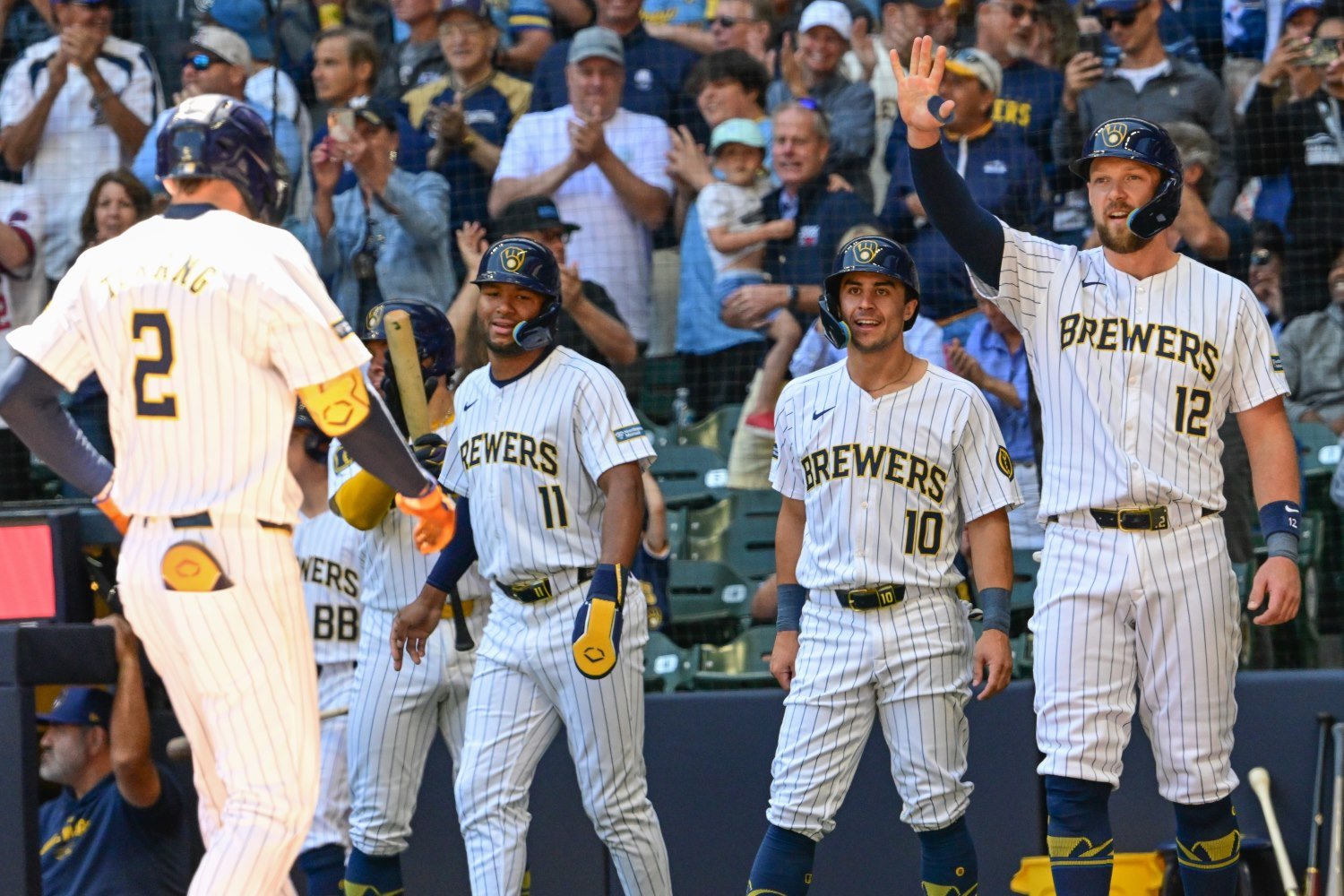 Brice Turang started the Brewers’ run of hitting five grand slams in eight games when he homered in San Diego last week, and he delivered the latest one in yesterday’s series finale against the division-rival Cubs. That second slam was Turang’s sixth home run of the year, tying his total from last season on the final day of June. Turang has made good on Pat Murphy’s promise of a “quantum leap,” with a breakout season fueled by a more compact swing. While most of his offensive value has come from reaching base and wreaking havoc with his speed, he has also experienced a slight power boost. The 24-year-old’s isolated power has increased from .082 in 2023 to .125 this year. He’s nudged his home run rate from one every 67.3 at-bats to one every 48. Turang is on pace to achieve a double-digit home run total this year. That uptick has come after Turang enacted an approach that isn’t geared toward hitting home runs. He added about 20 pounds of muscle over the offseason, but not with the intent of demolishing fly balls over the fence. “I’m not trying to crush or hit homers,” Turang said. “I’m trying to hit the ball hard back up the middle and just square it up. Good things happen when you’re focused like that.” Instead, the added power is a byproduct of that approach. It may seem paradoxical at first, but it’s not a coincidence that an extra ounce of power has come with the other gains Turang has made. Turang has become one of the game’s top contact hitters, and has one of baseball’s most controlled swings. That succinct and precise bat path enables him to consistently reach pitches that many hitters cannot, partially because it buys him more reaction time. “If you’re shorter, you can make a decision later,” Pat Murphy said. “If you’re quicker to the ball because your bat path is shorter, you can wait longer and identify [pitches] better. We’re talking about instances, but it gives you a little sense of confidence that, ‘Yeah, I can get to that.’” Being short to the ball keeps Turang from being late. It affords him the luxury of letting the ball get deep to shoot it to the opposite field. It’s also proving to be a vehicle by which Turang’s game power can play up from his raw power. Turang still doesn’t generate much loud contact. According to TruMedia, his 33.3% hard-hit rate ranks in the 13th percentile of qualified hitters. That doesn’t mean Turang can’t take swings with the necessary ingredients to drive the ball over the fence, though. While raw strength is a component of driving the ball, timing is also a significant factor. Rhys Hoskins generates ample natural power and can muscle out a home run on a ball he didn’t quite square up. Turang can’t. However, Turang’s compact swing helps him reach a contact point conducive to home runs. Most of Turang’s home runs have not come on powerful-looking swings. Instead, he is catching the ball with his barrel just as it’s about to cross the plate. That’s an ideal contact point for loud pull-side contact in the air. Turang hasn’t crushed most of these home runs, although he did launch a 419-foot blast in Anaheim on the Brewers’ last road trip. His average home run distance of 386.7 feet ranks in the 27th percentile. He’s generating just enough exit velocity in the air to his pull side, though. Five of his home runs have been hit to right or right-center. Below are videos of Turang’s home runs this season. His swing does not look damage-oriented in any of them. Instead, the ball jumps off his bat just enough because his compact swing brings him to a great contact point. Players of any level will recognize these swings as the ones where they don’t feel the ball hit the bat. Turang HRs.mp4 There has been some good fortune involved. Turang’s first home run of the year was a wall-scraper in Cincinnati, and Statcast says his home run at Fenway Park would have cleared in just 15 of 30 parks. Yet, he would still have a shot at 10 in a full season had one or two not left the yard. Turang certainly is not a power hitter. Nor is he trying to be one. Incidentally, that approach puts him in the best spot to hit more home runs. A double-digit home run tally would be a cherry on top of what has already blossomed into a productive offensive profile.
-
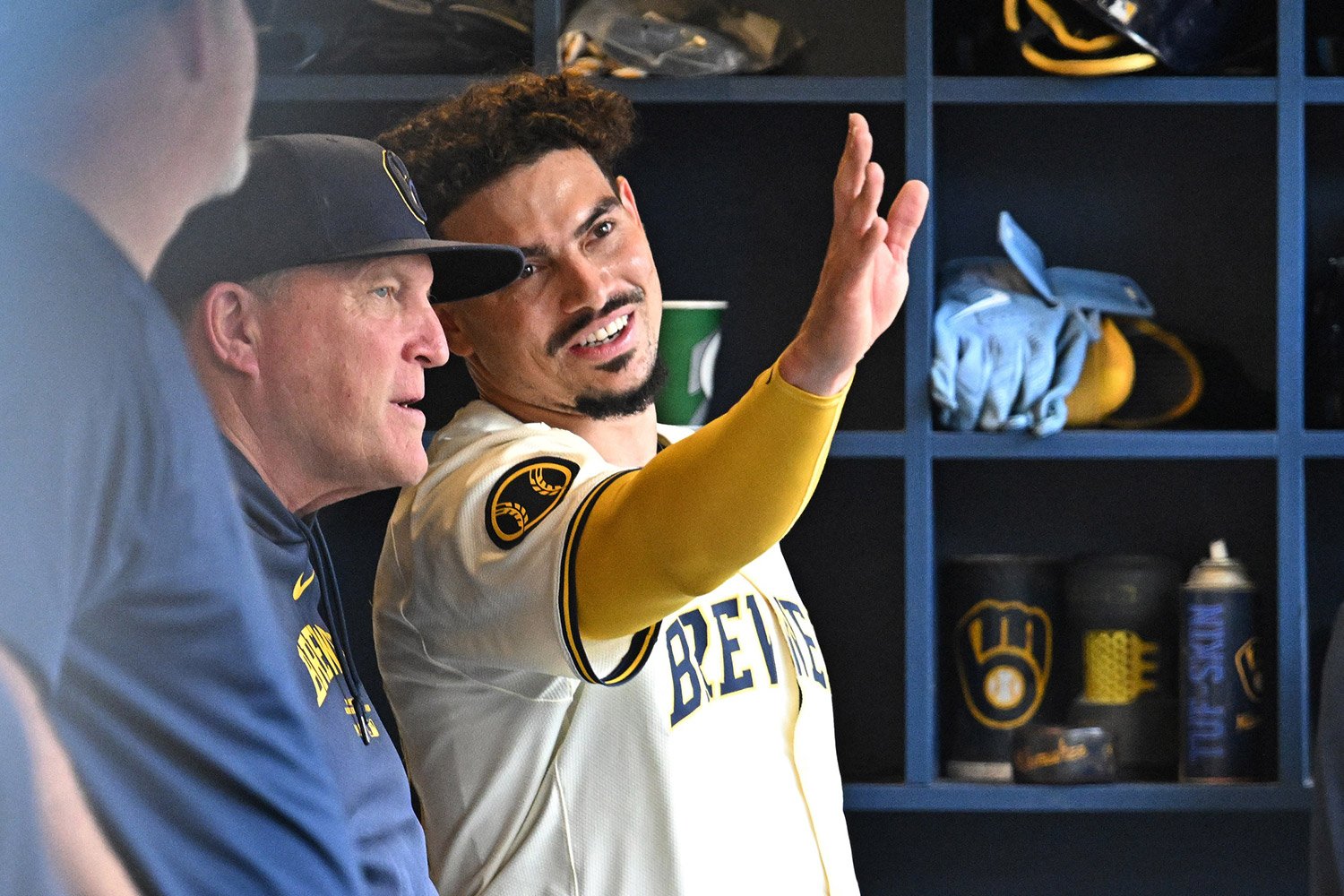 The Brewers opened the mathematical second half of the regular season with a win over the division-rival Cubs at home. At this juncture, the club finds itself in a better position than even the more optimistic preseason predictions forecasted: the third-best winning percentage (.598) in the National League and a 6.5-game lead over the St. Louis Cardinals in the NL Central. Most early-season noise has dissipated by the halfway point, and a club’s identity solidifies. That’s not to say the Brewers will continue performing at their current level for the rest of the schedule, but it does mean the season has reached a threshold at which larger concrete takeaways become plausible. Here are three things we’ve learned about this Brewers team. The Brewers' most balanced lineup in years may also be its best. Milwaukee’s offense has assumed many shapes over the past few seasons, and most have produced lackluster results. In a seven-year stretch from 2017 through 2023, the Brewers had a below-average offense by wRC+ in five seasons. Last year’s iteration was the worst in a full season during that stretch, finishing with a 92 wRC+ that ranked 24th in baseball and a .385 slugging percentage that ranked 25th. This year, the club’s 108 wRC+ places 10th in the sport. Some good fortune has probably elevated that figure, but the offense still grades out as average according to process-centric metrics like xwOBA (.319) and DRC+ (100). More balance has been the key. In past seasons, the Brewers have relied heavily on home runs while struggling to get on base or find other ways to score. Last season, they worked counts and boasted one of the highest walk rates in baseball, but a lack of power–their .146 ISO was the third-worst in baseball–rendered the offense punchless. The 2024 Brewers feature a productive blend of on-base ability, speed, and power that equips them with multiple ways to score runs. They rank fourth in baseball in on-base percentage (.331) and second in stolen bases (114) while maintaining a league-average home run rate (2.7%). Players like Brice Turang, Blake Perkins, and Sal Frelick have contributed by reaching base and taking extra bases. Others like Rhys Hoskins and Jake Bauers have provided power. Christian Yelich, William Contreras, and Joey Ortiz have anchored the lineup by demonstrating both attributes. While the offense has faced some inevitable regression in June, the ingredients of a sustainably above-average lineup are present. The Brewers have clubbed four grand slams in the past week, three of which have been go-ahead shots, demonstrating that they feature enough thump to slug their way out of prolonged slumps when the hits dry up. The run-prevention system was built to weather hits to the pitching depth. As of this writing, the Brewers have an entire starting rotation on the injured list. In addition to the anticipated absence of Brandon Woodruff, the Brewers have lost Wade Miley and Robert Gasser for the year due to Tommy John surgery. DL Hall and Joe Ross round out the list, and Jakob Junis was on the shelf for ten weeks after making his first start. The Brewers have kept chugging along, though. Colin Rea has emerged as the de facto ace amid Freddy Peralta's inconsistency. Tobias Myers and Bryse Wilson have stepped into starting roles with solid results. Those three have combined for a 3.59 ERA in 213 ⅓ innings, but their isolated performances have more closely resembled those of back-of-the-rotation depth starters. Their 4.74 FIP and 4.42 SIERA are far less flattering. Those discrepancies are not coincidental, however. Rea, Myers, and Wilson have benefitted from a run-prevention infrastructure purposely constructed to maximize their results. The Brewers are an excellent defensive team. They feature three shortstops in the infield and rangy center fielders across the outfield. That mobility enables the pitching staff to record outs on balls that would fall for hits against other teams. This system was already in place last year. Milwaukee’s 68 Defensive Runs Saved ranked second in baseball, and their pitchers allowed the lowest batting average on balls in play (.267). This year, it’s been more of the same, as the Brewers are seventh in DRS (30) and BABIP (.278). The trio of Rea, Myers, and Wilson have benefitted from a .252 BABIP. “The Milwaukee Brewers always have to play defense,” Pat Murphy said. “It just makes sense for our team to be able to baserun as good as we can, to be able to play defense, and to have a multitude of pitchers available.” That defensive unit helps that multitude of pitchers overperform the results one might expect based on their arsenals and the kind of contact they induce. It makes it far more feasible to plug an inexperienced or underperforming arm into the rotation and receive competitive results. If that pitcher throws strikes and keeps the ball in the yard, the Brewers will make plays behind them. “It’s not just you throwing the baseball out there,” Matt Arnold said. “You have to execute that pitch, and some of that is the pitch call that comes from the catcher or the dugout. The defense behind them, a guy puts the ball in play, you [see] the plays from Brice [Turang] and Willy [Adames]. It’s just like, these guys, it’s a team effort. It really is. And so I think the combination of all those guys, all the ingredients certainly helps the pitchers.” Pat Murphy is the right man for the job. The Brewers raised eyebrows when they promoted their longtime bench coach as Craig Counsell’s successor. Whereas Counsell became heralded for his new-school style that skillfully intertwined a data-driven approach with excellent communication skills, Murphy had a reputation as a fiery old-school coach from his days as a collegiate head coach. Those seem like sharply contrasting styles, which raised questions about the team's direction. Fast-forward a few months, and Murphy has proven that he was the right choice to manage the 2024 Brewers. The more Murphy talked throughout spring training about his philosophy, the clearer it became that his outdated rap did not accurately reflect the kind of manager he would be in his first full-time MLB opportunity. Murphy already had the respect of returning players from his time as bench coach and quickly endeared himself to the rest of the clubhouse. Players affectionately dubbed him “Patches,” a reference to the elderly and eccentric coach from the 2004 film Dodgeball. Murphy primarily communicates through his sense of humor and blunt speech but also knows when to handle delicate situations with greater care and sensitivity. That blend has made him the perfect leader for a young roster. As the season progressed, Murphy married his knowledge from experience with his willingness to continue learning as a student of the game. While he maintains that his experienced eye can tell him much of what he needs to know, he also welcomes data and conversations with an analytical front office. “Our game’s going to the data, and you’ve got to embrace it,” Murphy said during a pregame session with the media last month. “Because the data, it’s there for us to look at… You kind of can see it, but a lot of times, you’re fooled. So it’s a great way to kind of validate what you think you see. And that’s why I like it.” Given the open mind he carried into his new role, it’s no surprise that Murphy’s performance as a strategist has steadily improved along the way. The evolution of his bullpen management is an example. Murphy allowed key relievers to shoulder questionable workloads during the season’s inaugural weeks but has since spoken in detail about monitoring and pacing his bullpen arms. He has kept his high-leverage relievers down several times and trusted his “B” relievers in bigger spots. The balance between winning now and down the road is challenging to strike, and Murphy has gotten far better at it over time. Murphy has still made some debatable choices throughout the year, but no manager always pushes the right button or is immune to nitpicking. The bottom line is that he has successfully fulfilled the primary responsibilities of a manager: he’s been a positive leadership figure and has put his players in positions to succeed far more often than not.
-
Larger takeaways start to solidify by the midpoint of the regular season. It's been a telling first half for the Brewers, who have established their aura as a team after carrying many unknowns into the start of the year. Image courtesy of © Michael McLoone-USA TODAY Sports Larger takeaways start to solidify by the midpoint of the regular season. It's been a telling first half for the Brewers, who have established their aura as a team after carrying many unknowns into the start of the year. The Brewers opened the mathematical second half of the regular season with a win over the division-rival Cubs at home. At this juncture, the club finds itself in a better position than even the more optimistic preseason predictions forecasted: the third-best winning percentage (.598) in the National League and a 6.5-game lead over the St. Louis Cardinals in the NL Central. Most early-season noise has dissipated by the halfway point, and a club’s identity solidifies. That’s not to say the Brewers will continue performing at their current level for the rest of the schedule, but it does mean the season has reached a threshold at which larger concrete takeaways become plausible. Here are three things we’ve learned about this Brewers team. The Brewers' most balanced lineup in years may also be its best. Milwaukee’s offense has assumed many shapes over the past few seasons, and most have produced lackluster results. In a seven-year stretch from 2017 through 2023, the Brewers had a below-average offense by wRC+ in five seasons. Last year’s iteration was the worst in a full season during that stretch, finishing with a 92 wRC+ that ranked 24th in baseball and a .385 slugging percentage that ranked 25th. This year, the club’s 108 wRC+ places 10th in the sport. Some good fortune has probably elevated that figure, but the offense still grades out as average according to process-centric metrics like xwOBA (.319) and DRC+ (100). More balance has been the key. In past seasons, the Brewers have relied heavily on home runs while struggling to get on base or find other ways to score. Last season, they worked counts and boasted one of the highest walk rates in baseball, but a lack of power–their .146 ISO was the third-worst in baseball–rendered the offense punchless. The 2024 Brewers feature a productive blend of on-base ability, speed, and power that equips them with multiple ways to score runs. They rank fourth in baseball in on-base percentage (.331) and second in stolen bases (114) while maintaining a league-average home run rate (2.7%). Players like Brice Turang, Blake Perkins, and Sal Frelick have contributed by reaching base and taking extra bases. Others like Rhys Hoskins and Jake Bauers have provided power. Christian Yelich, William Contreras, and Joey Ortiz have anchored the lineup by demonstrating both attributes. While the offense has faced some inevitable regression in June, the ingredients of a sustainably above-average lineup are present. The Brewers have clubbed four grand slams in the past week, three of which have been go-ahead shots, demonstrating that they feature enough thump to slug their way out of prolonged slumps when the hits dry up. The run-prevention system was built to weather hits to the pitching depth. As of this writing, the Brewers have an entire starting rotation on the injured list. In addition to the anticipated absence of Brandon Woodruff, the Brewers have lost Wade Miley and Robert Gasser for the year due to Tommy John surgery. DL Hall and Joe Ross round out the list, and Jakob Junis was on the shelf for ten weeks after making his first start. The Brewers have kept chugging along, though. Colin Rea has emerged as the de facto ace amid Freddy Peralta's inconsistency. Tobias Myers and Bryse Wilson have stepped into starting roles with solid results. Those three have combined for a 3.59 ERA in 213 ⅓ innings, but their isolated performances have more closely resembled those of back-of-the-rotation depth starters. Their 4.74 FIP and 4.42 SIERA are far less flattering. Those discrepancies are not coincidental, however. Rea, Myers, and Wilson have benefitted from a run-prevention infrastructure purposely constructed to maximize their results. The Brewers are an excellent defensive team. They feature three shortstops in the infield and rangy center fielders across the outfield. That mobility enables the pitching staff to record outs on balls that would fall for hits against other teams. This system was already in place last year. Milwaukee’s 68 Defensive Runs Saved ranked second in baseball, and their pitchers allowed the lowest batting average on balls in play (.267). This year, it’s been more of the same, as the Brewers are seventh in DRS (30) and BABIP (.278). The trio of Rea, Myers, and Wilson have benefitted from a .252 BABIP. “The Milwaukee Brewers always have to play defense,” Pat Murphy said. “It just makes sense for our team to be able to baserun as good as we can, to be able to play defense, and to have a multitude of pitchers available.” That defensive unit helps that multitude of pitchers overperform the results one might expect based on their arsenals and the kind of contact they induce. It makes it far more feasible to plug an inexperienced or underperforming arm into the rotation and receive competitive results. If that pitcher throws strikes and keeps the ball in the yard, the Brewers will make plays behind them. “It’s not just you throwing the baseball out there,” Matt Arnold said. “You have to execute that pitch, and some of that is the pitch call that comes from the catcher or the dugout. The defense behind them, a guy puts the ball in play, you [see] the plays from Brice [Turang] and Willy [Adames]. It’s just like, these guys, it’s a team effort. It really is. And so I think the combination of all those guys, all the ingredients certainly helps the pitchers.” Pat Murphy is the right man for the job. The Brewers raised eyebrows when they promoted their longtime bench coach as Craig Counsell’s successor. Whereas Counsell became heralded for his new-school style that skillfully intertwined a data-driven approach with excellent communication skills, Murphy had a reputation as a fiery old-school coach from his days as a collegiate head coach. Those seem like sharply contrasting styles, which raised questions about the team's direction. Fast-forward a few months, and Murphy has proven that he was the right choice to manage the 2024 Brewers. The more Murphy talked throughout spring training about his philosophy, the clearer it became that his outdated rap did not accurately reflect the kind of manager he would be in his first full-time MLB opportunity. Murphy already had the respect of returning players from his time as bench coach and quickly endeared himself to the rest of the clubhouse. Players affectionately dubbed him “Patches,” a reference to the elderly and eccentric coach from the 2004 film Dodgeball. Murphy primarily communicates through his sense of humor and blunt speech but also knows when to handle delicate situations with greater care and sensitivity. That blend has made him the perfect leader for a young roster. As the season progressed, Murphy married his knowledge from experience with his willingness to continue learning as a student of the game. While he maintains that his experienced eye can tell him much of what he needs to know, he also welcomes data and conversations with an analytical front office. “Our game’s going to the data, and you’ve got to embrace it,” Murphy said during a pregame session with the media last month. “Because the data, it’s there for us to look at… You kind of can see it, but a lot of times, you’re fooled. So it’s a great way to kind of validate what you think you see. And that’s why I like it.” Given the open mind he carried into his new role, it’s no surprise that Murphy’s performance as a strategist has steadily improved along the way. The evolution of his bullpen management is an example. Murphy allowed key relievers to shoulder questionable workloads during the season’s inaugural weeks but has since spoken in detail about monitoring and pacing his bullpen arms. He has kept his high-leverage relievers down several times and trusted his “B” relievers in bigger spots. The balance between winning now and down the road is challenging to strike, and Murphy has gotten far better at it over time. Murphy has still made some debatable choices throughout the year, but no manager always pushes the right button or is immune to nitpicking. The bottom line is that he has successfully fulfilled the primary responsibilities of a manager: he’s been a positive leadership figure and has put his players in positions to succeed far more often than not. View full article
-
The newest Brewers hurler looks like a solid fit, as a ground-ball pitcher surrounded by excellent defensive infielders. However, his path to success has more to do with his pitch mix and benefiting from the rest of his defense. Image courtesy of © Erik Williams-USA TODAY Sports The newest Brewers hurler looks like a solid fit, as a ground-ball pitcher surrounded by excellent defensive infielders. However, his path to success has more to do with his pitch mix and benefiting from the rest of his defense. The Brewers finally bolstered their rotation depth with an external move, acquiring veteran starter Dallas Keuchel in a minor-league trade with the Seattle Mariners on Tuesday. Keuchel was pitching for Seattle’s Triple-A affiliate in Tacoma on a minor-league deal, but will immediately step into Milwaukee’s big-league pitching mix. He joined the club during Tuesday night’s game. The southpaw could debut in Wednesday’s series finale with the Texas Rangers. He last pitched on Friday, which lines him up for a Wednesday start on regular rest. Colin Rea was set to pitch, but is no longer listed as the probable starter. This move is akin to last summer’s acquisition of Julio Teherán. Milwaukee needed a cheap and available veteran for short-term innings coverage in a thin rotation. If it can coax five or so passable starts from the 36-year-old, he’ll go down as a successful addition. Formerly a Cy Young Award winner and two-time All-Star with the Houston Astros, Keuchel is far removed from his days as a mainstay in a big-league rotation. His last three seasons of MLB work have been especially rough: a 6.29 ERA, 5.20 FIP, and 5.01 SIERA in 260 ⅓ innings. His strikeout-to-walk ratio during that stretch is an unsightly 1.53, and his once-sterling home run rate has ballooned to 1.35 per nine innings. The Brewers have had plenty of success in helping pitchers with lackluster strikeout-to-walk ratios outperform their peripheral metrics by fielding an elite defense behind them. Wade Miley was a shining example in both of his stints in Milwaukee. The injury-ravaged rotation Keuchel is joining has remained afloat thanks to significant overperformance on batted balls from Rea, Bryse Wilson, and Tobias Myers. Could he be the latest in that trend? The potential is evident at first glance; the sinkerballing Keuchel has always been an extreme ground-ball pitcher, and he is playing in front of an excellent defense that features three natural shortstops with plus range. Keuchel’s 53.4% ground-ball rate during the aforementioned stretch falls short of the monstrous grounder rates he produced in Houston, but still ranks in the 93rd percentile of pitchers. In his 13 starts with the Tacoma Raiders this year, he induced grounders on 59.5% of balls in play. Milwaukee’s infield defense ranks fifth with 10 Outs Above Average this year, and that total includes a debatable -1 rating for Brice Turang, who ranks sixth in baseball with 8 Defensive Runs Saved. The run prevention unit has limited opponents to a .231 batting average on ground balls, the eighth-lowest mark in baseball. However, Keuchel’s .236 batting average allowed on ground balls since 2021 suggests that he does not stand to gain as much from that infield defense as one would think. Any boost he may experience could stem from inducing more ground balls and mitigating damage on other kinds of contact. Keuchel has gotten burned on balls in the air about as badly as any pitcher to work over 100 innings since 2021. Of 456 such pitchers, his .404 batting average allowed on fly balls ranks 454th. His .243 BABIP on fly balls, which excludes home runs, ranks the same. Much of that damage is self-inflicted. Keuchel’s hard hit and barrel rates on fly balls rank in the third and first percentiles of that list, respectively. He’s yielded louder fly balls than most pitchers, and this is a common problem. There's a platoon advantage for fly-ball hitters against ground-ball pitchers, because the locations where a ground-ball guy works often fit well with the ones where fly-ball hitters seek to make damage, and because a fly ball surrendered by a ground-ball hurler is usually a mistake pitch, therefore more likely to be squared up. At the same time, it may be the area where Milwaukee’s defense stands to aid him most. The outfielders behind Keuchel have combined for -4 Outs Above Average over his last three MLB seasons. The Brewers’ outfield ranks seventh in baseball this year with 6 Outs Above Average. They’ve recorded the fourth-most hard-hit outs on fly balls (117). The best way to avoid damage on fly balls is to limit them. Simplifying Keuchel’s pitch mix to focus on what he still does well is a good first step. Keuchel’s sinker still possesses above-average movement and has yielded a fly ball rate of just 13% since 2021. He has only thrown it 39% of the time during that stretch, though, while turning increasingly to an ineffective cutter that’s been responsible for most of the barrels he has allowed. Keuchel has leaned on the sinker more heavily with the Rainiers, boosting its usage to 46.5% while using his cutter just 13.5% of the time. His most-used secondary pitch has been his changeup, which features excellent separation from his fastball due to its plus vertical drop and average velocity of 79.7 mph. That’s the blueprint Keuchel will have to follow in Milwaukee: lean heavily on the sinker and changeup to induce ground balls and keep hitters out in front. He should probably take the prevalence of those two pitches to an even greater extreme than he has in Triple-A. From there, the cutter and slider can serve as occasional new-look offerings. As we know, though, the Brewers also like to keep secondary fastball looks in the mix for their starters, so we could see the cutter remain in the mix and generate unexpected utility. By using the right mix and getting enough help from the rangy outfield corps of Blake Perkins, Sal Frelick, Jackson Chourio, and perhaps Garrett Mitchell, Keuchel could be the holdover the Brewers need as the club waits on its rotation to get closer to full strength. Even if that doesn’t pan out, he was a worthwhile buy-low acquisition. View full article


