

Jump to content
Brewer Fanatic
  • Brewers Minor League Coverage

    Brewer Fanatic 2024 Offseason Top 20 Prospects: #11-15


    Spencer Michaelis

    Welcome back to Brewer Fanatic's 2024 top 20 prospect rundown! The Brewers graduated a number of their top prospects throughout the 2024 season, so there are some new names to look at heading into the offseason.

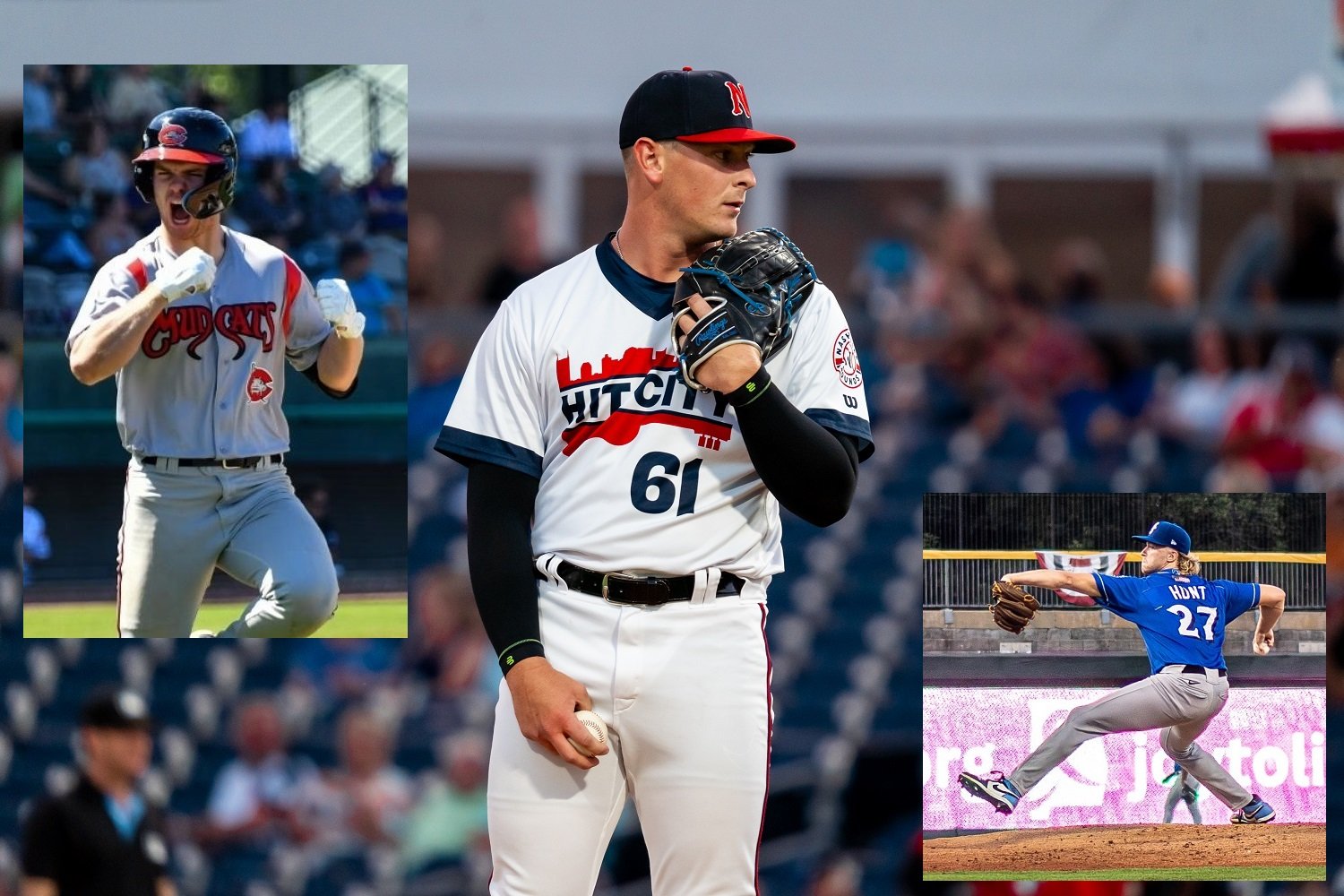
    Image courtesy of Left to Right: Neal Hock, Carolina Mudcats (photo of Adams), Nashville Sounds (photo of Yoho), Sierra Gatz, Biloxi Shuckers (photo of Hunt)

    Brewers Video

    Let's take a look at the second installment of prospects, which will cover 11-15, as voted on and compiled by the Brewer Fanatic community.

    #15 RHP Josh Knoth (Carolina Mudcats)
    AD_4nXe0s87_XR4Xf8ROUtDQGWTRD57hSTI44iK9

    The Brewers' Competitive Balance Round A selection in the 2023 Draft, Knoth has a smooth delivery that appears to be pretty repeatable. Going back to the summer of 2022, his profile was already very enticing, even though he only threw his fastball in the 90-93 range and was topping out at 95, at the time. The spring before he was drafted, however, he was up to 98 on occasion and sitting more in the 93-96 range. 

    AD_4nXeHQVpNY7n8K-3TDl0tIOvbG43a8-f1jCAy

    Knoth’s velocity held in that 93-96 range in 2024, and the fastball played quite well at the Low-A level. His athletic delivery gives him a low release height, which helps the fastball play well up in the zone, due to the carry he generates on the pitch. The fastball shape pairs extremely well with Knoth’s low-80s curveball. It’s a 3,000-RPM pitch with late bite and a ton of vertical movement.

    His slider could be a plus pitch as well, coming in on a different plane than his curve, with more sweep and less depth. The slider also has sharp movement and a spin rate around 3,000 RPMs, and it sits in the 86-88 MPH range. He seems more comfortable with commanding the slider than the curveball, and likes to use it as a put-away pitch against right-handed hitters.

    Knoth also mixes in an occasional changeup (mostly against lefties) that shows some interesting fade. So far, he doesn’t take as much velocity off of it as you would hope, and that’s likely something the Brewers will continue to work on with him. A decent fourth pitch, especially something that moves the opposite direction of his breaking balls, would make it more likely that he’s able to continue as a starting pitcher.

    While Knoth’s repertoire seems like one that would give right-handed hitters fits, given how breaking ball-heavy it is, he was actually much better against left-handed hitters this season. Lefties only managed a .630 OPS against him, while righties were at .808 for the year. An 84-inning sample isn’t big enough to make any conclusions with regard to platoon splits, but it will be worth monitoring as he moves forward.

    Knoth spent the vast majority of his season as an 18-year-old in Low A, and he definitely held his own. His command would come and go, and he allowed more hard contact and line drives than you would want. However, those types of struggles are not abnormal for such a youngster in full-season ball. It will be interesting to see if he remains in Carolina to begin 2025, or if they continue to push him by starting him at High-A Wisconsin. Knoth has one of the higher ceilings among the pitchers in the organization, but fans will need to remain patient. He will be a teenager for the majority of 2025; there’s still a lot of work to be done.

    #14 RHP Craig Yoho (Wisconsin Timber Rattlers, Carolina Mudcats, Biloxi Shuckers)
    AD_4nXes1rfSFICkYey98VfNiKuEGjqHH3pLC6Kw

    The Brewers' 8th-round selection in the 2023 draft out of Indiana, Yoho is the only pitcher on this list of 20 prospects who appears to be firmly slotted into a relief role in the future. Initially a position player in college, he transitioned to a two-way role for a couple of seasons, but after battling quite a few injuries, he gave up hitting. His draft year was his first season focusing solely on pitching. So, despite his advanced age, he entered pro ball with some untapped potential. After an incredible start with the Timber Rattlers, he quickly made his way to Double-A where he again was dominant enough to make another quick leap to Triple-A, which is where he would close out his impressive debut season.

    AD_4nXfcnoTD00q4pNfp6vfCOGeQ9_s4zdylI-aQ

    Yoho does not possess the velocity that we have all come to expect out of a high-leverage reliever. You will not see him in the upper 90s. His fastball is a strong offering, currently sitting in the 91-93 range with heavy arm-side run, getting up to 21 inches at times and averaging around 17 inches. It doesn’t get a lot of swing-and-miss, but it does generate a lot of ground balls and often sneaks in for called strikes on the glove side. What carries his profile though, are his secondaries. 

    Not many pitches should be compared to Devin Williams’s “airbender” changeup, but Yoho’s is maybe the lone exception. The movement profile is very similar, with Yoho generating around -2 inches of Induced Vertical Break (IVB), while Williams is at -3.5 inches on average. Yoho averaged 18 inches of horizontal movement to the arm side, while Williams was at 19.4 inches. They are in a very similar spot. It should be noted that Yoho throws his around 77-79 MPH on average, while Williams is in the 83-86 range, but everything else is very similar. Public data on the pitch wasn’t available until he reached Triple-A, but at that level, Yoho generated an elite 45.9% whiff rate on his changeup, while using it as his primary pitch and throwing it 41% of the time. It appears to be one of the best pitches in baseball.

    Unlike Williams, Yoho doesn’t stop there. He also possesses a curveball, which averaged around 75 MPH during his time in Nashville. The curve essentially mirrors the shape of the changeup, averaging over 20 inches of glove-side movement, and with an IVB of -7.8 inches. The curveball was not used as often as the changeup, but it still generated whiffs at a 45.5% clip. Another plus, or better, pitch in Yoho’s repertoire.

    Yoho also added a cutter this past season, which was likely meant to give him a mirror to the two-seam fastball he throws. The cutter averaged around 88 MPH, and while it showed some flashes, it was by far the least effective of his four pitches. It will be a continued work in progress for 2025, or perhaps they will eventually scrap it, as he may not need it to be effective.

    Yoho shared the Brewers' MiLB Co-Pitcher of the Year honors with K.C. Hunt, and won Relief Pitcher of the Year honors through all of Minor League Baseball (courtesy of Baseball America and MLB Pipeline). He was knocking on the doorstep of MLB in September, and may have only been an injury or two away from getting there. He is a definite candidate to join the Brewers bullpen in 2025, likely sooner rather than later.

    #13 1B/3B Luke Adams (Wisconsin Timber Rattlers)
    AD_4nXdwjZc_8lBtBqQdrsoxqMrBzdIjgbZRoGoA

    The Brewers' 12th-round pick in the 2022 draft. Adams was drafted out of Hinsdale Central High School in Illinois and appears to have been a really nice find by Area Scout Ginger Poulson. Adams spent the first few weeks of the 2024 season still a 19-year-old, before turning 20 in late April. 

    AD_4nXehwExgGrM6U52MlpXv6EsGfpebmwxzNDII

    Standing 6-foot-4 and weighing 210 pounds, Adams shows a rare blend of patience at the plate  go along with his plus raw power, as well as surprising speed for his size. Adams has played a very solid third base where he not only has the arm to handle the position, but has shown an ability to make off-platform throws, which is not easily done at 6’4. In a Baseball America survey of Midwest League coaches, Adams was voted the best defensive third baseman in the league. He also spent some time at first base, where he is a definite above average defender.

    Offensively, Adams has a very violent swing, but he did tone down the amount of movement in the swing from 2023 to 2024. Those adjustments helped him improve even further on his impressive plate discipline and bat-to-ball skills. While his patience definitely paid off to the tune of a 98th percentile walk rate, the key for him is going to be continuing to find the balance between being passive and patient. His overall swing rate of 40.6% was the lowest of all 525 qualified hitters in MiLB and MLB. The pitchers he faces will get better at throwing strikes as he climbs through the minors and he will need to find a way to be a bit more aggressive on in-zone pitches.

    When he does swing, he tends to make a lot of contact, and loud contact at that. For someone with as much movement as he still has in his swing, a whiff rate of 21.6% is fantastic, and placed him in the 84th percentile in MiLB. His 106 MPH 90th Percentile Exit Velocity would have placed him in the 90th percentile for Triple-A hitters, and is one of the highest of any twenty year old in baseball.

    When you hit the ball as hard as Adams does, the only ball in play that really doesn’t have a chance is a pop up and 31% of Adams’ fly balls were of the pop-up variety, a number that put him in the 13th percentile. That’s something that carried over from 2023 to 2024 and will be something he will likely be focused on improving heading into 2025.

    As mentioned earlier, Adams is also a freak athlete for his size, and he’s an above average runner presently. He stole 28 bases this year, though only at a 74% success rate. He likely won’t be a huge stolen base threat at the big league level, but he will definitely be enough of a threat to keep defenses on their toes.

    Adams ended the season as one of the best hitters at the High-A level, despite being one of the younger hitters at the level. He will likely be in a similar situation in Biloxi next year, where he seems likely to start the 2025 campaign.

    #12 CIF Eric Bitonti (ACL Brewers, Carolina Mudcats)
    AD_4nXf4Dcf5COwougXrJiAIkN4ZH6m_B8knL0eM

    Selected in the third round of the Brewers 2023 draft, Bitonti spent the entire 2024 season as an eighteen year old, and won’t turn nineteen until mid-November of 2024. Drafted as a shortstop, it was always unlikely that someone of his size would be able to stick there and he spent all of this past season at the corner infield spots.

    AD_4nXe_IfZ2qjetDJAKbgofG65qjMbOJjLCRZSk

    Equipped with arguably the most raw power of anyone in his high school class, Bitonti showed a strong ability to get to it in game, throughout his first full professional season. His 104.8 MPH 90th percentile exit velocity was in the upper tier for players his age, and his 24% barrel rate was an elite number, regardless of age. Overall Bitonti hit 16 home runs, hitting eight at the Complex level and eight at Low-A. He’s able to get to his game power because of his batted-ball profile. He hit over 50% of his balls in play for fly balls, which was 98th percentile. At the same time, Bitonti impressively avoided popping up the ball much, only doing so on 11.2% of his fly balls. His 28.3% ground ball rate was also in the 98th percentile, in the context of a low rate being better than a high one. 

    Bitonti has a sweet looking left handed swing, and while he did strikeout at a higher rate than you would want to see, he only chased at a 20% clip which would have been in the 94th percentile at the MLB level. He does have a healthy amount of swing and miss in his game, so his bat-to-ball grade would come in below average. However, his swing decision grade would grade out as plus so far. While the hit tool is unlikely to ever be better than mediocre, there is a lot of Kyle Schwarber to Bitonti’s profile as a hitter. The big time power, ability to hit the ball in the air and the ability to take pitches out of the zone are all calling-cards of Schwarber’s as well.

    While he was never going to be able to stick as a shortstop, Bitonti should be a pretty strong defender at the hot corner, and he certainly has the arm to handle it as well. His hands are pretty good, though he does struggle to move laterally at times. If that lack of range proves to be too big of an issue, he could end up at first base long term, where his hands would be more important. While a move to first would not be the most ideal outcome, the good news is that his bat would be able to hold up to the expectations that come with playing first base.

    Given how well Bitonti performed in Carolina to close out his season and the aggressiveness with which the Brewers have been pushing players this season, it’s possible he will begin 2025 in High-A. If not, he will be back in Carolina, where he could quickly force his way to High-A with another strong start.

    #11 OF Braylon Payne (Carolina Mudcats)
    AD_4nXdoFiS6uvxqNQ1MSfVvzrEt4trbNVPHhMCi

    The Brewers first round selection in the most recent MLB Draft, Payne was a surprising pick at the time it happened. The Brewers signed him to an under-slot deal, allowing them more room to maneuver later in the draft. While he was seen as a reach at the time, the early returns on Payne have been extremely encouraging.

    AD_4nXcePzTcrHtwikNRUksdxTBg0tWW1UMkLrIW

    After signing, Payne was assigned to the ACL Brewers, where he participated in the “Bridge League” which is a league designed to help get recent draftees acclimated to pro ball, and also to allow other young players the chance to play more games after the Complex League’s season has ended. Payne performed well enough there that he was given the opportunity to play in Carolina for the final week of the regular season, as well as the playoffs.

    Seen as a “slash and dash” type of hitter at the time of the draft, Payne quickly showed that he has the capability of being a lot more than that. There were reports that he hit multiple home runs in the Bridge League, and in just 19 regular season plate appearances for the Mudcats, Payne flashed exit velocities of 103, 104 and 110 MPH. He was the youngest player in Low-A at that time having only turned eighteen a couple of weeks prior. Per Baseball America, Payne’s 110.2 mph max exit velocity was the best of any player drafted out of high school and 13th-best among 158 total drafted players to make their debut.

    In the small professional sample, Payne did well in terms of not chasing pitches, limiting that to a 19.5% rate, but he did appear to have a habit of going after high fastballs. Something that may be able to be taken advantage of as he climbs through the system. He did also show an ability to get the bat to pitches in all quadrants of the zone, as well as outside of it, so that could help negate any chase issues he may eventually have pop up.

    Defensively, Payne received strong grades in high school and he appeared comfortable in his small sample at Low-A. His arm has reportedly improved over time, to the point where it grades out as average. He has mentioned that he believes there is more in the tank in terms of arm strength as well. His speed grades out as plus, which will help him as he develops in the outfield, and will also be a weapon for him on the bases, where he has already shown that he will be an aggressive, high effort base runner and base stealer.

    Payne will likely begin 2025 back with Carolina, where he will remain one of the youngest players. A surprise pick in July, Payne has the chance to be a surprise breakout in 2025. With signs of the power coming along, he has the potential to be a true five-tool player.


    What stands out from 11-15 in this list? Let us know your thoughts in the comments!


    Interested in learning more about the Milwaukee Brewers' top prospects? Check out our comprehensive top prospects list that includes up-to-date stats, articles and videos about every prospect, scouting reports, and more!

    View Brewers Top Prospects

    Follow Brewer Fanatic For Milwaukee Brewers News & Analysis

    Recent Brewers Articles

    Recent Brewers Videos

    Brewers Top Prospects

    Braylon Payne

    Wisconsin Timber Rattlers - A+, OF
    On Thursday, the 2024 top pick went 2-for-3 with two walks, with his fourth steal, and his second home run of the season. He's hitting .320 (1.029 OPS) in 8 games.

    User Feedback

    Recommended Comments

    Featured Comments

    27 minutes ago, Spencer Michaelis said:

    Welcome back to Brewer Fanatic's 2024 top 20 prospect rundown! The Brewers graduated a number of their top prospects throughout the 2024 season, so there are some new names to look at heading into the offseason.

    Brewers11to15.jpg.b6a67b877f0f8c5ef478d3cfd04e7958.jpg
    Image courtesy of Left to Right: Neal Hock, Carolina Mudcats (photo of Adams), Nashville Sounds (photo of Yoho), Sierra Gatz, Biloxi Shuckers (photo of Hunt)

    Let's take a look at the second installment of prospects, which will cover 11-15, as voted on and compiled by the Brewer Fanatic community.

    #15 RHP Josh Knoth (Carolina Mudcats)
    AD_4nXe0s87_XR4Xf8ROUtDQGWTRD57hSTI44iK9

    The Brewers' Competitive Balance Round A selection in the 2023 Draft, Knoth has a smooth delivery that appears to be pretty repeatable. Going back to the summer of 2022, his profile was already very enticing, even though he only threw his fastball in the 90-93 range and was topping out at 95, at the time. The spring before he was drafted, however, he was up to 98 on occasion and sitting more in the 93-96 range. 

    AD_4nXeHQVpNY7n8K-3TDl0tIOvbG43a8-f1jCAy

    Knoth’s velocity held in that 93-96 range in 2024, and the fastball played quite well at the Low-A level. His athletic delivery gives him a low release height, which helps the fastball play well up in the zone, due to the carry he generates on the pitch. The fastball shape pairs extremely well with Knoth’s low-80s curveball. It’s a 3,000-RPM pitch with late bite and a ton of vertical movement.

    His slider could be a plus pitch as well, coming in on a different plane than his curve, with more sweep and less depth. The slider also has sharp movement and a spin rate around 3,000 RPMs, and it sits in the 86-88 MPH range. He seems more comfortable with commanding the slider than the curveball, and likes to use it as a put-away pitch against right-handed hitters.

    Knoth also mixes in an occasional changeup (mostly against lefties) that shows some interesting fade. So far, he doesn’t take as much velocity off of it as you would hope, and that’s likely something the Brewers will continue to work on with him. A decent fourth pitch, especially something that moves the opposite direction of his breaking balls, would make it more likely that he’s able to continue as a starting pitcher.

    While Knoth’s repertoire seems like one that would give right-handed hitters fits, given how breaking ball-heavy it is, he was actually much better against left-handed hitters this season. Lefties only managed a .630 OPS against him, while righties were at .808 for the year. An 84-inning sample isn’t big enough to make any conclusions with regard to platoon splits, but it will be worth monitoring as he moves forward.

    Knoth spent the vast majority of his season as an 18-year-old in Low A, and he definitely held his own. His command would come and go, and he allowed more hard contact and line drives than you would want. However, those types of struggles are not abnormal for such a youngster in full-season ball. It will be interesting to see if he remains in Carolina to begin 2025, or if they continue to push him by starting him at High-A Wisconsin. Knoth has one of the higher ceilings among the pitchers in the organization, but fans will need to remain patient. He will be a teenager for the majority of 2025; there’s still a lot of work to be done.

    #14 RHP Craig Yoho (Wisconsin Timber Rattlers, Carolina Mudcats, Biloxi Shuckers)
    AD_4nXes1rfSFICkYey98VfNiKuEGjqHH3pLC6Kw

    The Brewers' 8th-round selection in the 2023 draft out of Indiana, Yoho is the only pitcher on this list of 20 prospects who appears to be firmly slotted into a relief role in the future. Initially a position player in college, he transitioned to a two-way role for a couple of seasons, but after battling quite a few injuries, he gave up hitting. His draft year was his first season focusing solely on pitching. So, despite his advanced age, he entered pro ball with some untapped potential. After an incredible start with the Timber Rattlers, he quickly made his way to Double-A where he again was dominant enough to make another quick leap to Triple-A, which is where he would close out his impressive debut season.

    AD_4nXfcnoTD00q4pNfp6vfCOGeQ9_s4zdylI-aQ

    Yoho does not possess the velocity that we have all come to expect out of a high-leverage reliever. You will not see him in the upper 90s. His fastball is a strong offering, currently sitting in the 91-93 range with heavy arm-side run, getting up to 21 inches at times and averaging around 17 inches. It doesn’t get a lot of swing-and-miss, but it does generate a lot of ground balls and often sneaks in for called strikes on the glove side. What carries his profile though, are his secondaries. 

    Not many pitches should be compared to Devin Williams’s “airbender” changeup, but Yoho’s is maybe the lone exception. The movement profile is very similar, with Yoho generating around -2 inches of Induced Vertical Break (IVB), while Williams is at -3.5 inches on average. Yoho averaged 18 inches of horizontal movement to the arm side, while Williams was at 19.4 inches. They are in a very similar spot. It should be noted that Yoho throws his around 77-79 MPH on average, while Williams is in the 83-86 range, but everything else is very similar. Public data on the pitch wasn’t available until he reached Triple-A, but at that level, Yoho generated an elite 45.9% whiff rate on his changeup, while using it as his primary pitch and throwing it 41% of the time. It appears to be one of the best pitches in baseball.

    Unlike Williams, Yoho doesn’t stop there. He also possesses a curveball, which averaged around 75 MPH during his time in Nashville. The curve essentially mirrors the shape of the changeup, averaging over 20 inches of glove-side movement, and with an IVB of -7.8 inches. The curveball was not used as often as the changeup, but it still generated whiffs at a 45.5% clip. Another plus, or better, pitch in Yoho’s repertoire.

    Yoho also added a cutter this past season, which was likely meant to give him a mirror to the two-seam fastball he throws. The cutter averaged around 88 MPH, and while it showed some flashes, it was by far the least effective of his four pitches. It will be a continued work in progress for 2025, or perhaps they will eventually scrap it, as he may not need it to be effective.

    Yoho shared the Brewers' MiLB Co-Pitcher of the Year honors with K.C. Hunt, and won Relief Pitcher of the Year honors through all of Minor League Baseball (courtesy of Baseball America and MLB Pipeline). He was knocking on the doorstep of MLB in September, and may have only been an injury or two away from getting there. He is a definite candidate to join the Brewers bullpen in 2025, likely sooner rather than later.

    #13 1B/3B Luke Adams (Wisconsin Timber Rattlers)
    AD_4nXdwjZc_8lBtBqQdrsoxqMrBzdIjgbZRoGoA

    The Brewers' 12th-round pick in the 2022 draft. Adams was drafted out of Hinsdale Central High School in Illinois and appears to have been a really nice find by Area Scout Ginger Poulson. Adams spent the first few weeks of the 2024 season still a 19-year-old, before turning 20 in late April. 

    AD_4nXehwExgGrM6U52MlpXv6EsGfpebmwxzNDII

    Standing 6-foot-4 and weighing 210 pounds, Adams shows a rare blend of patience at the plate  go along with his plus raw power, as well as surprising speed for his size. Adams has played a very solid third base where he not only has the arm to handle the position, but has shown an ability to make off-platform throws, which is not easily done at 6’4. In a Baseball America survey of Midwest League coaches, Adams was voted the best defensive third baseman in the league. He also spent some time at first base, where he is a definite above average defender.

    Offensively, Adams has a very violent swing, but he did tone down the amount of movement in the swing from 2023 to 2024. Those adjustments helped him improve even further on his impressive plate discipline and bat-to-ball skills. While his patience definitely paid off to the tune of a 98th percentile walk rate, the key for him is going to be continuing to find the balance between being passive and patient. His overall swing rate of 40.6% was the lowest of all 525 qualified hitters in MiLB and MLB. The pitchers he faces will get better at throwing strikes as he climbs through the minors and he will need to find a way to be a bit more aggressive on in-zone pitches.

    When he does swing, he tends to make a lot of contact, and loud contact at that. For someone with as much movement as he still has in his swing, a whiff rate of 21.6% is fantastic, and placed him in the 84th percentile in MiLB. His 106 MPH 90th Percentile Exit Velocity would have placed him in the 90th percentile for Triple-A hitters, and is one of the highest of any twenty year old in baseball.

    When you hit the ball as hard as Adams does, the only ball in play that really doesn’t have a chance is a pop up and 31% of Adams’ fly balls were of the pop-up variety, a number that put him in the 13th percentile. That’s something that carried over from 2023 to 2024 and will be something he will likely be focused on improving heading into 2025.

    As mentioned earlier, Adams is also a freak athlete for his size, and he’s an above average runner presently. He stole 28 bases this year, though only at a 74% success rate. He likely won’t be a huge stolen base threat at the big league level, but he will definitely be enough of a threat to keep defenses on their toes.

    Adams ended the season as one of the best hitters at the High-A level, despite being one of the younger hitters at the level. He will likely be in a similar situation in Biloxi next year, where he seems likely to start the 2025 campaign.

    #12 CIF Eric Bitonti (ACL Brewers, Carolina Mudcats)
    AD_4nXf4Dcf5COwougXrJiAIkN4ZH6m_B8knL0eM

    Selected in the third round of the Brewers 2023 draft, Bitonti spent the entire 2024 season as an eighteen year old, and won’t turn nineteen until mid-November of 2024. Drafted as a shortstop, it was always unlikely that someone of his size would be able to stick there and he spent all of this past season at the corner infield spots.

    AD_4nXe_IfZ2qjetDJAKbgofG65qjMbOJjLCRZSk

    Equipped with arguably the most raw power of anyone in his high school class, Bitonti showed a strong ability to get to it in game, throughout his first full professional season. His 104.8 MPH 90th percentile exit velocity was in the upper tier for players his age, and his 24% barrel rate was an elite number, regardless of age. Overall Bitonti hit 16 home runs, hitting eight at the Complex level and eight at Low-A. He’s able to get to his game power because of his batted-ball profile. He hit over 50% of his balls in play for fly balls, which was 98th percentile. At the same time, Bitonti impressively avoided popping up the ball much, only doing so on 11.2% of his fly balls. His 28.3% ground ball rate was also in the 98th percentile, in the context of a low rate being better than a high one. 

    Bitonti has a sweet looking left handed swing, and while he did strikeout at a higher rate than you would want to see, he only chased at a 20% clip which would have been in the 94th percentile at the MLB level. He does have a healthy amount of swing and miss in his game, so his bat-to-ball grade would come in below average. However, his swing decision grade would grade out as plus so far. While the hit tool is unlikely to ever be better than mediocre, there is a lot of Kyle Schwarber to Bitonti’s profile as a hitter. The big time power, ability to hit the ball in the air and the ability to take pitches out of the zone are all calling-cards of Schwarber’s as well.

    While he was never going to be able to stick as a shortstop, Bitonti should be a pretty strong defender at the hot corner, and he certainly has the arm to handle it as well. His hands are pretty good, though he does struggle to move laterally at times. If that lack of range proves to be too big of an issue, he could end up at first base long term, where his hands would be more important. While a move to first would not be the most ideal outcome, the good news is that his bat would be able to hold up to the expectations that come with playing first base.

    Given how well Bitonti performed in Carolina to close out his season and the aggressiveness with which the Brewers have been pushing players this season, it’s possible he will begin 2025 in High-A. If not, he will be back in Carolina, where he could quickly force his way to High-A with another strong start.

    #11 OF Braylon Payne (Carolina Mudcats)
    AD_4nXdoFiS6uvxqNQ1MSfVvzrEt4trbNVPHhMCi

    The Brewers first round selection in the most recent MLB Draft, Payne was a surprising pick at the time it happened. The Brewers signed him to an under-slot deal, allowing them more room to maneuver later in the draft. While he was seen as a reach at the time, the early returns on Payne have been extremely encouraging.

    AD_4nXcePzTcrHtwikNRUksdxTBg0tWW1UMkLrIW

    After signing, Payne was assigned to the ACL Brewers, where he participated in the “Bridge League” which is a league designed to help get recent draftees acclimated to pro ball, and also to allow other young players the chance to play more games after the Complex League’s season has ended. Payne performed well enough there that he was given the opportunity to play in Carolina for the final week of the regular season, as well as the playoffs.

    Seen as a “slash and dash” type of hitter at the time of the draft, Payne quickly showed that he has the capability of being a lot more than that. There were reports that he hit multiple home runs in the Bridge League, and in just 19 regular season plate appearances for the Mudcats, Payne flashed exit velocities of 103, 104 and 110 MPH. He was the youngest player in Low-A at that time having only turned eighteen a couple of weeks prior. Per Baseball America, Payne’s 110.2 mph max exit velocity was the best of any player drafted out of high school and 13th-best among 158 total drafted players to make their debut.

    In the small professional sample, Payne did well in terms of not chasing pitches, limiting that to a 19.5% rate, but he did appear to have a habit of going after high fastballs. Something that may be able to be taken advantage of as he climbs through the system. He did also show an ability to get the bat to pitches in all quadrants of the zone, as well as outside of it, so that could help negate any chase issues he may eventually have pop up.

    Defensively, Payne received strong grades in high school and he appeared comfortable in his small sample at Low-A. His arm has reportedly improved over time, to the point where it grades out as average. He has mentioned that he believes there is more in the tank in terms of arm strength as well. His speed grades out as plus, which will help him as he develops in the outfield, and will also be a weapon for him on the bases, where he has already shown that he will be an aggressive, high effort base runner and base stealer.

    Payne will likely begin 2025 back with Carolina, where he will remain one of the youngest players. A surprise pick in July, Payne has the chance to be a surprise breakout in 2025. With signs of the power coming along, he has the potential to be a true five-tool player.


    What stands out from 11-15 in this list? Let us know your thoughts in the comments!


    View full article


    Payne stands out for me.

    Potential 5-tool talents that perform like he did at his age can’t be outside of the team’s top 5, imo. 

    Didn’t take long for him to squash the picked him for underslot reasons narrative. 

    Having numerous young prospects for the league is an underrated aspect of this team’s system.

    • Like 6

    What a group of five that demonstrate all of the Brewers' scouting and development acumen! It was a fun read because I got more and more excited with each entry.

    It's only a matter of time before the world knows that the Brewers are not simply an organization that plucks guys at the margins and puts them in the pitching lab. The draft well, they sign international FAs well, they develop pitchers, young and "old". They develop speedsters, they develop power hitters, they develop 5-tool players.

    What a fun team of which to be a fan.

    • Like 5
    • Love 2
    43 minutes ago, Stealofhome said:

    Where do you get lower level exit velocity data? Is that from a non-public facing database? 

    It's not public info, but also not a database I have specific access to. I am lucky enough to have a couple sources I can ask for stuff like that once in a while. Some of the random EV data is also just from watching the games and having the announcers tell the listeners how hard it was hit.

    • Like 3

    I think Luke Adams is going to be a superstar.

    I also feel like there are more than a couple timelines where everything comes together and Bitonti rockets up to being a top 10 prospect in the blink of an eye.

    I find it hard to believe there is a higher ceiling 15-11 range in all of the minors.


    • Like 2

    I love Adams and had him highest rated out of the third base prospects in the system, but there a couple things that give me pause.

    There’s a little of that Darrien Miller in there where his profile is so walk and HBP heavy (40 plunks, MLB leader was Arozarena with 22) so that will taper off on the way up.

    Adams is considerably younger with more power so his walk rate should hold up better, but even there he was at 18.7% this year which is Soto/Judge territory in MLB. Then it’s a gap to Schwarber (15.3%) before another gap down to guys like India/Lowe (12.6%), Winker (12.4%), Freeman (12.2%), Harper (12.0%), Mookie (11.8%), Contreras (11.5%), etc so realistically that’s still Iike a six seven percent drop in a best case scenario by the time he hits MLB.

    The other red flag for me in his offensive profile is he now has 858 PAs the last two years with a .289 BABIP. The pop ups Spencer mentioned are probably a big part of that.

    • Like 2
    Joseph Zarr
  • Brewer Fanatic Contributor
  • Posted

    56 minutes ago, sveumrules said:

    I love Adams and had him highest rated out of the third base prospects in the system, but there a couple things that give me pause.

    There’s a little of that Darrien Miller in there where his profile is so walk and HBP heavy (40 plunks, MLB leader was Arozarena with 22) so that will taper off on the way up.

    Adams is considerably younger with more power so his walk rate should hold up better, but even there he was at 18.7% this year which is Soto/Judge territory in MLB. Then it’s a gap to Schwarber (15.3%) before another gap down to guys like India/Lowe (12.6%), Winker (12.4%), Freeman (12.2%), Harper (12.0%), Mookie (11.8%), Contreras (11.5%), etc so realistically that’s still Iike a six seven percent drop in a best case scenario by the time he hits MLB.

    The other red flag for me in his offensive profile is he now has 858 PAs the last two years with a .289 BABIP. The pop ups Spencer mentioned are probably a big part of that.

    I'm a fairly outspoken Adams supporter (was discussing him fairly regularly even back in his inaugural ACL days). YET, there is plenty to have pause about with Adams. He is definitively a player I am more 'cautious' about heading to Double-A. As you mention: the walk heavy/HBP heavy means of getting on base means very little in terms of actual production. It's a currently a low level Minor League anomaly. If people are concerned about Areinamo's swing, you can't feel comfortable with Adams' free form hack. He can hit the heck out of the ball when he hits it pure but that appears to be more a result of his insane athleticism and clear strength. He's young but he is very much a man beast. It isn't refined and it certainly isn't pure. Pop-ups also happen because of his inconsistent swing path. He also leaves the bat on his shoulders far too much. And, then, defensively he is extremely inconsistent. At the hot corner he has an absurd habit of making one-legged hero throws while falling away from his throwing path. It is head-scratching to say the least. He remains an insanely rough block of clay. Great prospect. Far from a certain anything until he commits to and successfully shapes his rough edges.

    • Like 4
    2 hours ago, Joseph Zarr said:

    At the hot corner he has an absurd habit of making one-legged hero throws while falling away from his throwing path. It is head-scratching to say the least. He remains an insanely rough block of clay. Great prospect. Far from a certain anything until he commits to and successfully shapes his rough edges.

    I was going to post this exact thing, you beat me to it.  He often takes routine plays and makes the throws as you describe, and it makes no sense that this hasn't been corrected.

    • Like 1
    3 hours ago, Joseph Zarr said:

    At the hot corner he has an absurd habit of making one-legged hero throws while falling away from his throwing path. It is head-scratching to say the least. He remains an insanely rough block of clay. Great prospect. Far from a certain anything until he commits to and successfully shapes his rough edges.

    38 minutes ago, TURBO said:

    I was going to post this exact thing, you beat me to it.  He often takes routine plays and makes the throws as you describe, and it makes no sense that this hasn't been corrected.

    No disagreement on this. It's definitely something that I've noticed as well. I think he's trying to do a variation of what the tweet below shows Arenado, Bregman, etc doing, but he doesn't actually keep his body moving toward first, and falls backwards, or off toward the 3B line like you guys are talking about. I have to imagine that will get corrected at some point.


    7 hours ago, snoogans8056 said:


    I find it hard to believe there is a higher ceiling 15-11 range in all of the minors.


    I was thinking the same thing reading the list. "These guys are 11-15?"

    The organization is really building some quality depth from the bottom up.

    Lots of people (Bitonti, Adams, Mike Boeve, Brock Wilken) that decisions will have to be made on regarding WHICH corner they eventually call home. Interesting, exhilarating times.

    • Like 1

    I struggle with how I feel about Adams.  I had him 19th on my list and really see a high risk of bust for him. As many have stated, his value right now is coming from his OBP (which is heavily driven by the HBP) and the stolen bases, which are both unlikely to continue as he moves up.  He also has raw power but little in game power.  What really bothers me (and I rarely rely on this statistic) is his low BA. A .230 average over the last two years is troubling.  I cant think of a major league hitter that had that low of a BA in the minors. Schwarber hit .334 in the minors and even Gallo hit .250 in the minors. Couple that with his violent swing and it seems he is really going to struggle against advanced competition.  Obviously he's very young and can make adjustments, but I just cant rate him that high until he makes some corrections.

    • Like 3
    On 10/24/2024 at 9:40 PM, ClosetBrewerFan said:

    I struggle with how I feel about Adams.  I had him 19th on my list and really see a high risk of bust for him. As many have stated, his value right now is coming from his OBP (which is heavily driven by the HBP) and the stolen bases, which are both unlikely to continue as he moves up.  He also has raw power but little in game power.  What really bothers me (and I rarely rely on this statistic) is his low BA. A .230 average over the last two years is troubling.  I cant think of a major league hitter that had that low of a BA in the minors. Schwarber hit .334 in the minors and even Gallo hit .250 in the minors. Couple that with his violent swing and it seems he is really going to struggle against advanced competition.  Obviously he's very young and can make adjustments, but I just cant rate him that high until he makes some corrections.

    The possibility  of a bust  comes with baseball.   Two years ago if someone would have told a Brewers fan that Tyler Black would be teetering on irrelevance no one would have believed you.   Busts happen but ranking talent is about the possibilities when a prospect puts it all together and becomes a pro. It is all based on what can be and what if so if the  player eventually does bust then you can still call it a success of the franchises Minor league.   Getting the talent to match the rest of what is needed to be a MLB position player always has an aspect of the risk of a player not being able to continue to improve at a rate that makes them a benefit to MLB play.   If the player hits a wall and progress stops that is just part of that story.   Bust are part of the gamble with any player.    I have learned to roll with it and see it as just part of the game when building any type of team through a draft and develop system.      Adams may bust but that should not have you fearing him in anyway.   There will always be another project to step into another's place to see if they can become more.      It is one of the great fun aspects of baseball which adds to the mystery and majesty of the development of MLB talent. 

    On 10/24/2024 at 6:59 AM, SF70 said:

    Payne stands out for me.

    Potential 5-tool talents that perform like he did at his age can’t be outside of the team’s top 5, imo. 

    Didn’t take long for him to squash the picked him for underslot reasons narrative. 

    Having numerous young prospects for the league is an underrated aspect of this team’s system.

    He will have to struggle and then overcome that before I am 100% sold .  He sure looks up to the workload.   I like his swing and I like that he is directional.    He sure looked better in truth than as a prospect.   I am excited to see him in 2025.   He is one to watch closely.    If he puts on the upper body weight his frame can carry he has a lot of room to become more than anyone thought.   

    I am past ready for baseball.  

    7 hours ago, jesusoftheapes said:

    He will have to struggle and then overcome that before I am 100% sold .  He sure looks up to the workload.   I like his swing and I like that he is directional.    He sure looked better in truth than as a prospect.   I am excited to see him in 2025.   He is one to watch closely.    If he puts on the upper body weight his frame can carry he has a lot of room to become more than anyone thought.   

    I am past ready for baseball.  

    Payne's swing and atletism remind me of Carl Crawford alot. If he can make contact enough (not to worried about him adding muscle to his frame) there is probably some better power potential as well.

    9 hours ago, jesusoftheapes said:

    The possibility  of a bust  comes with baseball.   Two years ago if someone would have told a Brewers fan that Tyler Black would be teetering on irrelevance no one would have believed you.   Busts happen but ranking talent is about the possibilities when a prospect puts it all together and becomes a pro. It is all based on what can be and what if so if the  player eventually does bust then you can still call it a success of the franchises Minor league.   Getting the talent to match the rest of what is needed to be a MLB position player always has an aspect of the risk of a player not being able to continue to improve at a rate that makes them a benefit to MLB play.   If the player hits a wall and progress stops that is just part of that story.   Bust are part of the gamble with any player.    I have learned to roll with it and see it as just part of the game when building any type of team through a draft and develop system.      Adams may bust but that should not have you fearing him in anyway.   There will always be another project to step into another's place to see if they can become more.      It is one of the great fun aspects of baseball which adds to the mystery and majesty of the development of MLB talent. 

    Agree 100% everyone has bust potential. Adams for me actually has more upside because I think that he can be a better hitter for average than he has shown. His frames and some massive homers would suggest there is 30 HR potential. On top of that I think he likely can be a plus defense 1B if fully moved, probably slightly below average 3B or if moved to corner OF. Sure the bust potential of him not hitting is real but he does have massive upside if everything comes together. 

    11 hours ago, jesusoftheapes said:

    The possibility  of a bust  comes with baseball.   Two years ago if someone would have told a Brewers fan that Tyler Black would be teetering on irrelevance no one would have believed you.   Busts happen but ranking talent is about the possibilities when a prospect puts it all together and becomes a pro. It is all based on what can be and what if so if the  player eventually does bust then you can still call it a success of the franchises Minor league.   Getting the talent to match the rest of what is needed to be a MLB position player always has an aspect of the risk of a player not being able to continue to improve at a rate that makes them a benefit to MLB play.   If the player hits a wall and progress stops that is just part of that story.   Bust are part of the gamble with any playe


    2 hours ago, jay87shot said:

    Agree 100% everyone has bust potential. Adams for me actually has more upside because I think that he can be a better hitter for average than he has shown. His frames and some massive homers would suggest there is 30 HR potential. On top of that I think he likely can be a plus defense 1B if fully moved, probably slightly below average 3B or if moved to corner OF. Sure the bust potential of him not hitting is real but he does have massive upside if everything comes together. 

    All valid point - prospects are just that - they are not known quantities and all is prospective predictions. But on the individual basis it is so difficult to predict, so taking the bigger picture of a large group, and particularly a deep pool like what Milwaukee has now, is how you hedge. If our division title last year was based upon Tyler Black's success (rather than Chourio), or our playoff chances in 2026/2027 are based upon Luke Adams progression then we are back in 1990s Brewers baseball (where the top 3-5 prospects HAVE to make it). But for example at 1B/3B alone we have Adams, Wilken, Bitonti, Baez, and a bevvy of 1b (Black, Burke, EMJ) or ss (Pratt, Made, Pena, Quintana) that could also fill in those roles in the next few seasons.

    And this team has done reasonably well in getting and developing those players. Our 2022 MLB Pipeline top 10 list had in order: Frelick, Wiemer, Ashby, Mitchell, Turang, Quero, Black, Small, H. Perez, and Chourio.

    If you told me we would have one likely All Star, 3 MLB regular players with solid traits, one pitcher who can succeed as a SP or RP, and a solid prospect who still could be a future MLB star, I'd take it. Now if that SP/RP had to be Small, then we struck out, but having Ashby turn out as decent is OK. If that star had to be Frelick or Weimer we would be struggling, but having Chourio become the face of the franchise makes it better. The fact we didn't need to Hedbert Perez and Joey Wiemer become our OF, but now have Chourio, Mitchell and Frelick in OF gives the team that benefit. So it is a gamble, but having multiple chips makes the gamble a little easier. And I do love the depth there is right now, and we know only a handful will fulfill their promises, but I will take it.

    • Like 2
    1 hour ago, biedergb said:


    All valid point - prospects are just that - they are not known quantities and all is prospective predictions. But on the individual basis it is so difficult to predict, so taking the bigger picture of a large group, and particularly a deep pool like what Milwaukee has now, is how you hedge. If our division title last year was based upon Tyler Black's success (rather than Chourio), or our playoff chances in 2026/2027 are based upon Luke Adams progression then we are back in 1990s Brewers baseball (where the top 3-5 prospects HAVE to make it). But for example at 1B/3B alone we have Adams, Wilken, Bitonti, Baez, and a bevvy of 1b (Black, Burke, EMJ) or ss (Pratt, Made, Pena, Quintana) that could also fill in those roles in the next few seasons.

    And this team has done reasonably well in getting and developing those players. Our 2022 MLB Pipeline top 10 list had in order: Frelick, Wiemer, Ashby, Mitchell, Turang, Quero, Black, Small, H. Perez, and Chourio.

    If you told me we would have one likely All Star, 3 MLB regular players with solid traits, one pitcher who can succeed as a SP or RP, and a solid prospect who still could be a future MLB star, I'd take it. Now if that SP/RP had to be Small, then we struck out, but having Ashby turn out as decent is OK. If that star had to be Frelick or Weimer we would be struggling, but having Chourio become the face of the franchise makes it better. The fact we didn't need to Hedbert Perez and Joey Wiemer become our OF, but now have Chourio, Mitchell and Frelick in OF gives the team that benefit. So it is a gamble, but having multiple chips makes the gamble a little easier. And I do love the depth there is right now, and we know only a handful will fulfill their promises, but I will take it.

    It's not just the "prospects" either. Teams will randomly run into good players through sheer luck, too. Usually guys that were late bloomers, or had some injury-issues in the minors. Every once in awhile you'll get a good starter or borderline all-star from those types of players, too.

    I'm not sure they fit the above description or not, but Blake Perkins and Tobias Myers come to mind.

    • Like 2
    On 1/27/2025 at 1:39 PM, Playing Catch said:

    It's not just the "prospects" either. Teams will randomly run into good players through sheer luck, too. Usually guys that were late bloomers, or had some injury-issues in the minors. Every once in awhile you'll get a good starter or borderline all-star from those types of players, too.

    I'm not sure they fit the above description or not, but Blake Perkins and Tobias Myers come to mind.

    I am so much higher on Blake Perkins than everyone else.  I still believe Perkins is going to become a better offensive player and his defensive outfield play is the best in the entire league.   I agree with you 100% .    


    Create an account or sign in to comment

    You need to be a member in order to leave a comment

    Create an account

    Sign up for a new account in our community. It's easy!

    Register a new account

    Sign in

    Already have an account? Sign in here.

    Sign In Now

×
×
  • Create New...