


Brewers Video
Mariano Rivera, Trevor Hoffman, and Craig Kimbrel had some of their most dominant years with a simple two-pitch mix. Sometimes, Rivera and Kenley Jansen only needed one offering: their uniquely brilliant cutters. However, today, high-leverage pitching is dominated by guys with a deeper bag of tricks. Even if a pitch is thrown less than 5% of the time, its presence in a pitcher's arsenal can create uncertainty and prevent hitters from sitting on primary pitches.
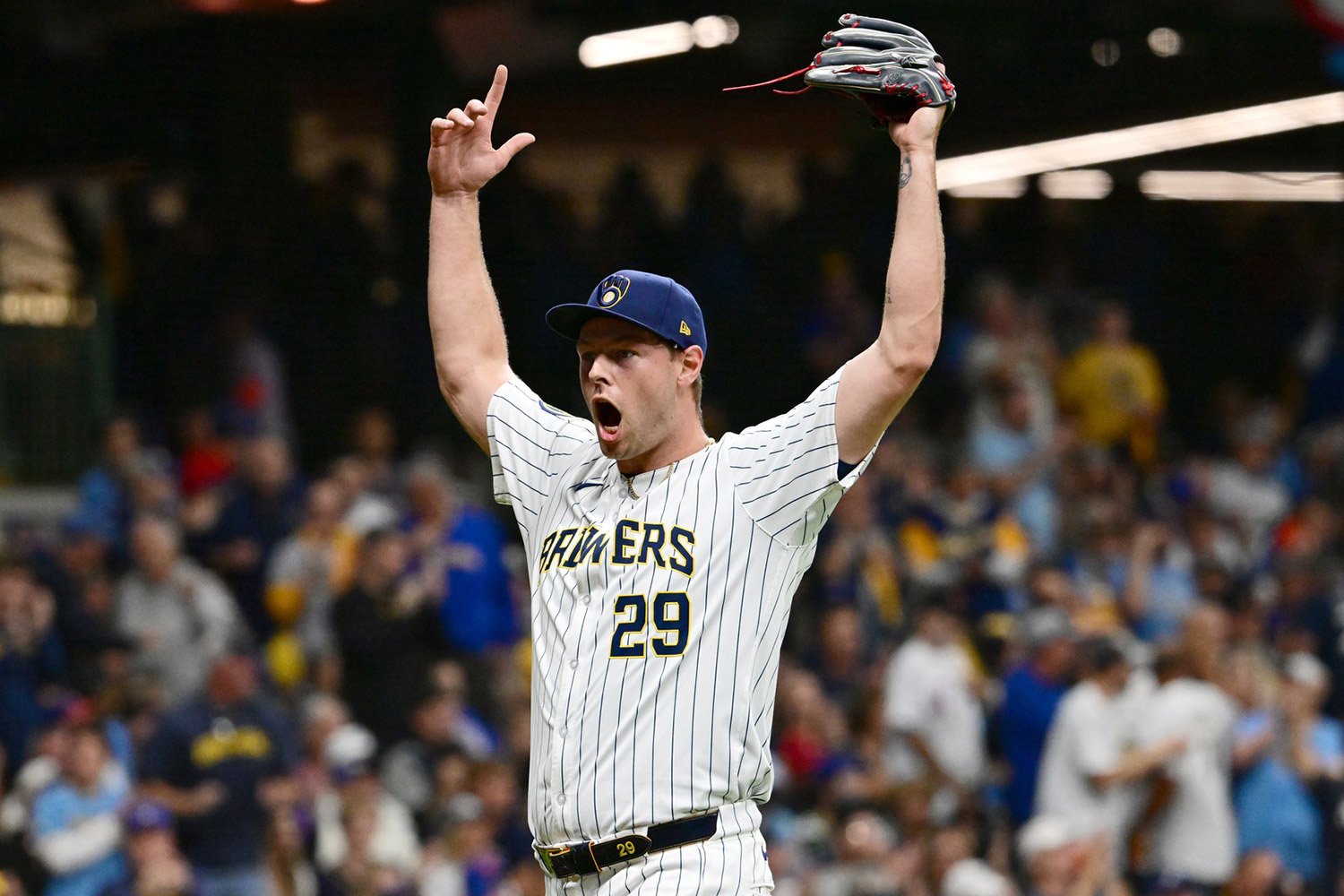
Today, only a handful of high-leverage relievers rely solely on two pitches, with the most notable names being Edwin Díaz, Tanner Scott, and Ryan Walker. Now, with Devin Williams out the door, two-pitch pitcher Trevor Megill will likely be handed the keys to the closer role in 2025. He proved he could do it in 2024, successfully converting 21 saves in 24 opportunities, stepping into high-leverage situations on a consistent basis for the first time. However, as Megill enters his sophomore season as some form of relief ace, can he sustain his success, or will the limitations of a two-pitch arsenal catch up with him?
In 2024, Megill had the best season of his career, throwing a four-seam fastball (71.6% usage) and a knuckle curve (28.4% usage). While his fastball movement is more good than great (he has a couple inches of carry more than hitters would expect, but the pitch is quite straight, horizontally), his elite velocity and imposing 6-foot-8 frame compensate for any shortcomings.

Megill's fastball is his most effective pitch, averaging 98.8 MPH and topping out at 101.4 MPH. If his raw velocity wasn't enough, his frame permits above-average extension, increasing his perceived velocity. According to Baseball Savant, in 2024, among pitchers with a minimum of 100 plate appearances featuring fastballs, Megill had the 18th-best 4-seam fastball by run value (12). However, his knuckle curve provided a run value of 0, ranking 83rd among pitchers who threw a curveball in at least 25 plate appearances. Technically, the movement on his curveball is average or below, but it benefits from tight spin and the third-highest velocity among major-league curves. Together, these traits create a viable secondary pitch, but the fastball will be critical to his success in 2025.
Against a two-pitch pitcher, the common hitting approach is to try to identify the pitch early, sit on the fastball, and adjust to the secondary pitch when necessary. Finding success with a two-pitch mix usually depends on more than elite stuff, although thanks to his fastball, Megill has that covered, having a FanGraphs Stuff+ of 141 in 2024. Without the advantage of extra pitches to keep the hitter guessing, a pitcher needs to deceive the batter. The best way to do this is by making both pitches look the same for as long as possible, which starts with the release point.
Some of the best two-pitch relievers in the game show how minor variations in release points can improve effectiveness. Edwin Diaz releases his fastball 4.8 feet above the ground, but his slider comes out higher at 5 feet for a 0.2-foot variation. Tanner Scott's variance is marginally better, with his four-seam coming out of his hand at 5.3 feet above the ground, nearly identical to his slider at 5.2 feet. In comparison, this is an area in which Trevor Megill excels, on average, releasing his four-seam fastball and his knuckle curve at an identical 6.6 feet above the ground.
His identical release point minimizes any visual cues the hitter may pick up to distinguish which pitch is coming early in the pitch's trajectory. That he comes straight over the top with both pitches also helps. Last spring, Matt Trueblood detailed how Megill's negative vertical release angle on the curve (that is, the downward angle of the pitch, matching the fastball and eliminating any risk of the telltale hump hitters spot in some curveballs) helps generate whiffs by fooling hitters. For the same reason, Megill had one of the highest opponent chase rates in baseball last year; it's viciously difficult to distinguish his pitches from one another.
However, deception alone is not enough against major-league hitters, especially if you can't throw strikes. Command is equally important. It's indispensable for any pitcher, regardless of pitch mix, but it becomes crucial for those with a limited repertoire. Additional pitches provide the flexibility to pivot away from those they're struggling to execute and rely on other options. Losing your secondary pitch can be detrimental when limited to two pitches, as beating major-league hitters while relying only on a fastball is nearly impossible.
Good command can neutralize predictability, enhance the effectiveness of the secondary pitch, and create more swings and misses. In addition to an above-average walk rate, Megill excels at getting ahead early with a strong first-pitch strike percentage of 65%. According to Pitch Profiler, Megill has 88th-percentile Location+, a metric that measures a pitcher's ability to locate pitches in the "right spot" given the count and the pitch type. Thanks to that capacity to induce chases, even when Megill was missing the zone, he remained effective.
Command can also limit hard contact by keeping pitches away from the heart of the plate. Pitchers who consistently hit their spots are more likely to induce weak contact or swing-and-miss. While Megill's command metrics highlight a strength, his biggest weakness as a pitcher is average exit velocity, suggesting hitters still make solid contact even when his pitches are well-located.
Megill's opposing batters had an average exit velocity of 91.4 MPH in 2024, the 17th-highest among major-league pitchers with a minimum of 100 batted ball events. He's a fly-ball guy, so ordinarily, you'd expect anything with a good exit velocity on it to be trouble. However, as seen by Megill's 2.72 ERA and 1.01 WHIP, he found a way to remain effective. While high exit velocity correlates with increased slugging, Megill's velocity "problem" isn't necessarily one, considering the strong defense behind him and his strikeout rate. Megill benefited by playing in front of the Brewers' elite defense, putting up a 3.10 FIP compared to his 2.72 ERA. Since that defense isn't going anywhere, though, those numbers need not worry Brewers fans.
Because a hitter who only has two pitches to hunt can more reliably meet the ball squarely when they guess right, a slightly higher Squared Up rate (based on bat-tracking data) and that relatively high exit velocity are to be expected for a two-pitch pitcher. Thanks to Megill's incredibly intense stuff, though, he's in the 90th percentile for slowing down hitters' bats (that is, he induced slower average swings than 90% of the rest of the league) and in the 89th percentile for preventing Fast Swings, Baseball Savant's count of swings at over 75 MPH and a good estimate of the number of 'A' swings a hitter is getting off against a given hurler.
Megill's success in 2024 significantly influenced the Brewers' willingness to deal Willams this winter. His ability to maintain the same release point for his two-pitch mix helps keep hitters guessing, allowing his curveball to play so well off his dominant fastball. Despite his high average exit velocity, pairing his deception and velocity with his solid command, Megill avoids barrels and plays well to his team's elite defense. If Megill can remain effective with his fastball, he should put up a monster year in 2025 while closing games for the Brewers.
Are you optimistic about the Brewers right now?

Follow Brewer Fanatic For Milwaukee Brewers News & Analysis



-
 1
1



Recommended Comments
Create an account or sign in to comment
You need to be a member in order to leave a comment
Create an account
Sign up for a new account in our community. It's easy!
Register a new accountSign in
Already have an account? Sign in here.
Sign In Now