


Brewers Video
After they agreed to sign Jackson Chourio to an eight-year, $82-million deal that could keep him in Milwaukee for as much as a decade, the Brewers are going to have their rookie phenom in the lineup pretty much right away in 2024. If they believed he needed any more than a formality's worth of time in Triple A, they wouldn't have committed to him this way. With Sal Frelick, Joey Wiemer, and Garrett Mitchell already in the mix, though, it's worth asking: What's the best way for the team to array its youngsters?
By the time the season begins (or even within a few weeks), this could resolve itself. Mitchell and Wiemer are seen, by and large, as trade candidates, ever since Chourio signed his deal. A move centered around either of them and aimed at upgrading the team's projected starting rotation would not come as a shock. Even with one of those two gone, though, it's not clear how the remaining talent ought to be deployed.
In general, the assumption has been that Chourio will be the center fielder. That's where he's listed on Roster Resource, a FanGraphs feature. The official site of the Brewers also lists him atop the Depth Chart in center, with Frelick in right. Baseball America's scouting report on Chourio says he "has the speed, acceleration and lateral range to be an above-average defender in center field." Everyone agrees that Chourio has some rough edges to sand off, defensively, but there's a general feeling that he can iron them out and end up as an above-average defender up the middle.
Because of Chourio's offensive profile, though, he'll eventually be a very good player even if he moves to a corner outfield spot. In fact, BA lists him as a right fielder, despite the praise above. He's thickly built, and the best version of him is a slugger who hits more than 30 home runs each year. There's room for an argument that he can best develop and serve the Brewers by moving to a corner sooner, rather than later, the same way Ronald Acuña Jr. has for the Atlanta Braves.
To buttress that argument, let's look at a few numbers. Here's how players who started at least 70 games in center field did when they were at that position, and when they were anywhere else, for each of the last three seasons.
Regular Center Fielders, At CF and Elsewhere, 2021-23
| Season Split | AVG | OBP | SLG | K% | BB% | BABIP | wOBA |
| 2021, CF | 0.25 | 0.323 | 0.41 | 22.3 | 8.7 | 0.301 | 0.317 |
| 2021, Other | 0.244 | 0.31 | 0.417 | 24.6 | 7.8 | 0.296 | 0.312 |
| 2022, CF | 0.249 | 0.314 | 0.408 | 22.5 | 7.7 | 0.298 | 0.315 |
| 2022, Other | 0.25 | 0.347 | 0.462 | 24 | 11.6 | 0.294 | 0.349 |
| 2023, CF | 0.25 | 0.317 | 0.426 | 24.8 | 8 | 0.307 | 0.324 |
| 2023, Other | 0.254 | 0.343 | 0.429 | 22.6 | 11 | 0.3 | 0.338 |
In 2021, guys who often played center were slightly better at that spot than when assigned to play elsewhere. The sample of plate appearances for that set of players at other spots was smallest that year, though. In 2022 and 2023, the bag looks a bit more mixed, but the advantage is clear in the big picture: Guys hit better when they were playing further down the defensive spectrum.
Yes, Aaron Judge somewhat biases this data, but nothing here is wholly a product of him, or of anyone else. Cody Bellinger split time between center and first base for the Cubs last year, but had an OPS .155 higher when playing center. The rest of the league more than offset that outlier.
This is not a surprising finding. Previous studies have shown that hitters hit better when playing less demanding defensive positions. It can be hard to tease out the cause and effect there, since only guys who might be a bit stretched at center or short are often asked to play more offense-first positions, like the corner spots. The data above is fairly free of that, though, because it starts by selecting the guys who played pretty often in center and only focuses on the differences between their performance there and elsewhere.
If you wanted to maximize Chourio's output at the plate, then, you'd be making the right choice by moving him to right field. Thinking long-term, maybe you want to hold right field open for a less athletic slugger, and maybe you want Chourio to get the maximum chance to make use of his speed, but even those considerations come with caveats. For instance, by signing him to this deal and moving him so rapidly to the majors, you're already risking rushing Chourio a little bit. Putting him in right takes away some pressure to refine his defense and lets him wrestle with the greater challenge of figuring out and assailing big-league hurlers.
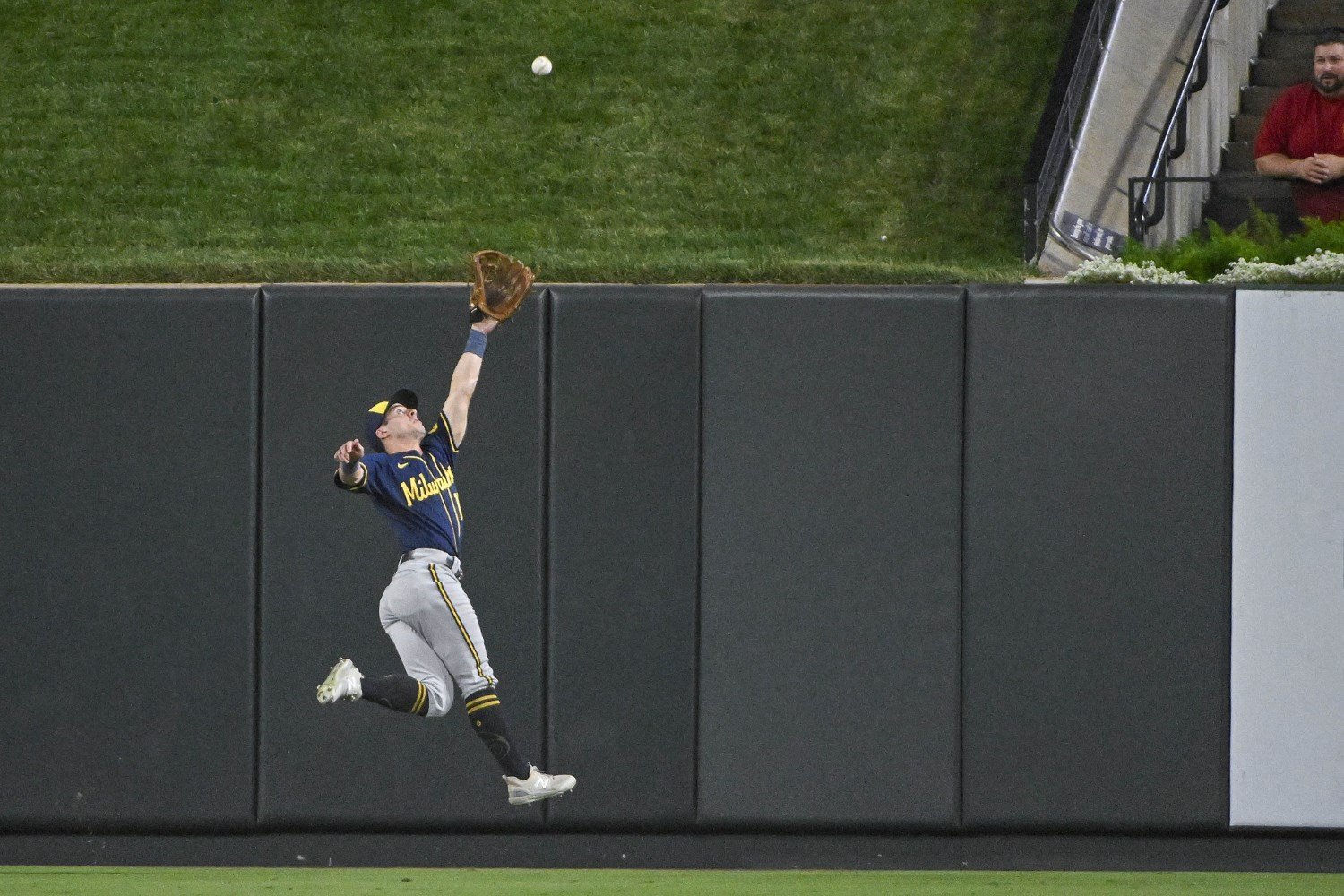
It's also a bit safer to play right field than to play center. Chourio is less likely to wear down or get hurt out there, especially since navigating the wall when going back on fly balls is already one of his documented areas of weakness and a center fielder has to do a bit more of that than does a corner man. Given only average (or, as many teams in a similar spot might have, worse than average) options to play out there with him, you might play Chourio in center, but the Brewers have somewhat better than average options.
That brings us around to Frelick. He came up last July and showed all kinds of signs of being a credible, dedicated, intelligent big-league player. He showed speed, great contact ability, a discerning eye at the plate and great skill and daring in the field. What he did not show was any ability to leave a mark on the ball. He didn't make nearly enough hard contact in MLB in 2023. Of the 362 batters who had at least 200 plate appearances, Frelick ranked 345th in 90th-percentile exit velocity. He just isn't going to find power, no matter where he plays.
Add up his time in Triple A and MLB, and he spent almost exactly equal time in center and right field last year. He was solidly above-average at both spots, with 2 Defensive Runs Saved (DRS) in center and 4 DRS in right, each in much less than a full share of playing time. Frelick does have what Chourio is still looking for, as he goes back on the ball smoothly and confidently and plays the wall well. He's a plus defensive center fielder, and remaining so is the only way he's going to be a valuable regular in MLB.
While all outlets agree that Frelick is currently positioned to be the regular who rounds out the outfield along with Yelich and Chourio, that needn't be locked in. Mitchell and Wiemer, should both be kept around, would make a solid platoon, with much more power potential and roughly equal defensive upside to Frelick, and they could slot into right field as well or better than they do in center. (Wiemer, in particular, looked a lot better in right last year.) They certainly don't project to get on base as much as Frelick should, though. On balance, keeping and starting Frelick makes the most sense, and if they do so, the optimal alignment has Chourio in right and Frelick in center.
Which way would you set the lineup for 2024--with Frelick in right and Chourio in center, or vice-versa? Is that decision primarily about winning this year or developing Chourio in the best possible way, at the big-league level? Can the team keep all the outfielders currently set for inclusion on the big-league roster, with the hope of moving Yelich to first base or DH in 2025 and beyond? Let's talk about the peculiar balancing act of trying to put talented but very divergent players in almost interchangeable spots.





Recommended Comments
Create an account or sign in to comment
You need to be a member in order to leave a comment
Create an account
Sign up for a new account in our community. It's easy!
Register a new accountSign in
Already have an account? Sign in here.
Sign In Now