


Brewers Video
In the past, we here at Brewer Fanatic have expressed well-founded skepticism of the idea that Ryan McMahon would be an ideal fit for the Milwaukee Brewers. McMahon, 30, was an All-Star last year and has five seasons with 20 or more home runs. He lacks sizzle at third base, but his glove is easily above average there. However, as Jack Stern analyzed last fall, he's tended strongly to hit the ball the opposite way throughout his career, wasting some of his power potential. Meanwhile, because he let the ball get so deep, he was often late on any average or better big-league fastball, and strikeouts piled up far more than is justifiable from a player who's not generating high-end slugging numbers.
Don't look too long at the topline numbers for McMahon so far this year, or you might become convinced that he's in deeper, murkier water than ever. He's batting just .204/.315/.345, with 16 extra-base hits in 241 plate appearances. He's still striking out a lot, although at least he's also walking a lot. It might seem like the very worst time to acquire McMahon, unless it be in some sweetheart deal whereby the Rockies package a prospect with him just to clear some of the $32 million they owe him for 2026 and 2027.
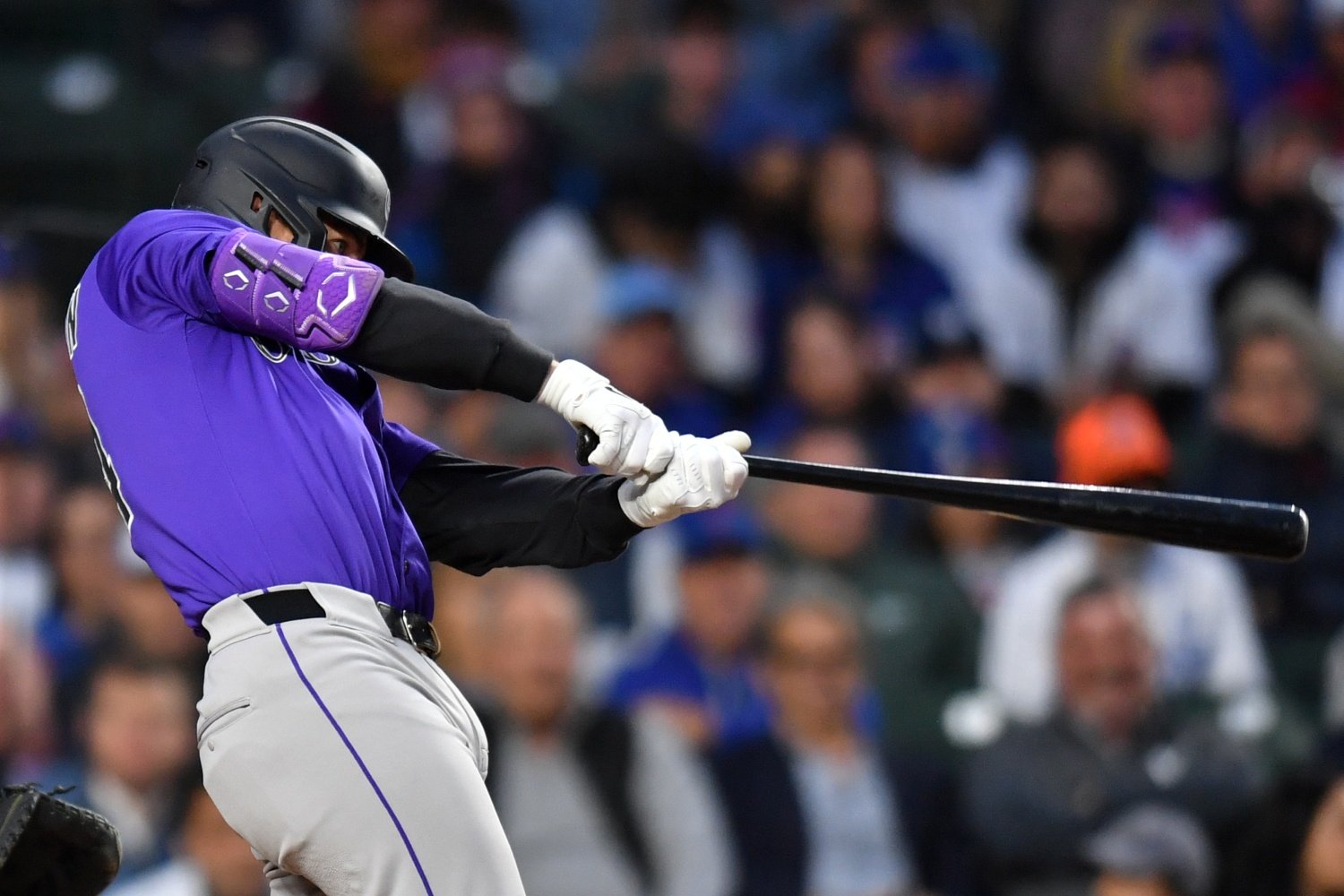
Things look much better under the hood, though—not only much better than the raw numbers this season, but much better than they looked in the past, too. For instance, if you read Jack's piece in November, you know that one of his concerns was what might happen if McMahon lost any bat speed. That's still a valid worry, but perhaps a less urgent one, because he's added 1.8 miles per hour to his average swing speed this season, going from an already-robust 72.5 mph to a more thoroughly dangerous 74.3. Hitters can sometimes achieve this kind of change by lessening the tilt of their swing (since, if their bat is moving more laterally and less upward, they're not fighting gravity as much), but McMahon has preserved his steep tilt while making this change. In fact, he tilts the bat 39° now, versus 38° last year.
A faster steep swing is an unalloyed good, but it's just one aspect of changing the offensive profile for McMahon. He also needed a tweak to his timing, to allow him to both lift and pull the ball more consistently. Happily, he's done that, too. His attack angle (15°, up from 9° in 2024), attack direction (2° toward the pull side, versus 5° to the opposite field last year) and contact point (27.8 inches in front of his center of mass this year, up from a hilariously untenable 22.5 inches in 2024) all speak to that. As a result, he's pulling the ball more than ever; hitting it in the air, to the pull field, more than ever; and hitting the ball a full 2 miles per hour harder this year.
You can see the changes in the visuals Statcast now provides to illustrate hitters' setups and swings. First, let's look at his stance. Here's how McMahon set up in the box (black footprints) and where his stride led (red ones) in 2024.

No hitter in baseball starts more spread-out than McMahon. As a result, his pickup and step into the swing is really just that; he doesn't stride forward the same way most hitters do. Notice, though, how far off the plate he is, and the slightly closed angle of his stance and stride. Notice, too, how deep in the hitting zone created by his own frame he's catching the ball, even though it's in front of the plate.
Here's the same look at McMahon, but for 2025.

Slightly but importantly less spread-out in his initial stance, McMahon now gains a very small but non-zero amount of ground with his stride. Substantially closer to the plate, he can cover the outer third better. He's a hair more open to the pitcher, too. There's a change afoot, alright.
Now, let's look at his swing itself, at three different stages. First, here's the moment where his bat first reaches the point of being parallel to the sides of home plate (or, put another way, to the hypothetical path of a perfectly straight pitch). It's an arbitrary selection, but one that lets us do some apples-to-apples comparison of the early stages of his swing.

The first thing to notice (because it will remain important) is that McMahon is subtly but clearly staying back longer in his lower half this year. Note that his torso is leaning back slightly more this year, while he's still deeper in his back leg and hasn't yet shifted his weight into his front leg via his front hip, as you can see him doing in the 2024 animation. The other thing of note is that, while his bat is not up to the same speed by this stage of the swing as it was last year, there's already more turn to the barrel. That slightly more open starting point comes into play here. It's harder to see, because of the angle we're using, but he's opening up with his front shoulder a bit more at this stage of the swing than he did last year. That's pulling his bottom hand—and thus, the entire bat, knob-first—a bit more toward first base than at the same point in 2024, so his barrel is getting closer to turning into the path of the pitch (attack direction: 45° opposite-field, around from 53° at the same point last year).
Next, here's the frame from each year's animation in which we're closest to a 0° attack angle. In other words, this is the moment in each swing when McMahon gets on plane and starts working uphill into the path of the pitch.

The biggest news here is the timing. Again, McMahon's not generating any more bat speed (yet) than he did at the same point in last year's swing, but he still has more weight in his back side, which means more force is still coming through him. His barrel is farther behind him on the right, which tells us that that earlier opening of the front shoulder (and the way, as you see, it invites his front elbow to row upward, maintaining tilt while still achieving extension relative to his body) is getting him on plane earlier in his swing. Also, look at the left edge of the frame in each animation. In the lefthand one, we can see the avatar of the ball appearing already. In the right, we can't. While McMahon's bat is farther forward and going the same speed on the left, he doesn't have as much acceleration of the barrel left in his body, and the ball is already getting on him. On the right, he has time, and there's still more power en route to the barrel.
Here's the frame closest to his contact point for each season.

This season, McMahon has the late bat speed to beat the ball to its spot, thanks to staying in his back leg a bit better and creating more rotational (albeit less linear) force with his front side. Because he got on plane earlier and worked faster in the final few milliseconds before contact, he's hitting the ball in a much better position to generate lift, and his barrel is around on the ball, able to pull it with authority. McMahon's swing is just plain better this year, by no small margin.
Why, then, aren't things going well from a results standpoint? For one thing, while this is a boring answer, he's gotten very unlucky. His actual weighted on-base average this year (.298) would be his worst since his brief 2018 stint, but his expected wOBA (.342) is the best of his career. He's also suffering from the worst home/road splits of his career, which is always worth a look when the Rockies are involved. At Coors Field, McMahon—whose new swing has him timed to the fastball, rather than to breaking stuff, for the first time in years—is hitting .271/.406/.494. On the road, however, he's hitting an untenable .157/.244/.240. He's more prone to being early on breaking and offspeed stuff this year. in the past, unlike most hitters, he did most of his damage on those pitches, and struggled against fastballs. Now that he's back on time for heaters, he's better able to attack the ball at elevation (where non-fastballs tend to be much less effective), but he's more vulnerable to stuff with big movement, especially away from the park where he has to be used to hitting.
That sounds like a major caveat for any optimistic analysis of McMahon, but it really isn't. For one thing, the Rockies are woeful at hitting development, and McMahon might well get better instruction on a balanced approach with his improved swing almost anywhere else, including Milwaukee. For another, the Coors Field Hangover Effect is very real. When hitters have to leave Coors and get acclimated to baseball at lower elevations again, their performance disproportionately suffers for a short time. Unlike the other 29 teams, the Rockies have to endure that effect a dozen times a year or so. Get McMahon off the Rockies, and you solve a few of his problems in a snap.
Again, this is a spectacular defender, with clear power upside. He gets on base enough to be valuable even while figuring out how to more consistently extract value from the hard contact he's been generating, and he's been generating so much of it that that value itself seems likely to materialize soon. His contract will prevent the Rockies from demanding an exorbitant trade return, and their situation will force them to consider more of a shakeup than they have entertained in the recent past. The Brewers need help on the left side of the infield, and if Cooper Pratt and Jesús Made (or any other young players in the system, like Joey Ortiz, Brock Wilken or Luis Peña) have shortstop and third base sewn up by the start of 2027, a successful McMahon acquisition would mean having first base taken care of, too. Meanwhile, the Brewers could ensure that they remain competitive for 2025 by acquiring a player who would suit their lineup, giving it the ingredient it's missing at a position where he wouldn't be replacing anyone who's been especially good.





Recommended Comments
Create an account or sign in to comment
You need to be a member in order to leave a comment
Create an account
Sign up for a new account in our community. It's easy!
Register a new accountSign in
Already have an account? Sign in here.
Sign In Now