


Michael Trzinski
-
Posts
923 -
Joined
-
Last visited
-
Days Won
1
Content Type
Profiles
Forums
Blogs
Events
News
2026 Milwaukee Brewers Top Prospects Ranking
Milwaukee Brewers Videos
2022 Milwaukee Brewers Draft Picks
Milwaukee Brewers Free Agent & Trade Rumors, Notes, & Tidbits
Guides & Resources
2023 Milwaukee Brewers Draft Picks
2024 Milwaukee Brewers Draft Picks
The Milwaukee Brewers Players Project
2025 Milwaukee Brewers Draft Pick Tracker
2026 Milwaukee Brewers Draft Tracker: Picks & Bonuses
Store
Downloads
Gallery
Everything posted by Michael Trzinski
-
I voted and had Areinamo around 17-18, can't remember. BUT, in defense of all the writers that took the time to vote, it is IMPOSSIBLE for us who don't see every player in the organization on a regular basis to get this list exactly right. We go by videos we might happen to see, or blurbs from 'experts' in making our choices. It's not easy; do you move Quero down the list because he was hurt all year? Do you put the 17-y-o DSL stud ahead of the 22-y-o star at Double-A who has a few more years of experience in pro ball? The day I can afford to go see everyone play several games each year is the day I become an expert and get them all correct. So watch for me to win Powerball and I will go on an 'all summer voyage' of minor league parks.
-
I've been a Brewer fan since 1970, so I am right with you. Money was a great defender and a pretty solid bat, too. I think he was in a lot of fans' Top 10 fave player lists.
-
Don Money was an excellent fielding, hard-hitting infielder who starred for the Milwaukee Brewers from 1973-1983, collecting four All-Star berths. He ranks fifth overall on the Brewers with a Wins Above Replacement number of 28.4 for his career, seventh with 1,168 hits, and eighth with 215 doubles. The man nicknamed "Brooks" never won a Gold Glove, but with competition like Brooks Robinson and Doug Rader (five-time NL Gold Glover at 3rd base), winning isn't always easy. Donald Wayne Money was born in June 1947 in Washington, DC. His family moved to Cherry Hill, New Jersey when Money was an infant. He started playing baseball when he was seven years old and played every year for the next 31 years until he retired at age 37. Don Money graduated from La Plata High School (Maryland) in 1965 and was signed by the Pittsburgh Pirates two weeks after his 18th birthday. The right-handed infielder began his pro career at Salem (Virginia) in the rookie Appalachian League, where he made the All-Star team despite batting only .241 with six home runs. Money enlisted in the Marine Corps Reserves after the season and was on active duty one weekend a month and two weeks in the summer for the next eight years. The following season, Money played for Clinton (Iowa) in the Class-A Midwest League, where he once again struggled with the bat, slashing only .236/.304/.341 in 125 games. In 1967, Money had arguably his finest minor league season with a slash line of .310/.382/.508 across 545 plate appearances for Raleigh (North Carolina) in the Class-A Carolina League. After lighting up the Florida Winter Instruction League in the offseason with a batting line of .336/.414/.544 and a league-leading six homers, Money was traded shortly before Christmas, along with pitchers Harold Clem, Woodie Fryman, and Bill Laxton to the Philadelphia Phillies for pitcher Jim Bunning. Money started the 1968 season with the Phillies, and in his first major league game, he doubled off Dodgers pitcher Claude Osteen in the eighth inning for his first big-league hit. In mid-April, after only four games with the Phillies, Money was optioned to Triple-A San Diego in the Pacific Coast League for the remainder of the season, where he batted .303/.353/.430. Other than two brief flings in the Florida winter leagues the next two seasons, Money would never again toil in the minors. Over the next four seasons, Money was a regular for Philadelphia, playing primarily at third base or shortstop, but he also played left field and second base. In his first full season (1969), he was named the Topps Major League Rookie All-Star shortstop. After hitting .295/.361/.463 in 1970, his batting average fell to .223 in 1971 and .222 in 1972. Money had said that playing numerous positions did not help matters at the plate. With future Hall of Famer Mike Schmidt waiting in the wings, Money was traded on Halloween 1972 with pitcher Bill Champion and infielder John Vukovich to the Milwaukee Brewers for pitchers Jim Lonborg, Ken Brett, Ken Sanders, and Earl Stephenson. In his first season with the Brewers, Money slashed .284/.347/.401 with 11 bombs and 22 steals, a career high. The following season was almost a carbon copy of 1973, as Money had a batting line of .283/.346/.415 with 15 home runs, earning All-Star Game honors. He also set a major league record with 86 consecutive errorless games at third base and committed only five errors during the season. Despite those numbers, Money was denied the Gold Glove in the American League; Brooks Robinson won it for the 15th straight year. Money’s new nickname became “Brooks.” After another solid year in 1975, Money again earned All-Star honors from 1976 to 1978. He hit a career-high 25 home runs and 83 RBIs in 1977 and followed up with a nice season in 1978, which would be his last as a full-time player. Money slashed .293/.361/.440 in 137 games. He also clubbed 14 homers and 30 doubles in a solid season. Injuries plagued the rest of his career, and he never played more than 96 games after 1978. In 1982, he played only 28 games in the field but platooned at designated hitter with southpaw Roy Howell as the Brewers made it to the World Series for the first (and only) time in franchise history. Money went 3-for-13 with a double and an RBI in the seven-game loss to St. Louis in the “Suds Series.” Money played his final big-league season in 1983 but saw sporadic action, hitting only .149/.221/.219 in 43 games. After the season, he turned down a small contract from Milwaukee and took an offer to play in Japan for the Osaka Kintetsu Buffaloes. After only 29 games, Money and his family returned home after his Japanese experience was less than memorable. His major league numbers included 1,720 games, 1,623 hits, 302 doubles, 176 home runs, 729 RBIs, and a career slash line of .261/.328/.406. After his retirement, he coached for five years at Sacred Heart High School in New Jersey and then managed the Brewers organization at Beloit (1998-2004), Huntsville (2005-2008), and Nashville (2009-2011). He served as a hitting coach and special instructor from 2012-2015. His grandson Buddy Kennedy has played with Arizona, Detroit, and Philadelphia and is currently in the Phillies organization. Money was elected to the Brewers ‘Walk of Fame’ in 2005 and the Brewers ‘Wall of Honor’ in 2014. View full article
-
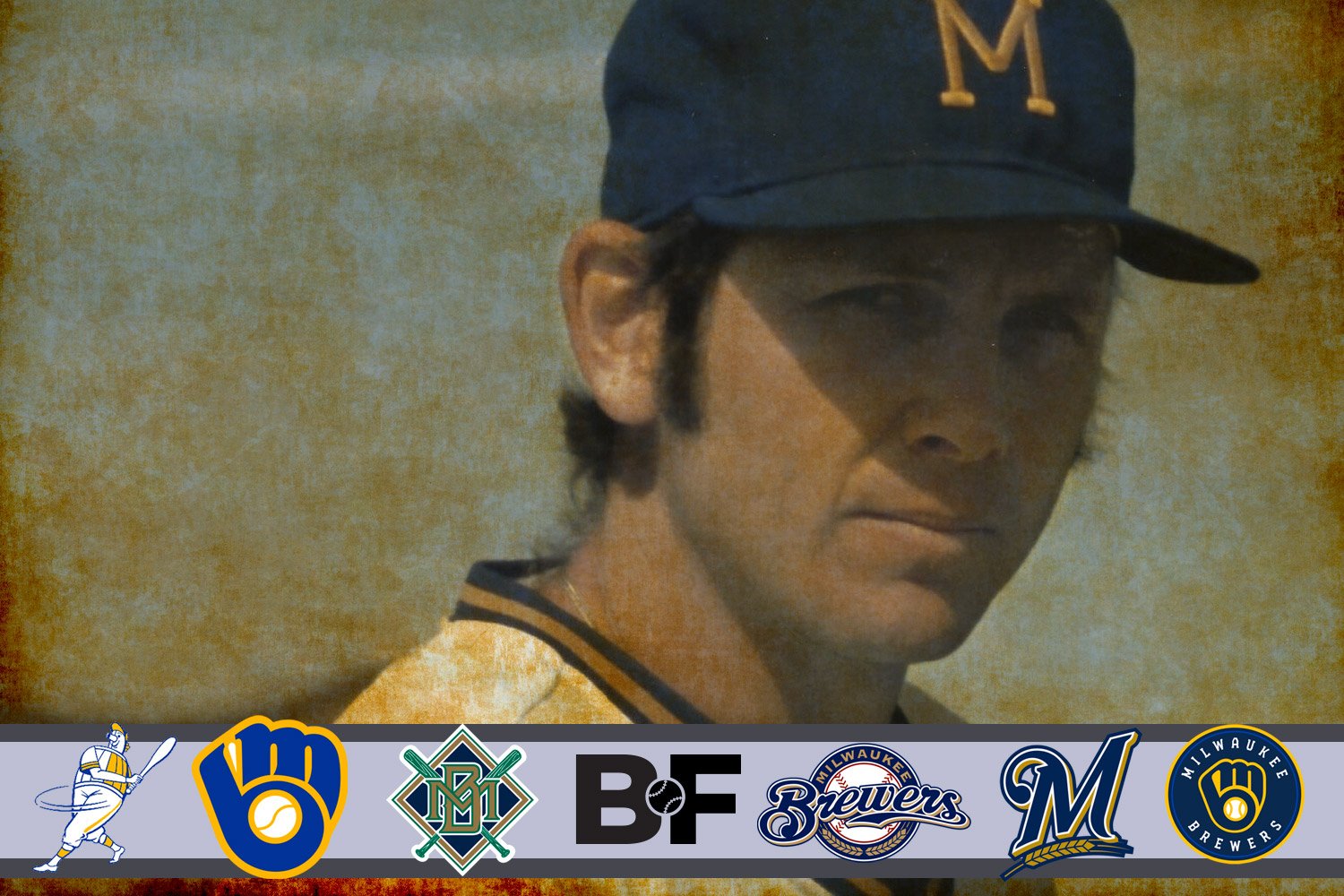 Donald Wayne Money was born in June 1947 in Washington, DC. His family moved to Cherry Hill, New Jersey when Money was an infant. He started playing baseball when he was seven years old and played every year for the next 31 years until he retired at age 37. Don Money graduated from La Plata High School (Maryland) in 1965 and was signed by the Pittsburgh Pirates two weeks after his 18th birthday. The right-handed infielder began his pro career at Salem (Virginia) in the rookie Appalachian League, where he made the All-Star team despite batting only .241 with six home runs. Money enlisted in the Marine Corps Reserves after the season and was on active duty one weekend a month and two weeks in the summer for the next eight years. The following season, Money played for Clinton (Iowa) in the Class-A Midwest League, where he once again struggled with the bat, slashing only .236/.304/.341 in 125 games. In 1967, Money had arguably his finest minor league season with a slash line of .310/.382/.508 across 545 plate appearances for Raleigh (North Carolina) in the Class-A Carolina League. After lighting up the Florida Winter Instruction League in the offseason with a batting line of .336/.414/.544 and a league-leading six homers, Money was traded shortly before Christmas, along with pitchers Harold Clem, Woodie Fryman, and Bill Laxton to the Philadelphia Phillies for pitcher Jim Bunning. Money started the 1968 season with the Phillies, and in his first major league game, he doubled off Dodgers pitcher Claude Osteen in the eighth inning for his first big-league hit. In mid-April, after only four games with the Phillies, Money was optioned to Triple-A San Diego in the Pacific Coast League for the remainder of the season, where he batted .303/.353/.430. Other than two brief flings in the Florida winter leagues the next two seasons, Money would never again toil in the minors. Over the next four seasons, Money was a regular for Philadelphia, playing primarily at third base or shortstop, but he also played left field and second base. In his first full season (1969), he was named the Topps Major League Rookie All-Star shortstop. After hitting .295/.361/.463 in 1970, his batting average fell to .223 in 1971 and .222 in 1972. Money had said that playing numerous positions did not help matters at the plate. With future Hall of Famer Mike Schmidt waiting in the wings, Money was traded on Halloween 1972 with pitcher Bill Champion and infielder John Vukovich to the Milwaukee Brewers for pitchers Jim Lonborg, Ken Brett, Ken Sanders, and Earl Stephenson. In his first season with the Brewers, Money slashed .284/.347/.401 with 11 bombs and 22 steals, a career high. The following season was almost a carbon copy of 1973, as Money had a batting line of .283/.346/.415 with 15 home runs, earning All-Star Game honors. He also set a major league record with 86 consecutive errorless games at third base and committed only five errors during the season. Despite those numbers, Money was denied the Gold Glove in the American League; Brooks Robinson won it for the 15th straight year. Money’s new nickname became “Brooks.” After another solid year in 1975, Money again earned All-Star honors from 1976 to 1978. He hit a career-high 25 home runs and 83 RBIs in 1977 and followed up with a nice season in 1978, which would be his last as a full-time player. Money slashed .293/.361/.440 in 137 games. He also clubbed 14 homers and 30 doubles in a solid season. Injuries plagued the rest of his career, and he never played more than 96 games after 1978. In 1982, he played only 28 games in the field but platooned at designated hitter with southpaw Roy Howell as the Brewers made it to the World Series for the first (and only) time in franchise history. Money went 3-for-13 with a double and an RBI in the seven-game loss to St. Louis in the “Suds Series.” Money played his final big-league season in 1983 but saw sporadic action, hitting only .149/.221/.219 in 43 games. After the season, he turned down a small contract from Milwaukee and took an offer to play in Japan for the Osaka Kintetsu Buffaloes. After only 29 games, Money and his family returned home after his Japanese experience was less than memorable. His major league numbers included 1,720 games, 1,623 hits, 302 doubles, 176 home runs, 729 RBIs, and a career slash line of .261/.328/.406. After his retirement, he coached for five years at Sacred Heart High School in New Jersey and then managed the Brewers organization at Beloit (1998-2004), Huntsville (2005-2008), and Nashville (2009-2011). He served as a hitting coach and special instructor from 2012-2015. His grandson Buddy Kennedy has played with Arizona, Detroit, and Philadelphia and is currently in the Phillies organization. Money was elected to the Brewers ‘Walk of Fame’ in 2005 and the Brewers ‘Wall of Honor’ in 2014.
-
Probably no solace to disappointed fans, but let me ask this question: would you rather win 81 games every year and miss the playoffs?
-
Jacob MisiorowskiJeferson QueroTyler BlackRobert GasserCarlos F RodriguezCooper PrattMike BoeveBrock WilkenLuis LaraYophery RodriguezJosh KnothLogan HendersonEric Brown JrLuke AdamsEric BitontiBrett WichrowskiJuan BaezDylan O'RaeDaniel GuilarteJadher Areinamo
-
Nice commentary on a decent season, although it didn't end the way we wanted it to.
-
I don't know if I could have seen the difference in his glove/hand position unless it was pointed out. Maybe the height of the glove, but not the hand inside the glove 1/2" farther.
-
If my math is right, the Brewers were 16-of-16 against the Mets in their six games. Turang had seven, Chewy, Yeli, and Mitchell each had two, while Perkins, Ortiz, and Contreras each had one. Sal Frelick had the only blemish, getting picked off first by Megill in the third game of the year. So yeah, they *should* have larceny in their hearts!!
-
Brewer Fanatic Minor League Hitter of the Year - 2024
Michael Trzinski posted an article in Minor Leagues
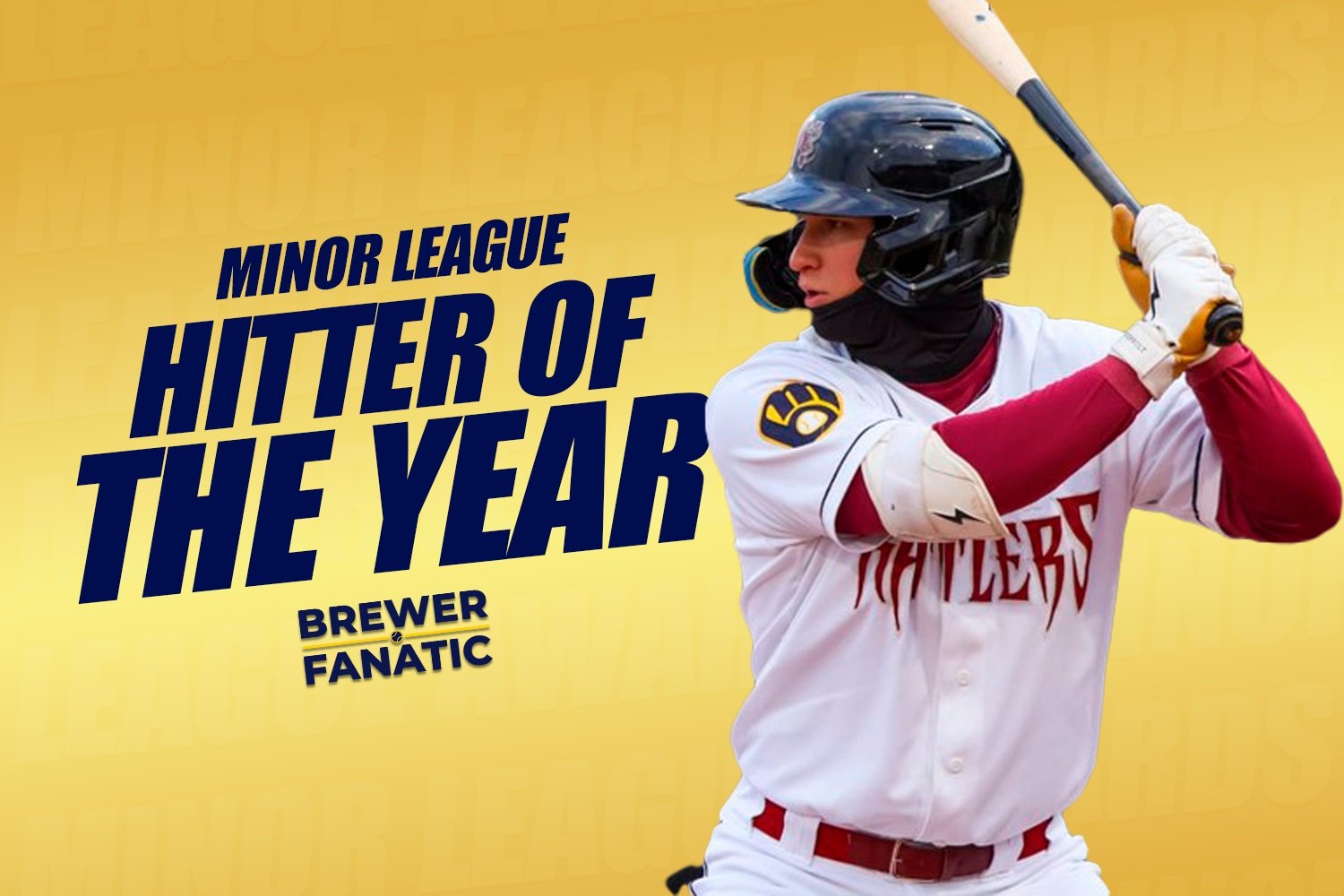 Honorable Mentions Cooper Pratt, SS (Carolina/Wisconsin/Biloxi) .277/.362/.406 with 26 extra-base hits and 27 stolen bases. Pratt was called up to Biloxi and went 2-for-8 with his first Double-A home run in the Southern League Division Series in late September. Brewer Hicklen, OF (Nashville) .246/.363/.470 with 22 home runs and 44 stolen bases. Hicklen got a cup of coffee with Milwaukee in September but is still looking for his first big league hit. He also went hitless in four trips with Kansas City in 2022. Tyler Black, 1B-3B-OF (Nashville) .258/.375/.429 with 14 home runs and 20 stolen bases. Black—who was the 2023 award winner for minor league hitter—dropped off in batting average and steals, but still had a decent season in Triple-A. Also Receiving Votes Wes Clarke, Biloxi/Nashville Carlos D. Rodriguez, Biloxi/Nashville Yhoswar Garcia, Carolina Luis Castillo, Carolina Yophery Rodriguez, Carolina Darrien Miller, Wisconsin/Biloxi Top Five 5. Luke Adams, 3B-1B (Wisconsin) .227/.443/.397 Adams was rated the #6 best minor league hitter last year by Brewer Fanatic. He struggles with average but has some pop and a great eye at the plate, drawing 78 free passes. He also has a Craig Biggio-like propensity for ‘taking one for the team,’ by getting plunked 40 times, including six games when he got hit twice! Tack on 28 stolen bases and he is in scoring position quite often. Ranked 14th on Brewer Fanatics Top Prospect list, the big (6’4) right-hander has a good mix of power, patience, and speed. 2025 Projection: Biloxi 4. Jadher Areinamo, 2B-SS-3B (Wisconsin) .301/.349/.442 The compact (5’10, 180) righty can play all the infield spots but first. For a little guy, he showed some pop with 10 home runs and speed with 32 steals. His 30 two-baggers led the Midwest League, and he finished in the top five in hits, RBI, and total bases. Areinamo is a career minor league .297 hitter. He ranks just outside the top 20 on the Top Prospect list and has a bright future. 2025 Projection: Biloxi 2. (tie) Isaac Collins, OF-2B-3B (Nashville) .273/.386/.475 The diminutive (5’8, 185) switch-hitter has a versatility that could make him an asset as the 26th man on the Brewers playoff roster, as posited by Brewer Fanatic’s Matthew Trueblood earlier this month. At age 27, he is a bit ‘long in the tooth’ for a prospect, but had some solid numbers at Triple-A, leading the International League with seven triples and placing in the top five in runs scored, RBI, and bases on balls. He should get a good look next spring as a major league utility man for Milwaukee. 2025 Projection: Milwaukee/Nashville 2. (tie) Ernesto Martinez, 1B-OF-DH (Biloxi) .284/.365/.466 Martinez is in his seventh season with the Brewers and at age 25, has yet to play at Triple-A. The 6’6, 250-pound lefty has pretty good speed for his size, stealing 20 bases this year. He led the Southern League with 30 doubles and placed in the top five in hits and total bases. Martinez hit 13 homers and at this point is likely to have no more than high-teens HR potential in the bigs. Our Jake McKibbin makes a case for Martinez to travel north with the Brewers next year to start the season in the bigs. 2025 Projection: Milwaukee/Nashville Brewers Minor League Hitter of the Year Mike Boeve, 1B-3B-DH (Wisconsin, Biloxi) .338/.415/.471 The lefty-hitting Boeve is a high-average hitter in his minor league career, batting .334 across 395 at-bats in two seasons. Ranked #8 on the Brewer Fanatic Top Prospect list, Boeve ended the 2024 season on the injured list and only had 342 plate appearances. Boeve had a strikeout rate of 15.8% this year, which is significantly lower than the previous year’s 20.8. His walk rate was 11.7%, almost the exact same number as the year before. According to Fan Graphs, both the K rate and BB rate are considered ‘above average.’ Boeve’s pathway to the bigs will be at one of the corner infield spots and although his defense is decent and his arm is about average at third, his bat will be what determines his success. Boeve hit a combined 15 doubles and six home runs at Wisconsin and Biloxi. He should be a 15 HR guy at Miller Park…er, American Family Field. 2025 Projection: Biloxi/Nashville Thanks to the Brewer Fanatic writers that cast their ballots for the Brewers Minor League Hitter of the Year. With all the great names on this list (and others that didn’t quite make it), next spring training will be an exciting time in Arizona. Thanks to all who took a minute to read this. Please leave comments in the comments section. How did we do?
-
Last year, the Brewer Fanatic Minor League Hitter of the Year awards mentioned 11 players. Of those players, four of them received votes from Brewer Fanatic writers this year. Notables missing from the 2024 awards are Jeferson Quero (injury) and Jackson Chourio (NL Rookie of the Year candidate). Eight players are on this year’s list, plus six that also received votes from the baseball scribes at Brewer Fanatic. Honorable Mentions Cooper Pratt, SS (Carolina/Wisconsin/Biloxi) .277/.362/.406 with 26 extra-base hits and 27 stolen bases. Pratt was called up to Biloxi and went 2-for-8 with his first Double-A home run in the Southern League Division Series in late September. Brewer Hicklen, OF (Nashville) .246/.363/.470 with 22 home runs and 44 stolen bases. Hicklen got a cup of coffee with Milwaukee in September but is still looking for his first big league hit. He also went hitless in four trips with Kansas City in 2022. Tyler Black, 1B-3B-OF (Nashville) .258/.375/.429 with 14 home runs and 20 stolen bases. Black—who was the 2023 award winner for minor league hitter—dropped off in batting average and steals, but still had a decent season in Triple-A. Also Receiving Votes Wes Clarke, Biloxi/Nashville Carlos D. Rodriguez, Biloxi/Nashville Yhoswar Garcia, Carolina Luis Castillo, Carolina Yophery Rodriguez, Carolina Darrien Miller, Wisconsin/Biloxi Top Five 5. Luke Adams, 3B-1B (Wisconsin) .227/.443/.397 Adams was rated the #6 best minor league hitter last year by Brewer Fanatic. He struggles with average but has some pop and a great eye at the plate, drawing 78 free passes. He also has a Craig Biggio-like propensity for ‘taking one for the team,’ by getting plunked 40 times, including six games when he got hit twice! Tack on 28 stolen bases and he is in scoring position quite often. Ranked 14th on Brewer Fanatics Top Prospect list, the big (6’4) right-hander has a good mix of power, patience, and speed. 2025 Projection: Biloxi 4. Jadher Areinamo, 2B-SS-3B (Wisconsin) .301/.349/.442 The compact (5’10, 180) righty can play all the infield spots but first. For a little guy, he showed some pop with 10 home runs and speed with 32 steals. His 30 two-baggers led the Midwest League, and he finished in the top five in hits, RBI, and total bases. Areinamo is a career minor league .297 hitter. He ranks just outside the top 20 on the Top Prospect list and has a bright future. 2025 Projection: Biloxi 2. (tie) Isaac Collins, OF-2B-3B (Nashville) .273/.386/.475 The diminutive (5’8, 185) switch-hitter has a versatility that could make him an asset as the 26th man on the Brewers playoff roster, as posited by Brewer Fanatic’s Matthew Trueblood earlier this month. At age 27, he is a bit ‘long in the tooth’ for a prospect, but had some solid numbers at Triple-A, leading the International League with seven triples and placing in the top five in runs scored, RBI, and bases on balls. He should get a good look next spring as a major league utility man for Milwaukee. 2025 Projection: Milwaukee/Nashville 2. (tie) Ernesto Martinez, 1B-OF-DH (Biloxi) .284/.365/.466 Martinez is in his seventh season with the Brewers and at age 25, has yet to play at Triple-A. The 6’6, 250-pound lefty has pretty good speed for his size, stealing 20 bases this year. He led the Southern League with 30 doubles and placed in the top five in hits and total bases. Martinez hit 13 homers and at this point is likely to have no more than high-teens HR potential in the bigs. Our Jake McKibbin makes a case for Martinez to travel north with the Brewers next year to start the season in the bigs. 2025 Projection: Milwaukee/Nashville Brewers Minor League Hitter of the Year Mike Boeve, 1B-3B-DH (Wisconsin, Biloxi) .338/.415/.471 The lefty-hitting Boeve is a high-average hitter in his minor league career, batting .334 across 395 at-bats in two seasons. Ranked #8 on the Brewer Fanatic Top Prospect list, Boeve ended the 2024 season on the injured list and only had 342 plate appearances. Boeve had a strikeout rate of 15.8% this year, which is significantly lower than the previous year’s 20.8. His walk rate was 11.7%, almost the exact same number as the year before. According to Fan Graphs, both the K rate and BB rate are considered ‘above average.’ Boeve’s pathway to the bigs will be at one of the corner infield spots and although his defense is decent and his arm is about average at third, his bat will be what determines his success. Boeve hit a combined 15 doubles and six home runs at Wisconsin and Biloxi. He should be a 15 HR guy at Miller Park…er, American Family Field. 2025 Projection: Biloxi/Nashville Thanks to the Brewer Fanatic writers that cast their ballots for the Brewers Minor League Hitter of the Year. With all the great names on this list (and others that didn’t quite make it), next spring training will be an exciting time in Arizona. Thanks to all who took a minute to read this. Please leave comments in the comments section. How did we do? View full article
- 6 replies
-
- 2
-

-
- mike boeve
- ernesto martinez jr
- (and 5 more)
-
Why not? What is it really gonna cost the Brewers? Oh yeah, $1882.35. Tellez was a fan favorite and what harm does it do? Rowdy...ROW-dy...ROW-DY!!!
-
In the first four months of the minor-league season, 23 different players have been named among the top hitters in the Brewers minor league system on Brewer Fanatic as Minor League Hitters of the Month. That speaks volumes about the depth of the organization, which started the season at #3 according to mlb.com. Due to promotions, trades, and injuries, the system has dropped to #17, as updated in mid-August, but still has a handful of top prospects. The six-player list for August Hitter of the Month includes four players that are making their debut on this prestigious monthly listing this year, while the other two players have been honored before, including our winner, who earned his second Hitter of the Month award for this season. Honorable Mentions Eric Bitonti (Carolina Mudcats) PA 98, .207/.286/.494, H 18, 2B 4, HR 7, R 14, RBI 21, BB 9, K 29, HBP 1 You may find it hard to believe that a player who batted .207 for the month was among the top MILB hitters in the Milwaukee organization, but Bitonti’s counting stats were among the best in the Brewers system. His numbers included 11 extra base hits, seven home runs, and 21 RBIs, which all ranked first in the organization for the month of August. Bitonti, ranked the 13th best prospect in the chain, is a Cal Ripken-type infielder at 6-foot-4 and 215 pounds. The lefty swinger, who has played mostly at the corner infield spots this season, could compete for the hot corner position in Milwaukee as early as 2026. Jorge Quintana (DSL 2) PA 60, .327/.450/.490, H 16, 2B 6, 3B 1, R 9, RBI 7, BB 10, K 11, HBP 1, SB 6 Quintana, an international signee by the Brewers in January for $1.7 million, is a lanky (6-foot-2, 183 pound) switch-hitting shortstop with 50 grades across the board. At age 17, he has time to improve, with an ETA in Milwaukee in 2029. Frandy Lafond (DSL 2) PA 51, .317/.451/.537, H 13, 2B 4, 3B 1, HR 1, R 11, RBI 8, BB 5, K 12, HBP 5, SB 5 Outfielder Lafond has played all three garden spots, but mostly center field and right field. The 6-foot-1, 180 pound righty hitter and fielder had a great August for ‘Cerveceros Dos.’ Frandy has three home runs and 15 stolen bases on the year, which both rank third on the team. He is only 17 and hopes to see Brew Town in 2028 or 2029. Watch some video of Lafond here. Moises Polanco (DSL 2) PA 50, .368/.520/.474, H 14, 2B 4, R 11, RBI 6, BB 10, K 6, HBP 2, SB 9 Polanco (5-foot-10, 150-pounds) has split time between 2B and SS this year but has committed 11 errors in 146 chances for a fielding percentage of .925, which needs improvement. The part of the righty-hitting Polanco’s game that does not need improvement is his base stealing ability. So far this season, Polanco has pilfered 23 bases in 28 attempts. Francisco Mejía (Nashville Sounds) PA 68, .365/.412/.619, H 23, 2B 4, HR 4, R 9, RBI 8, BB 5, K 14 Mejia is not a prospect at age 28 but offers the Brewers organizational depth at catcher and would be a top-rate emergency call-up to Milwaukee if needed, as the switch-hitter has over 1,000 major league at-bats with three big league teams. Signed as free agent in January, he does not have a great arm (17% CS this year) but shows some pop with nine homers in 299 at-bats at Nashville. August Player of the Month Mike Boeve (Biloxi Shuckers) PA 53, .400/.491/.667, H 18, 2B 3, HR 3, R 10, RBI 8, BB 7, K 8, HBP 1, SB 1 Boeve (6-foot-2, 210 pounds) is the #11 prospect for the Brewers and is having an outstanding season between Single-A Wisconsin and Double-A Biloxi. The southpaw’s slash line of .338/.415/.471 is one of the best in the Brewers farm system. He is a contact hitter who could hit 15 homers in the bigs. Boeve has played mostly at the infield corners this year. Boeve was placed on the injured list on August 20, so his month was even more impressive since he missed 10 days of action. Let us know how we did on our rankings in the comment section. Thanks for reading! View full article
-
- 1
-
-
- mike boeve
- francisco mejia
- (and 4 more)
-
Brewers Minor League Hitter of the Month: August 2024
Michael Trzinski posted an article in Minor Leagues
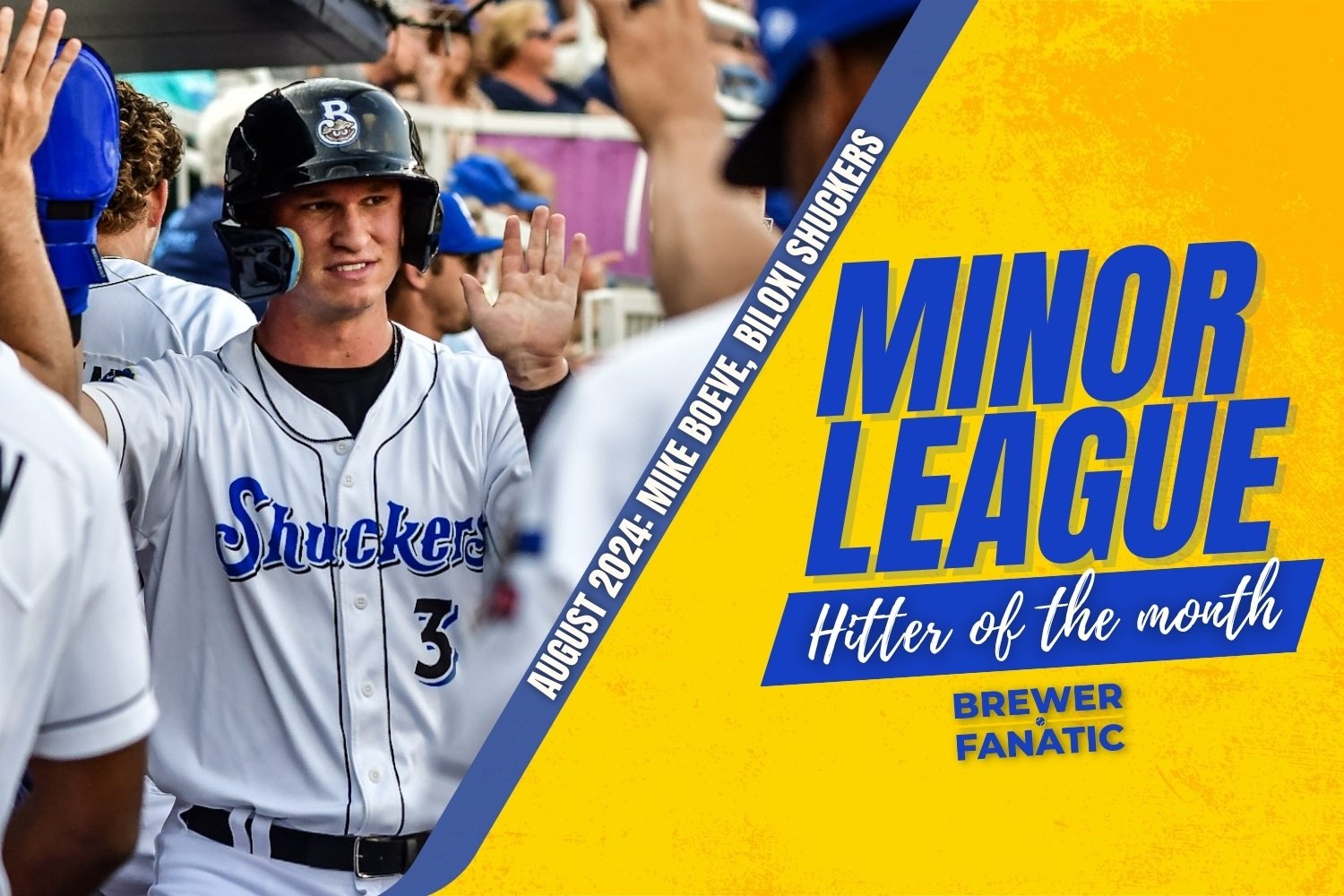 The six-player list for August Hitter of the Month includes four players that are making their debut on this prestigious monthly listing this year, while the other two players have been honored before, including our winner, who earned his second Hitter of the Month award for this season. Honorable Mentions Eric Bitonti (Carolina Mudcats) PA 98, .207/.286/.494, H 18, 2B 4, HR 7, R 14, RBI 21, BB 9, K 29, HBP 1 You may find it hard to believe that a player who batted .207 for the month was among the top MILB hitters in the Milwaukee organization, but Bitonti’s counting stats were among the best in the Brewers system. His numbers included 11 extra base hits, seven home runs, and 21 RBIs, which all ranked first in the organization for the month of August. Bitonti, ranked the 13th best prospect in the chain, is a Cal Ripken-type infielder at 6-foot-4 and 215 pounds. The lefty swinger, who has played mostly at the corner infield spots this season, could compete for the hot corner position in Milwaukee as early as 2026. Jorge Quintana (DSL 2) PA 60, .327/.450/.490, H 16, 2B 6, 3B 1, R 9, RBI 7, BB 10, K 11, HBP 1, SB 6 Quintana, an international signee by the Brewers in January for $1.7 million, is a lanky (6-foot-2, 183 pound) switch-hitting shortstop with 50 grades across the board. At age 17, he has time to improve, with an ETA in Milwaukee in 2029. Frandy Lafond (DSL 2) PA 51, .317/.451/.537, H 13, 2B 4, 3B 1, HR 1, R 11, RBI 8, BB 5, K 12, HBP 5, SB 5 Outfielder Lafond has played all three garden spots, but mostly center field and right field. The 6-foot-1, 180 pound righty hitter and fielder had a great August for ‘Cerveceros Dos.’ Frandy has three home runs and 15 stolen bases on the year, which both rank third on the team. He is only 17 and hopes to see Brew Town in 2028 or 2029. Watch some video of Lafond here. Moises Polanco (DSL 2) PA 50, .368/.520/.474, H 14, 2B 4, R 11, RBI 6, BB 10, K 6, HBP 2, SB 9 Polanco (5-foot-10, 150-pounds) has split time between 2B and SS this year but has committed 11 errors in 146 chances for a fielding percentage of .925, which needs improvement. The part of the righty-hitting Polanco’s game that does not need improvement is his base stealing ability. So far this season, Polanco has pilfered 23 bases in 28 attempts. Francisco Mejía (Nashville Sounds) PA 68, .365/.412/.619, H 23, 2B 4, HR 4, R 9, RBI 8, BB 5, K 14 Mejia is not a prospect at age 28 but offers the Brewers organizational depth at catcher and would be a top-rate emergency call-up to Milwaukee if needed, as the switch-hitter has over 1,000 major league at-bats with three big league teams. Signed as free agent in January, he does not have a great arm (17% CS this year) but shows some pop with nine homers in 299 at-bats at Nashville. August Player of the Month Mike Boeve (Biloxi Shuckers) PA 53, .400/.491/.667, H 18, 2B 3, HR 3, R 10, RBI 8, BB 7, K 8, HBP 1, SB 1 Boeve (6-foot-2, 210 pounds) is the #11 prospect for the Brewers and is having an outstanding season between Single-A Wisconsin and Double-A Biloxi. The southpaw’s slash line of .338/.415/.471 is one of the best in the Brewers farm system. He is a contact hitter who could hit 15 homers in the bigs. Boeve has played mostly at the infield corners this year. Boeve was placed on the injured list on August 20, so his month was even more impressive since he missed 10 days of action. Let us know how we did on our rankings in the comment section. Thanks for reading!
-
my bad...good catch.
-
Probably...my bad.
-
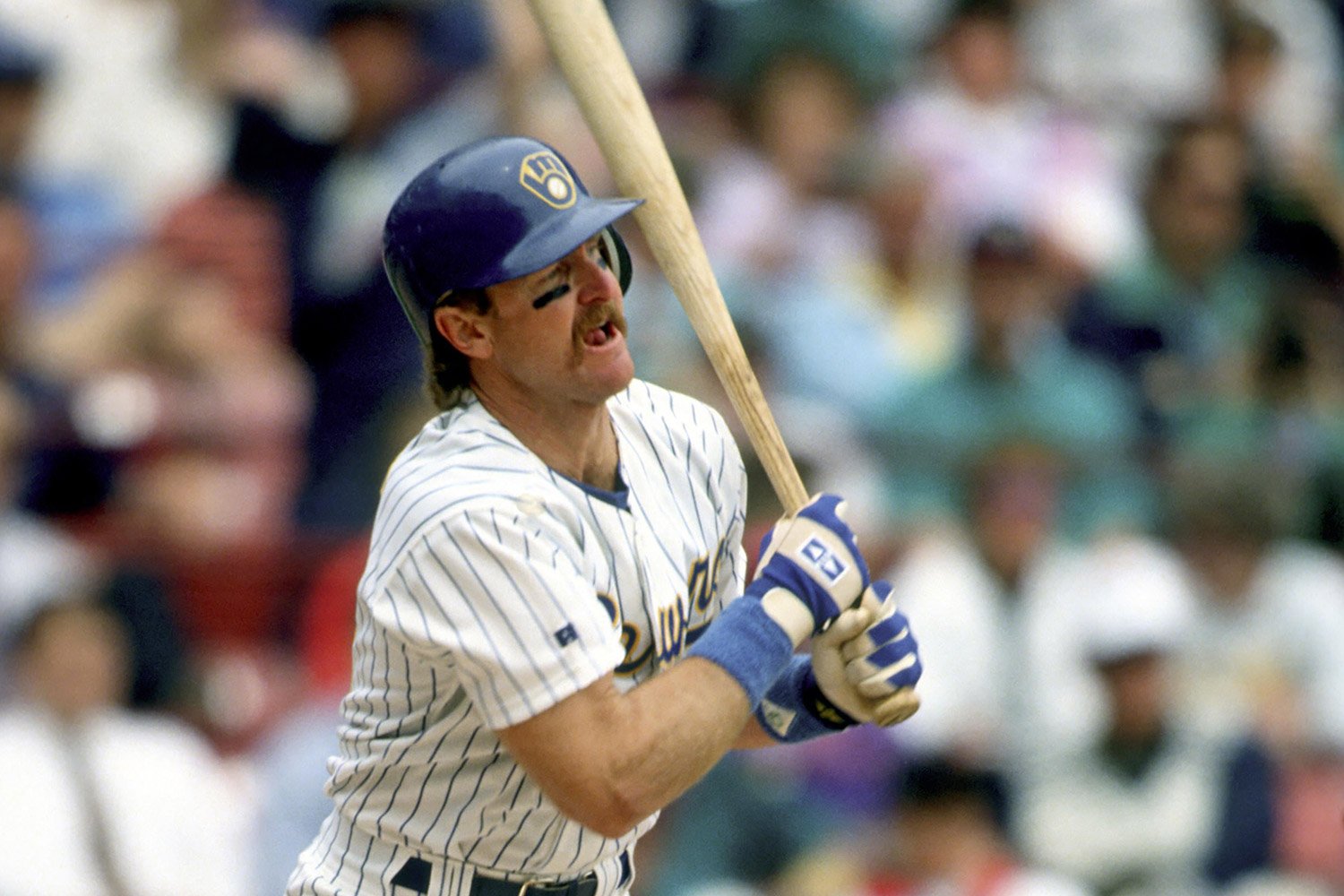 This weekend, the 2024 MLB Draft will take place July 14-16 in Fort Worth, Texas, in conjunction with the All-Star Game played at Globe Life Field in neighboring Arlington. This is the final of a three-part series discussing past Brewers drafts. Today, we look at the top drafts in Milwaukee Brewers history. I will discuss and list the top individual players, the top drafts by number of players that made it to ‘The Show,’ and the top drafts by ‘Wins Above Replacement (WAR). Note: Only drafts from 1970-2015 are considered. Numbers in parentheses indicate round drafted. TOP DRAFTS BY PLAYER 1973 Robin Yount (1) was the only player drafted to play in the majors, but his career made this an outstanding draft year. 1977 Paul Molitor (1) played 15 years with Milwaukee and three each with Toronto and Minnesota. Other players drafted were outfielder Kevin Bass (2), who only played 18 games for Milwaukee before he was traded in 1982 to Houston in the Don Sutton deal. Left-handed pitcher Dave LaPoint (10) was involved in the huge trade that brought Rollie Fingers, Ted Simmons, and Pete Vuckovich to Milwaukee in 1980. 2005 Ryan Braun (1) had an excellent 14-year career with the Brewers despite a year in which he was found guilty of using PEDs, casting a huge cloud over the Californian’s career, and outfielder Michael Brantley had a solid career after being traded from Milwaukee to Cleveland. 1986 Infielder/outfielder Gary Sheffield (1) spent only four years in Milwaukee but had a remarkable 22-year career with seven other teams, hitting 509 home runs. Outfielder Darryl Hamilton spent seven years in Milwaukee during a 13-year career. 2004 Yovani Gallardo (2) won 89 games for Milwaukee during eight years in Brew City and added another 32 victories for four other teams in a 12-year career. Lorenzo Cain (17) played one year for the Brewers before a trade to the Royals saw him spend seven years in Kansas City. He returned to Milwaukee in 2018 as a free agent and played into 2022 before being released. TOP DRAFTS BY THE NUMBER OF PLAYERS THAT PLAYED IN THE MAJORS 2009 Eight players, including Right-handed pitcher Mike Fiers (22), second baseman Ryan Gennett, aka ‘Scooter,’ outfielder Khris Davis, and left-handed pitcher Caleb Thielbar, who never pitched for Milwaukee but is still working games for Minnesota in 2024. 1993 Eight players, including shortstop Mark Loretta (7), right-handed pitcher Jeff D’Amico (1), and utilityman Brian Banks (2). Left-handed pitcher Kelly Wunsch never played for Milwaukee—he was granted free agency after six minor league seasons—but was fifth in AL ROY voting in 2000 for the White Sox. Outfielder Todd Dunn only played 50 games for Milwaukee. Infielder Danny Klassen was selected in the 1997 expansion draft by Arizona. 2011 Eight players, including right-handed pitchers Jacob Barnes (14), Taylor Jungmann (1), Jorge Lopez (2)—pitching for the Cubs this year, left-handed pitcher Jed Bradley (1), and first baseman Nick Ramirez (4), who switched to the mound and is a pitcher for the Dodgers this year. Five drafts had seven players each reach the big leagues: 1974 Right-handed pitcher Moose Haas (2), second baseman Jimmy Gantner (12), and left-handed pitcher Jerry Augustine (15) highlight that draft year. 1987 Shortstop Bill Spiers (1), right-handed pitchers Jaime Navarro (3), Steve Sparks (5), outfielder Troy O’Leary (13), and Jeromy Burnitz (24) are the top players in this solid draft class. 2005 See previous section. Right-handed pitchers Jake Arrieta (24) and Andrew Bailey (16) were two ‘that got away.' 2001 Shortstop JJ Hardy (2) and right-handed pitcher Tim Dillard (15) were drafted as a catcher, and left-handed pitcher Manny Parra (26) led this class. 2007 Third-round pick catcher Jonathan Lucroy was the only big name, but outfielder Matt LaPorta (1) went to Cleveland in the trade that brought the Brewers CC Sabathia. TOP DRAFTS BY WINS ABOVE REPLACEMENT (WAR) 1973 (77.4) Thank you, Robin Yount, who scored all the WAR. 1977 (58.9) Paul Molitor accumulated 59.9 WAR. 2005 (47.4) Ryan Braun scored 47.1 of the WAR for this draft class. 1974 (42.3) Jim Gantner (22.4) and Moose Haas (15.7) did most of the heavy lifting for this group. 1987 (30.4) Jeromy Burnitz notched 15.7 WAR for this class. Note: the numbers above only include WAR achieved in a Brewer uniform. Thank you for reading this article. It was a good chance for an old guy like me to reminisce and an opportunity for some readers to learn about Brewer's history. PART 1: The Worst Drafts PART 2: The Ones That Got Away
- 4 comments
-
- 1
-
-
- mlb draft
- robin yount
- (and 5 more)
-
This article discusses some of the best drafts, 1970-2015 inclusive. How many players in the 2024 draft class might find their names on these lists 20 years from now? Image courtesy of © RVR Photos-USA TODAY Sports This weekend, the 2024 MLB Draft will take place July 14-16 in Fort Worth, Texas, in conjunction with the All-Star Game played at Globe Life Field in neighboring Arlington. This is the final of a three-part series discussing past Brewers drafts. Today, we look at the top drafts in Milwaukee Brewers history. I will discuss and list the top individual players, the top drafts by number of players that made it to ‘The Show,’ and the top drafts by ‘Wins Above Replacement (WAR). Note: Only drafts from 1970-2015 are considered. Numbers in parentheses indicate round drafted. TOP DRAFTS BY PLAYER 1973 Robin Yount (1) was the only player drafted to play in the majors, but his career made this an outstanding draft year. 1977 Paul Molitor (1) played 15 years with Milwaukee and three each with Toronto and Minnesota. Other players drafted were outfielder Kevin Bass (2), who only played 18 games for Milwaukee before he was traded in 1982 to Houston in the Don Sutton deal. Left-handed pitcher Dave LaPoint (10) was involved in the huge trade that brought Rollie Fingers, Ted Simmons, and Pete Vuckovich to Milwaukee in 1980. 2005 Ryan Braun (1) had an excellent 14-year career with the Brewers despite a year in which he was found guilty of using PEDs, casting a huge cloud over the Californian’s career, and outfielder Michael Brantley had a solid career after being traded from Milwaukee to Cleveland. 1986 Infielder/outfielder Gary Sheffield (1) spent only four years in Milwaukee but had a remarkable 22-year career with seven other teams, hitting 509 home runs. Outfielder Darryl Hamilton spent seven years in Milwaukee during a 13-year career. 2004 Yovani Gallardo (2) won 89 games for Milwaukee during eight years in Brew City and added another 32 victories for four other teams in a 12-year career. Lorenzo Cain (17) played one year for the Brewers before a trade to the Royals saw him spend seven years in Kansas City. He returned to Milwaukee in 2018 as a free agent and played into 2022 before being released. TOP DRAFTS BY THE NUMBER OF PLAYERS THAT PLAYED IN THE MAJORS 2009 Eight players, including Right-handed pitcher Mike Fiers (22), second baseman Ryan Gennett, aka ‘Scooter,’ outfielder Khris Davis, and left-handed pitcher Caleb Thielbar, who never pitched for Milwaukee but is still working games for Minnesota in 2024. 1993 Eight players, including shortstop Mark Loretta (7), right-handed pitcher Jeff D’Amico (1), and utilityman Brian Banks (2). Left-handed pitcher Kelly Wunsch never played for Milwaukee—he was granted free agency after six minor league seasons—but was fifth in AL ROY voting in 2000 for the White Sox. Outfielder Todd Dunn only played 50 games for Milwaukee. Infielder Danny Klassen was selected in the 1997 expansion draft by Arizona. 2011 Eight players, including right-handed pitchers Jacob Barnes (14), Taylor Jungmann (1), Jorge Lopez (2)—pitching for the Cubs this year, left-handed pitcher Jed Bradley (1), and first baseman Nick Ramirez (4), who switched to the mound and is a pitcher for the Dodgers this year. Five drafts had seven players each reach the big leagues: 1974 Right-handed pitcher Moose Haas (2), second baseman Jimmy Gantner (12), and left-handed pitcher Jerry Augustine (15) highlight that draft year. 1987 Shortstop Bill Spiers (1), right-handed pitchers Jaime Navarro (3), Steve Sparks (5), outfielder Troy O’Leary (13), and Jeromy Burnitz (24) are the top players in this solid draft class. 2005 See previous section. Right-handed pitchers Jake Arrieta (24) and Andrew Bailey (16) were two ‘that got away.' 2001 Shortstop JJ Hardy (2) and right-handed pitcher Tim Dillard (15) were drafted as a catcher, and left-handed pitcher Manny Parra (26) led this class. 2007 Third-round pick catcher Jonathan Lucroy was the only big name, but outfielder Matt LaPorta (1) went to Cleveland in the trade that brought the Brewers CC Sabathia. TOP DRAFTS BY WINS ABOVE REPLACEMENT (WAR) 1973 (77.4) Thank you, Robin Yount, who scored all the WAR. 1977 (58.9) Paul Molitor accumulated 59.9 WAR. 2005 (47.4) Ryan Braun scored 47.1 of the WAR for this draft class. 1974 (42.3) Jim Gantner (22.4) and Moose Haas (15.7) did most of the heavy lifting for this group. 1987 (30.4) Jeromy Burnitz notched 15.7 WAR for this class. Note: the numbers above only include WAR achieved in a Brewer uniform. Thank you for reading this article. It was a good chance for an old guy like me to reminisce and an opportunity for some readers to learn about Brewer's history. PART 1: The Worst Drafts PART 2: The Ones That Got Away View full article
-
Milwaukee Brewers Draft History: The Ones That Got Away
Michael Trzinski posted an article in History
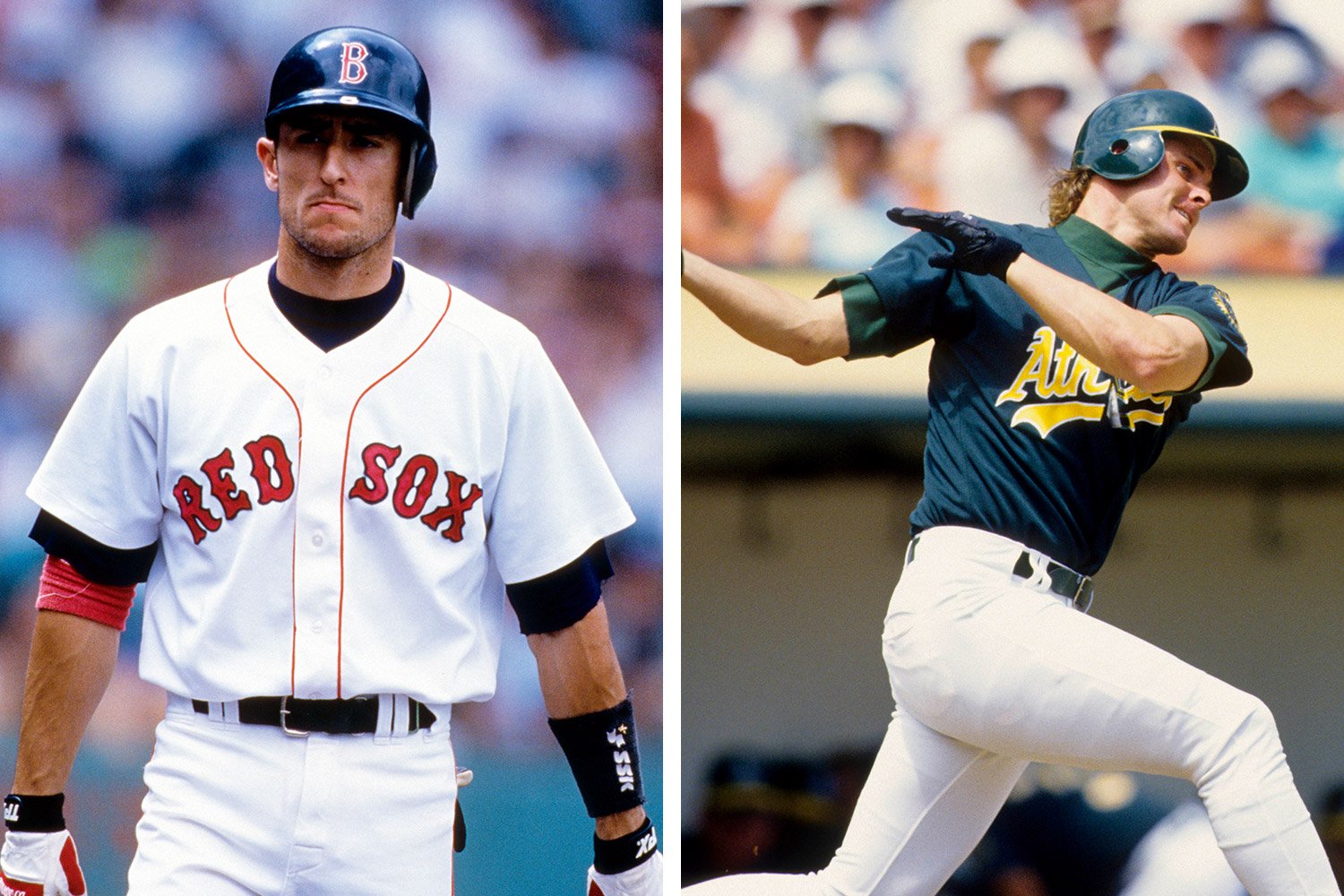 This is the second of a three-part series discussing past Brewers drafts. Today, we look at 12 top players who ‘got away’ from the Brewers, who were drafted by Milwaukee but did not sign. They became All-Stars, 20-game winners, MVPs, Rookies of the Year, and Cy Young winners. Unfortunately, none of these accolades happened with these players in Brewer jerseys. 1. Jason Giambi, 1B-DH Giambi was a 3B/SS/P at South Hills HS in West Covina, California, and was drafted in the 43rd round by the Brewers in 1989. Instead, he received a partial scholarship to Cal State-Long Beach and was named to Baseball America’s pre-season All-American team as a junior third baseman. Giambi was a three-time All-West Conference selection and was picked in the second round in 1992 by Oakland. His 20-year career was embroiled in controversy with the early 2000s steroid scandal. Giambi’s career numbers included 440 home runs and a slash line of .277/.399/.516. He was a five-time All-Star and was named the AL MVP in 2000. 2. Nomar Garciaparra, SS A slick shortstop who would later play on the 1992 US Olympic team, Garciaparra graduated from St. John Bosco HS in Bellflower, California, and was selected in the fifth round of the 1991 draft by Milwaukee but elected to attend Georgia Tech instead. He was the Atlantic Coast Conference (ACC) Rookie of the Year and was named to the All-ACC team twice in three years. In 1994, Boston chose the infielder with the 12th pick in the first round. Over 14 years, Garciaparra was the AL Rookie of the Year in 1997, won two batting titles, and was a six-time All-Star. His career slash line was .313/.361/.521. 3. Hunter Pence, OF A third baseman at Arlington (Texas) HS, Pence was a 40th-round Brewers pick. He elected to attend Texarkana College instead. He transferred to the University of Texas-Arlington and was picked by Houston in the second round after his junior year for a reported $575,000. Pence—who switched to the outfield—played 14 years in the bigs for Houston, San Francisco, Philadelphia, and Texas, earning All-Star team honors four times. He hit 244 home runs and slashed .279/.334/.461 over 1700 games. Pence was a key member of the 2012 and 2014 World Champion San Francisco Giants. 4. Kevin McReynolds, OF The Arkansas native was Milwaukee's 19th-round pick in 1978 out of Sylvan Hills HS (Sherwood, Arkansas) but did not sign with the Brewers, electing to attend the University of Arkansas. As a high school senior, McReynolds batted .638 with 16 home runs in 25 games. He also pitched, winning five games. McReynolds was drafted after his junior year from UA, the sixth overall pick by San Diego for $125,000. McReynolds played for San Diego, the New York Mets, and Kansas City during his 12-year big league career. He slashed .265/.328/.447 and slugged 211 home runs in 1500 games. 5. Alex Fernandez, RHP The Brewers took a lot of heat over their failure to sign their first-round pick in 1988. The Monsignor Edward Pace HS (Miami Gardens, Florida) product chose to attend the University of Miami instead. He threw a no-hitter against Maine in 1989 and then strangely transferred to Miami Dade Junior College the following year. Fernandez was the fourth overall pick of the Chicago White Sox in 1990 for $350,000. Fernandez won 107 games in 10 years for Chicago and Florida, winning a career-high 18 games in 1993 for Chicago. He won 17 games in 1997, leading the Marlins to the World Series, but didn’t pitch due to a torn rotator cuff. Fernandez had an ERA+ of 115 in 261 starts. 6. Jake Arrieta, RHP The Plano (TX) East HS product was drafted three times before he signed. In 2004, the Reds picked him in the 31st round. The next year, now attending Weatherford (TX) College, he turned down the Brewers’ 26th-round bid. Finally, in 2007, he signed after being picked by Baltimore in the fifth round out of TCU for $1.1 million. Arrieta struggled with elbow problems in Baltimore and was traded to the Cubs during his fourth season. With the Cubs, he was arguably the best pitcher in baseball in 2015-2016, winning a combined 40 games for Chicago. His 22 wins led all of baseball in 2015, and he won the NL Cy Young. The following year, he was named to the All-Star team for the only time. Arrieta won 115 games over his 12-year career with Baltimore, Chicago, Philadelphia, and San Diego. 7. Matt Morris, RHP The righty pitcher from southern New York was drafted by Milwaukee in the 26th round of the 1992 draft but elected to matriculate to Seton Hall. In 1995, Morris was tabbed as the 12th overall pick by the St. Louis Cardinals in the first round. He made it to the majors in less than two years and had an excellent 11-year career, pitching for the Cards, San Francisco, and Pittsburgh. Morris was a two-time All-Star, leading the NL with 22 victories in 2001. Overall, he won 121 games, fashioned an ERA of 3.98, and had an ERA+ of 107. 8. Don Slaught, C The Brewers drafted Slaught in the 20th round in 1979. Named to the College All-Star team, he did not sign and was picked by the Kansas City Royals in the seventh round in 1980. Slaught ended up being somewhere between a starter and a backup catcher, averaging 83 games and 254 ABs during his 16-year career, playing for Kansas City, Texas, New York (Yankees), Pittsburgh, California, Chicago (White Sox), and San Diego. Slaught's career slash line was .283/.338/.412, including 77 home runs. He hit .300 or better in six seasons and had a minimum of 200 ABs. 9. Carlos Rodon, LHP Named as the Tri-Nine Conference Player of the Year for Holly Springs (NC) HS, Rodon went 23-2 as a three-year starting pitcher. He was chosen by the Brewers in the 16th round of the 2011 draft but elected not to sign because of the low draft slot. Instead, he attended North Carolina State and won 25 games for the Wolfpack in three years. He was picked third overall in the 2014 draft by the Chicago White Sox and was given a signing bonus of $6.5 million. Rodon pitched for Chicago from 2015-2021, signed with San Francisco as a free agent in 2022, signed with the Yankees in 2023, and is still pitching for them in 2024. He was an All-Star in 2021 and 2022 and finished in the top 6 for Cy Young voting. He has 68 wins and an ERA+ of 106 in his ten years. He is only 31 years old and is signed through 2028. 10. Tim Teufel, 2B Teufel was another ‘three-draft’ player. As a student-athlete at St. Petersburg (FL) College, he was tabbed in the 16th round by Milwaukee in 1978, in the third round by the Chicago White Sox the following year out of Clemson, and finally in 1980 by the Minnesota Twins in the second round. He signed with the Twins and was fourth in the AL ROY voting in 1984. He was traded to the New York Mets after three years in Minnesota and spent six years with New York before being traded to San Diego. Teufel played three years in San Diego before retiring. His 11-year career included a slash line of .254/.336/.404 across 3100 ABs. 11. Jonathan India, 2B The Brewers tabbed the shaggy-haired infielder in the 26th round in 2015 out of American Heritage HS (Delray Beach, FL) but did not sign. After playing three years at the University of Florida, he was plucked fifth overall in 2018 by Cincinnati for $5.2 million. India was the NL ROY in 2021, slashing .269/.376/.459 with 21 home runs. He is signed with the Reds through 2025. 12. Garrett Crochet, LHP It is with a bit of irony that a player the Brewers are possibly looking for in a trade in 2024 was drafted by that team in 2017 in the 34th round out of Ocean Springs (MS) HS. Crochet elected not to sign and was taken 11th overall three years later by the White Sox. The southpaw is in his fourth season with Chicago and his first year as a starter. As of late June, he leads the AL in strikeouts. The White Sox are terrible this year and might be willing to deal with Crochet, one of their few trade pieces. The cost will be high, but he could be a pitcher who can help the Brewers deep into the post-season. Baseball teams don’t always get their man in the draft; every team has stories like the ones above. It is fun to say ‘what could have happened,’ but there are always star players that just got away. Part 1: The Worst Drafts Part 3: The Best Drafts (July 13)
-
One weekend from now the 2024 MLB Draft will take place July 14-16 in Fort Worth, Texas in conjunction with the All-Star game being played at Globe Life Field in neighboring Arlington. This is the second of a three-part series discussing past Brewers drafts. Today, we look at 12 top players who ‘got away’ from the Brewers, who were drafted by Milwaukee but did not sign. They became All-Stars, 20-game winners, MVPs, Rookies of the Year, and Cy Young winners. Unfortunately, none of these accolades happened with these players in Brewer jerseys. 1. Jason Giambi, 1B-DH Giambi was a 3B/SS/P at South Hills HS in West Covina, California, and was drafted in the 43rd round by the Brewers in 1989. Instead, he received a partial scholarship to Cal State-Long Beach and was named to Baseball America’s pre-season All-American team as a junior third baseman. Giambi was a three-time All-West Conference selection and was picked in the second round in 1992 by Oakland. His 20-year career was embroiled in controversy with the early 2000s steroid scandal. Giambi’s career numbers included 440 home runs and a slash line of .277/.399/.516. He was a five-time All-Star and was named the AL MVP in 2000. 2. Nomar Garciaparra, SS A slick shortstop who would later play on the 1992 US Olympic team, Garciaparra graduated from St. John Bosco HS in Bellflower, California, and was selected in the fifth round of the 1991 draft by Milwaukee but elected to attend Georgia Tech instead. He was the Atlantic Coast Conference (ACC) Rookie of the Year and was named to the All-ACC team twice in three years. In 1994, Boston chose the infielder with the 12th pick in the first round. Over 14 years, Garciaparra was the AL Rookie of the Year in 1997, won two batting titles, and was a six-time All-Star. His career slash line was .313/.361/.521. 3. Hunter Pence, OF A third baseman at Arlington (Texas) HS, Pence was a 40th-round Brewers pick. He elected to attend Texarkana College instead. He transferred to the University of Texas-Arlington and was picked by Houston in the second round after his junior year for a reported $575,000. Pence—who switched to the outfield—played 14 years in the bigs for Houston, San Francisco, Philadelphia, and Texas, earning All-Star team honors four times. He hit 244 home runs and slashed .279/.334/.461 over 1700 games. Pence was a key member of the 2012 and 2014 World Champion San Francisco Giants. 4. Kevin McReynolds, OF The Arkansas native was Milwaukee's 19th-round pick in 1978 out of Sylvan Hills HS (Sherwood, Arkansas) but did not sign with the Brewers, electing to attend the University of Arkansas. As a high school senior, McReynolds batted .638 with 16 home runs in 25 games. He also pitched, winning five games. McReynolds was drafted after his junior year from UA, the sixth overall pick by San Diego for $125,000. McReynolds played for San Diego, the New York Mets, and Kansas City during his 12-year big league career. He slashed .265/.328/.447 and slugged 211 home runs in 1500 games. 5. Alex Fernandez, RHP The Brewers took a lot of heat over their failure to sign their first-round pick in 1988. The Monsignor Edward Pace HS (Miami Gardens, Florida) product chose to attend the University of Miami instead. He threw a no-hitter against Maine in 1989 and then strangely transferred to Miami Dade Junior College the following year. Fernandez was the fourth overall pick of the Chicago White Sox in 1990 for $350,000. Fernandez won 107 games in 10 years for Chicago and Florida, winning a career-high 18 games in 1993 for Chicago. He won 17 games in 1997, leading the Marlins to the World Series, but didn’t pitch due to a torn rotator cuff. Fernandez had an ERA+ of 115 in 261 starts. 6. Jake Arrieta, RHP The Plano (TX) East HS product was drafted three times before he signed. In 2004, the Reds picked him in the 31st round. The next year, now attending Weatherford (TX) College, he turned down the Brewers’ 26th-round bid. Finally, in 2007, he signed after being picked by Baltimore in the fifth round out of TCU for $1.1 million. Arrieta struggled with elbow problems in Baltimore and was traded to the Cubs during his fourth season. With the Cubs, he was arguably the best pitcher in baseball in 2015-2016, winning a combined 40 games for Chicago. His 22 wins led all of baseball in 2015, and he won the NL Cy Young. The following year, he was named to the All-Star team for the only time. Arrieta won 115 games over his 12-year career with Baltimore, Chicago, Philadelphia, and San Diego. 7. Matt Morris, RHP The righty pitcher from southern New York was drafted by Milwaukee in the 26th round of the 1992 draft but elected to matriculate to Seton Hall. In 1995, Morris was tabbed as the 12th overall pick by the St. Louis Cardinals in the first round. He made it to the majors in less than two years and had an excellent 11-year career, pitching for the Cards, San Francisco, and Pittsburgh. Morris was a two-time All-Star, leading the NL with 22 victories in 2001. Overall, he won 121 games, fashioned an ERA of 3.98, and had an ERA+ of 107. 8. Don Slaught, C The Brewers drafted Slaught in the 20th round in 1979. Named to the College All-Star team, he did not sign and was picked by the Kansas City Royals in the seventh round in 1980. Slaught ended up being somewhere between a starter and a backup catcher, averaging 83 games and 254 ABs during his 16-year career, playing for Kansas City, Texas, New York (Yankees), Pittsburgh, California, Chicago (White Sox), and San Diego. Slaught's career slash line was .283/.338/.412, including 77 home runs. He hit .300 or better in six seasons and had a minimum of 200 ABs. 9. Carlos Rodon, LHP Named as the Tri-Nine Conference Player of the Year for Holly Springs (NC) HS, Rodon went 23-2 as a three-year starting pitcher. He was chosen by the Brewers in the 16th round of the 2011 draft but elected not to sign because of the low draft slot. Instead, he attended North Carolina State and won 25 games for the Wolfpack in three years. He was picked third overall in the 2014 draft by the Chicago White Sox and was given a signing bonus of $6.5 million. Rodon pitched for Chicago from 2015-2021, signed with San Francisco as a free agent in 2022, signed with the Yankees in 2023, and is still pitching for them in 2024. He was an All-Star in 2021 and 2022 and finished in the top 6 for Cy Young voting. He has 68 wins and an ERA+ of 106 in his ten years. He is only 31 years old and is signed through 2028. 10. Tim Teufel, 2B Teufel was another ‘three-draft’ player. As a student-athlete at St. Petersburg (FL) College, he was tabbed in the 16th round by Milwaukee in 1978, in the third round by the Chicago White Sox the following year out of Clemson, and finally in 1980 by the Minnesota Twins in the second round. He signed with the Twins and was fourth in the AL ROY voting in 1984. He was traded to the New York Mets after three years in Minnesota and spent six years with New York before being traded to San Diego. Teufel played three years in San Diego before retiring. His 11-year career included a slash line of .254/.336/.404 across 3100 ABs. 11. Jonathan India, 2B The Brewers tabbed the shaggy-haired infielder in the 26th round in 2015 out of American Heritage HS (Delray Beach, FL) but did not sign. After playing three years at the University of Florida, he was plucked fifth overall in 2018 by Cincinnati for $5.2 million. India was the NL ROY in 2021, slashing .269/.376/.459 with 21 home runs. He is signed with the Reds through 2025. 12. Garrett Crochet, LHP It is with a bit of irony that a player the Brewers are possibly looking for in a trade in 2024 was drafted by that team in 2017 in the 34th round out of Ocean Springs (MS) HS. Crochet elected not to sign and was taken 11th overall three years later by the White Sox. The southpaw is in his fourth season with Chicago and his first year as a starter. As of late June, he leads the AL in strikeouts. The White Sox are terrible this year and might be willing to deal with Crochet, one of their few trade pieces. The cost will be high, but he could be a pitcher who can help the Brewers deep into the post-season. Baseball teams don’t always get their man in the draft; every team has stories like the ones above. It is fun to say ‘what could have happened,’ but there are always star players that just got away. Part 1: The Worst Drafts Part 3: The Best Drafts (July 13) View full article
-
2019 was a disaster of a draft, although wasn't it bad for all? Either way - the best players are not in the organization (Hamilton and Kelly). D. Miller could become a MLBer maybe. And Jeferson Figueroa, Nick Kahle and Nick Bennet are the only draft picks (4) still in the organization a mere 5 years later. That is very bad as a draft class. Kahle, Bennett, and Miller are still in the organization. What if they become solid players? We just don't know yet.
-
I only went until 2015 because every draft beyond that has a potential for players to succeed.
-
I remember JM and Neugy. Was hoping for better, too.
- 7 replies
-
- 1
-
-
- rickey keeton
- kevin barker
- (and 5 more)
-
Two weeks from now, the 2024 MLB Draft will take place July 14-16 in Fort Worth, Texas, in conjunction with the All-Star game being played at Globe Life Field in neighboring Arlington. As a lead-up to the big event, we're examining the Crew's draft history. Image courtesy of © Milwaukee Journal Sentinel files / USA TODAY NETWORK The Milwaukee Brewers have the 17th pick in the first round, along with the 34th pick in the competitive balance round ‘A,’ acquired from Baltimore in the Corbin Burnes trade. In the second round, they have the 57th overall pick. The Brewers also have the 67th overall in the Competitive balance round ‘B.’ They have the 93rd overall pick in the third round and the 123rd in the fourth round. In the fifth round, Milwaukee has the 156th overall pick. For the remaining 15 rounds, Milwaukee will have the 17th pick in each round. Some of the top prospects this year are 3B/OF Charlie Condon (Georgia), 2B Travis Bazzana (Oregon State), RHP Chase Burns (Wake Forest), 1B Nick Kurtz (Wake Forest), and 1B/LHP Jac Caglianone (Florida). Brewer Fanatic writer Jamie Cameron has compiled a 2024 MLB Mock Draft Consensus Board, including rankings from MLB Pipeline, ESPN, The Athletic, and others. This is the first of a three-part series discussing past Brewers drafts. Today, we look at five of the ‘worst’ drafts in Milwaukee’s draft history. 1975 The 1975 draft leads the list. The Brewers chose 22 players, 13 high schoolers, and nine college players. This was the only draft from 1970-2010 that did not have a single player who reached the major leagues in a Brewers uniform, although an asterisk comes attached to this draft. The Brewers chose pitcher Bob Stoddard in the 19th round but did not sign with Milwaukee. In 1976, he was picked in the January secondary draft by Atlanta and in the June secondary draft by Oakland, but he did not sign with either club. Finally, he signed with Seattle as a 10th-round pick in the 1978 June draft. He pitched for seven years in the bigs with four different clubs from 1981-87. Here are the Brewers top five picks from 1975: #1 LHP Rick O’Keeffe, Yorktown HS (Yorktown Heights, NY) Scouted by roughly 20 big league teams, the 6-foot-6, 225-pounder was the fifth selection overall in the draft, picked ahead of Rick Cerone, Clint Hurdle, and Dale Berra. In his senior year, he pitched three no-hitters, had an ERA of 0.83, and struck out 114 batters in 59 innings. O’Keeffe also batted .426 with five home runs. He spent two seasons at Single-A and was traded to the Cincinnati organization for Mike Caldwell and another player in June 1977. O’Keeffe spent five years in the Reds chain before being released in early 1982. He missed all of 1983 with a bum elbow, which required surgery. He tried to make a comeback in 1984 in the Mets chain and pitched in seven games before calling it quits. #2 C Chuck Ross, Tates Creek HS (Lexington, KY) The left-handed batting Ross hit .438 in his senior year and turned down a scholarship at the University of Kentucky to sign a five-figure bonus with the Brewers. He played well in his first season at low-A Newark, slashing .271/.416/.338, earning a promotion the next year to Single-A Burlington in the Midwest League. Ross spent the next two years at that level before being promoted to Double-A Holyoke in 1978. After batting only .177/.283/.237 in a backup role at Holyoke, Ross was traded to the Baltimore organization in January 1979. He played the entire season at Single-A Miami and was a teammate of Cal Ripken, Jr. Ross slashed .237/.317/.309 with only two home runs. He was released after the season and called it a career after five pro seasons, never reaching higher than Double-A. #3 RHP Alvin Edge, Crawford HS (San Diego, CA) Not to be confused with Butch Edge, a Brewer pick from the previous year, Alvin Edge threw a no-hitter in his senior year. He spent four seasons at the lower levels of the Brewer organization, spending parts of three years at Single-A Burlington and even advancing as high as Double-A Holyoke in 1978. The Brewers released Edge after 1979 spring training. He was picked up by the Seattle organization and pitched six games at Single-A San Jose in the California League before being released. #4 OF Gregory Anderson, John W. North HS (Riverside, CA) Anderson was a 5-foot-10, 185-pound fly chaser who had a nice first pro season in 1975, slashing .293/.368/.462 at Low-A Newark. He hit nine homers and stole 26 bases in 50 games. That earned him a promotion to Single-A Burlington the following season. Anderson slashed .249/.333/.365 and stole 26 bases again. That wasn’t enough to earn a promotion, as he played at Burlington once again in 1977. Anderson played in only nine games, slashing .189/.318/.243 before getting released. #5 SS-2B Robert Hely, Fort Lauderdale HS (Fort Lauderdale, FL) Bob Hely did not sign with the Brewers, instead electing to attend Wake Forest University. He played mostly at second base from 1976-1979 and was named to the All-ACC first team in 1978 and the second team in 1979. Hely hit a home run in the Demon Deacons’ 16-2 win over Virginia in the first game of the 1978 ACC tournament. He did not play professional ball. Dishonorable Mentions 1978 The Brewers made 32 picks in this draft, and only one of them (Rickey Keeton) played for Milwaukee. Picked in the third round, ‘Buster’ played parts of two years in the majors, pitching in 22 games in 1980-81. First-round pick catcher Nick Hernandez signed for $50,000, spent four years in the minors, and never made it out of ‘A’ ball. Three players who did not sign and were drafted in future years made it to the majors with other clubs. Infielder Tim Teufel, OF Kevin McReynolds, and LHP Rob Murphy played a combined 34 years in the majors. 1996 Of the 57 picks made by the Brewers, only a pair of them performed for the Brewers in the bigs. Third-round pick 1B Kevin Barker played in 78 games over the 1999-2000 seasons, and RHP Allen Levrault (13th round) appeared in 37 contests in 2000-01. Barker played parts of three seasons for other teams (2002, 2006, 2009), while Levrault pitched for Miami in 2003. First-round pick OF Chad Green was the Brewers' first million-dollar signee but sadly never made it past Triple-A and was traded to San Diego after the 2000 season. RHP Josh Hancock and Brandon Backe did not sign with Milwaukee but were drafted in 1998 and played in the majors for other teams. Hancock died in a car crash in 2007 at the age of 29. 1990 Only OF Duane Singleton (5th round) and RHP Marshall Boze (12th round) made it to the bigs of the 43 Milwaukee draftees. Singleton played in 15 games for Milwaukee in 1994-95 and then appeared in 18 contests for Detroit in 1996. Boze had one save in his 25 relief appearances in 1996 for the Brewers. Top pick OF Larue Baber never made it past Single-A in his three years in the Brewers organization. He was released by Milwaukee before the 1993 season and picked up by San Diego. Baber topped out at High-A and was released by the Padres after the 1994 season. 1997 The Brewers made 53 picks and once again had limited success. Only first-rounder RHP Kyle Peterson—who signed for $1.4 million—and RHPs Matt Childers (9th round) and Brian Mallette (27th round) appeared in a Milwaukee Brewers uniform. Peterson pitched in 1999 and 2001, appearing in 20 games. Childers threw in eight contests for Milwaukee in 2002 and three times for Atlanta in 2005. Mallette made five appearances for Milwaukee in 2002. Bucky Jacobsen played six years in the minors for Milwaukee, making it as high as Triple-A before getting released in mid-2002. He signed with the Cardinals and a year later with the Mariners before reaching the bigs. He played in 42 games for Seattle in 2004, hitting nine HRs. After calling it quits in 2007 in the Mexican League, Jacobsen had launched 186 homers in 11 minor league seasons. RHP Geoff Geary did not sign, instead signing with Philadelphia in 1998. Geary pitched for the Phillies and Astros between 2003 and 2009, appearing in 287 games. It just goes to show that the MLB Draft is often a crapshoot. How does the 1974 draft happen? Number one pick Robin Yount becomes a Hall of Famer, while none of the other 20 players selected even get a ‘Cup of Coffee.’ What about 1984 when only #14 pick John Jaha plays in the majors, hitting 141 career homers? Part two will discuss a few players who got away when they did not sign after being drafted by Milwaukee but were drafted in the following years by other teams and went on to have big careers. It is a case of ‘what could have been.’ View full article
-
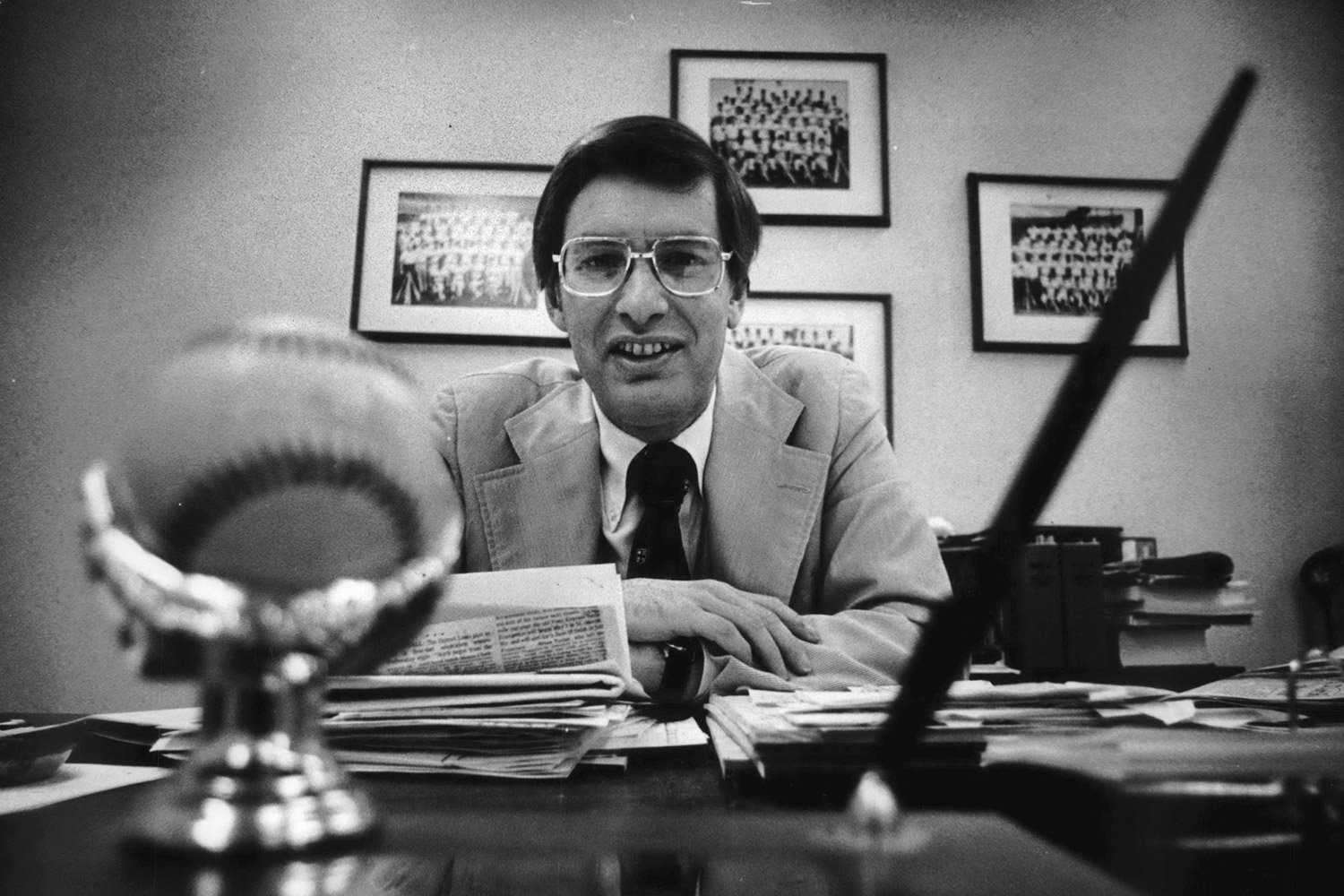 The Milwaukee Brewers have the 17th pick in the first round, along with the 34th pick in the competitive balance round ‘A,’ acquired from Baltimore in the Corbin Burnes trade. In the second round, they have the 57th overall pick. The Brewers also have the 67th overall in the Competitive balance round ‘B.’ They have the 93rd overall pick in the third round and the 123rd in the fourth round. In the fifth round, Milwaukee has the 156th overall pick. For the remaining 15 rounds, Milwaukee will have the 17th pick in each round. Some of the top prospects this year are 3B/OF Charlie Condon (Georgia), 2B Travis Bazzana (Oregon State), RHP Chase Burns (Wake Forest), 1B Nick Kurtz (Wake Forest), and 1B/LHP Jac Caglianone (Florida). Brewer Fanatic writer Jamie Cameron has compiled a 2024 MLB Mock Draft Consensus Board, including rankings from MLB Pipeline, ESPN, The Athletic, and others. This is the first of a three-part series discussing past Brewers drafts. Today, we look at five of the ‘worst’ drafts in Milwaukee’s draft history. 1975 The 1975 draft leads the list. The Brewers chose 22 players, 13 high schoolers, and nine college players. This was the only draft from 1970-2010 that did not have a single player who reached the major leagues in a Brewers uniform, although an asterisk comes attached to this draft. The Brewers chose pitcher Bob Stoddard in the 19th round but did not sign with Milwaukee. In 1976, he was picked in the January secondary draft by Atlanta and in the June secondary draft by Oakland, but he did not sign with either club. Finally, he signed with Seattle as a 10th-round pick in the 1978 June draft. He pitched for seven years in the bigs with four different clubs from 1981-87. Here are the Brewers top five picks from 1975: #1 LHP Rick O’Keeffe, Yorktown HS (Yorktown Heights, NY) Scouted by roughly 20 big league teams, the 6-foot-6, 225-pounder was the fifth selection overall in the draft, picked ahead of Rick Cerone, Clint Hurdle, and Dale Berra. In his senior year, he pitched three no-hitters, had an ERA of 0.83, and struck out 114 batters in 59 innings. O’Keeffe also batted .426 with five home runs. He spent two seasons at Single-A and was traded to the Cincinnati organization for Mike Caldwell and another player in June 1977. O’Keeffe spent five years in the Reds chain before being released in early 1982. He missed all of 1983 with a bum elbow, which required surgery. He tried to make a comeback in 1984 in the Mets chain and pitched in seven games before calling it quits. #2 C Chuck Ross, Tates Creek HS (Lexington, KY) The left-handed batting Ross hit .438 in his senior year and turned down a scholarship at the University of Kentucky to sign a five-figure bonus with the Brewers. He played well in his first season at low-A Newark, slashing .271/.416/.338, earning a promotion the next year to Single-A Burlington in the Midwest League. Ross spent the next two years at that level before being promoted to Double-A Holyoke in 1978. After batting only .177/.283/.237 in a backup role at Holyoke, Ross was traded to the Baltimore organization in January 1979. He played the entire season at Single-A Miami and was a teammate of Cal Ripken, Jr. Ross slashed .237/.317/.309 with only two home runs. He was released after the season and called it a career after five pro seasons, never reaching higher than Double-A. #3 RHP Alvin Edge, Crawford HS (San Diego, CA) Not to be confused with Butch Edge, a Brewer pick from the previous year, Alvin Edge threw a no-hitter in his senior year. He spent four seasons at the lower levels of the Brewer organization, spending parts of three years at Single-A Burlington and even advancing as high as Double-A Holyoke in 1978. The Brewers released Edge after 1979 spring training. He was picked up by the Seattle organization and pitched six games at Single-A San Jose in the California League before being released. #4 OF Gregory Anderson, John W. North HS (Riverside, CA) Anderson was a 5-foot-10, 185-pound fly chaser who had a nice first pro season in 1975, slashing .293/.368/.462 at Low-A Newark. He hit nine homers and stole 26 bases in 50 games. That earned him a promotion to Single-A Burlington the following season. Anderson slashed .249/.333/.365 and stole 26 bases again. That wasn’t enough to earn a promotion, as he played at Burlington once again in 1977. Anderson played in only nine games, slashing .189/.318/.243 before getting released. #5 SS-2B Robert Hely, Fort Lauderdale HS (Fort Lauderdale, FL) Bob Hely did not sign with the Brewers, instead electing to attend Wake Forest University. He played mostly at second base from 1976-1979 and was named to the All-ACC first team in 1978 and the second team in 1979. Hely hit a home run in the Demon Deacons’ 16-2 win over Virginia in the first game of the 1978 ACC tournament. He did not play professional ball. Dishonorable Mentions 1978 The Brewers made 32 picks in this draft, and only one of them (Rickey Keeton) played for Milwaukee. Picked in the third round, ‘Buster’ played parts of two years in the majors, pitching in 22 games in 1980-81. First-round pick catcher Nick Hernandez signed for $50,000, spent four years in the minors, and never made it out of ‘A’ ball. Three players who did not sign and were drafted in future years made it to the majors with other clubs. Infielder Tim Teufel, OF Kevin McReynolds, and LHP Rob Murphy played a combined 34 years in the majors. 1996 Of the 57 picks made by the Brewers, only a pair of them performed for the Brewers in the bigs. Third-round pick 1B Kevin Barker played in 78 games over the 1999-2000 seasons, and RHP Allen Levrault (13th round) appeared in 37 contests in 2000-01. Barker played parts of three seasons for other teams (2002, 2006, 2009), while Levrault pitched for Miami in 2003. First-round pick OF Chad Green was the Brewers' first million-dollar signee but sadly never made it past Triple-A and was traded to San Diego after the 2000 season. RHP Josh Hancock and Brandon Backe did not sign with Milwaukee but were drafted in 1998 and played in the majors for other teams. Hancock died in a car crash in 2007 at the age of 29. 1990 Only OF Duane Singleton (5th round) and RHP Marshall Boze (12th round) made it to the bigs of the 43 Milwaukee draftees. Singleton played in 15 games for Milwaukee in 1994-95 and then appeared in 18 contests for Detroit in 1996. Boze had one save in his 25 relief appearances in 1996 for the Brewers. Top pick OF Larue Baber never made it past Single-A in his three years in the Brewers organization. He was released by Milwaukee before the 1993 season and picked up by San Diego. Baber topped out at High-A and was released by the Padres after the 1994 season. 1997 The Brewers made 53 picks and once again had limited success. Only first-rounder RHP Kyle Peterson—who signed for $1.4 million—and RHPs Matt Childers (9th round) and Brian Mallette (27th round) appeared in a Milwaukee Brewers uniform. Peterson pitched in 1999 and 2001, appearing in 20 games. Childers threw in eight contests for Milwaukee in 2002 and three times for Atlanta in 2005. Mallette made five appearances for Milwaukee in 2002. Bucky Jacobsen played six years in the minors for Milwaukee, making it as high as Triple-A before getting released in mid-2002. He signed with the Cardinals and a year later with the Mariners before reaching the bigs. He played in 42 games for Seattle in 2004, hitting nine HRs. After calling it quits in 2007 in the Mexican League, Jacobsen had launched 186 homers in 11 minor league seasons. RHP Geoff Geary did not sign, instead signing with Philadelphia in 1998. Geary pitched for the Phillies and Astros between 2003 and 2009, appearing in 287 games. It just goes to show that the MLB Draft is often a crapshoot. How does the 1974 draft happen? Number one pick Robin Yount becomes a Hall of Famer, while none of the other 20 players selected even get a ‘Cup of Coffee.’ What about 1984 when only #14 pick John Jaha plays in the majors, hitting 141 career homers? Part two will discuss a few players who got away when they did not sign after being drafted by Milwaukee but were drafted in the following years by other teams and went on to have big careers. It is a case of ‘what could have been.’
- 7 comments
-
- 1
-
-
- rickey keeton
- kevin barker
- (and 5 more)
