


Brewers Video
For years, the Brewers' catching corps was defined by elite pitch framing. From 2019-2023, they consistently ranked as one of the top five teams in framing, maximizing their pitchers' effectiveness by stealing extra strikes. However, in 2024, that skill took a noticeable step back. The Brewers may have re-evaluated how they value catchers.
Over more than a decade, Milwaukee's success was primarily driven by the revolving door of strong framing catchers: Jonathan Lucroy's pioneering brilliance; Manny Piña's elite defensive profile during his prime; Omar Narváez, the project built from the ground up after a woeful defensive reputation pushed him out of Chicago, who posted 100th-percentile framing for his first two seasons; and Victor Caratini, who ranked 89th-percentile in 2023. The coaching staff deserves a lot of credit for this. However, in 2024, that skill took a noticeable step back, largely due to a significant defensive regression for William Contreras.
Unlike framing, other catcher-specific defensive metrics like blocking and throwing out runners have fluctuated year-to-year without a clear trend. The Brewers have had some dominant seasons of late in these categories, but they're not consistently excellent in that regard. But in 2024, it wasn't just the framing that took a hit. The team framing ranking in 2024 slipped eight spots from the year before, to 13th—its lowest ranking since 2018. The 2024 Brewers tied their worst placement league-wide in Blocks Above Average since Statcast started recording the metric in 2018, finishing 21st. While their Caught Stealing Above Average ranking improved by six spots from 2023 to 2024, 21st is underwhelming for a team so heavily focused on run prevention. The overall defense from the position, while still very good (at 10th, by Defensive Runs Saved), fails to live up to the standard set by the other position groups like second base (1st by DRS), third base (5th), and the outfield (3rd).
So, what does this decline signify? One possibility is that, given the current construction of the roster, the Brewers are re-evaluating how they value catchers. The team has leaned into a defense-first identity for years, and by October, it always feels like the team is one impact bat away. Given the team's defensive abilities, they may have identified catcher as a position in which they are willing to trade defense for offense, as long as they can call a good game. Rather than targeting elite framers and good defense, they may embrace and coach a more offense-first catching corps to fill out the lineup.
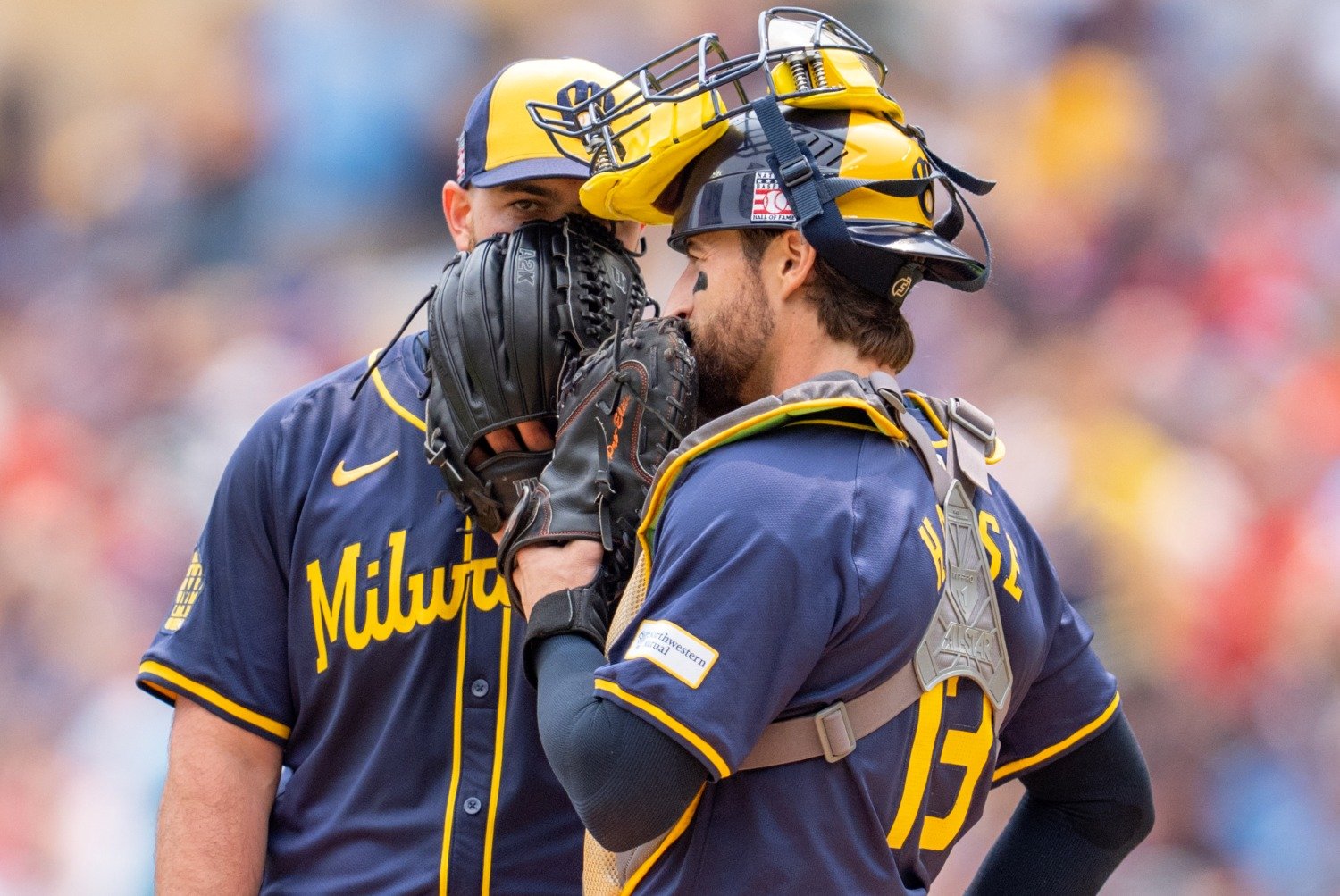
That shift in ideology becomes apparent when looking at the catching tandem for 2025: Contreras and Eric Haase.
William Contreras: Trading Defense for Offense
When the Brewers acquired Contreras from the former Milwaukee club that now plays in Cobb County, Ga. before the 2023 season, he was primarily seen as an offense-first catcher. In his final year with his former club, he spent a fair portion of his starts in the DH role, deferring the catching duties to the superior defensive catcher, Travis d'Arnaud. But in one offseason, Contreras and the Brewers made incredible strides in turning around his poor fielding. His framing jumped from the 20th percentile to the 93rd percentile. His blocking of errant pitches jumped from the 22nd percentile to the 84th. As a result, Contreras saw his Fielding Run Value jump from -7 (7th percentile) to 8 (90th percentile).
However, his increased hitting ability in 2024 might have cost him some of the defensive strides he made in 2023. Slashing .281/.365/.466, Contreras had a career year in 2024, leading all catchers in FanGraphs WAR (5.4) and placing 5th in MVP voting for his efforts. His offensive output made him one of the most productive at his position. His offensive run value increased by 9 points, but was offset by a matching 9-point decrease in his FRV. His previously elite framing metrics decreased to league average, while his blocking slipped below the league average mark. Additionally, Contreras struggled mightily to control the run game last year, grading out to be one of the least accurate throwing catchers in the game. Matthew Trueblood did a deep dive on the topic. You can check it out here.
Eric Haase: A Cost-Effective Bat with Upside
With Gary Sánchez heading to Baltimore, Eric Haase is set to get a run as the backup in 2025. On the surface, Haase may be an unconventional choice, far from the strong defensive catchers we have seen in the past. He has never been known for his glove. While athletic enough for the position, he grades out as average at best behind the plate. In his first year with the Brewers, Haase improved his framing, which is the Brewers' forte in developing catchers. For a deeper profile of his framing abilities, you can check out this article by Jack Stern, but despite the improvements, he still grades out around league average in that category. Blocking has been an issue for him throughout his career. And like Contreras, he struggled to control the run game last year.
Offensively, there is some intriguing upside for Haase. Although he is not historically an offensive threat, he had a strong showing in a small sample with the big-league club in 2024. Only appearing in 30 games, Haase put together an impressive 125 wRC+ in that span. Expecting this success to translate through an entire season's workload is optimistic. However, he could be more productive than a typical backup. As a hitter, Haase grades out similarly to last year's backup, Sánchez: An aggressive hitter with good power and a swing-and-miss problem. In 2024, Haase struck out at a 40.6% clip, up from his career average of 30.1%, which, combined with his 4.3% walk rate (6.5% career average), raises some red flags about his offensive sustainability.
Still, the Brewers see upside. The 2024-25 free-agent catcher market had a couple of superior defensive options, but the front office decided to tender a contract to Haase. The most significant reason for this is likely the price point. You get Haase for at least $2 million less than any other name on the market, but you also get some offensive upside the Brewers hope to tap into. If Haase can hover around his career wRC+ of 85, he will provide adequate offensive production for a backup, especially considering the starter he is playing behind. But two years removed from a very good offensive season in Detroit (111 wRC+) and some early success with the Brewers between spring training, Triple A, and the big leagues, there might be some more offense on the table for Haase. He already has the power tool; if he can cut down on the swing and miss, he could be an important piece for the Brewers in 2025.
Where Things Stand
The Brewers' catching philosophy has long been centered around fielding, particularly pitch framing. Last year, the front office was looking to add a more productive bat to the lineup when they signed Sánchez; that didn't necessarily work out as the front office planned. The goal remains the same this year, but (in true Brewers fashion) with a name you wouldn't expect.
With Contreras emerging as one of the game's best offensive catchers and the potential power that Haase brings to the table, their defensive metrics behind the plate may no longer be elite, but if the tradeoff is a more potent offensive lineup, it's a shift that could pay dividends in 2025. Since it's also possible that they've sacrificed some framing to set more strike-throwing-friendly targets for their pitchers, maybe catcher stats aren't quite equipped to capture all the ways the Crew's backstops are helping the team prevent runs.





Recommended Comments
Create an account or sign in to comment
You need to be a member in order to leave a comment
Create an account
Sign up for a new account in our community. It's easy!
Register a new accountSign in
Already have an account? Sign in here.
Sign In Now