


Brewers Video
With their most prized trade asset now spent, what other parts of Milwaukee’s roster still need help going into 2025?
It has been a pretty busy offseason around the league. More than $2 billion in free-agent contracts have been signed, and the trade front has seen more than a few impact players change hands. The Brewers got involved themselves, shipping Devin Williams to the Yankees in exchange for Nestor Cortes and infield prospect Caleb Durbin. The Airbender was bound for a new home in his walk year, and Milwaukee’s anticipated offseason additions depended heavily on his return package. So, now that he’s gone, what does the team still need—and will it be enough to maintain their dominance over the division?
Infield
Caleb Durbin was a 14th-round draft pick by team who plays at the highway interchange just north of Atlanta in 2021, and he's been on the minor-league grind ever since. He started hitting his stride over the past two years, steadily climbing the ranks. Most recently, he posted an .867 OPS over 375 plate appearances in Triple-A Scranton/Wilkes-Barre and torched the Arizona Fall League, posting a .976 OPS and stealing 29 bases there. A certified short king, he has adapted his playing style to compensate for a lack of power and has excellent fielding flexibility, making him a great fit for an already versatile Brewers squad. Heading into the offseason, there were questions over who would play which position after the departure of Willy Adames. Now that Durbin is on board, it seems Pat Murphy will have plenty of options for almost every position in the infield.
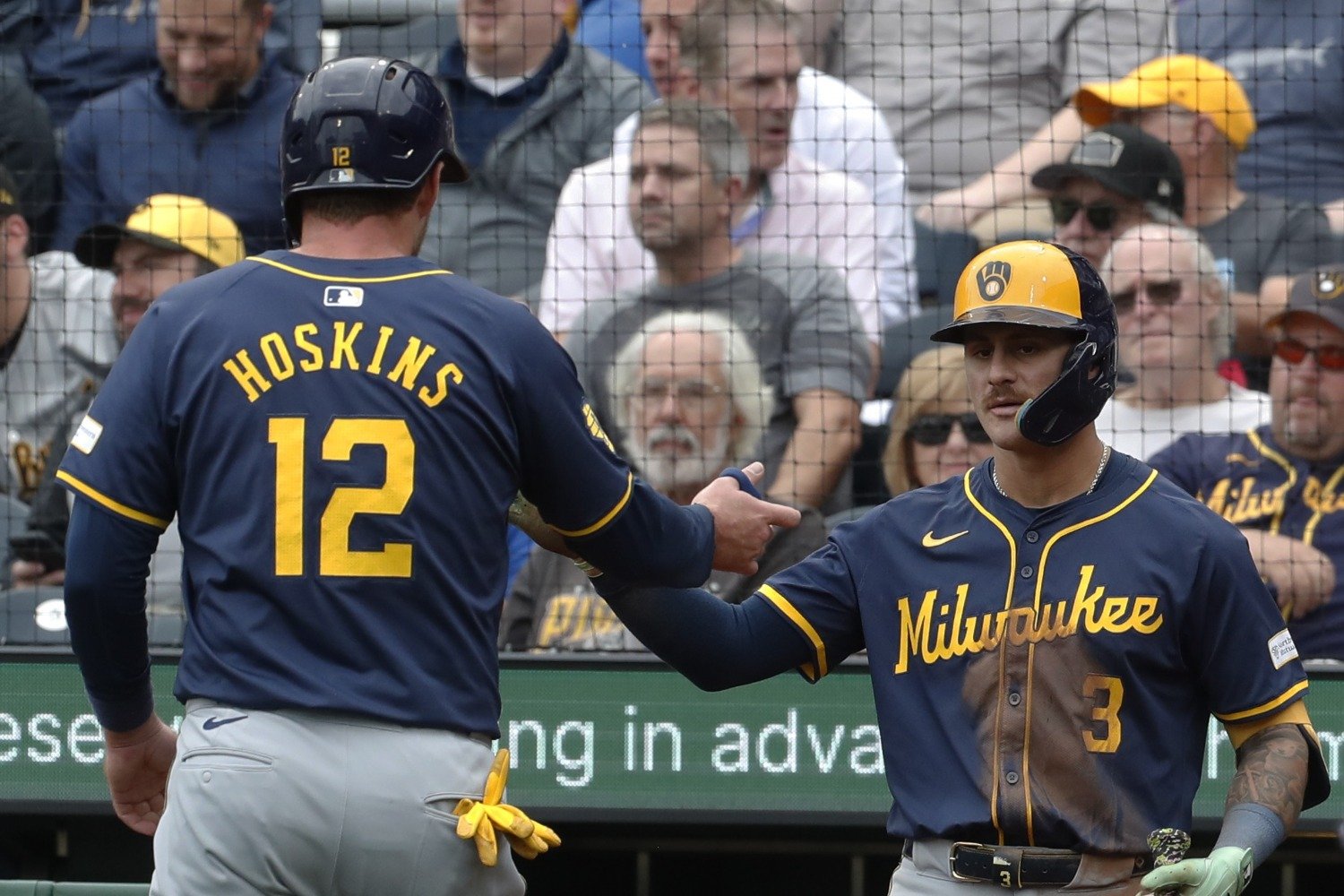
One area that could still use some improvement is first base. While the Rhys Hoskins signing was exciting at the time of its announcement, a full season of his performance left much to be desired, especially given his $12 million salary. He had -0.2 rWAR, slashing .214/.303/.419 for an OPS+ of 98. After officially exercising his $18-million player option for 2025, there were hopes that he could get traded, but with his stock at an all-time low, it was likely difficult to find a willing buyer at his price point. Even if a suitable replacement was found, the team would still be on the hook for most of his money, so they’ll have to wait for 2026 to decline their part of the mutual option and look for a more meaningful bat, should his numbers remain the same.
Of course, they could move Hoskins to DH permanently and pick up a more well-rounded first baseman, but given the extra money or prospect equity they’d have to surrender in a free agent or trade situation, the team will probably just hang in there with Hoskins. Moves throughout the league have foreclosed even the options that did seem to loom for them, as the Guardians, Yankees, Diamondbacks, Astros, and Nationals all landed new first basemen over the last handful of days.
Outfield
Arguably the area in which they have the most depth, Milwaukee’s outfield is jam-packed with young talent. Injury concerns for Christian Yelich and Garrett Mitchell are well-founded, but based on what we saw from them last year, they’re outstanding when healthy. When you throw in Blake Perkins, Sal Frelick, and the phenomenal Jackson Chourio, you get more than enough pieces for this part of the roster to be successful. If anything, it seems that the surplus in the outfield could drive another trade later in the offseason.
Catcher/DH
Similar to the outfield, the Brewers are set when it comes to backstops and designated hitters. There’s plenty of crossover between who’s on the depth chart for both roles, with William Contreras and Eric Haase. The organization did also utilize Gary Sánchez on occasion in 2024, but getting a third-string catcher probably isn’t a priority for the front office right now. Keeping DH playing time available for Yelich and Contreras is more important than whatever production they could find on the market from a budget-friendly bat.
Rotation
There’s a lot to like about the Brewers' starters—at least in theory. Given the tragic injury luck of the past few years, one can never be too sure about betting the house on the team’s rotation to stay healthy. With arms like Brandon Woodruff and Robert Gasser still on unclear timelines to return, the team will have to hope the combination of Nestor Cortes and full seasons from DL Hall and Aaron Civale will be enough to hold down the fort.
There’s actually a lot to like about Cortes and his potential fit on the team. He’s a crafty lefty who does some unorthodox things, something that could fit well within a development program that has made the most out of arms with neither spectacular velocity nor stuff. His fly ball rate has consistently been higher than average throughout his seven-year career, and while some of those fly balls will inevitably go for extra bases, he hasn’t played with an outfield as defensively proficient as the Brewers’, so his numbers could be even better than anticipated next year.
When Woodruff does finally make it back to the team after his lengthy rehabilitation process, someone may cede their spot, or the team could utilize a six-man rotation. You could always go out and get another arm just to be safe, but with the current talent on the board and starting pitching talent coming at a high premium, it’s not a necessity.
Bullpen
Milwaukee is great at making the most of what they have. Last year, after Devin Williams was sidelined for months due to stress fractures, the team turned it into an opportunity to start grooming Trevor Megill for the full-time closer job. He excelled, accumulating 21 saves before handing off the reins. We’ve gotten to see what Megill can do over the two past seasons with the Crew, and it seems like the perfect time to promote him to the most important role in the bullpen. Behind him is the same cast of characters as we saw last season, including Joel Payamps, Jared Koenig, Bryan Hudson, and Nick Mears. While the loss of Williams is definitely a meaningful subtraction, the bullpen still looks to be in great shape heading into next year. They could get another arm if the price is right, but don’t expect the team to surrender too much of the farm trying to get a slight upgrade in the reliever department.
Will It Be Enough?
After remembering that they are, indeed, a big-market team, the Cubs have been fairly active this winter. In addition to signing free agents Matthew Boyd and Carson Kelly, they acquired Kyle Tucker from the Astros and traded Cody Bellinger to the Yankees. The Tucker deal in and of itself was great, but they haven’t shown signs of slowing down. There are reports that they’ve made a big push to sign Roki Sasaki, and they’ve gotten some additional breathing room in the budget after getting most of the Bellinger contract off the books. They were also in discussions to acquire Jesús Luzardo or Luis Castillo, but it seems those talks stalled. Luzardo is now a Phillie.
But Chicago has quite a bit of catching up to do. They were 10 games back of Milwaukee in 2024, and without subsequent moves to improve other parts of their lineup, it would seem that the Brewers are safe for now. The other teams in the division have practically been asleep at the wheel, and haven’t given their fans much to look forward to, so it seems like 2025 could be yet another year of the Brewers taking the top spot in the NL Central.
Getting past the other titans in the National League is a different story. As usual, the bigger spenders in the East and West divisions have more obvious talent on paper, but a closer look suggests there is a smaller gap than one might otherwise expect. It may not be enough for the team to win the World Series, but if the team shows up to Opening Day with the roster as-is, it’s looking like another successful regular season for the Brew Crew.





Recommended Comments
Create an account or sign in to comment
You need to be a member in order to leave a comment
Create an account
Sign up for a new account in our community. It's easy!
Register a new accountSign in
Already have an account? Sign in here.
Sign In Now